 |
|
|
 |
|
 |
|
|||
|
||||
|
||||
|
Maryland State Archives Jeffersonian, Towson, Maryland mdsa_sc3410_1_81-0423 Enlarge and print image (6M) |
|
|
|
|
|
|
|
|||
|
||||
|
||||
|
Maryland State Archives Jeffersonian, Towson, Maryland mdsa_sc3410_1_81-0423 Enlarge and print image (6M) |
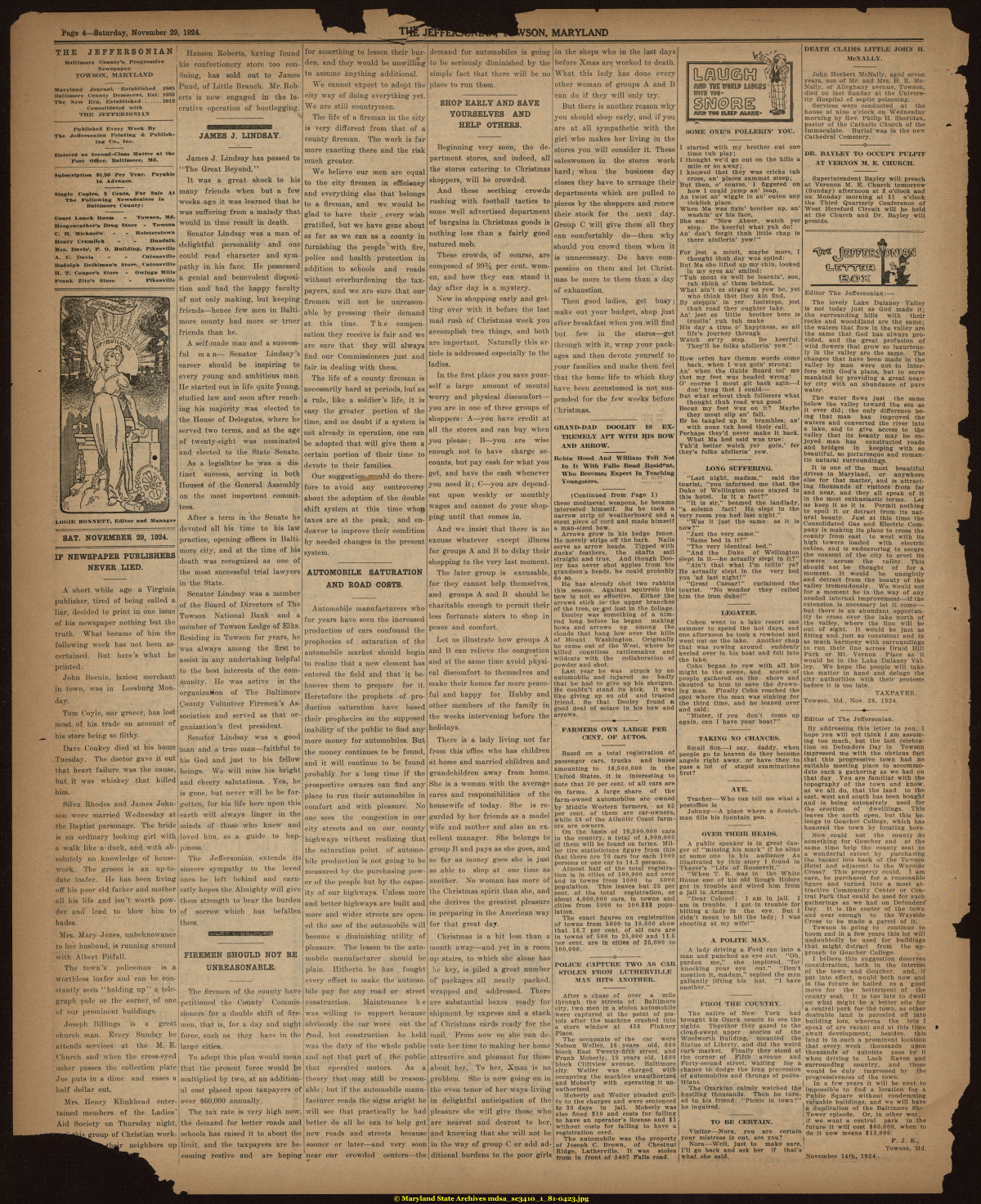
| Page 4—Saturday, November 29, 1924. ¦Maa 'SON, MARYLAND THE JEFFERSONIAN] Hanson Roberts, having found ;his confectionery store too eon- Baltimore County's Progressive Newspaper. TOWSON, MARYLAND Maryland Journal, Established 1865 Baltimore County Democrat, Est. 1885 The New Era, Established.......1&13 Consolidated with THE JEFFERSONIAN Published Every Week By The Jeffersonian Printing & Publishing Co., Inc. Entered as Second-Class Matter at the Post Office, Baltimore, Md. Subscription $1.50 Per Year. In Advance. Payable Single Copies, 8 Cents, For Sale At The Following Newsdealers In Baltimore County: Court Lunch Room - Towson, Md. Hergenrather's Drug Store - Towson C. H. Michael's - - Reisterstown Henry Crumlich - - Dundalk, Mrs. Davis', P. O. Building, Pikesville A. C. Davis - - Catonsville Rudolph Deihlman's Store, Catonsville H. T. Cooper's Store - Owings Mills Frank Zito's Store - Pikesville fining, has sold out to James Pund, of Little Branch. Mr. Roberts is now engaged in the lucrative operation of bootlegging. JAMES J. LINDSAY. L.OGIE BONNETT, Editor and Manager SAT. NOVEMBER 29, 1924. IF NEWSPAPER PUBLISHERS NEVER LIED. A short while ago a Virginia publisher, tired of being called a liar, decided to print in one issue of his newspaper nothing but the truth. What became of him the following week has not been ascertained. But here's what he printed: John Beenin, laziest merchant in fown, was in Leesburg Monday. Tom Coyle, our grocer, has lost most of his trade on account of his store being so filthy. Dave Conkey died at his home Tuesday. The doctor gave it out that heart failure was the cause, but it was Avhiskey that killed him. Silva Rhodes and James Johnson were married AVednesday at the Baptist parsonage. The bride is an ordinary looking girl with a walk like a duck, and with absolutely no knowledge of housework. The groom is an up-to-date loafer. He has been living off his poor old father and mother all his life and isn't worth powder and lead to blow him to hades. Mrs. Mary Jones, unbeknowance to her husband, is running around with Albert Pitfall. The town's policeman - is a worthless loafer and can be constantly seen "holding up" a telegraph pole or the corner ( of one of our prominent buildings. Joseph Billings is a great church man. Every Sunday he attends services at the M. E. Church and when the cross-eyed usher passes the collection plate Joe puts in a dime and eases a half dollar out. Mrs. Henry Klinkhead entertained members of the Ladies' Aid Society on Thursday night, y^^group of Christian work-^hjiir neighbors up James J. Lindsay has passed to "The Great Beyond." It was a great shock to his many friends when but a few weeks ago it was learned that he was suffering from a malady that would in time result in death. Senator Lindsay was a man of delightful personality and one could read character and sympathy in his face. He possessed a genial and benevolent disposition and had the happy faculty of not only making, but keeping friends—hence few men in Baltimore county had more or truer friends than he. A self-made man and a successful m a n— Senator Lindsay's career should be inspiring to every young and ambitious man. He started out in life quite young, studied law and soon after reaching his majority was elected to the House of Delegates, where he served two terms, and at the age of twenty-eight was nominated and elected to the State Senate. As a legislator he was a distinct success, serving in both Houses of the General Assembly on the most important committees. After a term in the Senate he devoted all his time to his law practice, opening offices in Baltimore city, and at the time of his death was recognized as one of the most successful trial lawyers in the State. Senator Lindsay was a member of the Board of Directors of The Towson National Bank and a member of Towson Lodge of Elks. Residing in Towson for years, he was always among the first to assist in any undertaking helpful to the best interests of the community. He was active in the organization of The Baltimore' County Volunteer Firemen's Association and served as that organization's first president. Senator Lindsay was a good man and a true man—faithful to his God and just to his fellow beings. We will miss his bright and cheery salutations. Yea, he is gone, but never will he be forgotten, for his life here upon this earth will always linger in the minds of those who knew and loved him, as a guide to happiness. The Jeffersonian extends its sincere sympathy to the loved ones he left behind and earnestly hopes the Almighty will give them strength to bear the burden of sorrow which has befallen them. for something to lessen their burden, and they would be unwilling to assume anything additional. We cannot expect to adopt the city way of doing everything yet. We are still countrymen. The life of a fireman in the city is very different from that of a county fireman. The work is far more exacting there and the risk much greater. We believe our men are equal to the city firemen in efficiency and everything else that belongs to a fireman, and we would be glad to have their every wish gratified, but we have gone about as far as we can as a county in furnishing the people with fire, police and health protection in addition to schools and roads without overburdening the taxpayers, and we are sure that our firemen will not be unreasonable by pressing their demand at this time. The compensation they receive is fair and we are sure that they will always find our Commissioners just and fair in dealing with them. The life of a county fireman is necessarily hard at periods, but as a rule, like a soldier's life, it is easy the greater portion of the time, and no doubt if a system is not already in operation, one can be adopted that will give them a certain portion of their time to devote to their families. Our suggestion "'~uld do therefore to avoid any controversy about the adoption of the double shift system at this time when taxes are at the peak, and endeavor to improve their condition by needed changes in the present system. demand for automobiles is going to be seriously diminished by the simple fact that there will be no place to run them. SHOP EARLY AND SAVE YOURSELVES AND HELP OTHERS. AUTOMOBILE SATURATION AND ROAD COSTS. FIREMEN SHOULD NOT BE UNREASONABLE. The firemen of the county have petitioned the County Commissioners for a double shift of firemen, that is, for a day and night force, such as they have in the large cities. To adopt this plan would mean that the present force would be multiplied by two, at an additional cost placed upon taxpayers of over $60,000 annually. The tax rate is very high now, the demand for better roads and schools has raised it to about the limit, and the taxpayers are becoming restive and are hoping Automobile manufacturers who for years have seen the increased production of cars confound the prophecies of saturation of the automobile market should begin to realize that a new element has entered the field and that it behooves them to prepare for it. Heretofore the prophets of production saturation have based their prophecies on the supposed inability of the public to find any more money for automobiles. But the money continues to be found, and it will continue to be found probably for a long time if the prospective owners can find any place to run their automobiles in comfort and with pleasure. No one sees the congestion in our city streets and on our county highways without realizing that the saturation point of automobile production is not going to be measured by the purchasing power of the people but by the capacity of our highways. Unless more and better highways are built and more and wider streets are opened the use of the automobile will become a diminishing utility of pleasure. The lesson to the automobile manufacturer should be plain. Hitherto he has fought every effort to make the automobile pay for any road or street construction. Maintenance h e was willing to support because obviously the car wore out the j*Oad, but construction he held was the duty of the whole public and not that part of the public that operated motors. As a theory that may still be reasonable; but if the automobile manufacturer reads the signs aright he will see that practically he had better do all he can to help get new roads and streets because sooner or later—and very soon near our crowded centers—the Beginning very soon, the department stores, and indeed, all the stores catering to Christmas shoppers, will be crowded. And these seething crowds rushing with football tactics to some well advertised department of bargains in Christmas goods is nothing less than a fairly good natured mob. These crowds, of course, are composed of 99% per cent, women, and how they can stand it day after day is a mystery. Now in shopping early and getting over with it before the last mad rush of Christmas week you accomplish two things, and both are important. Naturally this article is addressed especially to the ladies. In the first place you save yourself a large amount of mental worry and physical discomfort— you are in one of three groups of shoppers: A—you have credit at all the stores and can buy when you please; B—you are wise enough not to have charge accounts, but pay cash for what you get, and have the cash whenever you need it; C—you are dependent upon weekly or monthly wages and cannot do your shopping until that comes in. And we insist that there is no excuse whatever except illness for groups A and B to delay their shopping to the very last moment. The later group is excusable, for they cannot help themselves, and groups A and B should be charitable enough to permit their less fortunate sisters to shop in peace and comfort. Let us illustrate how groups A and B can relieve the congestion and at the same time avoid physical discomfort to themselves and make their homes far more peaceful and happy for Hubby and other members of the family in the weeks intervening before the holidays. There is a lady living not far from this office who has children at home and married children and grandchildren away from home. She is a woman with the average cares and responsibilities of the housewife of today. She is regarded by her friends as a model wife and mother and also an excellent manager. She belongs to group B and pays as she goes, and so far as money goes she is just as able to shop at one time as another. No woman has more of the Christmas spirit than she, and she derives the greatest pleasure in preparing in the American way for that great day. Christmas is a bit less than a month away—and yet in a room up stairs, to which she alone has he key, is piled a great number of packages all neatly packed, wrapped and addressed. There are substantial boxes . ready for shipment by express and a stack of Christmas cards ready for the mail. Prom now on she can devote her time to making her home attractive and pleasant for those about her, To her, Xmas is no problem. She is now going on in the even tenor of her ways living in delightful anticipation of the pleasure she will give those who are nearest and dearest to her, and knowing that she will not be in the way of group C or add additional burdens to the poor girls in the shops who in the last days before Xmas are worked to death. What this lady has done every other woman of groups A and B can do if they will only try. But there is another reason why you should shop early, and if you are at all sympathetic with the girl who makes her living in the stores you will consider it. These saleswomen in the stores work hard; when the business day closes they have to arrange their departments which are pulled to pieces by the shoppers and renew their stock for the next day. Group C will give them all they can comfortably do—then why should you crowd them when it is unnecessary. Do have compassion on them and let Christmas be more to them than a day of exhaustion. Then good ladies, get busy; make out your budget, shop just after breakfast when you will find but few in the stores;—get through with it, wrap your packages and then devote yourself to your families and make them feel that the home life to which they have been accustomed is not suspended for the few weeks before Christmas. AP3© TOM SB.S5P AL@K!g ^ — ¦ =^—.... SOME ONE'S FOLLERIN' YOU. GRAND-DAD DOOLEY IS EXTREMELY APT WITH HIS BOW AND ARROW. Robin Hood And William Tell Not In It With Falls Road Resident, Who Becomes Expert In Teaching 11 \ oungsters. (Continued from Page 1) these mediaeval weapons, he became interested himself. Sa he took a narrow strip of Weatherboard and a stout piece of cord and made himself a man-sized bow. Arrows grow in his hedge fence. He merely strips off the bark. Nails serve as arrow heads. Tipped with ducks' feathers, the shafts sail straight and true. And though Doo-ley has never shot apples from his grandson's heads, he could probably do so. He has already shot two rabbits this season. Against squirrels his bow is not so effective. Either the arrows stick in: the upper branches of the tree, or get lost in the foliage. Dooley was something of a nim-rod long before he began making bows and arrows up among the clouds that hang low over the hills of Mount Washington. Originally he came out of the West, where he killed countless rattlesnakes and wildcats with the collaboration of powder and shot. Last year he was struck by an automobile and injured so badly that he had to give up his shotgun. He couldn't stand its kick. It was like giving up an old and trusted friend. So that Dooley iound » good deal of solace in his bow and arrows. FARMERS OWN LARGE PER CENT. OF AUTOS. Based on a total registration of passenger cars, trucks and buses amounting to 16,500,000 in the United States, it is interesting to note that 30 per cent, of all cars are on farms. A large share of the farm-owned automobiles are owned by Middle Western farmers, as 85 per cent, of them are car-owners, while 58 of the Atlantic Coast farmers are owners. On the basis of 16,500,000 cars in the country, a total of 4,900,000 of them will be found on farms. Miller tire statisticians figure from this that there are 70 cars for each 1000 persons or one car to 14.3 persons. Almost half of the total registration is in cities of 100,000 and over and in towns from 1000 to 5000 population. This leaves but 25 per cent, of the total registration, or about 4,000,000 cars, in towns and cities from 5000 to 100,$$$ population. The exact figures on registration of towns from 5000 to 10,000 show that 16.7 per cent, of all cars are in towns of 500 to 25,000 and 11.5 oer cent, are in cities of 25,000 to 100,000. POLICE CAPTURE TWO AS CAR STOLEN FROM LUTHERVILLE MAN HITS ANOTHER. After a chase of over a mile through the streets of Baltimore city, two men in a stolen automobile were captured at the point of pistols after the machine crashed into a store window at 458 Pinkney Place. The occupants of the car were Nelson Weller, 18 years old, 600 block East Twenty-fifth street, and Frank Moberly, 19 years old, 1600 block Cliftview avenue, Baltimore city. Weller was charged with occupying the machine unauthorized and Moberly with operating it unauthorized. Moberly and Weller pleaded guilty to the charges and were sentenced to 30 days in jail. Moberly was also fined $10 and costs for failing to have an operator's license and $1 without costs for failing to have a registration card. The automobile was the property \ of Joseph C. Brown, of Chestnut | Ridge, Lutherville. It was stolen! from in front of 3407 Falls road. I started with my brother out one time tuh play; I thought we'd go out on the hills a mile er so away; I knowed thet they wus cricks tuh cross, an' places summat steep; But then, o' course, I figgered on how I could jump an' leap, An twist an' wiggle in an' outen any ticklish place. When Ma was fixin' brother up, an' washin' uv his face, She sez: "Now Abner, watch yer step. Be keerful what yuh do! An' don't fergit thuh little chap is there afollerin' yew!" For jest a minit, maybe more, I thought thuh day wus spiled: But Ma she lifted up my chin, looked in my eyes an' smiled: "Yuh mout ez well be learnin', son, tuh think o' them behind, What ain't ez string ez yew be, yet who think thet they kin find, By steppin' in yer footsteps, jest thuh road they oughter take. An' jest ez little brother here is trustin' yuh tuh make His day a time o' happiness, so all life's journey through Watch ev'ry step. Be keerful. They'll be folks afollerin' yew." How orfen hav themm words come back, when I wuz goin' strong; An' when the Guide Board tol' me thet my feet wus headed wrong! O' course I mout git back agin—I don' brag thet I could— But what erbout thuh follerers what thought thuh road wuz good Becuz my feet wuz on it? Maybe they mout slip an' fall, Er be tangled up in brambles; an' with none tuh heed their call, Perhaps they'd never make it back. What Ma hed said wus true: Yuh'd better watch yer goin,' fer they's folks afollerin' yew. DEATH CLAIMS LITTLE JOHN H. McNALLY. John Herbert McNally, aged seven years, son of Mr. and Mrs. H. R. McNally, of Alleghany avenue, Towson,. died on last Sunday at the University Hospital of septic poisoning. Services were conducted at the house at nine o'clock on Wednesday morning by Rev. Philip H. Sheridan,, pastor of the Catholic Church of the-Immaculate. Burial was in the new Cathedral Cemetery. DR. BAYLEY TO OCCUPY PULPIT AT VERNON M. E. CHURCH. Superintendent Bayley will preach at Verenon M. E. Church tomorrow (Sunday) afternoon at 3 o'clock and on Monday morning at 11 o'clock the Third Quarterly Conference of West Hereford Circuit will be held at the Church and Dr. Bayley will preside. LONG SUFFERING. "Last night, madam," said the tourist, "you informed me that the Duke of Wellington once stayed in this hotel. Is it a fact?" "It is sir," beamed the landlady, "a solemn fact! He slept in the very room you had last night." "Was it just the same as it is now?" "Just the very same." "Same bed in it?" "The very identical bed." "And the Duke of Wellington slept in it—he actually slept in it?" "Ain't that what I'm tellin' ye? He actually slept in the very bed you 'ad last night!" "Great Caesar!" exclaimed the tourist. "No wonder they called him the iron duke!" LEGATEE. Cohen went to a lake resort one summer to spend the hot days, and one afternoon he took a rowboat and went out on the lake. Another chap that was rowing around suddenly keeled over in his boat and fell into the lake. Cohn began to row with all his might to the scene, and scores of people gathered on the shore and shouted to him to save the drowning man. Finally Cohn reached the spot where the man was sinking for the third time, and he leaned over and said: "Mister, if you don't come up again, can I have your boat?" TAKING NO CHANCES. Small Son—I say, daddy, when people go to heaven do they become angels right away, or have they to pass a lot of stupid examinations first? AYE. Teacher-—Who can tell me what a postoffice is Johnny—A place where a Scotchman fills his fountain pen. OVER THEIR HEADS. A public speaker is in great danger of "missing his mark" if he aims at some one in his audience As illustrated by this story I found in Thayer's "Life of Roosevelt." "When T. R. was in the White House one of his old Rough Riders got in trouble and wired him from a jail in Arizona: "Dear Colonel: I am in jail. I am in trouble. I got in trouble for hitting a lady in the eye. But I didn't mean to hit the lady; I was shooting at my wife!" Editor The Jeffersonian: — The lovely Lake Dulaney Valley is not today just as God made it; the surrounding hills with their rocks and wooddland are the same; the waters that flow in the valley are the same that God has always provided, and the great profusion of wild flowers that grow so luxuriously in the valley are the same. The changes that have been made in the valley by man were not to interfere with God's plans, but to serve mankind by providing a great nearby city with an abundance of pure water. The water flows just the same below the valley toward the sea as it ever did; the only difference being that man has improved the waters and converted the river into a lake, and to give access to the valley that its beauty may be enjoyed man has constructed roads and bridges in keeping with so beautiful, so picturesque and romantic natural surroundings. It is one of the most beautiful drives in Maryland, or anywhere else for that matter, and is attracting thousands of visitors from far and near, and they all speak of it in the most enthusiastic terms. Let us keep it as it is. Permit nothing to spoil it or detract from its natural beauty. Just at this time the Consolidated Gas and Electric Company is making its plans to cross the county from east to west with its high towers loaded with electric cables, and is endeavoring to secure the consent of the city to erect its towers across the valley. This should not be thought of for a moment. It would be unsightly and detract from the beauty of the valley tremendously. We would not for a moment be in the way of any needed internal improvement—if the extension is necessary let it come—¦ but there is an abundant opportunity to cross over the lake north of the valley, where the line will be out of sight. It would be just as fitting and just as consistent and in as much harmony with surroundings to run their line across Druid Hill Park or Mt. Vernon Place as it would be in the Lake Dulaney Valley. We hope the people will take the matter in hand and deluge the city authorities with their protests before it is too late. TAXPAYER. Towson, Md., Nov. 28, 1924. A POLITE MAN. A lady driving a Ford ran into a man and punched an eye out. "Oh, pardon me," she implored, "for knocking your eye out." "Don't mention it, madam," replied the man gallantly lifting his hat, "I have another." PROM THE COUNTRY. The native of New York had brought his Ozark cousin to see the sights. Together they gazed to the cloud-swept upper stories of the Woolworth Building, mounted the Statue of Liberty, and did the weird curb market. Finally they stood at the corner of Fifth avenue and Forty-second street, waiting for a chance to dodge the long procession of automobiles and throngs of pedestrians. The Ozarkian calmly watched the hustling thousands. Then he turned to his friend: "Picnic in town?" he inquired. TO BE CERTAIN. j Visitor—Nora, you are certain your mistress is out, are you? | Nora—Well, just to make sure, i I'll go back and ask her if that's' what she said. Editor of The Jeffersonian, By addressing this letter to you, I hope you will not think I am assuming too much, but the last celebration on Defenders Day in Towson impressed me with the obvious fact that this progressive town had no suitable meeting place to accommodate such a gathering as we had on that day You are familiar with the topography of the town and know, as we all do, that the land to the east, west and south has been bought and is being extensively used for the erection of dwellilngs. This leaves the north open, but this belongs to Goucher College, which has honored the town by locating here. Now could not the county do something for Goucher and at the same time help the county seat to a wonderful extent by purchasing the vacant lots back of the Towson Hotel and adjacent to the Wayside Cross? This property could, I am sure, be purchased for a reasonable figure and turned into a most attractive Community Center or Central Park that could be used for such gatherings as we had on Defenders Day. It is the center of the town and near enough to the Wayside Cross to be made a parcel of it. Towson is going to continue to boom and in a few years this lot will undoubtedly be used for buildings that might detract from the approach to Goucher College. I believe this suggestion deserves consideration, both in the interest of the town and Goucher, and, if put into effect, would both now and in the future be hailed as a good move for the betterment of the county seat. It is too late to dwell on what might be a better site for a central park for the town, as other desirable land is parceled off into building lots, whereas the lots I speak of are vacant and at this time await development; besides, this land is in such a prominent location that every, week thousands upon thousands of autoists pass by it when driving to Loch Raven and surrounding country, and these would be duly impressed by the progressiveness of the town. In a few years it will be next to impossible to find a location for a Public Square without condemning valuable buildings, and we will have a duplication of the Baltimore Sh^' Tower episode. Or, in other wor_ if we want a central park in the future it will cost $60,000, when to do it now means $13,000. F. J. E., Towson, Md. November 14 th, 1924. |