 |
|
|
 |
|
 |
|
|||
|
||||
|
||||
|
Maryland State Archives Jeffersonian, Towson, Maryland mdsa_sc3410_1_81-0958 Enlarge and print image (6M) |
|
|
|
|
|
|
|
|||
|
||||
|
||||
|
Maryland State Archives Jeffersonian, Towson, Maryland mdsa_sc3410_1_81-0958 Enlarge and print image (6M) |
|
Newsgravure and Magazine Section, THE JEFFKRSONIAN, Tows on, Md., May 10, 1924.
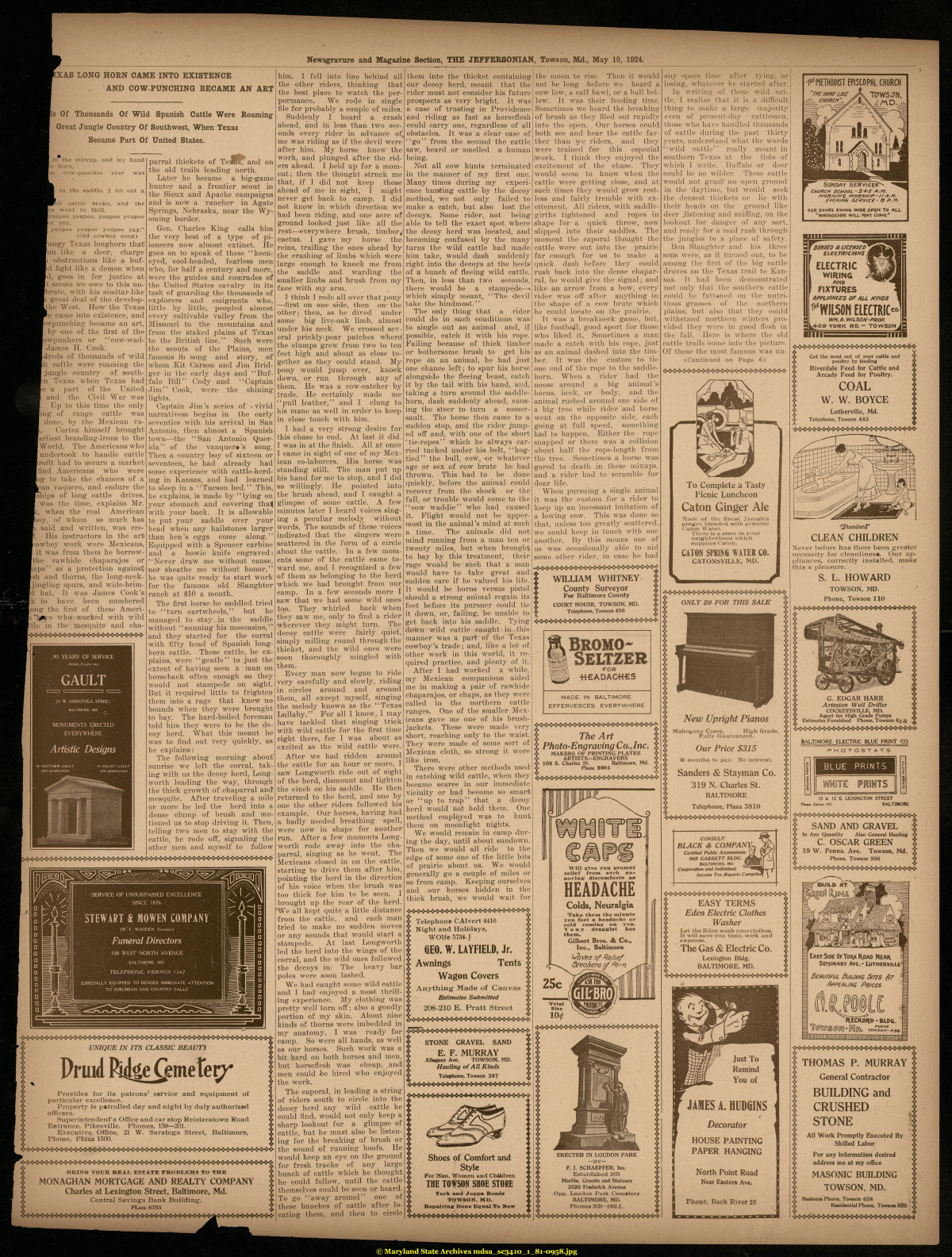
EXAS LONG HORN CAME INTO EXISTENCE
AND COW-PUNCHING BECAME AN ART
Is Of Thousands Of Wild Spanish Cattle Were Roaming Great Jungle Country Of Southwest, When Texas Became Part Of United States.
in the stirrup, and my hand le horn, |m cow-puncher ever was
in the saddle, I let out a
p,il cattle broke, and the Irs went to Hell, •youpee youpee, youpee youpee fee yay, youpee youpee youpee yay." (Old cowboy song)
|angy Texas longhorn that! fun like a deer, charge t obstructions like a buf-id fight like a demon when fd, goes in for justice at ft seems we owe to this un-Ibrute, with his simitar-like a great deal of the develop-ithe West. How the Texas no. came into existence, and f)wpunching became an art, by one of the first of the |owpunhers or "cow-wad-James H. Cook, feeds of thousands of wild sh cattle were roaming the jungle country of south-[•n Texas when Texas had Le a part of the United and the Civil War was Up to this time the only ling of range cattle was done, by the Mexican va-Cortez himself brought [arliest branding-irons to the (World. The Americans who undertook to handle cattle j>rofit had to secure a market jfind Americans who were fog to take the chances of a i&n vaquero, and endure the ["ships of long cattle drives, was the time, explains Mr. , when the real American >oy, of whom so much has said and written, was cre-His instructors in the art iowboy work were Mexicans, it was from them he borrow-fthe rawhide chaparajos or Laps" as a protection against Lsh and thorns, the long-neck-j jingling spurs, and wide-brim-d hat. It was James Cook's [k to have been numbered long the first of these Ameri-[ '^s who worked with wild Etie iii the mesquite and cha-
parral thickets of Te^S7 and on the old trails leading north.
Later he became a big-game hunter and a frontier scout in the Sioux and Apache campaigns and is now a rancher in Agate Springs, Nebraska, near the Wyoming border.
Gen. Charles King calls him the very best of a type of pi-ioneers now almost extinct. He goes on to speak of these "keen eyed, cool-headed, fearless men who, for half a century and more, were the guides and comrades of the United States cavalry in its task of guarding the thousands of explorers and emigrants who little by little, peopled almost every cultivable valley from the Missouri to the mountains and from the staked plains of Texas to the British line." Such were the scouts of the Plains, men famous hi song and story, of whom Kit Carson and Jim Brid-ger in the early days and "Buffalo Bill" Cody and "Captain Jim" Cook, were the shining lights.
Captain Jim's series of »vivid narrativess begins in the early seventies with his arrival in San Antonio, then almost a Spanish town—the "San Antonio Quer-ida" of the vanquere's song. Then a country boy of sixteen or seventeen, he had already had some experience with cattle-herding in Kansas, and had learned to sleep in a "Tucson bed." This, he explains, is made by "lying on your stomach and covering thaH with your back. It is allowable to put your saddle over your head when any hailstones larger than hen's eggs come along." Equipped with a Spencer carbine and a bowie knife engraved: "Never draw me without cause, nor sheathe me without honor," he was quite ready to start work for the famous old Slaughter ranch at $10 a month.
The first horse he saddled tried to "turn cartwheels," but he managed to stay in the saddle without "sunning his moccasins," and they started for the corral with fifty head of Spanish long-horn cattle. These cattle, he explains, were "gentle" to just the extent of having seen a man on horseback often enough so they would not stampede on sight. But it required little to frighten them into a rage that knew no bounds when they were brought to bay. The hard-boiled foreman told him they were to be the decoy herd. What this meant he was to find out very quickly, as he explains:
The following morning about1 sunrise we left the corral, taking with us the decoy herd, Long-worth leading the way, through the thick growth of chaparral and mesquite. After traveling a mile or more he led the herd into a dense clump of brush and motioned us to stop driving it. Then, telling two men to stay with the cattle, he rode off, signaling the other men and myself to follow
SERVICE OF UNSURPASSED EXCELLENCE
STEWART & MOWEN COMPANY
(W. F. WOODEN. Successor)
Funeral Directors
108 WEST NORTH AVENUE
BALTIMORE. MD
TELEPHONE, VERNON 1342
ESPECIALLY EQUIPPED TO RENDER IMMEDIATE ATTENTION TO SUBURBAN AND COUNTRY CALLS
TLiJHfc^^
UNIQUE IN ITS CLASSIC BEAUTY
Druid ft4ge£emeTei?*
Provides for its patrons' service and equipment of particular excellence.
Property is patrolled day and night by duly authorized officers.
Superintendent's Office and car stop Reisterstown Road Entrance, Pikesville. Phones, 159—201.
Executive Office, 21 W. Saratoga Street, Baltimore, Phone, Plaza 1500.
>AAAAAA*°*AAA.**^
'?•V '.
++**+*+**++++++*+*WM++vtt++++t+**i+ii+mi4fmm
BRING YOUR REAL ESTATE PROBLEMS TO THE
MONAGHAN MORTGAGE AND REALTY COMPANY Charles at Lexington Street, Baltimore, Md.
Central Saving's Bank Building". PLaza 6753
i*K**i**x**i**i*K**i**i**i*K^i*K^
him. I fell into line behind all the other riders, thinking that the best place to watch the per-pormance. We rode in single file for probably a couple of miles.
Suddenly I heard a crash ahead, and in less than two seconds every rider in advance of, me was riding as if the devil were after him. My horse knew the work, and plunged after the riders ahead. I held up for a moment; then the thought struck me that, if I did not keep those ahead of me in sight, I might never get back to camp. I did not know in which direction we had been riding, and one acre of ground looked just like all the rest—everywhere .brush, timber^' cactus. I gave my horse the reins, trailing the ones ahead by the crashing of limbs which were large enough to knock me from, the saddle and warding the smaller limbs and brush from my face with my arm.
I think I rode all over that pony —first on one side, then on- the other; then, as he dived under some big live-oak limb, almost under his neck. We crossed several prickly-pear patches where) the clumps grew from two to ten feet high and about as close together as they could stand. My pony would jump over, knock down, or run through any of them. He was a cow-catcher by trade. He certainly made me "pull leather," and I clung to his mane as well in order to keep in close touch with him.
I had a very strong desire for this chase to end. At last it did. I was in at the finish. All at once I came in sight of one of my Mexican co-laborers. His horse was standing still. The man put up his hand for me to stop, and I did so willingly. He pointed into the brush ahead, and I caught a glimpse of some cattle. A few minutes later I heard voices singing a peculiar melody without words. The sounds of these voices indicated that the singers were scattered in the form of a circle about the cattle. In a few moments some of the cattle came toward me, and I recognized a few of them as belonging to the herd which we had brought from our camp. In a few seconds more I saw that we had some wild ones too. They whirled back when they saw me, only to find a rider wherever they might turn. The decoy cattle were fairly quiet, simply milling round through the thicket, and the wild ones were soon thoroughly mingled with them.
Every man now began to ride very carefully and slowly, riding in circles around and around them, all except myself, singing the melody known as the "Texas Lullaby." For all I know, I may have tackled that singing trick with wild cattle for the first time right there, for I was about as excited as the wild cattle were.
After we had ridden around the cattle for an hour or more, I saw Longworth ride out of sight of the herd, dismount and tighten the cinch on his saddle. He then returned to the herd, and one by one the other riders followed his example. Our horses, having had a badly needed breathing spell, were now in shape for another run. After a few moments Long-worth rode away into the chaparral, singing as he went. The Mexicans closed in on the cattle, starting to drive them after him, pointing the herd in the direction of his voice when the brush was too thick for him to be seen. I brought up the rear of the herd. We all kept quite a little distance from the cattle, ' and each man tried to make no sudden moves or any sounds that would start a stampede. At last Longworth led the herd into the wings of the corral, and the wild ones followed the decoys in. The heavy bar poles were soon lashed.
We had caught some wild cattle and I had enjoyed a most thrilling experience. My clothing was pretty well torn off; also a goodly portion of my skin. About nine kinds of thorns were imbedded in my anatomy. I was ready for camp. So were all hands, as well as our horses. Such work was a bit hard on both horses and men, but horseflesh was cheapv andi men could be hired who enjoyed the work.
The caporal, in leading a string of riders south to circle into the decoy herd any wild cattle he could find, would not only keep a sharp lookout for a glimpse of cattle, but he must also be listening for the breaking of brush or the sound of running hoofs. He would keep an eye on the ground for fresh tracks of any large bunch of cattle which he thought he could follow, until the cattle themselves could be seen or heard. To go "away around" one of these bunches of cattle after locating them, and then to circle
them into the thicket containing our decoy herd, meant that the rider must not consider his future prospects as very bright. It was a case of trusting in Providence and riding as fast as horseflesh could carry one, regardless of all obstacles. It was a clear case of "go" from the second the cattle saw, heard or smelled a human being.
Not all cow hunts terminated in the manner of my first one. Many times during my experience hunting cattle by the decoy method, we not only failed to make a catch, but also lost the decoys. Some rider, not being able to tell the exact spot where the decoy herd was located, and becoming confused by the many turns the wild cattle had made him take, would dash suddenly right into the decoys at the heels of a bunch of fleeing wild cattle. Then, in less than two seconds, there would be a stampede—< which simply meant, "The devil take the hindmost."
The only thing that a rider could do in such conditions was to single out an animal and, if possible, catch it with his rope. Failing because of thick timber or bothersome brush to get his rope On an animal, he had just one chance left; to spur his horse alongside the fleeing beast, catch it by the tail with his hand, and, taking a turn around the saddle-horn, dash suddenly ahead, causing the steer to turn a somersault. The horse then came to a sudden stop, and the rider jumped off and, with one of the short 'tie-ropes" which he always carried tucked under his belt, "hog-tied" the bull, cow, -or whatever age or sex of cow brute he had thrown. This had to be done quickly, before the animal could recover from the shock or the fall, or trouble would come to the "cow waddie" who had caused it. Flight would not be uppermost in the animal's mind at such a time. The animals did not mind running from a man ten or twenty miles, but when brought to bay by this treatment, their rage would be such that a man would have to take great and sudden care if he valued his life. It would be horns versus pistol should a strong animal regain its feet before its pursuer could tie it down, or, failing, be unable to get back into his saddle. Tying down wild cattle caught in this manner was a part of the Texas cowboy's trade; and, like a lot of other work in this world, it required practice, and plenty of it.
After I had worked a while, my Mexican companions aided me in making a pair of rawhide chaparajos, or chaps, as they were called in the northern cattle ranges. One of the smaller Mexicans gave me one of his brush-jackets. These were made very short, reaching only to the waist. They were made of some sort of Mexican cloth, so strong it wore like iron.
There were other methods used in catching wild cattle, when they became scarce in our immediate vicinity or had become so smart or "up to trap" that a decoy herd would not hold them. One method employed was to hunt them on moonlight nights.
We would remain in camp during the day, until about sundown. Then we would all ride to the edge of some one of the little bits of prairie about us. We would generally go a couple of miles or so from camp. Keeping ourselves and our horses hidden in the thick brush, we would wait for
$$**$***«44h$>**************
Telephone CAlvert 4416 Night and Holidays, WOlfe 5734-J
GEO. W. LAYFIELD, Jr.
[ Awnings Tents
Wagon Covers
Anything Made of Canvas
Estimates Submitted
208-210 E. Pratt Street
STONE GRAVEL SAND X
E. F. MURRAY |
Allegany Ave. TOWSON, MD. ??
Hauling of All Kinds Telephone, Towson 247
$***«***ft*4HN*«**4**4***W
? Shoes of Comfort and Style
X For Men, Women and Children
| THE TOWSON SHOE STORE
York and Joppa Roads X TOWSON, MD.
?> Repairing Done Equal To New
the moon to rise. Then it would not be long before we heard a cow low, a calf bawl, or a bull bellow. It was their feeding time. Sometimes we heard the breaking of brush as they filed out rapidly into the open. Our horses could both see and hear the cattle farther than we riders, and they were trained for this especial iwork. I think they enjoyed the excitement of the chase. They would seem to know when the cattle were getting close, and at such times they would grow restless and fairly tremble with excitement. All riders, with saddle-girths tightened and ropes in .shape for a quick throw, now slipped into their saddles. The moment the caporal thought the cattle were out into the prairie far enough for us to make a quick dash before they could rush back into the dense chaparral, he would give the signal; and like an arrow from a bow, every rider was off after anything in the shape of a cow brute which he could locate on the prairie.
It was a breakneck game, but, like footbajl, good sport for those who liked it. Sometimes a man made a catch with his rope, just as an animal dashed into the timber. It was the custom to tie one end of the rope to the saddle-horn. When a rider had the noose around a big animal's horns, neck, or body, and the animal rushed around one side of a big tree while rider and horse went on the opposite side, each going at full speed, something had to happen. Either the rope snapped or there was a collision about half the rope-length from the tree. Sometimes a horse was gored to death in these mixups, and a rider had to scramble for dear life.
When pursuing a single animal it was the custom for a rider to keep up an incessant imitation of a lowing cow. This was done so that, unless too greatly' scattered, we could keep in touch with one another. By this means one of us was occasionally able to aid some other rider, in case he had
WILLIAM WHITNEY County Surveyor
For Baltimore County
COURT HOUSE, TOWSON, MD. Telephone, Towson 456
c«!^v>*m^>x^>x*»>k»»x»<«:*»x»*k-:-x*
MADE IN BALTIMORE EFFERVESCES EVERYWHERE
A
:| The Art
:»: Photo-Engraving Co.,Inc.
*l* MAKERS OF PRINTING PLATES * ARTISTS-ENGRAVERS
?> 109 S. Charles St. Baltimore, Md.
<£« Plaza 3004
Will srive you prompt relief from such annoying? discomforts as
HEADACHE
Colds, Neuralgia
Take them the minute you feel a headache or cold cominir on you. Your drusrKist has them.
Gilbert Bros. & Co., Inc., Baltimore
Whites of Re/tef dreahers of pa>n
lUi
ERECTED IN LOUDON PARK
—BY—
F. J. SCHAEFFER, Inc.
Established 1879
Marble, Granite and Statuary
3520 Frederick Avenue
Opp. Loudon Park Cemetery
BALTIMORE, MD.
Phones 2626-1982-J.
?:-:-;
any spare time after tying, or losing, whatever he started alter.
In writing of these wild cattle, I realize that it is a difficult thing to make a large majority even of present-day cattlemen, those who have handled thousands of cattle during the past thirty years, understand what the words "wild cattle" really meant in southern Texas at the time of which I write. Buffalo or deer could be no wilder. These cattle would not graze on open ground in the daytime, but would seek the densest thickets or lie with their heads on the ground like deer listening and sniffing, on the lookout for danger of any sort, and ready for a mad rush through the jungles to a place of safety.
Ben Slaughter and his three sons were, as it turned out, to be among the first of the big cattle droves on the Texas trail to Kansas. It had been demonstrated not only that the southern cattle could be fattened on the nutritious grasses of the northern plains, but also that they could withstand northern winters provided they were in good flesh in the fall. Here is where the old cattle trails come into the picture. Of these the most famous was un-(Continued on Page 6)
To Complete a Tasty Picnic Luncheon
Caton Ginger Ale
Made of' the finest Jamaica ifinger, blended with genuine Caton Water.
Tliere is a store in your neighborhood which supplies Caton.
CATON SPRING WATER CO.
CATONSVILLE, MD.
ONLY 20 FOR THIS SALE
New Upright Pianos
Mahogany Cases, High Grade,
Fully Guaranteed.
Our Price $315
30 months to pay. No interest.
Sanders & Stayman Co.
'319 N. Charles St.
BALTIMORE Telephone, Plaza 3810
^METHODIST EPISCOPAL CHURCH
"THE HOME-LIKE A, TOWSON ¦=. CHURCHY y>&\ ,f/v\D._k
CONSULT
BLACK & COMPAN
Certified Public Accountants 90S GARRETT BLDG BALTIMORE. MD. Corporation and Individual
Income Tax Reports Compile<
EASY TERMS
Eden Electric Clothes
Washer
Let the Eden wash your clothes. It will save you time, work arid expense.
The Gas & Electric Co.
Lexington BIdg. BALTIMORE, MD.
SUNDAY SERVICES^ church school -3.*s A./q.
MOKN/MQ WOKSH/P-// A.M. £VEWN |