 |
|
|
 |
|
 |
|
|||
|
||||
|
||||
|
Maryland State Archives Jeffersonian, Towson, Maryland mdsa_sc3410_1_81-0973 Enlarge and print image (4M) |
|
|
|
|
|
|
|
|||
|
||||
|
||||
|
Maryland State Archives Jeffersonian, Towson, Maryland mdsa_sc3410_1_81-0973 Enlarge and print image (4M) |
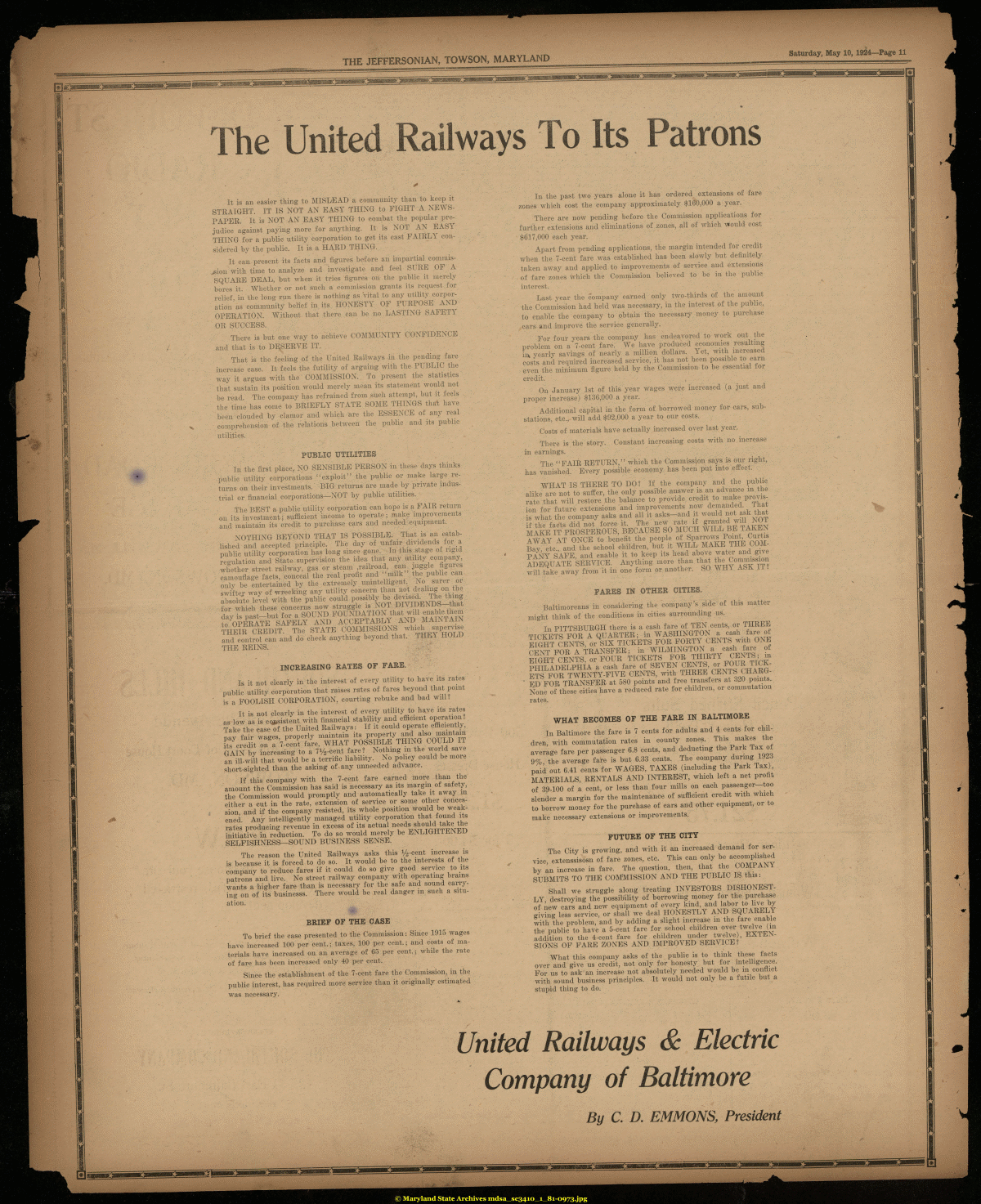
| THE JEFFERSONIAN, TOWSON, MARYLAND Saturday, May 10, 1924—Page 11 The United Railways To Its Patrons It is an easier thing to MISLEAD a community than to keep it STRAIGHT. IT IS NOT AN EASY THING to FIGHT A NEWSPAPER. It is NOT AN EASY THING to combat the popular prejudice against paying more for anything. It is NOT AN EASY THING for a public utility corporation to get its cast FAIRLY considered by the public. It is a HARD THING. It can present its facts and figures before an impartial commission with time to analyze and investigate and feel SURE OF A SQUARE DEAL, but when it tries figures on the public it merely bores it. Whether or not such a commission grants its request for relief, in the long run there is nothing as Vital to any utility corporation as community belief in its HONESTY OF PURPOSE AND OPERATION. Without that there can be no LASTING SAFETY OR SUCCESS. There is but one way to achieve COMMUNITY CONFIDENCE and that is to DESERVE IT. That is the feeling of the United Railways in the pending fare increase case. It feels the futility of arguing with the PUBLIC the way it argues with the COMMISSION. To present the statistics that sustain its position would merely mean its statement would not be read. The company has refrained from such attempt, but it feels the time has come to BRIEFLY STATE SOME THINGS that have been clouded by clamor and which are the ESSENCE of any real comprehension of the relations between the public and its public utilities. PUBLIC UTILITIES In the first place,- NO SENSIBLE PERSON in these days thinks public utility corporations "exploit" the public or make large returns on their investments. BIG returns are made by private industrial or financial corporations—NOT by public utilities. The BEST a public utility corporation can hope is a FAIR return on its investment; sufficient income to operate; make improvements and maintain its credit to purchase cars and needed equipment. NOTHING BEYOND THAT IS POSSIBLE. That is an established and accepted principle. The day of unfair dividends for a public utility corporation has long since gone. In this stage of rigid regulation and State.supervision the idea that any utility company, whether street railway, gas or steam ,railroad, can juggle figures camouflage facts, conceal the real profit and "milk" the public can only be entertained by the extremely unintelligent. No surer or swifter way of wrecking any utility concern than not dealing on the absolute level with the public could possibly be devised. The thing for which these concerns now struggle is NOT DIVIDENDS—that day is past—but for a SOUND FOUNDATION that will enable them to OPERATE SAFELY AND ACCEPTABLY AND MAINTAIN THEIR CREDIT. The STATE COMMISSIONS which supervise and control can and do check anything beyond that. THEY HOLD THE REINS. INCREASING RATES OF FARE. Is it not clearly in the interest of every utility to have its rates public utility corporation that raises rates of fares beyond that point is a FOOLISH CORPORATION, courting rebuke and bad will? It is not clearly in the interest of every utility to have its rates as low as is consistent with financial stability and efficient operation? Take the case of the United Railways: If it could operate efficiently, pay fair wages, properly maintain its property and also maintain its credit on a 7-eent fare, WHAT POSSIBLE THING COULD IT GAIN by increasing to a 7y2-cent fare? Nothing in the world save an ill-will that would be a terrific liability. No policy could be more short-sighted than the asking of any unneeded advance. If this company with the 7-cent fare earned more than the amount the Commission has said is necessary as its margin of safety, the Commission would promptly and automatically take it away in either a cut in the rate, extension of service or some other concession, and if the company resisted, its whole position would be weakened. Any intelligently managed utility corporation that found its rates producing revenue in excess of its actual needs should take the initiative in reduction. To do so would merely be ENLIGHTENED SELFISHNESS—SOUND BUSINESS SENSE. The reason the United Railways asks this %-cent increase is is because it is forced to do so. It would be to the interests of the company to reduce fares if it could do so give good service to its patrons and live. No street railway company with operating brains wants a higher fare than is necessary for the safe and sound carrying on of its businesss. There would be real danger in such a situation. BRIEF OF THE CASE To brief the case presented to the Commission: Since 1915 wages have increased 100 per cent.; taxes, 100 per cent.; and costs of materials have increased on an average of 65 per cent.; while the rate of fare has been increased only 40 per cent. Since the establishment of the 7-cent fare the Commission, in the public interest, has required more service than it originally estimated was necessary. In the past two years alone it has ordered extensions of fare zones which cost the company approximately $160,000 a year. There are now pending before the Commission applications for further extensions and eliminations of zones, all of which would cost $617,000 each year. Apart from pending applications, the margin intended for credit when the 7-cent fare was established has been slowly but definitely taken away and applied to improvements of service and extensions of fare zones which the Commission believed to be in the public interest. Last year the company earned only two-thirds of the amount the Commission had held was necessary, in the interest of the public, to enable the company to obtain the necessary money to purchase cars and improve the service generally. For four years the company has endeavored to work out the problem on a 7-cent fare. We have produced economies resulting in* yearly savings of nearly a million dollars. Yet, with increased costs and required increased service, it has not been possible to earn even the minimum figure held by the Commission to be essential for credit. On January 1st of this year wages were increased (a just and proper increase) $136,000 a year. Additional capital in the form of borrowed money for cars, substations, etc., will add $92,000 a year to our costs. Costs of materials have actually increased over last year. There is the story. Constant increasing costs with no increase in earnings. The "FAIR RETURN," which the Commission says is our right, has vanished. Every possible economy has been put into effect. WHAT IS THERE TO DO? If the company and the public alike are not to suffer, the only possible answer is an advance in the rate that will restore the balance to provide credit to make provision for future extensions and improvements now demanded. That is what the company asks and all it asks—and it would not ask that if the facts did not force it. The new rate if granted will NOT MAKE IT PROSPEROUS, BECAUSE SO MUCH WILL BE TAKEN AWAY AT ONCE to benefit the people of Sparrows Point, Curtis Bay, etc., and the school children, but it WILL MAKE THE COMPANY SAFE, and enable it to keep its head above water and give ADEQUATE SERVICE. Anything more than that the Commission will take away from it in one form or another. SO WHY ASK IT ? FARES IN OTHER CITIES. Baltimoreans in considering the company's side of this matter might think of the conditions in cities surrounding us. In PITTSBURGH, there is a cash fare of TEN cents, or THREE TICKETS FOR A QUARTER; in WASHINGTON a cash fare of EIGHT CENTS, or SIX TICKETS FOR FORTY CENTS with ONE CENT FOR A TRANSFER; in WILMINGTON a cash fare of EIGHT CENTS, or FOUR TICKETS FOR THIRTY CENTS; in PHILADELPHIA a cash fare of SEVEN CENTS, or FOUR TICKETS FOR TWENTY-FIVE CENTS, with THREE CENTS CHARGED FOR TRANSFER at 580 points and free transfers at 320 points. None of these cities have a reduced rate for children, or commutation rates. WHAT BECOMES OF THE FARE IN BALTIMORE In Baltimore the fare is 7 cents for adults and 4 cents for children, with commutation rates in county zones. This makes the average fare per passenger 6.8 cents, and deducting the Park Tax of 9%, the average fare is but 6.33 cents. The company during 1923 paid out 6.41 cents for WAGES, TAXES (including the Park Tax), MATERIALS, RENTALS AND INTEREST, which left a net profit of 39-100 of a cent, or less than four mills on each passenger—too slender a margin for the maintenance of sufficient credit with which to borrow money for the purchase of cars and other equipment, or to make necessary extensions or improvements. FUTURE OF THE CITY The City is growing, and with it an increased demand for service, extenssisosn of fare zones, etc. This can only be accomplished by an increase in fare. The question, then, that the COMPANY SUBMITS TO THE COMMISSION AND THE PUBLIC IS this: Shall we struggle along treating INVESTORS DISHONESTLY, destroying the possibility of borrowing money for the purchase of new cars and new equipment of every kind, and labor to live by giving less service, or shall we deal HONESTLY AND SQUARELY with the problem, and by adding a slight increase in the fare enable the public to have a 5-cent fare for school children over twelve (in addition to the 4-cent fare for children under twelve), EXTENSIONS OF FARE ZONES AND IMPROVED SERVICE? What this company asks of the public is to think these facts over and give us credit, not only for honesty but for intelligence. For us to ask an increase not absolutely needed would be in conflict with sound business principles. It would not only be a futile but a stupid thing to do. United Railways & Electric Company of Baltimore By C. D. EMMONS, President © Maryland State Archives mdsa_sc3410_1_81-0973.jpg |