 |
|
|
 |
|
 |
|
|||
|
||||
|
||||
|
Federal Gazette & Baltimore Daily Advertiser 1807/01-1807/06 msa_sc3722_2_6_1-0075 Enlarge and print image (4M) |
|
|
|
|
|
|
|
|||
|
||||
|
||||
|
Federal Gazette & Baltimore Daily Advertiser 1807/01-1807/06 msa_sc3722_2_6_1-0075 Enlarge and print image (4M) |
|
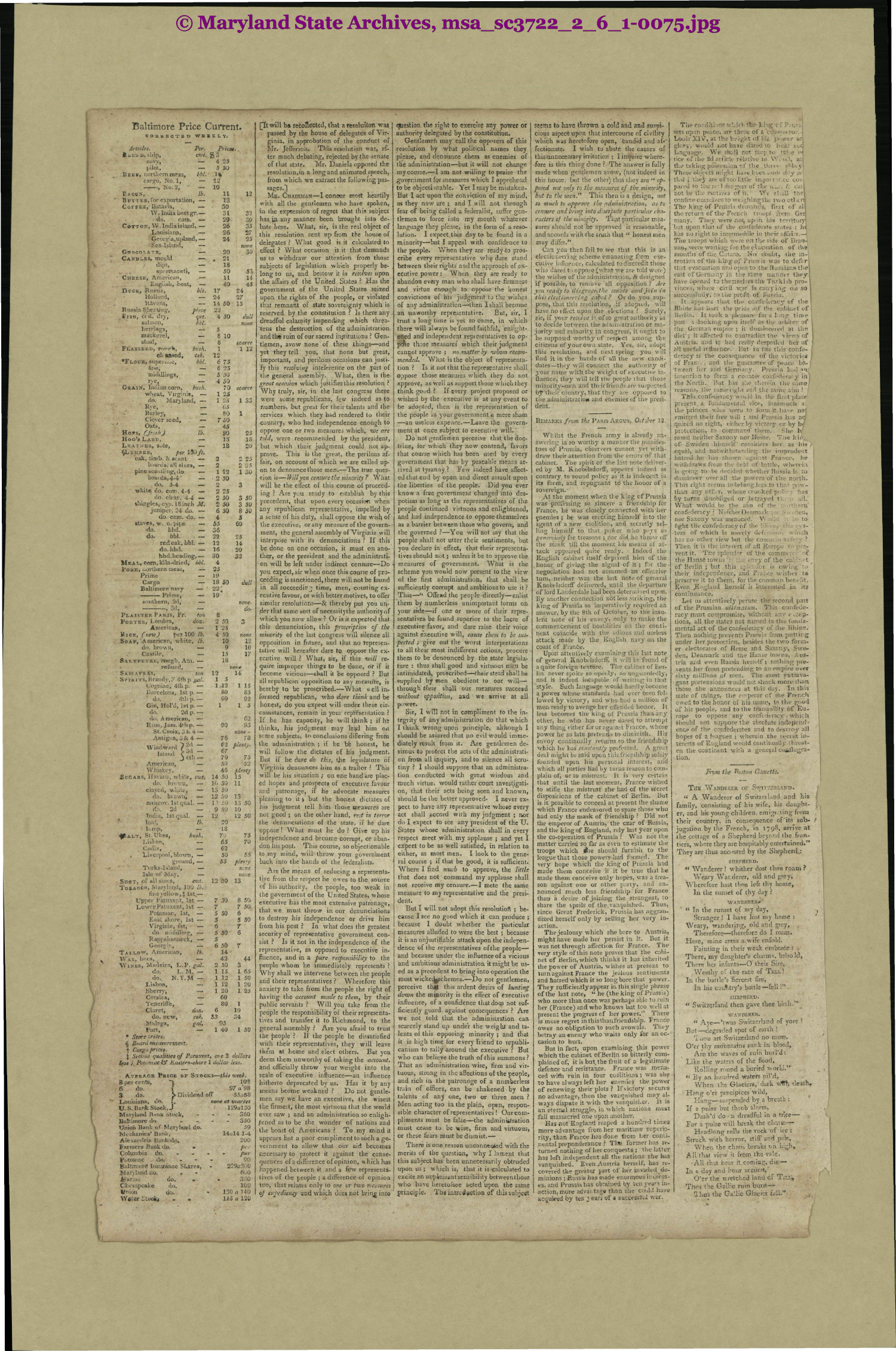
Baltimore Price Current.
COJUIECTKO WEEKLY.
Articles. Per. Prices.
Sle'au, ship, cto(. g3-
mivy, — 4 25
pilot, — 5 50
Bees, northern mess, bbl. 14.
cargo, No. 1, — 12
-------, No. 2, ' — 10
E*css, . lb. 11 12
Butt eh, for exportation, — 13
CorpEE, Batam, . — ¦ 30
Wi India best gr.— 31 32
do. com. — ¦ 29 30
Cotton, W. Indiaisland, — 26 35
Louisiana, — 26 27
Georgia, upland, — 24 25
Sea-Island, — none
CHOCOLATE, --- 20 30
Candi.es, mould — . 21
dipt, — 18
s;:< nnaceti, — 50 53
Cheese, American, — 11 14
, English, best, — 40 45
Dick, Russia, bit. 17 24
Holland, — 24 27
Have's, — 14 50 IS
Russia She.', tin;;-, piece 22
Fish, bed.', dry, cut. 4 50 dull
salmon, lbl. none
herring's, -i 5
mackerel, — 8 10
shad, — 8 scarce
Feaxseep, r'!iM>'h, bush. 1 1 12
ch ansed, csi. 12
.'Flour, sujiej i.,,e, bbl. 6 75
line, 6 25
middlings, — 5 50
rye, — 4 50
Grain, Indian corn, bush. 70 scarce
wheat, Virginia, — 1 25
do. Maryland, — 1 25 1 33
Rve, — 65
Barley, _ M 1
Clover seed, — 7 50
Oats, _ 45
Hops, fjrcshj lb. 20 25
Hog'sLabc, — 15 18
Leatheii, sole, — IS 20
^Lumber, per 1^0 ft.
oak, tirnb. & scant — 2 2 25
boards. aU si/.es, — 2 2 35
pine scantling', do. — 1 12 1 30
boaids,4-4' — ¦ 2 50
do. 5-4 — 2 3
•white, clo. com. 4-4 — 2 25
do. clear. 4-4 — 2 50 3 50
thlngles, cffl). 18 inch M. 2 50 3 50
juniper, 24 do. — 6 50 8 50
do. com. do. — 4 5
staves, w. o. pipe — 55 60
do. hhd. _ 36
do. bbl. . _ 22 25
red oak, bbl. — 12 14
do. hhd. — 16 20
hhd.heading,— 30 32
Meal, corn, kiln-dried, bbl. 4
1'okk, northern mess, — 25
Prime — 19
Cargo — 18 50 dull
Baltimore navy — 22;
----------Prime, — 19
southern, 2d, — none-
"d J,*
-'> oo, Co.
Plaister Pauis, Fr. ton 8
Porter, London, doz. 2 50 3
Ainericaii, -— 1 25
Kick, (nem) per 100 lb. 4 50 none
Soap, American, white, lb. 10 12
do. brown, — 9 10
Castile, — 15 17
Sm.tpetre, rough, Am. — 18
refined, — none
Sassathas, ton 12 14
SpiRiTS,Krandy,ii' 4th p gtil. 1 5
dogmas, 4th p. — 1 12 1 15
Barcelona, 1st p. — 80 85
do, 4th p.— 90 92
Gin, Hol'd, 1st p. — 1 1 5
do. 2d p. —
do. American, — ¦' 62
Rum, Jam. 4th p. — 50 93
St. Croix, 3 & 4 — none -
Antigua, 3&. 4 — 76 78
Windward / 1\ t'i 67 70 plenty.
Island cj{j ~ 75
American, — 50 52
Whiskey, — 46 plenty
Jaue.Ans, Havana, white, c-ixt. 14 50 15
do. brown, 10 50 11
clayed, white, — 13 50
do. hi own, i— 12 50 13
nmscov. lstqual. — l1 50 13 50
(To. 2d — 9 50 10
India, lstqual. — 12. 12 50
loaf, lb. 20
lump, — 18
i(|Salt, St. Ubes, bush. 70 75
Lisbon, — 65 70
Cadiz, — 62
Liverpool, blown, — 50 55
ground, — 55 plenty
Turks-Island, — none
Isle of May, — nor.s
Shot, pf ail sizes, pivt. 12 50 13
To»acco, Maryland, 100 lb.
fine yellow, } 1st —
Upper lJatuxe;.t, 1st — 7 50 8 sa
LowerPatuxent, 1st — 7 7 50
Potomac, 1st, — 5 50 6
East, shore, 1st — 5 5 50
Virginia, fat, — 6 7
do middling", '— 5 50 6
Rappahannock, —> 5
Geo'rgin, — 6 50 f
Tallow, American, lb. 14
Wax, bees, — 42 44
Wines, Madeira, L.P. gal. 2 50 3
do. L. M. — 1 15 1 65
do.. N.Y.M — 1 12 1 50
Lisbon, — 1 12 1 20
(sherry; — 1 20 1 25
Corsica, — 60
Tenerifl'e, — 80 1
Claret, d,>z. 6 10
do. new, esh. 33 34
Malaga, gal. 55
Port, — 1 40 1 50
* Store ttrieet.
§ Board incamrement.
f Cargo prices.
^ Sedma qualities of Patuxer.t, ate 2 dollars
less ; Potomac & Kuslern-shore 1 dollar less.
¦ Average Price of Stocks—(his wee/.
8 per cents, "1 105
6 do. s 97 c
3 , do. ^ Dii idetld off 55,758
Louisiana, do. i none at viarict
U. S. Rank Slock, j 129^130
Maryland Rank Stock", ... 350
Baltimore do. .... 350
Union Bank of Maryland do. '59
Mechanics' Bank, 14al4 1-4
Alexandria Bank do, 200
farmers Bank do. » per
Columbia do. - p*r
Potomac do. ... 90
Baltimore Insurance Shares, - 229*r300
Marylaml Co. . - 6O'0
JflWUie do. . - 330
Chesapeake do, 100
Union do. » 130 a 140
\V«t«r Stoafc, . . liS« 120
[It will bs recollected, that a resofuitoft was
passed by the house of delegates of Vir-
ginia, in approbation of the conduct of
Mr. Jefferson, This resolution was, af-
ter much debating, rejected by the senate
of that state. TVlr. Daniels opposed the
. resolution,in a long and animated speech,
from which we extract the following pas-
sages.]
Mr. Chairman—I concur most heartily
with all the gentlemen who have spoken,
in the expression of regret that this subject
has ia any manner been brought into de-
bate here. What, sir, is the real object of
this resolution sent np from the house of
delegates ? What good is it calculated to
effect ? What occasion is it that demands
us to withdraw our attention from those
subjects of legislation which properly be-
long to us, and bestow it in resolves upon
the affairs of the United States ? Has the
government of the United States seized
upon the rights of the people, or violated
that remnant of state sovereignty which is
reserved by the constitution ? Is there any
dreadful calamity impending which threa-
tens the destruction of the administration
and the ruin of our sacred institutions ? Gen-
tlemen, avow none of these things—and
yet they tell you, that none but great,
important, and perilous occasions can justi-
fy this resolving inteference on the part of
the general assembly. What, then is the
great occasion which justifies this resolution ?
Why truly, sir, in the last congress there
were some republicans, few indeed as to
numbers, but great for their talents and the
services which they had rendered to their
country, who had independence enough to
oppose one or two measures which, we are
told, were recommended by the president,
but which their judgment could not ap-
prove. This is the great, the perilous af-
fair, on account of which we are called up-
on to denounce those men.—The true ques-
tion is—Hill yon censure the minority ? What
will be the effect of this course of proceed-
ing ? Are you ready to establish by this
precedent, that upon every occasion when
any republican representative, impelled by
a sense of his duty, shall oppose the wish of
the executive, orany measure of the govern-
ment, the general assembly of Virginia, will
interpose with its denunciations ? If this
be done on one occasion, it must on ano-
ther, or the president and the administrati-
on will be left under indirect censure—Do
you expect, sir when once this course of pro-
ceeding is sanctioned, there will not be found
in all succeedir j time, men, courting ex-
ecutive favour, or with better motives, to offer
similar resolutions—& thereby put you un-
der that same sort of necessitythe authority of
which you now allow ? Or is it expected that
this denunciation, this proscription of the
minority of the last congress will silence all
opposition in future, and that no represen-
tative will hereafter dare to. oppose the ex-
ecutive will ? What, sir, if this will re-
quire impioper things to be done, or if it
become vicious—shall it be opposed ? But
all republican opposition to any measure, is
hereby to be proscribed.—What veil in-
formed republican, who dare think and be
honest, do you expect will under these cir-
cumstances, remain in your representation ?
If he has capacity, he will think ; if he
thinks, his judgment may lead him on
seme subjects, to conclusions differing from
the administration ; if he bb honest, he
will follow the dictates of his judgment.
But if he dare do this, the legislature of
Virginia denounces bina as a traitor ? This
will be his situation ; on one hand are plac-
ed hopes and prospect* of executive favour
and patronage, if he advocate measures
pleasing to it } but the honest dictates of
his judgment tell him those measures are
not good ; on the other hand, rest in terror
the denunciations oi the state, if he dare
oppose! What must he do ? Give up his
independence and become corrupt, or aban-
don his post. This course, so objectionable
to my mind, will throw your government
back into the hands ot the federalists.
Are the means of seducing a representa-
tive from the respect he owes to the source
of his authority, the people, too weak in
the government of the United States, whose
executive has the most extensive patronage,
that we must throw in our denunciations
to destroy his independence or drive him
from his post ? In what does the greatest
security of representative government con-
sist ? Is it not in the independence of the
representative, as opposed to executive in-
fluence, and in a pure responsibility to the
people whom he immediately represents ?
Why shall we intervene between the people
and their representatives ? Wherefore this
anxiety to take from the people the right of
having the account made to them, by their
public servants ? Will you take from the
people the responsibility of their representa-
tives and transfer it to Richmond, to the
general assembly ? Are you afraid to trust
the people ? If the people be dissatisfied
with their representatives, they will leave
them at home and elect others. But you
deem them unworthy of taking the account.
and officially throw your weight into the
scale of executive influence—an influence
hitherto deprecated by us. Has it by any
means beome weakned ? Do not gentle-
men say we have an executive, the wisest
the firmest, the most virtuous that the world
ever saw ; and an administration so enligh-
tened as to be the wonder of nations and
the boast ot Americans ? To my mind it
appears but a poor compliment to such a go-
vernment to allow that our aid becomes
necessary to protect it against the conse-
quences of a difference of opinion, which has
happened between it and a few representa-
tives of the people ; a difference of opinion
too, that relates only to one or two measures
of expediency and which dees not bring into
tficstion the right to exercise any power or
authority delegated by the constitution.
. Gentlemen may call the opposers of this
resolution by what political names they
please, and denounce them as enemies of
the administration—but it will not change
my course.—I am not willing to praise the
.government for measures which I apprehend
to be objecti onable. Yet I may bs mistaken.
But I act upon the conviction of my mind,
as they now arc ; and I will not through
fear of being called a federalist, suffer gen-
tlemen to force into my mouth whatever
language they please, in the form of a reso-
lution. I expect this day to be found in a
minority—but I appeal with confidence to
the people. When they are ready-to pros-
cribe every representative who dare stand
between their rights and the approach of ex-
ecutive power: When they are ready to
abandon every man who shall have firmness
and virtue enough to oppose the honest
convictions of his judgment to the wishes
of any administration—then I shall become
an unworthy representative. But, sir, I
trust a long time is yet to come, in which
there will always be found faithful, enlight-
ened and independent repiesentatives to op-
pose those measures which their judgment
cannot approve ; no matter by whom recom-
mended. What is the object of representa-
tion ? Is it not that the representative shall
oppose those measures which they do not
approve, as well as support those which they
think good ? If every project proposed or
wished by the executive is at any event to
be adopted, then is the representation of
the people in your government a mere sham
—an useless expence.—Leave the govern-
ment at once subject to executive will.
Do not gentlemen perceive that the doc-
trine, tor which they now contend, favors
that course which has been used by every
government that has by peacable means ar-
lived at tyranny ? Few indeed have affect-
ed that end by open and direct assault upon
the liberties of the people. Did you ever
know a free government changed into des-
potism as long as the representatives of the
people continued virtuous and enlightened,
and had independence to oppose themselves
as a barrier between those who govern, and
the governed ?—You will not say that the
people shall not utter their sentiments, but
you declare in effect, that their representa-
tives should not; unless it be to approve the
measures of government. What is the
scheme you would now present to the view
of the. first administration, that shall be
sufficiently corrupt and ambitious to use it ?
This—" Offexd the people directly—enlist
them by numberless unimportant forms on
your side—if one or more of their repre-
sentatives be found superior to the lucre of
executive favor, and dare raise their voice
against executive will, cause them to be sus-
pected ; give out the worst interpretations
to all their most indifferent actions, procure
them to be denounced by the state legisla-
ture : thus shall good and virtuous ir.on be
intimidated, proscribed—their stead shall bs
supplied by men obedient to oor will—
through these shall our measures succeed
•without opposition, aad we arrive at all
power.
Sir, I will not in compliment to the in-
tegrity of any administration do that which
I think wrong upon principle, although I
should be assured that no evil would imme-
diately result from it. Are gentlemen de-
sirous to protect the acts of the administrati-
on from all inquiry, and to silence all scru-
tiny ? I should suppose that an administra-
tion conducted with great wisdom and
much virtue, would rather court investigati-
on, that their acts being seen and known,
should be the better approved- I never ex-
pect to have any representative whose every
act shall accord with my judgment ; nor
do I expect to see any president of the U.
States whose administration shall in every
respect meet with my applause ; and yet I
expect to be as well satisfied, in relation to
either, as most men. I look to the gene-
ral course ; if that be good, it is sufficient.
Where I find much to approve, the little
that does not command my applause shall
not receive my censure.— I mete the same
measure to my representative and the presi-
dent.
But I will not adopt this resolution ; be-
cause I see no good which it can produce ;
because I doubt whether the particular
measures alluded to were the best ; because
it is an unjustifiable attack upon the indepen-
dence of the representatives of the people—
and because under the influence of a vicious
and ambitious administration it might be us-
ed as a precedent to bring into operation the
most wickeo^schemes.—Do not gentlemen,
perceive that this ardent desirs of hunting
down the minority is the effect of executive
influence, of a confidence that docs not suf-
ficiently guard against consequences ? Are
we not told that the administration can
scarcely stand up under the weight and ta-
lents ol this opposing minority ; and that
it is high time for every Friend to republi-
canism to rally around the executive ? But
who can believe the truth of this summons ?
That an administration wise, firm and vir-
tuous, strong in the affections of the people,
and rich in the patronoge of a numberless
train of offices, can be shakened by the
talents of any one, two or three men ?
Men acting too in the plain, open, respon-
sible character of representatives ! Our com-
pliments must be false—the administration
must cease to be wise, firm and virtuous,
or these fears must bedismist.—
There is one reason unconnected with the
merits of the question, why I lament that
this subject has been unnecessarily obtruded
upon us; which is, that it is calculated to
excite an unpfeasantsensibility betweenthose
who have heretofore acted upon the same
principle. Thj wtrctfoctioo of this subject
seems to have thrown a cold and and suspi-
cious aspect upon that intercourse of civility
which was heretofore open, candid and at*'
fectionate. I wish to abate the causes of
this unnecessary irritation ; 1 inquire where-
fore is this thing done ? The answer is fully
made when gentlemen avow, (not indeed in
this house, but the other) that they are " op-
posed not only to the measures cf the minority,
but to the men.'''' This then is a design, not
so much to apprrrce the administration, as to
censure and bring into d'srepuie particular cha-
racters of the minority. That particular mea-
sures should not be approved is reasonable,
and accords with the truth that " honest men
may differ."
Can you then fail to see that this is an
electioneering scheme emanating from exe-
cutive influence, calculated to discredit those
who dared to oppose£w,hat we are told were)
the wishes of the administration, ft designed
if possible, to remove all opposition ? Are
you ready to disgrace-thc senate and join in
this electioneering cabal ? Or clo you sup-
pose, that this resolution, if adopted, will
have no effect upon the elections? Surely,
sir, if your resolve is of so great authority as
to decide between the administration or ma-
jority and minority in congress, it ought to
be supposed worthy of respect among the
citizens of your own state. Yes, sir, adopt
this resolution, and next spring you will
find it in the hands of all the new candi-
dates—they will connect the authority of
your name with, the weight of executive in-
fluence, they will tell the people that those
minority-men and theirfriends are suspected
by their country, that, they are opposed to
the admiftistratioa and enemies of the presi-
dent.
Bek.'.rks from the Paris Argus, October 13.
Whilst the French army is already an-
swering in so worthy a maimer the manifes-
toes of Prussia, observers cannot yet with-
draw their attention from the errors of that
cabinet. The spirit of the list note deliver-
ed by M. KnobelsdorfT, appe-irs indeed as
contrary to sound policy as it is indecent in
its form, and repugnant td the honor of a
sovereign.
At the moment, when the king of Prussia
was professing so sincere a friendship for
France, he was closely connected with her
enemies ; he was erecting himself into the
agent of a new coalition, and secretly sel-
ling himself to that povVer who p; |