 |
|
|
 |
|
 |
|
|||
|
||||
|
||||
|
Federal Gazette & Baltimore Daily Advertiser 1807/01-1807/06 msa_sc3722_2_6_1-0175 Enlarge and print image (4M) |
|
|
|
|
|
|
|
|||
|
||||
|
||||
|
Federal Gazette & Baltimore Daily Advertiser 1807/01-1807/06 msa_sc3722_2_6_1-0175 Enlarge and print image (4M) |
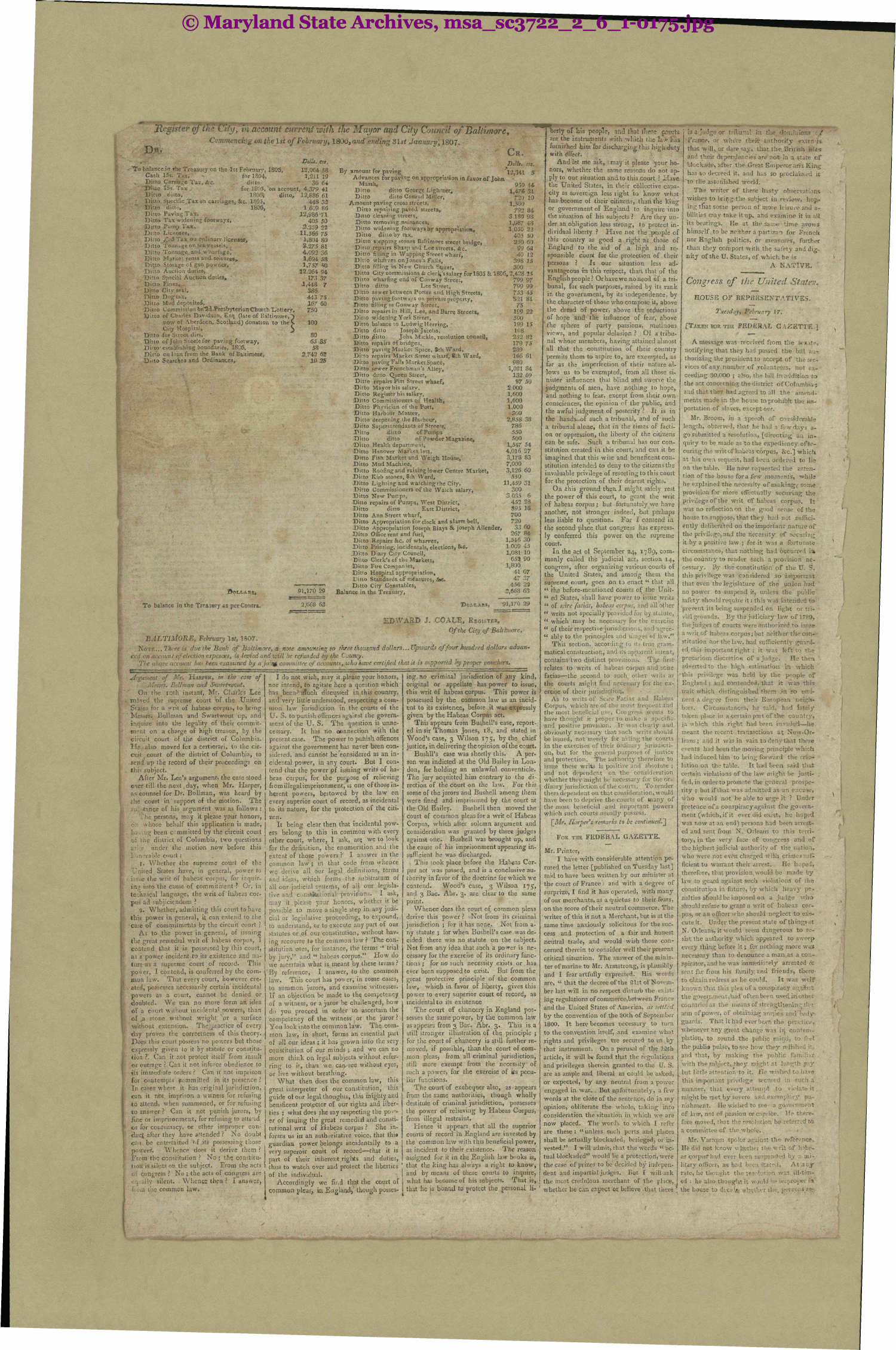
| I •V"',* "' HIT 1 /-*•- /^ .. , ~ . . Megister of me Cuy, m account current with the Mayor and City Council of Baltimore, Ccmniencivg on the 1st of February, 18003and ending 3lst January'', 1807. J>." Cr. Dolls, cts. ¦'To balance in the Treasury en the 1st February, 1805, 12,064 58 Cash 15s. Tax, tor 1804, 1,211 19 Ditto Carriage Tax, be. ditto 36 64. IVrcio fSs. Tax for 1805, on account, 4,379 41 JDino tiuto, 1806| ditto, 12,886 61 Ditto Specific Tax on carriages, Etc. 1K05, Ditto ditto, 1806, Ditto Paving Tax, Ditto Tax widening footways, •Ditto Pump Tax, Ditto Licenses, Ditto jQ. 5 Tax on ordinary licenses^ Ditto Tb'nriage on sea y^ssels, , Ditto Tonnage.and wharfage, Ditto Market rents avid seisures,. Ditto Storage of gun powder, Ditto Auction duties, Ditto Special Auction duties. Ditto Fines, ,. Ditto City seal. Ditto Dog tax, Ditto Mud. deposited, Ditto Commission btfSd PresbyterianChurch Lottery, Ditto of Charles Davidson, Esq (late of Baltimore,"} now of Aberdeen, Scotland) donation to the C City Hospital, ^ Ditto for Street dirt, Ditto of John Steele for paving footway, Ditto- establishing boundaries, 18C6, Ditto on loan from the Bank of Baltimore, Duto Searches attd Ordinances, 448 32 1.609 85 .12,986 71 405 50 2,259 22 11,566 75 1,804 80 *,27.5 81 4,092 36 1,694 58 1,757 TO 12,264 94 173 37 1,448 7 386 443 75 167 50 750 100 80 65 .85 58 .2,742 62 10 2S Collars, To balance in the Treasury as per Contra. 91,170 29 2,668 63 Dolls, cis. By amount for paving ' 12,341 5 Advances for paving on appropriation in favor of John. Marsh, ' 930 44 Ditto ditto George Lightner, 1,476 31 Ditto ditto Conrad MHler, yog 10 Amount paving cross streets, " 1,500 Ditto repairing paved streets, f92 84 Ditto cleaning streets, 3.180 98 Ditto removing nuisances, 1,087 48 .Ditto widening footways by appropriation, 1,050 '21 Ditto ditto by tax, 405 50 Ditto stepping atones Baltimore street hndge, 250 60 Ditto repairs Sharp and Lee streets, &c. 99 68 Ditto fining in Wapping Street wharf, 40 12 Ditto wharves on Jones's Falls, 398 15 Ditto filling in New Church Street, 300 Ditto City commissions & clerk's salary for 1805 h 1806,2,428 25 Ditto wharfing end of Conway Street, 799 97 Ditto ditto Lee Street, . 799 99 Ditto sewer between Porter and High Streets, 753 45 Ditto paving footways on private property, 'oil 81 Ditto tilling 111 Conway Street, 75 Ditto repairs in Hill, Lee, and Barre Streets, 199 22 Ditto widening York Street, 500 Ditto balance to Ludwig Herring, ; 199 15 Ditto ditto Joseph Jacobs, 108 Ditto ditto John Mickle, resolution council, 252 82 . Ditto repairs of bridges, 179 75 Ditto paving Market Space, 3th Ward, 289 Ditto repairs Market Street wharf, 8th Ward» 166 61 Ditto paving Falls Market Space, 980 Ditto sewer Frenchman's Alley, 1,081 84 Ditto ditto Queen Sheet, - 132 69 Ditto repairs Pitt Street wharf, 97 50 Ditto Mayor his salary, 2,000 Ditto Register his salary, 1,600 Ditto Commissioners of Health, .1,600 Ditto Physician of the Port, 1,000 Ditto Harbour Master, 300 Ditto deepening the Ha.hour, 2,858 38 Ditto Superititendauts.of Streetn, 786 Ditto ditto of Pumps 550 Ditto ditto of Powder Magazine, 500 Ditto Health department, 1,547 54 Ditto Hanover Market lots, 4,016 27 Ditto Fish Market and Weigh House, 3,178 83 Ditto Mud Machine, 7,000 Ditto Roofing and raising lower Centre Market, 3,126 60 Ditto Kirb stones, 8ih Ward, 550 Ditto Lighting and watching the City, 11,459 31 Ditto Commissioners of the Watch salary, 300 Ditto New Puirps, 3,035 6 Ditto repairs of Pumps, West District, 452 28 Ditto ditto East District, 895 16 Ditto Ann Street wharf, 700 Ditto Appropriation for clock and alarm bell, 720 Ditto Appropriation Joseph Biays & Joseph Allender, 33 60 Ditto Office rent and fuel, 267 84 Ditto Repairs &c. of wharves, 1,546 30 Ditto Printing, incidentals, elections, &c. 1,009 45 .Ditto Diary City Council, ' 1.081 10 Ditto Clerk's of the Markets, 653 90 Ditto Fire Companies, 1,800, Ditto Hospital appropriation, 41 07 Ditto Standards of measures, ,&c. 47 37 Ditto City Constables, 4543 22 Balance in the Treasury, 2,668 63 Doxt.Aits, 91,170 29 EDWARD J. COALE, Register, Of the City of Baltimore. BALTIMORE, February \st, 1S07. Note...TA.re is due the Bank of Baltimore, a note amounting to three thousand dollars... Upwards of'font hundred dollars admin* ccd en account of election ei peaces, is levied and will be refunded by the County. count /at' been examined by ajoil^ committee of accounts, who have certified that it is supported by proper vouchers* The ah v acce Argument of Mr. Harper, in the case of Ylcssrs. Bollman and Sivartxuout. On the 10th instant, Mr. Charles Lee moved the supreme court of the "United St liu:: for a writ of habeas corpus, to bring Messrs. Bollman and Swartwout up, and inquire into the legality of their commit- ment on a charge of high treason, by the circuit court of the district of Columbia. He also moved for a certiorari, to the cir- cuit court of the district of Columbia, to send up the record of their proceedings on this subject. After Mr. Lee's argument, the case stood over till the next,day, when Mr. Harper, as counsel for Dr. Bollman, was heard by the court in support of the motion. The tance of his argument -was as follows : he oersons, may it please your honors, ¦ hose behalf this application is made, g been c mmitted by the circuit court :.: she district, of Columbia, two questions under the motion now before this iraWe court : 1. Whether the supreme court of the d Slates have, in general, power to me the writ of habeas corpus, for inquir- ing into the cause of commitment 1 Or, in technical language, the writ of habeas cor- pus ad subjiciendum ? 1. Whether, admitting this court to have this power in general, it can extend to the ca;e of commitments by the circuit court ? As to the power in general, of issuing the great remedial writ of habeas corpus, 1 contend that it is possessed by this court, as a power incident to its existence and na- ture as a supreme court of record. This power, I contend, is conferred by the com- mon law. That every court, however cre- ated, possesses necessarily certain incidental powers as a court, cannot be denied or doubted. We can no more form an idea of a court without incidents1 powers, than of .a stone without weight .or a surface without extension. The ^iactice of every day proves the correctness of this theory. Does this court possess no powers but those expressly given to it by statute or constitu- tion ?. Can it not protect itself from insult or outrage \ Can it not inforce obedience to its immediate orders ? Can it not imprison for contempts (committed in its presence ? In cases where it has original jurisdiction, can, it not imprison a witness for refusing ,to attend, when summoned, or for refusing to answer ? Can it not punish jurors, by fine or imprisonment, for refusing to attend cr for contumacy, or other improper con- duct after they have attended ? No doubt can be entertained of .its possessing those powers'. Whence does it derive them ? From the constitution ? No ; the, constitu- tion is silent on the subject. From the acts igress ? No ; the acts of congress are 7 silent. Whence then ? I answer, . the, common law. I do not wish, may it .please your honors, nor intend, to agitate here a question which has been'- rrTuch discussed in this country, and very little understood, respecting a com- mon law Jurisdiction in the courts of the U. S. to punish offences against the govern- ment of the U. S. The question is unne- cessary. It has no connection with the present case. The power to punish offences against the government has never been con- sidered, and cannot be considered as an in- cidental power, in any court. But I con- tend that the power pf issuing writs of ha- beas corpus, for the purpose of relieving fiomillegalimprisonment, 13 one of those in- herent powers, bestowed by the law on every superior court of record, as incidental to its nature, for the protection of the citi- zen. It being clear then that incidental pow- ers belong to this in common with every other court, where, I ask, are. we to look for the definition, the enumeration and the extent of those powers ? I answer in the common law ; m that code from whence we; derive all our legal definitions, terms and ideas, which forms the substratum of all our judicial systems, of all our legisla- tive and constltuiional piovicions. I ask, may it please your honors, whether it be possible to move a single step in any judi- cial or legislative proceeding, to expound, to understand, or to execute any part of our statutes or of our constitution, without hav- ing recourse ta the common law ? The con- stitution uses, for instance, the terms ¦' trial by jury," and " habeas corpus." How do we ascertain what is meant by these tsrms ? By reference, I answer, to the common law. This court has power, in some cases, to summon jurors, and examine witnesses. If an objection be made to the, competency of a witness, or a juror be challenged, how do you proceed in order to ascertain the competency of the witness or the juror ? You look into the common law. The com- mon law, in short, forms an essential part of all our ideas ; it has grown into the very constitution of our minds ¦, and we can no more think on legal subjects without refer- ring to it, than we car^see without eyes, or live without breathing. What then does the common law, this great interpreter of our constitution, this guide of our legal thoughts, this mighty and beniftcent protector of our rights and liber- ties ; what does she say respecting the pot"- er of issuing the great remedial and consti- tutional writ of Habeas corpus ? She in- forms us in an authoritative voice, that this guardian power belongs incidentally to a very snperoir court of record—that it is part of their inherent rights and duties, thus to watch over and protect the liberties of the individual. Accordingly we find that the court of common pleas,, in England, though posses- ing no criminal jurisdiction of any kind, original or appellate has power to issue, this writ of habeas corpus. This power is possessed by the common law as an incid- ent to its existence, before it was expressly given by the Habeas Corpus act. This appears from Bushell's case, report- ed in sir Thomas Jones, 18, and stated in Wood's case, 3 Wilson 175, by the chief justice, in delivering the opinion of the court. Bushll's case was shortly this. A per- son was indicted at the Old Bailey in Lon- don, for holding an unlawful conventicle. The jury acquitted him contrary to the di- rection of the court on the law. For this some of the jurors and Bushell among them were fined and imprisoned by the court at the Old Sailey. Bushel! then moved the court of common pleas for a writ of Habeas Corpus, which after solemn argument and consideration was granted by three judges against one. Bushell was brought up, and the cause of his imprisonment appearing in- sufficient he was discharged. . This took place before the Habeas Cor- pus act was passed, and is a conclusive au- thority in favor of the doctrine for which we contend. Wood's case, 3 Wilson 175, and 3 Bac. Abr. 3. are clear to the same point. Whence does the court of, common pleas derive this power ? > Not from its criminal jurisdiction ; for it has none. Not from a- ny statute ; for when Bushell's case was de- cided there was no statute on the subject. Not from any idea that such a po»er is ne- cessary for the exercise of ils ordinary func- tions ; for no such necessity exists or has ever been supposed to exist. But from the great protective principle of the common lav/, which in favor of liberty, gives this power to every superior court of record, as incidental to its existence The court of chancery in England pos- sesses the same power, by the common law as appears from 3 Bac. Abr. 3. This is a still stronger illustration of the principle 5 for the court of chancery is still further re- moved, if possible, than the court of com- mon pleas, from all criminal jurisdiction, still more exempt from the necessity of such a power, for the exercise of its pecu- liar functions. The court of exehequer also, as appears from the same authorities, though wholly destitute of criminal jurisdiction, possesses the power of relieving by Habeas Corpus, from illegal restraint. Hence it appears that all the superior courts of record' in England are invested by the common law with this beneficial power, as incident to their existence. The reason assigned for it in the English law books is, that the king has always a right to know, and by means of these courts to inquire, what has become of his subjects. That is, that he is bomul to protect the personal li- " ed States, shall have power to issue writs " of scire facias, habeas corpus, and all other " writs not specially provided for by statute, " which may be necessary for the exercise " of their respective jurisdictions, and a'gre'e- " ably to the principles and lisages of law." This section, according to its true gram- matical construction, and its apparent intent, contains two distinct provisions. T\\e. first relates to writs of habeas corpus and scire facias—the second to such other writs as the courts might find necessary for the ex- ercise of their jurisdiction', As to writs of Scire Facias and Habeas Corpus, which are of the most frequent and the most beneficial pse, Congress seems to have thought it proper to make a specifio- and positive provision. It- was obviously necessary that such writs should be issued, not merely for aiding the courts in the exercises of their ordinary jurisdicti- on, but for the general purposes of justice and protection. The authority therefore to issue these writs is positive and absolute ; and not dependent on the consideration whether thev might be necessary {'or the or- dinary jurisdiction of the courts. To render them dependent on that consideration, would have been to deprive the courts of many of the most beneficial and important powers which such courts usually possess. [Mr, Harper's remarks to be continued.^ Fos. the FEDERAL GAZETTE. Mr. Printer, I have with considerable attention pe- rused the letter [published on Tuesday last] said to have been written by our minister at the court of France : and with a degree of surprize, I find it has operated, with many of our merchants, as a quietus to their fears, on the score of their neutral commerce. The writer of this is not a Merchant, but is at the same time anxiously solicitous for the suc- cess and protection of a fair and honest neutral trade, and would wish those con- cerned therein to consider well their present critical situation. The answer of the minis- ter of marine to Mr. Armstrong, is plausibly and I fear artfully expressed. His words are, " that the decree of the 21st of'Novem- ber last will in no respect disturb the exist- ing regulations of commerce,between France and the United States of America, as settled by the convention of the 30th of September 1800. It here becomes necessary to turn to the convention itself, and examine what rights and privileges ere secured to us by that instrument. On a perusal of the lath article, it will bv found that the regulations and privileges therein granted to the U. S. are as ample and liberal as could be asked, or expected, by any neutral from a power engaged in war. . But unfortunately, a few words at the close of the sentence, do in my opinion, obliterate the whole, taking into consideration the situation in which we are now placed. The words to which I refer are these: "unless such ports and places shall be actually blockaded, besieged, or in- vested." I will admit, that the words " ac- tual blockaded" would be a protection, were the case of prizes to be decided by indepen- dent and impartial judges. But I will ask the most credulous merchant of the place, whether be can expect or. believe -that there ? ... , ¦ '¦¦> — berty of his people, and that tnffse courts are the instruments with which the 1. furnished him for discharging this high duty with effect. And let me ask, may it please your ho- nors, whether the same reasons do not ap- ply to our situation and. to this court ? Have the United States, in their collective capa- city as sovereign less right to know what has become of their citizens, than the king or government of England to inquire into the situation of his subjects ? Are they un- der an obligation less strong, to protect in- dividual liberty ? Have not the people of this country as good a right as. those of England to the aid of a high and re- sponsible court for the protection of . their persons ? Is our situation less ad- vantageous in this respect, than that of the English people? Orhavewe noneed of a tri- bunal, for such purposes, raised by its rank in the government, by its independence, by the character of those who compose it, above the dread of power, above the seductions of hope and the influence of fear, above the sphere of party passions, mutinous views, and popular delusipn > Of a tribu- nal whose members, having attained almost all that the constitution of their country permits them to aspire to, are exempted, as far as the imperfection of their nature al- lows us to be exempted, from all those si- nister influences that blind and swerve the judgments of men, have nothing to hope, and nothing to fear, except from their own consciences, the opinion of the public, and the awful judgment of posterity ? It is in the hands of such a tribunal, and of such a tribunal alone, that in the times of facti- on or oppression, the liberty of the citizens can be safe. Such a tribunal has our con- stitution created in this court, and can it be imagined that this wise and beneficent con- stitution intended to deny to the citizens the invaluable privilege of resorting to this court for the protection of their dearest rights. On this ground then I might safely rest the power of this court, to grant the writ of habeas corpus ; but fortunately we have another, not stronger indeed, but perhaps less liable to question. For I contend in the second place that congress has express- ly conferred this power on the supreme court. In the act ol September 24, 1789, com- monly called the judicial act, section 14, congress, after organizing various courts of the United States, and among them the supreme court, goes on to enact " that all " the before-mentioned courts of the Unit- is a judge or tribunal hi the dominions ¦ ,' France, or where their authority exten t, that will, or daresay, that the British isles and their dependencies are not in a state of blockade, after the Great Emperor and King has so decreed it, and has so proclaimed it to the astonished world. The writer of these hasty observations wishes to bring -the subject in review, hop- ing tfiat some person of more leisure and a- bilities may take it up, and examine it in all its bearings. He at the Same time avows himself to be neither a partizan for French nor English politics, or measures, farther than they comport with the safety and dig- nity of the U. States, of which he is A NATIVE. Congress of the United States,. HOUSE OF REPRESENTATIVES. Tuesday, February 17. [Taken for the FEDKBAL GAZETTE.] A message was received from the senat , notifying that they had passed the bhl thorizing the president to accept of the ser- vices of any number of volunteers, not ex- ceeding 30,000 ; also, the bill, in addition to the act concerning the district of Columbia ; and that they had .agreed to all the amend- ments made in the house to prohibit the im- portation of slaves, except one. Mr. Broom, in a speech of considerable length, observed, that he had a few days a- go submitted a resolution, [directing an in- quiry to be made as ~to the expediency of Se- curing the writ of habeas corpus, &c] which at his own request, had been ordered to lie on the table. He now requested the atten- tion of the house for a few moment's, while he explained the necessity of making( some provision for more effectually securing the privilege of the writ of habeas corpus. It was no reflection on the good sense of the house to suppose, that they had not suffici- ently deliberated on the important nature of the privilege,,and the necessity of securing it by a positive law ; for it was a fortunate circumstance, that nothing had occurred i» the country to render such a provision' ne- cessary. By the constitution of the U. S. this privilege was considered so important that even the legislature of the union had no power to suspend it, unless the public safety should require it: this was intended to prevent its being suspended on light or tri- vial grounds. By the judiciary law of 17P9, tin-judges of courts were authorised, to issue a writ of habeas corpus;but neither the con- stitution nor the law. had sufficiently guard- ed ':i!s important right : it Was left to precarious discretion of a judge. He then adverted to the high estimation • in which this privilege was held by the people of England ; and contended, that it was this trait which distinguished them in so emi- nent a degree front their European neigh. bors. Circumstances, he said, had lately taken place in a certain part of the country, 1.1 which this right had been invaded—he meant the recent transactions at New-Or- leans; and it was in vain to deny that these events had been the moving principle which had induced him to bring forward the reso- lution on the table. It had been said that certain violations of the law might be justi- fied, in order to promote the general prospe- rity : but if that was admitted as an excuse, who would not be able to urge it ? Under pretence of a conspiracy against the govern- ment (which, if it ever did exist, he hoped was now at an end) persons had been arrest- ed and sent from N. Orleans to this terri- tory, in the very face of congress and of the highest judicial authority of the nation, who were not even charged with crimes suf- ficient to warrant their arrest. He hoped, therefore, that provision, would bo made by law to guard against such violations of the constitution in future, by which heavy nalties should be imposed on a judge Who should refuse to grant a writ of habeas cor- pus, or an officer who should neglect to exe- cute it. Under the present state of things at N. Orleans, it would seem dangerous to re- sist the authority which appeared to sweep every thing before it; for nothing more was necessary than to denounce a man as a con- spirator, and he was immediately arrested & sent far from his family and friends, there to obtain redress as he could. It was v. known that this plea of a conspiracy a&aitist the goverume-ntjhad often been used itt other countries as the means of strengthening- thjj arm of power, of obtaining ariryies ui"i :. it- guards. That it had ever been the . whenever any great change vitas at. plation, to sound the public mind, to the publie pulse, to see how they reli and that, by making the public familiar; with the subject, they mbijht at length but little attention-to it. He wished to have this important privilege secured in such a manner, that every attempt Vj violate it might be met by severe and exemplary pu- nishment. He wished to see a >vut of law, not cf passion or caprice. He there- fore moved, that the resolution be referred to a committee of the whole. Mr. Varmint spoke against the, refer.-tice,. He did not know wit,:- as corpus"had ever So- litary officer, as i At any rate, he thought the . was ill,-: ed : he also thought it would i1" impropei ia the house to du: < ¦ |