 |
|
|
 |
|
 |
|
|||
|
||||
|
||||
|
Federal Gazette & Baltimore Daily Advertiser 1807/01-1807/06 msa_sc3722_2_6_1-0223 Enlarge and print image (4M) |
|
|
|
|
|
|
|
|||
|
||||
|
||||
|
Federal Gazette & Baltimore Daily Advertiser 1807/01-1807/06 msa_sc3722_2_6_1-0223 Enlarge and print image (4M) |
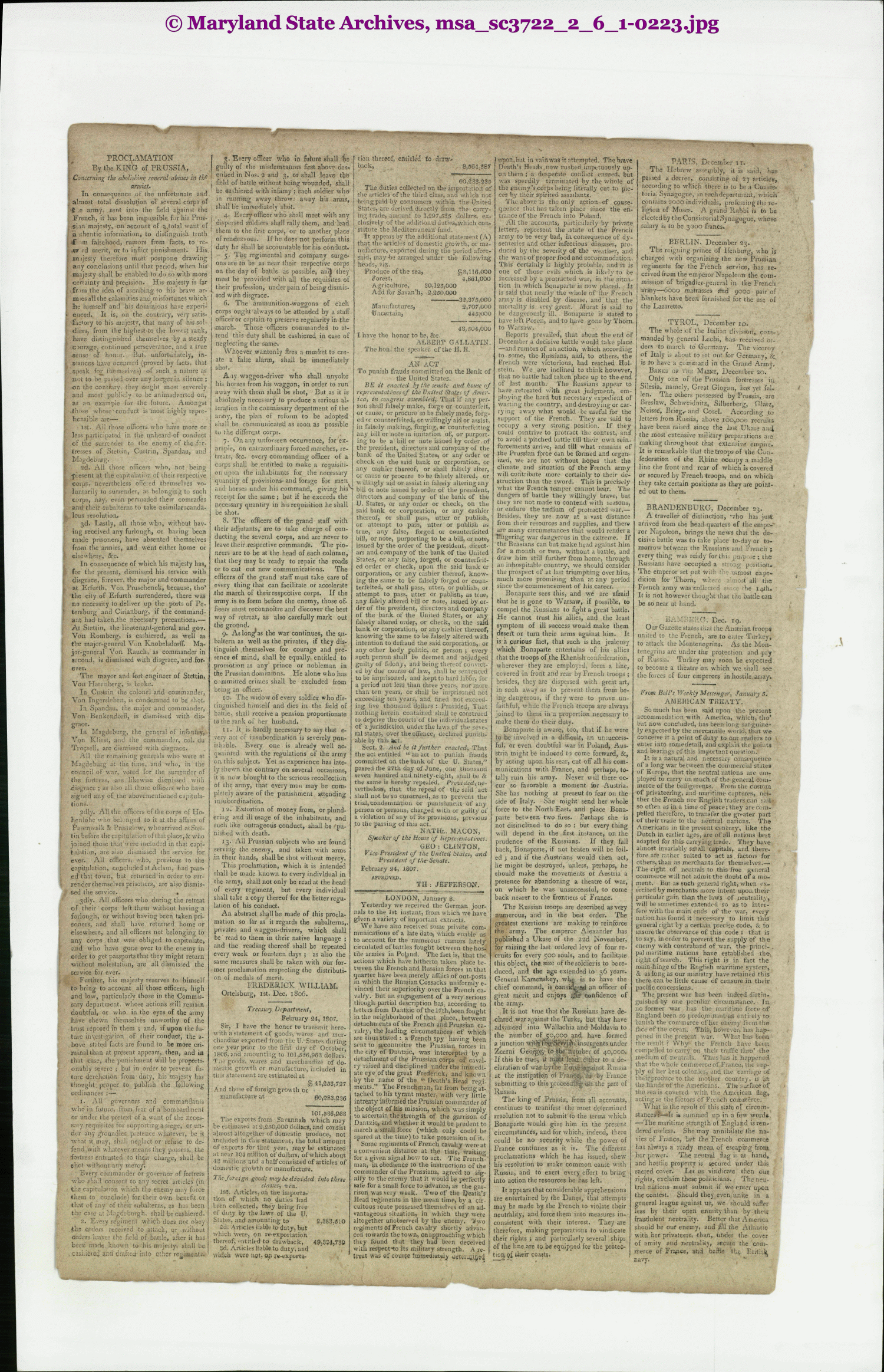
| > PROCLAMATION By the KING of PRUSSIA, Concerning the abolishing several abuses in fhe armies. In consequence of the unfortunate and almost total dissolution of several corps of ••C ,e army, sent into the field against the French, it has been impassible, f >r hi:; Prut- s': in majesty, on account of a.total want of a ithentic information, to distinguish truth f >m falsehood, rumors from facts, to re- ,w rd merit, or to inflict punishment. His. m ijesty therefore must postpone drawing any conclusions until that period, when his .majesty shall be enabled to d'> so with more certainty and precision. His majesty is far ifrim the idea of ascribing to his brave ar- mies all the calamities and misfortunes which he himself and his dominions have experi- • euced. It is, on the contrary, very satis- factory to his majesty, that many of his sol- diers, from the highest to the lowest rank, have distinguished themselves by a steady courage, continued perseverance, and a true -sense or hon:ir. But, unfortunately, in- stances U;r , : (proved by facts, that soeak elves) of such a nature as not to be passed over any longer in silence ; on the contlary, they ought most severely and most publicly to be animadverted on, as an example for the future. Amongst .those whose^conduct is most highly repre- hensible are— - 1st. Ail those officers who have more or less participated in the unheard-of conduct of the surrender to the enemy of th tresses of Stettin, Cuslrin, Spandau, and Magdeburg. 2d. All those officers who, not being i at the capitulation of their respective nevertheless offe ed themselves vo- luntarily to surrender, as belonging to such Cprps, nay, even persuaded their comrades and theft .subalterns to take asimilarscanda- lous resolution. 3d. Lastly, all those who, without hav- ing received any furlough, or having been made prisoners, have absented themselves from the armies, and went either home or elsewhere, &c. In consequence of which his majesty has, for the present, dismissed his service with disgrace, forever, the major and commander at Erfurth, Von Pruschenck, because, tho' the cily of Erfurth surrendered, there was no necessity to deliver up the ports of Pe- tersburg and Cirianburg, if the command- ant had taken.the necessary precautions.— At Stettin, the lieutenant-general and gov. Von Romberg, is cashiered, as well as the major-general Vim Knobelsdorff. Ma- jor-general Von Rauch, as commander in second, is dismissed with disgrace, and.for- ever. The mayor ami fort engineer of Stettin, Von Harenberg, is broke. In Custrin the colonel and commander, Von Ingersleben, is condemned to be In Spandau, the major and commander, Von Benkendorif, is dismissed with dis- grace. In Magdeburg, the genera! of infantry, Von Kliest, and the commander, col. du Troesetl, are dismissed with disgrace. All the remaining generals who were at Magdeburg at the time, and who, in the council of war, voted for the surrender of i'ne fortress, are likewise dismissed with disgrace ; as also all those officers who have signed any of the abovemeutioned capitula- tions. adly. All the officers of the corps of IIo- henlohe who belonged to it at the affairs of Paseiv.valk St PresleloW, who arrived at Sta- tin before the capitulation of that place, §c who joined those that were included in that capi- tulation, are also dismissed the service for ever. All officers, who, previous to the capitulation, concluded at Aclam, had pass- ed that town, but returned in order to sur- render themselves prisoners, are also dismis- sed the service. , 3dly. All officers who during the retreat of their corps left them without having a forlough, or without having been taken pri- soners, and shall have returned home or elsewhere, and all officers not belonging to any corps that was obliged to capitulate, and who have gone over to the enemy in order to get passports that they might return ¦without molestation, are all dismissed the service for ever. Further, his majesty reserves to himself to bring to account all those officers, high and low, particularly those in the Commis- sary department, whose actions still remain doubtful, or who in the eyes of the army have shewn themselves unworthy of the trust reposed in them ; and, if upon the fu- ture investigation of their conduct, the a- bove stated facts are found to be more cri- minal than at present appears, then, and in that case, the punishment will be proporti- onally severe ; but in order to prevent fu- ture dereliction from duty, his majesty has thought proper to publish the following ordinances :— 1. All governors and commandants who in future, horn fear of a bombardment or under the pretext of a want of the neces- sary requisites for supporting a siege, or un- der any gYoundles pretence whatever, be it what it may, shall neglect or refuse to de- fend with whatever means they possess, the fortress Entrusted to their charge, shall be shot without any mew. Every commander or governor of fortress who shall consent to any secret articles (in the capitulation which the enemy may force them to conclude) for their own benefit or that of any of their subalterns, as has been the case a! Magcicburgh, shall be cashiered. 2. Every regiment which does not oljay |IlS orders received to attack, ctr without Laves the Held of battle, after it has been made known to his mnjoty. shall be :.kta into other regiswnta 3. Every offiesr who in future shall be guilty of the misdemeanors first above dcs-. cribed in Nos. 2 and 3, or shall leave the field of battle without being wounded, shall be aashiered with infamy ; each soldier who in running away throw., away his arms, shall be immediately shot. 4. Every officer who shall meet with any dispersed soldiers shall rally them, and lead them to the first corps, or to another place of rendezvous. If he does not perform this duty he shall be accountable for his conduct. 5. The- regimental and company surge- ons are to be as near their rerpective corps on the day of battle as possible, anil they must be provided with all the requisites of their profession, under pain of being dismis- sed with disgrace. 6. The ammunition-waggons of each corps ought always to be attended by a staff officer or captain to preserve regularity in the march. Those officers commanded to at- tend this duty shall be cashiered in case of neglecting the same. Whoever wantonly fires a musket to cre- ate a false alarm, shall be immediately shot. A ly waggon-driver who shall unyoke his horses from his waggon, in order to run away with them shall be shot, But as it is absolutely necessary to produce a serious al- teration in the conmissary department of the army, the plan of reform to be adopted shall be communicated as soon as possible to the different corps. 7. On any unforseen occurrence, for ex- ample, on extraordinary forced marches, re- treats, &c. every commanding officer of a corps shall be entitled to make a requisiti- on upon the inhabitants for the necessary quantity of provisions' and forage for men and fiorses under his command, giving receipt for the same ; but if he exceeds the necessary quantity in his requisition he shall be shot. 8. The officers of the grand staff with their adjutants, are to take charge of con- ducting the several corps, and are never to leave their respective commands. The pio- neers are to be at the head of each column, that they may be ready to repair the roads or to cut out new communications. The officers of the grand staff must take care of every thing that can facilitate or accelerate the march of their respective corps. If the army is to form before the enemy, those of- ficers must reconnoitre and discover the best way of retreat, as also carefully mark out the ground. 9. As long as the war continues, the su- baltern as well as the privates, if they dis- tinguish themselves for courage and pre- sence of mind, shall be equally entitled to promotion as any prince or nobleman in the Prussian dominions. He alone who has committed crimes shall be excluded from being an officer. 10. The widow of every soldier who dis- tinguished himself and dies in the field of battle, shall receive a pension proportionate to the rank of her husband. n. It is hardly necessary to say that e- very act of insubordination is severely pun- ishable. Every one is already well ac- quainted with the regulations of the army on this subject. Yet as experience has late- ly shewn the contrary on several occasions, it is now brought to the serious recollection of the army, that every man may be com- pletely aware of the punishment attending insubordination. 12. Extortion of money from, or plund- ering and ill usage of the inhabitants, and such like outrageous conduct, shall be pu- nished with death. 13. All Prussian subjects who are found serving the enemy, and taken with arms in their hands, shall be shot without mercy. This proclamation, which it is intended shall be made known to every individual in the army, shall not only be read at the head of every regiment, but every individual shall take a copy thereof for the better regu- lation of his conduct. An abstract shall be made of this procla- mation so far as it regards the subalterns,, privates and waggon-drivers, which shall be read to them in their native language ; and the reading thereof shall be repeated every week or fourteen days ; as also the same measures shall be taken with our for- mer proclamation respecting the distributi- on of medals of merit. FREDERICK WILLIAM. Ortelsburg, 1st. Dec. 1806. Treasury Department, February 24, 1807. Sir, I have the honor to transmit here- with a statement of goods, wares and mer- chandize exported from the U." States during one year prior to the first day of October, 1806, and amounting to 101,536,963 dollars. The goods, wares and merchandize of do- mestic growth or manufacture, included in this statement are estimated at 8 41,253,727 And those of foreign growth or • manufacture at 60,983,236 tiou thereof, entitled to draw- back, 8,864,387 60,233,935 The duties collected on the importation' of the articles of the third class, and which not being paid by consumers within the United States, are derived directly from The carry- ing trade, a;ir.unf. to 1,297,53,5 dollars, ex- clusively of the additioncl duties, which con- stitute the Mediterranean iuncl. It appears by the additional statement (A) that the articles of domestic growth, or ma- nufacture, exported during the period afore- said, may he arranged under the following heads, viz. Produce of the sea, g3,116,000 forest, 4,861,000 Agriculture, 30,125,000 Add for Savan'h, 2,250,000 -------------32,375,000 Manufactures, 2,707,000 Uncurtain, 445,000 43,504,000 I have the honor to he, Ac. ALBERT GALLATIN. The hon. the speaker of the H. fi. AN ACT To punish frauds committed on the Bank of the United States. BE it enacted by the senate and house of representatives of the United States of Amer- ica, in congress assaulted, That if any per- son shall falsely make, forge or counterfeit, or cause, or procure so be falsely made, forg- ed or counterfeited, or willingly aid or assist, in falsely making, forging, »r counterfeiting any hill or note in imitation of, or purport- ing to be a bill or note issued by order of the president, directors and company of the bank of the United States, or any order or check on the said bank or corporation, or any cashier thereof, or shall falsely alter, or cause or procure to be falsely altered, or le!\l willingly aid or assist in falsely altering any his^i bill or note issued by order of the president, 101,536,863 The exports from Savannah which may be estimated at 2,250,000 dollars, and consist almost altogether of domestic produce, not included in this statement, the total amount ports for that year, may be estimated at near 104 million of dollars; of which about ¦Vi millions and a half consisted of articles of domestic growth or manufacture. The foreign goods may be divided into three classes, viz. 1st. Articles, on the importa- tion of which no duties had been collected, they being free of duty by the laws of the U. States, and amounting to 2,363.510 2d. Articles liable to duty, but which were, on re-exportation thereof, entitled to drawback, 49,324,73c 3d. Articles liable to duty, and which were net, on re-exporta- directors and company of the bank of the U. States, or any order or check, on the said bank or corporation, or any cashier thereof, or shall pass, utter or publish, j or attempt to pass, utter or publish as true, any false, forged or counterfeited bill, or note, purporting to be a bill, or note, issued by the order of the president, direct- ars and company of the bank of the United States, or any false, forged, or counterfeit- ed order or check, upon the said bank or corporation, or any cashier thereof, know- ing the same to be falsely forged or coun- terfeited, or shall pass, utter, or publish, or attempt to pass, utter or ptiblisn, as true, any falely altered hill or note, issued by or- der of the president, directors and company of the bank of the United States, or any falsely altered order, or check, on the said bank or corporation, or any cashier thereof, knowing the same to be falsely altered with intention to defraud the said corporation,, or any other body politic, or person ; every such person shall be dt-emed and adjudged guilty of felony, and being thereof convict- ed by due course of law, shall be sentenced I to be imprisoned, and kept to hard labor, for a period not less than three years, nor nxore than ten years, or shall be imprisoned not exceeding ten years, and fined not exceed- ing live thousand dollars : Provided, That nothing herein contained shall he construed to deprive the courts of the individual states of a jurisdiction under the laws of the seve- ral states, over the offence, declared punish- able by this act. Sect. 2. And be it further enacted, That the act entitled " an act to punish frauds committed oil the bank of the U. Slates," passed the 27th day of June, one thousand seven hundred and ninety-tight, shall be & the same is hereby repealed. Provided, ne- vertheless, that the repeal of the said act shall not be so construed, as to prevent the trial, condemnation or punishment of any person or persons, charged wiUi or guilty of a violation of any of its provisions, previous to the passing of this act. NATHl. MACON, S/teaker of the House of Representatives. GEO : CLINTON, Vice-President of the United States, and President of the-Senate. February 24, 1807. APPROVED. TH : JEFFERSON. LONDON, January 8. Yesterday we received the German jour- nals to the 1st instant, from which we have given a variety of important extracts. We have also received some private com- munications of a late date», which enable us to account for the numerous rumors lately circulated of battles fought between the hos- tile armies in Poland. The fact is, that the actions which have hitherto taken place be- tween the French and Russian forces in that quarter have been merely affairs of out-posts in which the Russian Cossacks uniformly e- vinced their superiority over the French ca- valry. But an engagement of a very serious though partial description has, according to letters from Dantzic of thel7th,been fought in the neighborhood of that place,. between detachments of the French and Prussian ca- valry, the leading circumstances of which are th us stated : a French spy having been sent to seconnoitre the Prussian forces in the city of Dantzic, was intercepted by a detachment of the Prussian corps of caval- ry raised and disciplined under the immedi- ate eye of the great Frederick, and known by the name of the " Death's Head regi- ments." The Frenchman, far from being at- tached to his tyrant master, with very little intreaty informed the Prussian commander of the object of his mission, which was simply to ascertain the strength of the garrison of Dantzic, and whether it would he prudent to march a small force (which only could be spared at the time) to take possession of it. Some regiments of French cavalry were at a convenient distance at the time, waiting for a given signal how to act. The French- man, in obedience to the instructions of the commander of the Prussians, agreed to sig- nify to the enemy that it would be perfectly- safe for a small force to advance, as the gar- rison was very weak. Two of the Death's Head regiments in the mean time, by a cir cuitous loute possessed themselves of an ad- vantageous situation, in which they were altogether unobserved by the enemy. '1'wo regiments of French cavalry shortly advan- ced towards the town, on approaching which they found that they had been deceived with respecf+o its military strength. A re- treat was of course immediately u«6r.n,uj»d upon,but in vainwas it attempted. The brave Death's Heads now rushed impetuously up- on them ; a desperate conflict ensued, but was speedily terminated by the whole of the enemy's corps being literally cut to pie- ces by their spirited assailants. The above is the only action of couse- quence that has taken place since the en- trance of the French into Poland. All the accounts, particularly by private letters, represent the .state of the French army to be very bad, in consequence of dy- senteries and other infectious diseases, pro- duced by the severity of the weather, and the want of proper food and accommodation. This certainly is highly probable, and it is one of those evils which is likely to be increased by a protracted war, in the situa- tion in which Bonaparte is now placed. It is said that nearly the whole of the French army is disabled by disease, and that the mortality is very great. Mural is said to be dangerously ill. Bonaparte is stated to have left Posen, and to have gone by Thorn, to Warsaw. Reports prevailed, that about the end of December a decisive battle would take place —and rumors of an action, which according to some, the Russians, and, to others, the French were victorious, had reached Hol- stein. We are inclined to think however, that no battle had taken place up to the end of last month. The Russians appear to have retreated with great judgment, em- ploying the hard but necessary expedient of wa.-'ting the country, and destroying or car- ry ing away what would be usejful for the support of the French. They are said to occupy a very strong position. If they could contrive to protract the contest, and to avoid a pitched battle till their own rein- forcements arrive, and till what remains of the Prussian force can be formed and organ- ized, we are not without hopes that the climate and situation of the French army will contribute more certainly to their de- struction than the sword. This is precisely what the French temper cannot bear. The dangers of battle they willingly brave, but they are not made to contend with seasons, or endure the txdiutn of protracted Besides, they are now at a vast distance from their resources and supplies, and ther« are many circumstances that would render a lingering war dangerous in the extreme. If the Russians can but make head against him for a month or two, without a battle, and draw him still further from home, through an inhospitable country, we should consider the prospect of at last triumphing over him, much more promising than at any period since the commencement of his career. Bonaparte sees this, and we are afraid that he is gone to Warsaw, if possible, to compel the Russians to fight a great battle. He cannot trust his allies, and the least symptom of ill success would make them desert or turn their arms against him. It is a curious fact, that such is the jealousy which Bonaparte entertains of his allies that the troops of the Rhenish confederation, wherever they are employed, form a line, covered in front and rear by French troops ; besides, they are dispersed with great art, in such away as to prevent them from be- ing dangerous, if they were to prove un- faithful, while the French troops are always joined to them in a proportion necessary to make them do their duty. Bonaparte is aware, too, that if he were to be involved in a difficult, an unsuccess- ful, or even doubtful war in Poland, Aus- stria might be induecd to come forward, &, by acting upon his rear, cut off all his com- munications with France, and perhaps, to- tally ruin his army. Never will there oc- cur so favorable a moment for Austria. She has nothing at present to fear on the side of Italy. She might send her whole force to the North East, and place Bona- parte between two hies. Perhaps she is not disinclined to do so : but every thing will depend in the first instance, on the prudence of the Russians. If they fall back, Bonaparte, if not beaten will be foil- ed ; and if the Austrians would then act, he might be destroyed, unless, perhaps, he should make the movements ot Austria a pretence for abandoning a theatre of war, on which he was unsuccesslul, to come back nearer to the frontiers of France. The Russian troops are described as very numerous, and in the best order. The greatest exertions are making to reinforce the army. The emperor Alexander has published a Ukase of the 22d Movember, for raising the last ordered levy of four re- cruits for every 500 souls, and to facilitate this object, the size of thesoidieris to bere- duced, and the age extended to 36 years. General Kamenskey, wi$| is to have the chief command, is considVojl an officer of great merit and enjoys $h confidence of the army. It is not true that the Russians have de- clared war against the Turks, but thay have advanced into Wallachia and Moldavia to the number of 50,000 and have formed a junction wttfyfT>g:SŁ;rv'iaVi insurgents under Zcerni Georgey to the number of 40,000. If this be true, il her to a de- claratian of war bylbe ..inst Russia at the instigation of ;;1 by France submitting to thisprce. t the part of Russia. The king of Prussia, from all accounts, continues to manifest the most determined resolution not to submit to the terms which Bonaparte would give him in the present circumstances, and for which, indeed, there could be no security while the power of France continues as it is. The different proclamations which he has issued, shew his resolution to make common cause with Russia, and to exert every effort to bring into action the resources he has left. It appears that considerable apprehensions are entertained by the Dan^s, that attempts may be made by the French to violate their neutrality, and force them into measures in- consistent with their interest. They are therefore, making preparations to vindicate their rights ; and particularly several ships of the line are to be equipped for the protec- tion, oi tlteir coasts, PARIS, E-osmber it. The Hebrew assembly, it is said, has passed a decree, consisting of 27 articles, according to which there is to be a Consis- toria; Synagogue, in eachdepsTtinent, which" contains 2000 individuals, professing the re- ligion of Moses. A grand Rabbi is to be electedby the ConsistoriaLSynagogue, whose salary is to be 3000 francs. BERLIN, December 23. The reigning prince of Ifenburg, who is charged with organizing the new Prussian regiments for the French service, has.re- ceived from the emperor Napoleon the com- mission of brigadier-general in the French; army—6000 matrasses rfnd gooo pair of blankets have been furnished for the ase of .the Lazaretto. TYROL, December 10. The whole,ot the Italian division, com-. tnanded by general Lechi, has received 01- ders to march to Germany. The viceroy of Italy is about to set out for Germany, & is to have a command in the Grand Army. Banks of tw Maine, December 20. Only one of the Prussian fortresses in. Silesia, namely, Great Glogau, has yet fal- len. The others possessed by Prussia, are Bresiaw, Schweidnitz, Silberberg, Glatz, Neisse, Brieg,- and Cosel. According to letters from Russia, above 100,000 recruits have been raised since the last Ukase audi the most extensive military preparations are making throughout that extensive empire. It is remarkable that the troops of the Cou- federation of the Rhine occupy a middle line the front and rear of which is covered or secured by French troops, and on which they take certain positions as they are point- ed out to them. BRANDENBURG, December 23. A traveller of distinction, "/ho has just arrived from, the bead-quarters of the unpe-* ror Napoleon, brings the news that the de- cisive battle was to take place to-day or to- morrow between the Russians and French ; every thing was ready for tin purp e; the Russians have occupied a strong position. The emperor set put w..1 utmost expe- dition for Thorn, wh . t all the French army was collected sinci be 14th. It is not however thought that the battle can, be so near at hand. " Dec. 19. Our Gazette states that the Austrian troops united to the French, are to enter Turkey, to attack the Montenegrins. As the Mon- tenegrins are under the protection and pay of Russia. Turkey may soon be expected to become a theatre on which we shall see the forces of four emperors in hostile array. From Belt's Weekly Messenger, January $'. AMERICAN TREATY. So much has been said upon the present accommodation with America, which, tho' but now concUidc>d, has been long sanguine- ly expected by the mercantile world, that we conceive it a point of duty to our readers to enter into somedetail, and explain the points and bearings of this important question. It is a natural and necessary consequence of a long war between the commercial States of Europe, that the neutral nations are em- ployed to carry on much of the general com- merce of the belligerents. From the custom of privateering, and maritime' captures, nei- ther the French nor English traders can sail." so often as in a time of peace; they are com- pelled therefore, to transfer the greater part of their trade to the neutral nations. The Americans in the present century, like the Dutch in earlicjr ages, are of all nations best adapted for this carrying trade. They have almost invariably small capitals, and there- fore are rather suited to act as . factors for others, than as merchants for themselves.—¦ The right of neutrals to this Irtie general commerce will not admit the doubt of a mo- ment. But as such general right, when ex- ercised by merchants more intent upon their particular gain than the laws of neutrality, will be sometimes extended so as to inter- fere with the main ends of the war, every nation has found it necessary to limit this general right by a certain precise code, &c to insure the observance of this code : that is to say, in order to prevent the supply of the enemy with contraband of war, the princi- . pal maritime nations have established the right of search. This right is in fact the main hinge of the English maritime system, cS: as long as our ministry have retained this there can be little cause of censure in their pacific concessions. The present war has been indeed distin- guished by one peculiar circumstance. In no former war has the maritime force of England been so predominant as entirely to banish the commerce of her enemy from the face of the ocean. This, however, has hap- pened in the present war. What Iras been the result ? Why the French have been compelled to carry on their traffic thro' the medium of neutrals. Thus has it happened that the whole coinmerce; of France, the sup- ply of her best colonies, and the carriage of theirjJroduce to the mother country, is jn the hands of the Americans. The surface of the sea is covered with the American Hag, acting as the factors of French commerce. What is the result of this state of circum- stances?—It i» summed up in a few words. —The maritime strength of England is ren- dered useless. She may annihilate the na- vies of France, tart the French commerce has always a ready mean of escaping from her power. The neutral flag is at hand, and hostile property is secured under this sacred cover. Let us vindicate then cus rights, exclaim these politicians. The ney? tral nations must submit if we enter upon the contest. Should they even, unite in a general league against us, we should suffer less by their open enmity than by their fraudulent neutrality. Better that America should be our enemy, and fill the Atlantic with her privateers, than, under the cover of amity and neutrality, sectue the com- merce of France, and baffle tU Eiit:;k navy. J |