 |
|
|
 |
|
 |
|
|||
|
||||
|
||||
|
Federal Gazette & Baltimore Daily Advertiser 1807/01-1807/06 msa_sc3722_2_6_1-0590 Enlarge and print image (4M) |
|
|
|
|
|
|
|
|||
|
||||
|
||||
|
Federal Gazette & Baltimore Daily Advertiser 1807/01-1807/06 msa_sc3722_2_6_1-0590 Enlarge and print image (4M) |
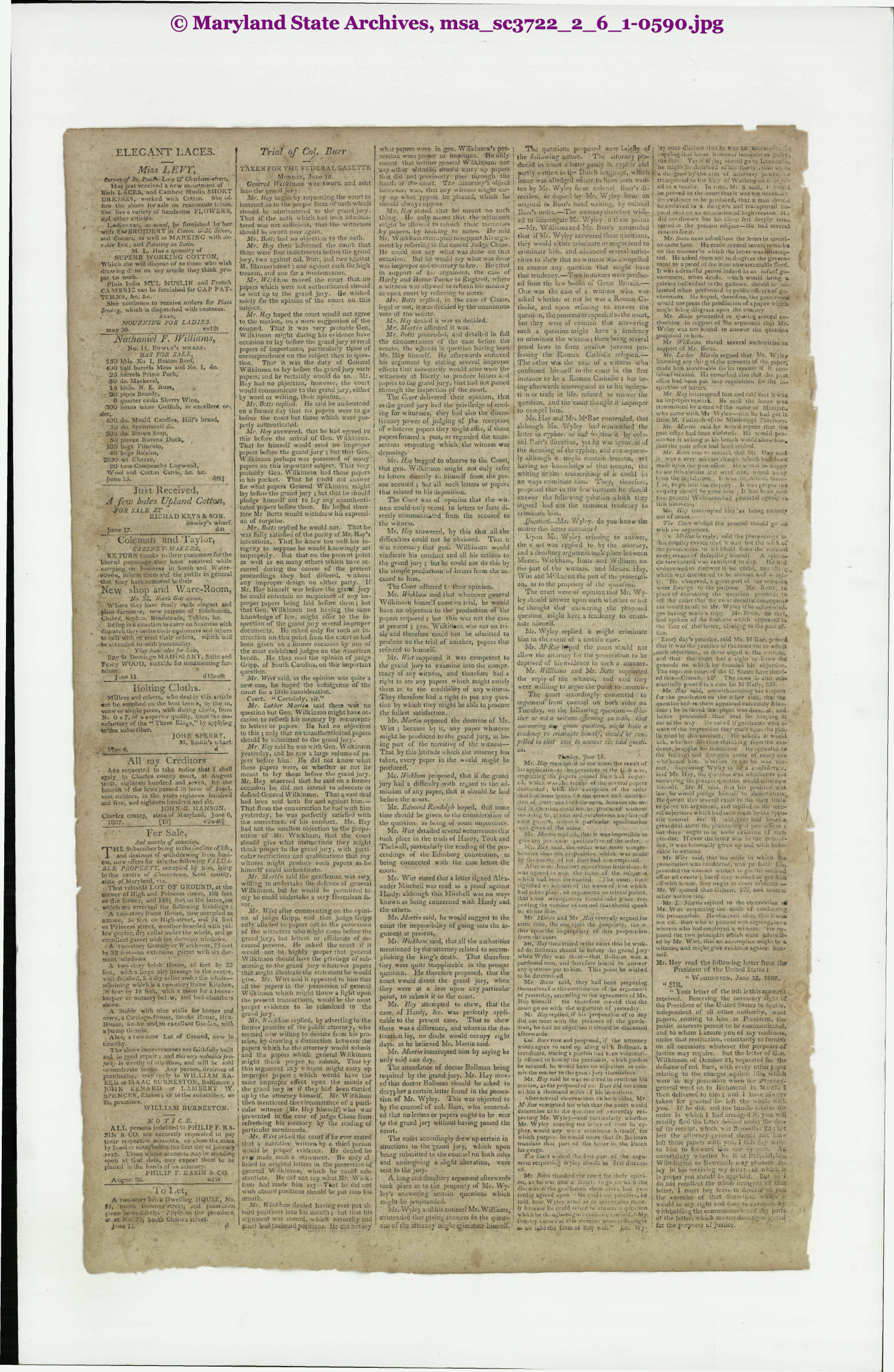
| \- ELEGANT LACES. Miss~LEVY, gomcr of St- Paulh-tane ts* Chatham-street, Has just received a new assortment of Rich {.ACES, and Cambric Stuslia SHORT DRESSES, worked with Cotton. .She of- fers. tjie above lor sale on reasonable terms. She has a variety of handsome FLOWERS, and other articles. Ladies can, as usual, be furnished by her with EMBROIDERY in Cotton. Gold, Silver, and Coiows, as well as MARKING with du- rable Ink, tin A Painting ok Satin. M. L. Has a quantity of SUPERB WORKING COTTON, Which she will dispose of to those who wish drawing d"ne on any article they think pro- per to work. Plain India M*UL MUSLIN and French CAMBRIC can be furnished for CAP PAT- TERNS, £tc. &c. She continues to receive .orders for Plain Sewing, which is dispatched with neatness. ALSO, MOURNING FOR LADIES. may 30. ___________ e»^t Nathaniel F, IViiliams, No. 15, IIowly's wharf. HAS FOR SALE, 250 bhls. No 1, Boston Beef, *00 half barrels Mess and No. 1, do. 25 barrels Prime Pork, 50 do. Mackeral, 15 hhds. N. E. Rum, 20 pipes Brandy, 6 quarter casks Sherry Wine, ;300 boxes white- Codfish, in excellent or- der, 400 do. Mould Candles, Hill's brand, 50 do. Spermaceti do. 30'J do. Brown Soap, 50 pieces Ravens Duck, 100 bags Pimento, 40 kegs Raisins, 20O0 wt Cheese, 20 tons Campeacby Logwood, Wool and Cotton Cards, i*c. &c. June 15. dStl. Just Received, A few bales Upland Cattail, FOR SALE BT R1CHAD KEYS &. SON. ih-nvley's wharf. June If. ________________ d4t Coleman and Taylor, CA SINE T. MAKERS, RETURN thanks to their customers for the liberal patronage they have received while carrying on business ill South and Water- • flU'ees, mforn; them and the public in general -that tuey have removed ho their New shop and Ware-Room, No. 32, North Gay -street, Where the) have ready i.v.de oleg-ant and plain furniture* new patrons of Sideboards, Chairs-, Sophas, Beadsteads, Tables, &c. Ucinjr in a situation to carry on business with flispat eh they invite their customers avid others to call with or send their orders, which "will 4>e attended to with punctuality. They hat).- a/so for Sale, Eav St. Doniii.jro MAHOGANY, Satin and Faacv WOOD, suitable for ornamenting fur- nilure. June. 15.____________________d12eo6t Bolting Cloths. Millers and others, who deal in this a: tide «an be supplied on the best tern s, by the in, voice or single piece, with Bolting Clot'ht, from No. 0 a 7, of a superior quality, from tfee ma- nufactory of the ". Three Kings," by applj ing to'the subscriber. JOHN SPEHRY, 35, Snath's wharf. Mfav 6.________________________. A All my Creditors Are requested to take notice that I shall apply to Charles county court, at August term, eighteen hundred and seven, for the beneiit of the laws passed in favor of Insol- vent debtors, in the years eighteen hundred and five, and eighteen hundred and six. JOHN B. HANSON. Charles county, state of Maryland, June 6, iqor.__________[10] e2w4t|| For Sale, And worthy of attention, rT"'HE Subscriber being in theiTeclioe oflife, X and desirous of withdrawing from busi- ess, now offers for sale the following VALUA- BLE PROPERTY, occupied by him, lying in the centre of Chtsiertuvm, Kent county, sts'te of Maryland, viz. That valuable LOT OF GROUND, at the corner of High and Princess-street, 198 feet nn the former, and 1481. feet on the latter,,on which :ix-c errected the following buildings : A two-story frame House, now occupied as a store, 59 feet on High-street, and 24 feet on Princess street, weather-boarded with yel- low poplar, dry cellar under the whole, and ar. excellent garret with ten dormant windows. A two-story Granary or Warehouse, 75 feet by 32 feet—an extensive garret with six dor- mant windows A two-story brick House, 46 feet by 32 feet, with a large airy passage, in the centre, ¦well-finished, &. a dry cellar under the whole— adjoining which is a two-story frame Kitchen, 36 feet by 18 feet, with a room for a house- keeper or nursery below, and bed-chambers above. A Stable with nine stalls for horses and cows, a Can'urge-House, Smoke House, Hen- House, isc.&c. and_an excellent Gai dm, with a pump therein". Also, a two-acre Lot of Ground, now in timothy. The above improvements are faithfully built raid in (rood repair ; wa& this very valuable pro- perty is worthy of attention, and will he sold on moderate terms. Any person, desirous of purchasing, rnar?ppry to WILLIAM BA- KER or ISA ACI1URNESTON, Baltimore ; JOHN KliNARD or LAMBERT W. SPBNCBR, Easton ; or to the subscriber, on the premises. WILLIAM BURNESTON. n o r i c e. . ALL persons indebted to PHILIP F. RA- SIN & CO. are earnestly requested to pay their respective accounts, or close the same by bonder note, before the first day of January next. Those whose accounts may he standing open at that dale, may expe«t them to be placed in the hands of an attorney. PHILIP F. LA SIN k CO. August 20-____________________G2W lo x^et, A two-story brick. Dwelling HOUSE, No. to, South Hanover-street, and possession given immediately. Apply on tin- promises, «r at No. 13, Jsgutb. Cbjuies street. June li. » Trial of Col. Burr TAKEN FOR THE FEDERAL GAZETTE Mokuay, June 15. General Wilkinson was sworn and sent into the grant) jury. Mr. Hay he$an by requesting the court to instruct as to the propar form of oath which should be administered to the grand jury. That if the oath which had been adminis- tered was not sufficient, that the witnesses should be sworn over ... Mr. Bolts had no objection to the oath. Mr. Hay then informed the court that there were four indictments before the grand jury, two against col. Burr, and two against M. Blannerhasset ; one against each for high treason, and one for a misdemeanor. Mr. Wickham moved the court that no papers which were not authenticated should . he sent up to the grand jury. He wished solely for the opinion of the court on this subject. Mr. Hay hoped the court would not agree to the motion, on a mere suggestion of the counsel. That it was very probable Gen. Wilkinson might during his evidence have occasion to lay before the grand jury several papers of importance, particularly- those of correspondence on the subject then in ques- tion. That it was the duty of General Wilkinson to lay before the grand jury such papers, and he certainly would do So. Mr. Hay had no objection, however, the court would communicate to the grand jury, either by word or writing, their opinion. Mr. Botts replied. He said he understood on a former day that no papers were to go before the court but those which were pro- perly authenticated. Mr, Hay answered, that he had agreed to this before the arrival of Gen. Wilkinson. That he himself would send no improper papers before the grand jury ; but that Gen. Wilkinson perhaps was possessed of many ' pipers on this important subject. That very probably Gen. Wilkinson had those papers in his pocket. That he could not answer for what papers General Wilkinson might lay before the grand jury ; but that he should pledge himself not to lay any unauthenti- cated papers before them. He hoped there- fore Mr Botts would withdraw his expressi- on of surprise. Mr. Butts replied he would not. That he was fully satisfied of the purity of Mr. Hay's intentions. That he knew too well his in- tegrity to suppose he would knowingly act improperly. But that on the present point as well as en many others which have oc- curred during the course of the present proceedings they had differed, without any improper design on either party. If Mr. Hay himself was before the grand jury he could entertain no suspicions of any im- proper papers being laid before them; but that Gen. Wilkinson not having the same knowledge of law, might offer lo the in- spection of the grand jury several improper documents. He asked only for such an in- struction on this point from the court as had been given on a former occasion by one of the most celebrated judges on the American bench. He then read the opinion of judge Gripp, of South Carolina, on this important question. Mr. Wirt said, as the opinion was quite a new one, he hoped the indulgence of the court for a little consideration. Court. " Certainly, sir." Mr. Luther Martin, said there was no question but Gen. Wilkinson might have oc- casion to refresh his memory by recurrence to letters or papers. He had no objection to this ; only that no unauthenticated papers should be submitted to the grand jury. Mr. Hay said he was with Gen. Wilkinson yesterday, and he saw a large volume of pa- pers before him. He did not know what these papers were, or whether or not he meant to lay them before the grand jury. Mr. Hay observed tiiat he said on a former occasion he did not intend to advocate or defend General Wilkinson. That a vast deal had been said both for and against him.— That from the conversation he had with him yesterday, he was perfectly satisfied with the correctness of his conduct. Mr. Hay- had not the smallest objection to the propo- sition of Mr. Wickham, that the couit thoulet give what instructions they might think proper to the grand jury, with parti- cular restrictions and qualifications that any witness might produce such papers as he himself could authenticate. Mr. Martin said the gentleman was very willing to undertake the defence of general Wilkinson, but he would be permit ted to say he could undertake a very Herculean fa- vor. Mr. Wirt after commenting on the opini- on of judge Gripp, said that judge Gripp only alluded to papers not in the possession of the witnesses who might come before the grand jury, but letters or affidavits of de- ceased persons. He asked the court if it would not be highly proper that general Wilkinson should have the privilege of sub- mitting- to the grand jury whatever papers that plight illustrate the statement he would give. Mr. Wirt said it appeared to him that all the papers in the possession of general Wilkinson which might throw a light upon the present transactions, would be the most proper evidence to be submitted to the grand jury. Mr. V,- ickhatn replied, by adverting to the former promise of the public attorney, who seemed now willing to deviate from his pro- mise, by drawing a distinction between the papers which he the attorney would submit and the papers which general Wilkinson might think proper to submit. That by this argument any witness might carry up improper papers ; which would have the same improper effect upon the minds of the grand jury as if they had been carried up by the attorney himself. Mr. Wickham then mentioned the circumstance of a parli- t cular witness (Mr. Hay himself) who was prevented in the case of judge Chase from refreshing his memory by the reading of particular memoranda. Mr. Wirt asked the court if he ever stated that a narrative written by a third person would be proper evidence. He denied he evur made such a statement. He only al hided to original letters in the possession of general Wilkinson, which he could sub- stantiate. He did not say what Mr. Wick- ham had made him say—That he did not wish absurd positions should be put into his mouth. Mr. Wickham denied having ever put ab rurd positions into his mouth ; but that his argument was absurd, which naturally and 4j;u£t kadpabsurdpojitiwis. Ik did lu'.say what papers were in gen. Wilkinson's pets- session were proper or improper. 'He only- meant that neither general Wilkinson, nor a.iy ud.er witness,'should carry- up papers that did not previously pass through the j hands of the court; The attorney's object | however, was, that any witness might car- ry up what papers he pleaded, which he should always oppose, Mr, Hap stated that he meant no such thing. He only nieawt that the witnesses might be allowed to refresh their memories by papers, by looking to notes. He said Mr. Wickham attem pled to support,his argu- ment by referring to the case of Judge Chase. He could not say what was done on that occasion. But he would say what was done i was improper and contrary to law. He cited j in support of hi.: argument, the case of Hardy and Home Tooke in England, where a witness was allowed to refresh his memory in open court by referring to notes. Mr. Botts replied, in the case of Chase, legal or not, it was decided by the unanimous vote of the senate. Mr. Hay denied it was so decided. Mr. Martin affirmed it was. Mr. Botts proceeded, and detailed in full the circumstances of the case before the senate, the wjti.ess in question having been Mr. Hay himself. He afterwards enforced his argument by stating several improper effects that necessarily would arise were the witnesses at liberty to produce letters and papers to the grand jury, that had not passed through the inspection of the court. The Curt delivered their opinion, that as the grand jury had the privtledgc of send- ing for witnesses, they had also the discre- tionary power of judging of tlie reception of whatever papers they might.offer, if those papers formed a part, or regarded the trans- actions respecting which the witness was deposing. Mr. Hay begged to observe to the Court, that gen. Wilkinson might not only refer to letters directly to himself from the .per- son accused ; but all such letters or papers that related to his deposition. The Court was of opinion that the wit- ness could only resort to letters or facts di- rectly communicated from the accused to the witness. Mr. Hay answered, by this that all the difficulties could not be obviated. That it was necessary that gen. Wilkinson would vindicate his conduct and all his actions to the grand jury ; but he could not do this by the simple production of letters from the ac- cused to him. The Court adhered t • their opinion. Mr. Wickham said that whenever general Wilkinson himself came on trial, he would have no objection to the production of tin; papers required ; but this was not the case at present ; gen. Wilkinson was not on tri- al, and therefore could not be admitted to produce on the trial of another, papers that refe'red to himself. Mr. flirt supposed it was competent to the grand jury to examine into the compe- tency of any witness, and therefore had a right to see any papers which might satisfy them as to the credibility of any witness. They therefore had a right to put any ques- tion by which they might be able to procure the fullest satisfaction. Mr. Martin opposed the doctrine of Mr. Wirt ; because by it, any paper whatever might be produced to the grand jury, as be- ing part of the narrative of the witness— That by this latitude which the attorney has taken, every paper in the world might be produced. Mr. Wickham proposed, that if the grand jury had a difficulty with regard to the ad- mission of any paper, that it should be laid before the court. Mr. Edmund Randolph hoped, that some time should be given to the consideration of the question, as being of some importance. Mr. Irirt detailed several occurrences that took place in the trials of Hardy, Took and Thclwall, particalarly the reading of the pro- ceedings of the Edinburg convention, as being connected with the case belore the conn. Mr. Wirt stated that a letter signed Alex- ander Mitchell was read as a proof against Hardy, although this Mitchell was no ways known as being concerned with Hardy aud the others. Mr. Martin said, he would suggest to the court the impossibility of going into the ar- gument at present. Mr. Wickham said, that all the authorities mentioned by the attorney related to accom- plishing the king's death. That therefore they were quite inapplicable in the present question. He therefore proposed, that the court would diiect the grand jury, when they were at a loss upon any particular point, to submit it to the court. Mr. Hay attempted to shew, that the case of Hardy, &c. was perfectly appli- cable to the present case. That to shew there was a difference, and wherein the dis- tinction lay, no doubt would occupy eight days, as he believed Mr. Martin said. Mr. Martin interrupted him by saying he only said one day. The attendance of doctor Bollman being required by the grand jury, Mr. Hay mov- ed that doctor Bollman should be asked to decypber a certain letter found in the posses- sion of Mr. Wyley. This was objected to by the counsel of col. Burr, who contend- ed that no letters or papers ought to be sent tp the grand jury without having passed the court. The court accordingly drew up certain in structions to the grand jury, which upon being submitted to the. counsel on both sides and undergoing a alight alteration, were sent to the jury. A. long and desultory argumeut afterwards took place as to the propriety of Mr. Wy- ley's answering certain.' questions which might be propounded. Mr. Wyley and his counsel Mr. Williams, contended that giving answers to the questi- ons of the attwnej aught eriuiinato la_i:-elf. The questions proposed were Uiefty of the following nature. The attorney pro- duced in court a letter partly in cypher and partly written in the Dutch kngmrge, which letter was alledged either to have )een writ- ten by Mr. Wyley from colonel Burr's di- rection, or copied by Mr. Wyley from an original in Burr's hand writing, by eolonel Bun's order.—The attorney theft I 're wish- ed to interrogate Mr. Wyley i n these points —Mr. Williams and Mr. Bott's contended that if Mr. Wyley answered these questions, they would either criminate or might tend to criminate him, and advanced several autho- rities to shew that no witness was compelled to answer any question that might have that tendency.—Two instances were produc- ed from the law books of Great Britain.— One was the case of a witness who was asked whether or not he was a Roman Ca- tholic, and upon refusing to .answer the question, the prosecutor appealed to the court, but they were of opinion that answering such a question might . have a tendency to criminate the witness; there being several penal laws in force against persons pro- fessing the Roman Catholic religion.— The other Wa* the case of a witness who confessed himself to the court in the first instance to be a Roman Catholic ; but be- ing afterwards interrogated as to his occupa- ti ui or trade in life, refused to answer the question, and the'court thought it improper to compel him. Mr. Hay and Mr. M'Rae contended, that ahhoiigh Mr. Wyley had transcribed the letter in cypher, or had written It by col i- nel P.utr's direction, yet he was ignoi\,nt of the meaning of the cypher: and consequent- ly although it might contain treason, yet having no-knowledge of that treason, the writing or the transcribing of it could in no ways criminate him. They, therefore, proposed that in.the first instance he. .should answer the follo'Vihg question-vjhich they argued had not the remotest tendency to criminate him. JJiijitL.'.....Mr. Wyley, do you know the matter this letter contains ? Upon Mr. Wyley refusing to answer, the c urt was applied to by the attorney, and a desultory argument took'piace between Messrs. Wickham, Botts and Williams on the part of the witness, and Messfo Hay, Wilt and M'Rae on the part of the prosecuti- on, as to the propriety of the question. The court were of opinion that Mr. Wy- ley should answer upon oath whether or not lie thought that answering the proposed question might have a tendency to crimi- nate himself. Mr. Wyley replied it might criminate him in the event of a certain case. Mr. M'Rae h*ped the court would not allow the attorney fpi' the prosecution to be deprived of his evidence in such a manner. Mr. Willliams and Mr. Butts supported the reply of the witness, and said they were willling to argue the point to-.uorrow- The court accordingly consented to argument from counsel on both sides on Tuesday, on the following question—Whe- ther or not a umt/teu affirming on oath) that answering a^i given question, might kviie a tendency t-> criminate himself, should be com. pilled iii that case to ansivcr the said aucsti- on, T»e>day, June 15. Mr. Hay mens ion d to the ouri the result of lus application to the. president of the U Sa es, respecting dm papers colonel Burr had recph- ed, which wa.s.Uu: neeip. of ihe several papers dern.nidcd ; vvhn the exception of the ordei niii had been jvtii i-» ihe irre«« im\ destflic- pon of ..urr :,na his followers, been use tile or- der in <;u, slum oolilji not n: produced' v, iihout rasaiiing to a vasi. and .voluminous liUJJiber: if state papers, ijnjessa particular speciiicaiion was given of the order. Mr. Martin reph.-d, that it was impossible to give any particular peciiicHtion of the order. Mi', Hey said, the order was more compre- hensive ihiui nu: j.top virion which was nnuie by ihecou:»ist of col llurrhad contemplated. After soma desultory remarks on both sides it was agreed'<> wait the isjrue of the subpecoa which hud been forwarded l'he court then signified o-.t account of ihe waste of .ime which had taken plac-., on arguments on trivial points, that some arrangement should take p'ace res- pecting tire number of coiusel that should speak Oil eh her side. Mr. Martin and Mr Hay severally argued for some time, the one upon the propriety, ihe o ther upon the impropriety of this proposition from the court. Mr. Hay then stated to the court that he wish- ed dr. Bollman should be before the grand jary when Wyley was there—that Bollman was a pardonednetu, and therefore hound to answer any qoestion put to him. This point he wished to be determined. Mr. Botts said, they had been preparing themselves for the continuance of the arguntcn's of yesterday, according to the agreement of Mr. Ha> himself He liisrefore moved that the conn go on with the aigument of yesterday. Mr //try replied, if his proposition of to day did not meet with the pleasure of the gentle- man, he had no objection it should be discussed afterwards. Col Burr rose and proposed, if the attorney wouid agree to send up along wi-h Bollman, a certificate, stating a pardon had been voluntari- ly offered to him by the president, which pardon he refused, he would have no objection to sub- mit the matter to the gran,1 jury themselves. Mr. Hay said he was resolved to continue his motion, as the proposal of co: Hun did not come wi.riin a thousand miles if his intentions. After several observations dh both sides, Mr. M'Rae remarked his wish that the court would determine as to the que lion of vesterday res- pecting Mr. Wyley—and particularly whether Mr. Wyley copying the ie irt of lurr In cy- pher, would any wits criminate himself, for which purpose he would move thai dr. Bolman translate that part oi the letter in the Dutch language, Tie Court wished Ihe first part of the argu- ment respecting Wyley should be first discuss- ed. Mr. Botts thanked the court for their op'mi- .011, as he wa; now a lb;cit. to go i n v, i h ihe discussion the gentlemen them Ives had yes- terday agreed upon He end i no perceive, he said, how Wyley acted as r.n mere- ly Invau/tc he. could refuse to ahsWci a qui whhhhe. thougJwtnitfht irimi :. '-My, cm try knows a: tMs ircmint vrhen uifiesliglit ft. air take tii« lama ul ftofy w'm.\' Lei VVv- ley once diiclote thftt he was ati ar i tr. copying ihat icter, however innocent or guilt; . thefact. Yet if Wyley, should go' to.L< he migl I be d< .rived of his liberty ; shut up ;_. a dungeon by"the arm of arbitrary power, . r transposed to the City of Washing'cn t bejti - ed as a traittr. In time, Mr. 8. said, i: be proved io the coin; that it was not necessary for evidence to be produced, that a msu shcu'U aved'ln a dungeon and transported be- yond sens on an accusation of high treason it., did not disown but his client felt deeply inie- les-edtn the present subject—lie had several reasons for it. Mr. Butts next asked, how the letterin questi- on came here. He made several severe remarks on the manner in which the letter was intercep- ted. He asked them not to disgrace the govern- ment oy a proof of the most unwarrantable It was a dreadful period indeed in an infant go- vernment, when deeds, which would bring a. private individual to the. gallows, should be to- lerated when perform, d by public officers of go- vernment. He hoped, therefore, the gentiemeij would not press the production of a paper which, might bring disgrace upon the country. Mr Botts proceeded in queting several au- thorities in support of the argument that Mr. Wyley was not bound to answer the question proposed '° him. Mr Williams stated several authorities in support of Mr. Bolts. Mr. Luther Martin argued that Mr. Wjler knowing any thii gofthe contents of the paper, made him answerable for its treason if it con- tained treason. He remarked also that .he post nfi'ite had been put inso requisition for ihe in, spection of letters. Mr Hay interrupted him aud said that it wa» an improper Remark. He said the letter was transmitted by a man of the name of Minijar:. who came With Mr Wyley—that he had got it from M. Toihnah of the Mississippi Territory. Mr. Martin said he would repeat that the post office had been violated. He would pro- nounce it as long as his breath would allow him, lhatihe post office had been robbed. Mr. Butts rcse. to rem;;.'; th.t Mr Hay said it was a very serious ell ¦ beerj made upon (he post offi i | ,, ..qipy to see tli'1'.slander iti[ wet; turn, wiped aviy from the legislature, f there- f ie, toovi into tlie'eriquiry. li wai proper the enquiry oh ' into, It has bit;. that gener.-l Wilkinson had poivcilul ;,ge'c_ m this business. Mr. Hay inteirupted him as being entirely out of order, The Ciuft wished the couuscl should go on with roe argument. ' r. M' l\'ae in reply, Bald the preceedrngs in :1ns enquiry, evince that it was not lite wi; h of the prosecutors to withhold from the recused every, means of¦ defending hirn.- elf A ¦ •¦ -. cle rare indeed was exhibited to dty. He h ti endeavored to discover if he could, any JSi.,j{ which was discovered to be serious and ,v islt- ty. He observed, o great part of tiie i. , were foreign to the purpose. Mr. Ihntr, in place of discussing the question, proceeds to tell the court that the im stdteadfulconseqaei-j* ces would result to Mr. Wyley ii'ha acknowled- ges having made a copy. lit. !:¦...s, r;; e&H, had spoken of the foulness which appeared ill the face of ihtttletter, allitdi^g to the poi f..i ry day's practice, said Mr. M llae, proved thatit was the practice of the court not to admit .such objections, as those urged by the witness, and that the court had a right to know the grounds on whieh he founded his objection. The supume court of the U. States hate dec til- ed this—Cranch, 137. The same is also sub- stantially proved in 3. case 1st M'Kally, ' Mr. Hay said, notwithstanding his respect for the gentlemen on the other side, that ihe question bef re them appeared extiemtly frivo- lous ; he believed tha, paper was dread til, ami hence proceeded that zeal for keep! cut oi'the way. v: e asl ed if gentlemen we,e a- wareof'the impression they re., . piib> lie, mind by ihis conduct, lie asked, & wwuid ask, whether his tints shrinking from the evi- dence, bespoke his inhocenee. He appealed t» :nse of every one. who'heard him. whether Or not he. was cor- rect, Sujioosing Wyley to be a confederate, said Mr. Hay, the question was whether or n.-.-t answi >ing tlieptescut question wouldctinainate himself. Mr. II said, that his position wai law, he would pledge himself to dernor.stjate He quoted also several cases in the stale I to prove his argument, and replied io the seve- ral abjections which had been made by the eppo- site counsel Mr. II taid, they had inisuda great-deal about the plunderimj-of post-o I but diete ought to be soi plunder. If ever ihe letter was in the post-ff- rice, it was honorably given up and with hono- rable intentions Mr Wirt said, that the mode in which prosecution was conducted, was perfect] provided the counsel wished u -u-ed off at all events ; but if they wished io get him. off with honor, they ought to court evidence.—- Mr. W. quoted then Gilbert, 122, and se . Other authorties. Mr. L. Martin replied to the observation i.# Mr. Wirt respecting the mode of comle the prosecution. He observed also, thatitwa* not col. Burr who at present was arguing", but a witness who had employed a witness, lie op- posed the two principles which were advocat- ed by Mr. Wire, that an accomplice might be- a. witness, and might give evidence against him- self. Mr. Hay read the following letter from the President of the United States : " Washington, June 12, 1S07. « SIR, " 'Your letter of the 9th is this moment received, lieserving the necessary right of the President of the United States to rhci.ie, independent of all other authority, viii.it papers, coming to him as President, the public interests permit to be comaiunicatcd, and to whom I assure you of my readiness, under that restriction, voluntarily to furnish on all occasions whatever the purposes of justice may require. But the letter of Gen. Wilkinson of October 21, requested for the defence of col. Burr, with every other papei relating to the charges .against hlr% which were in my possession when the aft .n-r.ey- general went on to Richmond it; March. I then delivered to iiini ; and 1 have al taken for granted lnj left the whole you. If he did, and the bundle retain order in which I had arranged it, you will readily find the letter de'sirt d under the data of its receipt, which was MQveiiibtr 23 ; but lest the attorney-general shoui I not ha*e left those papers with you, 1 this '.-. to hirn to forward tjiis one by post. Ail uncertainty whether he is at Pi: Wilmington or Newcastle tiiay proihicl lay in his receiving my letter, oi vvhii is proper vou should he apprised. li\jl do not recollect the v.'l lirtter, I must beg leave to the exercise of that would be my iie;hi and -out to t-xeici withholding the comnuuiicn - p-nf* of the letter, which am not liks-ci. for the purpose? of justice', r |