 |
|
|
 |
|
 |
|
|||
|
||||
|
||||
|
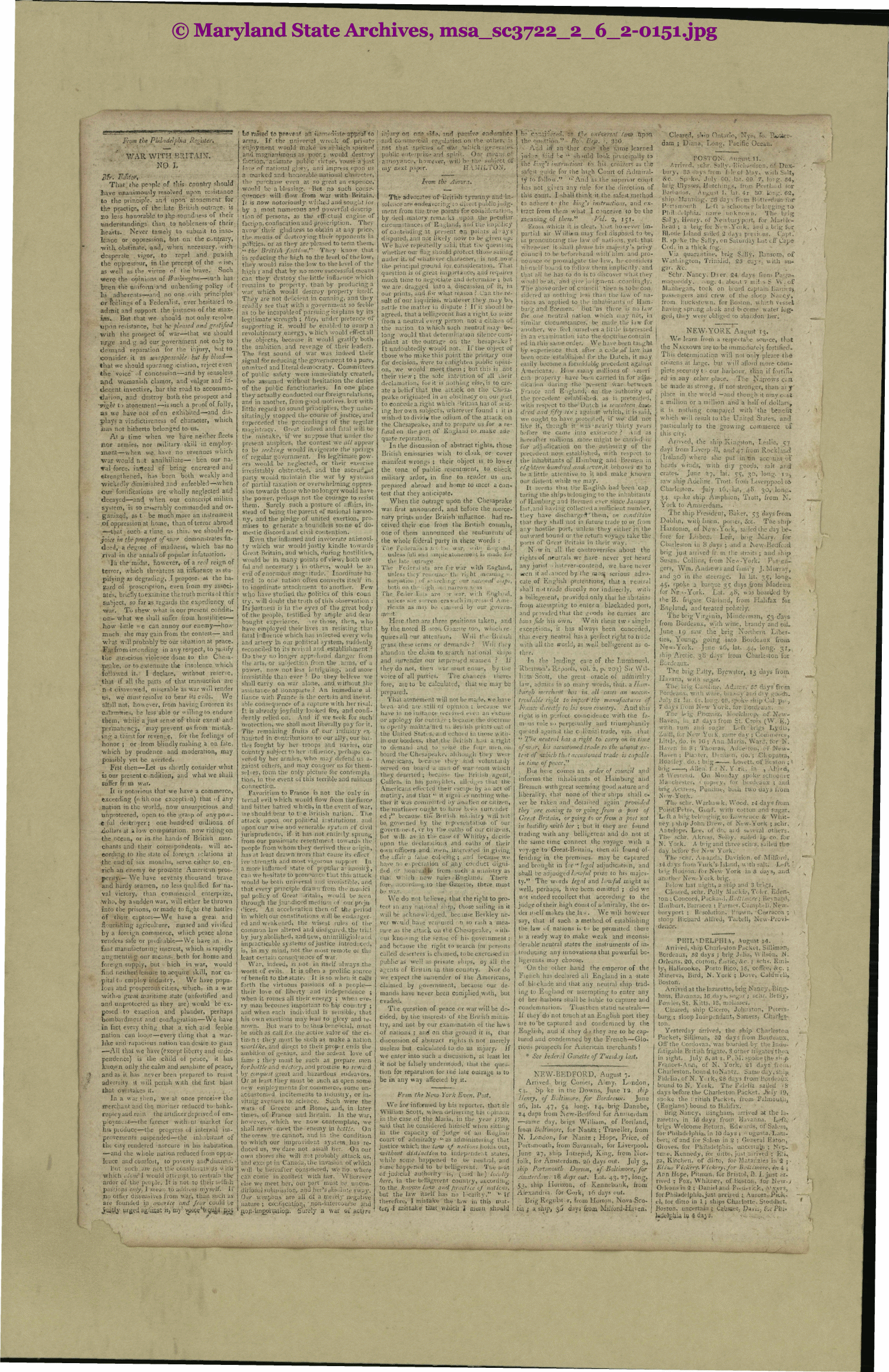
Federal Gazette & Baltimore Daily Advertiser 1807/07-1807/12 msa_sc3722_2_6_2-0151 Enlarge and print image (5M) |
|
|
|
|
|
|
|
|||
|
||||
|
||||
|
Federal Gazette & Baltimore Daily Advertiser 1807/07-1807/12 msa_sc3722_2_6_2-0151 Enlarge and print image (5M) |
|
¦i, u,""<\±m ,%nmtmt
From the Philadelphia Register.
V/AR WITH BXITAIN.-
NO I.
Jlfr. FJttoA
That, the people of this country should
i)aye upanimoosly resbTved upon resistance
to the principle. and upon atonement for
the practice, of the late British outrage is
jio less honorable to the soundness of their
understandings than to noblenessof their
hearts- Never tamely to submit to inso-
lence or oppression, but on the contrary,
•with obstinate, and, when necessary, vith
desperate . vigor, to repel and punish
the oppressor, in the precept of the " ise,
as well as the virtue of the brave. Such
were the opinions of Washington—su~h has
been the uniform and unbending policy f
hi adherents—and no one with principles
or fcelinos of a Federalist, ever hesitated to
admit and support the justness of the max-
im. But that we should not only resolve
Upon resistance, but be pleased and gratified
with the prospect of war—that we should
urge and g ad our government not only to
demand reparation for the injury, but to
consider it as unappeasable but by blood—
that we should spurnneg.ictatiori, reject even
the voice' of concession—and by senseless
and womanish clamor, and vulgar and ra-
nt invective, bar the road to accommo-
dation, and destroy both the prospect and
-right t i atonement—is such a proof of folly,
as we have not of en exhibited—and dis-
plays a vindictiveness of character, which
has not hitherto belonged to-us.
At a time when we have neither fleets
nor armies, nor military skill in employ,
merit—when we have no revenues which
war would n..t annihiliate— hen our na-
val force, innead cf being encrea'ed and
strengthened, has been both weakly and
¦wickedly diminished and enfeebled—-when
Cut fortifications are wholly neglected and
decayed—and when our conscript militia
system, is so ii»»erably commanded and or-
ganized, as t be much.more an instrument
of oppression at home, than of terror abroad
—that such a time as this, we should re.
jo'tce in the prmpect of-war demonstrates in-
deed,' a degree of madness, which has no
rival in the annals of popular infatuation.
lit the midst, however, of a redt reign of
terror, which threatens an influence as stu-
pifying as degrading, 1 propose- at the ha-
zard of proscription, even from my associ-
ates, briefly toexa'mine the truth merits of this
subject, so far as regards the expediency of
war. To shew what is our present conditi-
on- what we shall suffer from hostilities—
how little ^e can annoy our enemy—how
much she may gain from the contest— and
¦what will probably be our situation at peace.
Fathom intending in any respect, to ju itify
the atrocious violence done to the Chesa-
e, or to extenuate the insolence, which
followed it.' I declare, without reserve,
that if all the parts of that transaction arc
n 't disavowed, miserable as war will render
us, we' Must resolve to bear its evils. We
shall net, however, from having foreseen its
Calamities, be less able or willing to endure
them, while a just sense of their exeat and
permanency, may prevent us from mistak-
ing a thirst for revenge, for the feelings of
honor; or horn blindly rushing a on fate,
which by prudence and moderation, may
possibly vet be averted.
Frst then—Let us shi rtly consider what
is our present condition, and what we shall
Suffer rr< m war.
It is notorious that we have a commerce,
exceeding (withone exception) that of any
nation in the world, now unsuspicious and
unprotected, open to the grasp of any pow-
e fu.1 destroyers one hundred millions of
dollars at alow computation nowridingon
the ocean, or in the hands of British mer-
chants and their correspondents, will ac-
cording to the state of foreign iclations at
the end of six months, serve, either to en-
rich an enemy or promote American pros-
perity.—We have seventy thousand brave
and hardy seamen, no less qualified for na-
val victory, than commercial enterprise,
¦who, by a sudden war, will either be thrown
into the prisons, or made to fight the battles
of their captors—We have a great and
flourishing agriculture, nursed and vivified
by a foreign commerce, which peace alone
renders safe or profitable—We have an in-
fant manufacturing interest, which is vapidly
augmenting our means, both for home and
fore gn supply, but hich in war, would
hud neither!leisure to acquire skill, nor ca-
pital to employ industry. We have popu-
lous and p'osperouscities, which, in a war
wither great maritime state (unfortified and
and unprotected as they are) would be ex-
posed to exaction and plunder, perhaps
bombardment and conflagration—We have
in fact every thin^ that a, rich and feeble
nation can loose—every thing that a war-
like and rapacious nation can desire to gain
—Alt that we have (except liberty and inde-
pendence) is the child ot peace, it has
hno.vvn only the calm and sunshine of peace,
and as it has never been prepared to resist
adversity it will perish with the first blast
that ovi-itakes it.
In a war then, we at once perceive the
merchant and the mariner reduced to bank-
ruptcy aud ruin the artificer deprived of ern-
ploynaeiit—the farmer with ut market for
his produce—the progress of internal im-
provements suspended—the inhabitant of
the city rendered insecure in his habitation
— and the whole nation reduced from oppu-
leuce and comfort, to poverty ancMistress.
but such are not tb'iJ eon: v.. rati' as with
which i,lone 1 would attempt to restrain the
ardor of the people. It is not to thejrselfish
passions onfy} I mean to address myself, If
no other dissuasi'ves from war, than such as
are founded ill avarice an4 _/"-'' could be
juljjj' w:S*rdftg%s: it, my' vp.iceHv^d,jw|
' be raised Id prevent an ifcrrrn dial?- appeal f o
arms. If the universal wreck of private
enjoyment would make us as high spirited
and magnanimous as poor.; would destroy
faction," animate public virtue, rouse a just
love of national glory, and impress npori us
a marked and honorable national character,
the purchase even at so great an expen.ee,
would be a blessing. But no such cor.se-
ei'"uces will (low from war with Britain.
It is now notoriously wished and sought tor
by a most numerous and powerful descrip
tion of persons, as the eff-dual engine of
faction, confiscation and proscription. They
avow their gladness to obtain at any price,
the means of destroying their opponents in
politics, or as they are pleased to term them,
" the British faction.'" They know that
in reducing the high to the level of the low,
they would raise the low to the level of the
high ; and that by no more successful means
can the}' destroy the little influence which
remains to property, than by producing a
var which would destroy property itself.
They are not deficient in cunning, and they
readily see that with a government so feeble
as to be incapable of pdrsuing its plans by its
legitimate strength ; they, under pretence Of
supporting it. would be enabled to usurp a
revolutionary energy, which would effect all
the objects, because it would gratify both
the ambition and revenge of their leaders.
The first sound of war was indeed their
signal for reducing the government to a pure,
unmixed and literal democracy. Committees
of pnblic safety were immediately created,
who assumed without hesitation the duties
of the public functionaries. In one place
they act-.ially conducted our foreign relations,
and in another, from good motives, but with
little regard to sound principles, they unhe-
sitatingly stopped the course of justice, and
superceded the proceedings of the regular
magistracy. Great indeed and fatal will be
the mistake, if we suvpose that under the
present auspices, the contest we all appear
to be seeking would invigorate the springs
of regular government. IVs legitimate pow.
ers would be neglected, or their exercise
irresistably obstructed, and the ascendant
party would maintain the war l.y systems
of partial taxation or overwhelming oppres-
sion towards those who no longer would have
the power, perhaps not the courage to resist
them. Surely such a posture of affairs, in-
stead of being the parent of national harmo-
ny, and the pledge of united exertion, pro.
mises to generate a boundless scene ©f do-
mestic discord and civil contention.
Even the inflamed aud inveterate animosi-
ty which war would justly kindle tow.nds
Great Britain, and which, during hostilities,
would be in many points of view, both use
ful and necessary ; in others, would he an
evil of enormous magnitude.' Inordinate ha
tred to one nation often converts itself in-
to inordinate attachment to another. Few
who have studied the politics of this coun
try, will doubt the troth of thi's observation :
Its justness is hi the eyes of the great body
of the people, testified by ample and dear
bought experience. ¦ re those, then, who
have employed their lives in resisting that
fatal influence which has injected every vein
and artery in our political system, suddenly
reconciled to its revival and establishment ?
Do they no longer apprehend danger from
tfie arts, or subjection horn the anus, of a
power, now not lesis ii.trij.uing, and more
irresistible than ever ? Do they believe we
shall carry on war alone, and without the
assistance of t-.onapatte ? An immediate al
liance with France is the certain and inevit-
able consequence of a rupture with her rival.
It is already joyfully looked for, and confi-
dently relied on. And if we Seek for such
protection, we shall most liberally pay for it.
The remaining fruits cf our industry ex.
hausted in cbntributions to our ally, our bat-
tles fought by her troops aud navies, oar
country subject to her influence, perhaps co-
vered by her armies, who may defend us a-
jrainst others, and may conquer us ibi them-
selves, form the only picture for confempla
tion, in ttie event of this terrible and ruinous
connection.
Favoritism to France is not the only in
ternal evil which would flow from the fierce
and bitter hatred which, in the event of war,
up should bear to tie British nation. The
attack upon our political institutions and
upon our wise and venerable system of civil
jurisprudence, if it has not. entirely sprung
from our passionate resentment towards the
people from whom they derived then origin,
has at least drawn from that cause its effect
ive strength and most vigorous support In
a more inflamed state of p< pulaia- iuiosiiy,
caa we hesitate to pronounce that this attack
would be botli universal ! d irresistible, ami
that every principle drawn from the munici
pal policy of Great .ritain, would be seen
through the jaundiced medium of out prvjn
('ices. An acceleration then of the period
in which our constitutions will be endanger-
ed and weakened, the wisest rules of the
common law altered aud disfigured, the trial
by jury abolished, and new, unintilligibl a d
impiacticable systems of justice introduced,
is, in my mind, not the most remote oi tie.
least certain consequence of war.
War, indeed, is not in itself always the
worst of evils. It is often a prolific source
of benefit to the state. It is so when it. calls
forth the virtuous passions of a people—
their love of liberty and independence ;
when it rouses all their energy ; when eve-
ry man becomes important to his com,try ;
and when each individual is sensible, that
his own exertions may lead to glory and re-
nown, ljut wars to be thus beneficial, must
be such as call for the active,valor of the ci-
tizen ; they must be such as make a nation
•warlike, and direct to their proper ends the
ambition of genius, and the ardent love of
fame ; they must be such as prepare men
for battle and victory^ and promise »o rewind
by conqwst great and hazardous endeavors.
Or at least they must be such as open some
new employments for commerce, some un-
accustomed incitements to industry, or in-
viting avenues to. science. Such were the
wars of Greece and Rome, and, in later
times, of France and Britain. In the war,
however, which we now contemplate, we
shall never meet the enemy in battle. On
the ocean we cannot, and in the condition
to which our improvident system has re-
duced us, we dare not assail her. On Our
own shores she will not probably attack us,
and exc; pt in Canada, the invasion of which
will be hereafter considered, vVe no where
can come in contest with her. Wherever
else we meet her, our part must be uncon-
ditional submission, and her's abs-lute sway.
Our weapons are all ot a merely negative
nature ; confiscation, .non-intercourse and
Aorj-im£oVtation. Surely 3 war w aciavs
ihjary'-wj one s?8e,'andl p*$srw endurance
nnd commercial regulation on the other, is
not th.it species of war ' eraies
public -enterprise; and spirit. Otlr means.of
aonoyeuc., h r.ye.er. wit; be the subject of
my next piper. HAMii-TON.
I'rom the Aurora.
The advocates of British tyranny and in-
solence are endeavoring to od.e.t p ,'¦•].
ment from tire true points for consideration,
by deel matory remarks upon the peculiar
circumstance^ of England, -v^t the i
ot'cotending at present on paints a! ays
disputed, ami not likely now to be given up.
We have repeatedly said; that tin.' questi .11,
whether our hag should protect those sailing
under it, of whatever character, is not now
the principal ground for. consideration. That
question is of great importance, and requires
much time to uegdeiate and determine ; but
we are dragged into a discission of it, in
our prints, and fin- what reason I LJan the re-
sult of our inquiries, Whatever they may be,
settle the matter in dispute J If it should be
agreed, that a belligerent has a right to seize
i'rom a neutral every person not a citizen of
the nation to which such neutral may be-
long would that determination silence com-
plaint at the outrage on the hesapeake ?
It undoubtedly would not. If the object of
those who make this point the primary one
for decision, were to enlighten public opini-
on, we would meet tiietn ; but "this is not
their view ; the sole intention of all their
declamation, for it is nothing else, is to cre-
ate a belief that the attack on the Chesa-
peake originated in an obstinacy on our port
to concede a right which tritaiii has of seiz-
ing her own subjects, wherever found : it is
wished todivid* the odium of the attack on
the Chesapeake, and to prepare us for a re-
fusal on the part of England to make title
quate reparation.
In the discussion of abstract rights, those
British emissaries wish to cloak or cover
manifest wrongs ; their object is to lower
the tone of public resentment, to check
military ardor, in fine to render us un-
prepared abroad and h"me to meet a con-
test that they anticipate.
When the outrage upon the Chesapeake
was first announced, and before the merce-'
nary prints under British influence- had re-
ceived their cue from the British consuls,
one of them announced the sentiments of
the whole federal party in these words :
I'ne Federalists ai '- >, w u- witii feny aid.
unless ull nnd impJeatonenwiH, is made for
tie- led.- utnge
The Federufrts are fir war vith Eafrtand,
unless tticy inn inir th rijrht .meaning n
sulfation j of > Arching our nfttimnii aiiipn,
both on th igh >; . rial row t as
The Fe.ler 1. ...-, are u- war, with Rngliuid,
unless she surren erssuch impress' d Ame-
ricans as max be claimed by our govern-
.it it
Heie then are three positions taken, and
by the noted B ston Gazette too, which re-
quiies all our attention, Will the British
grant these itrms or demand* ? Will they
abandon the claim to.search national
and surrender our impressed seamen ? If
they do not, then ivar must ensue, by the
voice of all parties. Tiie chances there-
fore, aie to be calculated, that we may be
prepared.
That atonement will not be ma !e, we have
been and are -till ni opinion; because we
have in no instance received even an excuse
or apology for out: 1 >r ; because the doctrine
is openly malntanid 111 British print* out of
the United Stat' s, and achoi d in tiijose vvitn-
in our borders, that the Ibilish had a tight
to demand and to seize the four men on
board tile Chesapeake, although they weie
zVme-icans, because they hid voluntarily
served on board » man of war »rom winch
they deserted ; because the British agent,
Cullen, in hia pamphlet, alledges mat the
Americans eriv, ted their escape by an act of
mutiny, and that " it signi ,-s nothing whe-
ther it was Committed by an-,dien or citizen,
the mutineer ought to have bei-.i surrender
ed ;" because the British ministry will not
be governed by tile n piesentatioii of our
government, er by the oaths of our citizens,
but will, as in the case of Whitby, decide
upon the declarations and oaths of their
own officers and men, interested in giving
the affair a false col ning ; anl because we
have no expectation of any conduct digni-
fied ¦ " one table from such a ministry as
thai W i h now ruies England; There
fore, ¦ rdn g 10 the Gazette, there must
I. ¦ '.¦, ¦.
We do not believe, that the right topro-
tecl hi any ational isbtpi those sailing in it
will be acknowledged, bee.irise Berkley ne-
ver would have, ventured b so rash a mea-
sure as the attack on the" Chesapeake, *ith-
oul kno ¦ -ing the sense of hi^ government:
and because the right to search lor persons
called deserters is claimed, tobeexercised in
public as well as private ships, oy all the
a nts . I Britain in this countiy. ISor do
we expect, the surrender of the Americans,
claimed by government, because our de-
mands have never been complied with, but
evaded.
The question of peace or war will be de-
cided, by the interests of the British minis-
try, and not by our examination of the laws
of nations ; and on this ground it is, that
discussion of abstract rights is not merely
useless but calculated to do us injury. If
we enter into such a discussion, at least let
it not be falsely understood, that the ques-
tion for reparation for tlie late outrage is to
be in any way affected by it.
Vravi the New York Even. Post.
We are informed by his reporter, that sir
William Scott, when delivering his opinion
in the case of the Maria, in the year i79!>,
said that he considered himself when sitting
in the capacity of judge of an English
court of admiralty " as administering that
justice which the law of nations holds out,
without distinction to independent states,
while some happened to tie neutral, and
some happened to be belligerent. The seat
of judicial authority is, (said he) i
here, in the belligerent country, according
to the known law and practice of indicia,
but the law itself has ho l-calily." "If
therefore, I mistake the law in this mat-
ter,-I mistake thai, which I mean should
t,.. r-..::.:,,-..,;?. 51 f%e uni'versnl iato tcpon
t!i"'o'flifi!i," F.0-- F:.-p. r. 330
And in an >ther cas'ft the Same learned
jud e ?;iid !:e " should look principally to
the E'tng'i instructions in his crnizers as toe
for the high Court of Admiral-
illdw." "'And as the superior court
has not given any rule for the direction of
this court. I shall thinkit the safest .method
to adhere t - the hug's instructions, and ex-
tract from them what I cmceive to be the
meaning of them." Vol. 2, 151.
1 which it is clear, that however im-
partial sir William may feel disposed to be,
in pronouncing tlie law of nations, yet. that
whenever it shall please his majesty's privy
council to be beforehand wirli him and pro-
nounce or promulgate- the law, he considers
hins< If bound io follow them implicitly, and
that all lie has to do is to discover what they
leat, and give judgment ccorliogl,-.
sveorder of council then is tube con
sidered as nothing less than the law of na-
tions as applied to tin- inhabitants of Ham-
burg and I'remen. But as there is no law
for one neutral nation which may not, in
similar circumstances, be made tlie law for
another, we feel ourselves a little ii.teresced j
ill an examination into the doctrine contain |
ed in this sane order. We have been taught
by experience that after a code of law lias
been once established for the Dutch, it may
easily become a formidable precedent againsi
Americans. Mow many millions of >meri
can property have been earned in for adjn-
dica i>.n during the present war between
France and England, on the authority of .
the precedent established, as is pretended,
with respect to the Dutch i» seventeen hwi-
drcd and fifty six ; against which, it is said,
we ought to have protested, if we did not
like it', though if was nearly thirty years
before We came into existence ? And as
hereafter millions more might be carried in
for adjudication on the authority of the
precedent now established, with respect to
the inhabitants of Hamburg and Bremen in
eighteen hundred and iirWJ,it behoves us to
be a little attentive to it and make known
our dissent while we may.
It seems that the English had been cap
turing the ships belonging to the inhabitants
of Hamburg and Bremen ever since January
fast,and having collected a sufficient number,
they have discharged' them, on condition
that- they shall not in future trade to or from
any hostile port, unless they either in the
out ward bound or the return voyagt take the
ports Of Great Britain in their way.
N 'W in all the controversies about the
rights of neutrals we have never yet heard
any jurist . h it?ver-contend, we have never
ieen it"advanced bjf-'the njost serious advo-
cate of English pretentions, that a reirtral
shall not trade directly nor indirectly, with
a biliegerent, provided only that he abstains
from attempting to enter a blockaded port,
and provided that the ijoods he carries are
bona fide his own. With these t\v 1 single
exceptions, it has always been conceded,
thai every neutral has a perfect right to'trade
with all the world, as well belligerent as 0-
th:-r.
In the leading case of the Immanuel,
ll'ly-i(son's Report's, vol, 2, p. :oi) Sli
h in Scott, the great oracle of admiralty
law, admits in so many words, that, a ILnn-
bicc'ih merchant has in all cases an Hi ,
tradable right to import the manufactures of
/'ranee directly to his vain country. And this
right is in perfe.ct coincidence with the fa-
utuis rule S'> perpetually and triumphantly
cjo- ted against the colonial trade, viz. thai
" The neutral has a right to carry on in time
of'war, his accustonn-ci trade to the utmost e.\-
te -i > they are to be cap-
tured and condemned by the French—Glo-
rious prospects for American merchants!
* See bedcral Gazette of Tuesday last.
Cleared, skip Ontario, "Mye, fb. I&^sier-
darn ; Diana, Long, I'acific Ocean.
POSTON', Su?:\>st 11.
Arrived, schr. Sally. Richardson, of Dux-
bury, 3S days from 1 'eet Way, whhSalt,
i\c. Spoke, July CO, ht.e.o'7, long. 34,
brig Ulys-.es, Hutch ngs, from Portlai d (or
Barbados. August 1. lat. 4i SO' king. 62,
shin Manning. S8 days from Rotterdam for
Portsmouth Left a-schooner belonging to
Philadelphia, name unknown, "the trig
Sal y, Henry, of IS'ewburypoit. for e.
head ; a brig for Ntw-Yoik. and a b:ig for
Rhode Island sailed 2 hays previous. Cnpt.'
R. sp he the Sally, on Saturday last efi' Cape
Cod, in a thick fog.
Via quarantine, brig Sally, Ransom, of
Washington, Trinidid, 25 days, v. lib su-
gar. &c.
Schr. Nancy, Dver, 24 days from .'
maqtioddy. . ug. 4, about 7 mil -sS V\ . of
Mahhegan, took on board captain Barries^
passengers and crew of the sloop Nancy,
from buckstown, for Boston, which vessel
having sprung aleak and b( come water log-
ged, they weie obliged to abandon her.
NEW-BEDFORD, August 7.
Arrived, brig Comet, Almy, London,
c.|.. Sp ke in the Downs, June 12, ship
Henry, of Baltimore, for Bordeaux. June
26, lat. 47, 54 long. 14, brig Danube,
24. daps from New-Bedford for Amsterdam
—same day, brigs William, of Portland,
from Baltimore, for Nantz ; Traveller, from
N. London, for Nantz ; Hope, Price, of
Portsmouth, from Savannah, lor Liverpool,
June 27, ship Intrepid, King, from Nor-
folk, for Amsterdam. 26 days out. July 3,
ship Portsmouth Dorsou, if Baltimore, for
Amsterdam, 18 days cut. Lat. 43, 27, long.
53, ship Horizon, of Kennebnnk, from
Alexandria, lor Cotk, 16 days out.
Brig Regulator, from Horton. INova-Sro-
ti,l } a ship, 3a days team, Miiford-Haven.
NEW-YORK August 13.
We learn from a respei tahe source, that
the Narrows are to be immediately fortified.,
This determination will pot only please th£
citizens at large, but will afford more com-
plete security t > our harbour, than if f
ed in any other plate. The Narrows can
be made as strong, if not stronger, than ai y
place in the world —and though it rnav c< st
a million or a million and a half of dollars,
it is nothing compared with the benefit
which will result to the United States, and
particularly to the growing commerce of
this city.
Arnved, the ship Kingston, Leslie, 57
days from Liverp 11, and 47 from Rockland
(Ireland)where she put intfn ace i;;u "5
heads v. i'.icls, with diy goods, salt and
crates. June 27, lat. jj, 30, long. 1 ,,
saw ship Adeline Trott froith Liverppool 16
Charleston. July if>,-iat, 48 30, lour.
34 spoke ship Amphicn, Trott, from N.
York to Amsterdam.
The shij) President, Baker, 53 days from
Dublin, with linen, porter, &C. The ship
Hantonio, of New-Yoik, sailed the day be~
fore for Lisbon. Left, bug Mary, for
Charleston in 8 days ; and a Kew-Becfeid
brig jyst arrived Ir. m the straits; and
Susan, Collins, bom New-York. P
;,ers, Win. Aud.ews and fami'y J. Mu
and 30 in the steerage. In lat. 35, long,,
45, spoke a barque 35 days from Madeira
for Ne ^York. Lat. 48, Jed by
the B. frigate Garland, from Halifax foe
England, and treated politely.
The brig Virginia, Minderman, 5"
from Bordeaux, with wine, brandy and oiL
June (.9 saw the. brig Northern Liber-
ties, Young, going into Bordeaux from
New-York. June 26, lat, 44, long. 31,
slog Arctic, 3b' days hom Charleston for
OCX.
The brig Patty, Brewster, 13 days fioia
Havana, witii suaar.
The brig Caroline, Adams', S? days'from
¦ oods.
-I ps j
7 days from New Void;, far l.oiiaj:;.
>;g Fhceuix, Moolthiop, of New-
Haven, it; IS days from St. Croix (W. K.)
with rum and sugar Left brigs Lydia,
11k, same e - n era ,
Little, do. iw 10 ; Ann.Maria, Ward, for N.
Haven in 8 ; Thomas, AddeHbn, oi New-
Haven ; Planter, Deiiison, 1/0.; Cleopatra,
Itoadley do. i brig -,, ... Lovett. of Be si or, ; ¦
brig
Aliea, f, r N. Y rh, in , Afotd,
-.¦¦-.'tid. On Monday spokescl
Ma eh.--, , 1 ,.p-ey, for bordeaux ; and
brig Actress, Puntine, buih two days from
Ni w-Yor."..
The schr. Wjrliawk, Wood, i4 days from
Poi-nt'Petre, Guad. with cotton and Sugar.
Left a brig belonging to Lawrence & Whit-
ney ; ship John Drew, ot New-York ; schr.
Antelope, Lee, of do, aid several others.
The schr. Akross, Selby, sailed in co. for
N. York. A brigand three schrs. sailed th«
day before for New York.
The schr. Amanda, Davision. of Milfbrd,
i) days from Turk?s-Island, with sab. Left
brig Hudson, for New York in 5 days, and
another New-York brig.
Relow last night, a ship arid 3 brigs.
Cleared, schr. Polly Mackie, Ti-K-r Eden-
ton ; Concord, Packaid, Battiimrc; Reynard ,
Hurlburt, Bai pb< 11, New-
bnryport ; Resole.': ; . ' own, Cinracoa ;
sloop Richard Allied, Ta.bell, New-Provi-
dence.
PHIL'DELPHIA, August 14.
Arrived, ship Charleston Packet, Sillimart,
Bordeaux, S2 days ; brig Julia, V\ ilson, N.
Orleans, 20, cotton, fustic, Sc. ; sens. Emi-
ly, Halbrooke, Porto Rico, 15, coffee, &c. ;
Minerva, Bird, N.York ; Dove, Caldvveli,
Boston.
Arrived at the lazaretto, brig Nat
ham, Uavanna, 16 days, sugar'; schr. Betsy,
Fat ler, St. Kitts, 13, molasses.
Cleared, ship Cicero, Johnston, Peters-
burg ; sloop Indepeadant, Somers, Ci
ton.
Yesterday arrived, the ship Charleston*
Packet, Silliman, 52 days from Bo,;
Off the Cordovan, was board e Inde-
fatigable British frigate, 1? other trigates then
in sight. July 5, at 1, P. M e gfi-jj
FranceS-Awi, of N. York, iil days
Charleston, bound toNantz. Same day, Ship
Fidelia, of N. York, £8 days fvon
bound to N. York. The Fidelia sailed |