 |
|
|
 |
|
 |
|
|||
|
||||
|
||||
|
Federal Gazette & Baltimore Daily Advertiser 1807/07-1807/12 msa_sc3722_2_6_2-0175 Enlarge and print image (5M) |
|
|
|
|
|
|
|
|||
|
||||
|
||||
|
Federal Gazette & Baltimore Daily Advertiser 1807/07-1807/12 msa_sc3722_2_6_2-0175 Enlarge and print image (5M) |
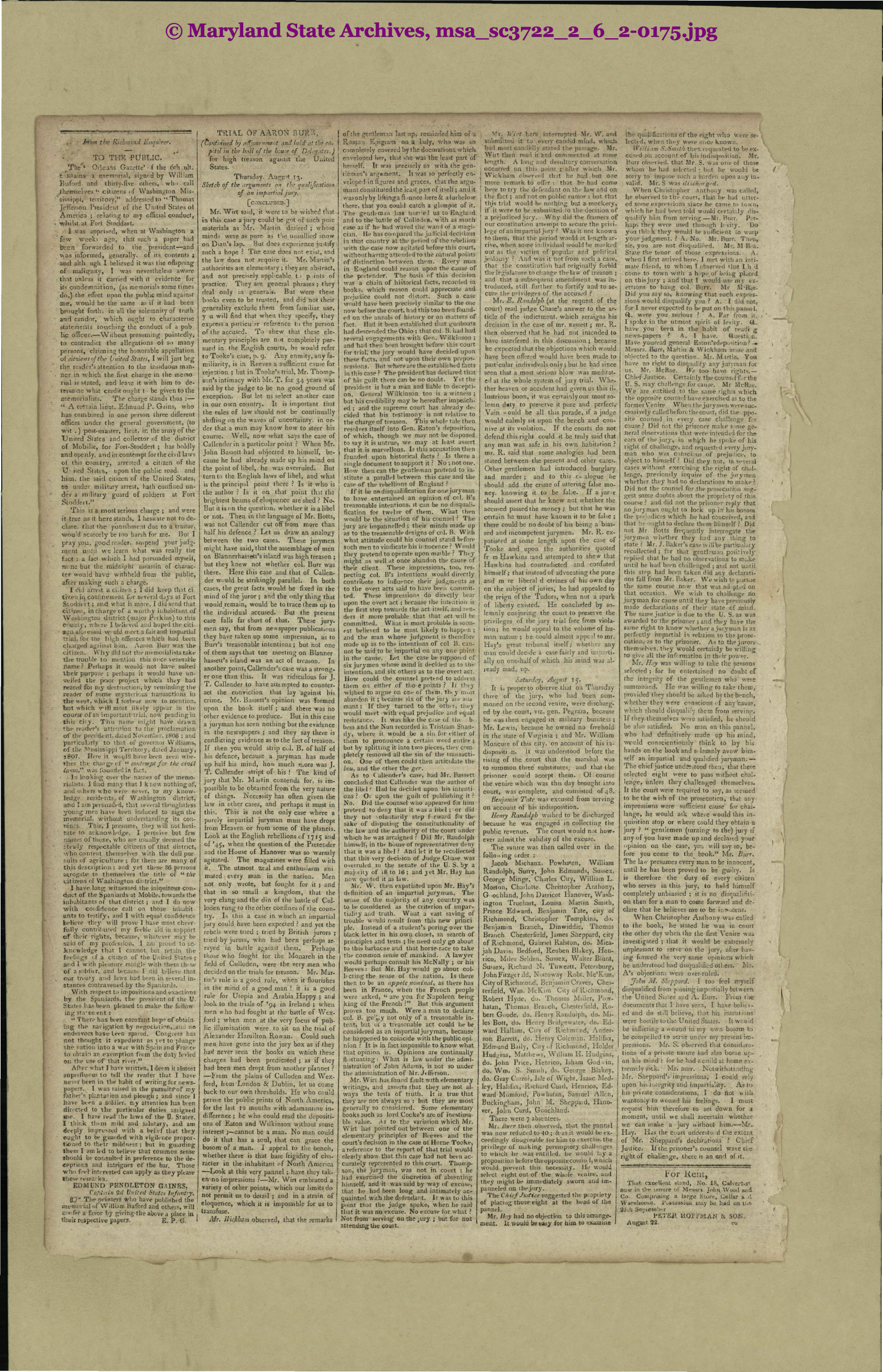
| , MMfW«waM)tl^^tf3V^'H*!»<«.«n*i{ir,' i , ¦ ¦ frr'om the Richmond Enquirer. TO THE PUBLIC. ^The'* Orleans Gazette' "f the 6th ult; fc-Mains a memorial, signed by William Buford and thirty-five others, who call themselves '• citizens of Washington Mis- sissippi, territory," addressed to " Thomas Jefferson President of the United States ot America ; relating to my official conduct, • whilst.at Fort Stoddart. I was apprised, when at Washington a few weeks ago, th.1t such a paper had "' been forwarded to the president—and was informed, generally, of its contents ; and alth ugh I believed it was the offspring of malignity, I was nevertheless aware that unless it carried with it evidence for its condemnation, (as memorials some times do,) the effect upon the public mind against Die, would be the same as if it had been brought forth, in all the solemnity of truth and candor, which ought to characterise statements touching the conduct of a pub lie officer.—Without presuming pointedly, to contradict the allegations ot so many persons, claiming the honorable appellation of citviensof the United States, I will just beg the reader's attention to the insiduous man- • iter in which the first charge in the memo rial is stated, and leave it with him to de- termine what credit ought t • be given to the memorialists. The charge stands thus :— " A certain lieut. Edmund P. Gains, who has combined in one person, three different offices under the general government, (to wit .) post-master, lieut. in the army of the "United States and collector of the district of Mobille, for Fort-Stoddert ; has boldly and openly, and in contempt for the civil laws of this country, arrested a citizen of the U' iled Slates, upon the public road, and him. the said citizen of the United States, So under military arrest, hath confined un- der a military guard of soldiers at Fort Stoddeit." This is a most serious charge ; and were it true as it here stands, I hesitate not to de- clare, that the punishment due to a traitor, wouM scarcely be too harsh for me. But I pray yon, good reader, suspend your judg- ment until we learn what was really the fact : a fact which I hid pursuaded myself, rtl ne but the midnight assassin of charac- ter would have withheld from the public, after making such a charge. I did arrest a citizen ; I did keep that ci tiwnin confinement for several days at Fort Stoddert ; and what is more, I did send that citizen, in charge of a woitliy inhabitant of Washington district (major Perkins) to this count)-, where I believed and hoped the citi. sen (Ujjregaid \\" uld meet a fair and impartial trial, for trie high offences which had been charged against him. Aaron Burr was the citizen. Why did not the memorialists take the trouble to mention this once venerable name? Perhaps it would not have suited their purpose ; perhaps it would ha\e un- veiled the poor project which they had reared for my destruction, by reminding the reader of some mysterious transactions in the west, which I forbear now to mention, but which will most likely appear in the course of an important trial, now pending in this city. This name might have drawn the reader's attention to the proclamation of the president, dated November, 18O6 ; and particularly to that of governor Williams, of the Mississippi Territory, dated January, l807. Here it would have been seen whe- ther the charge of " contempt for the civil Icaios" was founded ir. fact. . In looking over the names of the memo- rialists. I find many that 1 know nothing of, and others who were- never, to my know- . ledge residents of Washington district, and I am persuaded, that several thoughtless young men have been induced to sign the memorial, without understanding its con- rents. This, I presume, they will not hesi- tate to acknowledge. I perceive but few names of those, who are usually deemed the tieady respectable citizens of that district, who content themselves with the dull pur- f.uits of agriculture ; for there are many of this description; and yet these 36 persons airogate to themselves the title of " the citizens of Washington district." 1 have lonr; witnessed the iniquitous con- duct of the Spaniards at Mobile, towards the inhabitants of that district ; and I do now with confidence call on those inhabit ants to testify, and 1 with equal confidence believe they will prove 1 have most cheer- fully contributed my feeble aid in support of their rights, because, whatever may be said of my profession, I ani proud to ac- knowledge that I cannot but retain the feelings of a citizen, of the United States ; arid 1 with pleasure mingle with them those of a soldier, and because 1 did believe that our treaty and laws had been in several in- stances contravened by the Spaniards. With respect to impositions and exactions by the Spaniards, the president of the U. States baa been pleased to make the follow- ing sta'en ent : . »' There has been constant hop" of obtain- ing the navigation by negociation, and no endeavors have Leen spaied. Confess has not thought it expedient as yet to plunge r.he nation into a war with Spain and France to obtain an exemption from the duty levied on the use of that river." After what I have written, I deem it almost superfluous to tell the reader that I have never been in the habit of writing for news- papers. 1 was raised in the pursuits*of my father's plantation and plough ; and since I liave been a soldier, my attention has been directed to the particular duties assigned we. I have read the laws of the TJ. States. I think them mild and salutary, and am deeply impressed with a bel ef that they ought to be guarded with vigilence propor- tioned to their mildness ; but in guarding them I am led to believe that common sense should be consulted in preference to the de- ceptions and intrigues of the bar. Those ¦who feel interested can apply as they please these remarks. EDMUND PENDLETON GAINES, Cafiiain Qd United States Infantry. 87" The printers who have published the memorial of William Uuford and others, will confer a favor by gmng-the above a place in their, respective papers. E. P. G. TRIAL OF AARON BURS, (Continued by adjournment and''heldat the ca- pital in the hall of the house of Delegates.) for high treason against the United States. Thursday, August 13. Shetch of the arguments on the qualijicatiosn of an impartial jury. [concluded.] Mr. Wirt said, it were to be wished that in this case a jury could be got of such pure materials as Mr. Martin desired ; whose minds were as pure as the unsullied snow on Dian's lap. But does experience justify such a hope ? The case does not exist, and the law does not require it. Mr. Martin's authorities are elementary; theyare abstract, and not precisely apphcable t 1 p ints of practice. They are general phrases ; they deal only in generals. But were these books even to be trusted, and did not their generality exclude them from familiar use, y u will find that when they specify, they express a particular reference to the person of the accused. To shew that these ele- mentary principles are not completely pur- sued in the English courts, he would refer to Tooke's case, p. 9. Any enmity, any fa- miliarity, is in Reeves a sufficient cause for rejection ; but in Tooke's trial, Mr. Thomp- son's intimacy with Mr. T. for 34 years was said by the judge to be no good ground of exception. But let us select another case in our own country. It is important that the rules of law should not be continually shifting on the waves of uncertainty, in or- der that a man may know how to steer his course. Well, now what says the case of Callender in a particular point ? When Mr. John Bassett had objected to himself, be- cause he had already made up his mind on the point of libel, he was overruled. But turn to the English laws of libel, and what is the principal point there ? Is it who is the author ? Is it on that point that the brightest beams of eloquence are shed ? No. But it is on the question, whether it is a libel or not. Then in the language of Mr. Botts, was not Callender cut off from more than half his defence ? Let us draw an analogy between the two cases. These jurymen might have said, that the assemblage of men on Blannerhassott's island was high treason ; but they knew not whether col. Burr was there. Here this case and that of Callen- der WL>uld be strikingly parallel. In both cases, the great facts would be fixed in the mind of the juror ; and the only thing that would remain, would be to trace them up to the individual accused. But the present case falls far short of that. These jury- men say, that from newspaper publications they have taken up some impression, as to Burr's treasonable intentions ; but not one of them says that tne meeting on Blanner hassett's island was an act of treason. In another point, Callender's case was a strong- er one than this. It was ridiculous for J. T. Callender to have attempted to counter- act the conviction that lay against his crime. Mr. Bassett's opinion was formed upon the book itself ; and there was no other evidence to produce. But in this case a juryman has seen nothing but the evidence in the newspapers ; and they say there is conflicting evidence as to the fact of treason. If then you would strip col. B. of half of his defence, because a juryman has made up half his mind, how. much rtjore was J. T. Callender stript of his ! The kind of jury that Mr. Martin contends for, is im- possible to be obtained from the very nature of things. Necessity has often given the law in other cases, and perhaps it must in this. This is not the only case where a purely impartial juryman must have dropt from Heaven or horn some of the planets. Look at the English rebellions of 1715 and of '45, when the question of the Pretender and the House of Hanover was so warmly agitated. The magazines were filled with it. The utmost zeal and enthusiasm am mated every man in the nation. Men not only wrote, but fought for it ; and that in so small a kingdom, that the very clang and the din of the battle of Cul- loden rung to the other confines of the coun- try. Is this a case in which an impartial jury could have been expected ? and yet the rebels were tried ; tried by British jurors ; tried by jurors, who had been perhaps ar- rayed in battle against them. Perhaps those who fought for the Monarch in the field of Culloden, were the very men who decided on the trials for treason. Mr. Mar- tin's rule is a good rule, when it flourishes in the mind of a good man ! it is a good rule for Utopia and Arabia Happy ; and look to the trials of '94 in Ireland ; when men » ho had fought at the battle of Wex- ford ; when men at the very focus of pub- lic illumination were to sit on the trial of Alexander Hamilton Rowan. Could such men have gone into the jury box as if they has! never seen the books on which these charges had been predicated ; as if they had been men dropt from another plannet ? —lrom the plains of Culloden and Wex- ford, horn London & Dublin, let us come back to cur own thresholds. He who could peruse the public prints of North America, for the last is months with adamantine in- difference; he who could read the depositi- ons of Eaton and Wilkinson without some interest ;--cannot be a man. No man could do it that has a soul, that can grace the bosom of a man. I appeal to the bench, whether there is that base frigidity of cha- racter in the inhabitant of North America —Look at this very pannel ; have they tak- en-no impressions ?—Mr. Wirt embraced a variety of other points, which our limits do not permit us to detail ; and in a strain of eloquence, which it is impossible for us to transfuse. Mr. U'ickham observed, that the remarks of the gentleman last up, reminded him of a Roman Epigram on a lady, who was so completely covered by the docorarions. which enveloped her, that she was the least part of herself. It was precisely so with the gen- tleman's argument. It was so perfectly en- veloped in figures and graces, that the argu- munt constituted the least part of itself; and it wasonlyby liftinga fl aince here& a furbelow- there, that you could catch a glimpse of it. The gentleman has hurried us to England and to the battle of Culloden, with as much ease as if he had waved the wand of a magi- cian. He has compared the judicial decisions in that country at the period of the rebellion with the case now agitated before this court, without having attended to the natural points of distinction between them. Every man in England could reason upon the cause of the pretender. The basis of this decision was a chain of historical facts, recorded in books, which reason could appreciate and prejudice could not distort. Such a case would have been precisely similar to the one now before the court, had this too been found- ed on the annals of history or on matters of fact. Had it been established that gunboats had descended the Ohio ; that col. B. had had several engagements with Gen. Wilkinson ; and had then been brought before this court for trial, the jury would have decided upon these facts, and not upon their own prepos- sessions. But where are the established facts in this case ? The president has declared that of his guilt there can be no doubt. Yet the president is hut a man and liable to decepti- on. General Wilkinson too is a witness ; but his credibility may be hereafter impeach- ed ; and the supreme court has already de- cided that his testimony is not relative to the charge of treason. This whole tale then resolves itself into Gen. Eaton's deposition, of which, though we may not be disposed to say it is untrue, we may at least assert that it is marvellous. Is this accusation then founded upon historical facts ? Is there a single document to support it ? No ; not one. How then can the gentleman pretend to in- stitute a parallel between this case and the case of the rebellions of England ? If it be n» disqualification for one jury man to have entertained an opinion of col. B's treasonable intentions, it can be no disquali- fication for twelve of them. What then would be the situation of his counsel ? The jury are impannellcd ; their minds made up as to the treasonable designs of col. H. With what attitude could his counsel stand before such men to vindicate his innocence ? Would they pretend to operate upon marble ? They might as well at once abandon the cause of their client These impressions, too, res- pecting col. B's intentions would directly contribute to influence their judgments as to the overt acts said to have been commit- ted. These impressions do directly bear upon the overt act ; because the intention is the first step towards the act itself, and ren- ders it more probable that that act will be committed. What is most probable is soon- est believed to be most likely to happen ; and the man whose judgment is therefore made up as to the intentions of col B. can- not be said to be impartial on any one point in the cause. Let the case be supposed of six jurymen whose mind is decided as to the intention, and six others as to the overt act. How could the counsel pretend to address them on either of thoe points? It they wished to argue on one of them- th> y must abandon it ; because six of the jury are aoa mant: If they turned to the other, they would meet with equal prejudice and equal resistance. It was like the case of the b- bess and the Nun recorded in Tristram Shan- dy, where it would be a sin for either of them to pronounce a certain word entire ; but by splitting it into two pitces, they com pletely removed ail the sin of the transacti- on. One of them could then articulate the bou, and the other the ger. As to Callender's case, had Mr. Bassett concludtd that Callender was the author of the libel i Had he decided upon his intenti- ons ? Oi upon the guilt of publishing it ? No. Did the counsel who appeared for him pretend to deny that it was a libel ; or did they not voluntarily step forward for the sake of disputing the constitutionality of the law and the authority of the court under which he was arraigned ? Did Mr. Randolph himself, in tin house of representatives deny that it was a libel ? And let it be lecollected that this very decision of Judge Chase was overruled 111 the senate of the U. S. by a majiiiity of i8 to 16 ; and yet Mr. Hay has now quoted it as law. Mr. W. then expatiated upon Mr. Hay's definition of an impartial juryman. The sense of the majority ot any country was to be considered as the criterion of impar- tiality and truth. What a vast saving of trouble would result from this new princi pie. Instead of a student's poring over the black letter in his own closet, in search of principles and tests ; he need only go about to this barbacue and that horse-race to take the common sense of mankind. A lawyer would perhaps consult his McNally ; or his Reeves : But Mr. Hay would go about col- lecting the sense of the nation. Is there then to be an appete nominal, as there has been in France, when the French people were asked, " are you for Napoleon being king of the French ?" But this argument proves too much. Were a man to declare col. B. gu'Uy not only of a treasonable in- tent, but of a treasonable act could he be considered as an impartial juryman, because lie happened to coincide with the public opi nion ? It is in fact impossible to know what that opinion is. Opinions are continually fluetuating •¦ What is law under the admi- nistration of John Adams, is not so under the administration of Mr. Jefferson. Mr. Wirt has found fault with elementary writings, and asserts that they are not al- ways the tests of truth. It is true that they are not always so : but they are most generally so considered. Some elementary books such as lord Cocke's are of inestiina ble value. As to the variation which Mr. Wirt has pointed out between one of the elementary principles of Reeves and the court's decision in the case of Home Tooke, a reference to the report of that trial would clearly show that this case had not been ac- curately represented to this court. Thomp- son, the juryman, was not in court ; he had. exercised the discretion of absenting himself, and it was said by way of excuse, that he had been long and intimately ac- quainted with the defendant. It was to this point that the judge spoke, when he said that it was no excuse. No excuse for what ? Not from serving on the jury ; but for not attending the court. Vr, U'irt here interrupted Mr. W. and submitted it to every candid mind, which had most candidly stat«d the passage. Mr. Wirt then read it and commented at some length. A long and desultory conversation occurred on this point ; after winch Mr. Wickham observed that he had but one more remark to offer : that he had come here to try the defendant on the law and on the fact ; and not on public rumor : but that this trial would be nothing but a mockery, if it were to be submitted to the decision of a prejudiced jury. Why did the framers of our constitution attempt to secure the privi- lege of an impartial jury ? Was it not known to them, that the period would at length ar- rive, when some individual would he marked out as the victim of popular and political jealousy ? And was it not from such a case, that the constitution had originally forbid the legislature to change the law of treason ; and that a subsequent amendment was in- troduced, still further to fortify and to se- cure the privileges of the accused ? Mr. E. Randolph (at the request of the court) read judjjfl Chase's answer to the ar- ticle of the indictment, which arraigns his decision in the case of mr. Bassett ; rar. R. then observed that he had not intended to have interfered in this discussion ; because he expected that the objections which would have been offered would have been made to part'cular individvals only; but he had since seen that a most serious blow was meditat- ed at the whole system of jury trial. Whe- ther heaven or accident had given us this il- lustrious boon, it was certainly our most so- lemn duty to preserve it pure and perfect; Vain »ould be all this parade, if a judge would calmly sit upon the berch and con- nive at its violation. If the courts do not defend this right could it be truly said that any man was safe in his own habitation ? mr. R. said that some analogies had been stated between the present and other ca.-es. Other gentlemen had introduced burglary and murder ; and to this c« alogue he should add the crime of uttering false mo- ney, knowing it to be false. If a juror should assert that he knew not whether the accused passed the money ; but that he was certain he must have known it to be false ; there could be no doubt of his being a bias- sed and incompetent jurymen. Mr. R. ex- patiated at some length upon the case of Tooke and upon the authorities quoted fr m Hawkins rand attempted to shew that Hawkins had contradicted and confuted himself; that instead of advocating the pure and m re liberal d ctrines of his own day on the subject of juries, he had appealed to the reign of the Tudors, when not a spark of liberty existed. He concluded by so- lemnly conjuring the court to preserve the privileges of the jury trial free from viola- lion; he would appeal to the volume of hu- man nature ; he could almost appeal to mr. Hay's great tribunal itself; whet I 1 any man could decide a case fairly and ii li- ally on one-half of which his ramd was al- ready mad. up. Saturday, August 15. It ia proper to observe that on Thursday three of the jury, who had been sum- moned on the second venire, were discharg- ed by the court, viz. gen. Pegra'm, because he was then engaged in military business; Mr. Lewis, because he owned no freehold in the state of Virginia ; and Mr. William Moncure of this city, on account of his in- dispositi .n. it was understood before the rising of the court that the marshal was to summon three substitutes, and that the prisoner would accept them. Of course the venire which was this day brought into court, was complete, and consisted of 48. Benjamin Tate was excused from serving on account of his indisposition. Henry Randolph wished to be discharged because he was engaged in collecting the public revenue. The court would not how- ever admit the validity of the excuse. The venire was then called over in the folio -ing order : Jacob Michaust. Powhafen, William Randolph, Surry, John Edmunds, Sussex, George Minge, Charles City, William L. Morton, Charlotte. Christopher Anthony, G 'Ochland, John Diiricot Hanover, Wash- ington Truehart, Louisa Martin Smith, Prince Ed*ard, Benjamin Tate, city of Richmond, Christopher Tompkins, do. Benjamin Branch, Dinwiddie, Thomas Branch Chesterfield, James Sheppard, city of Richmond, Gabriel Ralston, do. Mica- jah Davis, Bedford, Reuben Bl.ikey, Hen- rico, Miles Seidell, Sussex, Walter Blunt, Sussex, Richard N. Tliweatt, Petersburg, JohnFitzgtr ild, Nottoway Robt. Mc'Kim, City of Richmond, Benjamin Craves, Ches- terfield, Win. Mcrvim City of Richmond, Robert Hyde, do. Thomas Miller, Pow- hatan, Thomas Branch, Chesterfield, Ro- bert Gnode, do. Henry Randolph, do. Mi- les Bott, do. Henry Bridgewater, do. Ed- ward Hallam, City of Richmond, Ander- son Barrett, do. Henry Coleman, Halifax, Edmund Baily, City of Richmond, Holder Htiduius, Matthews, William H. Hudgins, do. John Price, Henrico, Isham God > in, do. Wm. S. Smith, do. George Blakey, do. Gray Carrol, Isle of Wight, Isaac Med- ley, Halifax, Richaid Cuid, Henrico, Ed- ward Mumioid, Powhatan, Samuel Allen, Buckingham, John M. Sheppaid, Hano- ver, John Curd, Goochland. There were 7 absentees. Mr. Burr then observed, that the pannel was now reduced to 40 ; &as it would be ex- ceedingly disagreable tor him to exercise, the privilege of making peremptory challenges to which he was entitled, lie would lay a proposition befoietheoppositecoims-. 1, which j would prevent this necessity. He would select eight out of the whole venire, and they might he immediately sworn and im- panneled on the jury. The Chief Justice suggested the propriety of placing those eight at the head of the pannel. Mr. Bay had no objection to this- arrange- ment. It would be easy for him to examine the qualifications of the eight who were se- lected, when they were once known. William S. Smith then requested to be ex- cused on account of his indisqosiuon. Mr. Burr observed, that Mr. S. was one of those whom he had selected ; but he would be sorry to impose such a burdeii upon any in. valid. Mr. S was discharged. When Christopher Anthony was called, he observed to the courr, that he had utter- ed some expressions siace he came to town, which he had been told would certainly dis- qualify him from serving.— Mr. Bfirr. Per- haps they were used through levity. Do you think they would be sufficient to warp your judgment. ? A. No. Mr. Burr. Then, sir, you are not disqualified. Mr. M Bea. State the tenor of those expressions. A. when I first arrived here, I met with an inti- mate friend, to whom I observed that I h d come to town with a hope_ of being placed on this jury ; and that I would use my ex- ertions to hang col. Burr. Mr M'Rae. Did you say so, knowing that such expres- sions would disqualify you ? A. I did not, for I never expected to be put on this paiim I, ft. were you serious I A. Far from it, I spoke in the utmost spirit of levity, ft. have you been in the habit of veadi g news-papers 1 have. Question. Have youread general Eaton'sdeposition? -» Messrs. Burr, Martin & Wickham arose and objected to the question. Mr. Martin. You have no right to disqualify any juryman for us. Mr. McRae. We too have rights.— Chief Justice. Certainly the CMtnseffor the U. S. may challenge for cause. Mr McRae. We are. entitled to the same rights which the opposite counsel have exercised as to the former Venire When the j urymeii were suc- cessively called befortthecourt, did the ppo- site counsel in every case challenge for cause? Did not the prisoner make some ge- nera! observations that were intended for the ears of the jury, in which he spoke of his right of challenge, and requested every jury- man who was conscious of prejudice, to object to himself? Did they not, in several cases without exercising the right of chal- lenge, previously inquire of the jurymen, wdiether they had no declarations to make ? Did not the counsel for the prosecution sug- gest some doubts about the propriety of this course ? and did not the prisoner reply that no juryman ought to lock up in- his bosom the prejudices which he had conceived, ani that he ought to declare them himself ? Did not Mr Botts frequently interrogate the jurymen whether they had any thing to state ? Mr. J. Baker's case w ill be particulary recollected ; for that gentleman positively- replied that he had no observations to make until he had been challenged ; and not until this step had been taken did any declarati- ons fall from Mr. Baker. Wre wish to pursue the same course now that was ad pted on that occasion. We wish to challenge no juryman for cause until they have previously made declarations of their state of mind. The same justice is due to the U. S. as was awarded to the prisoner ; and they have the same right to know whether a juryman is as perfectly impartial f-i relation to "the prose- cution, as to the prisoner. As to the jurors themselves, they would certainly be willing to give all the information in their power. Mr. Hay was willing to take the persons selected ; for he entertained no doubt of the integrity of the gentlemen who' were summoned. He was willing to take them, provided they should be asked by the bench, whether they were conscious of any cause, which should disqualify them from serving. If they themselves weie satisfied, he should be also satisfied. No man on this pannel, who had definitively made up his mind, would conscientiously think to lay his hands on the book and solemnly avow him- self an impartial and qualified juryman; — The chief justice understood then, that these selected eight were to pass without chal- lenge, unless they challenged themselves. It the court were required to say, as seemed to be the wish of the prosecution, that any impressions were sufficient cause for chal- lange, he would ask where would this in- quisition stop or where could they obtain a jury ? " gentlemen (turning to the) jury if any of you have made up and declared your "pinion on the case, you will say so, be- fore you come to the book." Mr. Burr. The law presumes every man to be innocent,, until he has been proved to be guilty. It is therefore the duty of every citizen who serves in this jury, to held himself completely unbiassed ; it is no disqualinti- on then for a man to come forward and de- clare that he believes me to be innocent. When Christopher Anthony was called to the book, he stated he was in court the other day when the the first Venire was investigated ; that it would be extremely unpleasant to serve-on the jury, after hav- ing formed the very same opinions which he understood had disqualified others. Mr. A's objections were over-rultd. John M. Sheppard. I too feel myself disqualified from passing impartially between the United Stales and A. Burr. From the documents that I have seen, I have bel it li- ed and do still believe, that his rhtentiotw were hostile to the United States. It w aid be inflicting a wound in my own bosom to be compelled to serve under nry present im- pressions. Mr. S. observed that considera- tions of a private naiure tad also borne no- on his mind : lor he had a'cnild at home ex- tremely sick. Mr. Burr. Notwithstanding Mr. Sheppard's impressions, I could rely upon his iu-tegrity and impartiality. As to his private considerations, I do not wish wantonly to wound his feelings. I must request him therefore to set down for a moment, until we shall ascertain whether we can make a jury without him.—Mr. Hay. Has the court understood the extent of Mr. Sheppard's declarations ? Chief Justice. If the. prisoner's counsel wave the- right of challenge, there is an and of it. For Kent, That excellent stand, No. 18, Calvert.st now in the tenure of Mes-nrs. John Wood mid Co. Comprising- a large Store,' Cellar n .d Wavehou.su. i'ussissiun may be had en tlis- 25lIi September PSTE&. HOFFMAN & SON. August 22- eo |