 |
|
|
 |
|
 |
|
|||
|
||||
|
||||
|
Federal Gazette & Baltimore Daily Advertiser 1807/07-1807/12 msa_sc3722_2_6_2-0190 Enlarge and print image (5M) |
|
|
|
|
|
|
|
|||
|
||||
|
||||
|
Federal Gazette & Baltimore Daily Advertiser 1807/07-1807/12 msa_sc3722_2_6_2-0190 Enlarge and print image (5M) |
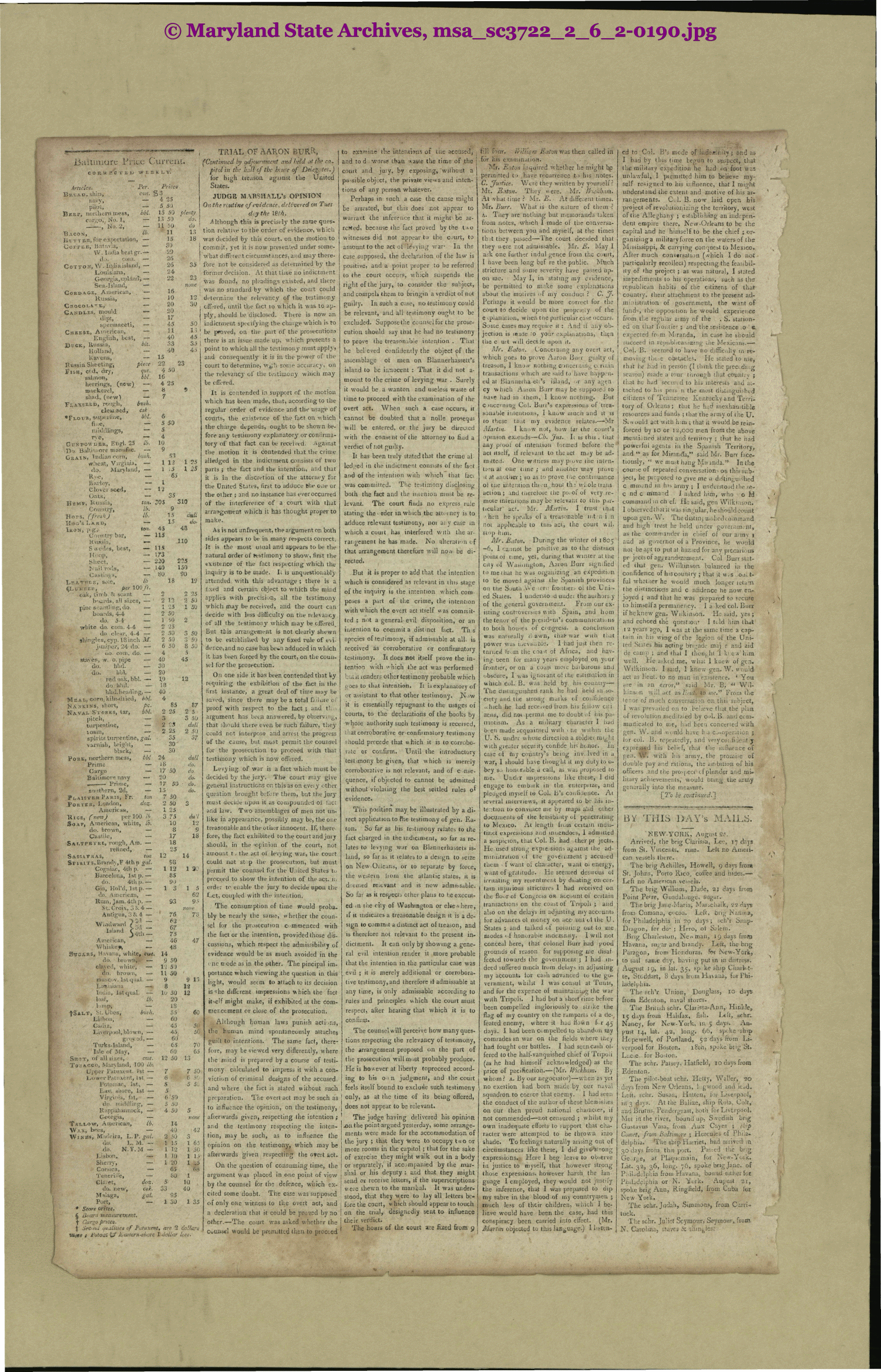
| Jiaitimare Price Current. C O E. H » C T Ii 1J W E B K 1. Y. " Per. bbl. lb. bit. bush, csk bbl. lb. bash. ton- lb. lb. ton, Articles. Bread, shin, navy, pilot, Beef, northern mess, CiJ'^o, No. 1, --------, No. 2, Bacon, Butted for exportation, — Coffee, Batavia^ — W. India best gi'--— d /. coin. — Cotton, \V. Irali a island, — Louisiana, — Georgia, upland — Sea-Island, — Cordage, American, — Russia, — Ckocoi.a ¦ e, — Candles, mould — dipt, _ — spermaceti, — Cheese, American, ish, best, Duck, Russia, Holland, Karens, Russia Sheeting, tii%, ctd, dry, salmon, herrings, (new) mackerel, shad, (new) Flaxseed, rough, clew sed, •Flour, superfine, fine, middlings, rye, Gunpov deu, Efigl. 25 Bo. Baltiurore mamilae. Grain, Indian corn; wheat, Virginia; — do. Maryland, — Rye, barley, ' Clover seed, Hemp, Russia, Country, Hors, ffresh J !Ii)i,'s I.ARD, Ikon, pie; Country bar, ltll.<.-i: . p ,vdoes, host, HiOQp, iShecl. I ..ii rods, Castings -, Lr.attic.a, sole, ^,L.vrEn, per 100,/i. oak, liir-b. & scant — boards, all sizes, — pjne scantling-, do. — boards, 4-4 — do. 5-4 white do. com. 4-4 do clear, 4-4 — shingles, cyp. 13inch M. juniper; 24 do. — no. com. do. — staves, w. o. pipe — do. hlid. — do. bbl. red oak, bbl. •— do hhd. _ — hhd.heading, — Meal, corn, kiln-ihied, bbl. Nankins, short, pC. Naval S'tores, tar, bbl. pitch, — turpentine, — losin, — spirits turpentine, gal. varnish, bright, — black, Fork, northern mess, Prime Cargo Baltimore navy a---------Prime, southern, 2d, Pi.aister Paris, Fr. Pokier, London, American, Bice, fneioj pel-100 Ih Soap, American, white, lb. do. brown, — Castile, — Saltpetre, rough, Am. — refined, — Sass,\fii.as, fcwi Sfibits. Brandy,F 4th p gal. Cogniac, 4th p. — Barcelona, 1st p. — do. 4th p. — Gin, Hol'd, 1st p. — do. American, — Ruin, Jam.4th p, — St. Croix, 3 is. 4— Antigua, 3 &4 — • 2d — Prices cwt. g3 — 4 25 5 5!) 15 50 13 50 11 50 11 15 30 29 26 2'."> 24 22 16 10 20 20 17 45 11 40 33 40 plenty do. do 13 18 35 23 none 12 30 50 ' i;I 45 35 I 4. — 15 piece 22 tut. 4 50 bbl. 16 __ 4 25 _ 8 — 7 — 5 50 6 5 5 4 10 9 1 i 51 12 — 65 I 12 305 510 9 15 15 45 115 115 173 220 140 80 It: 71 25 50 50 — 2 25 — 2 50 50 50 bbl ton doz. 2 6 4 40 30 20 10 18 40 4 85 2 25 3 2 25 2 25 si- so- so 24 j8 17 50 20 17 15 7 2 dull do. 43 110 235 150 90 19 2 25 2 50 1 50 2 3 SO 3 50 8 50 5 45 53 12 87 2 5 3 50 dull 2 50 dull do. do do. do. do. 12 1 50 50 25 75 10 8 17 18 25 98 12 85 90 i/uV 12 9 18 14 1 Windward Island .3d — 4th — 76 62 67 75 46 48 62 95 47 IS American, — Whiskey — Sugars, Havana, white, cut. do. brown, — clayed, white', — do. brown, — rtuscov. lstqual. — 9 9 Louisiana — 8 12 India, lstqual. — lo 50 12 loaf, lb. Lump} — fSalt, St. Ubes, bush. Lisbon, — Cadiz, — Liverpool, blown, — ground, — Turks-Island, — Isle of May, — Shcst, of all siy.es, «uf. Tobacco, Mankind, 100 lb: Upper JPatuxent, 1st — 7 7 Lower Patuxent, 1st — 6 Potomac, 1st, — Last shore, 1st — Virginia, tat, — do middling, — Rappahannock, — Georgia, — Tallow, American, lb. Wax, bees, — WinBS, Madeira, L.P. gal. Cm: L. M. — do. N.Y. M — Lisbon, — Sherry, — Corsica, — Teneri.le, — Claret, doz. do. new, csi. Malaga, gal. Port, — • Store Urices. § Board measurement. f Cargo prices. J Second qualities of Patuxent, air 2 dollars vijts i l'otoas f iitutem-rhore 1 dollar less. 14 9 50 V> 50 11 50 9 8 10 50 20 18 55 60 45 45 60 65 60 12 50 SO 50 50 U 40 50 15 12 10 20 65 80 1 51 5 none 42 65 50 1.7 ,5 68 5 33 95 30 1 1 I 1 1 1U 40 1 3< TRIAL OF AARON BURR, (Continued by adjournment and held at the ca- pital in the kill of the hwe of Dete^cfrs.) for high treason against the United States. JUDGE MARSHALL'S OPINION On the routine of evidence, delivered on Tues day the \eih. Although this is precisely the same ques- tion relative to the order of evidence, which was decided by this court, on the motion to commit, yet it is now presented under some- what different circumstances, and may there- fore not be considered as determined by the former decision. At that time no indictment was found, no pleadings existed, and there was no standard by which the court could determine the relevancy of the testimony ofivred, until the fact to which it was to ap- ply, should be disclosed. There is now an indictment specifying the charge which is to be proved, on the part of the prosecution) there is an issue made up, which presents a point to which all the testimony must apply j and consequently it is in the power of the court to determine, w^jh some accuracy, on the relevancy of the testimony which may be ('fit-red. It is contended in support of the motion which has been made, that, according to the regular order of evidence and the usage of courts, the existence of the fact on which the charge depends, ought to be shown be- fore any testimony explanatory or confirma- tory of that fact can be received. Against toe motion it is contended that the crime alledged in the indictment consists of two parts ; the fact and the intention, and that it is in the discretion of the attorney for the United States, first to adduce the one or the other ; and no instance lias ever occurred of the interference of a court with that arrangement which it has thought proper to make. As is not iinfrequent, the argument on both sides appears to be in many respects correct. It is the most usual and appears to be the natural order of eestimony to show, first the existence of the fact respecting which the inquiry is to be made. Ii is unquestionably attended with this advantage ; there is a fiked and certain object to which the mind applies with precision, all the testimony which may be received, and the court can decide with less difficulty on the relevancy of all the testimony which may be offered. But this arrangement is not clearly shewn to be established by any fixed rule of evi- dence,andno case hasbe«.n adduced in which it has been forced by the court, on the coun- sel for the prosecution. On one side it has been contended that by requiring the exhibition of the fact in the first instance, a great deal of time may he saved, since there may be a total failure of proof with respect to the tact ; and t>. argument has bent answered, by observ, ..,, that should there even be such failure, they could net interpose and arrest the progress of the cause, but must permit the counsel for the prosecution to proceed with that testimony which is now offered. Levying of war is a fact which must be decided by the jury. The court may give general instructions on this as on eveiy other question brought before them, but the jury must decide upon it as compounded oi fact and law. Two assemblages of men not un- like in appearance, possibly may be, the one treasonable and the other innocent. If, there- fore, the fact exhibited to the court and jury should, in the opinion of the court, not amount t, the act of levying war, the court could not stop the prosecution, but must permit the counsel for the United States to proceed to show the intention of the act, n. order to enable the jury to decide upon the f.ct, coupled with the intention, The consumption of time would proba- bly be nearly the same, w hether the coun- sel for the prosecution commenced with the factor the intention, provided those dis- cussions, which respect the admissibility of evidence would be as much avoided in the i nc mode as in the other. The pincipal im- portance which viewing the question in this light, would setm to attach to its decision is "lie different impressions which the fact itself might make, if exhibited at the com- mencement or close of the prosecution. Although human laws punish actions, the human mind spontaneously attaches guilt to intentions. The same fact, there- fore, may be viewed very differently, where the mind is prepared by a course of testi- mony calculated to impress it with a con- viction of criminal designs of the accused and where the fact is stated without such preparation. The overt act may be such as to influence the opinion, on the testimony, afterwards given, respecting the intention ; and the testimony respecting the inten- tion, may be such, as to influence the opinion on the testimony, which may be afterwards given respecting the overt act. On the question of consuming time, the argument was placed in one point of view by the counsel for the defence, which ex- cited some doubt. The case was supposed of only one witness to the overt act, and a decleration that it could be proved by no other.—The court was asked whether the cuunstl would be prermtted then to proceed to examine the intentions of the accused^ and tod •worse than *asie the time of the court and jury, by exposing, without a po sible objsct, the private views and inten- tions of any person whatever. Perhaps in such a case the cause wight be arrested, but this does not appear to warrant the inference that it might be ar- rested, because the fact proved by the t*o witnesses did not appear to the court, to amount to the act of levying war- In the case supposed, the declaration of the law is positive, and a point proper to be referred to the court occurs, which suspends the right of the jury, to consider the subject, and compels them to bnngin a verdict of not guilty. In such a ca.se, no testimony could be relevant, and all testimony ought to be excluded. Suppose the counsel for the prose- cution should say that he had no testimony to prove the treasonable intention . That he believed confidently the object of the assemblage ot men on Blannerhassett's island to be innocent : That it did not a- mouut to the crime of levying war . Surelv it would be a wanton and useless waste ot time to proceed with the examination of the overt act. When such a case occurs, it cannot be doubted that a nolle prosequi will be entered, or the jury be directed with the consent of the attorney to fiud a verdict of not guilty. It has been truly stated that the crime al (edged in the indictment consists of the fact and of the intention with which that fao was committed. The testimony disclosing both the fact and the intenion must be re- levant. The court finds no express rule stating the'-rder in winch the attorney is to adduce relevant testimony, not any case in which a couit has interfered with the ar rat gement he has made. No alteration of that arrangement therefore will no.v be di- rected. But it is proper to add that the intention which is considered as relevant in this stage of the inquiry is the intention which com- poses a part of the crime, the intention with which the overt act itself was commit- ted ; not a general evil disposition, or an intention to commit a dist'ncl fact. Tli s species of testimony, if admissable at all. is received as corroborative or confirmatory testimony. It does not itself prove the in- tention with which the act was performed : ...Lenders other testimony probable which . oes to that intention. It is explanatory of or assistant to that other testimony. Now it is essentially repugnant to the usages of courts, to the declarations of the books by whose authority such testimony is received, that corroborative or confirmatory testimony should precede that which it is to corrobc- ratc or confirm. Until the introductory testimony be given, that which is merely corroborative is not relevant, and of conse- quence, if objected to cannot be admitted without violating the best settled rules ot evidence. This position may be illustrated by a di- rect application to fhe testimony of gen. Ea- ton. So far as his testimony relates to the fact charged in the indictment, so far as re- lates to levying war on Bkmnerhassets is- land, so far as it lelates to a design to seize on New Oi leans, or to separate by force, the western bom the attanlic states, it is deemed re.tvant and is now admissable. So far as it respect., ether plans to l.e execut- ed in tire city of Washington or elsewhere, if it indicates a treasonable design it is a de- sign to commit a distinct act of treason, and is therefore not relevant to the present in- dictment. It can only by showing a gene- ral evil intention render it more probable that the intention in the particular case was evil ; it is merely additional or corrobora- tive testimony, and therefore it admissable at any time, is only admissable according to rules and principles which the court must respect, after hearing that which it is to confirm. The counsel will perceive how many ques- tions respecting the relevancy of testimony, the arrangement proposed cm the part of the prosecution will must probably produce. He is however at liberty toproceed accord- ing to his oan judgment, and the court feels itself bound to exclude such testimony j only, as at the time of its being offered, does not appear to be relevant. The judge having delivered his opinion .on the point argued yesterday, some arrange- ments were made for the accommodation of the jury ; that they Were to occupy two or more rooms in the capitol; that for the sake of exercise they might walk out in a body or separately, if accompanied by the mar- shal or his depity : and that they might send or receive letters, if the superscriptions were shewn to the marshal. It was under- stood, that they were to lay all letters be- fore the court, which should appear to touch on the trial, designedly sent to influence their verdict. The hoars of the court are fued from 9 till four. IVdliani Eaton was then called in for ins examination. Mr. E \ton inquired whether he might he permitted to have recurrence to his notes. C. Justice, Were they written bv yourself? Mr. Eaton. They <•.ere. Mr. lluckkim. At what time ? Mr. E. At different times. Mr. Burr. What is the nature of thein i A. They arc nothing but memoranda taken from notes, which I made of the conversa- tions between you and myself, at the times that tiiey passed—The court decided that they were not admissable. Mr. E. May I ask one further indul gence from the court, I have been long bsf re the public. Mitch stricture and some severity have passed up- on me. May I, in stating my evidence, be permitted to make some explanations about the motives of my conduct .' C. J. Perhaps it would be more correct for the court to decide upon the propriety of the e -.puliation, when toe particular case occurs. Some Cases may require it : And if any ob- jection is made :o your explanations, then the c urt will decide upon it. Mr. Eaton. Concerning any overt act, which goes to prove Aaron Burr guilty of treason, 1 know nothing onncernirig certain transactions which are said to have happen- ed, at Blaunerha eta's island, -r any age,tl cy winch Aaion Burr may be supposed to nave had in them, I know nothing. But Concerning Col. Bun's expressions of trea- sonable intentions, I know much and it is 10 these that my evidence relates.—Mr Martin. I know not, how !ar the coutt's iptnion ex.ends—Ch. fus. L is this . tiiat any proof ot intention formed before the act itselt, if relevant to the act may be ad- nivtteil. One witness may prove liie inten- tion at one tune ,• and auotner tnav prove d at another; so as to prove the continuance ol toe intention throughout th; wi.ole turns action; and therefore the p&oo{ oi very re- mote intentions may be relevant to this par- ticular" ac\ Mr. Martin. I trust ih.d • hen he speaks of a treasonable Hit.-ti i n not applicable to tins act, the couit wil. stop him. Air. Eaton. During the winter of 1805 -6, I cannot be positive as to the; distinct point oi time, yet, during that winter at the city ot Washington, Aaron Burr signified to me that he was organizing an expedition 10 be moved against the Spanish provinces on the South We tern frontier- oi the Unf- ed States. I understo cl under t'he authon;y of the general government. From our ex- isting controversies with Spain, and horn the tenor of the p;esid>-m's communications to both houses of congress, a conclusion was naturally dawn, that war with that power was inevitable1. 1 had just then re- tnrned t'r-.m the coast of Africa, and hav- ing Deen for many years employed on your frontier, or on a coast more baibarous an,i obscure, I was ignoiant ol the estimation in which col. B. was held by his country— The distinguished rank he had held in so- ciety and tiie strong m^rks of confidence .vhich he had received from his fellow citi zens, did noi permit me to doubt ot his paj triotism. As a military character 1 had been made acquainted with 1 ne within the (J. S. unite whose direction a soldiei might withgieater seem it) confide his honor. In case oi fuy country's being involved in a war, I should have thought it my duty to o- bey so honorable a call, as was proposed to me. Undt r impressions like these, I did engage to embark in the enterpiize, and pleoged myself to Col. L's confidence. At several interviews, it appeared 10 be his in- tention to convince me by maps and other documents of the feasibility of penetrating to Mexico. At length from certain indis- tinct expressions and inuendoes, I admitted a suspicion, that Col. B. had therpr jects. He used strong expie.-siona against ihe ad- ministration of tne government ; accused them 1 f want oi chaiacter, want oi energy, want of gratitude, lie seemed desirous ot irritating my resentment by dnating oncer- tain injurious strictures I had received on the floor oi Congress or account oi certain transactions on the coast ot Tripoli ; and also on the delays in adjusting my accounts for advances ol money on ace- tint ot the U. States ; and talked of pointing out to me modes of honorable indemnity. I will not conceal here, that colonel Burr tiad good giounds of reason for supposing me disat fectcd towards the government ; I had in- deed suffered much from delay-, in adjusting my accounts tor cash advanced to the go- vernment, whilst I was consul at Tunis, and for the expence of maintaining the war with Tripoli. 1 had but a short lime before been compelled inglorionsly to strike the flag of my country on the ramparts oi a de-, feated enemy, where it had flown for 45 days. I had been compelled to abandon my comrades in war on the fields where they had fought our battles. I had seen cash oi- fered to the half-vanquished chief ot Tripoli (as he had himself acknowledged) as the price of pacification.— (Mr. U'ickham. By whom ? A. By our negociator)—when as yet no exertion had been made by our naval squadron to coerce that enemy. I had seen the conduct of the author of these blemishes on our then proud national character, if not commended—not censured ; whilst my own inadequate efforts to support that cha- racter were attempted to be thrown into shade. To feelings naturally arising out of circumstances like these, I did givn^strong expressions.. Here I beg leave to observe in justice to myself, that however strong those expressions, however harsh the Ian guage 1 employed, they would not justify the inference, that I was prepared to dip my sabre in the bloodof my countrymen ; much less of their children, which I be- lieve would have been the case, had this conspiracy been carried into effect. (Mr. Martin objected to this language.) I listen- ed to Col. B's incde of indi-B-.nity j nnd as I had by this time begun to suspect, that the military expedition he had oil foot was unlawful, I piemitted him to believe my- self resigned to his influence, that I might understand the extent and motive of his ar- rangements. Col. B. now laid open his project of revolutionizing the territory, west of the Alleghany ; establishing an Indepen- dent empire tiiere, New-Orleans to be the capital and he himself to be the chief ; or- ganiziaga military force on the waters of the Mississippi, & carrying conquest to Mexico. After much conversation (*hich I do not particularly recollect) respecting the feasibil- ity of the project ; as was natural, I stated impediments to his operations, such as the republican habits of the citizens of that country, their attachment to the present ad- ministration of government, the want of funds, the opposition he would experience from the regular aimy of the . S. station- ed on that frontier ; and the resistence o e expected from Miranda, in case he should j succeed in republicanizing ihe Mexicans.—¦ Col. B. seemed to have no difficulty in re- moving these obstacle*. He stated to rue, that he had in person (I think the prec. ding season) made a tour through that country ; that he had set nod to his interests and at- tached to his peis n the most distinguished citizens of Tennessee Kentucky and Terri- tory of Orleans; that he had inexhaustible resources and funds ; that the army of the U. Si would act with him ; that it would be rein- forced by 10 or 12,000 men from the above mentioned states and territory ; that he tiad powerful agents ill the Spanish Territory, and " as for Miranda," said Mr. Burr face- tiously, " we must hang Miranda." In the course of repeated conversation- on this sub- ject, he proposed to give me n distinguished C.mrnand in his army ; I understood 1 lie se- c nd c mmaad I asked him, who o Id command in ch ef. He said, gen Wilkinson. I observc'dthatit was singular, lieshonidcoiuit upon gen. W. The distill; uishedcooimand and high trust he held under governni nt, as the commander in chief of our annv 1 and as governor of a Province, he vo-i.i not be apt to put at hazard for any precarious pr-jectsof aggrandizement. Col Burr stat- ed that gen. Wilkinson balanced in the confidence of his count ry ; that it w.s .00. t- ful whether he would much longer letain the distinctions and c niidence he now en- joyed ; and that he was prepared to secure to himself a permanency. I a ked col. Burr ifheknewgen. Wilkinson. He said, yes; and echoed the question- I told him that 1 2 years ago, I was at the same time a cap- tain in his wing of the legion oi the Uni- ted States his acting brigade maj r and aid de camp ; and that I thought I ki e.v him well, tie a.-ktd me, what 1 knew of gen. Wilkinson. I said, I knew gen. W. would act as lieut. to no mar. in existence. ' You are in an error," said Mr. B. " Wil- kinson will act as V:,id. to me." From (he oi much conversation on this subject, I was prevailed on to behove that thi of revolution meditated by col. B. and ci.ni- murticated to me, had been concened with gen. W. and tvould have, h -- Cj-operati lor col. B. repeatedly, and verycoi.fiuenl y sed his belief, that the influence of gen. W. with his armv, the promise of double pay and rations, the ambition of his officers .and the prospect cf plunder and mi- litary achievements; would bring the army generally into the measure. [_To be continued.'] BY THIS DAY'S MAILS. NEW-YORK, August 25. Arrived, the brig Clarissa, Lee, 17 daj'S from St. Vincents, rum. Left no Ameii- ca.'i vessels there. The brig Achilles, Howell, 9 days from St. Johns, Porto Rico, coffee and hides.— Left no American vessels. The brig William, Dade, ai days from Point Pe're, Guadalouge, sugar. The brig Jane-Maria, Maischdik, ii days from Cumana, cocoa. Left, brig Nanina, for Philadelphia in '.'.p days ; sch'r Snap- Diagon, for do- ; Hero, ot Salem. Brig Charleston, Newman, 19 days from Havana, sugar and brandy. Left, the brig Paragon, from Honduras, for New-Yerk, to sail same day, having put in in distress. August tg, in lat. 35, sp- ke ship Charlot- te, Stoddart, 8 days from Havana, for Phi- ladelphia. The sch'r Union, Douglass, 10 days from Edenton, naval stores. The British schr. Clarissa-Ann,¦ Hini-.V, 15 days from Halifax, fish. Left, schr; Nancy, for New-York, in 5 days. Au- gust 14, lat. 42, long. 66, spoke ship Hcpewell, of Portland, 52 days from Li- verpool for Boston. 18th, spoke brig St. Luctp, for Boston. The schr. Patsey, Hatfield, 10 days from Edenton. The pilot-boat schr. Hetty, Waller, 20 days from New Orleans, 1 gwood and n .,d. Left, sciir. Susan, Hatten, is- "avcpool, 111 3 days. At the Balize, ship R-ola, Colt, and Bruins, Peudergrast, both for Liverpool. Met in the river, bound up, Swedish brig Gustavus Vasa, from Aux Cayes ; (hip Comet, from Baltimore ; Hercuies of Phila. delphia. The ship Harriet, had arrived in 30 days .from; this port. Pasted the brfg Ge.i^e, at Plaqucmain, for i,-;-v-Yoik. Lat. 32, 36, long. 76, spoke hng Jane, of Philadelphia from Havana,,, hound either for Philadelphia or N. York. August ai, spoke brig Ann, Ringfield, from Cuba for New York. The schr. Judah, Simmons, from Curri- tuck. The schr. Juliet Seymour, Seymour, from. N. Carolina, Staves ?>: sninj |