 |
|
|
 |
|
 |
|
|||
|
||||
|
||||
|
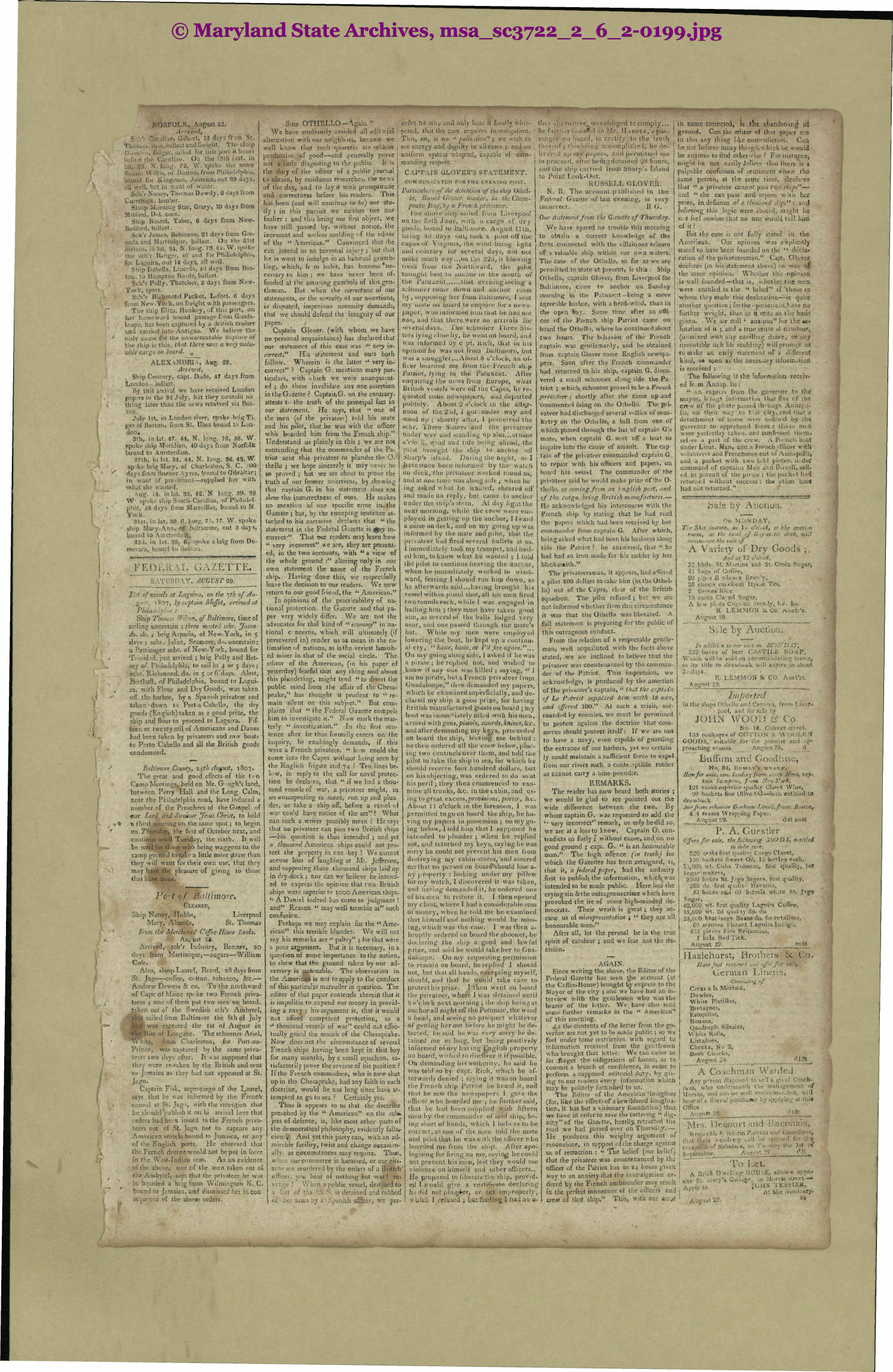
Federal Gazette & Baltimore Daily Advertiser 1807/07-1807/12 msa_sc3722_2_6_2-0199 Enlarge and print image (5M) |
|
|
|
|
|
|
|
|||
|
||||
|
||||
|
Federal Gazette & Baltimore Daily Advertiser 1807/07-1807/12 msa_sc3722_2_6_2-0199 Enlarge and print image (5M) |
|
Norfolk, August 23.
Arrived,
S •¦';. Caroli le, Gilbert, IS days frv.it St.
Tlionuj, rum, ballast and freight, tlic sloap
:, Edgar, sailed for this port 8 hours
the Caroline. On the 15th hist, in
lat, B9, N. long. 72, W. spoke the snow
Willis, of Boston, from Philailelpbia,
ijound for Kingston, Jamaica, out 38 days,
r.U well, bm in want of water.
SchY Nancy, Thomas Dowdy, 2 days from
Currituck, lumber.
Sloop Morning Star, Grary, 10 days from
Mili'ord, Del. corn.
Sliip Russel, Tatar, 6 days from New-
Bedford, ballast.
Sch'r James, Robinson, 21 days from Gre-
nada and Martinique, ballast. On the 21st
c, in fit. 34, N.long. 73,8r,W.spoke
the seh'r Rangsr, of and for Philadelphia,
for Laguira, out 14 days, all well.
Ship Isabella. Lincoln, t-> days from Bos-
ton, to Hampton Roads, ballast.
Stii'r Polly, Thatcher, 5 days from New-
York, spars.
Sch'r Richmond Packet, Lefort. 6 days
from New-York, on freight with passengers.
Tlie ship Eliza, Hookey, of this port, on
her homeward bound passage from Guada-
bupe, has been captured by a iiritish cruiser
:,,nd carried into Antigua. We believe the
only cause fir the unwarrantable capture of
the ship is this, that there was a very valu-
able cargo on board. #
ALEX.vNDRiT, Aug. 23.
Arrived,
Ship Century, capt. Dade, 47 days from
London ballast.
fiy this arrival we have received London
pap ts to the 3d July, but they contain no
thing later than the news received via bos-
ton.
July 1st, in London river, spoke brigTi
£-er of Boston, from St. Ubes bound to Lon-
don.
9th, in lat. 47. 44, N. long. 12, 58, W.
spoke ship Moridian, 40 days from Norfolk
bound to Amsterdam.
27th, in lat. 34, 44, N. long. 36, 43, W
sp-'ke brig Mary, of Charleston, S. C. '00
days from Buenos Ayres, bound to Gibraltar;
in want of provisions—supplied her with
what she wanted.
Aug. 14, in lat. 35, 42, N long. 59- 33
W spoke ship South-Carolina, of PhiJadel-
p'lin, 58 days from Marseilles, bound to N
York.
21st, in lat. 39. 0. long. 71, 17. W. spoke
ship Mary-Ann, of Baltimore, out 5 days,
bound to Auistc'd
23d, in lat. 39, 15, spoke a brig from De-
merara, bound to :¦» It • i.
Saw OTHELLO--Kg
cei've ho stir, and only neat it faintly '
We have studiously avoided all editorial pered, that the case requires investigation, he fin
FEDERAL GAZETTE.
SATURDAY AUGUST 29.
Jjst of vessels at Lagidra, on the "jtb of Au-
j r, 1807, by captain Moffet, arrived at
Philadelphia :
Ship Thomas Wilson, of Baltimore, time of
sailing uncertain ; three minted schr. Jason-
do. do. ; brig Aspasia, ol New-York, in 5
«3avs ; schr. Juliet, Seamore. d >. uncertain;
a Pettiauger schr. of New-York, bound for
Trinidad, juot arrived ; brig Polly and Bet-
sey of Philadelphia, to sail in 4 er 5 days;
schr. Richmond, do. in 5 or 6'days. Alert,
Berthoft, of Philadelphia, bound to Lagui-
ra, with Flour and Dry Goods, -was taken
off the harbor, by a Spanish privateer and
taken down to Port-a Cabello, the dry
goods (Eno-lish) taken as a good prize, the
ship and flour to proceed to Laguira. Fif-
teen or twenty sail of Americans and Danes
had been taken by privateers and row boats
to Porto Cabello and all the British goods
condemned.
Baltimore County, ijfh August, 1807.
The great and good effects of the t.10
Camp Meetings, held on Mr. G uigh's land,
between Perry Hall and the Long Calm,
near the Philadelphia road, have induced a
number of the Preachers of the Gospel of
•our Lord, and Strtmur Jesus Christ, to hold
¦« third meeting on the same spot ; to begin
on Thursday, the first of October next, and
continue until Tuesday, the sixth. It will
be well for those who bring waggons to the
camp ground to take a little more straw than
they will want for their own use, that they
may have the pleasure of giving to those
that have none.
Pot of Baltimore.
Cleared,
Ship Nancy, Hobbs, Liverpool
Mary, Alrneda, St. Thomas
From the Merchants' Coffee-House Looks.
August £8.
Arrived, sch'r Industry, Bonner, 20
days from Martinique,—sugars—William
Cole.
Also, sloop Laurel, Beard, 28 days from
St. Jago—coffee, cntton, tobacco, &c.—
Andrew Dewess & co. To the northward
of Cape of Maize spi>ke two French priva-
teers ; one of them put two men on board,
taken out of the Swedish sch'r Ambytel,
that sailed from Baltimore the 8th of July
and was captured the 1st ol August in
the Bite of Leogane. The schooner Ariel,
White, from Charleston, for Port-au-
Prince, was captured by the same priva-
teers two days after. It n as supposed that
they were re-taken by the British and sent
t-> Jamaica as they had not appeared at St.
Captain Fisk, supercargo of the laurel,
says that he was informed by the French
consul at St. Jago, with the intention that
he should publish it 011 hi arrival here that
orders had been issued to the French priva-
teers out of St. Jago not to capture any
American vessels bound to Jamaica, or any
of the English ports. Pie observed that
the French decree would not be put in force
in the West-Indian seas. As an evidence
of the above, one of the men taken out of
the Ambytel', says that the privateer lie was
in boarded a brig from Wilmington N. C.
bound to Jamaica, and dismissed her in con
>f the abovte orders.
altercation with our ne'i'ghbars, btcause we
well know that such quarrels are seldom
productive of good—and generally prove
not a little disgusting to the public- It is
the duty of the editor of a public journal
to obtain, by assiduous researches, the news
of the day, and to lay it with promptitude
and correctness before his readers. This
has been (and will continue to be) our stu-
dy ; in this pursuit we neither tire nor
faulter : and this being our first object, we
have still passed by, without notice, the
incessant and useless scolding "f the editor
of the " American." Convinced that -he
can intend us no personal injury ; but that
he is wont to indulge in an habitual grumb-
ling, which, fr m habit, has become "ne-
cessary to him ; we have never been of-
fended at the amusing gambols of this gen-
tleman. But when the correctness of our
statements, or the veracity ot our assertions,
is disputed, imperious necessity demands,
that we should defend the integrity of our
paper.
Captain Glover, (with whom we have
no personal acquaintance) has declared that
our statement of this case was " very in-
correct." His statement and ours both
follow. Wherein is the latter >' very in-
correct" ? Captain G. mentions many par-
ticulars, with which we were unacquaint-
ed ; do these invalidate any one assertion
in the Gazette ? CaptainG. on the contrary,
attests t< the truth of the principal fact in
our statement. He says, that " one of
the men (of the privateei) told his mate
and his pilot, that he was with the officer
who boarded him from the French ship."
Understand us plainly in this ; we are not
contending that the commander of the Pa-
triot sent this privateer to plunder the O-
thello ; we hope sincerely it may nevei he
so proved ; but we are about to p'ove the
truth of our former assertions, by shewing
that captain G. in his statement does not
shew the incorrectness of ours. He makes
no mention of one specific error in the
Gazette ; but, by the sweeping sentence at-
tached to his narrative declares that "the
statement in the Federal Gazette isjjg^y in-
correct-" That our readers may learn how
" very incorrect" *e are, they are present-
ed, in the two accounts, with " a view of
the whole ground :" altering only in our
own statement the name of the French
ship. Having done this, we respectfully
leave the decision to our readers. We now
return to our good friend, the "American."
In opinions of the practicability of na-
tional protection, the Gazette and that pa-
per very widely differ. We are not the
advocates for thai kind of " economy" in na-
tional c ncerns, which will ultimately (if
persevered in) render us as mean in the es-
timation of nations, as is the veriest famish-
ed miser in that of the social circle. The
editor of the American, (in his paper of
yesterday) fearful that any thing said about
this plundering, might tend "to divert the
public mind from the affair of the Chesa-
peake," has thought it prudent to " re-
main silent on this subject." But com-
plains that " the Federal Gazette compels
him to investigate it." Now mark the mas-
terly " investigation." In the first sen-
tence after he thus formally enters on the
inquiry, he exuhingly demands, if this
were a French privateer, " h w could she
come into the Capes without being seen by
the English frigate and 74 ? Ten lines be-
low, in reply to the call for naval protec-
tion he declares, that " if we had a thou-
sand vessels of war, a privateer might, in
an unsuspecting in merit, run up and plun
der, or take a ship off, before a vessel of
wa<- cculd have notice of the act" ! What
can such a writer possibly mean ? He says
that no privateer can pass two British ships
—his question is thus intended ; and yet
a thousand American ships could not pro-
tect the property in one bay ! We cannot
accuse him of laughing at Mr. Jefferson,
and supposing these thousand ships laid up
in dry-deck ; nor can we believe he intend-
ed to express the opinion that two British
ships were superior to 1000 American ships.
" A Daniel indeed has come to judgment !
and" Reason " may well tremble at" such
confusion.
Perhaps we may explain for the " Ame-
rican" this terrible blunder. We will not
say his remarks are " paltry" ; for that were
a poor argument. But it is necessary, in a
question of some importance to the nation,
to shew that the ground taken by our ad-
versary is untenable. The observation in
the American is not to apply to the conduct
of this particular marauder in question. The
editor of that paper contends therein that it
is impolitic to expend our money in provid-
ing a navy ; his argument is, that it would
not afford competent protection, as a
" thousand vessels of war" could iiv-t effec-
tually guard the mouth of the Chesapeake.
Now does not the circumstance of several
French ships having been kept in that bay
for many months, by a small squadron, sa-
tisfactorily prove the reverse of his position ?
If the French commodore, who is now shut
up in the Chesapeake, had any faith in such
doctrine, would he not long since have at-
tempted to go to sea ? Certainly yes.
Thus it appears to us that the doctrine
preached by the " American" on the sub*
ject of defence, is, like most other parts of
the democratical philosophy, evidently falla,
cion . And yet this party can, with an ad-
mirable facility, twist and change occasion-
ally, as circumstances may require. Thus,
our commerce is harassed, or ourciti-
c murdered by the orders of a British
r, you hear of nothing but war! re-
When a public vessel, destined to
a fort of the 01 S. is detained and robbed
I oi hei Sums .'; a ... *itiish officer* we per-
This, sir, is mo •' palliation" ; wc wish to
see energy and digiiity in all cases ; and an
uniform systenj adopted, capable of com-
manding respect,
CAPTAIN GLOVER'S STATEMENT.
COMMUNICATED FOR THE EVEN IN'G POST.
Particulars, of the detention oftheship Othel-
lo, Russet Glotiev buuster, in the Chesa-
peake Bay, hj a French privateer.
1 ne. above ship sailed from Liverpool
on the 2jth June, with a cargo of dry
goods, bound to Baltimore. August 1,7th,
being 4U days out, took a pilot oil'the
capes of Virginia, ihe wind being light
and contrary for several days, oid not
make much way...on the 2'id, it blowing
fresh from the .Northward, the pilot
tuougiit best to anchor in the mouth of
the Patu-xent......that evening'seeing a
schooner come down and author close
by, supposing iter from Baltimore, 1 sent
my mate on board to enquire for a news-
paper, win, informed mm that he had not
one, and that there were no arrivals for
several days. The schooner I'hree Sis-
ters lying close by, he went on board, and
was informed by c pt. Itich, that in his
opinion'he was not from Baltimore, but
was a smuggler... About 8 o'clock, an of-
ficer boarded me from tne Freud) sh.p
Patriot, lying iu the Paluxent. After
enquiring the news from Burope, what
Blitisb vessels were oil'the Capes, lie re-
quested some newspapers, and departed
politely. About 2 o'clock 111 the al'ty-
noon of the2.'id, 1 got under way and
stood up ; shortly after, I perceived the
schr. Three Sisters and the privateer
under wav and standing up also...attune
o'clbi k, wind and tide being ahead, the
pilot brought the ship to anchor oil
Sharp's island. During the night, as 1
havesince been informed ' by tne watch
on deck, the privateer worked round us,
and at one time was along side ; when be
ing asked w hat he wanted, sheered oil'
and made no reply, but came to anchor
under the ship's stem. At day liglit the
next morning, while the crew were em-
ployed in getting up the anchor, 1 beard
a noise on |