 |
|
|
 |
|
 |
|
|||
|
||||
|
||||
|
Federal Gazette & Baltimore Daily Advertiser 1807/07-1807/12 msa_sc3722_2_6_2-0198 Enlarge and print image (5M) |
|
|
|
|
|
|
|
|||
|
||||
|
||||
|
Federal Gazette & Baltimore Daily Advertiser 1807/07-1807/12 msa_sc3722_2_6_2-0198 Enlarge and print image (5M) |
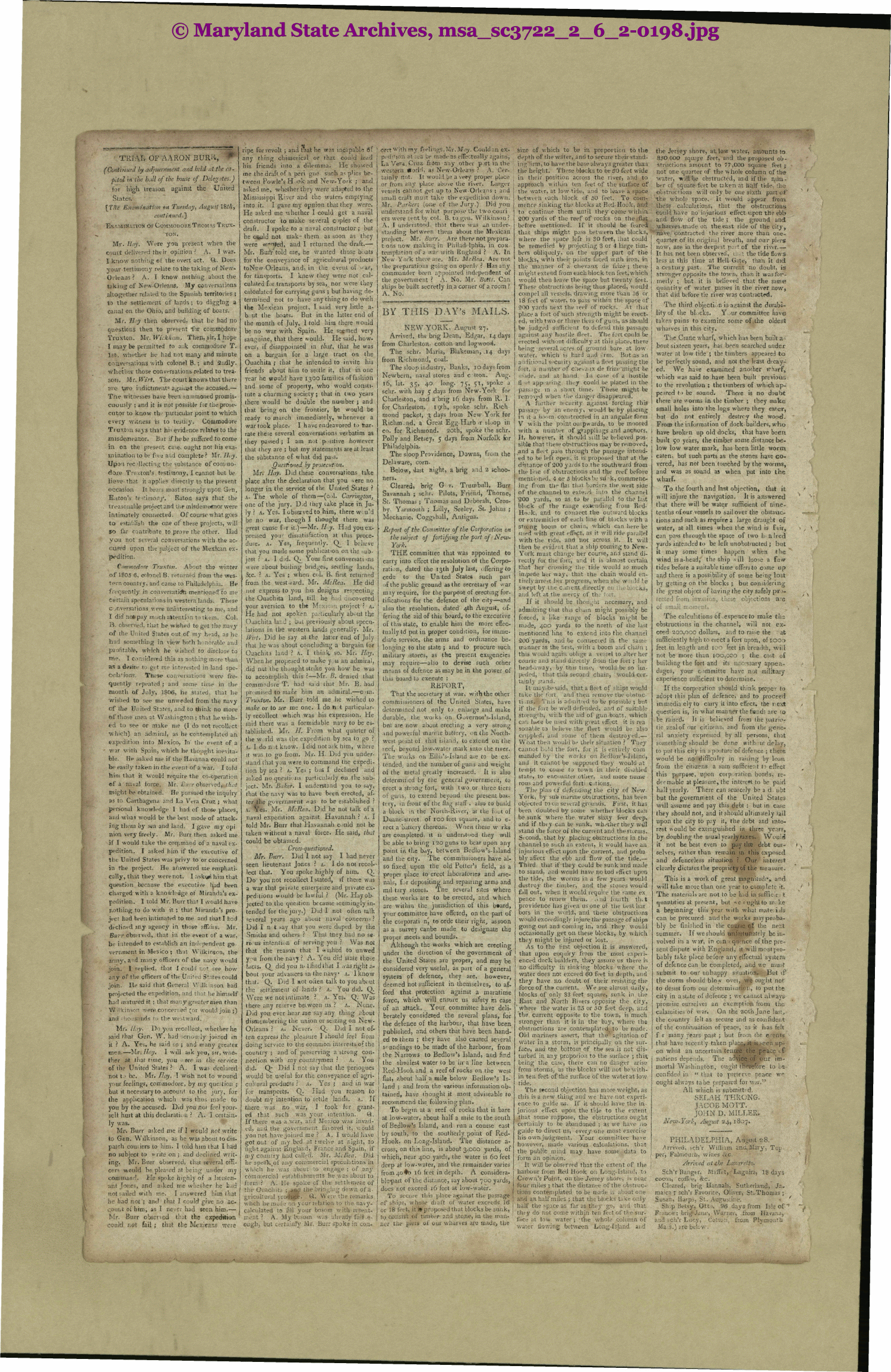
| ¦ TRIAL OF AARON" BURH., * (Continued !>y adjournment and held at the ca- pital in the hall of the house of Delegates.) for high treason against the United States. [Tile Examination en Tuesday, August \%tk, continued.^ EXAMINATION OK COMMODORE TllOMAS TRUX- TON. Mr. Hay. Were you present when the couit delivered their opinion I A. I was. I know nothing of the overt act. Ct. Does your testimony relate to the taking of New. Orleans ? A. I know nothing about the taking of New-Orleans. My conversations altogether related to the Spanish territories ; to the settlement of lands; to digging a canal on the Ohio, and building of boats. Mr. Way then observed, that he had no questions then to present for commodore Truxton. Mr. Wickkam. Then, sir,! hope I may be permitted to ask commodore T. 1st. whether he had not many and minute coaversatiojis with colonel B. -, and 2udly. whether those conversations related to trea- son. Mr. Wirt, The court knows that there are Uvo indictment" against the accused.— The witnesses have been summoned promis- cuously ; and it is not possible for the prose- cutor to know the particular point to which every witness is to testily. Commodore Truxton says that his evidence relates to the misdemeanor. But if he be suffered to come in on the present case, ought not his exa- mination to be fi e a and complete ? Mr. 11,y. Upon rec Meeting the substance of commo- dore Tru (ton's testimony, I cannot but be II eve that it applies directly to the present occasion It bears most strongly upon Gen. Eaton'.-; testimony. Eaton says that the treasonable project and U.e misdemeanor were intimately connected. Of course what goes to establish the one of these projects, will so far contribute to prove the other. Had you not several conversations with the ac- cused upon the subject of the Mexican ex- pedition. Commodore Truxton. About the winter of 1805 6, colonel B. returned from the wes- tern country, and came to Philadelphia. He frequently in conversation mentioned"To me certain speculations in western lands. These conversations were uninteresting to me, and I did no* pay much attention to tfcem. Col. B, observed, that he wished to get the navy of the United States out of my head, as he had something in view Both honorable and profitable, which he wished to disclose to me. I considered this as nothing more than as a desitc to get tr.e interested in land spe- culations. These conversations were fre- quently repeated ; and some time in the month of July, 1806, he stated, that he ¦wished to see me unweded from the navy of the United States, and to think no more of those men at Washington ; that he wish- ed to see or make me (I do not recollect ¦which) an admiral, as he contemplated an expedition into Mexico, In' the event of a war with Spain, which he thought inevita- ble. He asked me if the Havanna could not be easily taken in the event of a war. I told him that it would require the co-operation of a naval force. Mr. Burr observed, that might be obtained. He pursued the inquiry as to Carthagen.i and La Vera Cruz ; what personal knowledge 1 had of those places, and what would be the best mode of attack- ing them by sea and land. I gave my opi nion very freely. Mr. Burr then asked me if I would take the command of a naval ex- pedition. I asked him if the executive of the United States was privy to or concerned in the project. He answered me emphati- cally, that they were not. I aski#i him that question because the executive liad been Charged with a knowledge of Miranda's ex- pedition. I told Mr. Burr that I would have nothing to do with it ; that Miranda's pro- ject had been intimated to me and that I had declined any agency in those affaiis. Mr. Burr observed, that in the event of a war, he intended to establish an independent go vernment in Mexico ; that Wilkinson, the army, a'\d many officers of the navy would join. I replied, that I could not see how any of the officers of the United States could join. He said that General Wilkinson had projected the expedition, and that he himself had matured it ; that many greater men than Wilkinson were concerned [or would join ;) and ho isa'nds to the westward. Mr. Hay. Do you recollect, whether he said that Gen. W. had'seriously joined in it ? A. Yes. he said so ; and many greater men.—Mr. Hay. I will ask you, sir, whe- ther at that tune, you ere in the sendee of the United States ? A. I was declared not t.' be. Mr. flay. 1 wish not to wound your feelings, commodore, by my question ; but it necessary to account to the jury, for the application which was thus made to you by the accused. Did you noi feel your- scllhurtatthisdeclaratic.il? A. I certain- ly was. Mr. Burr asked me if I would not write to Gen. Wilkinson, as he was about to dis- patch couriers to him. I told him that I had no subject to write on; and declined writ- ing. Mr. Burr observed, that several offi- cers would he pleased at being under my command. He spoke highly of a lieuten- ant Jones, and a--ked me whether he had not sailed with me. I answered him that he had not ; ant!' that I could give no ac- count of him, as I never had seen him.— lVlr. Burr observed that the expedition could not fail ; that the Mexicans were ripe for revolt ; and that he was incapable df any thing chimerical or that coukl lead his friends into a dilemma. He showed ine the draft of a peri gue such as p'ics be- tween Powle's H iok and New-York ; and asked me, whether they were adapted to the Mississippi River and the waters emptying into it. I gave my optiion that they were. He asked me whether I could get a naval constructor to make several copies of the draft. I spoke to a naval constructor ; but he cwld not makj them as soon as they were wnfed, and I returned the draft.— Mr. Burr told me, he wanted those boats for the conveyance of agricultural products toNeiv Orleans, and, in the event of war, for tansports. I knew they were not cal- culated for transports by sea^nor were they calculated for carrying guns ; but having de- termined not to have any thing to do with the Mexican project, I said very little a- b- ut the boats. But in the latter end of the month of July, .1 told him there would be no war with Spain. He seemed very sanguine, that there would. He said, how- ever, if disappointed in that, that he was on a bargain for a large tract on the Ouachita; that he intended to invite his friends about him to settle it, that in one vear he would have 1300 families of fashion and some of property, who would consti- tute a charming society; that in two years there would be double the number ; and that being on the frontier, he would be ready 10 march immediately, whenever a war took place. I have endeavored to nar- rate these several conversations verbatim as they passed; I am not positive however that they are ; hut my statements are at least the substance of what did pa->s. Questioned hy prosecution. Mr. Hay. Did these conversations take place alter the declaration that you .ere no longer in the service of th< United States ? a. The whole of thera—(ool. Carrington, one of the jury. D.d they take place in Ju- ly ? A. Yes. I observed to him, there w.u'd be no war, though I thought there was great cause fur it.)—Mr. II y. Had you ex- pressed you- dissatisfaction at this proce- dure. A. Yas, frequently. Q_ 1 believe that you made some publication on the *ub- jest ? a. 1 did. Q^ Your first conversati >ns were about bulling bridges, settling lands, &c. ? a. Yes ; when col, B. first returned from the west-vard. Mr. Melted. He did not express to you his designs respecting the Ouachita land, till he had discovered your aversion to the M xi . project ? a. He had not spoken particularly about the Ouachita la;. J ; but previously about specu- lations in the western lands generally. Mr. Wirt. Did he say at the latter end of July that he was about concluding a bargain (or Ouachita land ? A. I think, so. Mr. Hay. When he proposed to make you an admiral, did not the thought strike you how he was to accomplish this I—Mr, B. denied that commodore T. had Said that Mr. B. had promised to make him an admiral.—c >ui. Truxton. Mr. Burr told me he wished to make or to see me one. I do ft t particular- ly recollect which was his expression. He said there was a formidable navy to be es- tablished. Mr. //. From what quarter of the w -rid was the expedition by sea to go > a. 1 do n t know. 1 did not ask him, where it was to go from. Mr. II Did you under- stand that you were to command the expedi- tion by sea ? a. Yes ; but 1 declined and asked no questions particularly en the sub- ject. Mr. Baker. I understand you to say, that the navy was to have been erected, af- - the govei Yes.. Mr. naval expedition against Havannah ? a. I told Mr. Burr that Havannah Coukl not be taken without a naval foice. He said, that could be obtained. Cross-questioned. Mr. Burr. Did 1 not say I had never seen lieutenant Jones ? a. I do not recol- lect that. You spoke highly of him. Q^ Do you not recollect I stated, if there was a war that private enierpnze and private ex- peditions would be lawful ? (Mr. H;iy ob- jected to the question brcause seemingly in- tended for the jniy.) Did 1 not often talk several years ago about naval concerns? Did I n t »ay that you were duped by the Smiths and others ? That tfley had no se rii-us intention of serving you ? Was not that the reason that I >* ished to unwed you from the navy ? A. You did state those facts. Q did yon n- tfiudthat I .vas right a- bout your advances in the navy a. I know that. Q. D;d 1 not often talk to you about the settlement of lands ? A. You did. Q^ Were we not intimate ? a. Yes. Q- Was there any reserve between us ? a. None. Did you ever hear me say any thing about dismembering the union or seizing on New- Orleans ? a. Never. Q. Did I not of- ten express the pleasure 1 should feel fiom doing service to the common interests of the country ; and of preserving a strong con- nection with my countrymen ? a. You did. Q^ Did I not say that the periogues would be useful for the conveyance of agri- cultural products ? a. Yes; and in war for transports. Q^ Had you reason to doubt my intention to settle lands, a. If there was no war, I took for grant- ed that such was your intention. ft. It* there was a war, and Mexico was invad- ed, and the government favored it, v.ould you not have joined me ? A. I would have got out of ray bed at twelve at night, to fight against England, France and Spain, if my country had called. Mr. MiRea. Did he speak^of any commercial speculations in which he was about to engage ; of any commercial establishments he was about to form ? A. He spoke of the settlement of the Ouachita ; aeja the bringing d< wn of a- gricultural ero^PL ft. Were the remarks wheh be made an your relation to the. navy- calculated to fill your bosom withresent- ment ? A. My bosom was- already foil e- ough, but certainty Mr. Burr spoke in con* ter the government a as to be established ? a. Yes. Mr. McRea. Did he not talk of a cert with my feelings. Mr. May. Could an ex. pvI'Mon at sea iie made as effectually agains, La Vera Cruz, from any other port in the western World, as New-Orleans ? A. Cer- tainly not. It would be a veey proper place or from any place above the river. Larger vessels cannot get up to New-Orleans ; and small craft must take the expedition down. Mr. barker; (one cf the Jury.). Did you understand for what purpose the two couri ers were sent by col. B. to gen. Wilkinson? A. I understood, that there was an under- standing between them about the Mexican project. Mr. Burr. Are there not prepara- t ons now making in Philad< lphia, in con temptation of a wfcr with England ? A. In New York there are. Mr. McRea. Are not the preparations going on openly ? Has any commander been appointed independent of the government ? A. No. Mr. Botts. Can ships be built secretly in a corner of a room? A. No. BY THIS DAY's MAILS. NEW YORK, August 27. Arrived, th« brig Dean, Ed,-;ar, 14 days from Charleston- cotton and logwood. The schr. Maria, Blakeman, .14 days from Richmond, coal. The sloop industry. Banks, iodaysfrom Newbern, naval stores and c tton. Aug. 16, lat. 35, 40 long. 75, 51, spoke a schr. with hay 5 days from New-York for Charleston, and a brig 16 days from R. I. for Charleston. 19th, spoke schr. Rich niond packet, 3 days trom New York tor Richm.nd, a Great Egg-Harb >r sloop in co. for Richmond. '20th, spoke the schr. Polly and Betsey, 5 days from Norfolk for Philadelphia. The sloop Providence, Downs, from the Delaware, corn. Below, Jast Right, a brig and 2 schoo- ners. Cleared, brig G v. Trumbull, Burr Savannah ; schr. Pilots, Friend, Thome, St. Thomas ; Tnomas and Deborah, Cros- by Yarmouth ; Lilly, Seeley, St. Johns ; Mechanic, Coggshall, Antigua. Report of the Committee of the Corporation on the subject oj fortifying the port of New- York. THE committee that was appointed to carry into effect the resolution of the Corpo- ration, dated the 13th July last, offering to cede to the United States such part of the public ground as the secretary of war may require, for the purpose ot erecting for- tifications for the defence of the city—and also the resolution, dated 4th August, of- fering the aid of this board, to the executive of this state, to enable him the more effec- tually td put in proper condition, lor imme- diate service, the arms and ordinance be- longing to the state ; and to procure such military stores, as the present exigencies may require—also to devise such other means of defence as may be in the power of this board to execute : REPORT, That the secietary at war, with the other commissioners of the United States, have determined not only to enlarge and make durable, the woiks on Governoi's-lsland, bnt are now about erecting a very strong and powerful marine battery, on the North- west point of thai island, to extend on the reef, beyond low-water mark into the river. The works on EUis's-Island aie to be ex- tended, and the number of guns and weight oi the metal greatly increased. It is also determined by the general government, to erect a strong fort, with two or three tiers of guns, to extend beyond the present bat- tery, in front of the flag staff . also to build a block in the North-River, at the foot of Duane-sireet. of 100 feet square, and to e- rect a battery thereon. Wiien these w rks are completed, it is understood they will be able to bring 120 guns to hear upon any point in the bay, between BedlowVLland and the city. The commissioners have al- so fixed upon the old Potter's field, as a proper place to erect laboratories and arse- nals, f.ir depositing and repairing arms and miliary stores. The several sites where these works are to be erected, and which are within the jurisdiction of this b«ard, your committee have offered, on the part of the corporati n', to cede their right., assoon as a survey canbe made to designate the proper meets and bounds. Although the works which are erecting under the direction of the government of the United States are proper, and may be considered very useful, as part of a general system of defence, they are, however, deemed hot sufficient in themselves, to af- ford that protection against a maritime force, which will ensure us safety m case of an attack. Your committee have deli- berately considered the several plans, for the defence of the harbour, that have been published, and others that have been hand- ed to them ; they have also caused several soundings to be made of the harbour, from the Narrows to Bedlow's Island, and find the slwalest water to be in a line between Red-Hook and a reef Gf rocks on the west flat, about half a mile below Bedlow's Is- land ; and trom the various information ob- tained, have thought it most adviseable to recommend the following plan. To begin at a reef of rocks that is bare at low-water, about half a mile to the south of Bedlow's Island, and run a course east by south, to the southerly point of Red- Hook, on Long-Island. The distance a- cross, on this line, is about 3,000 yards, of which, near 400 yards, the water is 60 feet deep at low-water, and the remainder varies from 40%) 16 feet in depth. A considera- ble-part of "the distance, say about 700 yards, docs'not exceed 16 feet at low-water. To secure this place against the passage of ships, whose diaft of water exceeds 16 or 18 feet, it it proposed that blocks be sunk, to, consist of timber and stone, in the man- ner the piers of our wharves ar>-' made, the Size of which to be in proportion to the depth of the water, and to secure their stand- ing rm, to have the base always greater than the height. These blocks to Oe 50 feet wide in their position across the river, and to approach within ten feet of the surface of the water, at low tide, and to leave a space between each block of 50 feet. To com- mence sinking the blocks at Red Hook, and to continue them until they come within 200 yards of the reef of rocks on the flat before mentioned. If it should be feared that ships might pass between the blocks, where the space left is 30 feet, that could be remedied by projecting 3 or 4 large tim- bers obliquely, on the upper part of the blocks, with their points faced with iron, in the manner of a chevaux de frize ; these might extend from each block ten feet, which would then leave the space but twenty feet. These obstructions being thus placed, would compel all vt-ssels, drawing more than 16 or 18"feet of water, to pass within the space of 200 yards next the reef of rocks. At that place a fort of such strength might be erect- ed, with two or three tiers of guns, as should be judged sufficient to defend this passage against any hostile fleet. The fort could be erected without difficulty at this place, there being several acres of ground bare at low water, which is hard and ,rm. But as an additional security against a fleet passing the fort, a iuenber ot coe.aix de frize "might be - > ide, and at hand. In case of a hostile tl e't appearing they could be placed in the passage m .1 short time. Tiiese might be ' removed when the danger disappeared. A further security against forcing this passage by an enemy, would be by placing in it a boom constructed in an angular form V With the point ouipwards, to be moored with a riurnbtfr of grappli.igs and alienors. It, however, it should still be believed pos- sible that these obstructions may be removed, and a fleet pass through the passage intend- ed to be left open, it is proposed that at the distance of 200 yards to the southward from the line of obstructions and the reef before mentioned, 4 or 5 Mocks be sink, commenc- ing from the flat tl.ai boaters the west side of the channel to extend into the channel 200 yards, so as to be parallel to the last block of the range extending from Red- Hook, and to connect the outward blocks or extremities of each line of blocks with a strong boom or chain, which can here be ined with great effnet, as it will ride parallel with the tide, and not across it. It will then be evident that a ship coming to New- York must change her course, and stand di- rectly for the fort, a:id it is almost certain that her crossing the tide would so much impede her way, that the chain would en- tirely arrest her progress, when she would 1 e swept by me c.ineilt directly on then! as, and left at the mercy of the tort. If it should be fhoiight necessary, and admitting that this chain might possibly be forced, a like range of blocks might be made, 400 yards to the north of the last mentioned line to extend into the channel 200 yards, and be connected in the same manner as the first, with a boom and chain ; this would again oblige a vessel to alter her course and stand directly from the fort ; her head-away, by this time, would be so im- peded, that this second chain, ' would cer- tainly stand. It may be said, that a fleet of ships would take the tort and then remove the obstuc ti ns. '. his is admitted to be possible ; but if the fort be well defended, and of suitable strength, with the aid of gun boats, which can livfe be u^ed with great effect it is rea sonable to believe the fleet would be also crippled, and some of them destroyed.— What then would be their situation ? They cannot hold the fort, for it is entirely com manded r>y the works on Redlow's-Ivlami, and it cannot be supposed they would at tempt to come to town in their disabled state, to encounter other, and more nuuie rous and powerful forti Cations, The plan cf defending the city of New York, by sub marine obstructions, has been objected to oh several grounds. First, it has been doubted by some whether blocks can be sunk where the water sixty feer deep, and if they can be sunk, wh.-ther they will stand the force of the current and the storms. Second, that by placing obstructions in the channel to such an extent, it would have an injurious effect upon the current, and proba bly affect the ebb and flow of the tide.— Third that if they could be sunk and made to stand, and would have no bad effect upon the tide, the worms in a few years would destroy the timber, and the stones would fall out, when it would require the same ex pence to renew them. ..nd fourth th.t providence has given us one of the best liar bors in the world, and these obstructions would exceedingly injure the passage of ships going out and coming in, and they would occasionally get on these blocks, by which they might be injured or lost. As to the first objection it is answered, that upon enquiry from the most experi- enced clock builders, they assure us there is no difficulty in sinking blocks where the water does not exceed 60 feet in depth, and they have no doubt of their resisting the force of th» current. We see almost riaily, blocks of only 33 feet square, sunk in the 1 East and North Rivers opposite the city, 'where the water is 35 or SO feet deep, and the current opposite to the town, is much stronger than it is in the bay, where the obstructions are contemplated, to be made. Old manners assert, that the' agitation of water in a storm, is principally on the sur- face, and the bottom of the sea is not dis- turbed in any proporion to the surface ; this. being the case, there can no danger arise from storms, as the blocks will not be with- in ten feet of the surface of the water at low tide. The second objection has more weight, as this is a new thing and we have not experi- ence to guide us. If it should have the in- jurious effect upon the tide to the extent that some suppose, the obstructions ought certainly to be abandoned ; as we have no guide to direct us, every one must exetcise his ownjudgment. Your committee have however, made various calculations, that the public mind may have some data to form an opinion. It will be observed that the extent of the harhour from Red Book on Long-Islam!, to Crown's Point, on the Jersey shore, is near four miles ; that the distance of the obstiuc- tions contemplated to be made is about one and an half miles ; that the blocks take only half the space as far as they go, and that they do not come within ten feet of the sur- face at lovv water; -the whole column of water flowing between Long-Island and the Jersey shore, at low water, amounts to 850 000 squaje feet, and the proposed ob- structions amount to 77,000 square feet ; not one quarter of the whole column of the water, -will be obstructed, and if the num- ber of square feet be taken at half tide, the obstructions will only be one sixth part of the whole space. It would appear from these calculations, that the obstructions could have no injurious effect upon the ebb) and flow of the tide ; the ground and wharves made on the east side of the city, nave contracted the river more than one- quarter of its original breath, and our piers now, are in the deepest part of the river.— It has. not been observed, 1 :. the tide flows less at this time at Hell Gate, than it did a century past. The current no doubt, is stronger opposite the town, than it was for- merly ; but it is believed that the same quantity of water passes in the river now, that did before tie river was contracted. The third objection is airainst the durabi- lity of the blocks. Y ,ur committee have taken pains to examine some of .the oldest wharves in this city. The Crane wharf, which has been built a - bout sixteen years, has been searched under water at low tide ; the timbers appeared to I be perfectly sound, and not the least decay- ; ed. We have examined anoiher w!iarf, ] which was said to have been built prtvioiii, , to the revolution ; the timbers of which ap. J peired to be sound. There is no doubt 1 there are worms in the timber ; they make small holes into the logs where they enter, bat do not entirely destroy the wood. From the information of dock-bui!ders, who ' have broken up old docks, that have been '; built 50 years, the timber some distance be- low low water mark, has been little worm eaten, but such parts as the stones have co- vered, has not been touched by the worms, and was as sound as when put into the wharf. To the fourth and last objection, that it will injure the navigation. It is answered that there will be water sufficient of nine- tenths of our vessels to sail over the obstauc- tious and such as require a large draught of water, at all times when the wind is f lir, can pass through the space of two hi n lred yards intended to be left unobstructed ; but it may some times happen when the wind is a-head, the ship vill loose a ft;w tides before a suitable time offers to come up and there is a possibility of some being lost by getting on the blocks ; but considering the great object of having the city safely pr >- tected from invasion, these objections are of small moment. The calculations of .expeuce to make th-i obstructions in the channel, will not ex- ceed 200,000 dollars, and to raise the at sufficiently high to erect a fort upon, ol 1000 feet in length and too feet in breadth, will not be more than 100.000 ; the cost of building the fort and its necessary appen- dages, your c-immitte have not military experience sufficient to determine. If the corporation should think propc to adopt this plan of defence, and to proceed lmmedia ely to carry it into effect, the rext question is, in what manner the funds are to be raised. It is believed from the patrio- tic zeal of our citizens, and from the gene- ral anxiety expressed by all persons, that something should be done without delay, to put this city in a posture of defence ; there would be no difficulty in raising by loan from the citizens a sum sufficient t") effect this purpose, upon corp ration bonds, re- deemable at pleasure, the intcrcrt to be paid halt yearly. There can scarcely be a d. ubt but the government of the United States will assume and pay this debt : but in case. they should not, and it should ultimately tail upon the city to p.iy it, the debt and inte- rest v\ ould be extinguished in three years, by doubling the usual yearly taxes. Would it not be best even to pay the debt our- selves, rather than remain in this exposed and defenceless situation ? Our interest clearly dictates the propriety of the measure. This is a work of great magnitude*, and will take more than one year to complete it. The materials are not to be hsd in Slifiiciei t quantities at present, but <\e 1 tight to in; ke a beginning this year with what mate-iils can be procured and the works may proba- bly be finished in the course cf the next summer. If we should unfortunately be in- volved in a wjr, in contquence of the pre- sent dispute with England, it will most pro- bably take place before any effectual system of defence can be completed, and vvc must submit to our unhappy situation. But if the storm should blow ovei, we ought not to desist from our determination, to put the city in a state of defence ; we cannot always promise ourselves an exemption from the calamities of war. On the 20th Jane last, the country felt as secure and as confident of the continuation of peace, as it lias felt f r many years past ; but from the cents that have recently taken place, it is seen up- on what an uncertain tenure the peace ef nations depends. The advice of car im- mortal Washington, ought tlTSBMre to be confided in " that to preserve peace we ought alvvavs tabe prepared for war." All which is submitt: d. SELAH THRONG. JACOB MO IT. JOHN D. MILLER, New-York, August 24, 1807. PHILADELPHIA, August 28. Arrived, tcirr William andrAlary, Tuj per, Falmouth, wines &c. Arrived atihe Lazaretto, Sch'r Hanger, R'iaffet, ¦ Laguira, 18 days cocoa, coffee, &c. Cleared, brig Hannah, Sutherland, Ja. ma;ca ', sch'r Favorite, Oliver, St. Thomas; Susan, Harps, St. Augustine. < ^ Ship Betsy, Ott., 96 days from Isle of ; brig .i,-.ue, Warner, from Havana, and sch'r Lucy, from Plymouth Ma.s.) are below. |