 |
|
|
 |
|
 |
|
|||
|
||||
|
||||
|
Federal Gazette & Baltimore Daily Advertiser 1807/07-1807/12 msa_sc3722_2_6_2-0252 Enlarge and print image (5M) |
|
|
|
|
|
|
|
|||
|
||||
|
||||
|
Federal Gazette & Baltimore Daily Advertiser 1807/07-1807/12 msa_sc3722_2_6_2-0252 Enlarge and print image (5M) |
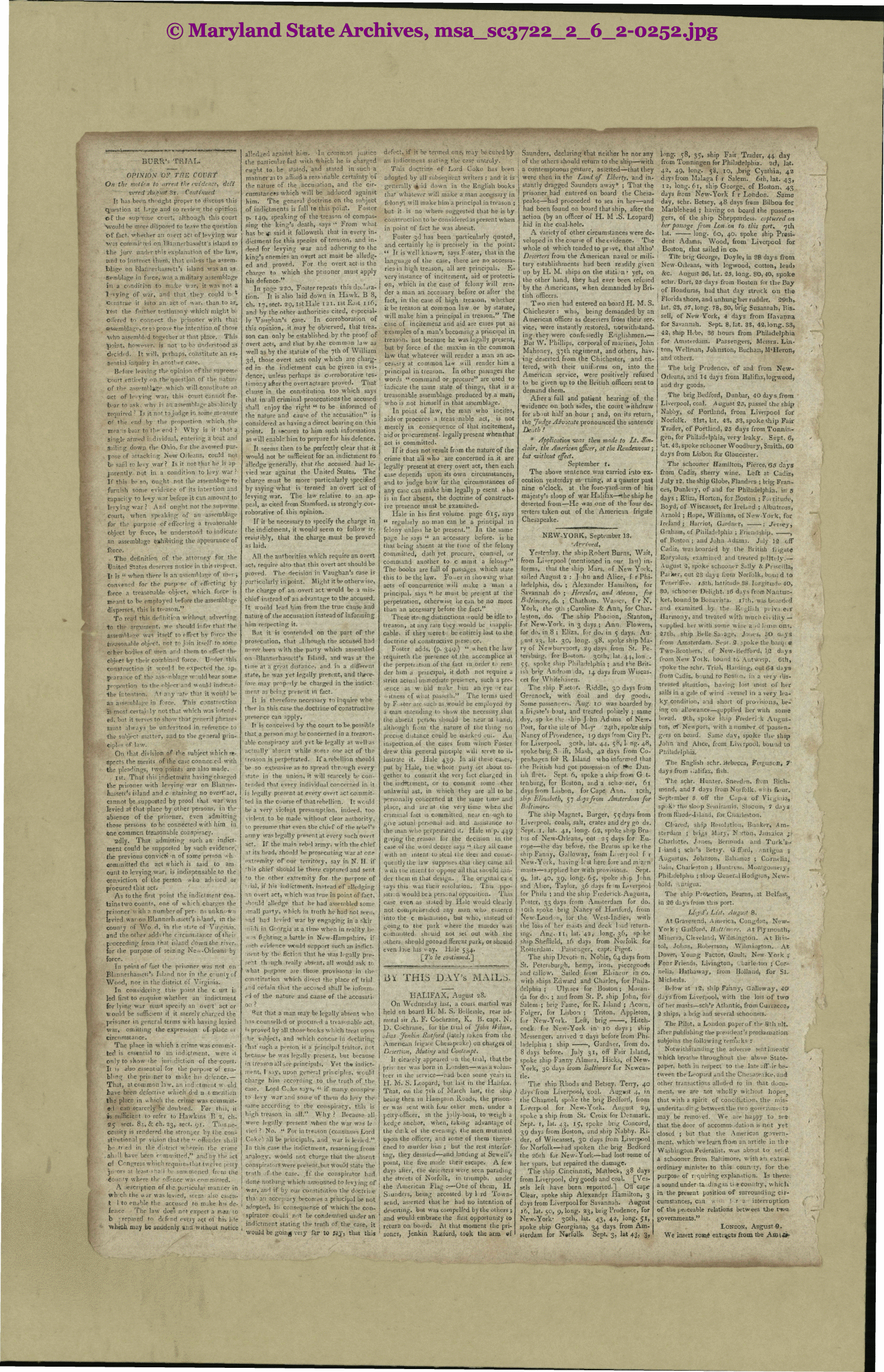
| rf <^i ».'»¦¦"¦&»> BURR's TRIAL. OPIXIOK W TBE COVET On ike molinn to arrest the. evidence., dell vend August 3i. Continued It has been thought proper to discuss this question at b.rge and to review the opinion cfthe sup'eme court, although this court ¦would be more disposed to leave the question of fact, whether an overt net of levying war •was commitfiecj on K'Snnnerhassett s island to the jurv under this explanation of the law, and to instruct 'them, th.it unless the assem- blage on Hairnethassett's island was an as Semblage in f'nee, was a military assemblage in a condition to make war, it was not a 1 jvying of war, and that tbey could in x Construe it into an act of war, than to ar_ irest the further testimony which might b<. offered t" connect the prisoner with that assemblage, or to prove the intention of those \vhr> assembled together at that place. This point, however, is not to be Understood as decided. It will, perhaps, constitute an es- sential inquiry in another rase. Before leaving the opinion of the supreme Court entirely on the question of the nature of the asseml U"?' which will constitute an act of levying war, this court cannrtr. for- bear to ask why i; an assemblage absolutely required : I? it not to judge in some pleasure of the end by the proportion which the means bsar tly be charged in the indict- ment as being present in fact. It is therefore necessary to inquire whe ther in this case the doctrine of constructive presence can apply. It is conceived by the court to be possible that a person may be concerned in a treason- able conspiracy and yet be legally as well as actually absent while Soma one act of the 'reason is perpetrated. If a rebellion should be 50 extensive as to spread through every state in the union, it will scarcely be con- tended that every individual concerned in it is legally present at every overt act commit- ted in the course of that rebellion. It would be a very violent presumption, indeed, too violent to be made without clear authority, to presume that even the chief of the rebel's army was legally present at every such overt act. If the main rebel army, with the chief it its head, should be prosecuting war at one extremity of our territory, say in N. II. if •his chief should be there captured and sent to the other extremity for the purpose of trial, if his indictment, instead of alledging an overt act, which was true in point of fact, should alledge that he had assembled some •mall party, which in truth he had not seen, and bad levied war by engaging in a nkir iriTsh in Georgia at a time when in reality he < as fighting a battle in New-Hampshire, if inch evidence would support such an indict- ment by ihr fiction that he was bgallv pre- sent though really absent, all would ask to what purpose aie those provisions in ibe constitution which direct the place of trial and ordain that the accused shall be inform- ed of the nature and cause of the accusati- on ? ¦*ut that a man may be legally absent who has counselled or procured a treasonable act, is proved by all those books which treat upon be subject, and which concur hi declaring 'bit such a person is a principal traitor, not because he was legally present, but because in treason all are principals. Yet th« indict- ment, I say, upon general principles, would charge him recording to tbe truth of the case. Lord C.ke says, «< if many ennspbe to levy war and some of them do levy the same according to tbe conspiracy, this is high treason in all." Why? Because all were legally present when the war was le vied? No. " For in treason (continues Lord Cokel all be principals, and war is levied." In this case the indictment, resaoning from analogy, would not charge that the absent conspirators were present, but Would state the truth ¦-[' the case. ,ii' the conspirator had done nothing which amounted to levying of war, and if by our constitution the doctrine tba- an accessary becomes a principal be not adopted, in consequence of which the con- spirator coulci not be condemned under an indictment stating the truth of the case, it would be going very far to fay, that this defect, if it be termed en;, may be cured by an indictment stating the case untruly. This doctrine of Lord Coke has been adopted by all subsequent writers ; and it is generally <^ud down in the English books tna' whatever will make a man accessary in felony", will make him a principal in treason ; but it is no where suggested that he is by construe! ion to be considered as present when in point of fact he was absent. Foster 3d has been particularly quoted, and certainly he is precisely in the point. " It is well knows, says Foster, that in the language of the case, there are no accessa- ries in high treason, all are principals. E- very instance of incitement, aid or protecti- on, which in tbe case of felony will ren- der a man an accessary before or after the fact, in the case of high treason, whether it be treason at common law or by statute, will make him a principal in treason." The case of incitement and aid are cases put as examples of a man's becoming a principal in treason, not because he was legally present, but by force of the maxim in the common law that whatever will render a man an ac- ces.nry at common law will render him a principal in treason. In other passages the words "command or procure" are used to indicate the same state of things, that is a treasonable assemblage produced by a man, who is not himself in that assemblage. In point of law, the man who incites, aids or procures a treasonable act, is not merely in consequence of that incitement, aid or procurement, legally present whenthat act is committed. If it does not result from the nature of the crime that all who are concerned in it are legally present at every overt act, then each case depends upon its own circumstances, and to judge how far the circumstances of any case can make him legally p escnt « ho is in fact absent, the doctrine of construct- ive presence must be examined. Hale in his first volume page 615, says " regularly no man can be a principal in felony unless he be present." In the same page lie says " an accessary before, is he that being absent at the time of the felony committed, doth yet procure, counsel, or command another to c mmit a felony" The books are full of passages which state this to be the law. Fo ..er in showing what acts of concurrence will make a man a principal, says " he must be present at the perpetration, otherwise he can be no more than an accessary before the fact." These strong distinctions would be idle to treason, at any rate tney would be inappli- cable, if they weret be entirely lost to the doctrine ot constructive piesei ce. Foster adds, (p. $V)) " when the law requireth the presence ot the accomplice at the perpetration of toe fact in order to ren- der him a principal, it doth not requiie a strict actual immediate presence, such a pre- sence as w uld make bun an eye or ear . itness r.f wi.at passetli." The terms used by F.rster are such as would be employed by a man intending to «how the necessity that the absent person should be near at hand, although fiom the nature of the thing no precise distance could be marked out. An inspection of the cases from which Foster drew this general pinciplc will serve to il- lustrate it. Hale 439. In all these caaes, put by Hale, tne whole party set about to- gether to commit the very fact charged in the iiirffCtment, or to commit some other unlawtui ast, in which they are all to be personally concerned at the same time and place, and are at the very time when the criminal fact is committed near enough to give actual personal aid and assistance to the man who perpetrated it. Hale in p. 4.19 giving the reason for the decision in the case of the word decree says ¦' they ail came with an intent to steal the deei and conse- quently the law supposes that they came ail w itti the intent to oppose all that siiould hin- der them in that design, 'i he original ca e says this was their resolution. This ppo- siti.ui would bea personal opposition. This case even as staled by Hale would clearly not comprehended any man who entered into the c mlatnaiion, but who, instead of going to trie park where the murder was committed, should not set out with the others, should gotoad fferent park, or should even bse his >-ay. Hale 534. [To be cd'itinued.") hY THIS DAY'S MAILS. HALIFAX, August 28. On Wednesday last, a court martial was held on board H. M. S. Belleisle, rear ad- miral sir A. F. Cochrane, K. B. capt. N. D. Cochrane, for the tnal of John Wilson, alias Jtnkin Ratford (lately laken from the American frigate Chesapeake) on charges ot Desertion, Mutiny and Contempt. It ciearely appeared >.n the trial, that the pris- ner was born in London—was a volun- teer 111 the service—nad been some years in H. M. S. Leopard, but last in the Halifax. That, on the 71I1 of Match last, the ship being then in Hampton Roads, the prison- er was sent with four other men, under a petty-officer, in the jolly-boat, to weigh a kedge anchor, when, taking advantage of the dusk ol the evening, the men mutinied upon the officer, and some of them threat- ened to murder him ; but the rest interfer- ing, they desisted—and landing at Sew ell's point, the five made their escape. A few days after, the deserters were seen parading the streets of Norfolk, in triumph, under the American Flag :—One of them, H. Sounders, being accosted by 1 rd Town- send, asserted that he had no intention of deserting, but was compelled by the others; and would embrace the lirst opportunity to return on board. At that moment the pri- soner, Jenkin, Ratford, took the arm »f Saunders, declaring that neither be nor any of the others should return to the ship—with a contemptuous gesture, asserted—that they were then in the Land of Liberty, and in- stantly dragged Saunders away* ; That the prisoner had entered on board the Chesa- peake—had proceeded to sea in her—and had been found on board that ship, after the action (by an officer of H. M .S. Leopard) hid in the coal-hole. A variety of other circumstances were de- veloped in the course of the evidence. The whole ol which tended to pr we, that altbo' Deserters from the American naval or mili- tary establishments had been readily given up by H. M. ships on the station* yet, on the other hand, they had ever been refused by the Americans, when demanded by Bri- tish officers. Two men had entered onboard H. M. S. Chichester : who, being demanded by an American officer as deserters from their ser- vice, were instantly restored, notwithstand- ing they were confessedly Englishmen.— But W. Phillips, corporal of marines, John Mahoney, 37th regiment, and others, hav- ing deserted from the Chichester, and en- tered, with their uniforms on, into the American service, were positively refused to be given up to the British officers sent to demand them. After a full and patignt hearing of the evidence on both sides, the court withdrew for about half an hour ; and, on its return, the Judge Advocate pronounced the sentence Death ! * Application was then made to Lt. Sin- clair, the American officer, at the Rendezvous • but "without effect. September I. The above sentence was carried into ex- ecution yesterday inr rninrr, at a quarter past nine o'clock, at the fore-yard-arm of his majesty's sloop of war Halifax—*theshiphe deserted from—He was one of the four de- serters taken out of the American frigate Chesapeake. NEW-YORK, September 13. Arrived, Yeste'day, the ship Robert Burns, Wait, from Liverpool (mentioned in our last) in- forms, that the ship Mars, of New York, sailed August 2 : J hn and Alice, f r Phi- ladelphia, do. ; Alexander Hamilton, for Savannah do ; Hercules, and rtbeona, for Baltimore, do. ; Chatham. Wasser, f r N. York, the Oth ; Caroline & Ann, for Char- leston, do. The ship Phooion, Stanton, fir New-York, in 3 days ; Ann. Flowers, for do. in 8 ; Eliza, for do. in 5 days. Au- s,ust23, lat. 30, long. 38. spoke ship Ma- ry of Newburvport, 29 days from St. Pe- tersburg, for Boston. 30th, lat.44.loa . 55. spoke ship Philadelphia ; and the Brit- ish brig Androm da, 14 days from Wiscas- cet for Whitehaven. The ship Factor. Riddle, 30 days from Greenock, with coal and dry goods. Some passent-ers. Aug. 10 was boarded by a frigate's biat, and treated politely ; same day. sp ke the »feip Jofitl Adams of New. Port, for the isle of May 24th, spoke ship Nancy of Providence, 19 days from City Pt. for Liverpool. 30th, lat. 44, 58,. I. ng. 48, spoke brig. S ift. Mash, 42 days from Co- penhagen for R Island who info'med that the British had got possession of !*ie Dan- ish fleet. Sept. 6, spoke a ship from G t- lenburg, for Boston, and a scbo-ner, 61 days from Lisbon, for Cape Ann. IOth, ship Elizabeth, 57 days from Amsterdam for Baltimore. The ship Magnet, Burger, 5-; days from Liverpool, coals, salt, crates and dry go ds. Sept. I, lat. 41,'long. 62, spoke ship Bru tus of New-Orleans, out 25 days for Eu- rope—the day before, the Brums sp ke the ship Fanny, Galloway, from Livetj.ool f r New-York, having lest here fore and nvzen masts-— sapplied her with provisions. Sept. 9, lat. 40, 39, long. 65, spoke ship J'-hn and Alice, Taylor, 36 days fr mi Liverpool for Phila ; and the ship Frederick-Augusta, Poiter, 33 days from Amsterdam for do. 10th spoke brig Nancy of Hartford, from New Londni, tor the West-Indies, with the loss of her masts and deck 1 iad return- ing. Aug. 11, lat. 42, long. 36, spake ship Sheffield, 16 days from Norfolk for Rotterdam. Passenger, capt. Pigot. The shipDcvoti' 11. Noble, 64days from St. 1'ctersburgh, hemp, iron, piecegoods and tallow. Sailed from Elsineur in co. with ships Edward and Charles, for Phila- delphia ; Ulysses for Boston; M.nan- da for do: ; and from St. P. ship John, for Salem ; brig Fame, forR. Inland ; Acorn, Folger, for Lisbon ; Triton, Appleton, for New-York. Left, brig-------, Hitch- cock, for New-York in 10 days ; ship Messenger, arrived 2 days before from Phi- ladelphia ; ship -------, Gardner, from do. 8 days before. Juiy 31, off Fair Island, spoke ship Fanny Almira, Hicks, of New- York, 30 days from Baltimore for Newcas- tle. The ship Rhoda and Betsey, Terry, 40 days from Liverpool, coal. August 4, in the Channel, spoke the brig Bedford, hoin Liverpool for New-York. August 2y, spoke a ship from St. Croix for Denmark. Sept. I, lat. 43, 15, spoke brig Concord, 39 days from Boston, and ship Nabby, Ri- der, of Wiscasset, 30 days from Liverpool for Norfolk—had spoken the brig Bedford the 26th for New-York—had lost some of her spars, but repaired the damage. The ship Cincinnati, Ma'tlock, 38 days from Liverpool, dry goods and coal. [Ves- sels left have been reported.] Off cape Clear, spoke ship Alexander Hamilton, 3 days from Liverpool for Savannah. August 16, lat. 50, 9, long. 23, brig Prudence, for New-York- 30th, lat. 43, 42, long. 51, spoke ship Georgians, 34 days from Am- sterdam for Nerfolfc. Sept. 3, lat 43, 3, long; c8, 35, ship Fair Trader, 44 day from Tonningen for Philadelphia. 2d, lat. 42, 49, long. 58, 10, .brig Cynthia, 42 days from Malaga f r Salem. 6th, lat. 43, 12, long. 61, ship George, of Boston, 43 days from New-York f: r London. Same day, schr. Betsey, 48 days frem Bilboa for Marblehead ; having on board the passen- gers, of the ship Sheppardess. captured on her passage from Lotion to this pert, ^th lat. -------long. 60, 40, spoke ship Presi- dent Adams, Wood, from Liverpool for Boston, that sailed in co. Tlte brig George, Doyle, in 38 days from New-Orleans, with logwood, cotton, lead* &c. August 26, lat. 25, long. SO, 40, spoke schr. Dart, 25 days from Boston for the Bay of Honduras, had that day struck 011 the Florida shore, and unhung her rudder. 29th, lat. 23, 57, long. 78, 30, b'rig Susannah, Bis- sell, of New York, 4 days from Ifavanna for Savannah. Sept. 8, lat. 33, 42, long. 33, 42, ship Hebe, 36 hours from Philadelphia for Amsterdam. Passengers, Messrs. Lin- ton, Welhnan, Johnston, Buchan, M'Heron, and others. The brig Prudence, of and from New- Orleans, and 14 days from Halifax, logwood, and dry goods. The brig Bedford, Dunbar, 40 days from Liverpool, coal. August 25, passed the ship Nabby, of Portland, from Liverpool for Norfolk. 31st, lat. 43, 53, spoke ship Fair- Trader, of Portland, 25 days from Tonnin- gen, for Philadelphia, very leaky. Sept. 6, kat. 43, spoke schooner Woodbury, Smith, 60 days from Lisbon for Gloucester. The schooner Hamilton, Pierce, 65 days from Cadiz, sherry wine. Left at Cadiz» July 12, the ship Globe, Flanders ; brig Fran- ces, Dunlevy, of and for Philadelphia, in S days ; Eliza, Horton, for Boston ; Fen titude, Boyd, of Wiscasset, for Ireland ; Albatross, Arnold ; Hope, Williams, of New-York, for Ireland; Harriot, Gardner, -------; Jersey, Graham, of Philadelphia ; Friendship, ------, of Boston ; and John Adam;. July 12 off Cadiz, was boarded by the British fiigate Euryalus, examined and treated politely.— August 2, spoke schooner Sally & Priscilla, Parker, out 23 days from Norfolk, be in d to TeiieriSee. x5th, lattitude 38, longitude 40, 30, schooner Delight. 16 days from Nantuc- ket, bound te Bonavista. i7th, was boarded and examined by tbe E.^ii.-h priva.ert Harmony, and treated with much civility— supplied her with some wine a id lairm on?. 27th, ship Belle Sa.age, Jooes, CO a.-ys from Amsterdam. Sept. 2 spoke the b.aicp « Two-Brothers, of New-Bedford, 12 days from New Yoik, hound to Antwerp. 6th, spoke the schr. Trial, Harding, out 64 days from Cadiz, bound to Boston, in a very dis- tressed situation, having lost most of her sails in a gale of wind -vessel In a very lea- ky condition, and short of provisions,, be- ing on allowance—supplied her with some bread. 9tb, spoke ship Frederick Augus- tus, of Newport, with a number ot passen- gers on board. Same day, spoke the ship John and Alice, from Liverpool, bound to Philadelphia. The English schr. itebecca, Ferguson, f' days from .lalifax, fish. The schr. Hunter, Sneeden, from Rich- mond, and 7 days fromNoifolk, with flour. September 5 off the Capas of Vii^uua, spoke the sloop Seinirauiis, Slocum, 7 days from Rhode-Island, for Charleston. Cleared, ship Resolution, Bunker, Am- sterdam ; bvi^s Mary, Narton, Jamaica ;. Charlotte, Jones, Bermuda and Turk's - I-iand; scbr's Betsy, Gffard, Antigua ; Augustus, Johnson, Bahamas ; Cornelia, Bain, Charleston ; Huntress. Muntjromeiy, Philadelphia ; sloop General Hodgson, New- bold, ¦. ntigua. The sbio Protection, Beams, at Belfast! 9! in 26 days from this port. Lloyd s List, August 8. At Gravesend, America, Con^dnn, New- Yoik; Guilford, Baltimore. At Plymouth, Minerva, Cleveland, Vv"ilir.int;ton. At Bris- tol, Johns, Robertson, Vv'ihnington. At Dover, Young Factor, Gault, New- York ;' Fonr Friends, Livington, barie-ton ; Cor- nelia, Hathaway, from Holland, for S3, Micbesls. Below at i2, ship Fanny, Galloway, 40' days from Liverpool, with the loss of two of her masts—sch'r Atlantic, from CuiTacoa? 2 ships, a brig and several schooners. The Pilot, a London paper of the 8th tilt, after publishing the president's proclamation subjoins the following remarks : Notwithstanding the adverse sentiments which breathe throughout the above State- paper, both in respect to the lateaff.ir be- tween the Leopard and the Chesapeake, and other transactions alluded to in that docu- ment, we are not wholly without hopes that with a spirit of conciliation, the inis- understar.dhig between the two governments may be removed. We are happy to see that the door of accomm dation is not yet closed ; but that the American govern- ment, which we learn from an article in tlvp Washington Federalist, was about to send a schooner from Baltimore, with an extra- ordinary minister to this county, for the purpose of requiring explanation. Is then- a sound under-ta dingm ti e country, which in the present position of surrounding cir- cumstances, can vv'-n ' .r a interruption of tbe peaceable relations between the tjt» governments." London, August &. We insert sow* extracts from the AmiO- |