 |
|
|
 |
|
 |
|
|||
|
||||
|
||||
|
Federal Gazette & Baltimore Daily Advertiser 1807/07-1807/12 msa_sc3722_2_6_2-0260 Enlarge and print image (5M) |
|
|
|
|
|
|
|
|||
|
||||
|
||||
|
Federal Gazette & Baltimore Daily Advertiser 1807/07-1807/12 msa_sc3722_2_6_2-0260 Enlarge and print image (5M) |
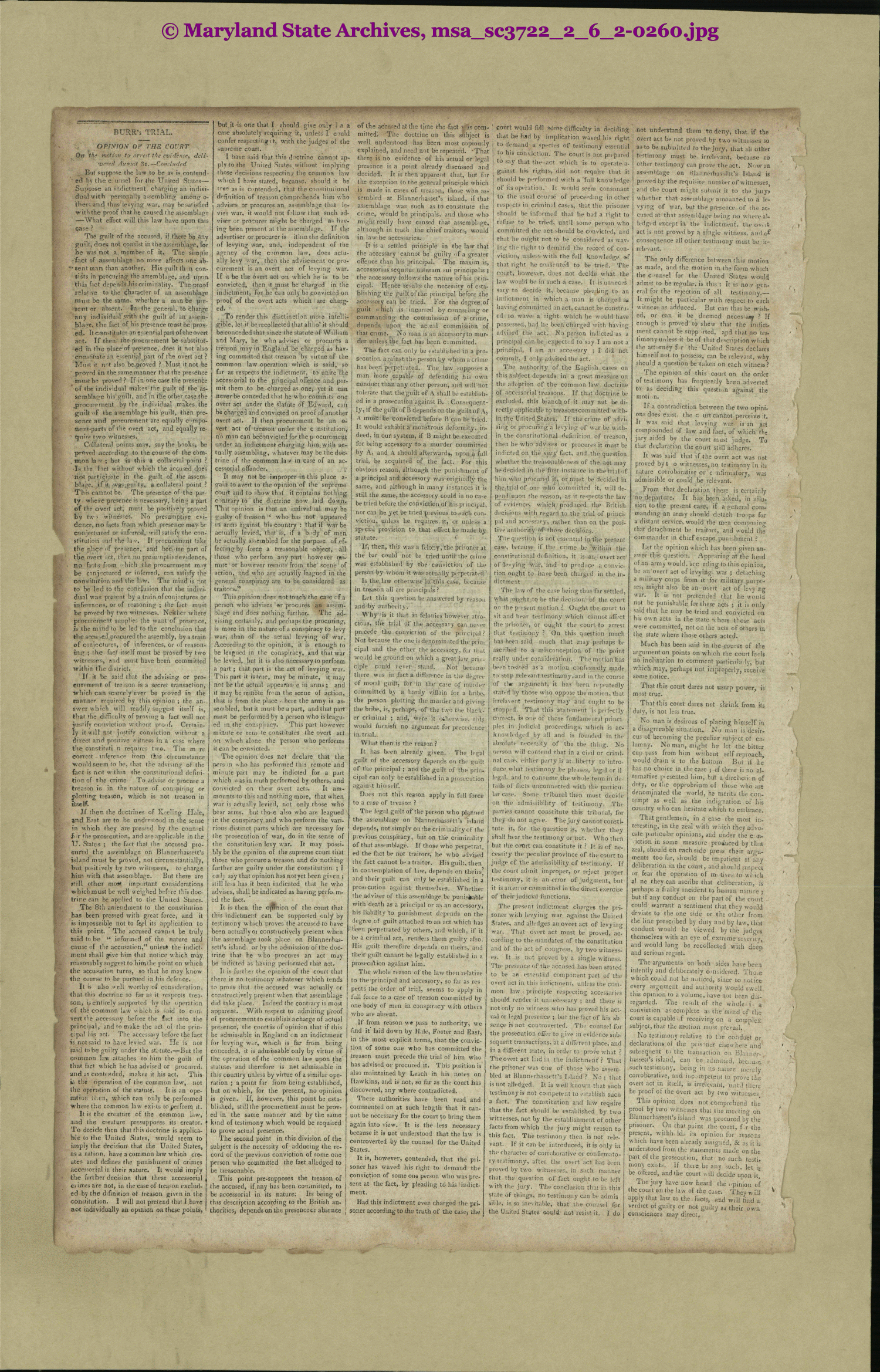
| BURR's TRIAL. oprmox of the court On the motion ty arrest the cvzdvnce, dcli- •verrrl Auottst 3i.— Concluded But suppose the law to he as is contend- ed hv the c. unsel for the United States— Suppose an indictment, charging an indivi- dual with personally assembling among o- thers and thus levying war, may be satisfied with the proof that he caused the assemblage —What effect will this lav/ have upon this case ? The guilt of the accused, it there be any guilt, does not consist in the assemblage, for he was not a member of it. The simple -'fact of assemblage no more affects one ab- *-Sent man than another. His guilt th h con- sists in procuring the assemblage, and upon, this fict depends his criminality. The proof relative to the character of an assemblage must be the same- whe'her a trnn be pre- sent or absent. In the general, to charge any individual with the guilt of an assem- blarre, the fact of his presence must he prov- ed. It constitutes an essential part of the overt act. IP then the procurement be substitut- ed in the place of presence, does it not also constitute an essential part of the overt act ? 'Must it nrt also be.proved ? Must it not be ¦ proved in the same manner that the presence must be proved ? If in one case the presence ' of the individual makes the. guilt oi the as- semblage his guilt, and in the other case the .procurement by the individual makes.the guilt of the assemblage his guilt, then pre- sence and procurement are equally c mpo- nent-parts of the overt act, and equally re- " quire two witnesses. Collateral points mav, say the books, be proved according to the course of the com- . mon la 1 ; but is this a collateral point ? •Is the foct without which the accused does not participate in the guilt of the assem biage, if it was^guilty, a collateral point ? This cannot be. The presence of the par ty where presence is necessary, leing a part of thp overt act, must be positively proved by tw > witnesses'. No presumptive evi- dence, no facts from, which presence may br Conjectured or inferred, will satisfy the con- stitution and the la v, II procurement take the place of presence, and become part of the overt act, then no presumptive evidence, no facts from hich the procurement may be conjectured or inferred, c?n satisfy the constitution and the law. The mind is not to be led to the conclusion that the indivi- dual was present by a train of conjectures or inferences, or of reasoning ; the fact must be proved by two witnesses. Neither where procurement supplies the want of presence, ,is the nnriid to be led to the conclusion that the accused procured the assembly, by a train of conjectures, of inferences, or of reason- ing ; the fact itself must be proved by two witnesses, and must have been committed within the district. If it he said that the advising or pro- curement of tre son is a secret transaction, which can scarcely ever be proved in the manner required by this opinion ; the an- swer which will readily suggest itself is, that the difficulty of proving a fact will not justify conviction without proof. Certain- ly it will not justify conviction without a direct and positive witness in a case where the constitnti n requires two. The m re Correct inference Irom this circumstance would seem to be. that the advising of the fact is not within the constitutional defini- tion of the crime To advise or procure a treason is in the nature of con .piring or plotting treason, which is not treason in itself. If then the doctrines of Keeling Hale, and East are to be understood in the sense in which they are pressed by the counsel for the prosecution, and are applicable in the U. States ; the fact that the accused pto- enred the assemblage on BlannerhasseU's island must be proved, not circumstantially, but positively by two witnesses, to charge him with that assemblage. But there are still other most important considerations whichmust be well weighed before thisdoc- Irine can he applied to the United States. The 8th amendment to the constitution has been pressed with great force, and it is imposssible not to feel its application to this point. The accused casne t be truly said to be " informed of the nature and cause of the accusation," unless the indict- ment shall prive him that notice which may reasonably suggest to him,the point on which the accusation turns, so that he may know the course to be pursued in his defence. It is also »eli worthy of consideration, that this doctrine so far as it respects trea- son, is entirely supported by (he operation ot the common law which is said to con- vert the accessary before the fact into the principal, and to make the act of the prin- cipal his act. The accessary before the fact is not said to have levied war. He is not said to be guilty under the sti tute.—But the common lav attaches to him the guilt of that fact which he has advised or procured. and as contended, makes it his act. This is the operation of the common law, not the operation ot the statute. It is an ope- ration then, which can only be performed where the common law exists to perform it. It is the creature of the common law, and the creature presupposes its creator. "To decide then that this doctrine is applica- J ble to the United Slates, would seem to imply the decision that the United Slates, as a nation, have a common law which cre- ates and defines the punishment of crimes accessorial in their nature. It would imply the further decision that these accessorial J ciime> are not, in the case of treason exclud- ed by the difinition ot treason given in the constitution. I will not pretend that lhave aot individually an opinion on these points, but it is one that I should give only ? it a of the accused at the time the fact \ .is com- ' court would fell some difficulty in deciding not understand them case absolutely requiring it, unless I could mittedi The doctrine on this subject is that he had by implication waved his right confer respecting it, with the judges of the well understood has been most copiously | to demand a sped supreme court. explained, and need not be repeated. 'That I have said that this doctrine cannot ap- there is no evidence of his actual or legal ply to the United States,without implying presence is a point already discussed and those decisions respecting toe common law which I havs stated, because, shou'd it be trae as is contended, that the constitutional definition of treason comprehends him who advises or procures an assemblage that le- vies war, it would not follow that such ad- viser or procurer might be charged as hav- ing been present at the assemblage. If the advertiser or procurer is ithin the definition of levying war, and, independent of the agency of the common law, does actu- ally levy war, then the advisement or pro- curement is an overt act of levying war. If it be the overt act on which he is to be convicted, then it must be charged in the indictment, for he can only be convicted on proof of the overt acts which are charg- ed. '¦ To render this disclinction more intelli- gible, letit be recollected thataltho' it should be conceded that since the statute of William and Mary, he who advises or procures a treason may in England be charged as hav- ing committ* d that treason by virtue of the common law operation which is said, so far as respects the indictment, to unite the decided. It is then apparent that, but for the exception to the general principle which is made in cases of treason, those who as- sembled at Blannerhasset's island, if that assemblage was such as to constitute the crime, would be principals, and those who might really have caused that assemblage, although in truth the chief traitors, would in law be accessaries. It is a settled principle in the law that the accessary cannot be guilty of a greater offence than his principal. The maxim is, accessorius sequitur naturam sui principalis ; the accessory follows the nature of his prin- cipal. Hence results the necessity of esta- blishing the guilt of the principal before the accessory can be tried. For the degree of guilt u hich is incurred by counseling or commanding the commission of a crime, depends, upon the aciual commission of that crime. No man is an accessory to mur- der unless the fact has been committed. The fact can only be established in a pro- secution against th" person by whom a crime has been perpetrated. The law supposes a ^^^^^^^^^^^^^^^^^^^^^_ . man inore capable of defending his own accessorial to the principal offence and per- ' con(illct than m other pmon^ a])d wi„ n,,t mit them to be charged as one, yet it can ^^^^^^^^^^^^^^^^^^^ ies of testimony essential to his conviction. The Courtis not prepared to say that the act which is to operate a- gajnst his rights, did not require that 'to deny, that if the overt act be not proved hy two witnesses so as to be submitted to the jury, that all other testimony must be irrelevant, because no other testimony can prove the act. Now an assemblage on i-la.ineihas ett's Island is should be performed with a full knowledge j proved by the requisite mini her of witnesses. never be conceded that he who commits one overt act under the slatute of Edward, can ba charged and convicted on proof of another overt act. If then procurement be ah o- vert act of treason under the c nstitution, no man can beconvicied for the p ocurement under an indictment charging hi in wilh ac- tually assembling, whatever may be the doc- trine of the common lav in case of an ac- cessorial offender. It may not be improper in this place a- gain to avert to the opinion of the supreme conft and to show that it contains nothing contrary to the d ictrine now laid down. That opinion is that an individual may be g.ulty of treason ' who has not appeared in arms against his country : 'that if War be acdially levied, that is, if a b dy of men be actually assembled for the purpose of ef- fecting by force a treasonable object, all those who perform any part however mi- nute ' or however remote from the scene' of action, and who are actually leagued in. the general conspiracy are to be considered as traitors." This opinion does not touch the case of a person who advises »r procures an assem- blage and does nothing further. The ad- vising certainly, and perhaps the procuring, is more in the nature of a conspiracy to levy war, than of the actual levying of war. According to the opinion, it is enough to be leagued in the conspiracy, and that war be levied, but it is also necessary to perform a part ; that part is the act of levying war. This part it is true, may be minute, it may not be the actual appearan e in arms; and it may be remote from the scene of action, that is from the place • here the army is as- sembled, but it must be a part, and that part must be performed by a person who is leagu- ed in, the conspiracy. This part however minute or rem te constitutes the overt act on winch alone the person who performs it can be convicted. The opinion does not declare that the pers 'n ivho has performed this remote and minute part may be indicted for a part which was in truth performed by others, and convicted on their overt acts. It am- mounts to this and nothing more, that when war is actually levied, not only those who bear arms, but tho-e also who are. leagued in the conspiracy and who perform the vari- rious distinct parts which arc necessary for the prosecution of war, do in the sense of the constitution levy war. It may possi- bly be the opinion of the supreme court that those who procure a treason and do nothing further are guilty under the constitution ; I only say that opinion has not yet been given ; still less has it been indicated that lie who advises, shall be indicated as having perfo. m- ed the fact. It is then the opYnion of the court that this indictment can be supported only" by testimony which proves the accused to have been actually oi constinctively present when the assemblage took place on Blannerhas- sett's island, or hy the admission of the doc- trine that he who procures an act may be indicted as having performed that act. L is further the opinion of the court that there is no testimony whatever which tends to prove that the accused was actually or constructively present when that assemblage did take place. Indeed the contraiy is most apparent. With respect to admiting proof of procurement to establish acharge of actual presence, the court is of opinion that if this be admissable in England on an indictment for levying war, which is far from being conceded, it is admissable only by virtue of the operation of the common law upon the staiute, and therefore is n*t admissable in this country unless by virtue of a similar ope- ration ; a point far from being established, but on which, for the present, no opinion 1 discovered, any where contradicted is given. If, however, this point be esta- blished, still the procuiement must be prov- ed in the same manner and by the same kind of testimony which would be required to prove actual presence. The second point in this division of the subject is the necessity of adducing the re- cord of the previuus conviction of some one person who committed the fact alledged to be treasonable. This point pre-supposes the treason of the accused, if any has been committed, to be accessorial in its nature: Its being of this description according to the British au- tolerate that the guilt of A shall be establish- ed in a prosecution against B. Consequent- ly, if the guilt of B depends on the guilt of A, A muSt be convicted before B can be tried. It would exhibit a monstrous deformity, in- deed, in our system, if B might be executed for being accessory to a murder committed by A, and A should afterwards, npon.a hill trial, be acquitted of the fact. For this obvious reason, although the punishment of a principal and accessory was originally the same, and although in many instances it is still the same, the accessory could in no case be tried before the conviction of his principal, nor can he yet be tried previous to such con- viction, unless he requires it, or unless a special provision to that effect be made by statute. If, then, this was a felony, the prisoner at the bar could not be tried until' ihe crime was established by the conviction of the person by whom it was actually perpetrati d. Is the law otherwise in this case, becatise in treason all are princip ds ? Let this question be answered by reason and by authority. Why is it that in felonies however atro- cious, the frjal of the accessary can never precede the conviction of the principal ? Not because the one is denominated the prin- cipal and the ether the accessory, fcr that would be ground on which a great law prin- ciple could never stand. Not because there was in fact a difference in the degree of moral guilt, for in the case of murder committed by a hardy villain for a bribe, the person plotting the murder and giving the bribe, is, perhaps, of the two the black- er criminal ; and, were it otherwise, tills would furnish no argument for precedence in trial. What then is the reason ? It has been already given. The legal guilt of tbe accessory depends on the guilt of the principal ; and the guilt of the prin- cipal can only be established in a piostcution against himself. Does not this reason apply in fill force to a case of treason ? The legal guilt of the person who planned the assemblage on Blannerhassett's inland depends, not simplv on the criminality of the previous conspiracy, but on the criminality of that assemblage. If those who perpetrat. ed the fact be not traitors, he who advised the fact cannot be a traitor. His guilt, then in contemplation of law, depends on theirs and their guilt can only be established in a prosecution against themselves. Whether ihe adviser of this assemblage be punishable with death as a principal or as an accessory, his liability to punishment depends on the degree cf guilt attached to an act which has been perpetrated by others, and which, if it be a criminal act, renders them guilty also. His guilt therefore depends on theirs, and their guilt cannot be legally established in a prosecution against him. The whole reason of the law then relative to theprincipal and accessory, so far as res peels the order of trial, seems to apply in full force to a case of treason committed by one body of men in conspiracy with others wdio are absent. If from reason we pass to authority, we find it' laid down by Hale, Foster and East, in the most explicit terms, that the convic- tion of some one who has committed the treason must precede the trial of him who has advised or procured it. This position is also maintained by Leach in his notes on Hawkins, and is not, so far as the court has These authorities have been read and commented on at such length that it can- uot be necessary for the court to bring them again into view. It is the less necessary because it is aot understood that the law is controverted by the counsel for the United States. It is, however, contended, that the pri- soner has waved his right to demand the conviction of some on« person who was pre- sent at the fact, by pleading to his indict- ment. Had this indictment even charged the pri- thoritics, depends on the presence or absence J soner according to the truth of the case, the of its operation.' It would seem consonant to the usual course of proceeding in other respects in criminal cases, that the prisoner should be informed that he had a right to refuse to be tried, until some person who committed the act should be convicted, and that he ought not to he considered as wav- ing the right to demand the record of con- viction, unless with the full knowledge of that right he consented to be tried. The court, however, does not decide what the law would be in such a case. It is utitiec?S sary to decide it, because pleading to an indictment in which a man is charged as having committed an act, cannot be constru- ed 10 w-ave a right which he would have possessed, had he been charged with having advised the act. No person indictedas a principal can be expected to say I am not a principal, I am an accessary ; I did not commit, 1 only advised the act. The authority of the English cases on this subject depends In a great measure on the adoption of the common law doctrine of accessorial treasons. If that doctrine be excluded, this branch of it nray not be di- rectly applicable to treasons committed with- in the United States. If the crime of advi- sing or procuring a levying of war be with- in the constitutional definition of treason, then he who advises or procures it must be indicted on the very fact, and the question whether the treasonableness of the aot may be decided in the first instance in the trial of him who procured it, or must be decided in the trial of one who committed it, will de- pend upon the reason, as it respects the law of evidence, which produced the British decisions with regard to the trial of princi- pal and accessary, rather than on the posi- tive authority of'those decisions.. Tiie question is not essential in toe present case, because if the crime be within the constitutional definition, it is an overt act of levying war, and to produce a, convic- tion ought to have beeh charged in the in- dictment The law of the case being thus far settled, what pjjghi to be the decision of the court Oil the present motion ? Ought tbe court to sit and hear testimony which cannot affect the prisoner, or ought the court to arrest that testiii.ony ? On this question much has been said much that may perhaps be ascribed to a misconception of the point really under consideration. The! motion has been treated as a motion confessedly made to stop relevant testimony, and in the course of tl*' argument, it has been repwrtadly stated by those who oppose the motion, that irrelaveirt testimony may and ought to be Stopped. That this statement is perfectly correct, is one of those fundamental princi pies in judicial proceedings, which is ac- knowledged by all and is founded in the absolute necessity of the the thing. No person will contend that in a civil or crimi- nal case, either party is at liberty to intro- duce what testimony he pleases, legal or il legal, and to consume the whole term in de tails of facts unconnected with the particu- lar case. Some tribunal then must decide on the admissibility of testimony. The parties cannot constitute this tribunal, for they do not agree. The jury cannot consti- tute it, for the question is, whether they shall hear the testimony or not. Who then but the court can constitute it ? It is of ne- cessity the peculiar province of the court to judge of the admissibility of testimony. If the court admit improper, or reject proper testimony, it is an error of judgment, but it is alienor committed in tile direct exercise of their judicial functions. The present indictment charges the pri- soner with levying war against the United States, and alledges an oveet act of levying war. That overt act must be proved, ac- cording to the mandates of the constitution and of the act of congress, by two witness- es. It is not proved by a single witness. The presence of the accused has been stated to be aw essential component part of the overt act in this indictment, unless the com- mon law principle respecting accessaries should render it unnecessary ; and there is notonly no witness who has proved his act- ual or legal presence ; but the fact of his ab sence rs not controverted. The counsel for the prosecution offer to give in evidence sub- sequent transactions, at a different place, and in a different state, in Order to prove what ? The overt act laid in the indictment ? That the prisoner was one of those who assem- bled at Blannerhassett's Island ? No ; that is not alledged. It is well known that such testimony is not competent to establish such a fact. The constitution and law require that the fact should be established by two witnesses, not by the establishment of other facts from which the jury might reason to this fact, The testimony then is not rele- vant. If it can be introduced, it is only in the character of corroborative or confirmato- ry testimony, after the overt act has been proved by two witnesses,, in such manner that the question of fact ought to be left with the jury. The conclusion that in this state of things, no testimony can be admis sihle, is so inevitable, that the counsel for the United States oould not resist it. , I do and the court might submit it to the juiy> whether that assemblage amounted to a le- vying of war, but the presence of the ac- cused at that assemblage being no where al- ledged except in the indictment, theov.it act is not proved by a single witness, and o^ consequence all other testimony must be ir- relevant. The only difference between this motion as made, and the motion in the form which the c -unsel for the United States would admit to be regular, is this : It is no.v gen- eral for the rejection of all testimony.— It might be particular with respect to each witness as adduced. But can this he wish- ed, or can it be deemed neces-, W If enough is proved to shew that the indict- ment cannot be supp .rted, and that no tes- timony unless it be of that description which, the attorney f r the United States declares himself not to possess, can be relevant, why should a question be taken on each witness? The opinion of this court on the order of testimony has frequently been adverted to as deciding this question against the tnoti n. If a contradiction between the two opini- ons does exist, the c urt cannot perceive it. It was said that levying war is an act compounded of law and fact, of which the jury aided by the court must judge. To that declaration the court still adheres. It was said that if the overt act was not proved byt o witnesses, no testimony in its nature corroborative or c nfirmatory, w^s admissible or could be relevant. From that declaration there is certainly no departure. It has been asked, in allu- sion to the present case, if a general com- manding an army should d.itach tro ops for a distant service, would the men composing that detachment be traitors, and *ould the commander in chief escape punishment ? Let the opinion which has been given an- swer this question. Appearing at the head of an army would, ace rding to this opinion, be an overt act of levying war ; detaching a military corps fiom it for military purpo- ses, might also be an overt act of levy ng war. It is not pretended that he would not be punishable for these acts ; it is only said that he may be tried and convicted on his own acts in the state where those acts were committed, not on ilie acts of others in the, state where those others acted. Much has been said in the course of the argument on points on which the court hols no inclination to comment particnlaily, but which may, perhaps not, improperly, receive some notice. That this court dares not usurp power, is most true. That this court dares net shrink from its duly, is not less true. No man is desirous of placing himself in a disagreeable situation. No man is desir- cus of becoming the peculiar subject of ca. himny. No man, might he let the bitter Cup.pass from him without self reproach, would drain it to the bottom. But il he has no choice in the case ; if there is no al- ternative presented him, but a direhction of duty, or the opprobrium of those who are denominated the world, he merits the con- tempt as well as the indignation of his country who can hesitate which to embrace. That gentlemen, in a case the most in- teresting, in the zeal with which they advo- cate particular opinions, and under the c n- iction in some measure produced by that aeal, should on each side press their argu- ments too far, should be impatient at any deliberation in the court, and should suspect or fear the operation of in. tives to which al ne they can ascribe that deliberation, is peihaps a frailty incident to human nature ; but if any conduct on the part of the court could warrant a sentiment that they would deviate to the one side or the other from the line prescribed by duly and by law, that conduct would be viewed by the judges themselves with an eye of extreme seventy, and would long be recollected with deep and serious regret. The arguments on both sides have been intently and deliberately feunsidered. Those which could not be noticed, since to notice every argument and authority would swell this opinion to a volume, have not been dis- regarded. The- result of the whole i a conviction as complete as the mind of the court is capable of receiving on a complex subject, that the motion must prevail* No testimony relative to tbe conduct or declarations ot the prisoner elsewhere and subsequent to the transaction on Blamier-,: hasseti's island, can be admitted, such testimony, being in its nature corroborative, and incompetent to prove the overt act in itself, is irrelevant, until there be proof ot the overt act by two witnesses. This opinion does not comprehend the prool by two witnesses that the mectiniJ on Blannerhassett's island was procured by the prisoner. On that point the court, f ,r the present, wilhh Ids its opinion for reasons which have been already assigned, & as it is understood from the statements made on the part of the prosecution, that no such tt:t.ti. mony exists, if there be any such, let it be offered, and the court will decide upon it. Toe jury have now heard the opinion of the court on the law of the case. They will apply that law to the facts, and will find a verdict of guilty or not guilty as their own consciences may direct. oec::usc merely |