 |
|
|
 |
|
 |
|
|||
|
||||
|
||||
|
Federal Gazette & Baltimore Daily Advertiser 1807/07-1807/12 msa_sc3722_2_6_2-0286 Enlarge and print image (5M) |
|
|
|
|
|
|
|
|||
|
||||
|
||||
|
Federal Gazette & Baltimore Daily Advertiser 1807/07-1807/12 msa_sc3722_2_6_2-0286 Enlarge and print image (5M) |
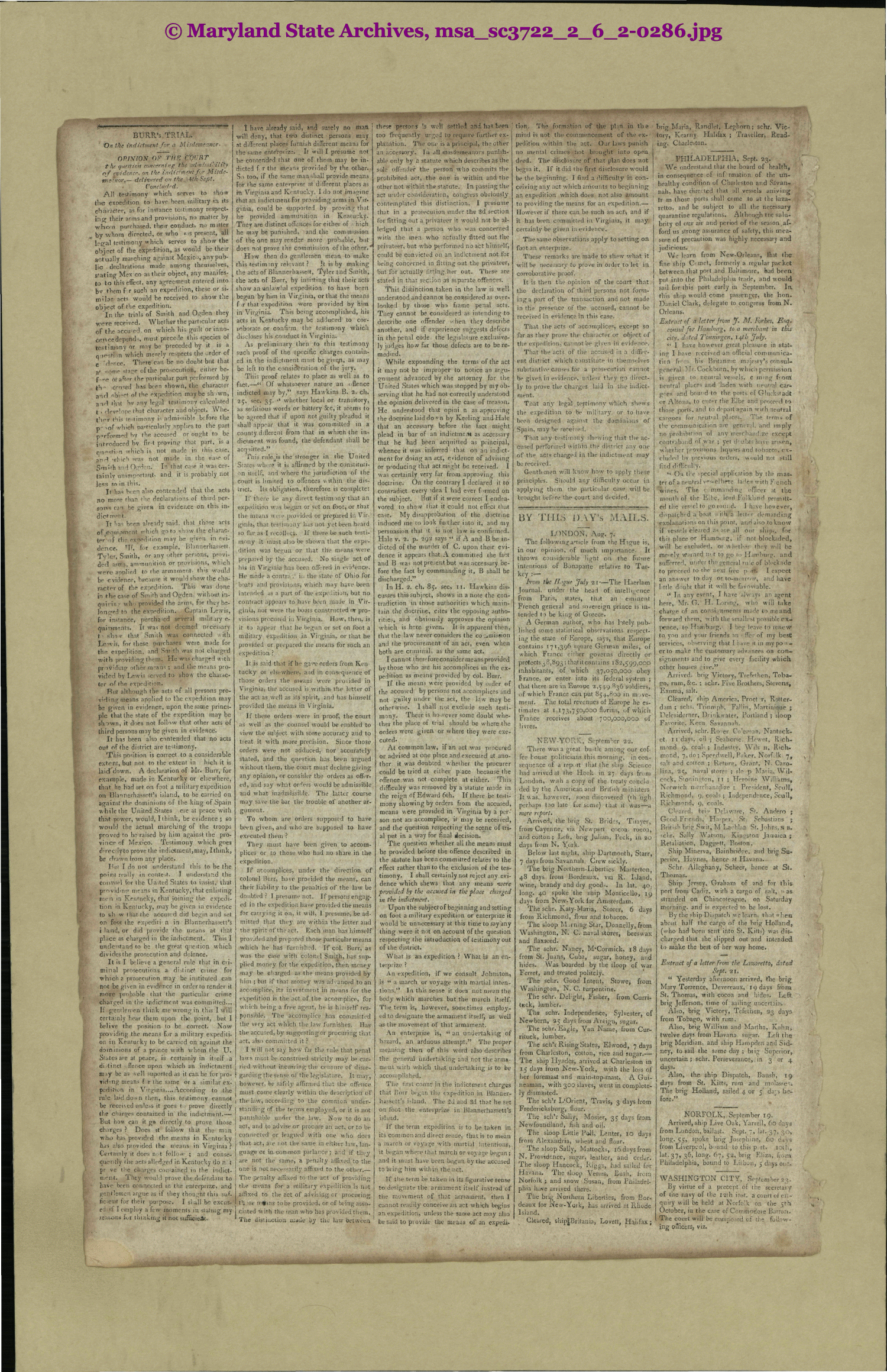
| . BURR's TRIAL. On the indictment for a Misdemeanor- OPINION OF THE CXSVRT t-fie question concerning the admissibility of evidence, on the indichnentfur Misde- rjieenor.— delivered on the fAth Sept. Concluded. All testimony which serves to show the exDedition to have been military i:i its character, as for instance testimony respect- ing their arms and provisions, no matter by whom purchased, their conduct, no mitter by whom directed, or who * is present, all legal testimony which serves to show the object of the expedition, as would be their actually marching against Mexico, any pub- lic declarations made among themselves, s*ating Mex co as their object, any manifes- to to this effect, any agreement entered into bv them f r such an expedition, these or si- milar acts would be received to show the object of the expedition. "In the trials of Smith and Ogden they were received. Whether the particular acts of the accused, on which his guilt or inno- cence depends must precede this species of testimony or may be preceded by it is a qnestion'which merely respects the order of e 'rl"nce. Theie can be no doubt but that ai .^me starve of the prosecution, either be- f ¦•"<=¦ orarter the particular part performed by ih~ idfnsed has been shown, the character and object of the expedition maybe shown, z\e\ that hv any legal testimony calculated t . develope that character and object. Whe- ther this testimony i- admissible b( fore the p- -of which particnktly applies to the part p-rformed by the accused or ought to be introduced bv fir-t proving that part, is a qnfstinn which is not made in this case. Mir} which was not made in the case of S-ni>h and Ogden. In that case it was cer- tainly unimportant- and it is probably not less so in this. It lias hi en also contended that the acts no mn'e than the declarations of third per- sons ran be gives in evidence on this in- dic'm¦" ' Tt has been already said, that those arts of Equipment which goto show the charac- ter' j" th> expedition may he given in evi- dence. 'If, for example. Blannerhassett Tyler, Smith, or any "ther persons, provi- ded arms, ammunition or provisions, which ¦were applied to the armament, this would he evidence, because it would show the cha- racter of the expedition. This was done in the case of Smith andOpden. without in- qnirin wba provided the arms, for they be- longed to the expedition. Captain Lewis, for instance, purchased several military e- quinments. It was not deemed, necessary t' sho v that Smith was connected ¦ ith Le-vis, for these purchases were made for the expedition, and Smith was nit charged with providing them. He was charged with prov;din? other means ; and the means pro- vided by Lewis served to show the charac- ter of the expedition. But although the acts of all persons pro- ving means applied to the expedition may be given in evidence, upon the same princi- ple that the state of the expedition may be shown, it does not follow that other acts of third persons may be given in evidence. It has been also contended that no acts out nf the district are testimony. This position is correct to a considerable extent, but not to the extent in hich it is laid'down. A declaration of Mr. Burr, for example, made in Kentucky or elsewhere, that he had set on foot a military expedition on Dlannerhassett's island, to be carried on against the dominions of the king of Spain ¦while the United States ere at peace with that power, would, I think, be evidence ; so would the actual marching of the troops proved to be raised by him against the pro- vince of Mexico. Testimony which goes ehrecltyto prove the indictment,may, I think, be drawn from any place. Lnt I do not understand this to be the point really in contest. I understand the counsel lor the United States to insist, that prnvidinf means in Kentucky, that enlisting ir.t-n in Kentucky, that joining the expedi- tion in Kentucky, may be given in evidence to sh w that the accus< d did begin and set on foot the expedite n in Blannorhassett's i land, or did provide the means at that place as charged in the indictment. This I understand to be the great question which divides the prosecution and defence. It is I believe a general rule that in cri- minal prosecutions a distinct Crime for which a prosecution may be instituted can not be given in evidence in order to render it more probable that the particular crime charged in the indictment was committed... If gentlemen think me wrong in this I will certainly hear them upon the point, but I belive the position to be correct. Now providing the means for a military expediti- on in Kentucky to be carried on against the dominions of a praice with whom the U. States are at peace, is certainly in itself a distinct offence upon which an indictment niay be as veil snported as it can be for pro- viding means f,r the same or a similar ex- pedition in Virginia....According to the rule laid do*n then, this testimony cannot be received unless it goes t prove directly the? charges contained in the indictment.— But how can it g9 directly to prove those charges ? Does it follow that the man who has provided the means in Kentucky has also piovided the trjeans in Virginia? Certainly it does not follow ; and conse- quently the acts aftedged in Kentucky do n t pr ve the charge;; contained in the indict- ment. They would prove the defendant to Lave been connected in the enterprize, and gentlemen argue as if they thought this suf- ficient for their purpose. I shall be exce.s- ed if I employ a few moments in stating my reasons Lt thiaking it not sufficient- 1 have already said, and surely no matt will deny, that tveo distinct persons may at different places furnish different means for the same enterprize. It will I presume not be contended that one of them may be in- dicted f r the meaiis provided by the other. So too, if the same man shall provide means for the same enterprise at different places as in Virginia and Kentucky. I do not imagine that an indicttnent for providing arms in Vir- ginia, could be supported by proving that he provided ammunition in Kentucky. They are distinct offences for either of hich he may be punished, and the commission of the on; may render more probable, but does not prove the commission of the other.* Hiw then do gentlemen mean to make this testimony relevant ? It is by making the acts of Blannerhassett, Tyler and Smith, the acts of Burr, by insisting that their acts show an unlawful expedition to have been begun by him in Virginia, or that the means f r that expedition were provided by him in Virginia. This being accomplished, his acts in Kentucky may be adduced to cor- roborate or confirm, the testimony which discloses his conduct in Virginia. As preliminary then to this testimony such proof of the specific charges contain- ed in the indictment must be givtyi, as may be left to the consideration of the jury. This proof relates to place as well as to fact.—" Of whatsoever nature an oflence indicted may by," says Hawkins B. 2. ch. 25. sec. 35. '' whether local or transitory, as seditious words or battery Sec, it seems to be agreed that if upon not guilty pleaded it shall appear that it was committed in a county different from that in which the in- dictment was found, the defendant shall be acqoitted." This rnlejs the stronger in the United States where it is affirmed by the constituti- on itself, and where the jurisdiction of the court is limited to offences uithin the dis- trict. Its obligation, therefore is complete: II' there be any direct testimony that an expedition was i.e,;ii'i or set on foot, or that the means were provided or prepared in Vir- ginia, that testimony has not yet been heard so far as I recolhct. If there be such testi- mony it must also be shown that the expe- dition was begun or that the means were prepared by the accused. No single act of his in Virginia has been 0 .To red in evidence. He made a contra .' in the state of Ohio for boats and provisions, which may have been intended as a part of the expedition, but no contract appears to have been made in Vir- ginia, nor were the boats constructed or pro- visions procured in Virginia. How, then, is it to appear that he begun or set on foot a military expedition in Virginia, or that he provided or prepared the means for such an expedition ? It is said that if he gave orders from Ken tucky or elsewhere, and in consequence of those orders the enwans were provided in Virginia, the accused is within the letter of the act as well as its spirit, and has himself provided the means in Virginia. If these orders were in proof, the court as well as the counsel would be enabled to view the subject with some accuracy and to tieat it with more precision. Since those orders were not adduced, nor accurately stated, and the question has been argued without them, the court must decline giving any opinion, or consider the orders as offer- ed, and say what orders would be admissible and what inadmissible. The latter course may save the bar the trouble of another ar- gument. To whom are orders supposed to have been given, and who are supposed to have executed them ? They must have been given to accom- plices or to those who had no share in the expedition. If accomplices, under the direction of colonel Butt, have provided the means, can their liability to the penalties of the law be doubted? I presume not. If persons engag- ed in the expedition have provided the means for carrying it on, it will, I presume, be ad- mitted that they are within the letter and the spirit of the act. Each man has himself provided and prepared those particular means which he has furnished. If col. Burr, as was the case with colonel Smith, has sup- plied money for the expedition, then money may loe charged as the means provided by him ; but if that money was advanced to an accomplice, its investment in means for the expedition is the act of the accomplice, for which being a free agent, he is himself res- ponsible. The accomplice has committed the very act which the law furnishes. Has the accused, by suggesting or procuring that act, also committed it ? I will not say how far the rule that penal laws must be construed strictly may b» car- ried without incurring the censure of disre- garding the sense 01" the legislature. It may, however, be Safely affirmed that the offence must come clearly within the description of 1 the law, according to the common under- standing of the terms employed, or it is not punishable under the law. Now to do an act, and to advise or procure an act, or to be connected or leagued with one who does that act, aie not the same in either law, lan- guage or in,gomroon parlance; and if they are not the same, a penalty affixed to the one is not necessarily affixed to the other.__ The penalty affixed to the act of providfflg the means for a military expedition is not affixed to the act of advising or procuring th sse mtjans to be provided, or of being ciated with the man who has provided them. The distinction uuue by the law between these persons !s well settled and. has been too frequently urged to require further ex- planation. The one is a principal, the other an accessory. In all misdemeanors punish- able only by a statute which describes as the sole offender the person who commits the prohibited act, the one is within and the other not within the statute. In passing the act under consideration, congress obviously contemplated this distinction. I presume that in a prosecution under the 3d section for fitting out a privateer it would not be al- ledged that a person who was concerned with the men who actually fitted out the privateer, but who performed no act himself, could be convicted on an indictment not for being concerned in fitting out the privateer, but for actually fitting her out. These are stated in that see'don as separate offences. This distinction taken in the law is well understood and cannot be cossideredas over- looked by those who frame penal acts. Toey cannot be considered as intending to describe one offender when they describe another, and if experience suggests defects in the penal code, the legislature exclusive- ly judges how far those defects are to be re- medied. While expounding the terms of the act it may not be improper to notice an atgu- gurnent advanced by the attorney for the United States which was stopped by my ob- serving that he had not correctly understood the opinion delivered in the case of treason. He understood that opiui n as approving the doctrine laid do "n by Keeling and Hale that an accessary before the fact might plead in bar of an indictment as accessary that he had been acquitted as principal, whence it was inferred that on an indict- ment for doing an act, evidence of advising or producing that act might be received. I was certainly very far from approving this doctrine. On the contrary I declared it to contradict every idea I had ever Formed on the subject. But if it were correct I endea- vored to show that it could not effect that case. My disapprobation of the doctrine induced me to look further into it, and my persuasion that it is not law is confirmed. Hale v. 2. p. 292 says •' if A and B be in- dicted of the murder of C. upon their evi- dence it appears that A committed the fact and B was not present but was accessary be- fore the fact by commanding it, B shall be discharged." In H. 2. ch. 85. sec, 11. Hawkins dis- cusses this subject, shows in a note the con- tradiction in those authorities which main- tain the doctrine, cites the opposing autho- rities, and obviously approves the opinion which is here, given. It is apparent then, that the law never considers the co amission and the procurement of an act, even when both are criminal, as the same act. I cannot thenforeconsider means provided by those who are his accomplices in the ex- pedition as means provided by col. Burr. If the means were provided by oider of the accused by persons not accomplices and not guilty under the act, the law may be otherwise. I shall not exclude such testi- mony. There is however some doubt whe- ther the place of trial should be where the orders were given or where they were exe- cuted- At common law, ifanactwas procured or advised at one place and executed at ano- ther it was doubted whether the procurer could be tried at either place because the offence was not complete at either. This difficulty was removed by a statute made in the reign of Edward 6th. If there be testi- mony showing by orders from the accused, means were provided in Virginia by a per-' son not an accomplice, il may be received, and the question respecting the scene of tri- al put in a way for final decision. The question whether all the means must be provided belore the offence described in the statute lias been committed relates to the effect rather than to the exclusion oi the tes- timony. I shall certainly not reject any evi- dence which shews that any means tvere provided by the accused in the place charged in the indictment. Upon the subject of beginning and setting on foot a military expedition or enterprize it would be unnecessary at this time to say any thing were it not on account of the question respecting the introduction of testimony out of the district. What is an expedition ? What is an en- terprize ? An expedition, if we consult Johnston, is u a march or voyage with martial inten- tions." In this sense it does not mean the body which marches but the march itself. The term is, however, sometimes employ- ed to designate the armament itself, as well us the movement of that armament. An enterprize is, " an undertaking of bastard, an arduous attempt." The proper meaning then of this word also describes the general undertaking and not the arma- ment with which that undertaking is to be accomplished. Trie first count in the indictment charges that Burr began the expedition in Blanner- hassett's i.-iand. The 2d and 3d that he set on foot the enterprize in Blannerhassett's island. If the term expedition is to be taken in its common and direct sense, that is to mean a march or voyage with martial intentions, it began where that march or voyage begun ; and it must have been begun by the. accused to bring him within the act. if the term he taken in its figurative sense to designate the armament itself instead of the movement of that armament, then I cannot readily conceive an act which begins an expedition,, unless the same act may also, be said to provide the niea.is of an expedi- tion. The formation of the plan in the mind is not the commencement of the ex- pedition within the act. Oar laws punish no mental crimes not brought into open deed. The disclosure of that plan does not begin it. If it did the first disclosure would be the beginning. I find a difficulty in con- ! ceiving any act which amounts to beginning an expedition which does not also amount j to providing the means for an expedition.— However if there can be such an act, and if j it has been committed in Virginia, it may j certainly be given in evidence. The same observations apply to setting on foot an enterprize. These remarks are made to shew what it will he necessary to prove in order to let in corroborative proof. It is then the opinion of the court that the declaration of third persons not form- ing a part of the transaction and not made ia the presence of the accused, cannot be received in evidence in this case. That the acts of accomplices, except so far as they prove the character or object of the expedition; cannot be given in evidence. That the acts of the accused in a differ- ent district which c institute in themselves substantive causes for a prosecution cannot be given in evidence, unless they go direct- ly to prove the charges laid in the indict- ment. Tnat any legal testimony which shews the expedition to be military, or to have been designed against the dominions of Spain, maybe received. That any testimony shewing that the ac- cused performed within the district any one of the acts charged in the indictment may be received. Gentlemen wdll know how to apply these principles. Should any difficulty occur in applying them the particular case will be brought, before the court and decided. BY THIS DAY's MAILS. LONDON, Aug. 7. The following article from theHigue is, in our opinion, of much importance. It throws considerable light on the future intentions of Bonaparte relative to Tur- key :¦— brom the Il'gue July 21—The Haerlam Journal, under the head of intelli once from Paris, states, that an eminent French general and sovereign prince is in- tended to be king of Greece. A German author, who has lately pub- lished some statistical observations respect- ing the state of Europe, says, that Europe contains 171,396 square German miles, of which France ( i her governs directly or protects j 8,893: that it contains 182,599,000 inhabitants, of which 37,050,000 obey trance, or enter into its federal system ; that there are in Europe 2,54.9 R36 soldiers, of which France can put 85a.,800 in move- ment. The total revenues of Europe he es- timates at 1,173,750,000 florins, of which France receives about 700,000,000 of 1 ivies. NEW-YORK, Septem'-er 22. There was a great bustle among our cof- fee bouse politicians this morning, incon- sequence of a report that the ship Science had arrived at the Hook in 27 days from London, with a copy of the treaty conclu ded by the American and British ministers It was, however, soon discovered (th ugh perhaps too late for some) that it was—a mere report. Arrived, the brig St. Brides, Thayer, from Cayenne, via New-pert cocoa, rocoa, and cotton; Left, brig Julian, Peck, in 20 days from N. York. Below last night, ship Dartmouth, Starr, 7 clays from Savannah. Crew sickly. The brig Northern-Liberties MaMcrton, 48 days from Bordeaux, via R. Island, wine, brandy and dry goods. In lat. 40 long. 40 spoke the ship Monticello, 19 days from New-York for Amsterdam. The schr. Katy-Maria, Storer, 6 days from Richmond, flour and tobacco. The sloop Morning Star, Donnelly, from Washington, N. C. naval stores, beeswax and flaxseed. The schr. Nancy, M'Cormick, 18 days from St. Juans, Cuba, sugar, honey, and hides. Was boarded by the sloop of war Ferret, and treated politely. The schr. Good Intent, Stowe, from Washington, N. C. turpentine. The schr. Dehght, Fisher, from Curri- tuck, lumber. The schr. Independence, Sylvester, of Newborn, 25 days from Antigu, sugar. The schr. Eagle, Van Name, from Cur- rituck, lumber. The sch'r Rising States, Elwood, 7 days from Charleston, cotton, rice and sugar.— The ship Hyades, arrived at Charleston in 15 days from New-York, with the loss of her foremast and main-top-mast. A Gui- neaman, with 300 slaves, went in complete- ly dismasted. The sch'r L'Orient, Travis, 3 days from Fredericksburg, flour. The sch'r Sally, Mosier, 35 days from Newfoundland, fish and oil. The sloop Little Pull, Lenter, 10 days from Alexandria, wheat and flour. The sloop Sally, Mattocks, 16 days from N. Providence, sugar, leather, and cedar. The sloop Hancock, Riggs, had sailed for Havana. The sloop Venus, Bush, from Norfolk ; and snow Susan, from Philadel- phia have arrived ihcre. The brig Northern Liberties, from Bor- deaux for New-York, has arrived at Rhode Island. Cleared, ship|Britania, Lovett, Halifax; brig Maria, Randlet, Leghorn; schr. Vic- tory, Kearny Halifax ; Traveller, Read- ing, Charleston. PHILADELPHIA, Sept. 23. We understand that the board of health, in consequence of inf rmation of the un- healthy condition of Charleston and Savan- nah, have directed that all vessels arriving tr in those ports shall come to at the laza- retto, and be subject to all the necessary quarantine regulations. Although tne salu- brity of our air and period of the season,af- ford us strong assurance of safety, this mea- sure of precaution was highly necessary and judicious. We learn from New-Orleans, that the fine ship C< met, formerly a regular packet between tliat poit and Baltimore, had been put into the Philadelphia trade, and would sail for this port early in September. In this ship would come passenger, the hon. Daniel Clark, delegate to congress from N. Orleans. Extract of a letter from J. M. Forhes, Esq. consul for Hamburg, to a merchant in this city, doted Tonnivgen, 14//0 July. " 1 have however gicat pleasure in stat- injr I have received an official communica- tion IV'-fi his Britannic majesty's consul- general Mr.Cockbtifa, by which permission is given to neutral vessels, c inmg from neutral places and 'laden with neutral car- gees antI boned to the ports of Gtuckstadt or Altona, to enter the Eibe and proceed to those ports, and to depart ajain with neutral cargoes for neut'al places. The term* of the communication are gem r.d. and imply no prohibition of any mercfiand.ze except contraband of war ; yet doubts have arisen, whether piovisions liquors and tobacco, ex- cluded by previous orders, would not still find difficulty. '• On the special application by the mas- terof a neutral vsneHifTe laden with Fetich wines. The c mmanding officer at the month of the Eilc. lord Folkland permitt- ed the ves'c! to jjoiou: d. I have however, dispatched a boat v. ith. a letter demanding explanations on this point, and aiso to know if vessels clc.ned as are all our ships for this place or Hamburg, if not blockaded, will be excluded, or vVbetbeSi they will be merely warned net to go to Hamburg, and snffcrrcd, under the;general rule of blockade to proceed to the next U\^ p ,rt. I expect an answer to day or to-morrow, and have little doubt that it will be favovrable. " In any evpnt, I have always an agent here, Mr. O. H. Loring, who will take charoe of an consignments made to mcand forward them, with the smallest possible ex- pence, to Hamburg.. I beg leave to lenevv to you and your friends an tier of my best services, observing that I have it in my po •• - er to make the customary .ulv inees on con- signments and to give every facility which other houses aive." Arrived, brig Victory, Trefethen, Toba- go, rum, &c. ; schr. Five Brothers, Stevens, Exnma, salt. Cleared, ship America, Proct r, Rotter- dam ; schs. Triumph, Fallin, Martinique ; IVlcsidcrner, Drink water, Portland; sloop Favorite, Keen Savannah, Arrived, schr. Roer Co'sman; Nantuck- et. 11 days, o'l ; Seahorse. Hewet, Rich- mond 9. coal- ; Industry, Wils 11, Rich- mond, 7,do; Speedwell, Baker. Norf.lk 7, salt and cotton. ; Return, Grant. N. Caro- lina, 2?, naval store'' ; slo p Maria, Wil- cock, Ston'ington, 11 ; Heroine Williams, Norwich m< trhautdize ; President, Scull, Richmond, 9. coals ; Independence, Scull, Richmond, 9, coals. Cleared, brig Delaware, St. Andero ; Gr-od-Fr ends. Hamper. St Sebastians ; British Brig Swit, M La'hlan St. John?, S is. schr. Sally Watson, Kingston Jamaica ; Retaliation, Daggett, Boston. Ship Minerva, Bainbridre. and brie- Su- perior, Haynes, hence at Havana. Schr. Alleghany, Scheer, hence at St. Thomas. Ship Jersey, Graham of and for this port from Cadiz, with a cargo of salt, is as stranded on Chincolearjue, on Saturday morning, and is expected to be lost. By the ship Dispatch we learn, that when about half the cargo of the brig Holland, (who had been sent into St. Kitts) was dis- charged that she slipped out and intended to make the best of her way home. Extract of a letter from the Lazaretto, dated! Sept. 21. " Yesterday afternoon arrived, the brig Mary Torrence, Devereaux, 19 days from St. Thomas, with cocoa and hides. Left brig Jefferson, time of sailing unce'rt Also, brig Victory, Tefeaien, 23 days from Tobago, with rum. Also, brig William and Martha,. Kuhn, twelve days from Havana sugar. Left the brig Meridian, and ship Hampden and Sid- ney, to sail the same day ; blig Superior, uncertain; schr. Perseverance, in 3 or 4 days. Also, the ship Dispatch, Baush, 19 days from St. Kitts, rum and molassgsj The brig Holland, sailed 4 or 5' da-5 be- fore." NORFOLK, September 19. Arrived, ship Live Oak, Yarieil, 60 days from London, ballast. Sept. 7, lat. 37, 30, long. 55, spoke brig Josephine, do days from Liverpool, bound to this p rt. iot.h, lat. 37, 36, long. 67, 52, brig Eliza, horn Philadelphia, bound to Lisbon, 5 days out. WASHINGTON CITY, September 23. By virtue of a precept of the secretary of the navy of the 12th inst. a court oi ei ~ quiry will be held at Norfolk on the Jt-hi October, in the case of Commodore Barron. The court will [v: d of the follow- ing oSicers, viz. . |