 |
|
|
 |
|
 |
|
|||
|
||||
|
||||
|
Maryland State Archives Maryland Colonization Journal Collection MSA SC 4303 msa_sc4303_scm11070-0012 Enlarge and print image (4M) |
|
|
|
|
|
|
|
|||
|
||||
|
||||
|
Maryland State Archives Maryland Colonization Journal Collection MSA SC 4303 msa_sc4303_scm11070-0012 Enlarge and print image (4M) |
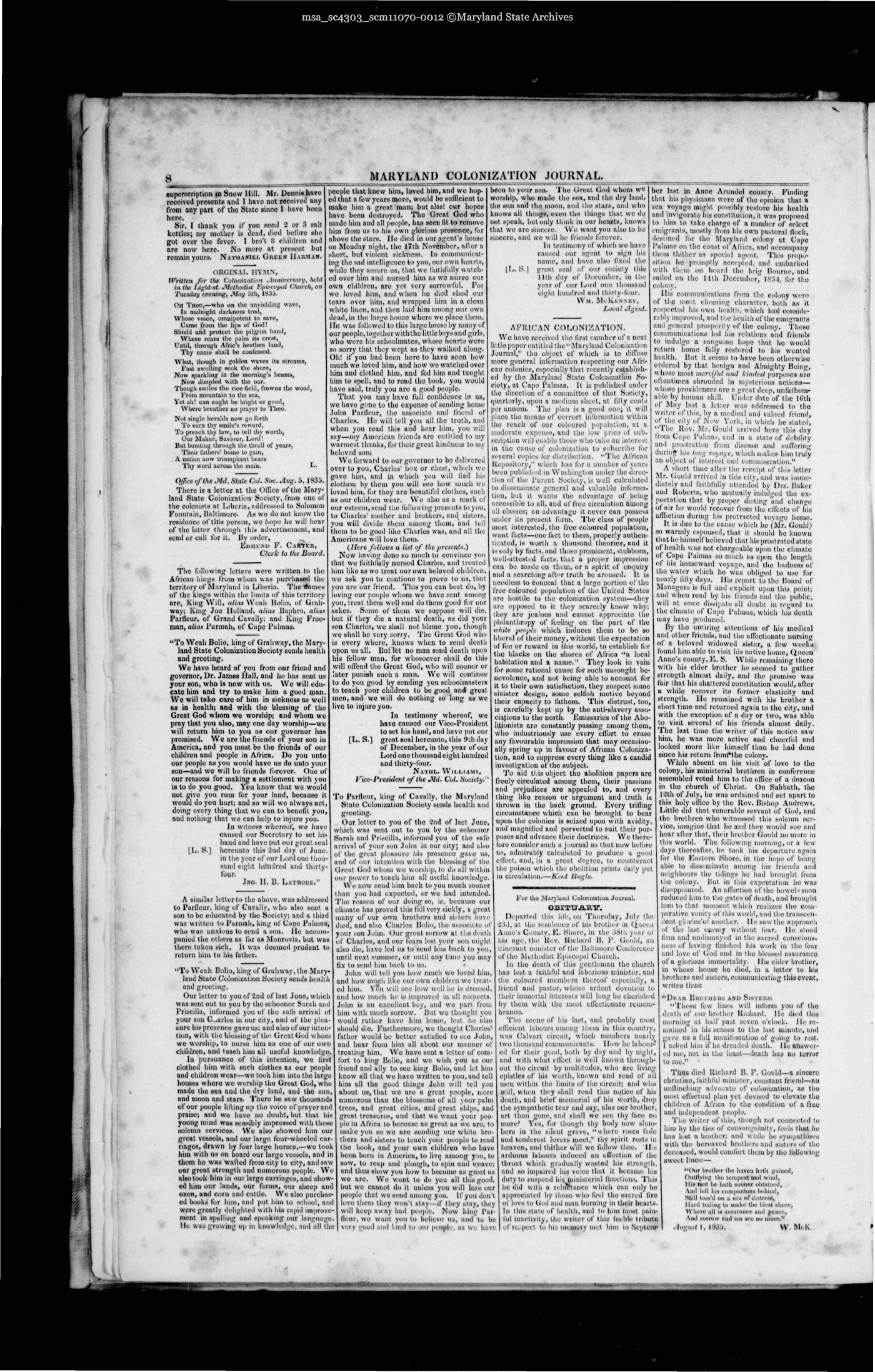
| MARYLAND COLONIZATION JOURNAL. superscription in Snow Hill. Mr. Dennis have received presents and I hnvc not received any from any part of the State since I liavc been here. Sir, I thank you if you send 2 or 3 salt kettles; my mother is dead, died before she got over the fever. I bro't fi children and are now here. No more at present but remain yours. Nathaniel Green Harman. ORGINA1. HYMN, Written fur the Clonizritii'ii . battel mttry, held in the Light-st. Methodist EMteopai Church, an Tuesday evening, May 5th, IBM. On Tiior,—who on llio unyielding wave, In midnight darkness trod, Whoso voice, omnipotent to save, Came from the lips of God! Shield and protect the pilgrim hand, Where rears the palm its crest, Until, through Al'ric's heathen land, Thy name shall be confessed. What, though in golden waves its streams, Fast swelling seek the shore, Now sparkling in the morning's beams, Now dimpled with the oar. Though smiles the rice held, frowns the wood, From mountain to the sea, Yet ah! can aught be bright or good, Where breathes no prayer to Thee. Not single heralds now go forth To earn thy smile's reward, To preach thy law, to tell thy worth, Our Maker, Saviour, Lord! But bursting through the thrall of years, Their fathers' home to gain, A nation now triumphant bears Thy word across the main. L. Office of the Mil. State Col. Soc. Aug. 5, 1935. There is a letter at the Otlicc of the Mary- land State Colonization Society, from one of the colonists at Liberia, addressed to Solomon Fountain, Baltimore. As we do not know the residence of this person, we hope he will hear of the letter through this advertisement, and send or call for it. By order, _ EDMUND F. CARTER, Clerk to the Board. The following letters were written to the African kings from whom was purchased, the territory of Maryland in Liberia. The Itaine.- of ilia kings within the limits of this territory are, King Will, alias Weah Bolio, of Grah- way; King Joe Holland, alias liaphro, alias Parlleur, of Grand Cavally; and King Free- man, alias Parmah, of Cape Palmas. "To Weah Bolio, king of Grahway, the Mary- land State Colonization Society sends health and greeting. We have heard of you from our friend and governor, Dr. James Hall, and he has sent us your son, who is now with us. We will edu- cate him and try to make him a good man. Wo will take care of him in sickness as well as in health; and with the blessing of the Great God whom we worship; and whom we pray that you also, may one day worship—we will return him to you as our governor has promised. We arc the friends of your son in America, and you must be the friends of our children and people in Africa. Do you unto our people as you would have us do unto your son—and we will be friends forever. One of our reasons for making a settlement with you is to do you good. You know that we would not give you rum for your land, because it would do you hurt; and so will we always act, doing every thing that we can to benefit you, and nothing that we can help to injure you. In witness whereof, we have caused our Secretary to set his hand and have put our great seal [L. S.] hereunto this 2nd day of June. in the year of our Lord one thou- sand eight hundred and thirty- four. Jno. H. B. LATROBE." people tliat knew liini, loved him, find we hop- ed that a lew years more, would he sufficient to make him a great man; but alas! our hopes have been destroyed. The Great God who made him and all people, has seen lit to remove him from us to his own glorious presence, far above the stars. He died in our agent's house on Monday night, the 17th November, allor a short, but violent sickness. In communicat- ing the sad intelligence to you, our own hearts, while they assure us, that we faithfully u a'di- ed over him and nursed him as wc nurse our own children, are yet very sorrowful. Tor wo loved him, and when lie died shed our tears over him, and wrapped him in a clean white linen, and then laid him among our own dead, in the largo house where we place them. He was followed to this large house by many of our people, together with the little buys and girls, who were his schoolmates, whose hearts were so sorry that they wept as they walked along. Oh! if you had been here to have seen how much we loved him, and how we watched over him and clothed him, and led him and taught him to spell, and to read the book, you would have said, truly you are a good people. That you may have full confidence in us, we have gone to the expense of sending home John l'arlleur, the associate and friend of Charles. He will tell you all the truth, and when you read this and hear him, you will say—my American friends arc entitled to my warmest thanks, for their great kindness to my beloved son: We forward to our governor to bo delivered over to you, Charles' box or chest, which we gave him, and in which yuu will find his clothes; by them you will see how much we loved him, for they are beautiful clothes, such as our children wear. We also as a n;ark of our esteem, send the following presents to yuu, to Charles' mother and brothers, and si.-lns. you will divide tlicm siiuong them, und toil them to be good like Charles was, and all the Americans will love them. (litre J'olluws a list of the jircs/nli.) Now having done so much to convince you that we faithfully nursed Charles, and treated him like as we treat our own beloved children, wo ask you to continue to prove to us, that you are our friend. This you can best do, by loving our people whom we have sent raoog you, treat them well and do them good for our sakes. Some of them we suppose will die, but if they die a natural death, as did your son Charles, we shall not blame you, though we shall be very sorry. The Great God who is every where, knows when to send death upon us all. lint let no man send death upon his fellow man, for whosoever shall do this will olfend the Great Gud, who will sooner or later punish such a man. We will continue to do you good by sending you schoolmasters to tcacli your children to be good and great men, and we will do nothing so long as wc live to injure you. In testimony whereof, we have caused our Vice-President to set his hand, and have put our [L. S.] great seal hereunto, this !lth day of December, in the year of our Lord one thousand eight hundred und thirty-lour. NATHL. WILLIAMS, Vice-President of the Md. Col. Society.'' been to your son. The Great God whom wu worship, who made the sen, ami I lie dry land, tin- sun and the moon, anil tlit: stars, ami who knows all things, even the things that wo do not speak, hut only think in our hearts, knows that we are sincere. Wo want you also to he sincere, ami we will he friends forever. [L. & In testimony of which we have caused our ujTeiit to si^ti his name, and have also fixed the great seal of our society this I IMi day of December, in the year of our Lord one thousand eight hundred and thirly-four. W'.m. McKenney Local Agent, A similar letter to the above, was addressed to Parlleur. king of Cavally, who also sent a son to be educated by the Society; and a third was written to Purniah, king of Cape Pahims, who wus anxious to send a sou. He accom- panied the others as far ua Monrovia, but was there taken sick. It was deemed prudent to return him to his father. "To Weah Bolio, king of Grahway, the Mary- laud State Colonization Society sends health and greeting. Our letter to you of 2nd of last June, which was sent out to you by the schooner Sarah and Priscilla, informed you of the safe arrival of your son Charles in our city, and of the plea- sure his presence gavo us: and also of our inten- tion, with the blessing of Ike Great God whom we worship, to nurse him as one of our own children, and teach him all useful knowledge. In pursuance of this intention, we tirst clothed him with such clothes as our people and children wear—wc took him into the large houses where we worship the Great God, who made the sea and the dry land, and the sun, and moon and stars. There he saw thousands of our people lilting up the voice of prayer and praise; and we have no doubt, but that his young mind was sensibly impressed with these solemn services. We also showed linn our great vessels, and our large four-wheeled car- riages, drawn by four large horses,—we took him with us on board our large vessels, and in them he was wafted from city to city, and saw our great strength and numerous people. We also took him in our largo carriages, and show- ed him our lands, our farms, our sheep and oxen, and corn und cattle. We also purchas- ed books for him, and put him to school, and were greatly delighted with his rapid improve- ment in spelling and speaking our language. Hu wan growing up in knowledge, and all the To ParhVur, king of Cavally. tlio Maryland State Colonization Society sends health ami greeting. Our letter to you of the 2nd of last June, which was sent out to you by the schooner Sarah and I'riscilla, informed you of the safe arrival of your son John in our city; and aho of the great pleasure his presence gave us, and of our intention with tiie blessing of the Great God whom we worship, to do all wilhiu our power to tench him all useful knowledge. We now semi him back to you much MOM! than you had expected, or we had intended. The reason of our doing so, is, because our climate has proved this fill very sickly, a great many of our own brothers and listen beve died, and nlso Charles Bolio, the MaotUte of your ^on John. Our great sorrow at tl.e death of Charles, and our fears Irst your son might also die, have led us to send linn hack to you, until next summer, or until any turn.' yuu may fix to send bin beck to us. John will tell you how much we loved him, and how much like our own children wo treat- ed him. You will see how Well he is lire.— ed, and how much he is improved in all reepecU. John is an excellent boy, and we part Prom him with much sorrow. Jlut we thought you would rather have him home, loot BO also should die. Furthermore, we thought Charles' father would be better satisfied to see John, and hear from him all about our manner of treating him. We have sent a letter of com- fort to king Bolio, and we wish you as our friend and ally to see king Bolio, and let tin know all that we have written to you, and tell him all the good things John will tell you about us, that we are a great people, iiiore numerous than the blossoms of all \ our palm trees, and great cities, and great ships, and great treasures, and that we want your peo- ple in Africa to become as great as we are, to make you so wc are sending our white bro- thers and sisters to teach your people to rend the book, and your own children who have been born m America, to live; among y-iti, to sow, to reap and plough, to spin and veave; and thus show you how to become as great as wo are. We wont to do you all this good, but we cannot do it unless you will love our people that wc send among yon. If you don't love them they won't stny—if they :i;i\, the) will keep aw ay had people. Now kiog Per ilcur, wo want you to believe us, and to be VI i ) good ami kind to our people as we have AFRICAN COLONIZATION. Wo have received the first cumber of a neat li'.tle paper entitled the'-Mary land Colonization Journal," tho object of which is to diffuse more general information respecting our Afri- can colonies, especially that recently establish- ed by the Maryland State Colonization So- ciety, at Cape l'ahnas, It is published under the direction of a committee of that Society, quarterly, upon a medium sheet, at fifty cents per annum. The plan is a good one; it will place the menus of correct information within the reach of our coloured population, at a moderate expense, and the low price of sub- scription will enable those who luke uu interest in the cause of colonisation to subscribe for several copies lor distribution. "The African Repository," which has for a number of years been published in Washington under the direc- tion of the Parent Society, is well calculated to disseminate general and valuable informa- tion, but it wants tho advantage of being accessible to all, and of free circulation among all classes; uu advantage it. never can possess under its present form. The class of people most interested, the free coloured population, want facts—one fiuct to them, properly authen- ticated, is worth a thousand theories, and it is only by facts, and those prominent, stubborn, well-attested facts, that a proper impression can be made on them, or a spirit of enquiry and a searching after truth be aroused. It is needless to conceal that a large portion of the free coloured population of the United States are hostile to the colonization system—they are opposed to it they scarcely know why; they are jealous and cannot appreciate the philanthropy of feeling on the part of the u-hitc ptoplt which induces then to be so liberal of their money, without the expectation of fee or reward in this World, to establish for the blacks on the shores of Africa "a local habitation and a name." They look in vain fur some rational cause for such iiusought be- nevolence, and not being able to account lor it to their own satisfaction, they suspect some sinister design, some sellish motive beyond their capacity to fathom. This distrust, too, is carefully kept up by the anti-slavery asso- ciations to the north. Emissaries of the Abo- litionists are constantly passing among them, who industriously use every effort to erase any favourable impression that may occasion- ally spring up in favour of African Coloniza- tion, and to suppress every thing like a cuudid investigation of the subject. To uid tiis object the abolition papers are freely circulated among them, their passions and prejudices are appealed to, and every thing like reason or argument and truth is thrown in the buck ground. Every trilling circumstance which can be brought to bear upon the colonies is seized upon with avidity, and magnified and perverted to suit their pur- poses and advance their doctrines. Wo there- lore consider such a journal ns that now before us, admirably calculated to produce u good effect, and, in a great degree, to counteract the poison which the abolition prints daily put in circulation.—Kent llugle. For the Maryland Culunizatiun Journal. OBITUARY. Departed this life, on Thursday, July the 93d, ut the residence of his brother in Queen Anne's County, K. Shore, in the .JSlti year ol his age, the Rev. Richard B. F. Gould, un itinerant minister of the Baltimore Conference of the Methodist Episcopal Church. In the death of this gentleman the church has lost u faithful and laborious minister, and the coloured members thereof especially, u friend and pastor, whose ardent devotion to their immortal interests will long be cherished by them with the most affectionate remem- b ranee. The scene of his last, and probably most efficient labours among them in this country, was Calvert circuit, which numbers neuily two thousand communicants. How be labour- ed fur their good, both by day and by night, and with what effect is well known through- out the circuit by multitudes, who are living epistles of his worth, known and read of nil men within the limits of the circuit; and who will, when tiny shall read this notice of his death, and brief memorial of his worth, drop the sympathetic tear und say, alus our brother, urt thou gone, and shall we see thy face nu more? Yes, for though thy body now slum- bers in the silent grave, "where roses fade and leuderest lovers meet," thy spirit rests m heaven, und thither w'lll we follow thee. His urduous labours induced an uffectioil of the throat which gradually wasted his strength, and so impaired his voice that it became Ins duty to suspend his ministerial functions. This he did with u relonance which can only be appreciated by those who feel the sacred lire of love to tied ami man burning in their hearts. In this slate of health, and to him most pain- ful inactivity, the writer of this lei hie tribute ufrc-ipcct to his memory met him in Septet* her last in Anne Arundel county. Finding that his physiciann were of the opinion that a sea voyage might possibly restore his health and invigorate his constitution, it was proposed to him to take charge of a number of select emigrants, mostly from his own pastoral Hock, destined for the Maryland colony nt Cape PalmSS on the coast of Africa, and accompany them thither as special agent. This propo- sition ho promptly accepted, and embarked with tin in on board the bug lloiirne, and sailed on the llth December, 1831, fur tho colony. His eommunirntions from the colony were of the no t cheering character, both as it respected his own health, which hnd conside- rably improved, and the health of the emigrants and general prosperity of the colony. These communications ted his relations and friends to indulge a sanguine hope that ho would retern homo fully restored to his wonted health. But it seems to have been otherwise ordered by that benign and Almighty Being, whose most merciful and kindest purposes are oftentimes shrouded in mysterious actions— whose providences are n great deep, unfathom- able by human skill. Under date of the lGth of nay last a letter was addressed] to the writer of this, by a medical and valued friend, of the city of New York, in which he stated, '•The Rev. Mr. Gould arrived here this day from Cape Paints, and in a state of debility and prostration from disease und suffering during his long voyage, which nuikes him truly an object of interest ami commiseration." A short time alter the receipt of this letter Mr. Gotlld arrived in this city,and was imme- diately and faithfully attended by Drs. Baker and Roberts, who mutually indulged the ex- pectation that by proper dieting and change of air be would recover from the effects of his affliction during his protracted voyage home. It is due to the cause which be (M"r. Gould) so warmly espoused, that it should bo known that ho himself believed that his prost rated state of health was not chargeable upon the climate of Cape Paints so much as upon the length of his homeward voyage, and the badness of the water which he was obliged to use for nearly fifty days. His report to the Hoard of Managers is lull and explicit upon this point; and when read by his friends and the public, will at once dissipate all doubt in regard to the climate of Cape l'ahnas, which his death may have produced. By the untiring attentions of his medical and other friends, and the affectionate nursing of a beloved widowed sister, a few weeks) found him able to visit his native home, Queen Anne's county. K. S. While remaining there with his elder brother he seemed to gather strength almost duily, and tho promise wag fair that his shattered constitution would, after a while recover its former elasticity and strength. He remained with his brother a short time and returned again to the city, und with the exception of a day or two, was able to visit several of his friends almost daily. The last time the writer of this notice saw him, he was more active and cheerful and looked more like himself than ho had dono since his return I'ronrMhe colony. While absent on his visit of love to tho colony, his ministerial brethren in conference assembled voted him to the office of a deacon in the church of Christ. On Subbath, the lith of July, ho wus ordained and set apart to this holy otlice by the Rev. Bishop Andrews. Little did that venerable servant of God, und the brethren who witnessed this solemn ser- vice, imagine that he and they would sec und hear after that, their brother Gould no mure in this world. The following morning, or u lew days thereafter, ho took Bis departure ugaiu for the Eastern Shore, in the hope of being able to dissi minute nniong his friends niul neighbours the tidings he had brought from the colony. But in this expectation he was disappointed. Aii aU'ection of the bowels soon reduced bin to the gates of death, and brought hini to that moment which realizes the com- parative vanity of this world, and the transcen- dent gl¦iries'u!'another, lie saw the approach of the last tunny without tear, lie stood firm and undismayed in the sacred conscious- nus-i of having finished his work in the fear and love of God and in the blessed assurance of a glorious immortality. His elder brother, in whose house he died, in a letter to his brothers and sisters, couiinunicating this event, writes thus: "Dear Brothers and Sisters: "These few lilies will intorm you of the death of our brother Richard. He died this morning at half past seven o'clock. Hi: re- mained in his senses to the last minute, and gave us u full manifestation of going to rest. I ashed him if he dreaded death. He answer- ed me, not in tho least—death has no terror to inc." Thus died Richard B. F. Gould—a sincere christian, faithful minister, constant friend—un unflinching advocate of colonization, us the most effectual plan yet devised to elevate the children of Africa to the condition of a free und independent people. The Writer aftUs, though not connected to him by the ties of Consanguinity, feels that he bus lost u brother; and while he sympathises with the bereaved brothers and sifters ol' the doe. ¦used, would Comfort them by the lbllowing sweet lines:— "Our brother the haven huh gained, OuUlying the tempest and wind, His rust he hath sooner obtained, And left his companions brlniul, Still toss'd on a soa ofdistreasj Haul toiling to make tin- blest shore, Where all is a>sinaiuc ssd |ieaee, And sorruvv nud sin ate no mule." August 1, 1835 W. McK 8 |