 |
|
|
 |
|
 |
|
|||
|
||||
|
||||
|
Maryland State Archives Maryland Colonization Journal Collection MSA SC 4303 msa_sc4303_scm11070-0013 Enlarge and print image (4M) |
|
|
|
|
|
|
|
|||
|
||||
|
||||
|
Maryland State Archives Maryland Colonization Journal Collection MSA SC 4303 msa_sc4303_scm11070-0013 Enlarge and print image (4M) |
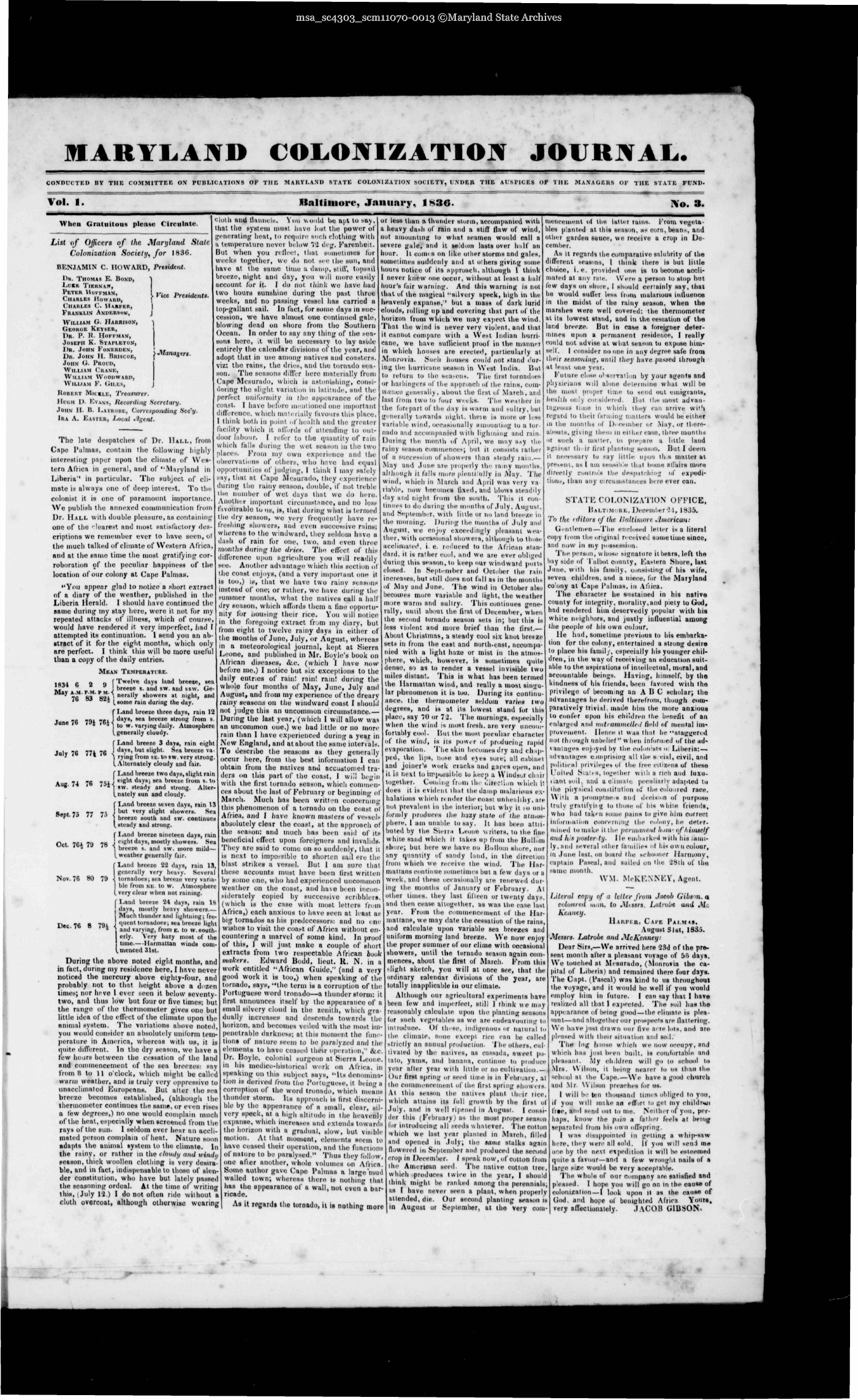
| MARYLAND COLONIZATION JOURNAL. CONDUCTED BY THE COMMITTEE ON PUBLICATIONS OF THE MARYLAND STATE COLONIZATION SOCIETY, UNDER THE Al'Sl'ICES OF THE MANAGERS Of THE STATE FUND. Vol. 1. Baltimore, January, 1836 No. 3. When Gratuitous please Circulate. List of Officers of the Maryland State Colonization Society, for 1830. BENJAMIN C. HOWARD, President. J'ice Presidents. Dr, Thomas E. Bond, Luke Tiernan, Peter Hoffman, Charles Howard, Charles C Harper, Franklin Anderson, William G. Harrison, George Keyser, Dr. P. R. Hoffman, Joseph K. Stapleton, Dr. John Fonerden, Dr. John H. Briscoe, John G. Proud, William Crane, William Woodward, William F. Giles, Robert Mickle, Treasurer. Hugh D. Evans, Recording Secretary. John H. B. Latrobe, Corresponding Scc'y. Ira A. Easter, Local Agent. } •Managers. The late despatches of Dr. Hall, from Cape I'almas, contain the following highly interesting paper upon the climate of Wes- tern Africa in general, and of "Maryland in Liberia" in particular. The subject of cli- mate is always one of deep interest. To ttrt colonist it is one- of paramount importance We publish the annexed communication from Dr. Hall with double pleasure, as containing one of the clearest and most satisfactory des- criptions we remember ever to have seen, ol the much talked of climate of Western Africa, and at the same time the most gratifying cor- roboration of the peculiar happiness of the location of our colony at Cape I'almas. "You appear glad to notice a short extract of a diary of the weather, published in the Liberia Herald. I should have continued the same during my stay here, were it not for my repeated attacks of illness, which of course, would have rendered it very imperfect, had I attempted its continuation. 1 send you an ab- stract of it for the eight months, which only are perfect. I think this will be more useful than a copy of the daily entries. Mean Temperatire. June 76 79* 76} 1-and breeze three days, rain 12 days, aea breeze strong from s. to w. varying daily. Atmosphere generally cloudy. July 76 774 76 i .mnl breeze 3 dnyi, rain eight days, but slight. Sea breeze va- rying from se. to aw. very strong. Alternately cloudy and fair. Aug. 74 76 7Si< Sept. 75 77 75 Oct. 76} 79 78 During the above noted eight months, and in fact, during my residence here, I hnve never noticed the mercury above eighty-four, and probably not to that height above a dozen times; nor hrve 1 ever seen it below seventy- two, and thus low but lour or five times; but the range of the thermometer gives one but little idea of the effect of the climate upon the animal system. The variations above noted, you would consider an absolutely uniform tem- perature in America, whereas with us, it is quite different. In the dry season, we have a lew hours between the cessation of the land and commencement of the sea breezes: sav from 8 to 11 o'clock, which might be called warm weather, and is truly very oppressive to unaccliinated Europeans. Hut alter the sea breeze becomes established, (although the thermometer continues the same, or even rises a tew degrees,) no one would complain much of the heat, especially when screened from the rays of the sun. 1 seldom ever hear an accli- mated person complain of heat. Nature soon adapts the animal system to the climate. In the rainy, or rather in the cloudy and windy season, thick woollen clothing is very desira- ble, and in fact, indispensable to those of slen- der constitution, who have but lately passed the seasoning ordeal. At the tune of writing this, \July It,) I do not often rule without a cloth overcoat, although otherwise wearing cloth nntf flannels. Von Mould be apl to say, that the system must have lost the power of generating heat, to require such clutlnng with a temperature never below ~i deg. Farenheit. But when you reflect, that sometimes for weeks together, we do not see the sun, and have at the same time a damp, stiff, topsail breeze, night and day, you will more easily account for it. I do not think we have had two hours sunshine, during the past three weeks, and no passing vessel has carried a top-gallant sail. In fact, for some days in suc- cession, we have almost one continued gale, blowing dead on shore from the Southern Ocean. In order to say any thing of the sea- sons here, ,t will be necessary to lay aside entirely the talendar divisions of the year, and adopt that in use among natives and coasters, viz: the rains, the dries, and the: tornado sea- son. The seasons differ hero materially from Cape Meiurado, which is astonishing, consi- dering the alight variation in latitude, ami the perfect uniformity in the appearance of the coast. 1 have before mentioned one important difference, which materially favours this place. I think both in point of health and the greater facility which it iill'.inls of attending to out- door labour. I refer to the quantity of rain which falls during the wet season iii the two places. From my own experience and (he observations of others, who h;:ve had etpnl opportunities of judging, I think 1 may safely say, that at Cape Heaurado, they experience during thu rainy season, double, if not treble the number of wet days that we do here. Another important circumstance, and no lest- ftvonrable to us, is, that during what is termed the dry season, wo very frequently have re- freshing showers, and even successive rains; whereas to the windward, they seldom have a dash of rain for one, two, and even three months during the dries. The effect of this diflerenet upon agriculture you will readily see. Another advantage which this seclion of the coast enjoys, (and a very important on it is too,) is, that we have two rainv seasons instead of one; or rather, we have during the summer months, what the natives call a hall dry season, which affords them a tine opportu- nity lor iiousing their rice. You will notice in the foregoing extract froej iny diary, but from eight to twelve rainy days in either of the months of June, July, or August, whereas in a meteorological journal, kept at Sierra Leone, and published in Mr. Boyle's hook on African diseases, &.c. (which I have now before me.) I notice but six exceptions to the daily entries of rain! rain! ram! during the whole four months of May, June, July ami August, and from my experience of the dreary rainy seasons on the windward coast I should not judge this an uncommon circumstance.— During the last, year, (which I will allow was an uncommon one.) we had little or no more rain than 1 have experienced during a year in New England, and at about the same intervals. To describe the seasons as they generally occur here, from the best information I can obtain from the natives and accustomed tra- ders on this part of the coast, 1 will begin with the first tornado season, which commen- ces about the last of February ur beginning ol March. Much has been written concerning this phenomenon of a tornado on the coast ol Africa, and I have known masters of fOsauli absolutely clear the coast, at the approach of the season: and much has been said of its beneficial effect upon foreigners and invalids. They are said to come on so suddenly, that it is next to impossible to shorten sail ere tin- blast strikes a vessel. But 1 am sure that these accounts must have been first written by some one, who hail experienced uncommon weather on the coast, and have been incon- siderately copied by successive scribblers. (which is the case with most letters from Africa,) each anxious to have seen at least as big tornados as his predecessors: and no one wishes to visit the coast of Africa without en- countering a marvel of some kind. In prool of this, 1 will just make a couple of short extracts from two respectable African book mulctrs. Kdward Bodd, lieut. R. N. in a work entitled "African Guide," (and a very good work it is too,) when speaking of the tornado, says, "the term is a corruption of the Portuguese word trnnado—a thunderstorm: it first announces itself by the appearance of a small silvery cloud in the zenith, which gra- dually increases and descends towards the horizon, nnd becomes veiled with the most im- penetrable darkness; at this moment the func- tions of nature seem to be paralyzed and the elements to have ceased their operation," &c. Dr. Boyle, colonial surgeon at Sierra Leone, in his medico-historical work on Africa, in speaking on this subject says, "Its denomina- tion is derived from tho Portuguese, it being a corruption of the word tronado, which means thunder storm. Its approach is first discerni- ble by the appearance of a small, clear, sil- very speck, at a high altitude in the heavenlv expanse, which increases and extends towards the horizon with a gradual, slow, but visible motion. At that moment, elements seem to have ceased their operation, nnd the functions ol nature to be paralysed." Thus they follow, one afier another, whole volumes on Africa. Some author gave Cape I'almas a large mud walled town; whereas there is nothing that has the appearance of a wall, not even"a bar- ricade. As it regard* the tornado, it is nothing more or less than a thunder slonn, accompanied with a heavy dash of rain and a stiff flaw of wind, not amounting to what seamen would call a severe gale, and it te',<]»in lasts over half an huiir. It coim s on like other storms and gales, sumetimes suddenly ami at others givinor some hours notice of its approach, although 1 think 1 never knew one occur, without at least a half hour's fair warning. And this warning is not that of the magical "silvery speck, high in the heavenly expanse,' but a mass of dark lurid clouds, lolling up and covering that part of the horizon from which we may expect the wind. That the wind is never very violent, and that it cannut compare with a West Indian hurri- cane, we have sufficient proof in the maimer in which houses are erected, particularly at Monrovia. Bach houses could not stand ('iir- ing the hurricane season in West India. Bet to return to the season*. The first tornadoes or harbingers of the approach of lhe rains, com- mence generally , about the first of March, and last from two to four weeks. The Weather In the forepart of the day is warm and sultry, but generally towards night, theie is more or less variable wind, occasionally ¦mounting to a tor- nado and aei-uiiipanied with lightning and rain. Daring the month of April-we miitj ths rainy season commences; hut it consists lather of a succession of showers than steady rain.— May and Jimp are properly the rainy months, although it falls more plenliinlly in May. The wind, which in March and April was very va liable, now become! fixed, and blows steadily day and night from the south. This H con- tinues n> do dining the inoiilbs of July. August, and September, with litlle or no land breeze in the morning. During the months of July ind August, we enjoy exceedingly pleasant wea- ther, with occasional showeis, although to those acclimated, i. c. reduced to the African stan- dard, it is rather cool, anil we are ever obliged during this season, to keep our windward polls closed. In September and October the rain increases, but still does not full as in the months of May and June. The wind in October also becomes more variable and light, the weather more warm and sultry. This continues o-ene- rally, tiiuil about the first of December, when the second tornado season sets in; but this is less violent and more brief than the first.— About Christmas, a steady cool six knot breeze sets in from lhe east and north-east, accompa- nied with a light haze or mist in the atmos- phere, which, however, is sometimes quite dense, so as to render a vessel invisible two miles distant. This is what has been termed the Harmattan wind, and really a most singu- lar phenomenon it is too. During its continu- ance, the thermometer seldom varies two decrees, and is at ils lowest stand for this place, say 70 or 72. The mornings, especially when the wind is most fresh, are very uncom- fortably cool. Bet the most peculiar rbaractei of the winJ, is its power of producing rapid evaporation. The skin becomes dry and chip- ped, the. lips, nose and e>e» sure; all Cabinet and joiner's work ctacks and gapes open, and if is next to impossible to keep a Windsor ch-.ir together. Coining from lhe direction which it does it is evident lhal the damp malarious ex- halations which r< nder the coast unhealthy, an not prevalent in the interior; but why it mi uni- formly produces the hazy stale of the atmos- phere, 1 urn unable to say. It has been attii- buted by the Sieira Leone writers, to the lint- white sand which it lakes up from the Biillom shore; but here we have nu Biillom shore, nur any quantity of sandy land, in the direction from which we receive the wind. The llar- mattans continue sometimes but a few days or a week, and these occasionally are renewed dur- ing the months of January or February. At other limes, they last fifteen or twenty days, and then cease altogether, as was tbe case last year. From the commencement of the llar- inaliatis, we may date the cessation of the rains, and calculate upon variable sea breezes and uniform morning land breeze. We now enjoy the proper summer of our clime with occasional showers, until the tornado season again com- menees, about the first of Match. From this slight sketch, you will at once see, that the ordinary calendar divisions of the year, are totally inapplicable in our climate. Although our agricultural experiments have been few and imperfect, still 1 think we may reasonably calculate upon the planting seasons lor such vegetables as we are endeavouring to introduce. Of these, indigenous or natural to the climate, none except rice can he called strictly an annual production. The others, cul- livaled by the natives, as cassada, sweet po- tato, yams, and banana, continue to produce year alter year with little or no cultivation.— Our first spring or seed lime is in February, at the commencement of the first spring showers. At this season the natives plant iheir lice, which attains ils lull growth by lhe first of July, and is well ripened in August. 1 consi- der this (February) as the most proper season lor introducing all seeds whatever. The cotton which we last year planted in March, filled and opened in July; the same stalks again flowered in September and produced the second crop in December. I speak now, of cotton from the American seed The native cotton tiee, which produces twice in the year, I shuuid ihink might be ranked among the perennials, as I have never seen a plant, when properly attended, die. Our second planting season is in August or September, at the very com- mencement of ttie latter rams. From vegeta- bles planted at this season, as corn, bean-, and olln-r garden sauce, we receive a crop in De- cember. As it regards the comparative salubrity of the different seasons, I think there is but little choice, i.e. provided one is to become accli- mated al any rale. Were a person lo stop hut lew days on shore, I should certainly say, that he would suffer less from malarious influence in the niidst of the rainy season, when the marshes were well covered: the thermometer at its lowest stand, and in the cessation of the land breeze. But in case a foreigner deter- mines upon a permanent residence, I really could not advise al what season to expose him- sell. | consider no one in any degree safe from their fMMlitng, until they have passed through at 'east one year. Future close ««' serration by your agents and plij.sicians will alone determine what will be the most proper lime lu tend out emigrants, health only considered. But the most advan- tageous It,ne in which ibey can arrive with. regard to their farming matters would be either in lhe months of December or May, or there- abouts, gi\ lug them in either ease, three months ¦it such a matter, to prepare a little laud against their first planting season. But I deem it necessary lo say little upon this mailer at present, as 1 am sensible that hums ail'airs more directly controls lhe despatching of expedi- tious, than any circumstances lure ever can. STATE COLONIZATION OFFICE, Baltimore, December-; I, 1H35. I'd tlie xlitort (J the llitltiiuiire .hucrican: Gentlemen—The enclosed letter is a literal copy from tbe original received some time since, and now in my possession. Tbe person, whose signature it bears, left the hay side of Talbot county, Fa-tern Shore, last June, with his family, consisting of his wife, seven children, and a niece, for the Maryland co'ony at Cape I'almas, tu Atiica. The character lie sustained in his native county for integrity, morality,and piety to God, had rendered him deservedly popular with his white neighbors, and justly influential among the people ol his own colour. He had, sometime previous to his embarka- tion for the colony, entertained a strong desire to place his faniilj,, especially his younger chil- dren, in the way of receiving an education suit- able lo the aspirations of intellectual, moral, and accountable beings. Having, himself, by the kindness of his friends, been favored wilh the privilege of becoming an A B C scholar; the advantages he derived therefrom, though com- paratively trivial, made him the more anxious lo confer upun his children the benefit of an enlarged anil uiitiumincllcl field of menial im- provement, llenee it was that he "staggered nol through unbelief when informed uf the ad- vantages enjoyed by tbe colon-sis o Liberia: — sdvantages ournprising all the s rial, civil, and political privileges of lhe tree citizens of these Foiled States, together with a rich and luxu- tiatit soil, and a climate peculiarly adapted to the physios] constitution of the coluoied race. With a promptness and deeisuil of purpose truly gratifyit g to those of his while friends, who had tak'ii some pants to L'ive him correct information concerning lhe colony, he deter- mined lo make il the jieriniiiicut li.mi' if'himself unit larj poster ty. I le embarked with his least- Is, and seveial other families ol liis ow u coluur, in June last, on board the schooner Harmony, captain Pascal, and sailed on the "28lh uf the same month. WM. McKENNEY, Agent. Literal copy of a letter from Jacob Gibson, a colored man, to Messrs. Latrobe and McKenney Harper, Cape Pai.mas. August 31st, 1835. .Messrs. Latrobe and McKenney: Dear Sirs,—We arrived here '23d of the pre- sent month after a pleasant voyage of 50 days. We touched at Mesurado, (Monrovia the ca- pital of Liberia) and remained there four days. The Cupt. (Pascal) was kind lo us throughout the voyage, and it would bo well if you would employ I,tin in future. I can say that I have realized all that I expected. The soil has the appearance of being good — the climate is plea- sant—and altogether our prospects are Haltering. We have just drawn our five acre lots, and are pleased with their situation and soil. Tho log house which we now occupy, and which has just been built, is comfortable and pbasanl. My children will go to school lo Mrs. Wilson, it being nearer to us than the school at tbe Cape.—We have a good church and Mr Wilson preaches for us. I will be ten thousand linos obliged to yon, if you will make an effort to get my children free, ami send out to me. Neither Of yon, per- haps, know lhe pain a father feels at being (operated frees, bis own offspring. I was disappointed in gelling a whip-saw here, ibey were all sold. If you will seni me one by the next expedition it will be esteemed quite a lavour—ami a few wrought nails ol » larire size would he very acceptable. The whole of our Company are satisfied and pleased. I hope you will go on tn the cause of colonization — I look upon it as the cause of God. and hope ol benighted Africa Yours, very affectionately. JACOB GIBSON- 1834 6 2 9 May a.m. p.m. pm- 76 83 b2J Twelve days land breeze, sea breeze s. and sw. and ISWi Ge- nerally showers at night, and , some rain during the day. Nov. 76 80 79 Dec. 76 8 794 Kami breeze two days, slight rain eight days; sea breeze i'rum s. U> sw. steady and strong. Alter- nately sun and cloudy. Land breeze seven days, rain It but very Blight showers. Sea breeze south and sw. continues steady and strong. I-.and breeze nineteen days, rain eight days, mostly showers. Sea breeze s. and sw. more mild— weather generally fair. Land breeze 22 days, rain 13, generally very heavy. Several tornadoes; Bea breeze very varia- ble from ne to w. Atmosphere . very clear when not raining. Land breeze 24 days, rain IK dayB, mostly heavy showers__ Much thunder and lightning; fre- quent tornadoes; sea breeze light and varying, from e. to w. south- erly. Very hazy most of the tunc-—-Hurmattan winds coni- .tnenced 31st. |