 |
|
|
 |
|
 |
|
|||
|
||||
|
||||
|
Maryland State Archives Maryland Colonization Journal Collection MSA SC 4303 msa_sc4303_scm11070-0015 Enlarge and print image (4M) |
|
|
|
|
|
|
|
|||
|
||||
|
||||
|
Maryland State Archives Maryland Colonization Journal Collection MSA SC 4303 msa_sc4303_scm11070-0015 Enlarge and print image (4M) |
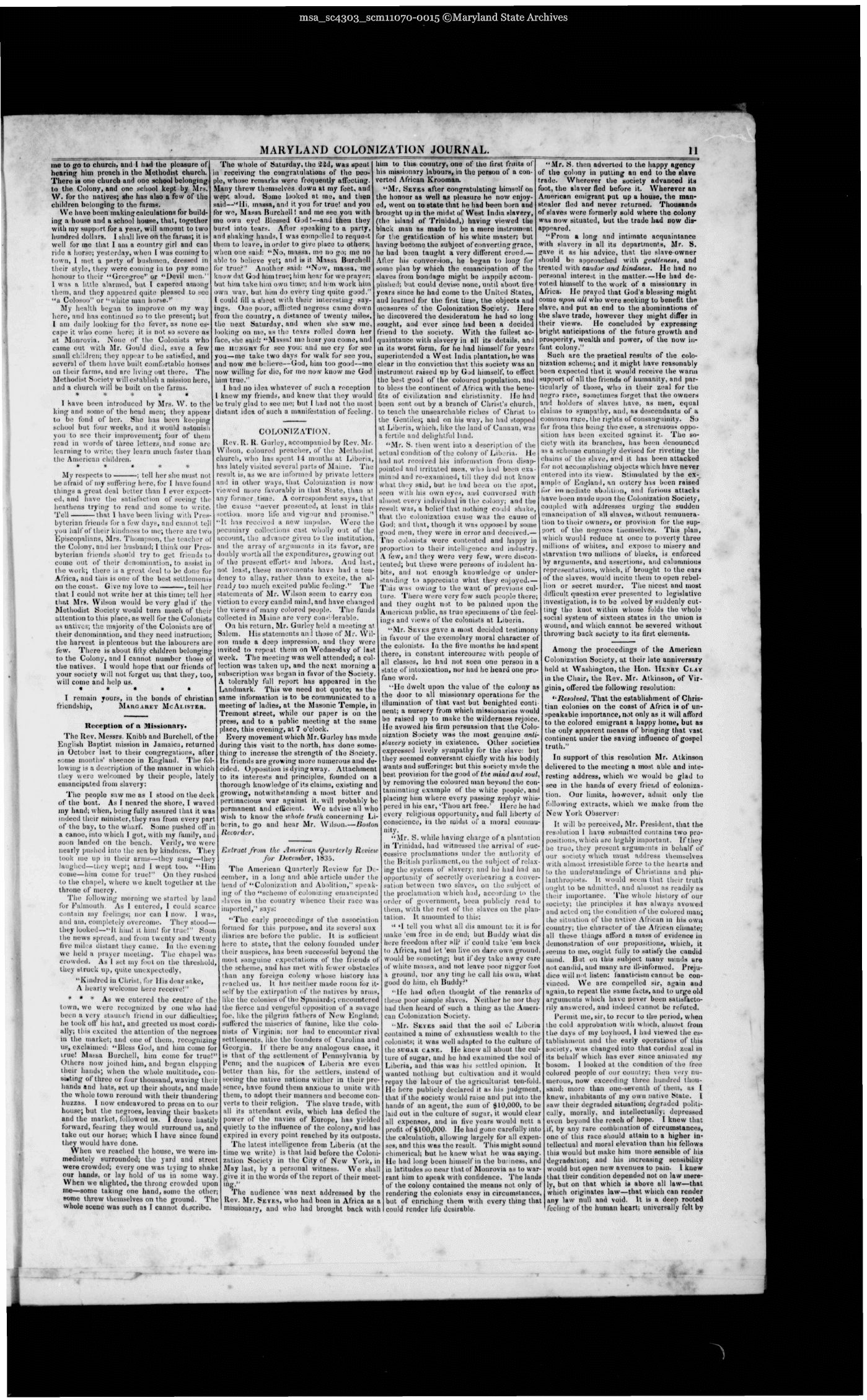
| MARYLAND COLONIZATION JOURNAL. 11 mo to go to church, and 1 had llic pleasure of hearing him preach in the Methodist church. There is one church and one school belonging to the Colony, and one school kept by Mrs. VV. for the natives; she has also a few of the children belonging to the farms. We have been makingcalculations for build- ing I house and a school house, that, together with my support for a year, will amount to two hundred dollars. 1 shall live on the farms; it is well for me that I am a country girl and can ride a horse; yesterday, when [ was coining to town, I met a party of buslnnon, dressed in their style, they were coining in to pay some honour to their "Greegree" or "Devil men." I was a little alarmed, but I capered among them, and they appeared quite pleased to see "a Colosoo" or '-white man horse." My health began to improve on my way here, ami has continued so to the present; but I am daily looking for the fever, as none es- cape it who come here; it is not so severe as at Monrovia. None of the Colonists who came out with Mr. Gould died, save a few small children; they appear to be satisfied, and several of them have built comfortable houses oil their farms, and are living out there. The Methodist Society will establish a mission here, and a church will be built on the farms. ***** 1 have been introduced by Mrs. W. to the king and some of the head men; they appear to be fond of her. She has been keeping school but four weeks, and it would astonish you to see their improvement; four of them read in words of three letters, and some an learning to write; they learn much fatter than the American children. » • • * * My respects to---------; tell her she must, not be afraid of my suffering here, for I have found things a great deal bettor than I ever expect- ed, and have the satisfaction of seeing the heathens trying to read and some to write. Tell---------that I have been living with Pree- hyterian friends for a few days, and cannot tell you half of their kindness to me; there are two Episcopalians, Mrs. Thompson, the teacher id the Colony, and her husband; I think our Proa- byterian friends should try to get friends to come out of their denomination, to assist in the work; there is a great deal to be done for Africa, and tins is one of the boat settlemenis on the coast. Give my love to---------, toil her that I could not write her at this time; tell her that Mrs. Wilson would be very glad if the Methodist Society would turn much of their attention to this place, as well for the Colonists as natives; the majority of the Colonists are of their denomination, and they need instruction; the harvest is plenteous but the labourers are few. There is about filly children belonging to the Colony, and I cannot number those ol the natives. I would hope that our friends of your society will not forget us; that they, too, will come and help us. The whole of Saturday, tliu -M, was spent in receiving the congratulations of the peo- ple, whose remarks were frequently affecting. Many threw themselves down at my feet, anil wept aloud. Some looked nt me, and then said—"Hi, massa, and it you fiir true! and you for we, Massa (lurched! and me see you with mo own eye! Blessed God!—and then they burst into tears. After speaking to a party, and shaking hands, I was compelled to request them to leave, in order to give place to others; when one said: "No, massa, me no go; me no able to believe yet; and is it Massa Burehell for true?" Another said: "Now, massa, me know dut God him true; him hear for we prayer; hut him take him own time; and b in work hiin own wav, but him do every ling quite good." [ could till a sheet with their interesting say- ings. One poor, afflicted negNM came down from the country, a distance of twenty miles, the next. Saturday, nnd when she saw mo, looking on me, us I be tears rolled down her fuce, she said: "Massa! m hear you come, and me hungry fur see you: and me cry for see you —me take two days for walk for see you, and now me believe—God, him too good—me now willing for die, for me now know me God him true." I bad no idea whatever of such a reception I knew my friends, and knew that they would be truly glad to see me; but I hail not the most distant idea of such a manifestation of feeling. I remain yours, in the bonds of christian friendship, Margaret McAlister. Reception of n Missionary. The Rev. Messrs. Knibb and Burchell, of the English Baptist mission in Jamaica, returned in October last to their congregations, after some months' absence in England. The fol- lowing is a description of the manner in which they were welcomed by their people, lately emancipated from slavery: The people saw me as I stood on the deck of the boat. As I neared the shore, I waved my hand; when, being fully assured that it was indeed their minister, they ran from every part of the bay, to the wharf. Some pushed off in a canoe, into which I got, with my family, and soon landed on the beach. Verily, we were neurly putbed into the sea by kindness. They took roe up in their arms—they sang—they laughed—u.ey wept; and 1 wept too. "Him come—him come for true!" On they rushed to the chapel, where we knelt together at the throne of mercy. The following morning we started by land for Falmouth. As 1 entered, I could scarce contain my feelings; nor can I now. I was, and am, completely overcome. They stood— they looked—"It him! it him! for true!" Soon I he news spread, and from twenty and twenty live miles distant they came. In the evening we held it prayer meeting. The chapel was crowded) As I set my foot On the threshold, they struck up, quite unexpectedly, "Kindred in Christ. for His dear sake, A hearty welcome here receive!" * * * As we entered the centre of the town, we were recognized by one who had been a very staunch friend in our difficulties; he took off his hat, and greeted us most cordi- ally; this excited the attention of the negroes in the market; and one of them, recognizing us, exclaimed: "Bless God, and him come for true! Massa Burchell, him come for true!" Others now joined him, and began clapping their hands; when the whole multitude, con- sisting of three or four thousand, waving their hands and hats, set up their shouts, and made the whole town resound with their thundering huzzas. I now endeavored to press on to our house; but the negroes, leaving their basket - and the market, followed us. I drove hastily forward, fearing they would surround us, and take out our horse; which 1 have since found they would have done. When we reached the house, we were im- mediately surrounded; the yard and street were crowded; every one was trying to shake our hands, or lay hold of us in some way. When we alighted, the throng crowded upon me—some taking one hand, some the other; some threw themselves on the ground. The whole scene was such as I cannot describe. COLONIZATION. Rev. R. R. Gurley, accompanied by Rev. Mr. Wilson, coloured preacher, of the Methodist church, who has spent 14 months at Liberia, has lately visited several parts of Maine. The result is, as we are informed by private letters and in other ways, that Colonization is now viewed more favorably in that Slate, than at any former time. A correspondent says, th it the cause "never presented, at least in this section, more life and vigour and promise." "It his received a new impulse. Were the pecuniary collection! cast wholly out ol' the account, the advance given to the institution, and the array of argument! in its favor, are doubly worth all I he expenditures, growing out of the present efforts and labors. And last, not least, these movement! have had a ten- dency to allay, rather than to excite, the al- ready too much excited public feeling." The statements of Mr. Wilson seem to carry con viction to every candid mind, and have changed the views of many colored people. The funds collected in Maine are very con-' lerablo. On his return, Mr. Gurley held a meeting at Salem. His statements an I those of Mr. Wil- son made a deep impression, and they were invited to repeat them on Wednesday of last week. The meeting was well attended; a col- lection was taken up, and the next morning a subscription was began in favor of the Society. A tolerably full report has appeared in the Landmark. This wo need not quote; as the same information is to be communicated to a meeting of ladies, at the Masonic Temple, in Tremont street, while our paper is on the press, and to a public meeting at the same place, this evening, at 7 o'clock. Every movement which Mr. Gurley has made during this visit to the north, has done some- thing to increase the strength of the Society. Its friends are growing more numerous and de- cided. Opposition it dying away. Attachment to its interests and principles, founded on a thorough knowledge of its claims, existing and growing, notwithstanding a most bitter and pertinacious war against it, will probably be permanent and efficient, We advise ell who wish to know the whole truth concerning Li- beria, to go and bear Mr. Wilson.—Beaten Recorder. Extract from the American Quarterly Review for December, 1835. Tlio American Quarterly Review for De- cember, in a long and able article under the bead of "Colonization and Abolition," apeak* ing iif tlio "scheme of colonizing emancipated slaves in the country whence their race was imported," says: "The early proceedings of the association formed tor this purpose and it.- several mix diaries are before the public. It is sufficient belt to state, that the colony founded under their auspices, has been succosliil beyond the mo.-t sanguine expectations of tlio friends of the scheme, and bus net with fewer obstacles than any foreign colony whose history has retched us. It bat neither made room lor it- self by the exlirpatiim of the natives by arms, like the colonies of tile Spaniards; encountered the fierce ami vengeful opposition of a savage foe. like the pilgrim fathers of New England; auffered the miseries of famine, like the colo- nists of Virginia; nor had to encounter rival settlements, like the founders of Carolina and Georgia, If there be any analogous case, it is that of the settlement of Pennsylvania by I'cnn; and the auspices of Liberia arc even better than bis, for the settlers, instead ol seeing the native nations wither in their pre- sence, have found them anxious to unite with them, to adopt their manners and become con- verts to their religion. The slave trade, with all its attendant evils, which lias defied the power of the navies of Europe, has yielded ipuetly to the influence of the colony, and has expired in every point reached by its outposts. The latest intelligence from Liberia (at the time we write) is that laid before the Coloni- zation Society in the City of New York, in May last, by a personal witness. We shall give it in the words of the report ol* their tneet- i"g-" The audience was next addressed by the Rev. Mr. Sevks, who had been in Africa us a missionary, and who had brought back with linn iii I ins country, one of the fint fruits of his missionary labours, in the person of a con- verteil African Krooman. "Mr. Seves after congratulating himself On the honour as well as pleasure he now enjoy- ed, went on to state that lie had been horn and brought up in the midst of West India slavery, (the island of Trinidad,) having viewed the black man as made to ho a mere iiistrtnm-nt for the gratification of his white master; but bavins become the subject of converting grace, he had boon taught a very different creed,— All or Ins conversion, he began to long for some plan by which the emancipation of the slaves from bondage might bo nappily accom- plished; but could devise none, until about live years since he had come to the United .States, and learned for the first time, the objects and measures of the Colonization Society. Here he discovered the desideratum he had so long sought, and ever since had been a decided friend to tho society. With the fullest ac- quaintance with slavery in all its details, and in its worst form, for he had himself lor years superintended a West India plantation, he was clear in the conviction that tins society was an instrument raised up by God himself, to effect the best good of the coloured population, and to bless the continent of Africa with the bene- fits of civilization and Christianity. He had been sent out by a branch of Christ's church, to teach the unsearchable riches of Christ to the Gentiles; and on his way, he had stopped at Liberia, which, like the laud of Canaan, was a fertile and delightful land. "Mr. S. then went into a description of the actual condition of the colony of Liberia, He had not received his information from disap- pointed and irritated men, who hid been exa- inin id and re-examined, till they did not know what they said, but he had been on the spot, seen with his own eyes, and conversed with almost every individual in the colony; and the result was, a belief that nothing could shake, that lie: Colonisation cause was the cause ol God; and that, though it was opposed by some food men, they were in error and deceived.— Tue colonists were contented and happy in proportion to their intelligence and industry. A few, and they were very few, Were discon- tented; but these were persons of indolent ha- bits, and not enough knowledge or under- standing to appreciate what they enjoyed___ Tills was owing to the want of previous cul- ture. There were very few such people there; and they oiiirht not. to be palmed upon the American public, as true specimens of the feel- ing-) and views of lite colonists at Liberia. •¦Mr. Skvks gave a most decided teslimonv in favour of the exemplary moral character of the colonists. In the live months he had spent there, in constant intercourse with peopio of all classes, bo had not seen one person in a state of intoxication, nor had ho heard one pro- fane word. "He dwelt upon the value of the colony as the door to all missionary operations for the illumination of that vast but benighted conti nent; a nursery from which missionaries would he raised up to make the wilderness rejoice. He avowed his firm persuasion that the Colo- nization Society was the most genuine anli- ilnvery society in existence. Other societies expressed lively sympathy for the slave: but they seemed conversant chielly with his bodily wants and sufferings: but this society made the best provision for the good of the mind ami tout. by removing the coloured man beyond the con- taminating example of tin white people, and placing linn where every passing zephyr whis- pered in his ear, "Thou art free.' Here he had every religious opportunity, and full liberty ol conscience, in the midst of u moral commu- nity. ".Mr. S. while having charge of a plantation in Trinidad, had witnessed the arrival of suc- cessive proclamations under the authority of the British parliament, on the subject of relax- ing the system of slavery; and he had had an opportunity of secretly overhearing a conver- sation between two slaves, on the .subject ol Iho proclamation which had, according to the order of government, been publicly read to them, with the rest of the slaves on the plan- tation. It amounted to this: " '1 tell you what all ills amount to: it is for make Vin tree in tie end; but Buddy what (lis here freedom after all? it'could take 'em back to Africa, and let 'em live on dare own ground. Would he Muneiing; but if dey take away care of white Baasa, and not leave poor nigger foot a ground, nor any ling lie call his own, what good do him, eh Buddy." "He bud often thought of the remarks of these poor simple slaves. Neither he nor they had then heard of such a thing us the Ameri- can Colonization Society. "Mr. BUM said that tho soil of Liberia contained a nunc of exhaustless wealth to the colonists) it was well adapted to the culture of the suoak cane. He knew all uboiit the cul- ture of sugar, and he had examined the soil of Liberia, and this was Ins settled opinion. It wanted nothing but cultivation and it would repay the labour of the agriculturist tun-fold. He here publicly declared it as bis judgment, that if the society would raise and put into the hands of an agent, the sum ol' §10,000, to be laid out in the culture of sugar, it would clear u 11 expenses, and in five years would nett a profit of $100,000. He had gone carefully into the calculation, allowing largely for all expen- ses, and this was the result. This might sound chimerical; but be knew what lie was saying. He had long been himself in the bill mess, and in latitudes so near that ot Monrovia as to war- rant him to speak with confidence. The lands of the colony contained the means not only of rendering the colonists easy in circumstances, but of enriching them with every thing that could render life desirable. "Mr. S. tluMi adverted lo the happy agency of the colony in putting an end to the slave trade. Wherever the society advanced its foot, the slaver fled before it. Wherever an American emigrant put up a house, the man- stcaler tied and never returned. Thousands of slaves were formerly sold where the colony was now situated, hut the trade had now dis- appnari.'il. "From a long nnd intimate acquaintance with slavery in all its departments, Mr. S. gave it as his advice, that the slaveowner should !>'! approached with gentleness, and treated with candor (tnd kindness, lie had no personal intere-t in the matter—He had de- voted himself to the work of a missionary in Africa. He prayed that Uod's blessing might come upon all who were seeking to benefit the slave, and put an end to the abominations of the slave trade, however they might differ in their views. He concluded by expressing bright anticipations of the future growth and prosperity, wealth and power, of the now in- fant colony.'' Such are the practical results of the colo- nization scheme.; and it might have reasonably been expected that it would receive the warm support of all the friends of humanity, and par- ticularly of those, who in their zeal for the negro race, sometimes forget that the owners and holders of slaves have, as men, equal claims to sympathy, and, as descendants of a common race, the rights of consanguinity. So titr from this being the case, a strenuous oppo- sition has been eicitad against it. The so- ciety with its branches, lias been denounced as a scheme cunningly devised for riveting the (¦hams of the slave, and it has been attacked for not accomplishing object* which have never entered into its view. Stimulated by the ex- ample of Kiigland, an outcry has been raised for im ucdiate abolition, and furious attacks have been made upon Ihi: Colonization Society, coupled with addresses urging the sudden ¦mancipation of nil slaves, without remunera- tion to their owners, or provision for the sup- port of the negroes tuemselvcs. This plan, which would reduce at once to p nerty three millions of whites, and expose to misery and starvation two millions of blacks, is enforced by arguments, and assertions, and calumnious representations, which, if brought to the ears of the slaves, would incite them to open rebel- lion or secret murder. The nicest and most difficult question ever presented to legislative investigation, is to be solved by suddenly cut- ting the knot within whose folds the whole social system of sixteen states in the union is wound, and which cannot be severed without throwing back society to its first elements. Among the proceedings of the American Colonization Society, at their late anniversary held at Washington, the Hon. Henry Ci.ay in the Chair, the Rev. Mr. Atkinson, of Vir- ginia, offered tho following resolution: '¦Resolved. That the establishment of Chris- tian colonies on the coast of Africa is of un- speakable importance, not only as it will afford to the colored emigrant a happy home, but as the only apparent means of bringing that vast continent under the saving influence of gospel truth." In support of this resolution Mr. Atkinson delivered to the meeting a most able and inte- resting address, which we would bo glad to see in the hands of every friend of coloniza- tion. Our limits, however, admit only the following extracts, which we make from the New York Observer: It will be perceived, Mr. President, that the resolution I have submitted contains two pro- positions, which are highly important. If thev be true, they present argument! in behalf of our society which must address thein.-elves with alnio.-t irresistible force to the hearts and to the understandings of Christian! and pln- laothropittl. It would seem that their truth ought to be admitted, and almost as readilv as their importance, The whole history of our society; the principles it has always avowed and acted on; the condition of the Colored man; the situation of the native African in his uwu country; the character of the African climate; all these things afford a mass of evidence ill demonstration of our propositions, which, it seems to me, ought fully to satisfy tho candid mind, lint on this subject uianv minds ure not candid, and many are ill-informed, Preju- dice will not listen: tanatieisin cannot be con- vinced. We ure compelled sir, again and again, to repeat the same facts, ami to urge old arguments which have never been satisfacto- rily answered, and indeed cannot be refuted. Permit me, sir, to recur to the period, when the cold approbation with which, almost from the day! of my boyhood, I had viewed the es- tablishment uud the early operations of tins s eietv, was changed into that cordial zeal in its behalf which has ever since animated my bosom. I looked at the condnion of the free colored people of our country; then very nu- merous, now exceeding three hundred thou- sand; more than one-seventh of them, as I knew, inhabitants of uiy own native Stale. I saw their degraded situation; degraded politi- cally, morally, and intellectually; depressed even beyond the reach of hope. I knew that if, by any rare combination of circumstances, one of this race should attain to a higher in- tellectual and moral elevation than bis fellows this would but make him more sensible of his degradation; and Ins increasing sensibility would but open new avenues to pain. I knew that their condition depended not on law mere- ly, but on that which is above all law—that winch originates law—that which can render any law null and void. It is a deep rooted feeling of the human heart; universally felt by |