 |
|
|
 |
|
 |
|
|||
|
||||
|
||||
|
Maryland State Archives Maryland Colonization Journal Collection MSA SC 4303 msa_sc4303_scm11070-0016 Enlarge and print image (5M) |
|
|
|
|
|
|
|
|||
|
||||
|
||||
|
Maryland State Archives Maryland Colonization Journal Collection MSA SC 4303 msa_sc4303_scm11070-0016 Enlarge and print image (5M) |
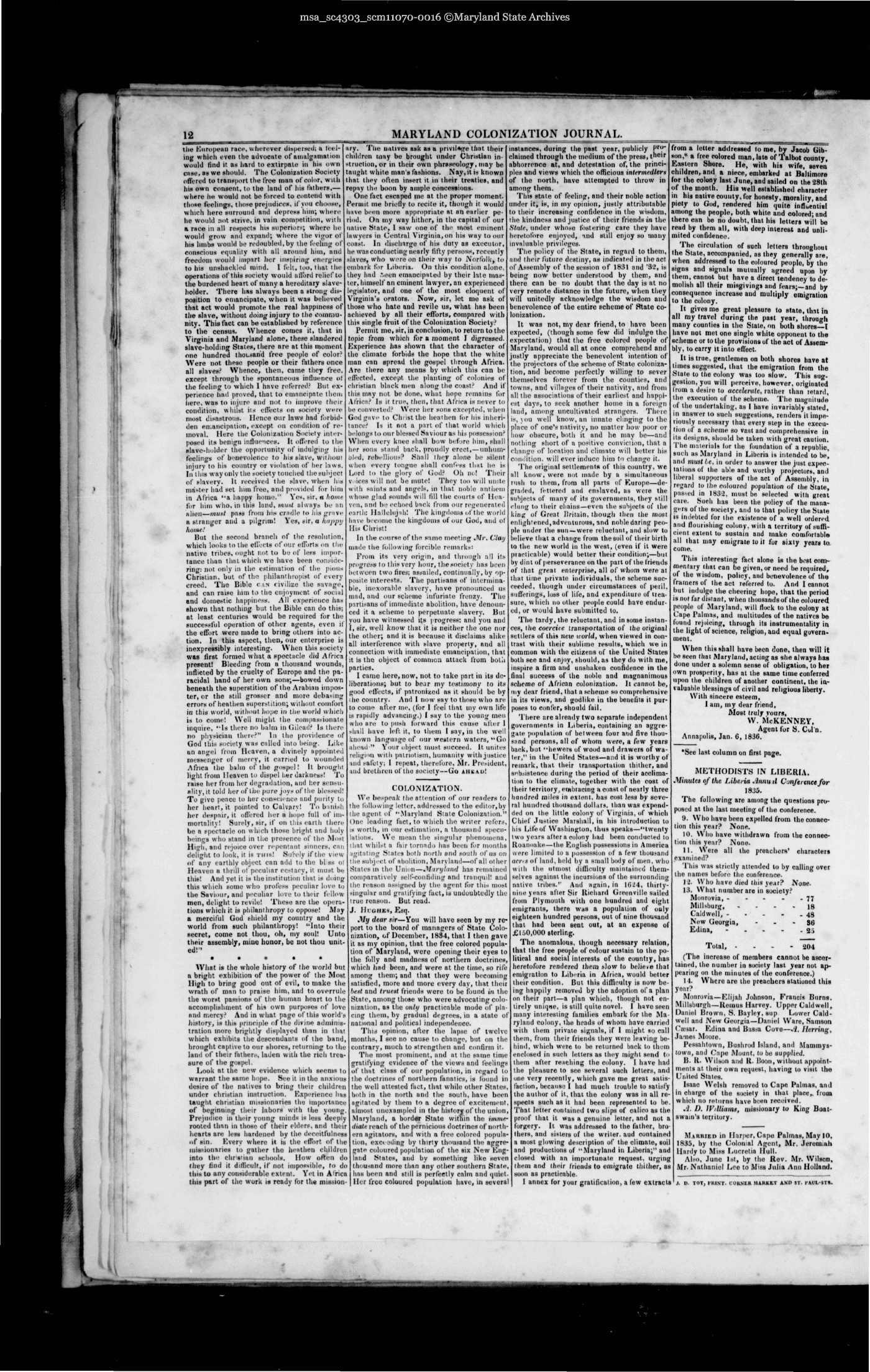
| 19 MARYLAND COLONIZATION JOURNAL. the European race, wherever diaoofioril a feel- ing which even the advocate of amalgamation would find it as hard to extirpate in his own case, as we should. The Colonization Society offered to transport the free man of color, with his own consent, to the land of his fathers,— where he would not be forced to contend with those feelings, thoM prejudices, if you choose, which here surround and depress him; where he would not strive, in vnin competition, wiili a race in all respects his superiors; where he would grow and expand; where the vigor of his limbs would be redoubled,by the feeling of conscious equality with all around him, and freedom would impart her inspiring energies to his unshackled mind. I felt, too, that the operations of this society would afford relief to the burdened heart of many a hereditary slave- holder. There lias always been a strong dis- position to emancipate, when it was believed that act would promote the real happiness of the slave, without doing injury to the commu- nity. This fact can be established by reference to the census. Whence comes it, that in Virginia and Maryland alone, these slandered slave-holding States, there are at this moment one hundred thousand free people of color? Were not these people or their fathers once all slaves? Whence, then, came they free, except through the spontaneous influence ot the feeling to which 1 have referred? But ex- perience bail proved, that to emancipate them here, was to injure and not to improve their condition, whilst its effects on society Wore most disastrous. Hence our laws had forbid- den emancipation, except on condition of re- moval. Here the Colonization Society inter- posed its benign influences. It offered to the slave-holder the opportunity of indulging his feelings of benevolence to his slave, without injury to his country or violation of her laws. In tins way onlv the society touched the subject of slaverv. It received the slave, when Ins master had set hun free, and provided for him in Africa '"a happy home." Yes, sir, n home for him who. in this land, tnttst always be nil alien—mutt pass from bin cradle to his grove a stranger and a pilgrim! Yes, sir, a nappy home! Hut the second branch of the resolution, which looks to the effects of our efforts on the native tribes, ought not to be of less impor- tance than that which wo have been conside- ring: not only in the estimation of the pious Christian, but of the philanthropist of every creed. The Bible tin rivilize the savage, and can raise him to the enjoyment of social and domestic happiness. All experience has shown that nothing but the Bible can do this; at least centuries would be required for the successful operation of other agents, even it the effort were made to bring others into ac- tion. In this aspect, then, our enterprise is inexpressibly interesting. When this society was first formed what n spectacle did Africa present! Bleeding from a thousand wounds, inflicted by the cruelty of Europe and the pa- racidal hand of her own sons;—bowed down beneath the superstition of the Arabian impos- ter, or the still grosser and more deba-ing errors of heathen superstition; without comfort in this world, without hope in the world which is to come! Well Bright the compassionate inquire, "Is there no balm in Gileail? Is there no physician there?" In the providence of God this •octet] was called into being. Like un angel from Heaven, a divinely appointed messenger of mercy, it carried to wounded Africa the balm of the gospel! It brought light from Heaven to dispel her darkness! To raise her from her degradation, and her soiisii- ality.lt told her of tile pure joys of the blBOMJI To give peace to her conscience and purity to her heart, it pointed to Calvary! To banian her despair, it oflered her a hope full of im- mortality! Surely, sir, if on this earth there be a spectacle on which those bright and holy beings who stand in the presence of the Moot High, and rejoice over repentant sinners, can delight to look, it is this! Surely if the view of any earthly object can add to the bl ss ol Heaven a thrill ot peculiar re.stacy, it must be this! And yet it is the institution that is doing this which some who profess peculiar love to the Saviour, and peculiar love to their fellow men, delight to revile! These are the opera- tions which it is philanthropy to oppose! May a merciful God shield my country and the world from such philanthropy! "Into their secret, come not thou, oh, my soul! Unto their assembly, mine honor, be not thou unit- ed!" • a * • • What is the whole history of the world but n bright exhibition of the power of the Most High to bring good out of evil, to make the wrath of man to praise him, and to overrule the worst passions of the human heart to the accomplishment of his own purposes of love and mercy? And in what page of this world's history, is this principle of the divine adminis- tration more brightly displayed than in that which exhibits the descendants of the band, brought captive to our shores, returning to the land of their father^, laden with the rich trea- sure of the gospel. Look at the new evidence which seems to warrant the same hope. See it in the anxious desire of the natives to bring their children under christian instruction. Experience has taught christian missionaries the importance of beginning their labors with the young. Prejudice in their young minds is less deeply rooted than in those of their elders, and their hearts are less hardened by the deceitfulness nf sin. Every where it is the effort of the missionaries to gather the heathen children into the chrsiian schools. How often do they find it difficult, if not impossible, to do this to any considerable cxtrnt. Yet in Africa this part of the work is ready for the mission- ary. Tin: unlives ask as a privilege that their children tuny be brought under Christian in- struction, or in their own phraseology, may be taught white man's fashions. Nay, it is known lhat they often insert it in their treaties, and repay the boon by ample concessions. One fact escaped me at, the proper moment. Permit me briefly to recite it, though it would iiiive been more appropriate at an earlier pe- riod. On my wav hither, in the capital of our native Slate, 1 saw one of the most eminent lawyers in Central Virginia,on his way to our coast. In discharge of his duty as executor, he was conducting nearly fifty persons, recently slaves, who were OB their way to Norfolk, to embark for Liberia, On this condition alone, they had Been emancipated by their late mas- ter, himself an eminent lawyer, an experienced legislator, and one of the most eloquent of Virginia's orators. Now, sir, let me ask of those who hate and revile us, what has been achieved by all their efforts, compared with this single fruit of the Colonization Society? Permit me, sir, in conclusion, to return to the topic from which for a moment I digressed. Experience lias shown that the character of the climate forbids the hope that the white man can spread the gospel through Africa. Are there any means by which this can be efl'ected, except the planting of colonies of christian black men along the coast? And if tins may Dot be done, what hope remains for Africa? Is it true, then, that Africa is never to be converted? Were her sons excepted, when God gave to Chiistthe heathen liir his inheri- tance? [s it not a part of that world which belongs to our blessed Saviour as his possession' When every knee shall bow before him, shall her sons stand back, proudly erect,—unburn* oh'd, rebellions? Shall they alone be silent when every tongue shall confess that li" is Lord to the glory of God? Oh no! Their v ices will not be mute! They too will unite with sainls and angels, in that noble antlieni whose glad sounds will till the courts of Hea- ven, and be echoed back from our regenerated earth: Hallelujah! The kingdoms of the world have become the kingdoms of our Cod, and ol His Christ! In the course of the same meeting Mr. Clay made the following forcible remarks: From its very origin, and through all its progress to this very hour, the society has been between two (ire?; as.-ailed, continually, by op- posite interests. The partisans of intermina- ble, inexorable slavery, have pronounced us mad, and our scheme infuriate frenzy. The partisans of immediate abolition, have denoun- ced it a scheme to perpetuate slavery. But you have witnessed its ] rogress: and you and I, sir. well know that it is neither the one nor the other; and it is because it disclaims alike all interference with slave properly, and all connection with immediate emancipation, that it is the object of common attack fiom botii parties, I came here, now, not to take part in its de- liberations; but to bear my testimony to its good effects, if patronized as it should be by ;he country. And I now say to those who are to come utter me, (for I feel that my own life is rapidly udvancuig.) I say to the young men who are to push forward this cause utter 1 shall have left it, to them I say, in the well known language of our western waters, "Go ahead" Your object must succeed. It unites religion with patriotism, humanity witli justice and safety; I repeat, therefore. Mr. President. in J brethren of the society—Go ahicad! COLONIZATION. We bespeak the attention of our renders to the following letter, addressed to the editor,by ihe agent of "Maryland Suite Colonization." One leading fact, to which the writer refers, is worth, in our estimation, a thousand specu- lations. We mean the singular phenomena, iliat whilst a fair tornado has been for months ¦igitnling Slates both north and south of us OB the subject of abolition, Maryland—of all other States in the Union—Maryland has remained comparatively self-confiding and tranquil! and the reason assigned by the agent for this most singular and gratifying fact, is undoubtedly the true reason. But read. J. HOMMi Esq. ,A/i/ dear sir—You will have seen by my re- port to the board of managers of State Colo- nization, of December, 1834, that I then gave it as my opinion, that the free colored popula- tion of Maryland, were opening their eyes to the fully and madness of northern doctrines, which had been, and were at the time, so rife among them; and that they were becoming satisfied, more and more every day, that their bent and truest friends were to be found in the State, among those who were advocating colo- nization, as the only practicable mode of pla- cing them, by gradual degrees, in a state of national and political independence- Tins opinion, after the lapse of twelve months, I see no cause to change, but on the contrary, much to strengthen and confirm it. The most prominent, and at the same time gratifying evidence of the views and feelings of that class of our population, in regard lo the doctrines of northern fanatics, is found in the well attested fact, that while other States, belli in the north ami the south, have been agitated by them to a degree of excitement, almost unexampled in the history of the union, .Maryland, a border State within the unmi- diate reach of the pernicious doctrines of north- ern agitators, and with a free colored popula- tion, exci ;ding by thirty thousand the aggre- gate coloured population of the six New Eng- land Slates, and by something like seven thousand more than any other southern State, has been and still is perfectly calm and quiet. Her free coloured population have, in several instances, during the past year, publicly fr"" claimed through the medium of the press, their abhorrence at, and detestation of, the princi- ples and views which the officious intermrdlem of the north, have attempted to throw in among them. This state of feeling, and their noble action under it, is, in my opinion, justly attributable to their increasing confidence in the wisdom, the kindness and justice of their friends in the Stale, under whose fostering care they have heretofore enjoyed, and still enjoy so many invaluable privileges. The policy of the State, in regnnl to them, and their future destiny, as indicated in the act of Assembly of the session of 1831 and '32, is being now better understood by them, and there can be no doubt that the day is at no very remote distance in the future, when they will unitedly acknowledge the wisdom and benevolence of the entire scheme of State co- lonization. It was not, my dear friend, to have been expected, (though some few did indulge the expectation) that the free colored people of Maryland, would all at once comprehend and justly appreciate the benevolent intention of the projectors of the scheme of State coloniza- tion, and become perfectly willing to sever themselves forever from the counties, and towns, and villages of their nativity, and from all the associations of their earliest and happi- est days, to seek another home in a foreign laud, among uncultivated strangers. There is, you well know, an innate clinging lo the place of one's nativity, no matter how poor or how obscure, both it and he may be—and nothing short of a positive conviction, that a change of location and climate will better his Condition, will ever induce him to change it. The original settlements of this country, we all know, were not made by a simultaneous tush to them, from all parts of Europe—de- gtaded, fettered and enslaved, as were the subjects of many of its governments, they still clung to I heir chains—even the subjects of ihe king of Great Itritain. though then the most enlightened,adventurous, and nobledarinir peo- ple under the sun —were reluctant, and slow to believe that a change from thesuil of their birth to the new world in the west, (even if it were piacticalde) would better their condition;—bill by dint of perseverance on the part of the friends o( that great enterprise, all of whom were at that lime private individuals, the scheme suc- ceeded, though under circumstances of peril, sufferings, lu»s of life, and expendiium of trea- sure, which no other people could have endur- ed, or would have submitted lo. The tardy, the reluctant, and in 9ume instan- ces, the coercive transportation of the original settlers of this MM world, when viewed in con- trast with their sublime results, which we in common with the citizens of the United States both see and enjoy, should, as they do with me, inspire a firm and unshaken confidence in the final success of the noble and magnanimous scheme of African colonization. It cannot be, my dear friend, that a scheme so comprehensive in its views, and godlike in the benefits it pur- poses to confer, should fail. There are already two separate independent governments in Liberia, containing an aggre- gate population of between four and five thou- sand persons, all of whom were, a hw years back, but "hewers of wood ami drawers of wa- ter," in the United States—and it is worthy of remark, that their transportation thither, and subsistence during the period of their acclima- tion to the climate, together with the cost of their territory, embracing a coast of nearly three hundred miles in extent, has cost less by seve- ral hundred thousand dollars, than was expend- ded on the little colony of Virginia, of which Chief Justice Marshall, in his introduction lo bis Life of Washington, thus speaks—"twenty two years alter a colony had been conducted to Roanoake—the English possessions in America were limited to a possession of a few thousand acf'S of land, held by a small body of men, who wilh the utmost difficulty maintained them- selves against the incursions of the surrounilino native tribes.'' And again, in ICJ4, thirty- nine years after Sir Richard Greenville sailed nun Plymouth with one hundred and eight emigrants, there was a population of only eighteen hundred persons, out of nine thousand that had been sent out, at an expense of £lo0,000 sterling. The anomalous, though necessary relation, that the free people of colour sustain to the po- litical and social interests of the countiy, has heretofore rendered them slow to believe thai emigration to Liberia in Africa, would better their condition. But this difficulty is now be- ing happily removed by the adoption of a plan on their part—a plan which, though not en- tirely unique, is still quite novel. I hove seen many interesting families embark for the Ma- ryland colony, the heads of whom have carried with them private signals, if 1 might so call them, from their friends they were leaving be- hind, which were lo be returned back to them enclosed in such letters as lliey might send lo them after reaching the colony. I have had the pleasure to see several such letters, and one very recently, which gave me great satis- faction, because I had much trouble to satisfy the author of it, thai the colony was in all re- spects such as it had been represented to be. That letter cuntained two slips of calico as the proof that it was a genuine letter, and nut a forgery. It was addressed to the father, bro- thers, and sisters of the writer, aud contained a most (.'lowing description of the climate, soil and productions of "Maryland in Liberia;" and closed wilh an importunate request, urging them and their friends to emigrate thither, as soon as practicable. I annex for your gratification, a few extracts from a letter addressed lo me, by Jacob Gib- son,* a free colored man, lata of Talbot county. Eastern Shore. He, with his wife, seven children, and a niece, embarked at Baltimore for the colony last June, and sailed on the '28th of the month. His well established character n his native county, for honesty, morality, and piety to God, rendered him quite influential among the people, both white and colored; and there can be no doubt, that his letters will be read by Ihem all, with deep interest and unli- mited confidence. The circulation of such letters throughout the State, accompanied, as they generally are, when addressed lo the coloured people, by the signs and signals mutually agreed upon by them, cannot but have a direct tendency to de- molish all their misgiving! and fears;—and by consequence increase and multiply emigration to the colony. It gives mo great pleasure to state, lint in all my travel during the past year, through many counties in the Stale, on both shores—I have not met one singlo white opponent to the scheme or to ihe provisions of the act of Assem- bly, to carry it into effect. It is true, gentlemen on both shores have at times suggested, that the emigration from the Slate to Ihe colony was loo stow. This suit- gestion. you will perceive, however, originated from a desire to accelerate, rather than tetard, the execution of the scheme. The magnitude of the undertaking, as I have invariably°stated, in answer to such suggestions, renders it impe- riously necessary that every step in the execu- tion of a scheme so vast arid cumprehensive in its designs, should be taken with great caution. The materials lor the foundation of a republic, 9uch as Maryland in Liberia is intended to be) ami must te. in order to answer the just expec- tations of the able and worthy projectors, and liberal supporters of the act of Assembly, in regard to the coloured population of the State, pas-ed in 183-2. must be selected with great care. Such has been Ihe policy of the mana- gers of the society, and to that policy the State is indebted for the existence of a well ordered and flourishing colony, wilh a territory of suffi- cient extent to sustain and make comfortable all that may emigrate lo it for sixty years lo come. This interesting fact alone is the best com- mentary thai can be given, or need be required, of the wisdom, policy, and benevolence of '.he framers of Ihe act referred to. And I cannot but indulge the cheering hope, that Ihe period is not far distant, when thousands of the coloured people of Maryland, will flock to the colony at Cape Palmas, and multitudes of the natives be found rejoicing, through its instrumentality in the light of science, religion, and equal govern- ment. When this shall have been done, then will it be seen that Maryland, acting as she always has done under a solemn sense of obligation, to her own prosperity, has at ihe same time conferred upon the children of another continent, the in- valuable blessings of civil and religious liberty. With sincere esteem, I am, my dear friend, Most truly vours, W. McKENNEY. Agent for S. Cul'n. Annapolis, Jan. 6, 1836. •See last column on first page. METHODISTS IN LIBERIA. Minutes of the Liberia .Innud Conference for 18J5. The following are among the questions pro- posed at the last meeting of the conference. 9. Who have been expelled from the connec- tion this year? None. 10. Who have withdrawn from the connec- tion this year? None. 11. Were all the preachers' characters examined? This was strictly attended to by calling over the names befuro the conference. 12. Who have died this year? None. 13. What number are in society? Monrovia, Millsburg, Caldwell, New Georgia, Edina, Total, - 77 18 48 36 25 204 (The increase of members cannot be ascer- tained, the number in society last year nol ap- pearing on the minutes of the conference.) 11. Where are the preachers statiuned this year? Monrovia—Elijah Johnson, Francis Burns. Millsbiirgh—Remus Harvey. Upper Caldwell, Daniel Brown, S. Bayley, sup Lower Cald- well and New Georgia—Daniel Ware, Samson Cmu, Edina and Bassa Cove—A. Herring, James Moore. Pessablown, Bushrod Island, and Mammy s- towa, and Cape Mount, to be supplied. B. It. Wilson and R. Boon, without appoint- ments at their own request, having lo visit the Uniled Slates. Isaac Welsh removed lo Cape Palmas, and in charge of the society in that place,, from which no returns have been received. A. D. Williams, missionary to King Boat- swain's territory. Married in Harper, Cape Palmas, May 10, 1835, by the Colonial Agent, Mr. Jeromiah Hardy to Miss Lucretia Hull. Also, June 1st, by the Rev. Mr. Wilson, Mr. Nathaniel Lee to Miss Julia Ann Holland. J. D. TOT, HUNT. CORNIR MARKET AND «T. CAUL-ITS. |