 |
|
|
 |
|
 |
|
|||
|
||||
|
||||
|
Maryland State Archives Maryland Colonization Journal Collection MSA SC 4303 msa_sc4303_scm11070-0020 Enlarge and print image (5M) |
|
|
|
|
|
|
|
|||
|
||||
|
||||
|
Maryland State Archives Maryland Colonization Journal Collection MSA SC 4303 msa_sc4303_scm11070-0020 Enlarge and print image (5M) |
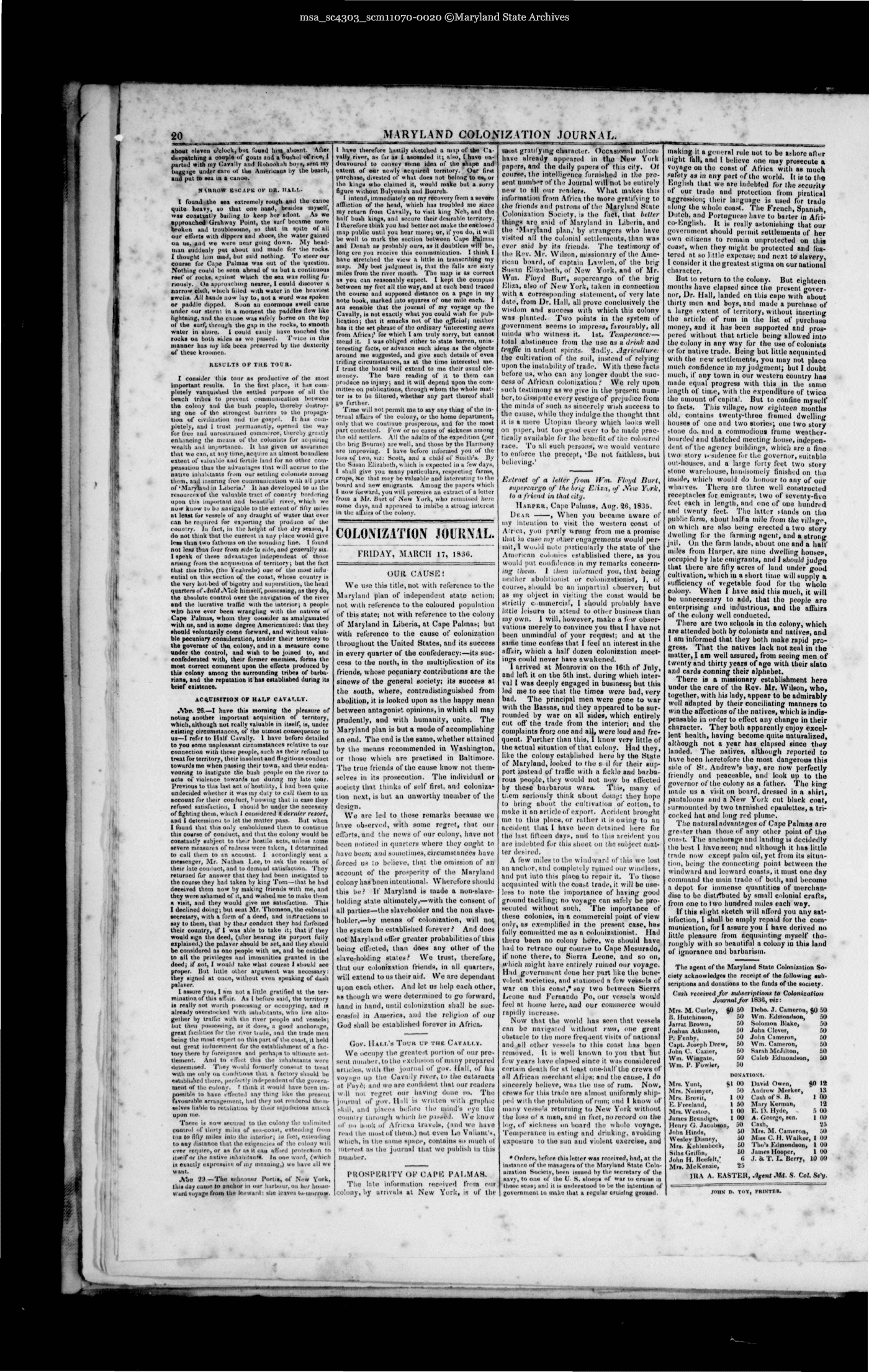
| 20 tbout eleven oflclock, but found hi:n aWsent. Afier despatching a couple of guats and i t-ushd of nee, ( parted with my CartIIj and Robodkah bova, sent inv baggige under en re ot lliu Americaus by lliu beach, aud put to sei in a canoe. NARROW ESCAPE OF DR. HALL. I found the aea extremely rough and the canoe quite heavy, so that one nand, br sulci myself, waa conttiiitly bailing to kepp her afloat. Aa we approached Grahway Point, the surf became more broken and troublesome, so that in spite of all our elfurtt with dipprrs and shoes, the water gained on us, aud we were near going down. My head- man suddenly put ubout and made for the rocks. I thought I.mi mad, but said nothing. To eteer our course for CtM Talmaa was out of the question. Nothing could be seen ahead of us but a continuous reef ot rocks, n;anist which the sea was rolling fu- riously. On appro aching nearer, I could discover a narrow cleft, which ailed with water in the heaviest ewt'iie. Ail hands now lay to, not a word was spoken or paddle dipped. Soon an enormous swell came under our stern: in a moment the paddles (lew like lightning, and the canoe was sufe.'v borne on the top of the surf, through the gap in the rocks, to smooth water in shore. i could easily have touched the rocks on botii sides as wa passed. Tvtce in this maimer has my life been preserved by the dexterity of thcae kroomen. RESULTS OP THE TOUR. I consider this tour as productive of tlie most important results. In the first place, it has com- pletely vanquished the settled purpose of all the beach tnbea to prevent communication between the colony and the bush people, thereby destroy- ing one of the strongest bainers to the propaga- tion of civilization and tlie gospel. It has com- pletely, and I tru-it permanently, opened the way for free and unrestrained commerce, thereby greatly enhancing the humus of the colonists for teqairtng wealth un.l nryiTUnee. It has given us as->urince that we can, at any time, acquire an almost boundless extent of valuable and fertile land for no other com- pensation than the advantages that will accrue to the native iiili.i!>.lants fr.un our settling colonials among them, and insuring free communication w.tii ail parts of 'Maryland in liberie.' it has developed to ua the resources of the valuable tract of country bordering upon this important and beaulil'ul river, which we now know to b.> navigable to the extent o/' fifty Bitot at least for vessels of any draught of water that ever can he required for exporting the prod ico of the eoun'ry. In fact, in the height of ihn dry season, 1 do not think that the current in any place won id give l"ss than two fathoms on the sounding line. I found not less than (our from side to aide, and generally six. 1 speak of these advantages independent of those arising from the acquitttion of territory, but the fact that this tribe, (the Veahrch*) one of the most irtuV ential on this section of the coast, whose country is the very hotbed of bigotry and superstition, the head quarters of *iu!dJ\~ick himself, possessing, as they do, the absolute control over the navigation of the river and the lucrative tralhc with the interior; a people who have ever been wrangling with the natives of Cape Pahnas, whom they consider as amalgamated with us, and in aome degree Americanized: that they should voluntarily come forward, and without valua- ble pecuniary consideration, tender their territory to the governor of the colony, and in a measure come under the control, and wish to be joined to, and confederated with, their former enemies, forms the moat correct comment upon the effects produced by thia colony among the surrounding tribes of barba- rians, and the reputation it has established during its brief eiiatence. ACQUISITION OF HALF CAVALLY. Abr. 26.—I have thia morning the pleasure of noting another important acquisition of territory, which, although not really valuable in itself, is, under existing circumstances, of the utmost consequence to us—I refer to Half Civally. 1 have before detailed to you aome unpleasant circumstances relative to our connection with UsfJM people, such M their refusal to treat for territory, their insolent and rhgitious conduct towards me when passing their town, and their endea- vouring to instigate the bush people on the river to acts of violence towards mc during my late tour. Previous to this last act of hostility, 1 had been quite undecided whether it was my duty to call them loan account for their conduct, luowiug that in case they refused satisfaction, I tmould he under the necessity of fighting them, which I considered fl dernier resort* and I deiermineu to let the matter pass. But when I found that this only emboldened them to continue this course of conduct, and that the colony would be constantly subject to their hostile acts, unless name severe measures of redress were taken, t determined to call them to an account. I accordingly sent a messenger, Mr. Nathan Lttj to ask the reason of their late conduct, and to demand satisfaction. They returned for answer that they had been instigated to the course they bad taken by king Tom—that he had deceived them now by making friends with me, and they were ashamed of it, and wished me to make them a visit, and thpy would give me satisfaction. Thia I declined doing; but sent Mr. Thomson, the colonial secretary, wuh a form of a deed, and instructions to •ay to them, that by the.r conduct they had forfeited their country, if I was able to take it; that if they would sign the deed, (ifter hearing its purport fully explained,) the palaver should be set, and they should be considered as one pmplc with us, aud be entitled to all the privileges and immunities granted in the deed; if not, I would take what course I should see proper. But little other argument was necessary: they signed at once, without even speaking uf dash palaver. 1 assure you, I am not a little gratified at the ter- mination of this affair. As I before said, the territory is really not worth posessing or occupying, and is already overstocked with inhabitants, who li,ve alto- gether by traffic with the river people and vessels; but then possessing, as it does, a good anchorage, great facilities for the river trade, and the trade rnen being the most expert on this part of the coast, it held out great inducement for the establishment of a fac- tory there by foreigners and perhaps to ultimate set- tlement. And to effect this the inhabitants were determined. They would formerly consent to treat with me only on conditions that a factory should be established there, perfectly independent of the govern- ment of the colony. I think it would have been im- possible to have effected anything like the present favourable arrangement, had they not rendered them- selves liabile to retaliation by their injudicious attack upon me. Tnere is now secured to the colony the unlimited control of thirty miles of sea-coast, extending from ten to fifty miles into the interior; in fact, extending to any distance that the exigencies of the colony will ever require, or as far as it can afford protection to itself or the native inhabitant. In one word, (which is exactly expressive of my meaning,) we have all we want. Nov. 19 —The schooner Portis, of New York, this day came to anchor in our harbour, on her home- ward voyage from the leeward: she leaves to-morrow. MARYLAND COLONIZATION JOURNAL. I have therefore hastily sketched a imp of the C&- vally river, as far as I ascended it; n'so, [ have en- deavoured to convey some idea of the shape and extent of our newly acquired territory. Our first purchase, divested of what does not belong to us, or the kinga who claimed it, would make but a sorry figure without Bulycmah and Bourch- l intend, immediately on my recovery from a severe affliction of the head, which has troubled me since my return from Cavally, to visit king Neh, and the half bush kings, and secure their desirable territory. I therefore think you had better not make the enclosed map public until you hear more; or, if you do, it will be well to mirk the section between Cape Palmis ami DoJttfe as probably ours, as it doubtless will be, long ere you receive this communication. I think I have stretched the view a little in transcribing my map. My best judgment is, that the falls are fluty miles from the river mouth. The map is as correct as you can reasonably expect. 1 kept the compass between my feet nil the way, and at each bend traced the course and supposed distance on a page in my note book, marked into squares of one mile each. I am sensible that the journal of my voyage up the Cavally, is not exactly what you could wish for pub- lication; that it smacks not of the official; neither has it the set phrase of the ordinary interesting news from Africa;' for which I am truly sorry, but cannot mend it. I was obliged either to state barren, unin- teresting facts, or advance such ideas as the objects around me suggested, and give Buch details of even trilling circumstances, as at the lime interested me. I trust the board will extend to mo their usual cle- mency. The bare reading of it to them can produce no injury; and it will depend upon the com- mittee on publications, through whom the whole mat- ter is to bo tillered, whether any part thereof shall go farther. Time will not permit me to say any thing of the in- ternal a flair* of the colony, or tho home department, only that we continue prosperous, and for the most part contented. Few or no cases of sickness among the old settler?. AH the adults of the expedition (per the brig B»urne) are well, and those by the Harmony are improving. I have before informed you of thu lo.-s of t»vo, viz: Scott, and a child of Smith's. By the Susan Elisabeth, which is expected in a lew days, I shall give you many particulars, respecting firms, crops, Mc that miy be valuable and interesting to the bo.ml and new emigrants. Among the papers which I now forward, you will perceive an extract of 1 letter from a Mr. Burt of New York, who rem lined here some days, and appeared to imbibe a strong iuttrtsi in thu alfiirs of the colouv. COLONIZATION JOURNAL. FRIDAY, MARCH 17, 1836. OUR CAUSE! Wo ti*e tliis title, not with reference to tho Maryland plan ot' independent state action; not with reference to the coloured population of this state; not with reference to the colony of Maryland in Liberia, at Cape Pulinas but with referenco to the cause of colonization throughout the United States, and its success in every quarter of the confederacy:—its suc- cess to the north, in the multiplication of its friends, whose pecuniary contributions are the sinews of the general society; its success at the south, where, contradistinguished from abolition, it is looked upon as the happy mean between antagonist opinions, in which all may prudently, and with humanity, unite. The Maryland plan is but a mode of accomplishing HI end. The end is the same, whether attained by the means recommended in Washington, or those which are practised in Baltimore. Tho true friends of the cause Unow not them- selves in its prosecution. The individual or society that thinks of self first, an 1 coloniza- tion next, is but an unworthy member of the design. We are lei to these remarks because we have ob-ervid, with some regret, that our efforts, and tho news of our colony, have not been noticed in quarters where they ought to have been; and sometimes,circumstances have forced ui !o believe, that the omission of nn account oi' tho prosperity of the Maryland colony has been intentional. Wherefore should this be? If Maryland is made a non-sluve- liolding state ultimately,—with the consent of all parties—the slaveholder and the non slave- holder,—by means of colonization, will not tho system be established forever? And does nut Maryland otter greater probabilities of this being ett'.cled, than does any other of the slave-holding states? We trust, therefore, that our colonization friends, in all quarters, will extend to us their aid. We are dependant Ujon each other. And let us help each other, as though wo were determined to go forward, hand m hand, until colonization shall be suc- cessful in America, and the religion of our Ood shall bo established forever in Africa. Gov. Hall's Tour up the Cavally. Wo occupy the greiite-t portion of our pre- sent number,toth« exclusion of many prepared urin'.es, with the journal of gov. Hull, of Ins voyage up tho Cavady river, to the cataracts it Cif^ and wo are confident that our readers w II not regret nor having done so. Tlie journal of gov. Hill is written with graphic skill, and place* before the mind's eyo tho eouniry through which lie passed. We know of no u .ok of African travels, (and we have read the moataf them.) not even Lt Valiant's, winch, in the same space, contains so much ol interest as tli,; journal that we publish in this number. most gratilying character. Occasional notice.- have already appeared in tlie- New York pap ts, and the daily papers of this city. Ol course, the intelligence furnished in the pre- sent number of the Journal will not be entirely new to nil our readers. What uvikes this information from Africa the more gratifying to the friends and patrons of the Maryland State Colonization Society, is the fact, that heller things are said of Maryland iu Liberia, and the 'Maryland plan.' by strangers who have visited all the colonial settlements, than was ever said by its friends. The testimony of the It-v. Mr. Wilson, missionary of the Ame- rican board, of captain Lawletl, of the brijr Susan Klizabeth, of New York, and of Mr. Win. Floyd Hurt, supercargo of tlin brig Kliza, also of New York, taken in connection with a corresponding statement, of very late date, from Dr. Hull, all prove conclusively the wisdom and success with which this colony was planted. Two points in the system of government seems to impress, favourably, all minds who witness it. 1st. Temperance:— total abstinence from the use as a drink and traffic in ardent spirits. 2nd!y. Agriculture. the cultivation of the soil, instead of relying upon the instability of trade. With these fuels before us, who can any longer doubt the suc- cess of African colonization ? We rely upon such testimony as we give in the present num- ber, to uissip'tte every vestige of prejudice from the minds of such as sincerely wish success to the cause, white they indulge the thought that it is a mere Utopian theory which loo:;s well on piper, but too good ever to be made prac- tically available tor the benefit of the Coloured race. To nil such persons, we would venture to enforce tho precept, 'Be not faithless, but behoving.' PROSPERITY OF CAPE PALMAS. The late information received from our :o!oiiy, by arrivals at New York, is of the Extract of a letter from Wm. Floyd Burt, supercargo of the brig Eliza, of New York, to a friend in that city. Harper, Cape Palmas, Aug. 26, 1835. Dear -------, When you became aware of my intern ion to visit tho we.-tern coast ol Afrcn, you partly wrung from me a promise that in COM my oilier engagements would per- mit, 1 would note particularly the state of the American colonics established there, as you would put coiifidinco in my remarks concern- ing iheui. 1 then informed you, that being neither abolitionist or colomzationist, I, ol course, should bo an Impartial observer; but as my object in vis ting the const would he strictly cinmercial, 1 should probably have little leioura to attend to Other business than my own. 1 will, however, make a liw obser- vations merely to convince you that 1 have not been unmindful of your rcquett; and at the same tunc confess that I feel an interest in the affair, which a half dozen colonization meet- ings could never have awakened. 1 arrived nt Monrovia on tho 16th of July, and left it on the 5th inst. during which inter- val I was deeply engaged in business; but this led me to see that the times were bad, very bad. Tho principal men were gone to war with tho Bassas, and they appeared to be sur- rounded by war on all sides, which entirely cut oft" the trade from the interior; and the complaints frors one and all, were loud and fre- quent. Further thnn this, 1 know very little of tlie actual situation of that colony. Had they, like llie colony established hero by the State of Maryland, looked to I ho s il for their sup- port inslead of traffic with n fickle and barba- rous people, they would not now bo affected by these bai barons ware. This, ninny of t.,em seriously think ubout dome; they hope to bring about tlie cultivation of cotton, to make it nn article of export. Accident brought mo to this pines, or rather it is owing to no accident that I have, been detained here for the last fifteen day-", and to this accident von are indebted for this sheet on the suljeel mat- ter desired. A few miles lo the windward of this we lost nn anchor,and completely ruined our windlass, tod put into I his place to repair it. To those acquainted with the Coast trade, it will be use- less to note the importance of having good ground tackling; no voyage ran safely be pro- secuted without such. The importance of these colonies, in a commercial point of view only, as exemplified in the present case, has fully committed me as a coloiiizatinnist. Had there been no colony here, we should have had to retrace our course to Cape Mesurado, if none there, to Sierra Leone, and so on, which might have entirely ruined our voyage. Had government done her part like the bene- volent societies, and nutioncd a few vessels of war on this const," say two between Sierra Leone and Fernando Po, our vessels WOtaJd feel at home here, and our commerce would rapidly increase. Nuw that the world has seen that vessels can bo navigated without rum, one great obstacle to l lie more frequent visits of national and nil other vessels to I his coast has been removed. It is well known lo you lhat but few years have elapsed since it was considered certain death for nt least one-half the crews of nil African merchant snipe; and (he cause, 1 <)o sincerely believe, wus tlie use of ruin. Now, crews for this trade are almost uniformly ship- ped with the prohibition of rum; mid I know of ninny vessels returning lo New York without the loss ol a man, and in fact, no record on the log, of sickness on board the whole voyage. Temperance ia eming nnd drinking, avoiding txposiiro to the sun and violent exercise, uud • Orders, Refers lhin Intler w«i rrccired, had, nt the instance ol" tlie manager* of the Maryland State Colo- inzntion Society, esse iRsued by llic secretary of tlie navy, to one of tlie V- S. sloops of war to cruise in those seas; and it i- understood to be the intention of government to malic lhat a regular cruirdng ground. making it a general rule not to be isliorc after night fall, and I believe one muy prosecute a voyage on tho coast of Africa with as much safely as in any part cfthc world. It is to the English that we are indebted for the security of our trade and protection from piratical aggression; their language is used for trade "long the whole coast. The French, Spanish, Dutch, and Portuguese have to barter in Afii- co-Knglish. It is really ustonishing that our government should peimit settlements of her own citizens to remain unprotected on this coast, when they might be prulected and fos- tered nt so little expense; nnd next to slavery, I consider it the greatest stigma on our national character. But to return to thu colony. But eighteen months have elapsed since the present gover- nor, Dr. Hall, landed on this capu with about thirty men and boys, and made a purclmsc of a large extent of territory, without inserting tho article of rum in the list of purchase money, and it has been supported and pros- pered without that article being allowed into the colony in any wny for the use of colonists or for native trade. Being but little acquainted with the new settlements, you may not place much confidence in my judgment; but I doubt much, if any town in our western country has made equnl progress with this in the tamo length of time, with the expenditure of twice the amount of capital. But to confine myself to facts. This village, now eighteen months old, contains twenty-three framed dwelling houses of one and two stories; one two story stone do. and a commudious frame wenthcr- boarded and thatched meeting house, indepen- dent of the agency buildings, which are a lino two story i, sidence for the governor, suitable out-houses, and a large forty feet two story stone warehouse, handsomely finished on tho itisiile, which would do honour (o any of our whaives. There ore three well constructed receptacles for emigrants, two of seventy-fivo feet each in length, and one of one hundred and twenty feet. The latter stands on tho public farm, about half a mile from the village, on which are nlso being erected a two story dwelling for the farming ngeiil, and a strong jail. On the farm lands, ubout one and a half miles from Harper, are nine dwelling houses, occupied by late emigrants, and I should judn-o that there are fifty ucres of lund under good cultivation, which m a short time will supply a sufficiency of vegetable food for the wholo colony. When 1 have said this much, it will be unnecessary to add, that tho people aro enterprising nnd industrious, and the affairs of the colony well conducted. There are two schools iu the colony, which aro attended both by colonists and natives, and I am informed that they bofh make rapid pro- gress. That the natives lack not zeal in the matter, I am well assured, from seeing men of twenty and thirty years of age with their slato and cards conning their alphabet. There is a missionary establishment hero under the care of the llev. Mr. Wilson, who, together, with his lady, appear to be admirably well adapted by their conciliating manners to win the affections of the natives, which is indis- pensable in order to effect any change in their character. They both apparently enjoy excel- lent health, having become quite naturalized, although not a year has elapsed since tlmy landed. The natives, although reported to have been heretofore the most dangerous this side of Si. Andrew's bay, are now perfectly friendly nnd peaceable, and look up to tho governor of the colony as a father. The king made us a visit on board, dressed in a shirt, pantaloons nnd a New York cut black coat, surmounted by two tarnished epaulettes, a tri- coeked hat and long red plume. The natural advantages of Cape Pnlmas nro greater than llio.-e of any other point of the const. The anchorage and landing is decidedly the beat 1 havoeeen; and although it has little trade now except palm oil,yet from its situa- tion, being the connecting point between the windward nnd leeward coasts, it must one day command the main trade of both, nnd become a depot for immense quantities of merchan- dise to bo distributed by small colonial craft-,, from one to f vvo hundred miles each way. If this slight sketch will afford you any sat- isfaction, I shall bo amply repaid for the com- munication, for 1 assure you 1 have derived no little pleasure from acquainting myself tho- roughly with so beautiful a colony in this lund of iijruoranee and barbarism. The agent of the Maryland Stale Colonization So- ciety acknowledges tho receipt of the following tub- scnptions and donations to the funds of the society. Cash received for subscriptions to Colonization Journal for 1836, viz: Mrs. M. Curley, $0 50 Debo. J. Cameron, $0 50 B. Hutchinson, 50 Wm. Edmondson, 50 Jarrat Brown, 50 Solomon Blake, 50 Joshua Atkinson, 50 John Clever, 50 P. Fenby, 50 John Cameron, 50 Capt. Joseph Drew, 50 Wm. Cameron, 50 Julia C. Cazier. 50 Sarah McJilton, 50 Wm. Wingate, 50 Caleb Edmondson, 50 Wm. P. Fowler, 50 DONATIONS. Mrs. Yunt, $l 00 David Owen, $0 12 Mrs. Neimeyer, 50 Andrew Merker, 13 Mrs. Brevit, 1 00 Cash of S. B. 100 E. Freeland, 1 50 Mary Kerman, 12 Mrs. Weston, 100 E. D. Hyde, 50 James Brundige, 100 A. George, sen. 100 Henry G. Jacobson, 50 Cash, 25 John Hinds, 50 Mrs. M. Cameron, 50 Wesley Disney, 50 Miss C. H. Walker, 1 00 Mrs. Kehlenbeck, 50 Tho's Edmondson, 1 00 Silas Griffin, 50 James Hooper, 1 00 John H. Beefelt,* 6 J. & T. L. Berry, 10 00 Mrs. McKenzie, 25 IRA A. EASTER, Agent Md. S. Col. Sc'y. JOHN D. TOY, PRINTER. |