 |
|
|
 |
|
 |
|
|||
|
||||
|
||||
|
Maryland State Archives Maryland Colonization Journal Collection MSA SC 4303 msa_sc4303_scm11070-0021 Enlarge and print image (4M) |
|
|
|
|
|
|
|
|||
|
||||
|
||||
|
Maryland State Archives Maryland Colonization Journal Collection MSA SC 4303 msa_sc4303_scm11070-0021 Enlarge and print image (4M) |
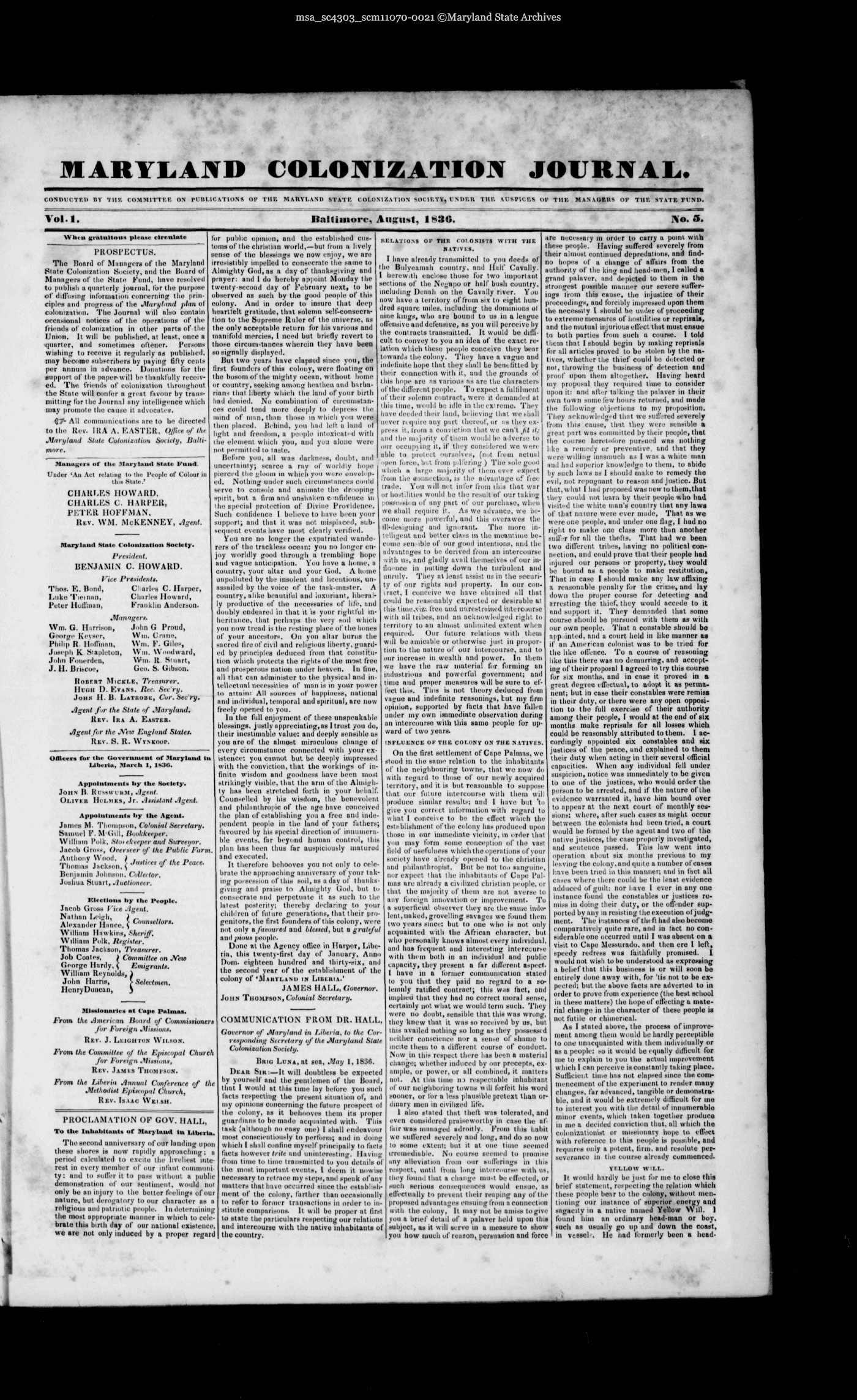
| MARYLAND COLONIZATION JOURNAL,. CONDUCTED BY THE committee on PUBLICATIONS of the MARYLAND STATE colonization- society, under the auspices of the managers of the state fund. Vol.1. Baltimore, August, 1836. No. 5. When gratuitous please circulate PR0SPECTUS. The Hoard of Managers of the Maryland State Colonization Society, and the Board of Managers of the State Fund, have resolved to publish u quarterly journal, tor the purpose of diffusing information concerning tin; prin- ciples and progress of the Maryland plot) ol colonization. The Journal will also contain occasional notices of the operations of the friends of colonization in other parts of the Union. It will he published, at least, once a quarter, and some) lines oflener. Persons wishing to receive it regularly as published, may become subscribers bv paying fifty cents per annum in advance. Donation! for the support of the paper will be thankfully receiv- ed. The friends of colonization throughout the Stale will confer n great favour by trans- mitting for the Journal any intelligence which may promote the cause it advocate!¦ All Communications are to he directed to the Rev. IRA A. EASTER, Office of the Maryland Slide Colonization Society, Balti- more. Managers of the Maryland State Fund Under 'An Act relating to the People of Colour in this State.' CHARLES HOWARD, CHARLES C. HARPER, PETER HOFFMAN, Rev. WM. McKENNEY, Agent. Maryland State Colonization Society. President. BENJAMIN C. HOWARD. Vice Presidents. Thos. K. Bond, Charles C. Harper Luke Tiernan, Charles Howard, Peter Hoffman, Franklin Anderson. Wm. G. Harrison, George Keyser, Philip R Hoffman, Joseph K Stapleton, John Fonerden, J. H. Briscoe, Managers. John G Proud, Wm. Crane, Wm. F. Giles, Wm. Woodward, Wm. R Stuart, Geo. S. Gibson. Robert Micki.e, Treasurer. Hugh D. Evans, Rec, Sec'ry. John H. B. Latrobe, Cor. Sec ry. Agent for the State of Maryland. Rev. Ira A. Easter. Agent for the New England States. Rev. S. R. Wynkoop. Officers for the Government of Maryland in Liberia, March 1, 1836 Appointments by the Society. John B. Russwurm, Agent. Oliver Holmes, Jr. Assistant Agent. Appointments by the Agent. James M. Thompson, Colonial Secretary. Samuel F. McGill, Bookkerper. William Polk, Storekeeper and Surveyor. Jacob Gross, Overseer of the Public Farm. Anthony Wood. Justices of the Peace. Thomas Jackson, Benjamin Johnson. Collector. Joshua Stuart, Auctioneer. Elections by the People. Jacob Gross Vice Agent. Nathan Leigh, Counsellors. Alexander Hance, William Hawkins, Sheriff. William Polk, Register. Thomas Jackson, Treasurer. Job Coates, Committee on New George Hardy, Emigrants. William Reynolds, John Harris, Selectmen. Henry Duncan, for public opinion, ami the established cus- toms of the christian world,—but from ii lively sense of the blessings we now enjoy, we are irresistibly impelled to consecrate the same to Almighty God, as a day of thanksgiving and prayer: and I do hereby appoint Monday the twenty-second day of February next, to be observed as such by the good people of this colony. And in order to insure that deep heartfelt gratitude, that solemn self-consecra- tion to the Supreme Ruler of the universe, as the only acceptable return for his various and manifold mercies, 1 need but briefly revert to those circum-tances wherein Ihey have been so signally displayed. lint two years have elapsed since you, the first founders of this colony, were floating on the bosom of the mighty ocean, without home or country, seeking among heathen and h irba- rians that liberty which the land of'yonr birth had denied. No combination of circumstan- ces could tend more deeply to depress the mind of man, than those in which you were then placed. Hchind, you had left a land of light and freedom, a people intoxicate d with the element which you, and you alone were not parasitica' to laste. Before you, ail was darkness, doubt, ami uncertainty; scarce a ray of worldly hope pierced the gloom m wduch you were envelop* ed. Nothing under such circumstances could serve to console and animate the drooping spirit, but a firm and unshaken confidence in the special protection of Divine Providence. Such confidence I believe to have been your support; and that it was not misplaced, sub- sequent events have most clearly verified. Vou are no longer the expatriated wande- rers of the trackless ocean: you no longer en- joy worldly good through a trembling hope and vague anticipation. Von have a home, a country, your altar and your (iod. A home unpolluted by the insolent ami licentious, un- aaaatled by the voice of the task-master. A country, alike beautiful and luxuriant, liberal' ly productive of the necessaries of life, and doubly endeared in that it is your rightful in- heritance, that perhaps the very soil which you now tread is the resting place of t he hones of your ancestors. On yon altar bums the sacred fire of civil and religions liberty, guard- ed by principles deduced from that constitu- tion which protects the rights of the most free and prosperous nation under heaven. In line, all that can administer to the physical and in- tellectual necessities of man is in your power to nltuin: All sources of happiness, national ami individual, temporal and spiritual, are now freely opened to you. In the full enjoyment of these unspeakable blessings, justly appreciating.as I trust you do, their inestimable value: and deeply sensible as you are of the almost miraculous change of every circumstance connected with your ex- istence: you canuut but be deeply impressed with the conviction, that the workings of in- finite wisdom and goodness have been most strikingly visible, that the arm of the Almigh- ty has been stretched forth in your behalf Counselled by his wisdom, the benevolent and philanthropic of the age have conceived the plan of establishing you a free ami inde- pendent people in the land of your father.-; favoured by Ins special direction of innumera- ble events, far beyond human control, this plan has been thus far auspiciously matured and executed. It therefore behooves you not only to cele- brate the approaching anniversary of your tak- ing pu.-session oflhis soil,as a day of thanks- giving and praise to Almighty God, but to consecrate and perpetuate it as such to the lale.-t posterity; thereby declaring to your children of future generations, that their pro- genitors, the first founders of this colony, were not only a favoured and blessed, but a grat if id and pious people. Done at the Agency office in Harper, Libe- ria, this twenty-first day of January, Anno Dom. eighteen hundred and thirty-six, and the second year of the establishment of the colony of'Maryland in Liberia.' JAMES HALL, Governor. John Thompson, Colonial Secretary. RELATIONS OF THE COLONIES WITH THE NATIVES. I have already transmitted to you deeds of the Biilyeamah country, and Half Cavally. I herewith enclose those for two important sections of the Negapo or half bush country, including Dinah on the Cavally river. Vou now have a territory of from six to eight hun- dred square miles, including the dominions ol nine kings, who are bourn! to us in a league offensive and defensive, as you will perceive by the contracts transmitted. It would be diffi- cult to convey to you an idea of the exact re- lation which these people conceive they bear towards the colony. They have a vague and indefinite hope that they shall be benefitted by their connection with it, and the grounds of this hope are ns various as are the characters of the different people. To expect a fulfilment of their solemn contract, were it demanded at ibis time, would be idle in the extreme, They have deeded their land, h. lieving that we shall never require any part thereof, or as they ex- press it. Iron a conviction that we can't jit it; and the majority of them Would bo adverse to our occupying it, if they considered we wen able to protect oufoelvea, (not from actual open force, but from pilfering.) The sole good which h large majority of them ever aspect from the connection, is the advantage of free trade. You will not infer from ihis that war or hostilities would be the result of our taking : peeeteion of any part ol' our purchase, when we shall require it. As we advance, we In- nome more powerful, and this overawes the nVdeiigntng and ignorant. The more in- telligent and better cla-s m the meantime be- come feasible of our good intentions, and the advantage! to be derived from an intercourse ¦•. ith ue, and gladly avail themselves of our in- fluence in putting down the turbulent and Unruly. They at least assist us in the securi- ty of our rights and properly. In our con. irnct, I conceive we have obtained all that could be reasonably expected or desirable at this time .viz-, free and unreatraintd intercourse with all tribes, and au acknowledged right to territory to an almost unlimited extent when required.. Our future relations with them will he amicable or otherwise just in propor- tion to the nature of our intercourse, and to our increase in wealth and power. In them we have the raw material for firming an industrious and powerful government; and time and proper measures will be sure to ef- fect this. Tins is not theory deduced from vague and indefinite reasonings, but my firm opinion, supported by facts that have fallen under my own immediate observation during an intercourse with this same people for up- ward of two years. Missionaries at Cape Palmas. From the American Board of Commissioners for Foreign Missions. Rev. J. Leighton Wilson. From the Committee of the Episcopal Church for Foreign .Missions, Rev. James Thompson. From the Liberia Annual Conference of the Methodist Episcopal Church, Rev. Isaac Welsh. PROCLAMATION OF GOV. HALL, To the Inhabitants of Maryland in Liberia. The second anniversary of our landing upon these shores is now rapidly approaching; a period calculated to excite the liveliest inte- rest in every member of our infant commnni ty: and to sutler it to pass without, a public demonstration of our seulimeiit, would not only bo an injury to the belter foldings of our nature, but derogatory to our character as a religious and patriotic people. In determining the most appropriate maimer in which to cele- brate this birth day of our national existence, we are not only induced by a proper regard COMMUNICATION FROM DR. HALL, Governor of Maryland in Liberia, to the Cor- responding Secretary of the Maryland Stale Colonization Society. Brig Luna, at sea, May 1, 1836. Dear Sir:—It will doubtless be expected by yourself and the gentlemen of the Board, that I would at this time lay before you such facts respecting the present situation of, and my opinions concerning the future prospect of the colony, as it behooves them its proper guardians to be made acquainted with. This task (although no easy one) I shall endeavour most conscientiously to perforin; and in doing which I shall confine myself principally to facts facts however trite and uninteresting. Having from lime to lime transmitted to you d.'tails ol the most important events, I deem it nowise neco.-sary to retrace my steps, and speak of any matters that have occurred since the establish- ment of the colony, farther than occasionally to refer to Conner transactions in order to in- stitute comparisons. It will be proper at first to state Mm particulars respecting our relations and intercourse with the native inhabitants of the country. INFLUENCE OF THE COLONY ON THE NATIVES. On the first settlement of Cape Palmas, we stood in the same relation to the inhabitants of the neighbouring towns, that we now do with regard to those of our newly acquired territory, and it is but reasonable to suppose that our future intercourse with them will produce similar results; and I have but 'to give you cornet information with regard to what I conceite to bo the effect which the establishment of the colony has produced upon those in our immediate vicinity, in order that you may form some conception of the vast field of usefulness which the operations of your society have already opened to the christian and philanthropist. But be not too sanguine, nor expect that the inhabitants of Cape Pal- mas are already a civilized chiistiau people, or that the majority of them are nut averse to any foreign innovation or improvement. To a superficial observer they are the same indo- lent,naked, grovelling savages we found them two years since: but lo one who is not only acquainted with the African character, but who personally knows almost every individual, and has frequent and interesting intercourse with lluui both in an individual and public capacity, they present a far different aspect. I have m a former communication staled to you that they paid no regard to a so- lemnly ratified contract; this was fact, and implied that they had no correct moral sense, certainly not what we would term such. They were no doubt, sensible that this was wrong, they knew that it was so received by us, but tins availed nothing so long as they poeaaaji d neither conscience nor a sense of shame to mete them to a different course of conduct. Now in this respect there has been a material change; whether induced by our precepts, ex- ample, or power, or all combined, it matters not. At this lime n ) respectable inhabitant of our neighboring towns will forfeit his word sooner, or for a less plausible pretext than or- dinary men m civilized life. 1 also stated that theft was tolerated, and even considered praiseworthy in case the af Mr am managed adroitly. From this habit we suffered severely and lone, and do so now to some extent; but it at one time seemed irremediable. No course seemed to promise any alleviation from our buffering! in this reapeet, until from long intereourea with us, they found that a change inu-t be effected, or such serious con-equences would ensue, as effectually to prevent their reaping any of the proposed advantages ensuing from a connection with the colony, It may not be amiss to give you a brief detail of a palaver held upon this subject, as it will serve in a measure to show you how much of reason, persuasion and force are necessary in order to carry a point with these people. Having suffered severely from their almost continued depredations, and find- no hopes of a change of affairs from the authority of the king and head-men, I called a grand palaver, and depicted to them in the strongest possible manner our severe suffer- ings from this cause, the injustice of their proceedings, and forcibly impressed upon them the necessity I should be under of proceeding to extreme measures of hostilities or reprisals, and the mutual injurious effect that must ensue to both parties from such a course. I told I hem that I should begin by making reprisals for all articles proved to be stolen by the na- tives, whether the thief could be detected or not, throwing the business of detection and proof upon them altogether. Having heard my proposal they required lime to consider upon it: and after talking the palaver in their own town some few hours returned, and made the following objection! to my proposition. They acknowledged that we intend severely from this cause, tint they wen; sensible a great part was committed by their people, that the course heretofore panned was nothing like a remedy or preventive, and that they were willing innsinuch as I was a white man and had superior knowledge lo them, to abide by such laws as I should make to remedy the evil, not repugnant to reason and justice. But that, what I had proposed was new lo them,that they could not learn by their people who had visited tbe white man's country that any lawa of that iKiuirc were ever made, That as we were one people, and under one flag, I had no right to make one class more than another suffer for nil the thefts. That had we been two different tribes, having no political con- nection, and could prove that their people had injured our persons or property, tiiey would be bound as a people to make restitution. That in case I should make any law affixing a reasonable penally for the crime, and lay down the proper course for detecting and arresting the thief, they would accede to it and support it. They demanded that somo course should be pursued with them as with our own people. That a constable should be app imted, and a court held in like manner aa if an America! colonist was to be tried for the like offence. To a course af reasoning like tiiis there was no demurring, and accept- ing of their proposal 1 agreed to try this course for six months, and in case it proved in a great degree effectual, to adopt it as perma- nent; but in case their constables were remiss in their duty, or there were any open opposi- tion to the full exercise of their authority among their people, I would at the end of six months make reprisals for all losses which could be reasonably attributed to them. I ac- cordingly appointed six constables and six justices of the peace, and explained to them their duly when acting in their several official capacities. When any individual fell under suspicion, notice was immediately to be given to one of the justices, who would order the person to be arrested, and if the nature ol'the evidence warranted it, have him bound over to appear at the next court of monthly ses- sions: where, after such cases as might occur between the colonists had been tried, a court would he formed by the agent and two of the native justices, the case properly investigated, and sentence passed. This law went into operation about six months previous to my leaving the colony, and quite a number of cases have been tried in this maimer; and in fact all cases where there could be the least evidence adduced of guilt: nor have I ever in any one instance found the constables or justices re- miss in doing their duty, or the offender sup- ported by any in resisting theexecution of judg- ment. The instances of tin ft had also become comparatively quite rare, and in tact no con- siderable one oectirred until I was absent on a visit to Cape Messiirado. and then ere I left, speedy redress was faithfully promised. I would not wish tube understood as expressing a belief that this business is or will soon be entirely done away with, for 'tis not to be ex- pected; but the above facts are adverted to in order to prove from experience (the best school in these matters) the hope of effecting a mate- rial change in the character of these people is not futile or chimerical. As I stated above, the process of improve- ment among iheui Would be hardly perceptible to one unacquainted with them individually or as a people: so it would beiqually difficult for me to explain to you the actual improvement which I can perceive is constantly taking place. Sufficient time has not elapsed since the com- mencement oftbe experiment to render many changes, far advanced, tangible or demonstra- ble, and it would be extremely difficult for me to interest you with the detail of innumerable minor events, which taken together, produce in me a decided conviction that, all which the coloiiizationist or missionary hope to effect with reference to this people is possible, and require! only a potent, firm, and resolule per- tevereaoe in the course already commenced. YELLOW WILL. It would hardly be just for me to close this brief statement, respecting the relation which these pecqde bear to the colony, without men- tioning our instance of superior energy and sagacity in a native named Yellow W ill. I found him an ordinary head-man or boy, such as usually go up and down the coast, in vessel . He nad formerly been a head- |