 |
|
|
 |
|
 |
|
|||
|
||||
|
||||
|
Maryland State Archives Maryland Colonization Journal Collection MSA SC 4303 msa_sc4303_scm11070-0025 Enlarge and print image (5M) |
|
|
|
|
|
|
|
|||
|
||||
|
||||
|
Maryland State Archives Maryland Colonization Journal Collection MSA SC 4303 msa_sc4303_scm11070-0025 Enlarge and print image (5M) |
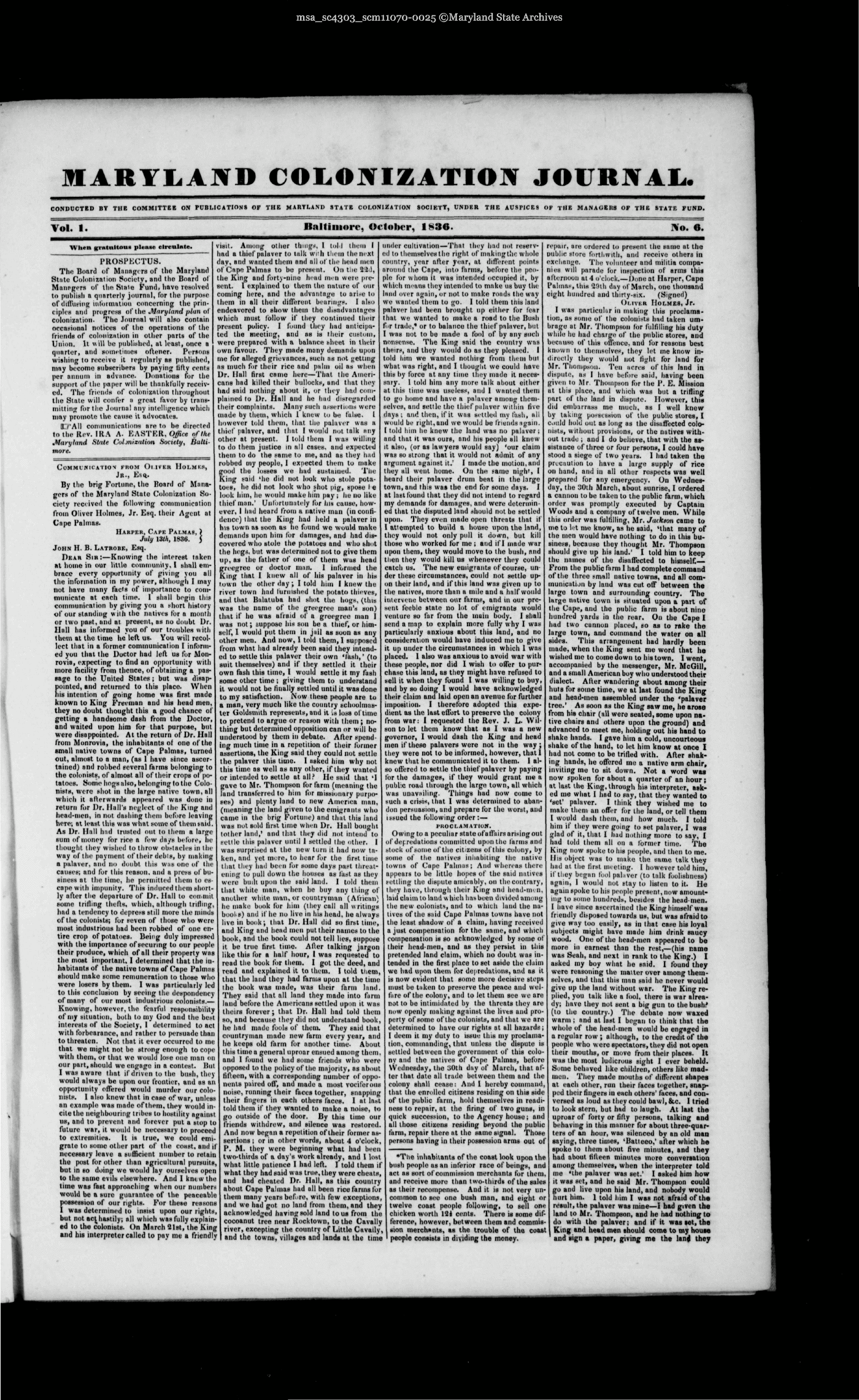
| MARYLAND COLONIZATION JOURNAL. CONDUCTED BY THE COMMITTEE ON PUBLICATIONS OF THE MARYLAND STATE COLONIZATION SOCIF.TY, UNDER THE AUSPICES OF THE MANAGERS OF THE STATE FUND. Vol. 1. Baltimore, October, 1836. No. 6. When gratuitous please circulate. PROSPECTUS. The Board of Manners of the Maryland State Colonization Society, and the Board ol Malingers of the Stale Fund, have resolved to publish a quarterly journal, for the purpose of diffusing inhumation concerning the prin- ciples and progress of the Maryland plan ot colonization. The Journal will also contain occasional notices of the operations of the friends of colonization in other parts of the Union. U will he published, at least, once a quarter, and NWMM oftoner. Persons wishing to receive it regularly as puhlished, may become subscribers by paying fifty cents per annum in advance. Donations for the support of the paper will be thankfully receiv- ed. The friends of colonization throughout the State will confer a great favor by trans- milting for the Journal any intelligence which may promote the cause it advocates. lli'All communications are to be directed to the Rev. IRA A. RASTER, Office of Ike Maryland State Cahnization Society, Balti- more. Communication from Oliver Holmes, Jr., Esq. By the brig Fortune, the Board of Mana- gers of the Maryland State Colonization So- ciety received the following communication from Oliver Holmes, Jr. Esq. their Agent at Cape Palmas. Harper, Cape Pai.mas, ) July 13M, 1836. j John H. B. Latrobe, Esq. Dear Sir:—Knowing the interest taken at home in our little community, I shall em- brace every opportunity of giving you all the information in my power, although I may not have many facts of importance to com- municate at each time. I shall begin this communication by giving you a short history of our standing with the natives for a month or I wo past, and at present, as no doubt Dr. Hall lias informed you of our troubles with them at the time be left us. You will recol- lect that in a former communication I inform- ed you that the Doctor had left us for Mon- rovia, expecting to find an opportunity with more facility from thence, of obtaining a pas- sage to the United States; but was disap- pointed, and returned to this place. When his intention of going home was first made known to King Freeman and his head men, they no doubt thought this a good chance of getting a handsome dash from the Doctor, and waited upon him for that purpose, but were disappointed. At the return of Dr. Hall from Monrovia, the inhabitants of one of the small native towns of Cape Palmas, turned out, almost to a man, (as 1 have since ascer- tained) and robbed several farms belonging to the colonists, of almost all of their crops of po- tatoes. Some hogs also, belonging to the Colo- nists, were shot in the large native town, all which it afterwards appeared was done in return for Dr. Hall's neglect of the King and head-men, in not dashing them before leaving here; at least this was wiiat some of them said. As Dr. Hall hud trusted out to them a large sum of money lor rice a few days belbre, he thought they wished to throw obstacles in the way of the payment of their debls, by making a palaver, and no doubt this tm unc of Ihe causes; and for this reason, and a press of bu- siness at the time, he permitted them to es- cape with impunity. This induced them short- ly ofter the departure of Dr. Hall to commit some trifling thefts, which, although trifling, had a tendency to depress still more ihe miiuls of the colonists; for seven of those who were most industrious had been robbed of one en- tire crop of potatoes. Being duly impressed with the importance of securing to our people their produce, which of all their property was the most important. I determined that the in- habitants of the native towns of Cape Pahnii6 should make some remuneration to those who were losers by them. I was particularly led to this conclusion by seeing the despondency of many of our most industrious colonists.— Knowing, however, the fearful responsibility of my situation, both to my God and the best interests of ihe Society, I determined to act with forbearance, and rather to persuade than to threaten. Not that it ever occurred to me that we might not he strong enough to cope with them, or that we would lose one man on our part, should we engage in a contest. Bui I was aware that if driven to Ihe bush, they would always be upon our frontier, and as an opportunity offered would murder our colo- nists. I olso knew that in case of war, unless an example was made of them, they would in- cite the neighbouring tribes to hostility against ns, and to prevent and forever put a slop to future war, it would be necessary to proceed to extremities. It is true, we could emi- grate to some other part of ihe coast, and if necessary leave a sufficient number to retain the post for other than agricultural pursuits, but in so doing we would lay ouiselves open to the same evils elsewhere. And I kntw the time was fast approaching when our numbers would be a sure guarantee of the peaceable possession of our rights. For these reasons I was determined to insist upon our rights, but not act hastily; all which was fully explain- ed to the colonists. On March 21st, the King and his interpreter called to pay me a friendly visit. Among other things, 1 tul I them I had a thief palaver to talk wi'h tliein the next day, and wanted them and all nf the head men of Cape Palmas to bu present. On Die MA, the King and forty-nine lead men were pre- sent. I explained to them the nature of our coming here, and the advantage to arise to them in all their different hearings. I also endeavored to show them the disadvantages which must follow if they continued their present policy. I found they had anticipa- ted the meeting, and as is their custom, were prepared with a balance sheet in their own favour. They made many demands upon me for alleged grievances, such as not jjetting as much for their rice and palm oil as when Dr. Hall first came here—That the Ameri- cans had killed their bullocks, and that they had said nothing about it, or they had com- plained to Dr. Hall and he had disregarded their complaints. Many such assertions were made by them, which 1 knew to he false. 1 however told them, that the palaver was a thief palaver, and that [ would not talk any other at present. 1 told them I was willing to do them justice in all cases, and expected them to do the same to me, and as they had robbed my people, I expected them to make good the losses we had sustained. The King said 'he did not look who stole pota- toes, he did not look who shot nig, spose I e look him, he would make him pay; he no like thief man.' Uulbrtiiiiately for his cause, how- ever, I hud heard from a native man (in confi- dence) that the King had held a palaver in bis town a» soon as he found we would make demands upon him lor damages, and had dis- covered who stole the potatues and who shot the hogs, but was determined not to give them up, as the father of one of them was head greegree or doctor man. 1 informed the King that I knew all of his palaver in his town the other clay; I told liiiu I knew the river town bad furnished the potato thieves, and that Ualatuba had shot the hoirs, (this was the name of the greegree man's son) that if he was afraid of a greegree man 1 was not; suppose his son be a thief, or him- self, I would put them in jail as soon as any other men. And now, 1 told them, I supposed from what had already been said they intend- ed to settle this palaver their own 'lash,' (to suit themselves) and if they settled it their own fash this time, I would settle it my fash some other time ; giving them to understand it would not be finally settled until it was done to my satisfaction. Now these people are to a man, very much like the country schoolmas- ter Goldsmith represents, and it is loss of time to pretend to argue or reason with them ; no- thing but determined opposition can or will be understood by them in debate. After spend- ing much time in a repetition of their former assertions, the King said they could not settle the palaver this time. I asked him why not this time as well as any other, if they wanted or intended to Bettle at all? He said that '1 gave to Mr. Thompson for farm (meaning the land transferred to him for missionary purpo- ses) and plenty land to new America man, (meaning the land given to the emigrants who came in the brig Fortune) and that this land was not sold first time when Dr. Hall bought (other land,' and that they did not intend to settle this palaver until 1 settled the other. 1 was surprised at the new turn it had now ta- ken, and yet more, to hear for the first time that they had been for some days past threat- ening to pull down the houses as last as they were built upon the said land. I told them that white man, when he buy any thing ol another white man, or countryman (African) he make book for him (they call all writings bools) and if he no live in his head, he always live in book1, thut Dr. Hull did so first time, and King and bead men put their names to the book, and the book could not tell lies, suppose it be true first time. After talking jargon like this for a half hour, I was requested^ to read the book for them. I got the deed, and read and explained it to them. I told them, that the land they had farms upon at the time the book was made, was their farm land. They said that all land they made into farm land before the Americans settled upon it was t heirs forever ; that Dr. Hall had told them so, and because they did not understand book, he had made fools of them. They said that countryman made new farm every year, and he keeps old farm for another time. About this time a general uproar ensued among them, and I found we had some friends who were opposed to the policy of the majority, as about fifteen, with a corresponding number of oppo- nents paired off, and made a most vociferous noise, running their faces together, snapping their fingers in each others faces. I at last told them if they wanted to make a noise, to go outside of the door. By this time our friends withdrew, and silence was restored. And now began a repetition of their former as- sertions ; or in other words, about 4 o'clock, P. M. they were beginning what had been two-thirds of a day's work already, and I lost what little patience I had left. I told them if what they hadsaid was true, they were cheats, and had cheated Dr. Hall, as this country about Cape Palmas had all been rice farms for them many years before, with few exceptions, and we had got no land from them, and they acknowledged having sold land toua from the cocoanut tree near Rocktown, to the Cavally river, excepting the country of Littlo Cavally, and the towns, villages and lands at the time under cultivation—That they had not reserv- ed to themselves the right of makingthr whole coun(ry, year after year, at different points around the Cape, into farms, before (he peo- ple for whom it. was intended occupied it, by which means they intended to make us buy (In- land over again, or not to make roads the way we wanted them to go. 1 told them tliis land palaver had been brought up either for tear (hat we wanted to make a road to the Bush f">r trade,* or to balance the thief palaver, hut I vvns not to be made a fool of by any such nonsense. The King said the country was theirs, and they would do as they pleased. 1 told Mm we wanted nothing from them bin what was right, and I thought we could have this by force at any time they niado it neces- sary. 1 told him any more talk about either at this time was useless, and I wnnted them to go home and have a palaver among them- selves, and settle the thief palaver within five days; and then, if it was settled my lash, all would be right,and we would be friends again. I told him he knew the land was no palaver; and that it was ours, and Ins people all knew it also, (or as lawyers would say) *our claim was so strong that it would not admit of any argument against it.' I made the motion, and they all went home. On the same nigh', I heard their palaver drum bent in the large town, and this was the end for some days. I at last found (hat they did not intend to regard my demands for damages, and were determin- ed that the disputed land should not be settled upon. They even made open threats that it I attempted to build a house upon the land, they would not only pull it down, but kill those who worked for me ; and if I made war upon them, they would move to the hush, and then they would kill us whenever they could catch us. The new emigrants of course, un der these circumstances, could not settle up- on their land, and if this land was given up to the natives, more than a mile and a half would intervene between our farms, and in our pre- sent feeble state no lot of emigrants would venture so far from the muin body. 1 shall send a map to explain more fully why I was particularly anxious about this land, and no consideration would have induced me to give it up under the circumstances in which 1 was placed. 1 also was anxious to avoid war with these people, nor did I wish to offer to pur- chase this land, as they might have refused to sell it when they found I was willing to buy, and by so doing I would have acknowledged their claim and laid open an avenue for further imposition. I therefore adopted this expe- dient as the last effort to preserve the colony from war: I requested the Rev. J. L. Wil- son to let them know that as I was a new governor, I would dash the King and head men if these palavers were not m the way ; they were not lo be informed, however, that 1 knew that he communicated it to them. I al- so offered to settle the thief palaver by paying lor the damages, if they would grant me o public road through the large town, all which was unavailing. Things had now come to such a crisis, that I was determined to aban- don persuasion, and prepare for the worst, and issued the following order:— PROCLAMATION. Owing to a peculiar state of affairs arising out of depredations committed upon the larms and stock of some of the citizens of this colony, by some of the natives inhabiting the native towns of Cape Palmas; And whereas there appears to be little hopes of the said natives settling the dispute amicably, on the contrary, (hey have, through their King and head-nnn, laid claim lo land w Inch has been divided among the new colonists, and to which land the na- tives of the suid Cape Palmas towns have not the least shadow of a claim, having received a just compensation for the same, and which compensation is so acknowledged by some ot their head-men, and as they persist in this pretended land claim, which no doubt was in- tended in the first place to set aside the claim we had upon them for depredations, and as it is now evident that some more decisive steps must be taken to preserve the peace and wel fare of the colony, and to let them see we are not to he intimidated by the threats they are now openly making against the lives and pro- perly of some of the colonists, and that we are determined to have our rights at all hazards; I deem it my duty to issue this my proclama- tion, commanding, that unless the dispute is settled between the government of this colo- ny and the natives of Cape Palmas, before Wednesday, the jOtti day of March, that af- ter that date all trade between them and the colony Bhall cease: And I hereby command, that ihe enrolled citizens residing on this side of the public farm, hidd themselves in readi- ness to repair, at the firing of two guns, in quick succession, to the Agency house; and all (hose citizens residing beyond the public farm, repair there at the same signal. Those persons having in their possession arms out of •Tlie inhabitants of the coast look upon the bush people as an inferior race of beings, and act aa sort of commission merchants fur them, and receive more than two-thirds of the sales as their recompense. And it is not very un- common to see one bush man, and eight or twelve coast people following, to sell one chicken worth 121 cents. There is some dif- ference, however, between them and commis- sion merchants, as the trouble of the coast people consists in dividing the money. repair, ure ordered lo present Ihe same at the public store forthwith, and receive others in exchange. The volunteer and militia compa- nies will parade for inspection of arms this afternoon at 4 o'clock.—Done at Harper, Cape Palmas, thw 2!>th day of March, one thousand eight hundred and thirty-six. (Signed) Oliver Holmes, Jr. I was particular in making this proclama- tion, as some of die colonists had taken um- brage ut Mr. Thompson for fulfilling his duty while he had charge of the public stores, and because of this offence, and for reasons best known lo themselves, they let me know in- directly they would not tight for land for Mr. Thompson. Ten acres of this land in dispute, us I have before said, having been given to Mr Thompson tor the P. E. Mission ut this place, and which was but a trifling part of the land in dispute. However, this did embarrass me much, as I well knew by taking possession of the public stores, I could hold out as long as the disaffected colo- nists, without provisions, or the natives with- out trade ; and I do believe, that with the as- sistance of three or four persons, I could have stood a siege of two years. I had taken the precaulion to have a large supply of rice on hand, and in all other respects was well prepared for any emergency. On Wednes- day, the 30th March, about sunrise, I ordered a cannon to be taken to the public farm, which order wus promptly executed by Captain Woods and a company of twelve men. While this order was fulfilling, Mr. Jackson came to me Id 1 it me know, as he said, Uhat many of the men would have nothing to do in this bu- siness, because they thought Mr. Thompson should give up his land.' I told him to keep the names of the disaffected to himself.— From the public farm I had complete command of the three small native towns, and all com- munication by land was cut off between the large town and surrounding country. The large nutive town is situated upon a part of the Cape, and the public farm is about nine hundred yards in the rear. On the Cape I hud two cunnou placed, so as to rake the large town, and command the water on all sides. This arrangement had hardly been made, when the King sent me word that he wished me to come down to his town. I went, accompanied by the messenger, Mr. McGill, and a small American boy who understood their dialect. After wandering about among their huts for some time, we at last found the King and head-men assembled under the 'palaver tree.' As soon as the King saw me, he arose from his chair (all were seated, some upon na- tive chairs and others upon the ground) and advanced to meet me, holding out his hand to shake hands. I gave him a cold, uncourteoua shake of the hand, to let him know at once I had not come to be trifled with. After shak- ing hands, he offered me a native arm chair, inviting me to Bit down. Not a word was now spoken for about a quarter of an hour; at last the King, through his interpreter, ask- ed me what 1 had to say, that they wanted to 'set' palaver. I think they wished me to make them an offer for Ihe land, or tell them I would dash them, and how much. I told him if they were going to set palaver, I was glad of il, that I hud nothing more to say, I had told them all on a Ibrmer time. The King now spoke to his people, ami then to me. His object was to make the same talk they had at the first meeting. I however told him, if they began hail paluver (to talk foolishness) again, 1 would not stay to listen to it. He again spoke to his people present, now amount- ing to some hundreds, besides the head-men. I huve since ascertained the King himself was friendly disposed towards us, but was afraid to give way too easily, as in that case his loyal subjects might have made him drink saucy wood. One of the head-men appeared to be more in earnest than the rest,—(his name was Seah, and next in rank to the King.) I asked my boy what he said. I found they were reasoning the matter over among them- selves, and that this man said he never would give up ihe land without war. The King re- plied, you talk like a tool, there is war alrea- dy; have they not sent a big gun to the bush.' (to the country.) The debate now waxed warm ; and at last I began to think that the whole of the head-men would be engaged in a regular row ; although, to the credit of the people who were spectators, they did not open their mouths, or move from their places. It was the most ludicrous sight I ever beheld. Some behaved like children, others like mad- men. They made mouths of different shapes at each other, run their faces together, snap- ped their fingers in each others' faces, and con- versed as loud as they could bawl, &c. I tried to look stern, but had to laugh. At last the uproar of forty or fitly persons, talking and behaving in this manner for about three-quar- ters of an hour, was silenced by an old man saying, three times, 'Batteeo,' after which he spoko to them about five minutes, and they had about fifteen minutes more conversation among themselves, when the interpreter told me Hhe palaver was set.' I asked him how it was set, and he said Mr. Thompson could go and live upon his land, and nobody would hurt him. 1 told him I was not afraid of the result, the palaver was mine—I had given the land to Mr. Thompson, and he had nothing to do with the palaver; and if it was set, the King and head men should come to my house and sign a paper, giving me the land they |