 |
|
|
 |
|
 |
|
|||
|
||||
|
||||
|
Maryland State Archives Maryland Colonization Journal Collection MSA SC 4303 msa_sc4303_scm11070-0026 Enlarge and print image (4M) |
|
|
|
|
|
|
|
|||
|
||||
|
||||
|
Maryland State Archives Maryland Colonization Journal Collection MSA SC 4303 msa_sc4303_scm11070-0026 Enlarge and print image (4M) |
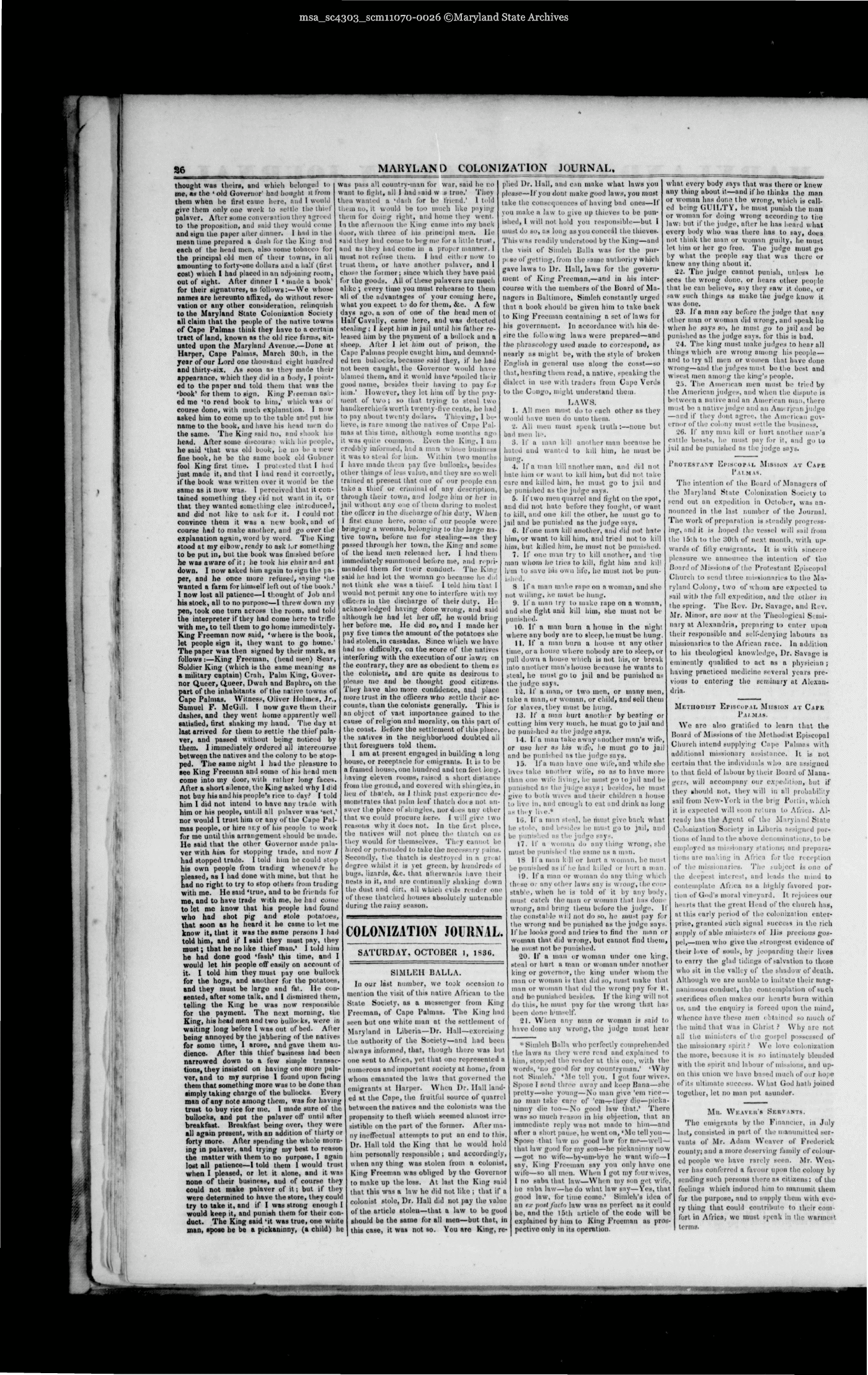
| 26 MARYLAND COLONIZATION JOURNAL. thought wus theirs, and which belonged to me, as the ' old Governor' hail bought it from them when he first MMM here, and I would give l hem only one week to settle the thiol palaver. After some couvcisitiuuthcy agreed to the proposition, ami said tlu'y would come and sign the paper alter dinner. I hud iu the mean lime prepared a dash tor the King and each ot the head men, also mm tobacco tor the principal old men of their towns, in all amounting to forty-one dollars and a hull (first cost) which I had placed in an adjoining room, out of sight. After dinner I • made, a book' for their signatures, as follows:—We whose names are hereunto affixed, do without reser- vation or any other consideration, relinquish to the Maryland State Colonization Society all claim that the people of the native towns of Cape Palmas think they linve to a certain tract of land, known ns the old rice farms, sit- uated upon the Maryland Avenue.— Done at Harper, Cape Palmas, March SOih, in the year of our Lord one thousand eight hundred and thirty-six. As soon as they nuule their appearance, which they did in a body, I point- ed to the paper and told them that was the •book' for them to sign. King Ficenian as!;- ed me 'to read book to him,' which was o! course done, with much explanation. I now asked him to come up to the table and put his name to the book, and have his head men do the same. The King Mid no, nnd shook his head. After some discerns- with hi* people, he said 'that was old hook, i.o 00 be a new- fine book, he be the same book old Guboer fool King first time. I protested that I had just made it, and that 1 had rem! it eoireclly, if the book was written over it would be the same as it now was. I perceived that it con- tained something they i id not want in it, or that they wanted something else introduced, nnd did not like to ask d r it. 1 could not convince them it was a new book, nnd ol course had to make another, and go over the explanation again, word by word. The King stood at my elbow, ready to ask l„r something to be put in, but the book was fm,shed before he was aware of it; he took his chair and sat down. I now asked him again to sign the | a- per, and he once more refused, saying 'he wanted a farm for himself left out of the book.' I now lost all patience—1 thought of Job and his stock, all to no purpose—I threw down my pen, took one turn across the room, and told the interpreter if they had come here to trifle with me, to tell them to go MMM immediately. King Freeman now said, 'where is the book, let people sign it, they want to go home.' The paper was then signed by their mark, as follows :—King Freeman, (head men) Sear, Soldier King (which is the same meaning as a military captain) Crah, l'alm King, Gover- nor Queer, Queer, Dwah and Baphro, on the part of the inhabitants ofthe native towns of Cape Palmas. Witness, Oliver Holmes, Jr., Samuel F. McGill. I now gave them their dashes, and they went home apparently well satisfied, first shaking my hand. The day at last arrived for them to settle the thief pala- ver, and passed without being noticed by them. 1 immediately ordered all intercourse between the natives and the colony to be stop- ped. The same night 1 hud the pleasure to see King Freeman and some of his head men come into my door, with rather long faces. After a short silence, the King asked why 1 did not buy his and his people's rice to day? I told him 1 did not intend to have any trade with him or his people, untill all palaver was 'set,' nor would I trust him or any ofthe Cape Pal- mas people, or hire ai.y of Ins people to work for me until this arrangement should be made. He said that the other Governor made pala- ver with Mm for stopping trade, nnd now / had stopped trade. I told him he could stop his own people from trading whenever he pleased, as 1 had done with mine, but that he had no right to try to stop others Irom trading witii me. He said 'true, and to be friends for me, and to have trade with me, he had come to let mc know that his people had found who had shot pig and stole potatoes, that soon as he heard it he come to let me know it, that it was the same persons 1 had told him, and if I said they must pay, they must; that he no like thief man.' 1 told him he had done good 'fash' this time, and I would let his people off easily on account of it. I told him they must pay one bullock for the hogs, and another for the potatoes, and they must be largo and fat. He con- sented, after some talk, and I dismissed them, telling the King he was now responsible for the payment. The next morning, the King, his head men and two bulloi ks, were in waiting long belbre I was out of bed. Alter being annoyed by the jabbering of the nat i\ as for some time, I arose, and gave them au- dience. After this thief business had been narrowed down to a few simple transac- tions, they insisted on having one more pala- ver, and to my surprise I found upon facing them that something more was to be done than simply taking charge of the bullocks. Every man of any note among them, was for having trust to buy rice for me. 1 made sure of the bullocks, and put the palaver off until after breakfast. Breakfast being over, they were all again present, with an addition of thirty or forty more. After spending the whole morn- ing in palaver, and trying my best to reason the matter with them to no purpose, I again lost all patience—I told them 1 would trust when I pleased, or let it alone, and it was none of their business, and of course they could not make palaver of it; but if they were determined to have the store, they could try to lake it, and if I was strong enough I would keep it, and punish them for their con- duct. The King said 'it was true, one while man, spose he be a pickaninny, (a child) he was pi - til country-man lor war, said ho DO want to fight, all 1 had -aid w I true.' Tne\ then wauled a -dash for be friend.' 1 told 11.Mo no, it would he loo much like paying them for doing rigfat, nnd home they uenl. Iu the afternoon the King came into my booh door. With InfM of Ins principal men. He said they had come to beg me for a liule trust, ami as tiny hail eume in a prop, r manner I must not refuse them. I had eilh r BOW In trust them, or have another palaver, and 1 eho.- ¦ the fiiimer; since which they huve paid for the goods. All of these palavers are much alike ; every time you must rehearse to them all of the advantages of your coming here, what you expect to do for them, &c. A few days ago, a son of one of the head men ol HalfCavally, came here, and was detected stealing; 1 kept him in jail until his I'm Iter re- leased him by the payment of a bullock und a ¦beep, Alter 1 let him out of prison, the Cape Pahnas people cuuglit him, and demand- ed ten buhocks, because said they, if he had Hot been caught, the Governor Would have blamed them, nnd it would have'spoiled their good name, besides their having to pes fin linn.' However, they let him off by tin- pay- ment of two ; so that trying to steal two handkerchiefs worth twenty-five cents, he had to pay about twenty dollars. Thieving, 1 be- lieve, is rare among the natives of Cape Pal- mas at tins time, although some month* ago it wa> qui e common, liven the King, I am credibly informed, bad a nun whose bu in n it wus to steal for him. Witbin two months I have made them pay five bullocks, besides other things of less value, and they are to well trained at present that one of our people can take a thief or criminal of any description, through their town, and lodge him or be! iu jail without any one of them daring to molest the officer iii the discharge ofhit duty. When i firs: came here, some of our people were bringing a woman, belonging to the large na- tive town, before me for stealing—as they passed through her town, the King and some of the head men released her. 1 hail then immediately summoned before me, and r, pii- in Hided them for taeir conduct. The King said he had let the woman go because he did not think she was a thief. I told him thai I would not permit anyone to interfere with my officers iu the discharge of their duty. He acknowledged having done wrung, and said although he had let her off, ho would briuir her belbre me. lie did so, and I made her pay five times the amount ofthe potatoes she had stolen, in cassadas. Since which we have had no dilliculty, on the score of the natives interfering with the execution of our laws; M the contrary, they arc as obedient to them os the colonists, und are quite as desirous to please me and be thought good citizens. They have also more confidence, and place more trust in the ollicers who settle their ac- counts, than the colonists generally. Toil i- iiii object of vast importance gained to the cause of religion and morality, on this part ol the coast. Before the settlement of ibis place, the natives in the neighborhood doubted nil that foreigners told them. I am ut present engaged in building a long house, or receptacle for emigrants. It is to be a framed BOOM, one hundred and ten feet long. having eleven rooms, raised a short distance from the ground, and covered with shingles, in lieu of tlia'ch, ns 1 think pas) expert! nee de- monstrates that palm leaf thatch dm s not an- swer the place of shingles, nor does any other that we could procure here. I will give two reasons why it does not. In the first pi av, the natives will not place the thatch 00 us they would for themselves. Tin y cannot be lured or persuaded to take the necess iry ; sine. Secondly, the thatch is destroyed iu it great degreo whilst it is yet green, by hundred*' ol bugs, lizards, &c. that afterwards have their nests in it, and are continually Making down the dust and dirt, alt which evds render one of these thatched houses absolutely untenable during the rainy season. COLONIZATION JOURNAL. SATURDAY. OCTOBER 1, 1836. SIMLEH BALLA. In our last number, no tojk occasion to mention the visit of"this native African to tlie State Society, as a messenger from King Freeman, of Cape l'almas. The King h;ul seen but one white man at the settlement el Maryland in Liberia—Dr. Hall—exercising the authority of the Society—and had been hlu'fiys informed, that, though there was but one sent to Africa, yet that OM represented a numerous and important fociety at home, (nun whom emanated the laws that governed the emigrants nt Harper. When Dr. Hull laud- ed at the Cope, the fruitful source of quarrel between the natives and the colonists was the propensity to theft which seemed almost irre- sistible on the part of the former. After mu- ny ineffectual attempts to put an end to this. Dr. Hall told the King thai he would hold him personally responsible ; und accordingly, when any thing was stolen from a colonist, King Freeman was obliged by the Governor to make up the loss. At last the Kmg said that this was a law he did not like ; that if a colonist stole, Dr. Hall did not pay the value of the article stolen—that a luw to bo good should be the same for all men—but that, in this case, it was not so. You are King, re- plied Dr. Hull, and can make what laws you p|ea.-e—If you dent make good laws', you must take the conseipienees of having bad ones—If you make a law to give up thieves to be pun- ished, 1 will not hold you responsible—but I must do bo, M long as you conceal the thieves. This was readily understood by the King—and the \isit of Snnleh Belli wus for the pur- p< se of get ling, from the same authority which gave luws to Dr. Hall, laws for the govern- ment of King Freeman,—and iu his inter- course with the members ofthe Board of Ma- nagers in Baltimore, Siinleh constantly urged that a book should be given him to take back to King Freeman containing a set of laws for his government. In accordance with his de- sire the following laws were prepared—and the phraseology used made to correspond, us nearly M might be, with the style of broken English iu general use along the coast — so that, hearing them read, a native, speaking the dialect in use with traders from Cape VerJs to the Congo, might understand them. LAWS, I, All men must do to each other as they would have men do unto them. t, Ah men must speak truth:—none but bad men He, 3. If a nun kill another man because he hat. d and wan;, d lo kill him, ho must be hung. 4. [fa man hill another man, and did not hate him or want lo kill him, but did not lake eare and killed him, he must go to jail and be punished as the judge mys. 5. If two men quarrel ami fight On the spot, and did not hate before they fought, or want to kill, and one kill the other, he must go to jail and be punished as the judge Myt. 6. If one men kill another, and did not hnfe him, or want to kill him, and tried not to kill him, but killed him, ho must not be punished. 7. If one inin try to kill another, and the man whom he tries to kill, tight him and kill hhfl to save his own life, he must not be pun- ish, d. 8 If a man make rape on n woman, and she not willing, he must be hung. 9. If a mnn try to make rape on a woman, and she fight and kill him, she must nut be punished. 10. If a man burn a house in the night where any body are to sleep, he must be hung. 11. If a man burn a house nt any other time, or a house where nobody are to sleep, or pull down a house winch is not his, or break into another man's house because he wants to steal, he must go to jail and be punished as Uie jud^e says. 12. If a man, or two men, or many men, take a man, or woman, or child, and sell them lor slaves, they must bu hung. 13. If a man hurt another by beating or cutting him very much, he must go to jail and be puui-hod as the judge says. 1-1. If a man lake away another man's wife, or use lur M his wife, he must go to jail und be punished as the judge says. 13. lfu man huve one wife, and while she lives take another Wife, so as to have more than one wife living, he must go to jail and be punished as the judge saysi bee idee, he must give to both wives and their children a house to live in, and enough to eat and drink us long as tli. y live.* lo. If a man steal, he limst give back what he stole, und lie-:,les he must go lo jail, and :,¦ i intshed as the judge says. 17. If a woman du anything wrong. I lie niii-t he punished the same as I man. 18 11 u man I; 11 or hurt a Woman, he must he punished us if he had killed or hurt a man. 19. If a man or woman do any thing which theM or any other laws say is wrong, the corf stable, when he is told of it by any body, must catch the man or woman that has doni wrong, ami bring them before the judge. If the constable nil not do so. he niii-t pay for I lie wrong and be punished ns the judge says. If he looks good anil tries to find the mnn or unman that did wTOM, hut cannot find them, he must not be punished. 20. If a man or woman under one king, steal or hurt a man or woman under another king or governor, the king under whom the man or woman is that did so, must make that man or Woman I hat did the wrong pay for It. and be punished besides. If the king will not do this, he must pay fur Ihe wrong that has been done li'in-elf. 21. When any man or woman is said to have done uny wrong, the judge must hear what every body says that wus there or knew any thing about it—and if he thinks the mnn or woman has done the wrong, which is cull- ed being GUILTY, he must punish the man or woman for doing wrong according to the law: but if tin- judge, after he has heard what every body who wus there has to My, docs not think the man or Woman guilty, he must let him or her go freo. The judge must go by what the people say that was there or knew any thing about it. It, The judge cannot punish, unless he sees the wrong done, or hears other people that be cull believe, say they saw it done, or ¦ aw such things ns make the judge know it was done. 23. If a man say before the judge that any other mnn or woman did wrong......I speak lie when he says so, ho must go to jail and bo punished as the judge says, for this is bad. '.'4. The king must make judges to hear all things which are wrong among his people— and to Iry all men or women that have done wrong—and the judges most be the best and wisest men among I he king's people. 23. The American men must be tried by the American judges, and when the dispute is between a native and an American man, there must be a native judge and an Ann n,e:iii judge —ami if they dont agree, the American gov- ernor of the colony must settle the business. 26. If nuy man kill or hurt another man's eat 11,, Ineists, he must pay for it, and go to jail and he punished ns the juiige says. Protestant Episcopal Mission at Cape Palmas. The intention of lite Beard of Managers of the Maryland State Colonization Society to send out an expedition in October, was an- nounced in the last number of the Journal. The work of preparation is steadily progress- ing, and it is hoped tli" vessel will mU from the 15th to the UOlh of next month, with up- wards ot' fifty emigrants. It is with sincere pleasure we announce the intention of the Board of Mis-ions of the Protestant Episcopal Church to send three' missionaries to the Ma- ryland Colony, two of whom are' expected to sail with the fall expedition, and the other in Ihe spring. The Rev. Dr. Savage, and Itev. Mr. Minor, are now nt the Theological Scmi- nary at Alexandria, preparing to enter upon their responsible and sell-denying labours as missionaries to the African race, hi uddilion to his theological knowledge, Dr. Savage is eminently qualified to act as n physiciun ; having practiced medicine several years pre- vious to entering the seminary at Alexan- dria. Simleh Balla who perfectly comprehended the laws as they u ere read mid explained to him, stopped the reader at this one, with the word*,'no rood for my countrymen.' 'Why not Simleh.' 'Me tell yon. I got. lour wive-. Spose I send three away and keep liana—she pretty—she young—No man give 'em rice — no man take cure of 'cm—they die—picka- ninny die loo—No Mod law that.' There was so much reason in his objection, that an immediate reply was not made to him—and after a short pau.e, lie went on, 'Me tell you— Spose that law no good law for me—well— that law good for my son—he pickaninny now —got no wife—b\-uin-b\u he want wife—I say, King Freeman say you only have one wife—so all men. When I got my four wives, I no saba that law—When my son get wife. lie eabu law—he do what law say—Yes, that good law, for time come.' Hunleh's idea of no <<• jinsl facta law was as periled as it could be, and the 15th article of the code will be explained by luni to King Freeman us pros- pective only in its operation. Methodist Episcopal Mission at Cape Palmas. We are also gratified to learn that the Board of Missions of the Methodist F.piscopnl Church intend supplying Cape Palmes with additional missionary assistance. It is not certain that, the individuals who are assigned to that field of labour by theirBoard of Mana- gers, will accompany our expedition, but if they should not, they will iu nil probability sail from New-York in the brig Portia, which it is expected will soon return to Africa. Al- ready has the Agent of the Maryland Slate Colonization Society in Liberia assigncd por- tions of land to the above denominate ns,tobe employed as missionary stations! end prepara- tions me making in Africa for the reception of the missionaries. The subject Is one of the deepesl inhri ', and hails ||,(. mind to contemplate Africa as a highly favored por- tinii of God's mural vineyard. It rejoices our hearts that ihe great Head ofthe church has, ntlhis early period of the colonization enter- prise, granted such signal success iu the rich supply of able ministers of His precious gos- pel,—men who give ihe strongest evidence of their live of soul-, hy jeoparding their lives to carry the glad tidings of salvation to those who tit in the valley of the shadow of death. Although we are unable to Imitate tin ir mag- nanimous conduct, the contemplation of such sacrifices often makes our hearts bum within us, anil the enquiry is forced upon the mind, whence have these men < btained so much of the mind that was in Christ ? Why .are not all tho ministers ofthe gospel possessed of the missionary spirit ? We love eosMattiiaa the more, because it is so Intimately blended wilh the snirit and labour of missions, and up- on this union we have ba ted mueli ofour hope of its ultimate success. What God hath joined together, let no man put asunder. Mr. Weaver's Servants. The emigrants by the Financier, in July la»t, consisted in part of the manumitted ser- vants of Mr. Adam Weaver of Frederick county; and a more deserving family of colour- ed people we have rarely seen. Mr. Wea- ver has oonferred a fovour upon the colony by sending such persons there as citizens: of the feelings which Induced him to manumit them for the purpose, and to supply ilium with eve- rything that could contribute to their com- fort in Africa, we must speak in the warmest terms. |