 |
|
|
 |
|
 |
|
|||
|
||||
|
||||
|
Maryland State Archives Maryland Colonization Journal Collection MSA SC 4303 msa_sc4303_scm11070-0028 Enlarge and print image (5M) |
|
|
|
|
|
|
|
|||
|
||||
|
||||
|
Maryland State Archives Maryland Colonization Journal Collection MSA SC 4303 msa_sc4303_scm11070-0028 Enlarge and print image (5M) |
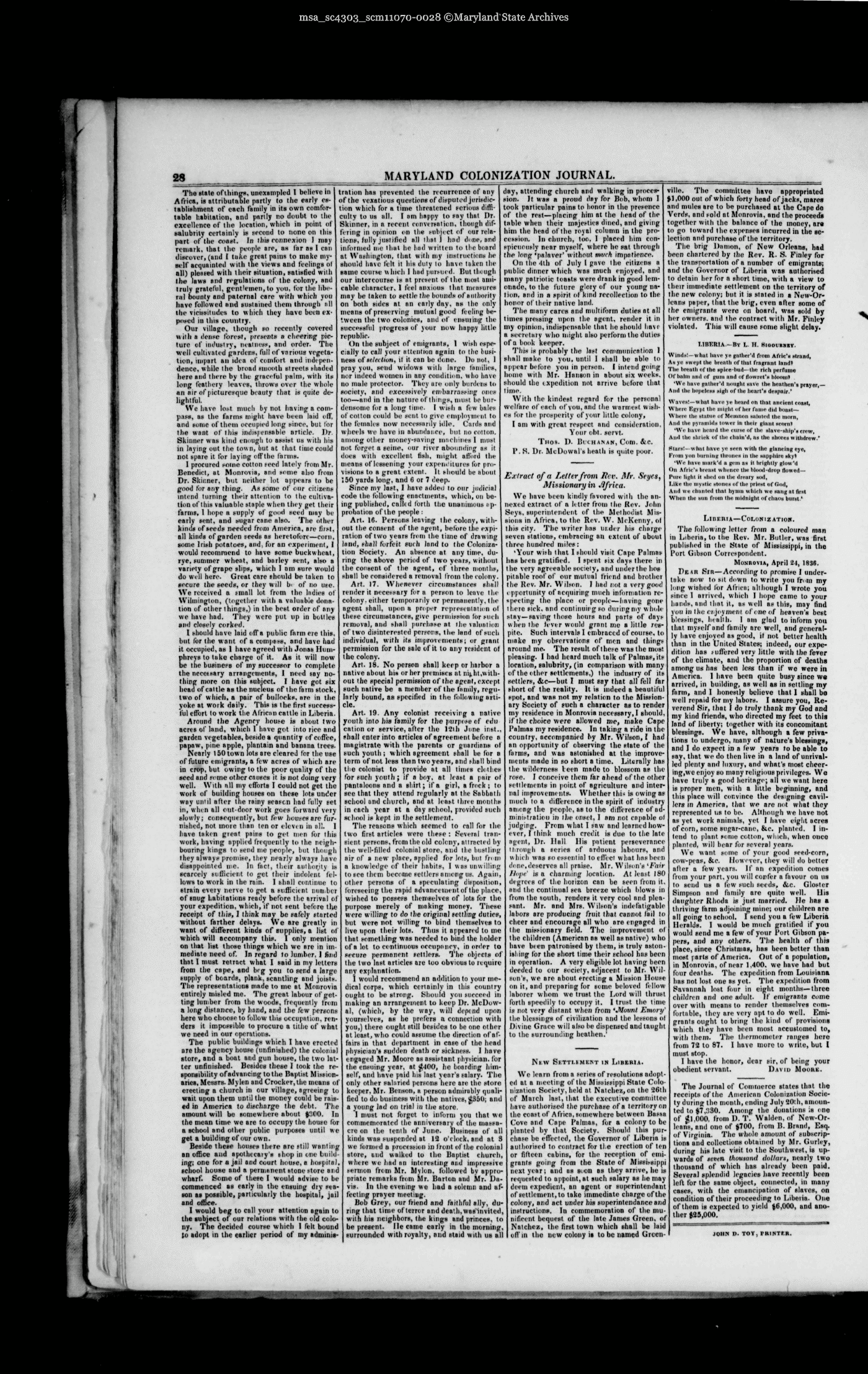
| 28 MARYLAND COLONIZATION JOURNAL. The atate of things, unexampled 1 believe in Africa, is attributable partly to the early es- tablishment of each family in its own comfor- table habitation, and partly no doubt to the excellence of the location, which in point of salubtity certainly is second to none on this port of the coast". In tins connexion I may remark, that the people are, as far as I can discover, (and 1 lake great pains to make my- self acquainted with the views and feelings ol all) pleated with their situation, satisfied with the laws and regulations of the colony, anil truly grateful, gont'emen, to you, for the libe- ral bounty and paternal care with which yon have followed mid sustained them through "II the vicissitudes to which they have been ex- posed in this country. Our village, though so recently covered wild a dense forest, presents a cheering pic- ture of industry, neatness, and order. The well cultivated gardens, full of various vegeta- tion, impart an idea of comfort and indepen- dence, while the broad smooth streets shaded here and there by the graceful palm, with its long feathery leaves, throws over the whole an air of picturesque beauty that is quite de- lightful. We have lo.-t much by not having a com- pass, as the farms might have been laid off, and some of them occupied long since, but for the want of this indispensable article. Dr. Skinner was kind enough to assist us with his in laying out the town, hut at that lime could not spare it for laying offthe farms. I procured some cotton seed lately from Mr. Benedict, at Monrovia, and seme also from Dr. Skinner, but neither lot appears to be good for any thing. As some Of our citizens intend turning their attention to the cultiva- tion of this valuable staple when they get their farms, 1 hope a supply of good seed niuy be early sent, and sugar cane nlso. The other kinds of seeds needed from America, are Slot, all kinds of garden feeds as heretofori—corn, some Irish potatoes, and, for an experiment, I would recommend to have some buckwheat, rye, summer wheat, and barley sent, also a variety of grape slips, which I nm sure would do will here. Great care should be taken to secure the seeds, or they will b< of no use. We received a small lot from the ladies of Wilmington, (together with a valuable dona- tion of other ihings,) in the best order of any we have had. They were put up in bottles and closely corked. I should have laid ofl"a public fnrinere this, but for the want of a compass, and have had it occupied, as 1 have agreed with Jonas Hum- phreys to take charge of it. As it will now be the business of my successor to complete the necetsary arrangements, 1 need say no- thing more on this subject. I have got six head of cattle as the nucleus of the farm stock, two of which, a pair of bullocks, are in the yoke at woik daily. This is the first success- ful effort to work the African cattle in Liberia. Around the Agency house is about two acres of land, which I have got into rice and garden vegetables, beside a quantity of coffee, papaw, pine apple, plantain and banana trees. Nearly 150 town lots are cleared lor the use of future emigrants, a few acres of which are in crop, but owing lo the poor quality of the seed and seme other causes it is not doing very well. With nil my efforts I could not get the work of building houses on these lots under way until after Ihe rainy season had fully set in, when all out-door work goes forward very slowly; consequently, but few houses are fur- nished, not more than ten or eleve n in all. I have taken great psins to get men for this work, having applied frequently to the neigh- bouring kings to send me people, hut (hough they always promise, they nearly always have disappointed me. In fact, (heir authority is scarcely sufficient (o get their indolent fel- lows to work in Ihe rain. I shall continue to strain every nerve to get a sufficient nun.her of snug habitations ready before the arrival of your expedition, which, if not sent before the receipt of this, I think may be safely started without farther delays. We are greatly in want of different kinds of supplies, a list of which will accompany this. I only mention on that list those things which we are in im- mediate need of. In regard lo lumber. I find that I must reuoct what I said in my letters from the cape, and brg you to send a large supply of boards, plank, scantling and joists. The representations made to mc at Monrovia entirely misled me. The great labour of get- ting lumber from the woods, frequently from a long distance, by hand, and the few persons here who choose to follow this occupation, ren- ders it impossible to procure a lithe of what we need in our operations. The public buildings which I have erected ore the agency house (unfinished) the colonial store, and a boat and gun house, (he two lat- ter unfinished. Besides these I took the re- sponsibility ofadvancing to the Baptist Mission- aries, Messrs. Mylen and Crocker, the means of erecting a church in our village, agreeing to wait upon them until the money could be rais- ed in America to discharge the debt. The amount will be somewhere about |300. In the mean time we are to occupy the house for a Bchool and other public purposes until we get a building of our own. Beside these houses there are still wanting an office and apothecary's shop in one build- ing; one for a jail and court house, a hospital, school house and a permanent stone store and wharf. Some of these I would advise to be commenced as early in the ensuing dry sea- son as possible, particularly the hospital, jail and office. I would beg to call your attention again to the subject of our relations wifh the old colo- ny. The decided course which I felt bound to adopt hi the earlier period of my adminis- tration has prevented the recurrence of any of the vexatious questions of disputed jurisdic- tion which for a time threatened serious diffi- culty to us all. I am happy to say that Dr. Skinner, in n recenl conversation, (hough dif- fering in opinion on (he subject of our rela- tions, fully justified all that! had done, and informed me that he hud written to the board at Washington, that with my instructions he should ha\e fell it his duty lo have (liken the smie course which 1 had pursued. Hut though our intercourse is at present of Ihe most ami- cable character, I feel anxious I lint measures mny he taken lo settle Ihe hounds of authority on both sides at an early day, as Ihe only means of preserving mutual good feeling be- '.weeii the two colonics, and of enstiiing the successful progress of your now happy little republic. On the subject of emigrants, 1 wish espe- cially (o call your attention again to the husi- ness of sclettiun, il i( can be done. Do not, I pray you, send widows with large families, nor indeed women in any condition, who have no mule protector. They uro only burdens lo society, and excessively embarrassing ones too—and in the nature of things, must lie bur- densome for a long tune. I wish a few bales of cotton could bo sent to give employment lo the females now necessarily idle. Cards and wheels we have in abundance, but no cotton. among other money-saving machines I must not forget a seine, our river abounding as it does with excellent fish, might afford the means of lessening your expenditures for pro- visions to a great extent. It should be about 150 yards long, and 6 or 7 deep. Since my last, I have added lo our judicial code the following enactments, which, on be- ing published, called forth the unanimous ap- probation of the people I Art. 16. Persons leaving the colony, with- out Ihe consent of the agent, before the expi- ration of two years fri'in the lime of drawing land, shall forfeit sue h land to the Coloniza- tion Society. An absence at any time, du- ring the above period of two years, without the consent of the agent, of three months, shall he considered a removal from the colony. Art. 17. Whenever circumstances shall render it necessary tor a person to leave Ihe1 colony, either temporarily or permanently, the agent shall, upon a prefer representation ol these circumstances, give permission for such removal, anil shall purchase at the valuation of two disinterested persons, the land of such individual, with its improvements; or grant permission for the sale of it lo any resident of the colony. Art. 18. No person shall keep or harbor a native about his or her premises at nil ht,w ith- ota Uie special permission of the agent, except such native be a member of the family, regu- larly bound, as specified in the fidlowing arti- cle. Art. 19. Any colonist receivirg a nntive youth into his family for the purpose of cdu cation or service, after the Ifltk June inst.. shall enter into articles of agreement before a magistrate with Ihe parents or guanlinns of such youth ; which agreement shall he for a term of not less than twoyenrs, and shall bind the colonist to provide at all limes chihes for such youth; if a beiy, at least a pair of pantaloons and a shirt; if a girl, a frock ; to see that they attend regularly at the Sabbnlh school and church, and at least ihrie months in OBch year at a day schoeil, provided such sihool is kept in the settlement. The reasons which seemed to call for the two first articles were these : Several tran- sient persons, from the old colony, attracted by the well-filled colonial store, and Ihe hustling air of a new place, Bpplied for lots, but from a knowledge of their habits, I was unwilling to see them become settlers among us. Aguin, other persons of a speculating disposition, foreseeing the rapid advancement of the place, wished to possess themselves of lots for the purpose merely of ninking money. These were willing- to do the original settling duties, but were not willing lo bind themselves to live upon their lots. Thus it appeared to me that something was needed lo hind the holder of a lot to ce'ntinnous occupancy, in order to secure permanent settlers. The objects of the two last articles are too obvious to require any explanation. I would recommend an addition to your me- dical corps, which certainly in this country ought to be strong. Should you succeed in making an arrangement to keep Dr. McDuw- al, (which, by the way, will depend upon yourselves, as he prefers a connection with you,) there ought still besieles to be one other at least, who could assume the direction of af- fairs in that department in case of the heael physician's sudden death or sickness. I have engaged Mr. Moore as assistant physician, for the ensuing year, at $400, he boarding him- self, and have paid his last year's salary. The only other salaried persons here are the store keeper, Mr. Benson, a person admirably quali- fied to do business with the natives, $850; and a young lad on trial in the store. I must not forget to inform you that we commemorated (he anniversary of the massu- cre on (he (enth of June. Husincsa of all kinds was suspended at 12 o'clock, and at 3 we formed o procession in front of the colonial store, and walked to the Baptist church, where we had an interesting and impressive sermon from Mr. Nylon, followed by appro- priate remarks from Mr. Barton and Mr. Du- via. In the evening we had a solemn and af- fecting prayer meeting. Bob Grey, our friend and faithful ally, du- ring that time of terror and dea'.h, was invited, with his neighbors, the kings and princes, to be present, lie came early in the morning, surrounded with royalty, and staid with ue all day, attending church and walking in proces- sion. It was a proud day for Bob, whom 1 took particular pains to honor in the presence of the rest—placing him at the heael of the table when their majesties dined, and giving him the head of the royal column in the pro- cession. In church, loo, I placed him con- spicuously near myself, where he sat through the long 'palaver' without much impatience. On the 4th of July I gave the citizens a public dinner which was much enjoyed, and many patriotic toasts were drank in good lem- onade, lo the future glory of our young na- tion, and in a spirit eif kind recollection to the honor of their native land. The many cares and multiform duties at all times pressing upon the agent, render it in my opinion, indispensable that he should ha\r a secretary who might also perform the duties of a hook keeper. This is probably the last communication 1 shall make to you, until I shall be able te> appear before you in person. I inlenel going home with Mr. Hanson in about six weeks, should the expedition not arrive before that time. With the kindest regard for the personal welfare of each of you, and the warmest wish- es for the prosperity of your little colony, I am with great respect and consideration. Your obl. servt. Thos. D. Buchanan, Com. &c. P. S. Dr. McDowal's heath is quite poor. Extract of a Letter from Rev. Mr. Seyes, Missionary in Africa. We have been kindly favored with the an- nexed extract of n It tier frotii the Rev. John Seys, superintendent of the Methodist Mis- sions in Afrira, to the Rev. VV. McKenny, ot this city. The writer has under his charge seven stations, embracing an extent of about three hundred miles: 'Your |M that I should visit Cape Palmas has been gratified. I spent six days there in the very agreeable society, anrl underthe hos pit able roof of our mutual friend and brother the Rev. Mr. Wilson. J had not a very good opportunity of acquiring much information re- 'perling the place or people—having gone there sick, and continuing so during my whole stay—saving those hours and parts of days when the (ever would grant me a little res- pite. Such intervals I embraced of course, to make my observations of men and things around me. The result of these was the most pieasmg. I had heard much talk of I'almas, its location, salubrity, (in comparison with many of the ether settlements,) the industry of its settlers, &.c—but I must say that all fell far short of the reality. It is indeed a beautiful spot, and was not my relation to the Mission- ary Society of such a character as to render my residence in Monrovia necessary, I should, if the choice were allowed me, make Cape I'almas my residence. In taking a ride in the country, accompanied by Mr. Wilson, I had an opportunity of observing the state of the farms, and was astonished at the improve- ments made in so short a time. Literally has the wilderness teen made to blossom as the rose. I conceive them far ahead of the other settlements in poir.t of agriculture and inter- nal improvements. Whether thi» is owing as much to a difference in the spirit of industry among the people, as to the difference of ad- ministration in the onset, I am not capable ol judging. From what I saw and learned how- ever, I think much credit is due to the late agent, Dr. Hall His patient perseverance through a series of arduous labours, and which was so essential to effect what has been done,deserves all praise. Mr. Wilson's 'Fair Ihrpe' is a charming location. At least 180 degrees of the horizon can be seen from it. and the continual sea breeze which blows in from the south, renders it very cool and plea- sant. Mr. and Mrs. Wilson's indefatigable labors are producing fruit that cannot fail to cheer and encourage all who are engaged in the missionary field. The improvement ot the children (American as well as native) w ho have bten patronised by them, is truly aston- ishing for the short time their school has been in operation. A very eligible lot having been deeded to our society, adjacent to Mr. Wil- son's, we are about erecting a Mission House on it, and preparing for some beloved fellow laborer whom we trust the Lord will thrust forth speedily to occupy it. I trust the time is not very distant when from 'Mount Emory' the blessings of civilization and the lessons ot Divine Grace will also he dispensed and taught to the surrounding heathen.' New Settlement in Liberia. We lenrn from a series of resolutions adopt ed at a meeting of the Mississippi State Colo- nization Society, held at Natchez, on the 26th of March last, that the executive committee have authorised the purchase of a territory on the coast of Africa, somewhere between Bassa Cove and Cape Palmas, for a colony to be planted by that Society. Sheiuld this pur- chase be effected, the Governor of Liberia is authorised to cemtrBct for tie erection of ten or fifteen cabins, for the reception of emi- grants going from the State of Mississippi next year; and as soon as they arrive, he is requested to uppoint,at such salary as he may deem expedient, an agent or superintendent of settlement,to take immediate charge of the colony, and act under his superintendence and instructions. In commemoration of the mu- nificent bequest of the late James Green, of Natchez, ihe first town which shall be laid off in the new colony il to be named Green- ville. The committee have appropriated #1,000 out of which forty head of jacks, marcs and mules are to be purchased at the Cape de Verds, and soltl at Monrovia, and the proceeds together with the balance of the money, aro to go toward Ihe expenses incurred in the se- lection and purchase of the territory. The brig Damon, of New Orleans, had been chartered by the Rev. R. S. Finley for the transportation of a number of emigrants; and the Governor of Liberia was authorised to detain her for a short time, with a view to their immediate settlement on the territory of the new colony; but it is staled in a New-Or- leans paper, that, the brig, even after some of the emigrants were on board, was sold by her owners, and ihe contract with Mr. Finley violated. This will cause some slight delay. LIBERIA. --By L. H. SIGUOURNEY Wind*!— what have1 II gnlher'd from Afric's strand, As ye swept the breath ol* that fragrant land? The breath of the spire-hud- ttie rich perfume Of halm and nf gum and of flowret's bloom? 'We have pather'd nought save the heathen's prayer,— And tlte hopeless High of the heart's despair.' Waves! —what have ye heard on that anrient roast. When- Fgypt the inli'ht of her fnine did boast— Where Ihe statue of Memnnn saluted the morn, And the pyrnmids tower in their giant scorn? 'We have heard the eurse of (be slave-ship's rrew. And the shriek t.f ihe rhain'd, as the shores w ithdrew.' stturs!- whnt have ye seen with (he gtanring eye, From yon burning throne* in Ihe sapphire skyl 'We have mark'it a gem as il brightly glnw'd On Afric's breast whence the h)ood-drop flowed— Pure light il shed on the dreary sod. Like tin.- mystie stones of Ihe priest of find. And we (hunted that In..... which we sang at first When the sun from the midnight of chaos burst.1 LIBERIA — COLONIZATION. The fidlowing letter from a coloured man in Liberia, to the Rev. Mr. Butler, was first published in the Stale of Mississippi, in the Port Gibson Correspondent. Monrovia, April M, 1836. Deir Sir—Ace'eirding to promise I under- take now to sit down lo write you froin my long wished lor Africa; although I wrote you since I arrived, which I hope came to your hands, nnd that it, as well as this, may find you in the eijovme'iit of ene eif heaven's best blessings, health. I am glad to inform you that myself and family are well, and general- ly have cnjoyeel as good, it not better health than in the United Slates; indeed, our expe- dition has Miffered very little with the fever of the climate, and the proportion of deaths among us has been less than if we were in America. 1 have been quite busy since wo arrived, in building, as well as in settling my farm, and I honestly believe that 1 shall be well repaid for my labors. I assure you, Re- verend Sir, that I do truly thank my God and my kind friends, who directed my feet to this land of liberty; together with its concomitant blessings. We have, although a few priva- tions to undergo, many of nature's blessings, and I do expect in a tew years to be able to say, that we do then live in a land of unrival- led plenty and luxury, and what's most cheer- ing.wc enjoy so many religious privileges. We have truly a good heritage; all we want here is proper men, wilh a hltle beginning, and this place will convince the designing cavil- lers in America, that we are not what they represented us to be. Although we have not as yet work animals, yet I have eight acres of corn, some sugar-cane, &c. planted. I in- tend to plant some cotton, which, when ouco planted, will hear fur several years. We want seiine of your good seed-corn, cow-peas, &e. However, they will do better after a few years. If an expedition comes from your pari, you will confer a favour on ns to scud us a few such seeds, &c. Gloster Simpson and family are quite well. His daughter Rhoda is just married. He has a thriving farm aeljoining mine; our children are all going to school. I send you a few Liberia Heralds. I would be much gratified if you would send me a few of your Port Gibson pa- pers, and any others. The health of this place, since Christmas, has been better than most farts of America. Out of a population, in Monrovia, of near 1.400. we have had but four deaths. The cxpeelition from Louisiana has not lost one asyot. The expedition from Savannah lost four in eight months—three children and one adult. If emigrants come over wilh means to render themselves com- fortable, they are very apt to do well. Emi- grants ought to bring the kind of provisions which they have been most accustomed to, with them. The thermometer ranges here from 72 to 87. I have more to wrile, but I must stop. I have the honor, dear sir, of being your obedient servant. David Moore. The Journal of Commerce states that the receipts of the American Colonization Socie- ty during the month, ending July 20:h, amoun- ted to $7,330. Among the donations is one of $1,000, from D. T. Walden, of New-Or- leans, and one of $700, from II. Brand, Esq. of Virginia. The whole amount of subscrip- tion! and collections obtained by Mr. Gurley, during his late visit to the Southwest, is up- wards of seven thousand dollars, nearly two thousand of which has already been paid. Several splendid legacies have recently been left for the same object, connected, in many cases, with the emancipation of slaves, on condition of their proceeding to Liberia. One of them is expected to yield $6,000, and ano- ther $25,000. JOHN D. TOY, PRINTE.R. |