 |
|
|
 |
|
 |
|
|||
|
||||
|
||||
|
Maryland State Archives Maryland Colonization Journal Collection MSA SC 4303 msa_sc4303_scm11070-0027 Enlarge and print image (4M) |
|
|
|
|
|
|
|
|||
|
||||
|
||||
|
Maryland State Archives Maryland Colonization Journal Collection MSA SC 4303 msa_sc4303_scm11070-0027 Enlarge and print image (4M) |
|
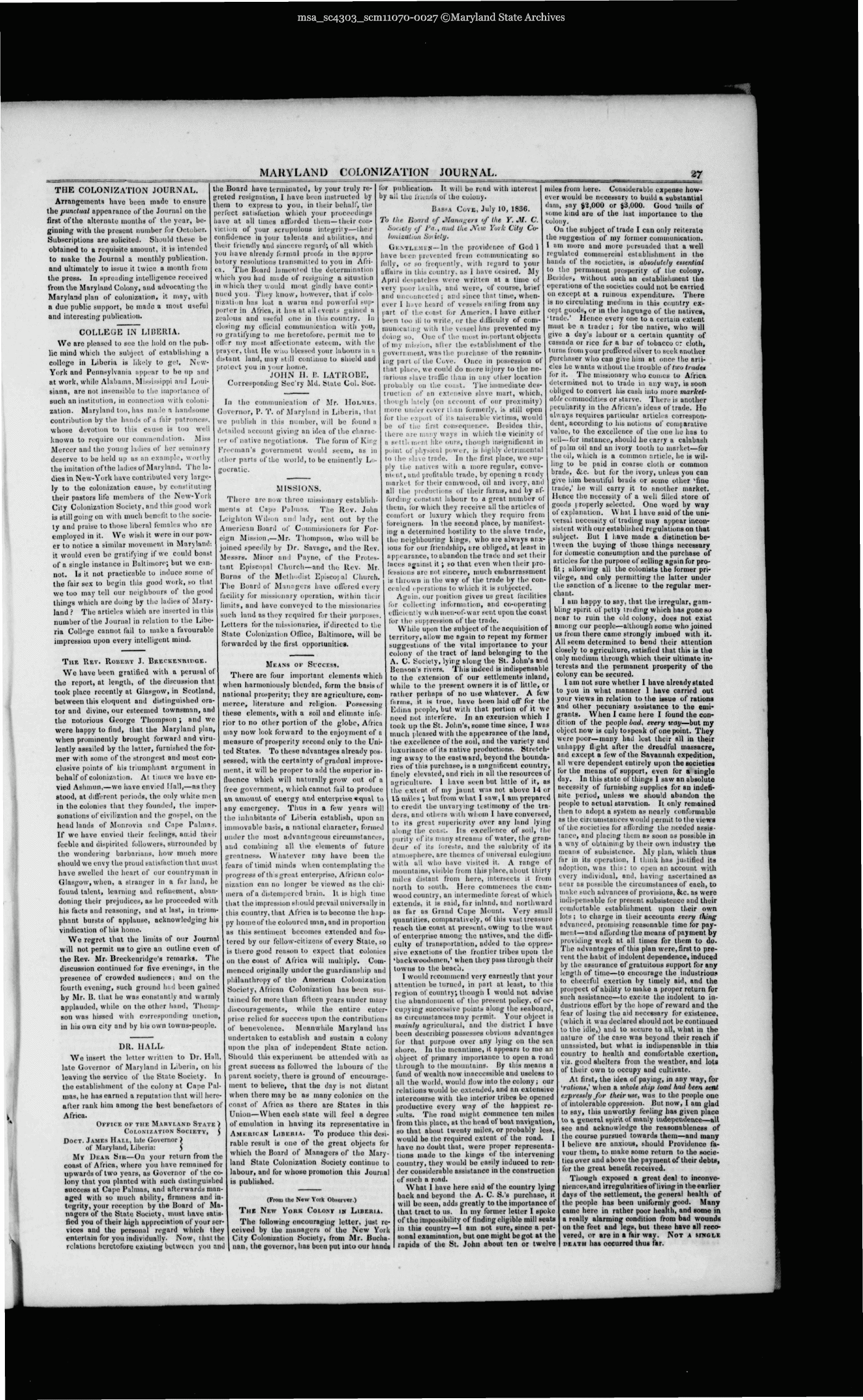
MARYLAND COLONIZATION JOURNAL.
27
THE COLONIZATION JOURNAL.
Arrangements linve been made to ensure
(he punctual appearance ofthe Journal on tlie
first oftlie alternate months of the year, be-
ginning with the present number for October.
Subscriptions are solicited. Should these be
obtained to a requisite amount, it is intended
to make the Journal a monthly publication.
nnd ultimately to issue it twice a month From
the press. In spreading intelligence received
from the Maryland Colony, and advocating the
Maryland plan of colonization, it may, with
n due public support, be made a most useful
and interesting publication.
COLLEGE IN LIBERIA.
We are pleased to see the hold on the pub-
lic mind which the subject of establi.-hing a
college in Liberia is likely to get. New-
York and Pennsylvania ippear to he up and
at work, while Alabama, Mississippi and Loui-
siana, are not insensible to the importance of
such an institution, in connection with coloni-
zation. Maryland too, has made a liandaofM
contribution by the hands of a lair patroDOM,
whose devotion to this cause is too well
known to require our commendation. Mkl
Mercer and the young holies of her seminary
deserve to be held up as an example, worth}
the imitation ofthe ladies of'Maryland. The la-
dies in New-York have contributed very large-
ly to the colonization cause, by constituting
their pastors life members of the New-York
City Colonization Society, and this good work
is still going on with much benefit to the socie-
ty and praise to those liberal females who are
employed in it. We wish it were in our pow-
er to notice a similar movement in Maryland:
it would even be gratifying if we could boast
of a single instance in Baltimore; but we can-
not. Is it not practicable to induce some of
the fair sex to begin this good work, so that
we too may tell our neighbours, of the good
things which are doing by the ladies of Mary-
land ? The articles which are inserted in this
number ofthe Journal in relation to the Libe-
ria College cannot fail to make a favourable
impression upon every intelligent mind.
the Board have terminated, by your truly rc-
greted resignation, I have been instructed by
them to express to you. in their behalf, the
perfect satisfaction which your proceeding!
have at all tunes afforded them—their con-
viction of your scrupulous integrity—llie.r
confidence in your talents and abilities, and
their friendly and sincere regard', of all svhieli
you have already formal proofs in the appro-
batory resolutions transmitted to you in Afri-
ca. The Hoard lamented the determination
which you had made of resigning a situation
in which they would nrnst gladly have conti-
nued you. They know, however, that if colo-
nization has luat n warm mid powerful sup-
porter in Africa, it has at all ( vents gained a
zealous and useful one in this country. In
closing my official communication with you,
so gratifying to me heretofore, permit me to
off r my ino.-t affectionate esteem, with the
prayer, that He Who blessed your labours in a
distant land, may st ill continue to shield and
protect you in \our home.
JOHN H.B. LATROBE.
Corresponding Sec'ry Md. State Col. Soc.
In the communication of Mr. Holmes.
Governor, P. V. ofMaryland in Liberia, that
we publish in this number, will be found a
detailed account giving an idea ofthe charac-
ter of native negotiations. The form of King
Freeman's government would seem, as m
other parts ofthe World, to be eminently Lc-
goeratic.
MISSIONS.
There are now three missionary establish-
ments nt Cipa Pelmet The Rev. John
Leighloii Wilton mo! lady, sent out by the
American Board of Commissioners for For-
eign Mis-ion,—Mr. Thompson, who will be
joined speedily by Dr. Savage, and the Rev.
.Messrs. Minor and Payne, of the Protes-
tant Episcopal Church—and the Rev. Mr.
Burns of the Methodist Episcopal Church.
The Board of Managera have offered every
facility for missionary operation, within tin ir
limits, and have conveyed to the missionaries
such land as they required for their purpose*.
Letters for the missionaries, if directed to the
State Colonization Office, Baltimore, will be
forwarded by the first opportunities.
The Rev. Robert J. BRECKENRIDGE
We have been gratified with a perusal of
the report, at length, of the discussion that
took place recently at Glasgow, in Scotland,
between this eloquent and distinguished ora-
tor and divine, our esteemed townsman, and
the notorious George Thompson ; and we
were happy to find, that the Maryland plan,
when prominently brought forward and viru-
lently assailed by the latter, furnished the for-
mer with some id'the strongest and mo.-t con-
clusive points of his triumphant argument in
behalf of colonization. At tunes we have en-
vied Ashuinn,—we have envied Hall,—as they
atood, at different periods, the only white men
in the colonies that they founded, the imper-
sonations of civilization and the gospel, on the
headlands of Monrovia nnd Cape Palmes.
If we have envied their feelings, an.id their
feeble and dispirited followers, surrounded by
the wondering barbarians, how much more
should we envy the proud satisfaction that must
have swelled the heart of our countryman in
Glasgow, when, a stranger in a far land, he
found talent, learning and refinement, aban-
doning their prejudices, as he proceeded with
his facts and reasoning, and at last, in trium-
phant bursts of applause, acknowledging his
vindication of his home.
We regret that the limits of our Journal
will not permit us to give an outline even of
the Rev. Mr. Breckenridge's remarks. The
discussion continued for five evenings, in the
presence of crowded audiences; and on the
fourth evening, such ground bad been gained
by Mr. B. that he was constantly nnd warmly
applauded, while on the other hand, Thomp-
son was hissed with corresponding unction,
in his own city and by bis own towns-people.
DR. HALL.
We insert the letter written to Dr. Hall.
late Governor ofMaryland in Liberia, on his
leaving the service of the Slate Society. In
the establishment of the colony at Cape Pal-
mas, he has earned a reputation that will here-
after rank him among the best benefactors of
Africa.
Office of the Maryland State
Colonization Society,
Doct. James Hall, late Governor
of Maryland, Liberia:
Mv Dear Sir—On your return from the
coast of Africa, where you have remained for
upwards of two years, as Governor ofthe co-
lony that you planted with such distinguished
success at Cape Palmas, nnd afterwards man-
aged with so much ability, firmness and in-
tegrity, your reception by the Board of Ma-
nagers of the Slate Society, must have satis-
fied you of their high appreciation of your ser-
vices and the personal regard which they
entertain for you individually- Now, that the
relations heretofore existing between you and
Mfans of Success.
There are four important elements which
when harmoniously blended, form the basis of
national prosperity; they are agriculture, com-
merce, literature and religion. Possessing
these elements, with a soil and climate Infe-
rior to no other portion of the globe, Africa
may now look forward to the enjoyment of n
measure of prosperity second only to the Uni-
ted States. To these advantages already pos-
sessed, with the certainty of gradual improve-
ment, it will be proper to add the superior in-
fluence which will naturally grow out of a
free government, which cannot fail to produce
an amount of energy and enterprise equal to
any emergency. Thus in a few years will
the inhabitants of Liberia establish, upon nn
immovable basis, a national character, formed
under the most advantageous circumstances,
and combining all the elements of future
greatness. Whatever may have been the
fears of timid minds when contemplating the
progress of thsgreat enterprise, African colo-
nization can no longer be viewed ns the chi-
mera of a distempered brain. It is high time
that the impression should prevail universally in
this country, that Africa is to become the hap-
py houieof the coloured tivin, and in proportion
ns this sentiment becomes extended and fos-
tered by our fellow-citizens of every Slate, so
is there good reason to expect that colonies
on the coast of Africa will multiply. Com-
menced originally under the guardianship and
philanthropy of the American Colonization
Society, African Colonization has been sus-
tained for more than fifteen years under many
discouragements, while the entire enter-
prise relied for success upon the contributions
of benevolence. Meanwhile Maryland has
undertaken to establish and sustain a colony
upon the plan of independent State action.
Should this experiment be attended with as
grent success as followed the labours of the
parent society, there is ground of encourage-
ment to believe, that the day is not distant
when there may be as many colonies on the
coast of Africa as there are States in this
Union—When each state will feel a degree
of enuilution in having its representative in
American Liberia. To produce this desi-
rable result is one of the great objects for
which the Board of Managers of the Mary-
land State Colonization Society continue to
labour, and for whose promotion this Joun.al
is published.
(From the New York Observer.)
The New York Colony in Liberia.
The following encouraging letter, just re-
ceived by the managers of the New York
City Colonization Society, from Mr. Bucha-
nan, the governor, has been put into our hands
lor publication. It will be read with interest
by all lite friend) ofthe colony.
Bassa Cove, July 10, 1836.
To the Board of Managers if the Y. M. C.
Society of Pa., and the New York City Co-
lonization Society.
Gentlemen— In the providence of God 1
have been previ tiled from coiiuininicating so
fully, or so frequently, with tegard to your
(flairs in this country, as 1 have decked). My
April despatches were written at a time ot
very poor health, anil were, of course, brief
and uni onRi et< d ; and since that time, when-
ever I h.ive heard of \i aw Is sailing from any
I art of the coast for America. I have either
bei n too ill to write, or the difficulty of com-
uiun.ciii.i.g with the vessel has prevented my
doing so. One of the most important objects
of my mission, after the establishment of the
government, was the purchase of the remain-
ing part ol the Cove. Once ill pos.-essiou of
that place, we could do more injury to the ne-
larious slave triillie than in any other location
probably on the eoast. The immediate des-
truction of nn |