 |
|
|
 |
|
 |
|
|||
|
||||
|
||||
|
Maryland State Archives Maryland Colonization Journal Collection MSA SC 4303 msa_sc4303_scm11070-0039 Enlarge and print image (4M) |
|
|
|
|
|
|
|
|||
|
||||
|
||||
|
Maryland State Archives Maryland Colonization Journal Collection MSA SC 4303 msa_sc4303_scm11070-0039 Enlarge and print image (4M) |
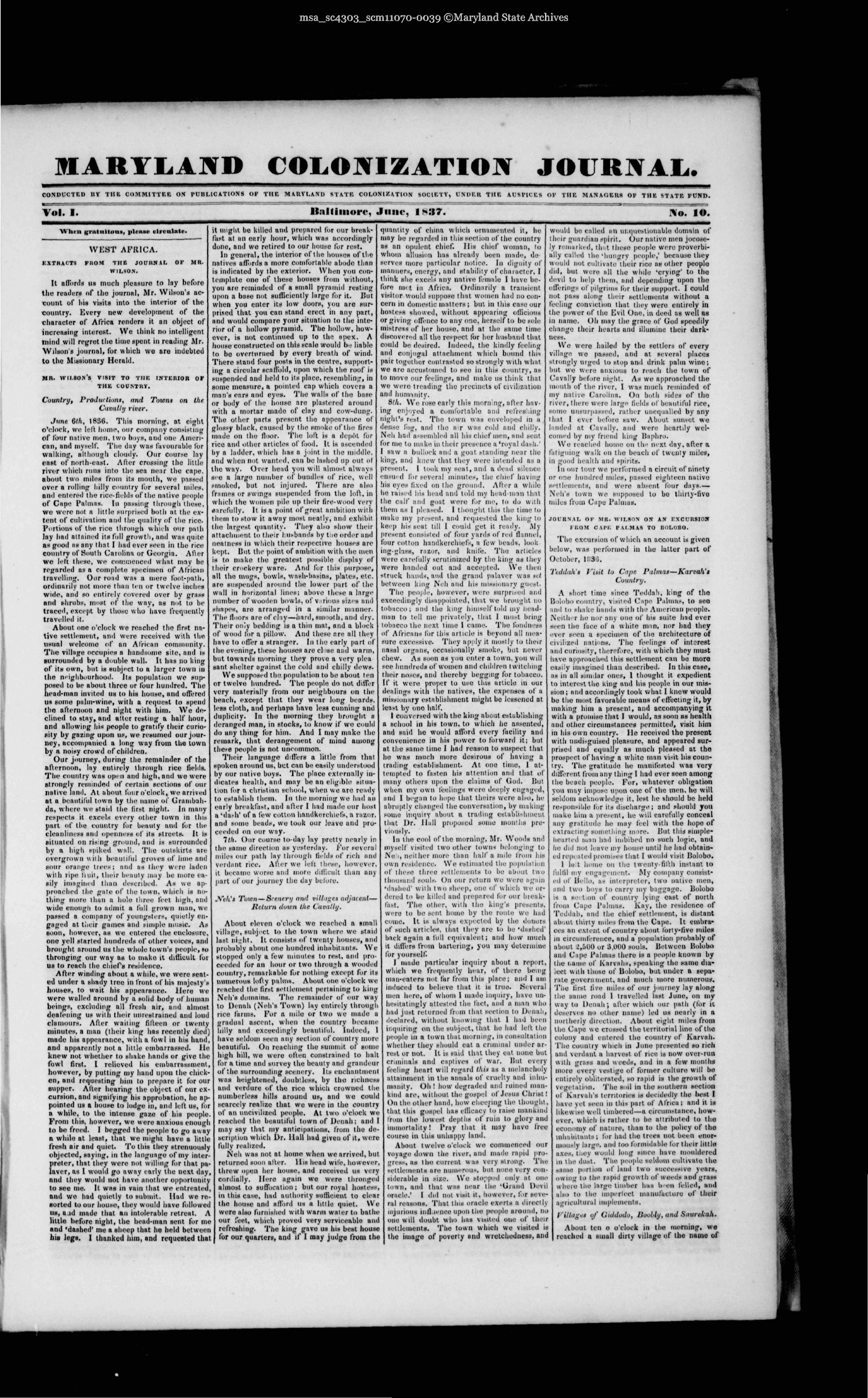
| MARYLAND COLONIZATION JOURNAL. CONDUCTED l!Y THE COMMITTEE ON PUBLICATIONS OP THE MARYLAND STATE COLONIZATION SOCIETY, UNDER THE AUSPICES OP THE MANAGERS OF THE STATE FUND. Vol. I. Baltimore. June, 1837. No. 10. When gratuitous, please circulate. WEST AFRICA. EXTRACTS FROM THE JOURNAL OF MR. WILSON. It affords us much pleasure to lay before the readers of tlic journal, Mr. Wilson's ac- count of liis visits into the interior of the country. Every new development of the character of Africa renders it on object of increasing interest. We think no intelligent mind will regret the time spent in reading Mr. Wilson's journal, for which we are indebted to the Missionary Herald. MR. WILSON'S VISIT TO THE INTERIOR OF THE COUNTRY. Country, Productions, and Towns on the. Cavally river. June 6th, 1836. This morning, at eight o'clock, we left home, our company consisting of four native men, two boys, and MM Ameri- can, anil myself. The day was favourable lor walking, although cloudy. Our Course lay east Of north-cast. After crossing the little river which runs into the sea near the cape. about two miles from its mouth, we passed over a rolling hilly country for several miles, ami entered the rice-fields of the native people of Cape I'ahnas. hi passing through these, wo were not a little surprised both at the ex- tent of cultivation ami the quality of the rice. Portions of the rice through Which our path lay hod attained its full growth, anil was quite as gooil as any that I hail ever seen in the rice country of South Carolina or Georgia. Afler we left these, we commenced what mav be regarded as a complete specimen of African travelling. Our road was a mere foot-path, ordinarily not more than ten or twelve inches wide, ami so entirely covered over by grass and shrubs, most of the way, as not to be traced, except by those who have frequently travelled it. About one o'clock we reached the first na- tive settlement, and were received with the usual welcome of an African community. The village occupies a handsome site, and is surrounded by a double wall. It has no king of its own, but is subject to a larger town in the neighbourhood. Its population we sup- posed to be about three or four hundred. The head-man invited us to his house, and offered us some palm-wine, with a request to spend the afternoon and night with him. We de- clined to stay, and alter resting a half hour, and allowing his people to grotify their curio- sity by gazing upon us, we resumed our jour- ney, accompanied a long way from the town by a noisy crowd of children. Our journey, during the remainder of the afternoon, lay entirely through rice fields. The country was open and high, and we were strongly reminded of certain sections of our native land. At about four o'clock, we arrived at a beautiful town by the name of Crutnbuh- da, where we staid the first night, hi many respects it excels every other town in this purl of the country for beauty and for the cleanliness and openness of its streets. It is situated on rising ground, and is surrounded by a high spiked wall. The outskirts are overgrown with beautiful groves of lime and sour orange trees; and us they were laden with ripe fruit, their beauty may be more ea- sily imagined than described. As we ap- proached the gate of the town, which is no- thing more than a hule three feet high, and wide enough to admit a full grown man, we passed a company of youngsters, quietly en- gaged at their games ami simple music. As soon, however, as we entered the enelosure, one yell started hundreds of other voices, and brought around us the whole town's people, n> thronging our way ns to make it difficult tor ns to reach the chief's residence. After winding about a while, we were seat- ed under a shady tree in front of his majesty's houses, to wait his appearance. Here we were walled around by a solid body of human beings, excluding all fresh air, and almost deafening U9 with their unrestrained and loud clamours. After wailing fifteen or twenty minutes, a man (their king has recently died) made his appearance, with a fowl in his bund, and apparently not a little embarrassed. He knew not whether to shake hands or give the fowl first. I relieved his embarrassment, however, by putting my hund upon the chick- en, and requesting him lo prepare it for our supper. After hearing the object of our ex- cursion, and signifying his approbation, he ap- pointed us a house to lodge in, and left us, for a while, to the intense gaze of his people. From this, however, we were anxious enough to be freed. I begged the people to go awoy a while at least, that we might have a little fresh air and quiet. To this they strenuously objected, saying, in the language of my inter- preter, that they were not willing fur that pa- laver, as I would go away early the next day, and they would not have another Opportunity to see me. It was in vuin that we entreated, and we hud quietly to submit. Hud we re- sorted to our house, they would iiave followed us, a.id made that an intolerable retreat. A little before night, the head-man sent for me and 'dashed' me a sheep that he held between his legs. I thanked him, and requested that it might be killed and prepared tor our break- fast at itri early hour, which was accordingly done, and we retired to our house tor rest. In general the interior of the houses of the natives affords a more comfortable abode thnn is indicated by the exterior. When you con- template one of these houses from without, you are reminded of a small pyramid rating upon a base not sufficiently lurge for it. But when you enter its low doors, you arc sur- prised that you can stand erect iu any part, and would compare your situation to the inte- rior of u hollow pyramid. The hollow, how- ever, is not continued up to the apex. A house constructed on this scale would be liable to bo overturned by every breath of wind. There stand four posts in the centre, support- ing a circular scaffold, upon which the roof is suspended and held to its place, resembling, in some measure, a pointed cap which covers a man's ears and eyes. The walls of the base or body of the house are plastered around with a mortor made of clay and cow-dung. The other parts present the oppearance ol glossy black, caused by the smoke of the fires made on the floor. The loft is a depot for rice and other articles of food. It is ascended by a ladder, which has a joint in the middle, and when not wanted, can be lashed up out ol the way. Over head you will almost always s>e a large number of bundles of rice, Well smoked, but not injured. There are also frames or swings suspended from the loft, in which the women pile up their fire-wood very aarefully. It is a point of great ambition with them to stow it away most, neatly, and exhibit the largest quantity. They al.-o show their attachment to their husbands hy toe Offer and neatness iu which their respective houses are kept. Dut the point of ambition with the men is to make the greatest possible display of their crockery ware. And for this purpose, all the- mugs, bowls, wnsh-Uasins, plates, etc. are suspended around the lower part of the wall in horizontal lines; above these a large number of wooden bowls, of virions sizes and shapes, are arranged in a similar manner. The floors are of clay?hard, smooth, and dry. Their only bedding is a thin mat, and a block of wood tiir a pillow. And these are all they have to offer a stranger. In the early part of the evening, these houses are close and warm, but towards morning they prove a very plea sant shelter against the cold unci chilly dews. We supposed the population to be about ten or twelve hundred. The people do not differ very materially from our neighbours on the beach, except that they wear long beards, less cloth, and perhaps have less cunning ami duplicity. In the morning they brought ? deranged man, in stocks, to know if we could do uny thing for him. And I may make the remark, that derangement of mind among the.-e people is not uncommon. Their language differs a little from that spoken around us, but can be easily understood by our native boys. The place externally in- dicates heullIi, and may be nn eligible situa- tion for a christian school, when WO are ready to estuhlish them. In the morning we had an early breakfast, und after I had made our host a 'dash' of a few cotton handkerchiefs, a razor, and some beads, we took our leave und pro- ceeded on our way. 1th. Our course to-day lay pretty nearly in the same direction as yesterday. J''or several miles our path lay through fields of rich and verdunt rice. Afier we fofl these, however, it became worse and more difficult than any part of our journey the day bctore. Neh's Town ? Scenery and villages adjacent? Return down the Cavally. About eleven o'clock wo reached a small village, subject to the town when' we staid hist night. It consists of twenty houses, and probably ubout one hundred inhabitants. We stopped only a few minutes to rest, anil pro- ceeded fur an hour or two through a wooded country, remarkable for nothing except for its numerous lofly pulnis. About one o'clock we reached the first settlement pertaining to king Neb's domains. The remainder of our way to Denah (Neh's Town) lay entirely through rice farms. For a mile or two we made u gradual ascent, when the country became billy and exceedingly beautiful. Indeed, 1 have seldom seen any section of country more beautiful. On reaching the summit of some high bill, we were often constrained to halt for a time and survey the beauty und grandeur of the surrounding scenery. Its enchantment was heightened, doubtless, by the richness and verdure of the rice which crowned the numberless hills uround us, and we could scarcely realize that we were in the country of an uncivilized people. At two o'clock we reached the beautiful town of Uenuh; und I may say that my anticipations, from the de- scription which Dr. Hull hud given of it, were fully realized. Neh was not at home when we arrived, but returned soon alter. His head wile, however, threw open her house, and received us very cordially. Here again we were thronged almost to suffocation ; but our royal hostess, iu this case, hud authority sufficient to clear the house ami uflord us u little quiet. We were also furnished with warm water to bathe our feet, which proved very serviceable and refreshing. The king gave us his best house for our quarters, and if I may judge from the quantity of china which ornamented it, he may he regarded ill this section of the country as an opulent chief. His chief woman, lo whom allusion has already been made, do serves more particular notice. In dignity of manners, energy, and stability of character, I think she excels any native female I have be- fore mi t in Africa. Ordinarily a transient visitor would suppose that women had no con- cern in domestic matters ; but iu this case our hostess showed, without appearing officious or giving offence to any one, herself to he sole mistress of her house, and at the same time discovered all the respect lor her husband that could be desired. Indeed, the kindly feeling and conjugal attachment which bound this pair together contrasted so strongly with what we are accustomed to see in this country, as to move our feelings, and make us think that we were treading the precincts of civilization and humanity. 8th. We rose early this morning,after hav- ing enjoyed a comfortable and relies ling night's rest. The town was enveloped in a dense fog, and the inr was cold and chilly. Neh had assembled all his chief men, and sent for me to make ill their presence a 'royal dash.' I saw a bullock and a goat, standing near the king, and knew that they were iuteieh d as a present. 1 look my seat, and a dead silence ensued for several minutes, the chief having his eyes fixed on the ground. After a while he raised bis head and told my bead-man that the calf and goat were f>r tne, lo du with them as I pleased, 1 thought this the time to make my present, and requested the king to keep his seat till 1 could get it ready. My present consisted of four yards of red flannel, four cotton handkerchiefs, a few beads, look ing.glass, razor, and knife. The articles were carefully scrutinized by the king as liny were handed out and accepted. We then struck hands, and the grand palaver was sit between king Neh and his missionary guest. The people, however, were surprised and exceedingly disappointed, that we brought no tobacco; and the king himself told my head- man to tell mo privately, that I must bring tobacco the next time I caul'". The fondness of Africans for this article is beyond all mea- sure excessive. They apply it mostly to their nasal organs, occasionally smoke, but never chew. As soon as you enter a town, you will see hundreds of women and children twitching their noses, and thereby begging for tobacco. If it were proper to use this article iu our dealings with 1 lie natives, the expenses of a missionary establishment might be lessened at least by one half. I conversed with the king about establishing a school in his town, to which he assented, and said he would afford every facility and convenience in his power to forward it; but at the same lime I had reason to suspect that ho was much more desirous of having a trading establishment. At one time, 1 at- tempted to fasten his attention and that of many others upon the claims of God, But when my own feelings were deeply engaged, and I began to hope that theirs were al.-o, he abruptly changed the conversation, by making some inquiry about u trading establishment that Dr. Hull proposed some months pre- viously. In the cool of the morning, Mr. Woods and myself visited two other towns belonging to Ne i, neither more than half a mile from his own residence. We estimated the population of these three settlements to he ubout two thousand souls. On our return We were again 'dashed' with two sheep, one of which we or- dered to be killed and prepared fur our break- last. The other, with the king's presents, were to be sent home by the route we had come. It is always expected by the donors of such articles, ihat they ore to he 'dashed' back again a full equivalent; und how much it differs from bartering, you may determine for yourself I made particular inquiry about a report, which we frequently hear, of there being man-eaters not far from this place; and I am induced to believe that it is true. Several men here, of whom I made inquiry, have un- hesitatingly attested the fact, and a man who had just returned from that section to Denah, declared, without knowing that I had been inquiring on the subject, that he had left the people in a town thai morning, in consultation whether they should eat a criminal under ar- rest or not. It is said that thej eat none but cr,initials and captives of war. Hut every feeling heart will regard this as a melancholy attainment in the annuls of cruelty and inhu- manity. Oh ! how degraded und ruined man- kind are, without tin: gospel of Jesus Christ I On the other hand, how cheering the thought, that this gospel has efficacy to raise mankind from the luwe.-t depths of ruin to glory and Immortality I Troy that it may huvo free course iu this unhappy laud. About twelve o'clock we commenced our voyage down the river, and made rapid pro- gress, as the current was very strong. The settlements are numerous, but none very con- siderable in size. We stopped only at one town, and that was near the 'Grand Devil oracle.' I did not visit it, however for seve- ral reasons. That this oracle exerts a directly injurious influence upon the people around, no one will doubt who has visited one of their settlements. The town which we visited is the image of poverty and wretchedness, and would be culled an unquestionable domain of their guardian Spirit, Our native men jocose- ly remarked, that these people were proverbi- ally called the'hungry people,' because they would not cultivate their rice as other people did, but were nil the while 'crying' to the devil to help them, und depending upon the offerings of pilgrims for their support. I could not pass along their settlements without a feeling conviction that they were entirely in the power of llie Evil One, in deed as well as in name, Oh may the grace of Cod speedily change their hearts and illumine their dark- ness. We were hailed by the settlers of every village we passed, and at several places strongly urged to stop and drink palm wine; hut we were anxious to reach the town of Cavally before night. As we approached the month of the river, I was much reminded of my native Carolina. On both sides of the river, there were large fields of beautiful rice, some unsurpassed, rather unequalled by any that I ever before saw. About sunset we landed at Cavally. and were heartily wel- comed by my friend king Bepbro, We reached home on the next day, after a fatiguing walk on the beach of twenty miles, in good health and spirits. In our tour we performed a circuit of ninety or one hundred miles, passed eighteen native settlements, and were absent four days? Neh's town we supposed lo be tlnriy-fivo miles from Cape 1'aluias. JOURNAL OF MR. WILSON ON AN EXCURSION FROM CAPE PALMAS TO BOL0B0. The excursion of which an account is given below, was performed in the latter part of October, 1836. Teddah's Visit to Cape Palmas?Karvah's Country. A short time since Teddah. king of the Bolobocountry, visited Cape Palmes, to see and to shake bauds with tin' American people. Neither he nor any one ol' his suite had ever seen the face of a while man, nor had they ever seen a specimen of the architecture of civilized nations. The feelings of interest and curiosity, therefore, with which they must have approached this settlement can be mora easily imagined than described. In this case, as in all similar ones, 1 thought it expedient to interest the king and his people in our mis- sion; and accordingly took what I knew would bo the most favorable means of"effecting it, by making him a present, and accompanying it with a promise that I would, as soon us health and other circumstances permitted, visit him in his own country. He received the present with undi-giiised pleasure, and appeared sur- prised and equally as much pleased at tho prospect of having a white man visit his coun- try. The gratitude he manifested was very different (ran any thing I had ever seen among the beech people. For, whatever obligation you may impose upon one of the men, he will seldom acknowledge it, lest he should be held responsible for its discharge j and should you make him a present, he will carefully conceal any gratitude he may feel with the hope of extracting something more. Hut this simple- hearted man had imbibed no such logic, and he did not leave my house until he had obtain- ed repeated promises that I would visit Bolobo. I left home on the twenty-fifth instant to fulfil my engagement. My company consist- ed ol Bello, as interpreter, two native men, and two boys lo carry my baggage. Bolobo is a aection of country lying cast of north from Cape Palmas. Kay, the residence of Teddah, and the chief settlement, is distant about thirty miles from the Cupe. It embra- ces an extent of country about. Ibrly-five miles in circumference, and a population probably of about 1,600 or 3.000 souls, lietween Bolobo and Cape Palmes there is a people known by the name of Karvahs, speaking the same dia- lect with those of Bolobo, but under a sepa- rate government, and much more numerous. The first five miles of our journey lay along the same road 1 travelled last June, on my way to Denah; after which our path (tor it deserves no other name) led us nearly in a northerly direction. About eight miles from the Cape we crossed the territorial line of the colony and entered the country of Karvah. The country which in June presented so rich and verdant a harvest of rice is now over-run with grass and weeds, and in a few months more every vestige of former culture will be entirely obliterated, so rapid is the growth of vegetation. The soil in the southern section of Karvahs territories is decidedly the best I huvo yet seen in this part of Africa; and it is likewise well limbered?a circumstance, how- ewr. which is rather to be attributed to tho economy of nature, than to the policy of the inhabitants) lor had the trees not been enor- mously large, and loo formidable lor their little ax,... i.,ev would long since have mouldered in the doit, The people seldom eultivute the same portion of land two successive years, owing to the rapid growth of weeds and grass where the large limber has b en felled, and also to the imperfect manufacture of their agricultural implements. Villages of Giddodo, Boobly, and Saurekah. About ten o o'clock in the morning, we reached a small dirty village of the name of |