 |
|
|
 |
|
 |
|
|||
|
||||
|
||||
|
Maryland State Archives Maryland Colonization Journal Collection MSA SC 4303 msa_sc4303_scm11070-0043 Enlarge and print image (5M) |
|
|
|
|
|
|
|
|||
|
||||
|
||||
|
Maryland State Archives Maryland Colonization Journal Collection MSA SC 4303 msa_sc4303_scm11070-0043 Enlarge and print image (5M) |
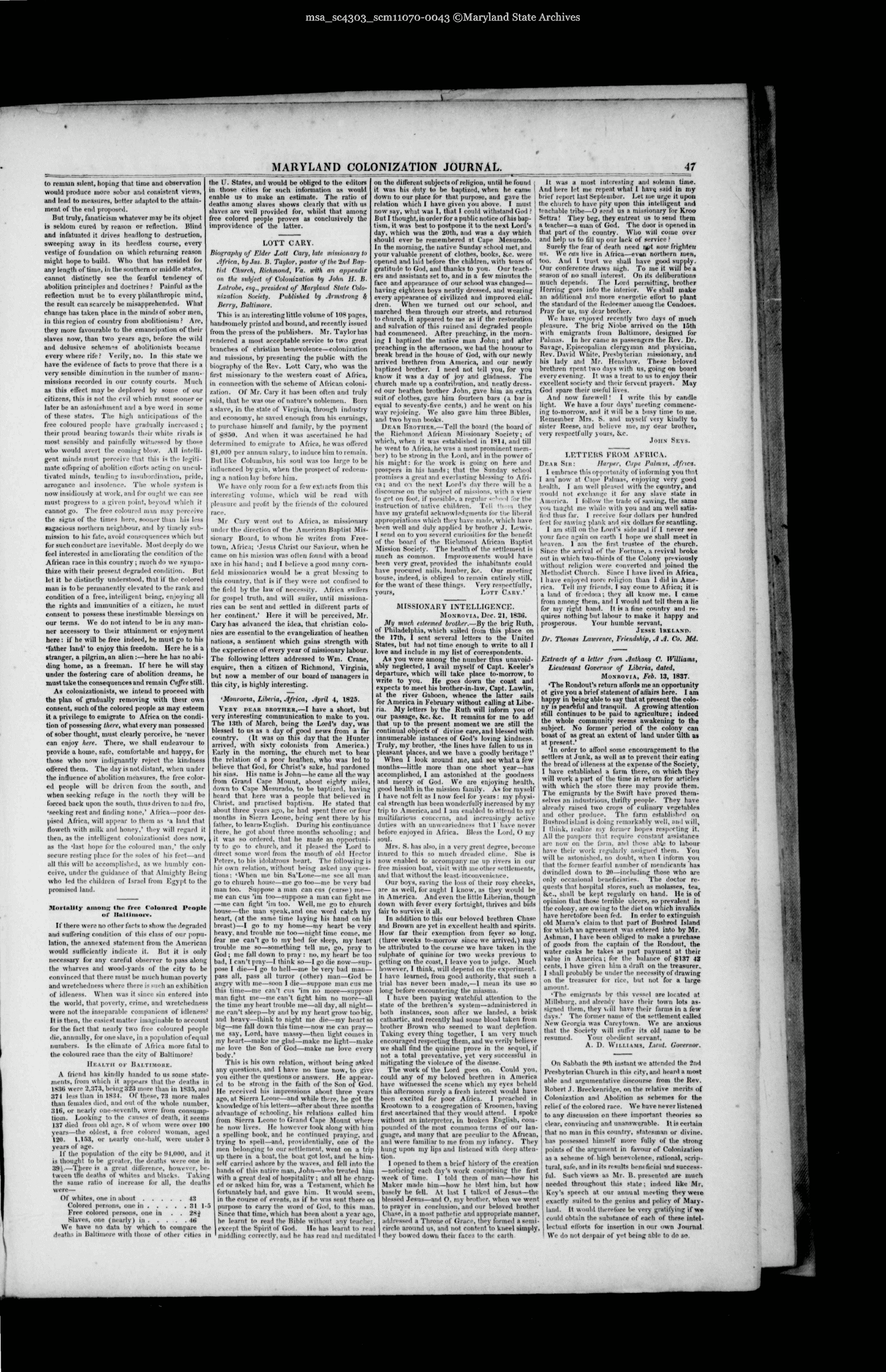
| MARYLAND COLONIZATION JOURNAL. 47 to remain silent, hoping that time and observation would produce more sober and consistent views, and lead to measures, belter adapted to the attain- ment of the end proposed. But truly, fanaticism whatever may be its object is seldom cured by reason or reflection. Wind and infatuated it drives headlong to destruction, sweeping away in its heedless course, every vestige of foundation on which returning reason might hope to build. Who that has resided for any length of time, in the southern or middle states, cannot distinctly see the fearful tendency of abolition principles and doctrines? Painful as the reflection must be to every philanthropic mind, the result call scarcely he misapprehended. What change has taken place in the minds of sober men, in this region of country from abolitionism ? Are, they more favourable to the emancipation of their slaves now, than two years ago, before the wild and delusive schemes of abolitionists became every where rife? Verily, no. In this state we have the evidence of facts to prove that there is a very sensible diminution in the number of manu- missions recorded in our county courts. Much as this effect may he deplored by some of our citizens, this is not the evil which must sooner or later be an astonishment aiel a live word in some of these states. The high anticipations of the free coloured people have gradually increased ; their proud hearing towards their while rivals is most sensibly and painfully witnessed by those who would avert the coining blow. All intelli- gent minds must perceive that this is (be legiti- mate offspring of abolition efforts acting on uncul- tivated minds, tending to insubordination, pride, arrogance and insolence. The whole lysten is now insidiously at Work, and for ought we can see must progress to a given point, beyond which it cannot go. The free coloured nun may perceive the signs of the times here, sooner thin his leu •agacioiis northern neighbour, and by timely sub- mission to his fate, avoid consequences which but for such conduct are inevitable. Most deeply do we feel interested in ameliorating the condition of the African race in this country; much do we sympa- thize with their present degraded condition. But let it be distinctly understood, that if the rolored man is tube permanently elevated to the rank and condition of a free, intelligent being, enjoying all the rights and immunities of a citizen, he must consent to possess these inestimable blessings on our terms. We do not intend to be in any man- ner accessory to their attainment or enjoyment here: if he will be free indeed, he must go to his 'father land' to enjoy this freedom. Here he is a stranger, a pilgrim, an alien:—here he has no abi- ding home, as a freeman. If here he will stay under the fostering care of abolition dreams, he must take the consequences and remain Cuffee still. As coloni/.ationists, we intend to proceed with the plan of gradually removing with their own consent, such of the colored people as may esteem it a privilege to emigrate to Africa on the condi- tion of possessing /Acre, what every man possessed of sober thought, must clearly perceive, he never can enjoy here. There, we shall endeavour to provide a home, safe, comfortable and happy, for those who now indignantly reject the kindness ottered them. The day is not distant, when under the influence of abolition measures, the free color- ed people will be driven from the south, and when seeking refuge in the north they will be forced back upon the south, thus driven to and fro, 'seeking rest and finding none,' Africa—BOOT des- pised Africa, will appear to them as 'a land that floweth with milk and honey,' they will regard it then, as the intelligent coloni/.atioiiist does now, as the 'last hope tin- the coloured man.' the only secure Meting pi ice lor the soles of his feet—and all this will he accomplished, as we humbly con- ceive, under tin- guidance of that Almighty Bring who led the children of Israel from Egypt to the promised land. the U. States, and would be obliged to the editors in those cities for such information as would enable us to make an estimate. The ratio of deaths among slaves shows clearly that with us slaves are well provided for, whilst that among free colored people proves as conclusively the improvidence of the latter. Mortality nmoiu; Die free Coloured People of lEn 11 imoi i . It' there were no other tacts to show the degraded and sutfering condition of this class of our popu- lation, the annexed statement from the American would sullicirntly Indicate it. Hut it is only necessary for any careful observer to pass along the wharves and wood-yards of the city to be convinced that there must be much human poverty and wretchedness where there il IDi h an exhibition of idleness. When was it since -in entered into the world, that poverty, crime, and wretchedness were not the inseparable companion! of idleness: It is then, the easiest matter imaginable to account lor the fact that nearly two free coloured people die, annually, for one slave, in a population of equal numbers. Is the climate of Africa more fatal to (lie coloured race than the city of Baltimore? Health of Baltimore. A friend has kindly handed to us some state- ments, from which it appeal* that the deaths in lSISli were 2,373, being 323 more than in is:!.",, and 371 less than in ISM. Of these, 7:1 more males than females died, and out of the whole number, ¦IS, or nearly one-seveiilh, were IVoin consump- tion!. Looking to the cannot of death, it seems 137 died from old age, I of whom were over 100 years—the oldest, a free colored woman, aged 120. 1.153, or nearly one-half, were under .'< years of ago. If the population of the city be ft 1,000, and it in thought to be greater, the deaths were on* in 394.—There is a greet difference, however, be- tween the deaths of whites and blacks. Taking the same ratio of increase for all, the deaths were— Of whites, one in about.....13 Colored per-ons, nne in.....31 |-.r) Free colored persons, one in 2"^ Slaves, one (nearly ) in.....Mi We have no data hy which to compare the deaths in Baltimore with thote of other cities in LOTT CARY. Biography of Elder J.ott Cary, late missionary to .Africa, by Jas. B. Taylor, pastor of the 2nd Bap- tist Church, Richmond, Vn. with an appendix on the subject of Colonization by John H. B. Latrobe, esq., president of Maryland State Colo- nization Society. Published by Armstrong & Berry, Baltimore. This is an interesting little volume of 10* pages, handsomely printed and humid, and recently issued from the press of the publishers. Mr. Taylor has rendered a most acceptable service to two great branches of christian benevolence—colonization anil missions, by presenting the public with the biography of the Ilcv. Lott Cary, who was the first missionary to the western coast of Africa, in connection with the scheme of African coloni- zation. Of Mr. Cary it has been often and truly said, that he was one of nature's noblemen. Born a slave, in the state of Virginia, through industry and economy, he saved enough from his earnings, to purchase himself and family, by the payment ol s.-Cii). And when it was ascertained be bad determined to emigrate to Africa, he was offend 01,000 per annum salary, to induce him to remain. l!ut like Columbus, his soul was too largo to be influenced by gain, when the prospect of redeem- ing a nation lay before liim. We have only room for a fevvextiacts from this interesting volume, which will he reail with pleasure and profit by the friend! of the coloured race. Mi- Cary went out to Africa, as missionary under the direction of the American Baptist Mis- sionary Board, to whom he writes from Free- town, Africa; 'Jesus Christ our Sa\iour, when he came on his mission was often Ibund with a broad axe in bis hand; and I believe a good many corn- field missionaries would be a great blessing to this country, that is if they mn not confined to the field by the law of necessity. Africa sudors for gospel truth, and will sillier, until missiooa- rics can be sent and settled in dilferetit parts of her continent.' Here it will be perceived, Mr. Cary has advanced the idea, that christian colo- nies are essential to the evangelisation of heathen nations, a sentiment which gains strength with the experience of every year of missionary labour. The following letters addressed to Win. Crane, esquire, then a citizen of Richmond, Virginia, but now a member of our board of managers in this city, is highly interesting. 'Monroeta, Liberia, Africa, April 4, 1825. Very dear brother,—I have a short, hut very interesting communication to make to you. The l.'ith of March, being the Lord's day, was blessed to us as a day of good news from a far country. (It was on this day that the Hunter arrived, with sixty colonists from America.) Karly in the morning, the church met to hear the relation of a poor heathen, who was led to believe that God, for Christ's sake, had pardoned his sins. His name is John—he came all the way from Grand Cape Mount, about eighty miles, down to Cape Mesurado, to be baptized, having heard that here was a people that believed in Christ, and practised baptism, lb' stated that about three years ago, he had spent three or four months in Sierra Leone, being sent there bv bis lather, to learn-1'iiglisb. During his continuance there, he got about three months schooling; and it was so ordered, that he made an opportuni- ty to go to church, and it pleased the Lord to direct some word from the mouth of old Hector Peters, to bis idolatrous heart. The following is hi- own rotation, without being asked anv ques- tions: 'When me bin Sa'Lone—DM see all man go to church house—me go too—me lie Nn bad man too. Suppose a man can cus (curse) me— me can cus 'im too—suppose a man can light me --me can tight 'im too. Well, me goto church house—the man speak,and one word catch my heart, (at the same time laying his hand on his breast)—I go to my home—my heart he very heavy, arid trouble me too—night time come, me fear me can't go to my bed for sleep, my heart Irouble me so—something tell me, go, pray to God ; me fall down to pray : no, my heart he too bad, I can't pray—I think so—I go die now—sup- pose I die—I go to hell—me be very bad man— pass all. pass all tiin'or (other) man—God be angry with me—soon J dip—suppose man cus me this time—me can't cus 'im no more—suppose man tight me—me can't light him no more—all the time my heart trouble me—all day. all night — me can't sleep—by and by my heart grow too big, and heavy—think to night me die—my heart so big—me fall down this time—now me can pray— im' say. Lord, have massy—then light comes in my head — make me glad—make me light—make rne love the Son of God—make me love every body.' This is his own relation, without being a*ked any questions, ami I have no time now, to give you either the questions or answers, lie appear- ed to he strong in the faith id the Son of God. He received his impressions about three years ago, at Sierra Leone—and while there, he got the knowledge of his letters—after about three months advantage of schooling, bis relations called him from Sierra Leone to Grand Cape Mount where he now lives, lie liowcwr took along with him • spelling book, ami be continued praying, and trying to spell—and, providentially, rule of the men belonging to our settlement, went on a trip up there in a boat, the boat got Lost, and be him- self carried ashore by the waves, and fell into the hands of this native man. John—who stated him with a great ileal of hospitality ; and all he charg- ed or asked him lor, was a Testament, which he fortunately bad. and gave him. It would seem, in the course of events, as if he was sent there on purpose to carry the word of God, to this man. Since that time, which has been about a year ago, he learnt to read the Bible without any teacher, except the Spirit of Cod. lie lias h unit to read 'middling correctly, wd he has read and meditated on the different subjects of religion, until he found it was his duty to be baptized, when he came down to our place lor that purpose, and gave the relation which I have given you above. I must now say, what was I, that I could withstand God I But I thought, in order for a public notice of his bap- tism, it was best to postpone it to the next Lord's day, which was the 20th, and was a day which should ever be remembered at Cape Mesurado. In the morning,the native Sunday-school met,and your valuable present of clothes, books, &.c. were opened and laid before the children, with tears of gratitude to Cod, and thanks to you. Our teach- ers anil assistants set to. and in a few minutes the face and appearance of our school was changed— having eighteen hovs neatly dressed, and wearing every appearance of civilized and improved chil- dren. When we turned out our school, and marched them through our streets, and returned to church, it appeared to me as if the restoration and salvation of this mined and degraded people had commenced. After preaching, in the morn- ing I baptized the native man John; and alter preaching in the afternoon, we had the honour to break bread in the house of God, with our newly arrived brethren from America, and our newly baptized brother. 1 need not tell you, for you know it was a day of joy and gladness. The church made up a contribution, and neatly dress- ed our heathen brother John, gave him an extra suit of clothes, gave him fourteen bars (a bar is equal to seventy-five cents,) and he went on his way rejoicing. We also gave him three Bibles, and two hymn books. Df.au Brother,—Tell the board (the hoard of the Richmond African Missionary Society; of which, when it was established in 1*1 J, and till he went to Africa, he was a most prominent mem- ber) to be strong in the Lord, and in the power of his might: for the work is going on here and prospers in his hands; that the Sunday school promises a great and everlasting blessing to Afri- ca; and 01 the next Lord's day there will be a discourse on the subject of missions, with a view to get on foot, if possible, a regular «chn d for the instruction of native children. Tell them they have my grateful acknowledgments lor Cue liberal appropriations which they have made, which have been well and duly applied by brother J. Lewis. I send on to you several curiosities for the benefit of the hoard of the Richmond African Baptist Mission Society. The health of the settlement is much as common. Improvement! would have been very great, provided the inhabitants could have procured nails, lumber, &e. Our meeting house, indeed, is obliged to remain entirely still, for the want of these things. Very respectfully, yours, Lott Cary.' It was a most interesting and solemn time. And here let me repeat what I have, said in my brief report last September. Let me urge it upon the church to have pity upon this intelligent atirt teachable tribe—O send us a missionary for Kroo Setlra! They beg, they entreat us to send them a teacher—a man of God. The duor is opened in that part of the country. Who will come over anil help us to fill up our lark of service ? Surely the fear of death need n)pt now frighten us. We ran live in Africa—Itm northern men, too. And I trust wc shall have good sup Our conference draws nigh. To me it will sea-oii of no small interest. On its deliberations much depends. The Lord permitting, brother Herring goes into the interior. We shall make an additional and more energetic etfort to plant the standard ol the Redeemer among the Coniloes. Pray for us, my dear brother. We have enjoyed recently two days of much pleasure. The brig Nloba arrived on the 15th with emigrants from Baltimore, designed for Palatal. In her came as passengi rs the Rev. Dr. Savage, Episcopalian clergyman and physician. Rev, David White, Presbyterian missionary, and his lady and Mr. Henshaw. These b"loved brethren spent two days with us, going on board every evening. It was a treat to us to enjoy their excellent society and their fervent prayers. May God spare their useful lives. And now fore Well I 1 write this by candle light. We have a four days' meeting commenc- ing to-morrow, and it will be a busy time to me. Remember Mrs. S. and myself very kindly to sister Reese, and believe me, my dear brother, very respectfully yours, JStc. John Seys. MISSIONARY INTELLIGENCE. Monrovia, Dec. 21, 1836, My much esteemed brother.—By the brig Ruth, of Philadelphia, which sailed from this place on the 17th, I sent several letters to the United States, but had not time enough to write to all I love and include in my list of correspondents. As you were among the number thus unavoid- ably neglerted, I avail myself of Capt. Keeler's departure, which will take place to-morrow, to write to you. He goes down the coast and expects to meet his brother-in-law, Capt. Lawlin, at the river Gaboon, whence the latter sails for America in February without calling at Libe- ria. My letters by the Ruth will inform you of our passage, fee. &c. It remains for me to add that up to the present moment we are still the continual objects of divine care, and blessed with innumerable instances of God's loving kindness. Truly, my brother, 'the lines have fallen to us in pleasant [daces, and we have a goodly heritage '.' When I louk around me, and see what a few mouths—little more than one short year—has accomplished, I am astonished at the goodness and mercy of Cod. We are enjoying health, good health in the mission family. As for myself 1 have not felt as 1 now feel lor years : my physi- cal strength has been wonderfully increased hy my trip to America,and I am enabled to attend to my multifarious concerns, and increasingly active duties with an nnweariedness that 1 nave never before enjoyed ill Africa. Blent the Lord, o my soul. Mrs. S. has also, in a very great degree, become inured to this to much dreaded clime. She is now enabled to accompany me up rivers in our free mission boat, visit with me other seiileniems, and that without the least inconvenience. Our hoys, saving the loss of their rosy cheeks, are as well, for aught 1 know, as they would be in America. And even the little Liberian, though down with fever every fortnight, thrives and bids fait to survive it all. In addition to this our beloved brethren Chase and Brown are yet in excellent health and spirits. How far their exemption from fever so long, (three weeks to-morrow since we arrived,) may be attributed to the course we have taken in the sulphate of quinine for two weeks previous to getting on the coast, I leave you to judge. Much DOWevCT, I think, will depend on the experiment. I have learned, from good authority, that such a trial has never been made,—I mean its use so long before encountering the miasma. I lu.ve been paying watchful attention to the state of the brethren's system—administered in both instances, soon after we lauded, a brisk cathartic, and recently bad some blood taken from brothel Brown who seemed to want depletion. Taking every thing together, I am very much encouraged respecting them, and we verily believe We shall find the quinine prove in (he sequel, if not a total preventative, yet very successful in mitigating the violence of the disease. The work of the Lord goes on. Could you, could any of my beloved brethren in America have witnessed the scene which my eyes beheld this afternoon surely a fresh interest would have been excited for poor Africa. I preached in Krootown to a congregation of Kroomen. having first ascertained that they would attend. I spoke without an interpreter, in broken English, com- pounded of the most common terms of our lan- guage, and many that are peculiar to the African, and were familiar to me from my infancy. They hung upon my lips and listened with deep atten- tion. I opened to them a brief history of the creation —noticing each day's work comprising the first week of time. 1 told them ol man—how his Maker made him—how he blest him, but how basely he fell. At last I talked of Jesus—the blessed Jesus—and O, my brother, when we went to prayer in conclusion, and our beloved brother Chase, in a most pathetic and appropriate manner, addressed a Throne of Once, they formed a semi- circle around us, and not content to kneel simply, they bowed down their faces to the earth. LETTERS FROM AFRICA. Dear Sir: Harper, Cape Palmas, Africa. 1 embrace this opportunity of informing you that I am'now at Cape Pal mas, enjoying very good health. I am well pleased with the country, and would not exchange it for any slave state in America. I follow the trade of sawing, the same you tangld me while with you and am well satis- fied thus far. I receive four dollars per hundred feet for sawing plank and six dollars for scantling. I am still 011 the Lord's side and if I never see your face again on earth I hope we shall meet in heaven. 1 am the first trustee of the church. Since the arrival of the Fortune, a revival broke out in Which two-thirds of the Colony previously without religion were converted and joined the Methodist Church. Since I have lived in Africa, I have enjoyed more religion than I did in Ame- rica. Tell my friends, I say come to Africa; it is a land of freedom; they all know me, I came from among them, and I would not tell them a lie for my right hand. It is a line country and re- quires nothing hut labour to make it happy and prosperous. Your humble servant, Jesse Ireland. Dr. Thomas Lawrence, Friendship, A A. Co. Md. Extracts of a letter from Anthony C. Williams, Lieutenant Governor of Liberia, dated, Monrovia, Feb. 13, 1837. 'The Rondout's return affords me an opportunity ot give you a brief statement of aliairs here. I am happy in being able to say that at present the colo- ny is peaceful and tranquil. A growing attention still continues to be paid to agriculture; indeed the whole community seems awakening to the subject. No former period of the colony can boast of as great an extent of land under tilth as at present.' 'In order to afford some encouragement to the settlers at Junk, as well as to prevent their eating the bread of idleness at the expense of the Society, I have established 1 farm there, on which they will work apart of the time in return for articles with which the store there may provide them. The emigrants by the Swift have proved them- selves an industrious, thrifty people. They have already raised two crops of culinary vegetables and other produce, The farm established on Bttfhrodisland is doing remarkably well, and will, 1 think, realise my former hopes respecting it. All the paupers tint require constant assistance are now on the farm, and those able to labour have their work regularly assigned them. V011 will he astouished. no doubt, when I inform you that the former fearful number of mendicants has dwindled down to 20—including those who are only occasional beneficiaries. The doctor re- quests that hospital stores, such as molasses, tea, KC., shall be kept regularly on hand. He is of opinion (hat those terrible ulcers, so prevalent in the colony, are ow ing to the diet on which invalids have heretofore been fed. In order to extinguish old Mama's claim to that part of Bushrod Island for which an agreement was entered into by Mr. Ashman, I have been obliged to make a purchase of goods from the captain of the Rondout, the water casks he takes as part payment at their value in America; for the balance of S137 43 cents, 1 have given him a draft on the treasurer. 1 shall probably be under the necessity of drawing on the treasurer for rice, hut not for a large amount. •The emigrants bv this vessel are located at Millsbiirg, and already have their town lots as- signed them, they v.ill have their farms in a few days.' Th,. former name of the settlement called New Ceorgia was Careytown. We are anxious that the Society will suffer its old name to be resumed. Yout obedient servant, A. D. Williams, Lieut, Governor. On Sabbath the 9th instant we attended the 2nd Presbyterian Church in this city, and heard a most able and argumentative discourse from the Rev. Robert J. Breckenridge, on the relative merits of Colonization and Abolition as schemes for the relief of the colored race. We have never listened to any discussion on these important theories so clear, convincing and unanswerable. It is certain that no man in this country. statesman or divine. has possessed himself more fully of the strong points of the argument in favour of Colonization as a scheme of high benevolence, rational, scrip- tural, safe, and in its results beneficial and MCCOSS fill. Such views as Mr. B. presented are ninrli needed throughout this state; indeed like Mr, key's speech at our annual meeting they weie exactly suited to the genius and policy of Mary- laud. It would therefore he very gratifying if we could obtain the substance of each of these intel- lectual efforts for insertion in our own Journal We do not despair of yet being able to do so. |