 |
|
|
 |
|
 |
|
|||
|
||||
|
||||
|
Maryland State Archives Maryland Colonization Journal Collection MSA SC 4303 msa_sc4303_scm11070-0044 Enlarge and print image (5M) |
|
|
|
|
|
|
|
|||
|
||||
|
||||
|
Maryland State Archives Maryland Colonization Journal Collection MSA SC 4303 msa_sc4303_scm11070-0044 Enlarge and print image (5M) |
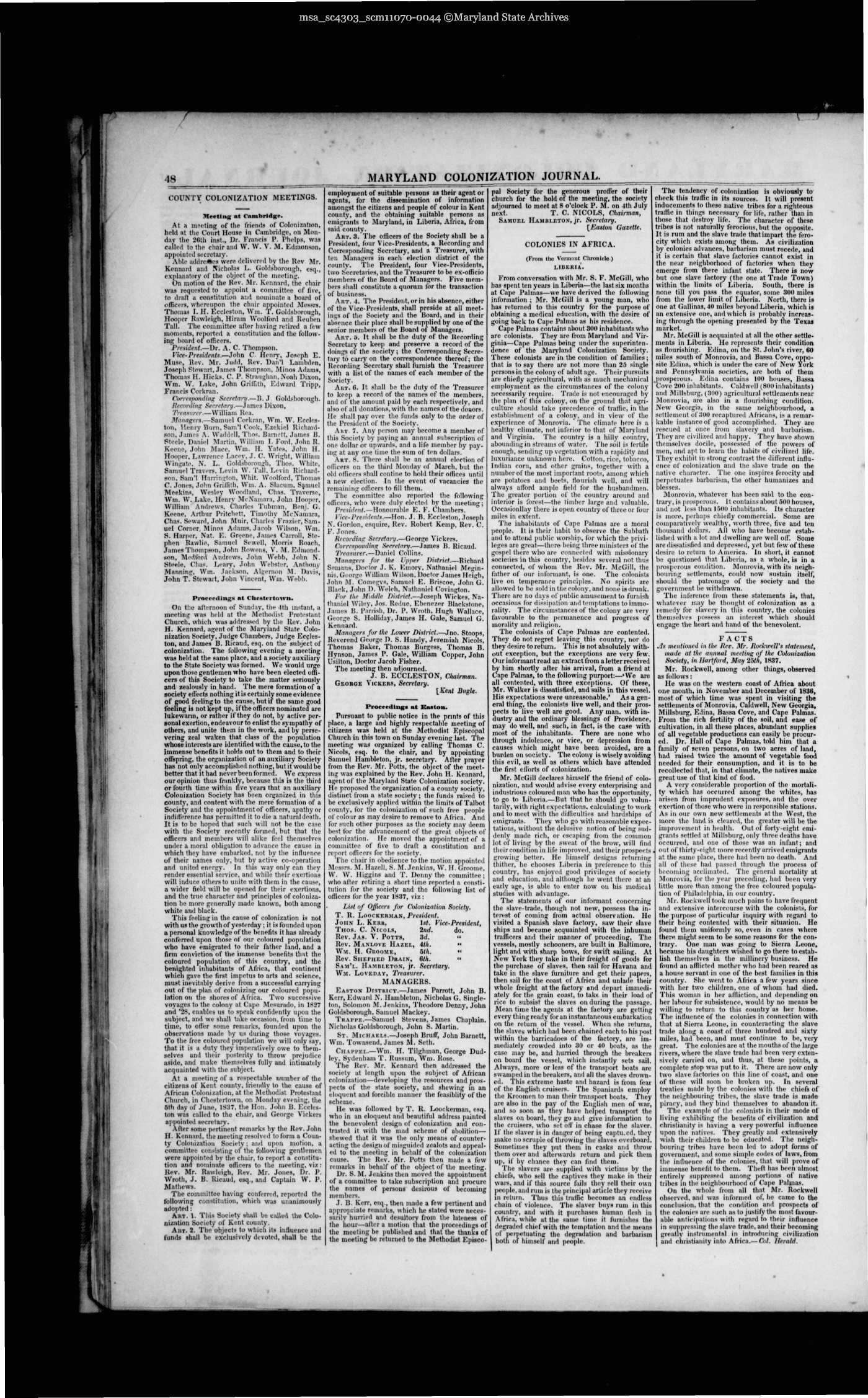
| 48 MARYLAND COLONIZATION JOURNAL. COUNTY COLONIZATION MEETINGS. Meeting at Cambridge. At a meeting of the friends of Colonization, held at the Court House in Cambridge, on Mon- day the Mb inst.. Dr. Francis P. Phelps, was called to the chair and W. W. V. M. Edmonson, appointed secretary. Alt.' addresles were delivered by the Rev Mr. Kennard and Nicholas L. Goldsborough, esq., explanatory of the object of the meeting. On motion of the Rev. Mr. Kennard, the chair was requested to appoint a committee of five, to draft a constitution and nominate a hoard of officers, whereupon the chair appointed Messrs. Thomas I. H. Eccleston, Win. T. Goldsboioiigli, Hooper Rawleigh, Hiram Woolford and Reuben Tall. The committee after taring retired a few moments, reported a constitution and the follow- ing board of officers. President.—Dr. A. C. Thompson. Vice-Presidents.—John C. Henry, Joseph E. Muse, Rev. Mr. Judd, Rev. Dan'l Lamhden, Josepli Stewart, James Thompson, Minos Adams, Thomas H. Hiclu, C. P. Straughan, Noah Dixon, Wm. W. Lake, John Griffith, Edward Tripp, Francis Corkran. Corresponding Secretary.—B. J Goldsborough. Recording Secretary—James Dixon, Treasurer—William Rea. Managers.—Samuel Corkran, Wm. W. Eccles- ton, Henry Burn. Sam'l Cook, Ezekiel Richard- son, Janus A. W.iddell, Thos. Harnett. James li. Steele. Dtnicl Martin, William I. Ford, John R. Keene, John Mace. Win. II. Yates, John H. Hooper, Lawrence Lacey, J. C. Wright, William Wingate, .V. L. Goldsborough, Tims. White, Samuel Travers. Levin W. Till, Levin Richard- son, Sam'l Harrington, Whit. Woolford, Thomas C. Jones, John Griffith, Wm. A. Slacuin. Samuel Meekins, Wesley Woodland, Chas. Tftrtfte, Win. W. Lake, Henry Mc.Vamara. John Hooper, William Andrew*, Charles Tubman, Bonj. G. Keene, Arthur l'ritchett, Timothy McN'amara, Chas. Seward, John Mnir, Charles Frazbr, Sam- uel Corner. Minns Adams, Jacob Wilson, Wm. S. Harper, Nat. E. Greene, James Carroll, Ste- phen Rawlie, Samuel Sewell, Morris Roach, James Thompson, John Rowens, V. M. Ediuond- son, Medlord Andrews. John Wehb, John N. Steele, Chas. Leary. John Webster, Anthony Manning. Wm. Jackson. Algernon M. Davis, John T. Stewart, Jolin Vincent, Win. Webb. Proceedings at Chestertown. On the afternoon of Sunday, the 4th instant, a meeting was held at the Methodist Protestant Church, which was addressed by the Rev. John H. Kennard, agent of the Maryland State Colo- nization Society, Judge Chambers, Judge Eccles- ton, and James B. Rieaud, esq. on the subject of colonization. The following evening a meeting was held at the same place, and a society auxiliary to the State Society was formed. We would urge upon those gentlemen who have been elected offi- cers of this Society to take the matter seriously and zealously in hand. The mere formation of a society elfects nothing it is certainly some evidence of good feeling to the cause, but if the same good feeling is not kept up, if the officers nominated are lukewarm, or rather if they do not, by active per- sonal exertion, endeavour to enlist the sympathy of others, and unite them in the work, and by perse- vering zeal waken that class of the population whose interests are identified with the cause,to the immense benefits it holds out to them and to their offspring, the organization of an auxiliary Society has not only accomplished nothing, but it would be better that it had never been formed. We express our opinion thus frankly, because this is the third or fourth time within five years that an auxiliary Colonization Society has been organized in this county, and content with the mere formation of a Society and the appointment of officers, apathy or indifference has permitted it to die a natural death. It is to be hoped that such will not he the eat* with the Society recently formed, hut that the officers and members will alike feel themselves under a moral obligation to advance the cause in which they have embarked, not by the influence of their names only, but by active co-operation and united energy. In this way only can they render essential service, and while their exertions will induce others to unite with them in the cause, a wider field will be opened for their exertions, and the true character ami ]>rinciples of coloniza- tion be more generally made known, both among white and black. This feeling in the cause of colonization is not with us the growth of yesterday ; it is founded upon a personal knowledge of the benefits it has already conferred upon those of our coloured population who have emigrated to their father land, and a firm conviction of the immense benefits that the coloured population of this country, and the benighted inhabitants of Africa, that continent which gave the first impetus to arts and science, must inevitably derive from a successful carrying out of the plan of colonizing our coloured popu- lation on tne shores of Africa. Two successive voyages to the colony at Cape Mesurado, in 1S27 and '2S, enables us to speak confidently upon the subject, and we shall take occasion, from time to time, to offer some remarks, founded upon the observations made by us during those voyages. To the free coloured population we will only say, that it is a duty they imperatively owe to them- selves and their posterity to throw prejudice aside, and make themselves fully and intimately acquainted with the subject. At a meeting of a respectable number of the citizens of Kent county, friendly to the cause of African Colonization, at the Methodist Protestant Church, in Chestertown, on Monday evening, the 5th day of June, 1837, the Hon. John B. Eceli |. ton was called to the chair, and George Vickers appointed secretary. After some pertinent remarks by the Rev. John II. Kennard, tiie (Meting resolfi d to lorm a Coun- ty Colonization Society; and upon motion, a committee consisting of the following gentlemen were appointed by the chair, to report a constitu- tion and nominate officers to the meeting, vis I Rev. Mr. Rawleigh, Rev. Mr. Jones, Dr. P. Wroth, J. B. Rieaud, esq., and Captain W. P. Mathews. The committee having conferred, reported the following constitution, which was unanimously adopted: Art. 1. This Society shall be c;dled the Colo- nization Society of Kent county. Art. 2. The objects to which its influence and funds shall be exclusively devoted, shall be the employment of suitable persons as their agent or agents, for the dissemination of information amongst the citizens and people of colour in Kent county, and the obtaining suitable persons as (migrants to Maryland, in Liberia, Africa, from said county. Art. 3. The officers of the Society shall be a President, four Vice-Presidents, a Recording and Corresponding Secretary, and a Treasurer, with ten Managers in each election district of the rounty. The President, four Vice-Presidents, two Secretaries, and the Treasurer to be ex-officio members of the Board of Managers. Five mem- bers shall constitute a quorum for the transaction of business. Art. 4. The President, or in his absence, either of the Vice-Presidents, shall preside at all meet- ings of the Society and the Board, and in their absence their place shall be supplied by one of the senior members of the Board of Managers. Art. 5. It shall be the duty of the Recording Secretary to keep and preserve a record of the doings of the society; the Corresponding Secre- tary to carry on the correspondence thereof; the Recording Secretary shall furnish the Treasurer with a list of the names of each member of the Society. Art. 6. It shall be the duty of the Treasurer to keep a record of the names of the members, and of the amount paid by each respectively, and also of all donations.with the names of (he donors. He shall pay over the funds only to the order of the President of the Society. Ai.r 7. Any person may become a member of this Society by paying an annual subscription of one dollar or upwards, and a life member by pay- ing at any one time the sum of ten dollars. Art. 8. There shall be an annual election of officers on the third Monday of March, but the old officers shall contine to hold their offices until a new election. In the event of vacancies the remaining officers fo fill them. The committee also reported the following officers, who were duly elected by the meeting; President.— Honourable E. F. Chambers. Vice-Presidcnts.—Hon. J. B. Eccleston, Joseph K. Gordon, esquire, Rev. Robert Kemp, Rev. C. F. Jones. Recording Secretary.—George Vickers. Corresponding Secretary.—James B. Rieaud. Treasurer.—Daniel Collins. Managers for the Upper District.—Richard Si'iu ins. Doctor J. K. Emory. Nathaniel Mcgin- DiS,George William Wilson, Doctor James Heigh, John M. Comogvs, Samuel E. Briscoe, John G. Black, John D. Welch, Nathaniel Covington. For the Middle District. Joseph Wicket, Na- thaniel Wiley, Jos. Redue. F.benezer Blaekstone. James B. Pirrish, Dr. P. Wroth. Hugh Wallace, George S. Holltday, James H. Gale, Samuel G. Kennard. Managers for the Lower District.—Jno. Stoops, Reverend George D. S. Handy, Jeremiah Nicols, Thomas Baker, Thomas Burgess, Thomas B. Hynson, James P. Gale, William Copper, John Usilton, Doctor Jacob Fisher. The meeting then adjourned. J. B. ECCLESTON, Chairman. George Vickers, Secretary. [Kent Bugle. Proceedings at Easton. Pursuant to public notice in the prints of this place, a large and highly respectable meeting of citizens was held at the Methodist Episcopal Church in this town on Sunday evening last. The meeting was organized by calling Thomas C. Nicols, esq. to the chair, and by appointing Samuel Hambleton, jr. secretary. After prayer from the Rev. Mr. Potts, the object of the meet- ing was explained by the Rev. John H. Kennard, agent of the Maryland State Colonization society. He proposed the organization of a county society, distinct from a state society ; the fundi raised to be exclusively applied within the limits of Talbot county, for the colonization of such free people of colour as may desire to remove to Africa. And lor such other purposes as the society may deem best for the advancement of the great objects of colonization. He moved the appointment of a committee of five to draft a constitution and report officers for the society. The chair in obedience to the motion appointed Messrs. M. Hazell, S. M.Jenkins, W. H. Groome, W. W. Higgins and T. Denny the committee; who alter retiring a short time reported a consti- tution for the society and the following list of officers for the year 1837, viz: List of Officers for Colonization Society. T. R. Loockerman, President. John L. Kerr, 1st. Vicc-Presidtnt, Thos. C. Nicols, 2nd. do. Rev. Jas. V. Potts, 3d. " Rev. Manlove Hazel, 4th. " Wm. H. Croome, 5th. " Rev. Shepherd Drain, 6/A. " Sam'l. Hambleton, jr. Secretary. Wm. Lovedav, Treasurer. MANAGERS. Easton District.—James Parrott, John B. Kerr, Edward N. Hambleton, Nicholas G. Single- ton, Solomon M. Jenkins, Theodore Denny, John Goldsborough. Samuel Mackey. Trappe.—Samuel Stevens, James Chaplain. Nicholas Goldsborough, John S. Martin. St. Michaels.—Joseph Brulf, John Barnett, Wm. Townsend, James M. Seth. Chappf.l.—Win. H. Tilghman, George Dud- ley, Sydenham T. Russum, Wm. Rose. The Rev. Mr. Kennard then addressed the society at length upon the subject of African colonization—developing the resources and pros- pects of the state society, and shewing in an eloquent and forcible manner the feasiblity of the scheme. He was followed by T. R. Loockerman, esq. who in an eloquent and beautiful address painted the benevolent design of colonization and con- trasted it with the mad scheme of abolition— shewed that it was the only means of counter- acting the design of misguided zealots and appeal- ed to the meeting in behalf of the colonization cause. The Rev. Mr. Potts then made a few nmarks in behalf of the object of the meeting. Dr. S. M. Jenkins then moved the appointment of a committee to take subscription and procure the names of persons desirous of becoming members. J. B. Kerr, esq., then made a few pertinent and appropriate remarks, which he stated were neces- sarily hurried and desultory from the lateness of the hour—alter a motion that the proceedings of the meeting be published and that the thanks of the meeting be returned to the Methodist Episco- pal Society for the generous proffer of their church for the hold of the meeting, the society adjourned to meet at 8 o'clock P. M. on 4th July next. T. C NICOLS, Chairman, Samuel Hambleton, jr. Secretary. [Easton Gazette. COLONIES IN AFRICA. (From the Vermont Chronicle ) LIBERIA. From conversation with Mr. S. F. McGill, who has spent ten years in Liberia—the last six months at Cape I'almas—we have derived the following information ; Mr. McCiill is a young man, who has returned to this country for the purpose of obtaining a medical education, with the desire of going back to Cape I'almas as his residence. Cape I'almas contains about MO inhabitants who arc colonists. They are from Maryland and Vir- ginia—Cape Palmas being under the superinten- dence of the Maryland Colonization Society. These colonists are in the condition of families ; that is to say there are not more than 25 single persons in the colony of adult age. Their pursuits are ehielly agricultural, with as much mechanical employment as the circumstances of the colony necessarily require. Trade is not encouraged by the plan of this colony, on the ground that agri- culture should take precedence of traffic, in the establishment id' a colony, and in view of the experience of Monrovia. The climate here is a healthv climate, not inferior to that of Maryland and \ irginia. The country is a hilly country, abounding in streams of water. The soil is fertile enough, sending up vegetation with a rapidity and luxuriance unknown here. Cotton, rice, tobacco, Indian corn, and other grains, together with a number of the most important roots, among which are potatoes and beets, flourish well, and will always ali'ord ample field for the husbandmen. The greater portion of the country around and interior is forest—the timber large'and valuable. Occasionllay there is open country of three or lour miles in extent. The inhabitants of Cape I'almas are a moral people. 11 is their habit to observe the Sabbath and to attend public worship, for which the privi- leges are great—then being three minister.* of the gospel there who are connected with missionary societies in this country, besides several not thus connected, of whom the Rev. Mr. McGill, the father of our informant, is one. The colonists live on temperance principles. No spirits arc allowed to he sold in ttie colony, and none is drunk. There are no days of public amusement to furnish occasions for dissipation and temptations to immo- rality. The circumstances of the colony are very favourable to the permanence and progress of morality and religion. The colonists of Cape Palmas are contented. They do not regret leaving this country, nor do they desire to return. This is not absolutely with- out exception, but the exceptions are very few. Our informant read an extract from a letter received by him shortly after his arrival, from a friend at Cape Palmas, to the following purport:—'We are all contented, with three exceptions. Of these, Mr. Walker is dissatisfied, and sails in this vessel. His expectations were unreasonable.' As a gen- eral thing, the colonists live well, and their pros- pects to live well are good. Any man. with in- dustry and the ordinary blessings of Providence, may do well, and such, in fact, is the case with most of the inhabitants. There are none who through indolence, or vice, or depression from causes which might have been avoided, are a burden on society. The colony is wisely avoiding this evil, as well as others which have attended the first ellbrts of colonization. Mr. McGill declares himself the friend of colo- nization, and would advise every enterprising and industrious coloured man who has the opportunity, to go to Liberia.—But that he should go volun- tarily, with right expectations, calculating to work and to meet with the difficulties ami hardships of emigrants. They who go with reasonable expec- tations, without the delusive notion of being sud- denly made rich, or escaping from the common lot of living by the sweat of (be brow, will find their condition in life improved, and their prospects growing better. He himself designs returning thither, he chooses Liberia in preference to this country, has enjoyed good privileges of society and education, and although he went there at an early age, is able to enter now on his medical studies with advantage. The statements of our informant concerning the slave-trade, though not new, possess the in- terest of coining from actual observation. He visited a Spanish slave factory, saw their slave ships and became acquainted with the inhuman traificers ami their manner of proceeding. The vessels, mostly schooners, are built in Baltimore, light and with sharp bows, for swift sailing. At New York they take in their freight of goods for the purchase of slaves, then sail for Havana and take in the slave furniture and get their papers, then sail for the coast of Africa and unlade their whole freight at the factory and depart immedi- ately for the grain coast, to take in their load of rice to subsist the slaves on during the passage. Mean time the agents at the factory are getting every thing ready for an instantaneous embarkation on the return of the vessel. When she returns, the slaves which had been chained each to his post within the barricadoes of the factory, are im- mediately crowded into 30 or 40 boats, as the case may be, and hurried through the breakers on board the vessel, which instantly sets sail. Always, more or less of the transport boats arc swamped in the breakers, and all the slaves drown- ed. This extreme haste and hazard is from fear of the English cruisers. The Spaniards employ the Kroomen to man their transport boats. They are also in the pay of the English men of war, and so soon as they have helped transport the slaves on board, they go and give information to the cruisers, who set oil in chase for the slaver. If the slaver is in danger of being eaptu.cd. they make no scruple of throwing the slaves overboard. Sometimes they put them in casks and throw them over and afterwards return and pick them up, if by chance they can find them. The slavers are supplied with victims by the chiefs, who sell the captives they make in their wins, and if this source fails they sell their own people, and ruin is the principal article they receive in return. Thus this traffic becomes an endless chain of violence. The slaver buys rum in this country, and with it purchases human flesh in Africa, while at the same time it furnishes the degraded chief with the temptation and the means I of piipetuating the degradation and barbarism both of himself and people. The tendency of colonization is obviously to check this traffic in its sources. It will present inducements to these native tribes for a righteous traffic in things necessary for life, rather than in those that destroy life. The character of these tribes is not naturally ferocious, but the opposite. It is rum and the slave trade that impart the fero- city which exists among them. As civilization by colonies advances, barbarism must recede, and it is certain that slave factories cannot exist in the near neighborhood of factories when they emerge from there infant state. There is now but one slave factory (the one at Trade Town) within the limits of Liberia. South, there is none till you pass the equator, some 300 miles from the lower limit of Liberia. North, there is one at Gallinas, 40 miles beyond Liberia, which is an extensive one, and which is probably increas- ing through the opening presented by the Texas market. Mr. McGill is acquainted at all the other settle- ments in Liberia. He represents their condition as flourishing. Edina, on the St. John's river, 60 miles south of Monrovia, and Bassa Cove, oppo- site Edina, which is under the care of New York and Pennsylvania societies, are both of them prosperous. Edina contains 100 bouses, Bassa Cove 200 inhabitants. Caldwell (800 inhabitants) and Millsbiirg, (300) agricultural settlements near Monrovia, are also in a flourishing condition. New Georgia, in the same neighbourhood, a settlement of 300 recaptured Africans, is a remar- kable instance of good accomplished. They are ivsciiod at once from slavery and barbarism. They are civilized and happy. They have shown themselves docile, possessed of the powers of men, and apt to learn the habits of civilized life. They exhibit in strong contrast the different influ- ence of colonization anil the slave trade on the native character. The one inspires ferocity and perpetuates barbarism, the other humanizes and MtJtttl. Monrovia, whatever has been said to the con- trary, is prosperous. It contains about 500 houses, and not lets than 1500 inhabitants. Its character is more, perbt.pt chiefly commercial. Some are comparatively wealthy, worth three, five and ten thousand dollars. All who have become estab- lished with a lot and dwelling are well oil'. Some are dissatisfied and depressed, yet but few of these desire to return to America. In short, it cannot be questioned that Liberia, as a whole, is in a prosperous condition. Monrovia, with its neigh- hoiiring settlements, could now sustain itself, should the patronage of the society and the government be withdrawn. The inference from these statements is, that, whatever may be thought of colonization as a lemedy for slavery in this country, the colonies themselves possess an interest which should engage the heart and hand of the benevolent. F A C T S As mentioned in the Rev. Mr.Rockwell's statement, made at the annual meeting of the Colonization Society, in Hartford, May 25th, 1837. Mr. Rockwell, among other things, observed as follows: He was on the western coast of Africa about one month, in November and December of 1836, most of which time was spent in visiting the settlements of Monrovia, Caldwell, New Georgia, Millsbiirg, Edina, Bassa Cove, and Cape Palmas. F'rom the rich fertility of the soil, and ease of cultivation, in all these places, abundant supplies of all vegetable productions can easily be procur- ed. Dr. Hall of Cape Palmas, told him that a family of seven persons, on two acres of land, had raised twice the amount of vegetable food needed for their consumption, and it is to be recollected that, in that climate, the natives make great use of that kind of food. A very considerable proportion of the mortali- ty which has occurred among the whites, has arisen from imprudent exposures, and the over exertion of those who were in responsible stations. As in our own new settlements at the West, the more the land is cleared, the greater will be the improvement in health. Out of forty-eight emi- grants settled at Millsbiirg, only three deaths have occurred, and one of those was an infant; and out of thirty-eight more recently arrived emigrants at the same place, there had been no death. And all of these bad passed through the process of becoming acclimated. The general mortality at Monrovia, for the year preceding, had been very little more than among the free coloured popula- tion of Philadelphia, in our country. Mr. Rockwell took much pains to have frequent and extensive intercourse with the colonists, for the purpose of particular inquiry with regard to their being contented with their situation. He found them uniformly so, even in cases where there might seem to be some reasons for the con- trary. One man was going to Sierra Leone, because bis daughters wished to go there to estab- lish themselves in tbp millinery business. He found an afflicted mother who had been reared as a house servant in one of the best families in this country. She went to Africa a few years since with her two children, one of whom had died. This woman in her affliction, and depending on her labour for subsistence, would by no means be willing to return to this country as her home. The influence of the colonies in connection with that at Sierra Leone, in counteracting the slave trade along a coast of three hundred and sixty miles, had been, and must continue to be, very great. The colonies are at the mouths of the large rivers, w here the slave trade had been very exten- sively carried on, and thus, at these points, a complete stop was put to it. There are now only two slave factories on this line of coast, and one of these will soon be broken up. In several treaties made by the colonies with the chiefs of the neighbouring tribes, the slave trade is made piracy, and they bind themselves to abandon it. The example of the colonists in their mode ol living exhibiting the benefits of civilization and Christianity is having a very powerful influence upon the natives. They greatly and extensively wish their children to be educated. The neigh- bouring tribes have been led to adopt forms of government, and some simple codes of laws, from the influence of the colonies, that will prove of immense benefit to them. Theft has been almost entirely suppressed among portions of native fiibes in the neighbourhood of Cape Palmas. On the whole from all that Mr. Rockwell observed, and was informed of, he came to the conclusion, that the condition and prospects of the colonies are such as to justify the most favour- able anticipations with regard to their influence in suppn s-ing the slave trade, and their becoming greatly instrumental in introducing civilization and Christianity into Africa.— Col. Herald. |