 |
|
|
 |
|
 |
|
|||
|
||||
|
||||
|
Maryland State Archives Maryland Colonization Journal Collection MSA SC 4303 msa_sc4303_scm11070-0047 Enlarge and print image (4M) |
|
|
|
|
|
|
|
|||
|
||||
|
||||
|
Maryland State Archives Maryland Colonization Journal Collection MSA SC 4303 msa_sc4303_scm11070-0047 Enlarge and print image (4M) |
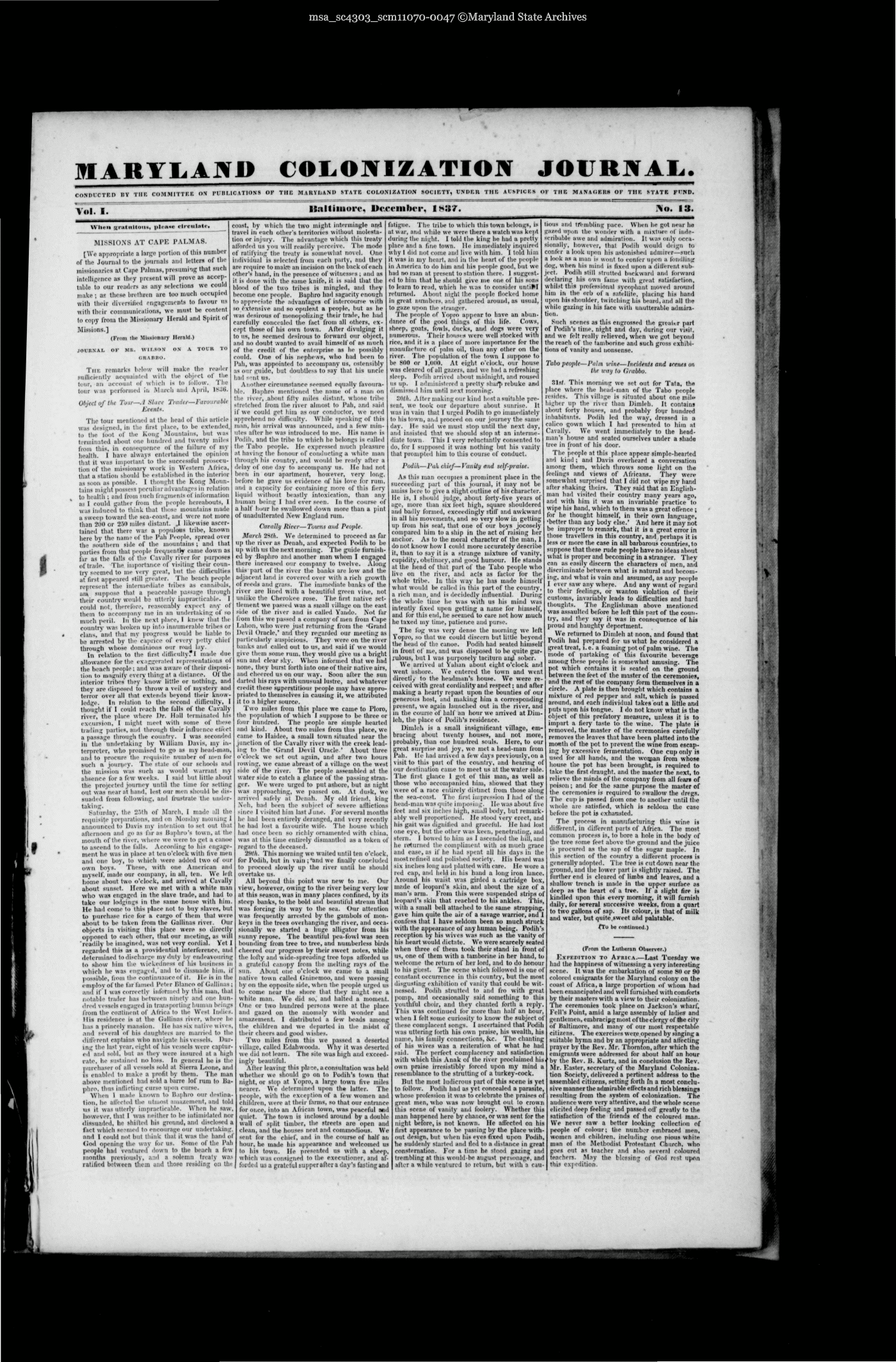
| MARYLAND COLONIZATION JOURNAL. CONDUCTED BY THE COMMITTEE ON PUBLICATIONS OF THE MARYLAND STATE COLONIZATION SOC1ETV, UNDER THE AUSPICES OF THE MANAGERS OF THE STATE FUND. Vol. 1. Baltimore. December, 1837. No. 13. When gratuitous please circulate. MISSIONS AT CAPE PALMAS. [We appropriate a large portion of this number of the Journal to the journals and letters of the missionaries at Cape Palmas, presuming that such intelligence as they present will prove as accep- table to our readers as any selections wc could make ; as these brethren are too much occupied with their diversified engagements to favour us with their communications, wc must be content to eepy from the Missionary Herald and Spirit of Missions.] (From the Missonary Herald.) The remarks below will make the reader sufficiently acquainted with the object of the tour, an account of which is to follow. The tour was performed in March and April, 1836. Object of the Tour—A Slave Trader—Favourable Events. The tour mentioned at the head of this article wu designed, in tba Brat placa, to ba extended, to the loot of the Ka«g Mountains, but was terminated about one hundred and twenty milea from this, in eonaeqaeoc* of the failure of nj health. I have always entertained the opinion that it was Important to tha successful prosecu- tion of the missionary work in WaataTB Africa, that a station should be estahlished in the Interior aj toon h poaaible, I thought the Kong Moun- tain! might poaaaai peculiar advantage! in relation to health; and from Mich Dragmenta of information a.- 1 could gather from the people hereabouts, 1 was induced to think that thus ¦ mountains made a sweep toward the sca-roa-t. and wara not more than 2(10 or MO miles distant. J likewise ascer- tained that there was a populous trihe, known here by the nam I of the l'ah People, spread over the eoathern side of the mountains; and that partial from that people frequently came down as i';ir as the falls of tin1 Cavally river for purposes of trade. The Importance of raiting their eoun- try seemed to BM very peat, bol the difficulties at first appeared still plater. The beach people represent the intermediate tribes as cannibals, em suppose that a peaceable passage through their country would be utterly Impracticable. I could ii"'. therefore, reaaonably expect any ol them to accompany me in an undertaking of so much peril. In the next place, I knew lh.it tin country was broken up Into innumerable tril.es or elans, and that my pmgiass would be liable to be aueetsd by Ihe caprice of every petty chief through whose dominions our road lay. In relation to the first difficulty71 made due allowance for the exaggerated representations of the beach people; and was aware of their disposi- tion to magnify every thing at a distance. Ot the interior tribes they know little or iiothitisr, and they are disposed to throw a veil of Bysterj and terror over all that extends beyond their know- ledge. In relation to the second difficulty, I thought if I could reach the falls of the I'avally river, the place where Dr. Hall terminated his excursion, I might meet with some of these trading parties, and through their influence affi el a passaga through the country. I was seconded iii the undertaking by William Davis, my in- terpreter, who promised to go as my head-man, and to procure the requisite number of men for such a journey. The state of our school- and the mission was such us would warrant my absence for a few weeks. I said but little about the projected journey until the time lor setting out was near at hand, lest our men should be dis- suadi d from following, and frustrate the under- taking. Saturday, the 25th of March. I made all the requisite preparations, and on Monday morning 1 announced to Davis my Intention to set out that afternoon and go as far as Baphro'a town, at the mouth of the river where we were to get a canoe to ascend to the falls. According to his engage- ment he was iii place at ten o'clock with five men and one boy, to which were added two of our own boys These, with one American and myself, mads our company, in all, ten. We hit home about two o'clock, and arrived at Cavally about sunset. Here we met with a white man who was engaged in the slave trade, and had to take our lodgings in the same bouse with him. He had come to this place not to buy slaves, but to purchase rice for a cargo of them that wire about to be taken from the Uallinas river. Our objects in visiting this place were so directly opposeil to each other, that our meeting, as will readily be Imagined, was not very cordial. Yet 1 regarded this as a providential interference, and determined to discharge my duty by endeavouring to show him the wickedness of his business in which he was engaged,'and to dissuade him. if passible, from the continuance of it. He is in the employ of the far famed Peter Blanco ofGallinas; and it' 1 was correctly Informed by this man, that notable trader has between ninety and one hun- dred vessel! engaged in transporting human beings from the continent of Africa to the West Indies. His residence is at the Gallinas river, where he lias a princely mansion, lie has six native wlvi S, .mil several of his daughters are married to the different captains who navigate his vessels. Dar- ing the la-t year, eight of his vessels wire captur- ed and sold, but as they were insured at a high rate, he sustained no loss. In general he is DM purchaser of all vessels -old at Sierra Leone, and is enabled to make a profit by them. The man above m. ationed bad sold a birN lof runi to Ba- phro. thus Inflicting curse upon eur-e. When I made known to Baphro our destina- tion, he affected the utmost amazement, sad told ns it was utterly Impracticable. When ha saw. however, that 1 was neither to be intimidated nor dissuaded, he shifted his ground, ami disclosed a fact which is imi .I to encouragea our undertaking and I could not but think that it was the hand of God opening the way for us. Some of the Pah people had ventured down to the beach a few months previously, and a solemn treaty was ratified between them and those residing on tin coast, liy which the two might intermingle anil travel in each other's territories without mob-sta- tion or injury. The advantage which this treaty afforded us you will nnlllf perceive. The mode of ratifying the treaty I* somewhat mml. One individual is selected from each party, anil they are require to inak"f an incision on the hack of each other's hand, in the presence of witnesses ; and as it i* d"iie with the same knife, it is said that the blood of the two tribes is mingled, and they become one people, liaphro bad sagacity enough to appreciate the advantages of intercnur-o uilh so extensive and so opulent a people, hut as be m de-irous id' monopolizing tiltir trade, be had carefully concealed the fact from all others, ex- cept those of bis own town. After divulging it to us, he seemed desirous to forward our object, anil no doubt wanted to avail himself of as much of the credit of the enterprise as be pouibrj could. One of bis nephews, who bad been to I'ah, was appointed to accompany us, ostensibly as our guide, but doubtless to say that bis uncle had tumt lis. Another circumstance spenied equally favoura- ble. Kaphm mentioned the name of a man on the river, about littv miles distant, whose tribe Wretched from the river almost to I'ah, and said if we could get him as our conductor, we need apprehend no dillic ulty. While speaking of this man, his arrival was announced, and a few miii- lltM alter he was introduced to me. His name is I'odih, and the tribe to which he belongs is called the Tabo people. He expressed much pleasure at having the honour of conducting a white man through bis country, and would he ready after a del iv of one day to accompany ns. He had not been in our apartment, however, very long, before he gave us evidence of his love for ruin, and a capacity tor containing more of this fiery liquid without beastly intoxication, than any human being I bad ever seen. In the course of a hall hour he swallowed down more than a pint of unadulterated New England rum. Cavally River—Towns and People. March 28th. We determined to proceed as far up the river as Denah, and expected I'odih to be up with us Ihenext morning. The guide furnish- ed by Haphro and another man whom I engaged there increased OUT company to twelve. Along this part of the river the banks are low and the adjacent land is covered over with a rich growth of reeds and grass. The immediate banks of the river are lined with a beautiful green vine, not unlike the Cherokee rose. The first native set- tlement we pas-cd was a small village on the east side of the river and is called Yando. Not far l.om this we passed a company of men from Cape Lahon who were just returning from the 'Grand Devil Oracle,' and they regarded our meeting as particularly auspicious. They were on the river hanks and called out to us, and said if we would give thein some rum. they would give us a bright sun and clear sky. When informed that we had none, they burst forth into one of their native airs, and cheered us on our way. Soon after the sun darted bis rays with unusual bistre, and whatever credit these superstitious peojile may have appro- priated to themselves in causing it, we attributed it to a higher source. Two miles from this place we came to I'loro, the population of which I suppose to be three or four hundred. The people are simple hearted and kind. About two miles from this place, we came to Haidee, a small town situated near the junction of the Cavally river with the creek lead- ing to the 'Grand Uevil Oracle ' About three o'clock we set out again, and alter two hours rowing, we came abreast of a village on the west side of the river. The people MtMkM at the water side to catch a glance of the passing stran- gi r. U'e were urged to put ashore, but as night was approaching, we passed on. At dusk, we arrive.! safely at Denah. My old friend, king Neb, bail been the subject of severe affliction! since I visited him last June. For several months lie bad been entirely deranged, and very recently he had lost a favourite wile. The bouse which had once been so richly ornamented with china, was at this tune entirely dismantled as a token of regard to the deceased. 29th This morning we wailed until ten o'clock, for Podih, but in vain;'and we IIihIIt rnnrlnrlrrl to proceed slowly up tlie river until lie should overtake us. All beyond this point was new to inc. Our view, however, owing to the river being very low at this season, was in many places confined, by its steep banks, to the bold and beautiful stream that was forcing its way to the sea. Our attention was frequently arrested by the gambols of uion- l.i \s in the trees oveihanging the ri\cr, and occa- sionally we started a huge alligator from his sunny repose. The beautiful peafowl was seen bounding from tree to tree, and numberless birds cheered our progress by their sweet notes, while the lofty and wide-spreading tree tops arlbrded us a grateful canopy from the melting rays of the sun. About one o'clock we came to a small native town called Gninemoo, and were passing by on the opposite side, when the |.....pie urged us to come near the shore that they might see a white man. We did so, and halted a moment. One or two hundred pntOM wire at the place and gazed on the anomaly with wonder and .inia/emeiit. I distributed I few heads among the children and we departed in the n.i.iM ,,| their cheers and good wishes. Two miles from this we passed a deserted village, called Kdahwooda. Whv it was deserted we did not learn. The site was high and exceed- ingly beautiful. Alter leaving this pbee, aconsultation was held whither we should go on to l'odih's town that night, or stop at Yopro, a large town live miles nearer. We determined upon the latter. The people, with the exception of a few women and children, were at their farms, so that our entrance for once, into an African town, was peaceful and quiet. The town is inclosed around by a double wall of split timber, the streets are open and elean. and the houses neat and commodious. We sent for the chief, and in the course of half an hour, he made his appearance and welcomed us to his town. He presented us with a sheep, which was consigned to the executioner, and af- forded us a grateful supper after a day's fasting and fatigue. Th" tribe to which this town belongs, is at war, and while we were there a watch was kept during the night. I told the king he had a pretty pact and a due town. He immediately inquired why I did not come and live with him. I told him it was in my heart, and in the heart of the people in America to do him and his people good, but we had no man at present to station there. 1 suggest- ed to him that he should give me one of his sons to learn to read, which he was to consider initial returned. About night the people flocked home in great intinbi is. ai.d gathered around, as usual, to gaze upon the stranger. The people of Yopro appear to have an abun- dance of the good things of this life. Cows, sheep, goats, fowls, ducks, and dogs were very numerous. Their lions, s were well stocked with rice, and it is a place of more importance for the manufacture of palm oil. than any other on the river. The population of the town I suppose to be WO or I.linn. At eight o'clock, our house was cleared of all ga/.ets, and we bad a refreshing sleep. Podih arrived about midnight, and roused us up. I administered a pretty ihaA rebuke and dismiss, ,| him until next morning. ::o//i. Altermakingour kind Inst a suitable pre- sent, we took our departure about sunrise. It was in vain that 1 urged Podih to go immediately to his town, and proceed on our journey the BBna day. He said we must stop until the next day, and insisted that we should stop at an interme- diate town This I very reluctantly consented to do, for 1 luppntd it was nothing hut his vanity that prompted him to this course of conduct. Podih—Pah chief— Vanity and self-praise. As this man occupies a prominent place in the succeeding part of this journal, it may not be amiss lure to give a slight outline of his character. He is, I should judge, about forty-five years of age, more than six feet high, square shouldered and badly formed, exceedingly stiff' and awkward in all his movements, and so very slow in getting up from his seat, that one of our boys jocosely compared him to a ship in the act of raising her anchor. As to the moral character of the man, 1 do not know how I could more iccurately describe it, than to say it is a strange mixture of vanity, cupidity, obstinacy, and good humour. He stanils at the bead of that part of the Tabo people who live on the river, and acts as factor for the whole tribe. In this way he has made himself what would be called in this part of the country, a rich man, and is decidedly inllucntial. During the whole time he was with us his mind was intently fixed upon getting a name for himself, and for this end, he seemed to care not how much he taxed iny time, patience and purse. The log was very dense the morning we left Yopro, so that we could discern but little beyond tin' bead of the canoe. Podih had seated himself in front of me, and was disposed to be quite gar- rulous, but I was purposely taciturn and sober. We arrived at Vidian about eight o'clock and went •shore. We entered the town and went directly to the headman's house. We were re- ceived with great cordiality and respect; and after making a hearty repast upon the bounties of our generous host, and making him a corresponding present, we again launched out in the river, and in the course of half an hour we arrived at Dim- leh, the place of Podih's residence. Dinileh is a small insignificant village, em- bracing about twenty houses, and not more, probably, than one hundred souls. Here, to our great surprise and joy, we met a head-man from Pah. He had arrivctl a few days previously,on a visit to this part of the country, and hearing of our destination came to meet us at the water siile. The fust glance 1 got of this man, as well as those who accompanied him, showed that they were of a race entirely distinct from those along the sea-coast. The first impression I had of the head-in.in was quite imposing. He was about five feet and six inches high, small body, but remark- ably well proportioned. He stood very erect, and his gait was dignified and graceful. He had lost one eye, but the other was k,., ,f. penetrating, and stern. I bowed to him as 1 ascended the hill,and he returned the compliment with as much grace and ease, as il be had spent all his days in the most refined and polished society. His beard was six inches long and plaited w ith care. He wore a red cap, and held in his hand a long iron lance. Around his waist was girded a cartridge box, made of leopard's skin, and about the size of a man's arm. from this were suspended strips of leopard's skin that reached to his ankles. This, with a small bell attached to the same strapping, gave him quite the air of a savage warrior, and 1 confess that I have seldom been so much struck bout and trembling pace. When he got near he gazed upon the wonder with a mixture of inde- scribable awe ami admiration. It was only occa- sionally, however, thai Podih would deign to confer a look upon bis astonished admirer—such a look as a man la wont to colder upon a fondling dog, when his mind is fixed upon a different sub- ject. Podih still strutted backward and forward declaring his own fame with great satisfaction, whilst this professional sycophant moved around him in the orb of a satellite, placing his hand upon his shoulder, twitching his beard, and all the while gazing in his face with unutterable admira- tion. Such scenes as this engrossed the ansae* part of Podih's time, night and day, during our visit, and we felt really relieved, wfien we got beyond the reach of the iainborine and such gross exhibi- tions of vanity and nonsense. with the appearance of any human being. Podih's reception by his wives was such as the vanity of his heart would dictate. We were scarcely seated when three of them took their stand in front of us, one of them with a tamborine in her hand, to welcome the return of her lord, and to do honour to his guest. Tlie scene which followed is one of constant occurrence in this country, but the most disgusting exhibition of vanity that could be wit- nessed. Podih strutted to and fro with great pomp, and occasionally said something to this youthful choir, and they chanted forth a reply. This was continued for more than half an hour, when 1 felt some curiosity to know the subject of that* complacent songs. I ascertained that Podih was uttering forth his own praise, his wealth, his nana, his family connections, &c. The chanting of his wives was a reiteration of what he had said. The attract complacency and satisfaction with which this Anak ol the river proclaimed his own praise irresistibly (breed upon my mind a n ii uiblance to the strutting of a turkey-cock. But the most ludicrous part of this scene is yet to follow. Podih had as yet concealed a parasite, whose profession it was to celebrate the praises a* great men, who was now brought out Io crown this scene of vanity and foolery. Whether this man happened here by chance, or was sent for the night before, is not known. He affected on his fust appearance to be passing by the place with- out design, but when bis eyes fixed upon Podih, be suddenly started and lied to a distance in great consternation. For a time he stood gazing and trembling at this would he august personage, and after a while ventured to return, but w ith a rjii- Tabo people—Palm wine—Incidents and scenes on the way to Grabbo. 31st. This morning we set out for Tata, the place where Ihe head-man of the Tabo people resides. This village is situated about one mil* higher up the river than Dimleh. It contain! about forty houses, and probably four hundred inhabitants. Podih led the way, dressed in a calico gown which I hail presented to him at Cavalry, We went immediately to the head- man's house and seated ourselves under a shade tree in front of his door. The people at this place appear simple-hearted and kind ; and Davis overheard a conversation among them, which throws some light on the feelings and views of Africans. They were somewhat surprised that I did not wipe my hand after shaking theirs. They said that an English- man had visited their country many years ago, and with him it was an invariable practice to wipe his hand, which to them was a great offence ; for he thought himself, in their own language, 'better than any body else.' And here it may not be improper to remark, that it is a great error in those travellers in this country, and perhaps it is less or more the case in all barbarous countries, to suppose that these rude people have no ideas about what is proper and becoming in a stranger. They can as easily discern the characters of men, and discriminate between what is natural and becom- ing, and what is vain and assumed, as any people I ever saw any where. And any want of regard to their feelings, or wanton violation of their customs, invariably leads to difficulties and hard thoughts. The Englishman above mentioned was assaulted before he left this part of the coun- try, and they say it was in consequence of his proud and haughty deportment. We returned to Dimleh at noon, and found that Podih had prepared for us what fie considered a great treat, i.e. a foaming pot of palm wine. The mode of partaking of this favourite beverage among these people is somewhat amusing. The pot which contains it is seated on the ground between the feet of the master of the ceremonies, and the rest of the company form themselves in a circle. A plate is then brought which contains a mixture of red pepper and salt, which is passed around, and each individual takes out a little and puts upon his tongue. I do not know what is the object of this prefatory measure, unless it is to impart a fiery taste to the wine. The plate is removed, the master of the ceremonies carefully removes the leaves that have been platted into the month of the pot to prevent the wine from escap- ing by excessive fermentation. One cup only is used for all hands, and the woman from whose house tiie pot has been brought, is required to take the first draught, and the master the next, to relieve the minds of the company from all fear* of poison ; and for the same purpose the master of the ceremonies is required to swallow the dregs. The cup is passed from one to another until the wliile are satisfied, which is seldom the case belore Ihe pot is exhausted. The process in manufacturing this wine is different, in different parts of Africa. The most common process is, to bore a hole in the body of the tree some feet above the ground and the juice is procured as the sap of the sugar maple. In this section of the country a different process is generally adopted. The tree is cut down near the ground, and the lower part is slightly raised. The further end is cleared of limbs and leaves, and a shallow trench is made in the upper surface as deep as the heart of a tree. If a slight fire is kindled upon this every morning, it will furnish daily, for several successive weeks, from a quart to two gallons of sap. Its colour, is that of milk and water, but quite,sweet and palatable. {To be continued.) (From the Lutheran Observer.) Expedition to Africa.—Last Tuesday we had the happiness of witnessing a very interesting scene. It was the embarkation of some 80 or 90 colored emigrants for the Maryland colony on the coast of Africa, a large proportion of whom had been emancipated and well furnished with comforts by their masters with a view to their colonization. The ceremonies took place on Jackson's wharf, Fell's Point, amid a large assembly of ladies and gentlemen, embracing most of the clergy of tbe city of Baltimore, and many of our most respectable citizens. The exercises were opened by singing a suitable hymn and by an appropriate and allecting prayer by the Rev. Mr. Thornton, alter which the emigrants were addressed for about half an hour by the Rev. B. Kurtz, and in conclusion the Rev. Mr. Easter, secretary of the Maiyland Coloniza- tion Society, delivered a pertinent address to the assembled citizens, setting forth fn a most conclu- sive manner the admirable effects and rich blessings resulting from the system of colonization. The audience were very attentive, and the whole scene elicited deep feeling and passed oil' greatly to the satisfaction of the friends of the coloure'd man. We never saw a better looking collection of people of colour; the number embraced men, women and children, including one pious white man of Ihe Methodist Protestant Church, who goes out as teacher and also several coloured Teachers. May the blessing of God rest upon this expedition. JOURNAL OF MR. WILSON ON A TOUR TO GRABBO. |