 |
|
|
 |
|
 |
|
|||
|
||||
|
||||
|
Maryland State Archives Maryland Colonization Journal Collection MSA SC 4303 msa_sc4303_scm11070-0046 Enlarge and print image (5M) |
|
|
|
|
|
|
|
|||
|
||||
|
||||
|
Maryland State Archives Maryland Colonization Journal Collection MSA SC 4303 msa_sc4303_scm11070-0046 Enlarge and print image (5M) |
|
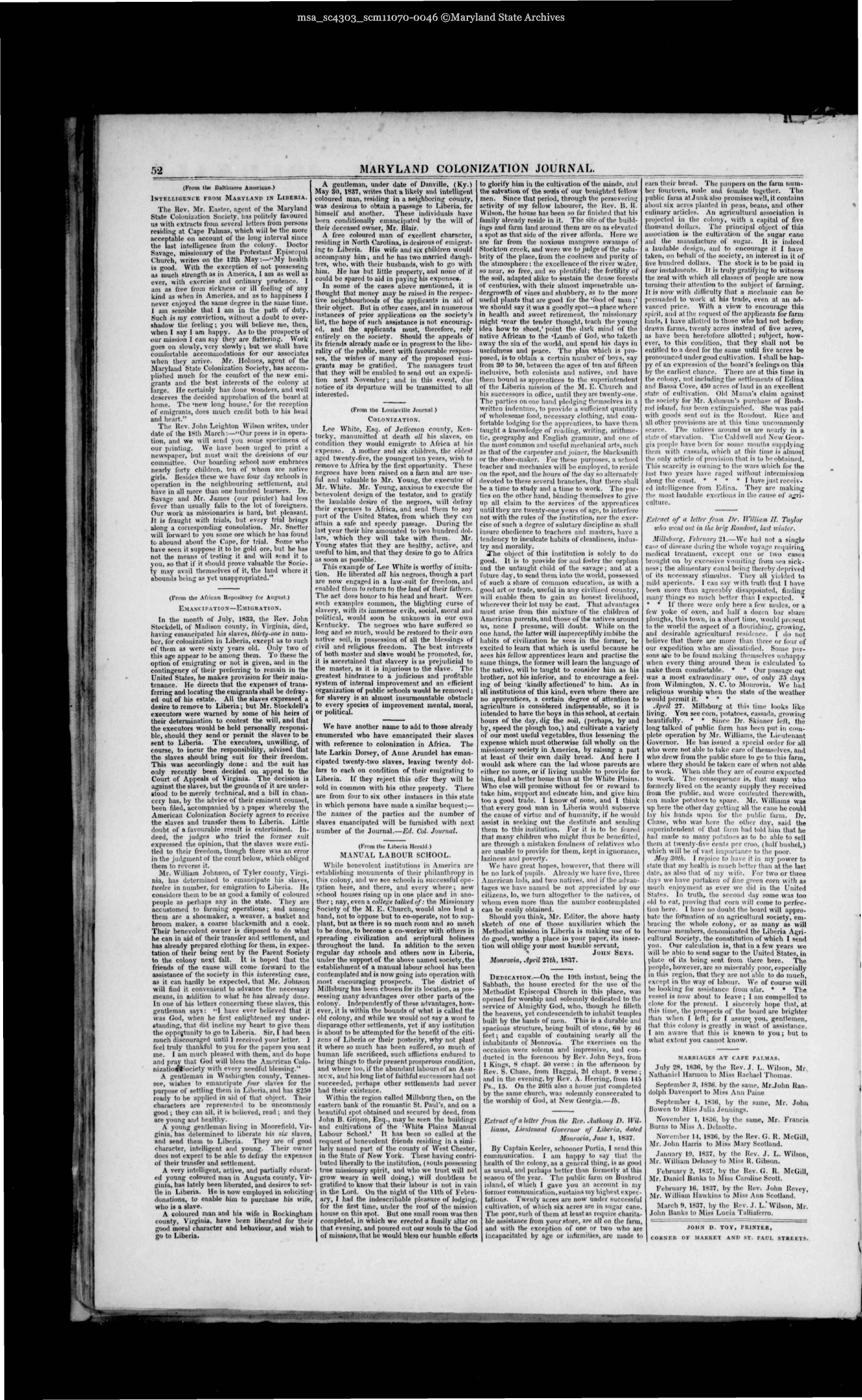
52
MARYLAND COLONIZATION JOURNAL
(From the Baltimore American)
INTELLIGENCE FROM MARYLAND IN LlBERIA.
The Rev. Mr. Easter, agent of the Maryland
State Colonization Society. has politely favoured
us with extracts from several letters from persons
residing at Cape Palmas, which will be the more
acceptable on account of the Ions; interval since
the last intelligence from the colony. Doctor
Savage, missionary of the Protestant Episcopal
Church, writes on the 12th May:—"My health
is pood. With the exception of not possessing
as much strength as in America, I am as well as
ever, with exercise and ordinary prudence. 1
am as free from sickness or ill feeling of any
kind as when in America, and as to happiness I
never enjoyed the same degree in the same time.
I am sensible that 1 am in the path of duty.
Such is my conviction, without a doubt to over-
shadow the feeling; you will believe me, then,
when I say I am happy- As to the prospects of
our mission I can say they are flattering. Work
goes on slowly, very slowly; but we shall have
comfortable accommodations for our associates
when they arrive. Mr. Holmes, agent of the
Maryland State Colonization Society, has accom-
plished much for the comfort of the new emi-
grants and the best interests of the colony at
Evn, lie certainly has done wonders, and well
deserves the decided approbation of the board at
home. The 'new long house,' lor the reception
of emigrants, does much credit both lo his Mad
and heart."
The Hev. John I.eighton Wilson writes, under
date of the 18th March:—"Our press is in opera-
tion, and we will send you some specimens of
our printing. We have been tiigod to print a
newspaper, but must wait the decisions of our
committee. Our boarding school now embraces
nearly forty children, ten of whom are native
girls. Besides these we have four day schools in
operation in the neighbouring settlement, and
have in all more than one hundred learners. Dr.
Savage and Mr. James (our printer) had less
fever than usually falls to the lot of foreigners.
Our work as missionaries is bard, but pleasant.
It is fraught with trials, but eveiy trial brings
along a conesponding consolation. Mr. Snetter
will forward to you some ore which he has found
to abound about the Cape, for trial. Some who
have seen it suppose it to be gold ore, but he has
not the means of testing it and will send it to
you, so that if it should prove valuable the Socie-
ty may avail themselves of it, the land where it
abounds being as yet unappropriated."
A gentleman, under date of Danville, (Ky.)
May 30, 1S37, writes that a likely and intelligent
coloured man, residing in a neighboring county,
was desirous to obtain a passage to Liberia, for
himself and another. These individuals have
been conditionally emancipated by the will of
their deceased owner, Mr. Blair.
A free coloured man of excellent character,
residing in North Carolina, is desirous of emigrat-
ing to Liberia. His wile and six children would
accompany him, anil he has two married daugh-
ters, who. with their husbands, wish to go with
him. He has but little property, and none of it
could be spared to aid in paying his expenses.
In some of the cases above mentioned, it is
thought that money may be raised in the respec-
tive neighbourhoods of the applicants in aid of
their object. Hut in other cases, and in numerous
instances of prior applications on the society's
list, the hope of such assistance is not encourag-
ed, and the applicants must, therefore, rely
entirely on the society. Should the appeals of
its friends already made or in progress to the libe-
rality of the pubiic, meet with favourable respon-
ses, the wishes of many of the proposed emi-
grants may be gratified. The managers trust
that they will be enabled to send out an expedi-
tion next November; and in this event, due
notice of its departuie will be transmitted to all
interested.
(From the African Repository for August.)
Emancipation—Emigration.
In the month of July, 1833, the Rev. John
Stockdell, of Madison county, in Virginia, died,
having emancipated his slaves, thirty-one in num-
ber, for colonization in Liberia, except as to such
of them as were sixty years old. Only two of
this age appear to be among them. To these the
option of emigrating or not is given, and in the
contingency of their preferring to remain in the
United States, he makes provision for their main-
tenance. He directs that the expenses of trans-
ferring and locating the emigrants shall be defray-
ed out of his estate. All the slaves expressed a
desire to remove to Liberia; but Mr. Stockdell's
executors were warned by some of his heirs of
their determination to contest the will, and that
the executors would be held personally responsi-
ble, should they send or permit the slaves to be
sent to Liberia. The executors, unwilling, of
course, to incur the responsibility, advised that
the slaves should bring suit for their freedom.
This was accordingly done: and the suit has
only recently been decided on appeal to the
Court of Appeals of Virginia. The decision is
against the slaves, but the grounds of it are under-
stood to be merely technical, and a bill in chan-
cery has, by the advice of their eminent counsel,
been filed, accompanied by a paper whereby the
American Colonization Society agrees to receive
the slaves and transfer them to Liberia. Little
doubt of a favourable result is entertained. In-
deed, the judges who tried the former suit
expressed the opinion, that the slaves were enti-
tled to their freedom, though there was an error
in the judgment of the court below, which obliged
them to reverse it.
Mr. William Johnson, of Tyler county, Virgi-
nia, has determined to emancipate his slaves,
twelve in number, for emigration to Liberia. He
considers them to be as good a family of coloured
people as perhaps any in the state. They arc
accustomed to farming operations; and among
them are a shoemaker, a weaver, a basket and
broom maker, a coarse blacksmith and a cook.
Their benevolent owner is disposed to do what
he can in aid of their transfer and settlement, and
has already prepared clothing for them, in expec-
tation of their being sent bv the Parent Society
to the colony next fall. It is hoped that the
friends of the cause will come forward to the
assistance of the society in this interesting case,
as it can hardly be expected, that Mr. Johnson
will find it convenient to advance the necessary-
means, in addition to what he has already done.
In one of his letters concerning these slaves, this
gentleman says: "I have ever believed that it
was God, when he fust enlightened my under-
standing, that did incline my heart to give them
the opportunity to go to Liberia. Sir, I had been
much discouraged until 1 received your letter. I
feel truly thankful to you for the papers you sent
me. I am much pleased with them, and do hope
and pray that God will bless the American Colo-
ni/.atinsJt;ociety with every needful blessing."
A gentleman in Washington county, Tennes-
see, wishes to emancipate four slaves for the
purpose of settling them in Liberia, and has MM
ready to be applied in aid of that object. Their
characters are represented to be uncommonly
good ; they can all, it is believed, read ; and they
are young and healthy.
A young genileman living in Moorefield, Vir-
ginia, has determined to liberate his six slaves,
and send them to Liberia. They are of ;.....I
character, intelligent and young. Their owner
docs not expect to be able to defray the expenses
of their transfer and settlement.
A very intelligent, active, and partially educat-
ed young coloured man in Augusta county, Vir-
ginia, has lately been liberated, and desires to set-
tle iu Liberia. He is now employed in soliciting
donations, to enable him to purchase his wilt,
who is a slave.
A coloured man and his wife in Rockingham
county, Virginia, have been liberated for their
good moral character and behaviour, and wish to
go to Liberia.
(From the Louisville Journal )
Colonization.
Lee White, Esq. of Jefferson county, Ken-
tucky, manumitted at death all his slaves, on
condition they would emigrate to Africa at his
espouse. A mother and six children, the eldest
aged twenty-live, the youngest ten years, wish to
remove to Africa by the first opportunity. These
negroes have been raised on a iarm and are use-
ful and valuable to Mr. Young, the executor of
Mr. White. Mr. Young, anxious to execute the
benevolent design of the testator, and to gratify
the laudable desire of the negroes, will defray
their expenses to Africa, and send them to any
part of the I'nited States, from which they can
attain a safe and speedy passage. During the
last year their hire amounted to two hundred dol-
lars, which they will take with them. Mr.
Voung states that they are healthy, active, and
useful to him, and that they desire to go to Africa
as soon as possible.
This example of Lee White is worthy of imita-
tion. He liberated all his negroes, though a part
are now engaged in a law-suit for freedom, and
enabled them to return to the land of their fathers.
The act does honor to bis head and heart. Were
such examples common, the blighting curse of
slavery, with its immense evils, social, moral and
political, would soon he unknown in our own
Kentucky. The negroes who have sullered so
long and so much, would be restored to their own
native soil, in possession of all the blessings id'
civil and religious freedom. The best interests
of both master and slave would be promoted, for,
it is ascertained that slavery is as prejudicial to
the master, as it is injurious to the slave. The
greatest hindrance to a judicious and profitable
system of internal improvement and an etiieient
organization of public schools would be removed ;
for slavery is an almost insurmountable obstacle
to every species of improvement mental, moral,
or political.
We have another name to add to those already
enumerated who have emancipated their slaves
with reference to colonization in Africa. The
late Larkin Dorsey, of Anne Arundel has eman-
cipated twenty-two slaves, leaving twenty dol-
lars to each on condition of their emigrating to
Liberia. If they reject this offer they will be
sold in common with his other property. There
are from four to six other instances in this state
in which persons have made a similar beipiest;—
the names of the parties and the number of
slaves emancipated will be furnished with next
number of the Journal.—Si. Col- Journal.
(From the Liberia Herald.)
MANUAL LABOUR SCHOOL.
While benevolent institutions in America are
establishing monuments of their philanthropy in
this colony, and we see schools in successful ope-
ration here, and tliere, and every where; new
school houses rising up in one place and in ano-
ther; nay, even a college lofted e/j the Missionary
Society of the M. E. Church, would also lend a
hand, not to oppose but to co-operate, not to sup-
plant, but as tliere is so much room ami so much
to he done, to become a co-worker with others in
spreading civilization and scriptural holiness
throughout the land. In addition to the seven
regular day schools and others now in UntrU,
under the support of the above named society, the
establishment of a manual labour school has been
contemplated and is now going into operation with
ino-l encouraging prospects, The district of
Millshurg has been chosen for its location, as pos-
sessing many advantages over other parts of the
colony. Independently of these advantages, how-
ever, it is within the bounds of what is called the
old colony, and while we would not say a word to
disparage other settlements, yet if any institution
is about to be attempted for the benefit of the citi-
zens of Liberia or their posterity, why not plant
it where so much has been sullered, so much of
human life sacrificed, such afflictions endured to
bring things to their present prosperous condition,
and where too, if the abundant labours of an Asii-
.Mi;n, and bis long list of faithful successors had not
succeeded, perhaps other settlements had never
had their existence.
Within the region called Millsburg then, on the
eastern bank of the romantic St. Paul's, and on a
beautiful spot obtained and secured by deed, from
John B. Gripon, Esq., may be seen the buildings
and cultivations of the 'Whits Plains Manual
Labour School.' It has been so called at the
request of benevolent friends residing in a simi-
larly named part of the county of West Chester,
in the State of New York. These having contri-
buted liberally to the institution, (souls possessing
true missionary spirit, and who we trust will not
grow weary in well doing,) will doubtless be
gratified to know that their labour is not iu vain
in the Lord. On the night of the 11th of Febru-
ary, I had the indescribable pleasure of lodging,
for the first time, under the roof of the mission
house on this spot. But one small room was then
completed, in which we erected a family altar on
that evening, and poured out our souls to the God
of missions, that he would bless our humble efforts
to glorify him in the cultivation of the minds, and
the salvation of the souls of our benighted fellow
men. Since that period, through the persevering
activity of iny fellow labourer, the Hev. B. R.
Wilson, the house has been so far finished that his
family already reside in it. The site of the build-
ings and farm land around them are on as elevated
a spot as that side of the river alfords. Here we
are far from the noxious mangrove swamps of
Stockton creek, and were we to judge of the salu-
brity of the place, from the coolness and purity of
the atmosphere: the excellence of the river water,
so near, so free, and so plentiful; the fertility of
the soil, adapted alike to sustain the dense forests
of centuries, with their almost impenetrable un-
dergrovvth ot' vines and shubbory, as to the more
useful plants that are good for the 'food of man;'
we should say it was a goodly spot—a place where
in health and sweet retirement, the missionary
might 'rear the tender thought, teach the young
idea how to shoot.' Mbit the dark Blind of the
native African to the 'Lamb of tlod, who takoth
away the sin of tho world, and spend his days in
usefulness and peace. The plan which is pro-
posed, is to obtain a Certain number id' boys, say
from 3D to 50, between the ages of ten and fifteen
inclusive, both colonists and natives, and have
them bound as apprentices to the superintendent
of the Liberia mission of the M. B. Church and
his successors in ollice, until they are twenty-one.
The parties on one hand pledging themselves ill a
written indenture, to provide a sufficient quantity
of wdiolesome food, necessary clothing, and com-
fortable lodging lor the apprentices, to have them
taught a knowledge of reading, writing, arithme-
tic, geography and English grammar, ami one of
the most common anil useful mechanical arts, such
as that of the carpenter and joiner, the blacksmith
or the shoe-maker. For those purposes, a seined
teacher and mechanics will bo employed, to reside
on the spot, and the hours of the day SO alternately
devoted to these several branches, that there shall
he a time to study ami a time to work. The par-
ties on the other hand, binding themselves to give
up all claim to the services of the apprentices
until they an' twenty-one years of age, to interfere
not with the rules of the institution, nor the exer-
cise of such a degree of salutary discipline a* shall
insure obedience to teachers and masters, have a
tendency to inculcate habits of cleanliness, indus-
try and morality.
.The object of this institution is solely to do
good. It is to provide tor and foster the orphan
and the untaught child of the savage ; and at a
future day, to send them into the world, possessed
of such a share of common education, as wilh a
good art or trade, useful in any civilized country,
will enable them to gain an honest livelihood,
wberam their lot may be cast. That advantages
must arise from this mixture of the children of
American parents, and those of the natives around
us, none I presume, will doubt. While on the
one hand, the latter will imperceptibly imbibe the
habits of civilization he sees in the former, be
excited to learn that which is useful because be
sees his fellow apprentices learn and practise the
same tilings, the former will learn the language of
the native, will be taught to consider him as his
brother, not his inferior, and to encourage a feel-
ing of being 'kindly atfectioned' to him. As in
all institutions of this kind, even where there are
no apprentices, a certain degree of attention to
agriculture is considered indispensable, so it is
intended to have the hoys in this school, at certain
hours of the day, dig the soil, (perhaps, by and
by, speed the plough too,) and cultivate a variety
of our most useful vegetables, thus lessening the
expense which must otherwise fall wholly on the
missionary society in America, by raising a part
at least of their own daily bread. And here I
would ask where can the lad whose parents are
either no more, or if living unable to provide for
him, find abetter home than at the White Plains.
Who else will promise without fee or reward to
take him, support and educate hiin, and give him
too a good trade. I know of none, and 1 think
that every good man in Liberia would subserve
the cause of virtue and of humanity, if he would
assist in seeking out the destitute and sending
them to this institution. Tor it is to be (eared
that many children who might thus be benefitted,
are through a mistaken fondness of relatives who
are unable to provide for them, kept in ignorance,
laziness and poverty.
Wo have great hopes, however, that there will
be no lack of pupils. Already we have live, throe
American lads, and two natives, and if the advan-
tages we have named be not appreciated by our
citizens, lo, we turn altogether to the natives, ot
whom even more than the number contemplated
can be easily obtained.
Should you think, Mr. Editor, the above hasty
sketch of one of those auxiliaries which the
Methodist mission in Liberia is making use of to
do good, worthy a place in your paper, its inser-
tion will oblige your most humble servant,
John Seys.
Monrovia, J/rii 27th, 1837.
DF.mcATioN.—On the loth instant, being the
Sabbath, the house erected for the use of the
Methodist Episcopal Church in this place, was
opened for worship and solemnly dedicated to the
service of Almighty God, who, though he lilh th
the heavens, yet condescendetb to inhabit temples
built by the hands of men. This is a durable and
spacious structure, being built of stone, tiii by 10
feet; and capable of containing nearly all the
inhabitants of Monrovia The exercises on the
occasion were solemn and Impressive, and con-
ducted in the forenoon by Hev. John Seys, from
1 Kings, H ehapt. 30 verse i in the afternoon by
Rev. S. Chase, from llaggai, 2d chapt. !) verse;
and in the evening, by Rev. A. Herring, from 115
Ps., 1.5. On the 2 |