 |
|
|
 |
|
 |
|
|||
|
||||
|
||||
|
Maryland State Archives Maryland Colonization Journal Collection MSA SC 4303 msa_sc4303_scm11070-0053 Enlarge and print image (5M) |
|
|
|
|
|
|
|
|||
|
||||
|
||||
|
Maryland State Archives Maryland Colonization Journal Collection MSA SC 4303 msa_sc4303_scm11070-0053 Enlarge and print image (5M) |
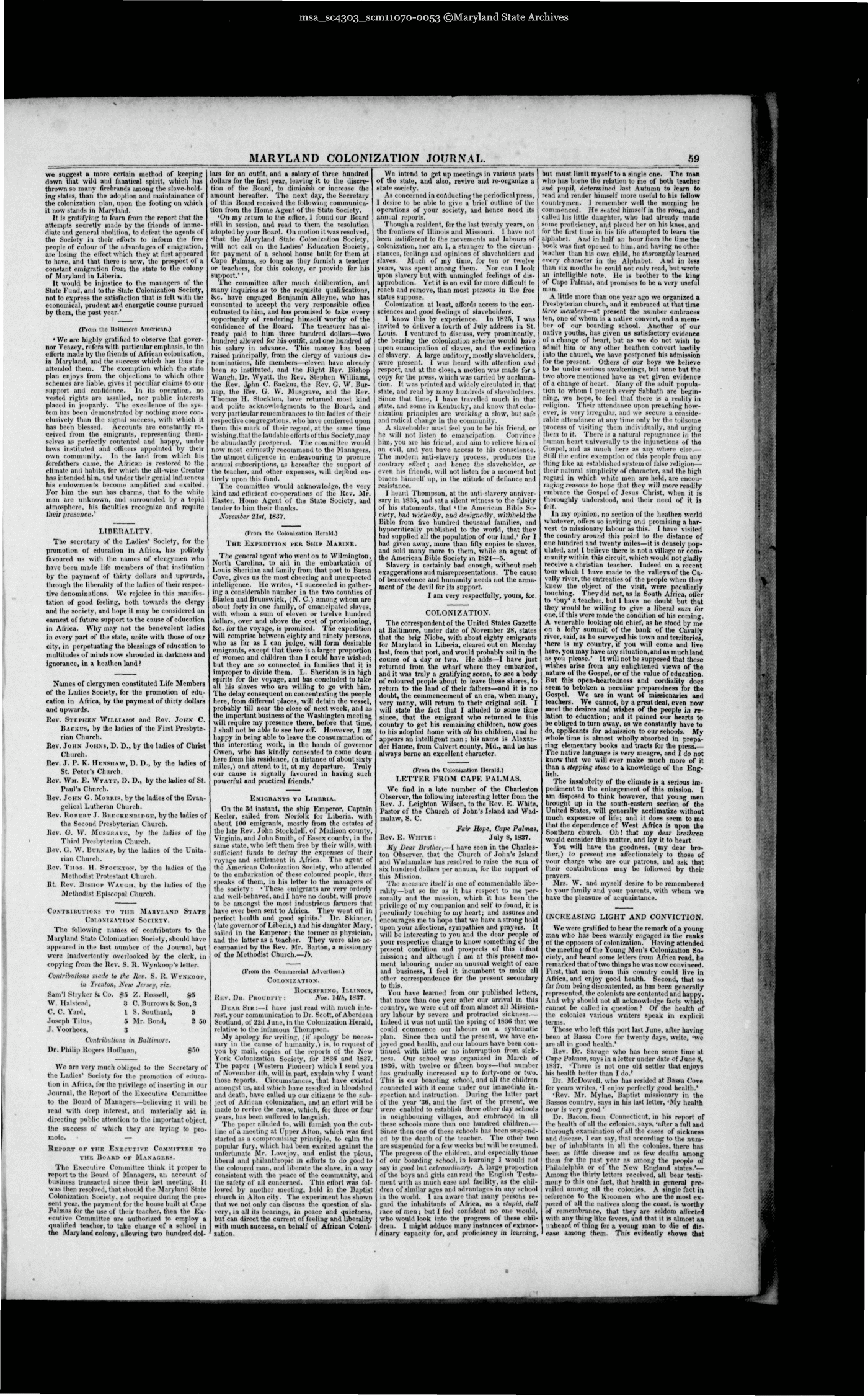
| MARYLAND COLONIZATION JOURNAL. 59 we suggest a more certain method of keeping down tliat wild and fanatical spirit, which has thrown so many fnclirands among the slave-hold- ing stales, than the adoption and maintainance of the colonization plan, upon the footing on w.hich it now stands in Maryland. It is gratifying to learn limn the report that the attempts secretly made hy the friends of imme- diate and general aholilion, to defeat the agents of the Society in tlieir ellbrts to inform the free people of colour of the advantages of emigration, are losing the ell'ect which they at first appeared to have, and that there is now, the prospect of a constaid emigration from the state to the colony of Maryland in I.iheria. It would be injustice to the managers of the State Fund, and to the State Colonization Society, not to express the satisfaction that is felt with the economical, prudent and energetic course pursued by them, the past year.' (From the Baltimore American.) ' We are highly gratified to observe that gover- nor Veazcy, refers with particular emphasis, to the efforts made by the friends of African colonization, in Maryland, and the success which has thus fir attended them. The exemption which the state plan enjoys from the objections to which other schemes are liable, gives it peculiar claims to our support and conliih'iire. In iu operation, no vested rights are assailed, nor public interests placed in jeopardy. The excellence of the sys- tem has been demonstrated by nothing more con- clusively than the signal success, with which it has been blessed. Accounts are constantly re- ceived from the emigrants, representing them- selves as perfectly contented and happy, under laws instituted and officers appointed by their own community. In the land from which his forefathers came, the African is restored to the climate and habits, for which the all-wise Creator has intended him, and under their genial influence* his endowments become amplified and exalted. For him the sun has charms, that to the white man are unknown, and surrounded by a tepid atmosphere, his faculties recognize and reipiite their presence.' LIBERALITY. The secretary of the Ladies' Society, for the promotion of education iu Africa, has politely favoured us with the names of clergymen who have been made life members of that institution by the payment of thirty dollars and upwards, through the liberality of the ladies of their respec- tive denominations. We rejoice in this manifes- tation of good feeling, both towards the clergy and the society, and hope it may be considered an earnest of future support to the cause of education in Africa. Why may not the benevolent ladies iu every part of the state, unite with those of our city, in perpetuating the blessings of education to multitudes of minds now shrouded in darkness and ignorance, in a heathen land ? Names of clergymen constituted Life Members of the Ladies Society, for the promotion of edu- cation in Africa, by the payment of thirty dollars and upwards. Rev. Stephen Williams and Rev. John C. Backus, by the ladies of the First Presbyte- rian Church. Rev. John Johns, D. D., by the ladies of Christ Church. Rev. J. P. K. Henshaw, D. D., by the ladies of St. Peter's Church. Rev. Wm. E. Wyatt, D. D., by the ladies of St. Paul's Church. Rev. John G. Morris, by the ladies of the Evan- gelical Lutheran Church. Rev. Robert J. Breckenridge, by the ladies of the Second Presbyterian Church. Rev. G. W. Musgrave, hy the ladies of the Third Presbyterian Church. Rev. G. W. Burnap, hy the ladies of the Unita- rian Church. Rev. Thos. H. Stockton, by the ladies of the Methodist Protestant Church. Rt. Rev. Bishop Waugii, by the ladies of the Methodist Episcopal Church. Contributions to the Maryland State Colonization Society. The following names of contributors to the Maryland State Colonization Society, should have appeared in the last number of the Journal, but were inadvertently overlooked by the clerk, in copying from the Rev. S. R. Wynkoop's letter. Contributions made to the Rev. S. R. Wynkoop, in Trenton, New Jersey, viz. Sam'l Stryker & Co. $5 Z. Rossell, $5 W. Halstead, 3 C. Burrows & Son, 3 C. C. Yard, 1 S. Southard, 5 Joseph Titus, 5 Mr. Bond, 2 50 J. Voorhees, 3 Contributions in Baltimore. Dr. Philip Rogers Hodman, $50 lars for an outfit, and a salary of three hundred dollars for the first year, leaving it to the discre- tion of the Board, to diminish or increase the amount hereafter. The next day, the Secretary of this Hoard received the following communica- tion from the Home Agent of the State Society. 'On my return to the office, I found our Board still in session, and read to them the resolution adopted by your Board. On motion it was resolved, 'that the Maryland State Colonization Society, will not call on the Ladies' Education Society, for payment of a school house built for them at Cape Palmas, so long as they furnish a teacher or teachers, for this colony, or provide for his support.'' 1 he committee after much deliberation, and many inquiries M to the requisite qualifications, etc. have engaged Benjamin Alleyne, who has consented to accept the very responsible office entrusted to him, and has promised to take every opportunity of rendering himself worthy of the confidence of the Board. The treasurer has al- ready paid to him three hundred dollars?two hundred allowed for his outfit, and one hundred of his salary in advance. This money has been raised principally, from the clergy of various de- nominations, life members?eleven have already heen so instituted, and the Right Rev. Bishop Waugh, Dr. Wyatt, the Rev. Stephen Williams, the Rev. John C. Backus, the Rev. G. W. Bur- nap, the Rev. G. W. Musgrave, and the Rev. Thomas H. Stockton, have returned most kind and polite acknowledgments to the Board, and very particular remembrances to the ladies oftheir respective congregate mis. who have conferred upon them this mark of their regard, at the same time wishing.that the laudahle ellortsof this Society,may be abundantly prospered. The committee would now most earnestly recommend to the Managers, the utmost diligence in endeavouring to procure annual subscriptions, as hereafter the support of the teacher, and other expenses, will depend en- tirely upon this fund. The committee would acknowledge, the very kind and efficient co-operations of the Kev. Mr. Easter, Home Agent of the State Society, and tender to him their thanks. November 21st, 1837. We are very much obliged to the Secretary of the Ladies' Society for the promotion of educa- tion in Africa, for the privilege of inserting in our Journal, the Report of the Executive Committee to the Board of Managers?believing it will be read with deep interest, and materially aid in directing public attention to the important object, the success of which they are trying to pro- mote. ? Report of the Executive Committee to the Board of Managers. The Executive Committee think it proper to report to the Board of Managers, an account of business transacted since their last meeting. It was Ihen resolved, that should the Maryland State Colonization Society, not require during the pre- sent year, the payment for the house built at Cape Palmas far the use of their teacher, then the Ex- ecutive Committee are authorized to employ a qualified teacher, to take charge of a school in the Maryland colony, allowing two hundred dol- (From the Colonization Herald.) The Expedition per Ship Marine. The general agent who went on to Wilmington, North Carolina, to aid in the embarkation of Louis Sheridan and family from that port to Bassa Cove, gives us the most cheering and unexpected intelligence. He writes, ' I succeeded iu gather- ing a considerable number iu the two counties of Bladen and Brunswick, (N. C.) among whom are about forty in one family, of emancipated slaves, with whom a sum of eleven or twelve hundred dollars, over and above the cost of provisioning, Sec. for the voyage, is promised. The expedition will comprise between eighty and ninety persons, who as far as I can judge, will form desirable emigrants, except that there is a larger proportion of women and children than I could have wished; but they are so connected in families that it is improper to divide them. L. Sheridan is in high spirits for the voyage, and has concluded to fake all his slaves who are willing to go with him. The delay consequent on concentrating the people here, from different places, will detain the vessel, probably till near the close of next week, and as the important business of the Washington meeting will require my presence there, before that time, I shall not be able to see her off. However, I am happy in being able to leave the consummation of this interesting work, in the hands of governor Owen, who has kindly consented to come down here from his residence, (a distance of about sixty miles,) and attend to it, at my departure. Truly our cause is signally favoured in having such powerful and practical friends.' Emigrants to Liberia. On the 3d instant, the ship Emperor, Captain Keeler, sailed from Norfolk for Liberia, with about 100 emigrants, mostly from the estates of the late Rev. John Stockdell, of Madison county, Virginia, and John Smith, of Essex county, in the same state, who left them free by their wills, with sufficient funds to defray the expenses of their voyage and settlement in Africa. The agent of the American Colonization Society, who attended to the embarkation of these coloured people, thus speaks of them, in his letter to the managers of the society: 'These emigrants are very order!} and well-behaved, and I have no doubt, will prove to be amongst the most industrious farmers that have ever been sent to Africa. Thev went off in perfect health and good spirits.' Dr. Skinner, (late governor of Liberia,) and his daughter Mary, sailed in the Emperor; the former as physician, ami the latter as a teacher. They were also ac- companied hy the Rev. Mr. Barton, a missionary of the Methodist Church.?lb. (From the Commercial Advertiser.) Colonization. Rockspring, Illinois, Rev. Dr. Proudfit: Nov. 14th, 1837. Dear Sir:?I have just read with much inte- rest, your communication to Dr. Scott, of Aberdeen Scotland, of 22d June, in the Colonization Herald, relative to the infamous Thompson. My apology for writing, (if apology be neces- sary in the cause of humanity,) is, to request of you by mail, copies of the reports of the New York Colonization Society, for ISM and 1837. The paper (Western Pioneer) which I send you of November 1th, will in part, explain why I want those reports. Circumstances, that have existed amongst us, and which have resulted in bloodshed and death, have called up our citizens to the tab- ject of African colonization, and an ell'ort will he made to revive the cause, which, for three or four years, has been sulfcrcd to languish. The paper alluded to, will furnish you the out- line of a meeting at Upper Alton, which was first started as a compromising principle, to calm the popular fury, winch had been excited against the unfortunate Mr. Lnvejoy, and enlist the pious, liberal and philanthropic in efforts to do good to the coloured man, and liberate the slave, in a way consistent with the peace of the community, and the safety of all concerned. This effort was fid- lowed by another meeting, held in the Baptist church in Alton city. The experiment has shown that we not only can discuss the question of sla- very, in all its bearings, in peace and quietness, but can direct the current of feeling and liberality with much success, on behalf of African Coloni- zation. We intend to get up meetings in various parts of the state, and also, revive and re-organize a state society. As concerned in conducting the periodical press, I desire to be able to give a brief outline of the operations of your society, and hence need its annual reports. Though a resident, for the last twenty years, on the frontiers of Illinois and Missouri. I have not been indillerent lo the movements and labours of colonization, nor am I, a stranger to the circum- stances, feelings and opinions of slaveholders and slaves. Much of my time, for ten or twelve years, was spent among them. Nor can I look upon slavery but with unniingled feelings of dis- approbation. Yet it is an evil far more difficult to reach and remove, than most persons in the free states suppose. Colonization at least, adonis access to the con- sciences and good feelings of slaveholders. I know this by experience. In 1825, I was invited to deliver a fourth of July address in St. Louis. I ventured to discuss, very prominently, the hearing the colonization scheme would have upon emancipation of slaves, and the extinction of slavery. A large auditory, mostly slaveholders, were present. I was heard with attention and respect, and at the close, a motion was made for a copy for the press, which was carried by acclama- tion. It was printed and widely circulated in that state, and read by ninny hundreds of slaveholders. Since that time, I have travelled much in that state, and some in Kentucky, and know that colo- nization principle! are working a slow, but safe and radical change in the community. A slaveholder must feel you to he his friend, or he will not listen to emancipation. Convince him, you are his friend, and aim to relieve him of an evil, and you have access to his conscience. The modern anti-slavery process, produces the contrary ellect; and hence the slaveholder, or even his friends, will not listen for a moment hut braces himself up, in the atitude of defiance and resistance. I heard Thompson, at the anti-slavery anniver- sary in 1835, and sat a silent witness to the falsity of his statements, that ' the American Bible So- ciety, had wickedly, and designedly, withheld the Bible from five hundred thousand families, and hypocritically published to the world, that they had supplied all the population of our land,' for I had given away, more than fifty copies to slaves, and sold many more to them, while an agent of the American Bible Society in 1824?5. Slavery is certainly bail enough, without such exaggerations and misrepresentations. The cause of benevolence and humanity needs not the arma- ment of the devil for its support. I am very respectfully, yours, &tc, COLONIZATION. The correspondent of the United States Gazette at Baltimore, under date of November 28, states that the brig Niobe, with about eighty emigrants for Maryland in Liberia, cleared out on Monday last, from that port, and would probably sail in the course of a day or two. He adds?i have just returned from the wharf where they embarked, and it was truly a gratifying scene, to see a body of coloured people about to leave these shores, to return to the land of their fathers?and it is no doubt, the commencement of an era, when many, very many, will return to their original soil. I will state the fact that I alluded to some time since, that the emigrant who returned to this country to get his remaining children, now goes to his adopted home with all his children, and he appears an intelligent man ; his name is Alexan- der Hance, from Calvert county, Md., and he has always borne an excellent character. (From the Colonization Herald.) LETTER FROM CAPE PALMAS. We find in a late number of the Charleston Observer,the following interesting letter from the Rev. J. Leighton Wilson, to the Rev. E. White, Pastor of the Church of John's Island and Wad- malaw, S. C. Fair Hope, Cape Palmas, Rev. E. White : July 8, 1837. My Dear Brother,?I have seen in the Charles- ton Observer, that the Church of John's Island and Wadamalaw has resolved to raise the sum of six hundred dollars per annum, for the support of this Mission. The measure itself is one of commendable libe- rality?but so far as it has respect to me per- sonally and the mission, which it has been the privilege of my companion and self to found, it is peculiarly touching to my heart; and assures and encourages me to hope that we have a strong hold upon your affections, sympathies and prayers. It will be interesting to you and the dear people of your respective charge to know something of the present condition and prospects of this infant mission; and although 1 am at this present mo- ment labouring under an unusual weight of care and business, I feel it incumbent to make all other correspondence lor the present secondary to this. You have learned from our published letters, that more than one year after our arrival in this country, we were cut Off from almost all Mission- ary labour by severe and protracted sickness.? Indeed it was not until the spring of 1830 that we could commence our labours on a systematic plan. Since then until the present, we have en- joyed good health, and our labours have been con- tinued with little or no interruption from sick- ness. Our school was organized in March of 183G, with twelve or fifteen boys?that number has gradually increased up to forty-one or two. This is OUT boarding school, and all the children connected with it come under our immediate in- spection and instruction. During the latter part of the year ':it>, and the first of the present, we were enabled to establish three other day schools in neighbouring villages, and embraced in all these schools more than one hundred children.? Since then one id 'these schools has heen suspend- ed hy the death of the teacher. The other two are suspended for a few weeks but will be resumed. The progress of the children, and especially those of our boarding school, in learning I would not say is good but extraordinary. A large proportion of the boys and girls can read the English Testa- ment with as much ease and facility, as the chil- dren of similar ages and advantages in any school in the world. I am aware that many persons re- gard the inhabitants of Africa, as a stupid, dull race of men; but I feel confident no one would, who would look into the progress of these chil- dren. I might adduce many instances of extraor- dinary capacity for, and proficiency in learning, but must limit myself to a single one. The man who has borne the relation to me of both teacher and pupil, determined last Aufumn to learn to read and render himself more useful to his fellow countrymen. I remember well the morning he commenced. He sealed himself in the room, and called his little daughter, who bad already made some proficiency, and placed her on his knee,and lor the first time in his life attempted to learn the alphabet. And in half an hour from the time the book was first opened to him. and having no other teacher than bis own child, he thoroughly learned every character in the Alphabet. And in less than six months he could not only read, but wrote an intelligible note. He is brother to the king of Cape Palmas, and promises to be a very useful man. A little more than one year ago we organized a Presbyterian church, and it embraced at that time three members?at present the number embraces ten, one of whom is a native convert, and a mem- ber of our boarding school. Another of our native youths, has given us satisfactory evidence of a change of heart, but as we do not wish to admit him or any other heathen convert hastily into the church, we have postponed his admission for the present. Others of our boys we believe to be under serious awakenings, but none hut the two above mentioned have as yet given evidence of a change of heart. Many of the adult popula- tion to whom I preach every Sabbath are begin- ning, we hope, to feel that there is a reality in religion. Their attendance upon preaching how- ever, is very irregular, and we secure a conside- rable attendance at any time only by the toilsome process of visiting them individually, and urging them to it. There is a natural repugnance iu the human heart universally to the injunctions of the Gospel, and as much here as anywhere else.? Still the entire exemption of this people from any thing like an established system of false religion? their natural simplicity of character, and the high regard in which white men are held, are encou- raging reasons to hope that they will more readily embrace the Gospel of Jesus Christ, when it is thoroughly understood, and their need of it is felt. In my opinion, no section of the heathen world whatever, oilers so inviting ami promising a har- vest to missionary labour as this. I have visited the country around this point to the distance of one hundred and twenty miles?it is densely pop- ulated, and I believe there is not a village or com- munity within this circuit, which would not gladly receive a christian teacher. Indeed on a recent tour which I have made to the valleys of the Ca- vally river, the entreaties of the people when they knew the object of the visit, were peculiarly touching. They did not, as in South Africa, offer to 'buy a teacher, hut I have no doubt but that they would be willing to give a liberal sum for one, if this were made the condition of his coming. A venerable looking old chief, as he stood by me on a lofty summit of the bank of the Cavally river, said, as he surveyed his town and territories, 'here is my country, if you will come and live here, you may have any situation, and as much land as you please.' It will not be supposed that these wishes arise from any enlightened views of the nature of the Gospel, or of the value of education. But this open-heartedness and cordiality does seem to betoken a peculiar preparedness for the Gospel. We are in want of missionaries and teachers. We cannot, by a great deal, even now meet the desires and wishes of the people in re- lation to education; and it pained our hearts to be obliged to turn away, as we constantly have to i\o, applicants for admission to otir schools. My whole time is almost wholly absorbed in prepa- ring elementary books and tracts for the press.? The native language is very meagre, and I do not know that we will ever make much more of it than a stepping stone to a knowledge of the Eng- lish. The insalubrity of the climate is a serious im- pediment to the enlargement of this mission. I am disposed to think liowcver, that young men brought up in the south-eastern section of the United States, will generally acclimatize without much exposure of life; and it does seem to me that the dependence of West Africa is upon the Southern church. Oh! that my dear brethren would consider this matter, and lay it to heart You will have the goodness, (my dear bro- ther,) to present rne affectionately to those of your charge who are our patrons, and ask that their contributions may be followed by their prayers. Mrs. W. and myself desire to be remembered to your family and your parents, with whom we have the pleasure of acquaintance. INCREASING LIGHT AND CONVICTION. We were gratified to hear the remark of a young man who has been warmly engaged in the ranks of the opposers of colonization. Having attended the meeting of the Young Men's Colonization So- ciety, and heard some letters from Africa read, he remarked that of two things he was now convinced. First, that men from this country could live in Africa, and enjoy good health. Second, that so far from being discontented, as has been generally represented, the colonists are contented and happy. And why should not all acknowledge facts which cannot be called in question ? Of the health of the colonies various writers speak in explicit terms. Those who left this port last June, after having been at Bassa Cove for twenty days, write, 'we are all in good health." Rev. Dr. Savage who has been some time at Cape Palmas, says in a letter under date of June 8, 1837. 'There is not one old settler that enjoys his health better than I do.' Dr. McDowell, who has resided at Bassa Cove for years writes, 'I enjoy perfectly good health." 'Rev. Mr. Mylue, It.qitist missionary iu the Bassos country, says in his last letter, 'My health now is very good.' Dr. Bacon, from Connecticut, in his report of the health of all the colonies, says, 'after a lull and thorough examination of all the cases of sickness ami disease, I can say, that according to the num- ber of inhabitants in all the colonies, there has been as little disease and as few deaths among them for the past year as among the people of Philadelphia or of the New England states.'? Among the thirty letters received, all bear testi- mony to this one fact, that health in general pre- vailed among all the colonies. A single fact in reference to the Kroomen who are the most ex- po-ed of all the natives along the coast, is worthy of remembrance, that they are seldom affected with any thing like fevers, and that it is almost an nhcaid ot thing for a young man to die of dis- ease among them. This evidently shows that |