 |
|
|
 |
|
 |
|
|||
|
||||
|
||||
|
Maryland State Archives Maryland Colonization Journal Collection MSA SC 4303 msa_sc4303_scm11070-0054 Enlarge and print image (5M) |
|
|
|
|
|
|
|
|||
|
||||
|
||||
|
Maryland State Archives Maryland Colonization Journal Collection MSA SC 4303 msa_sc4303_scm11070-0054 Enlarge and print image (5M) |
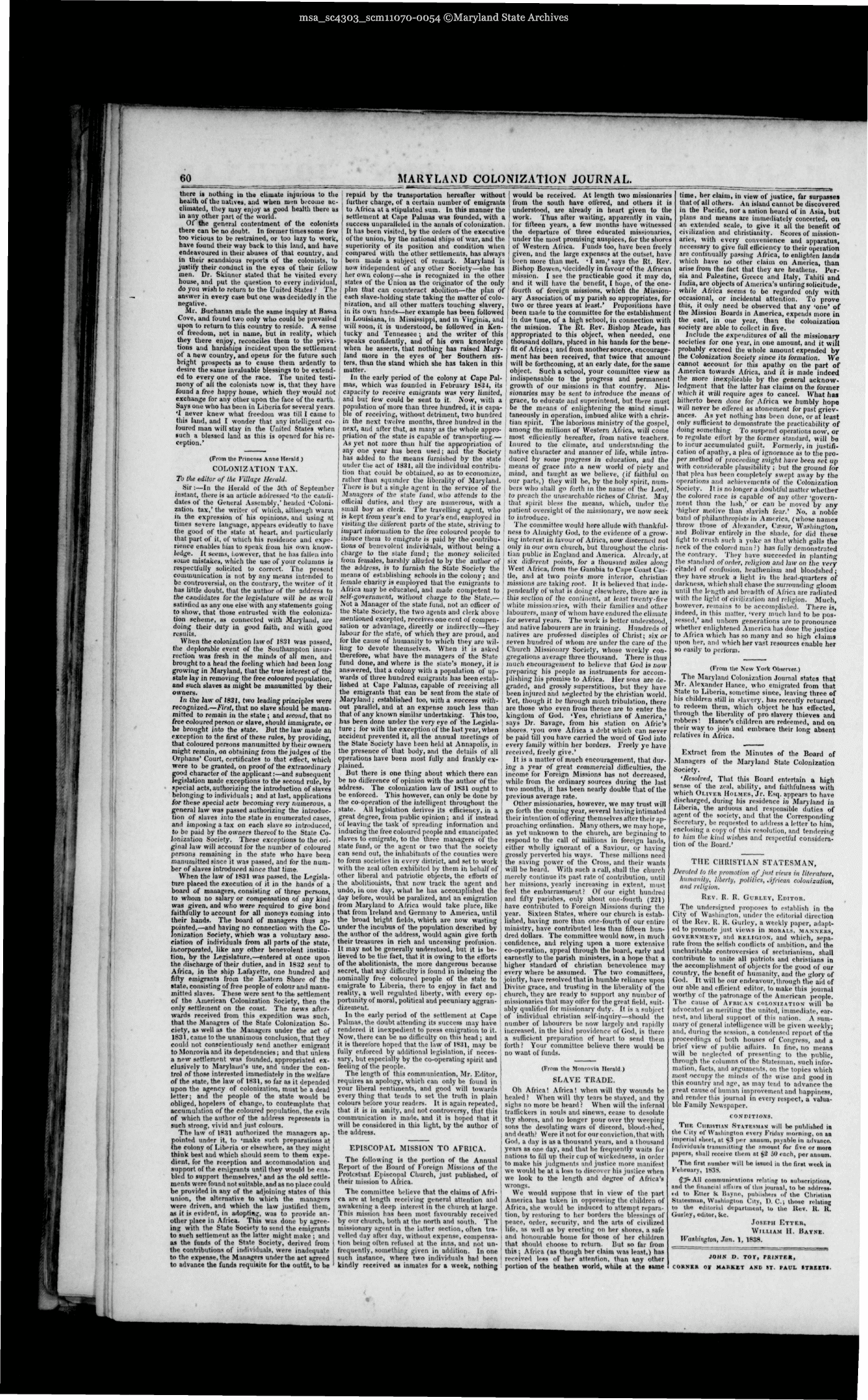
| 60 MARYLAND COLONIZATION JOURNAL. repaid by the transportation hereafter without tHither charge, of a certain number of emigrants to Africa at a stipulated sum. In this manner the settlement at (Jape Palmas was founded, with a success unparalleled in the annals of colonization. It has been visited, by the orders of the executive of the union, by the national ships of war, and the superiority of its position and condition when compared with the other settlements, has always been made a subject of remark. Maryland is now independent of any other Society—she has her own colony—she is recognized in the other states of the L'nion as the originator of the only plan that can counteract abolition—the plan of each slave-holding state taking the matter of colo- nization, and all other matters touching slavery, in its own hands—her example has been followed in Louisiana, in Mississippi, and in Virginia, and will soon, it is understood, be followed in Ken- tucky and Tennessee ; and the writer of this speaks confidently, and of his own knowledge when he asserts, that nothing has raised Mary- land more in the eyes of her Southern sis- ters, than the stand which she has taken in this matter. In the early period of the colony at Cape Pal- mas, which was founded in February 1834, its capacity to receive emigrants was very limited, and but lew could be sent to it. Now, with a population of more than three hundred, it is capa- ble of receiving, without detriment, two hundred in the next twelve months, three hundred in the next, and after that, as many as the whole appro- priation of the state is capable of transporting.— As yet not more than hall the appropriation of any one year has been used; and the Society has added to the means furnished by the state under the act of 1831, all the individual contribu- tion that could be obtained, so as to economize, rather than scpnnder the liberality of Maryland. There is but a single agent in the service of the Managers of the state fund, who attends to the official duties, and they are numerous, with a small boy as clerk. The travelling agent, who is kept from year's end to year's end, employed in visiting fhedifferent parts of the slate, striving to impart information to the free coloured people to induce them to emigrate is paid by the contribu- tions of benevolent individuals, without being a charge lo the slate fund; the money solicited from females, harshly alluded to by the author of the address, is to furnish the State Society the means of establishing schools in the colony; and female charily is employed that the emigrants to Africa may be educated, ami made competent to self-government, without charge to the State.— .Not a Manager of the state fund, not an officer of the State Society, the two agents and clerk above mentioned excepted, receives one cent of compen- sation or advantage, directly or indireclly—they labour for the state, of which they are proud, and for the cause of humanity to which they are wil- ling to devote themselves. When it is asked therefore, what have the managers of the State fund done, and where is the slate's money, it is answered, that a colony with a population of up- wards of three hundred emigrants has been estab- lished at Cape Palmas, capable of receiving all the emigrants that can be sent from the state of Maryland ; established too, with a success with- out parallel, and at an expense much less than that of any known similar undertaking. This too, has been done under the very eye of the Legisla- ture ; for with the exception of the last year, when accident prevented it, all the annual meetings of the State Suciety have been held at Annapolis, in the presence of that body, and the details of all operations have been most fully and frankly ex- plained. would be received. At length two missionaries from the south have offered, and otheH it is understood, are already in heart given to the work. Thus after waiting, apparently in vain, for fifteen years, a few months have witnessed the departure of three educated missionaries, under the most promising auspices, for the shores of Western Africa. Funds too, have been freely given, and the large expenses at the outset, have been more than met. ' I am,' says the Rt. Rev. Bishop Bowen,'decidedly in favour of the African mission. I see the practicable good it may do, and it will have the benefit, I hope, of the one- fourth of foreign missions, which the Mission- ary Association of my parish so appropriates, for two or three years at least.' Propositions have been made to the committee for the establishment in due time, of a high school, in connection with the mission. The Rt. Rev. Bishop Meade, has appropriated to this object, when needed, one thousand dollars, placed in his hands for the bene- fit of Africa; and from another source, encourage- ment has been received, that twice that amount will be forthcoming, at an early date, for the same object. Such a school, your committee view as indispensable to the progress and permanent growth of our missions in that country. Mis- sionaries may be sent to introduce the "means of grace, to educate and superintend, but there must be the means of enlightening the wind simul- taneously in operation, imbued alike with a chris- tian spirit. The laborious ministry of the gospel, among the millions of Western Attica, will come most efficiently hereafter, from native teachers. Inured to the climate, and understanding the native character and manner of life, while intro- duced by some progress in education, and the means of grace into a new world of piety and mind, and taught as we believe, (if faithful on our parts,) they will he, by the holy spirit, num- bers who shall gn forth in the name of the j.ord, to preach the unsearchable riches of Christ. May that spirit bless the means, which, under the patient oversight of the missionary, we now seek to introduce. there is nothing in the climate injurious to the health of the natives, and when M b.come ac- climated, they may enjoy as good health (here as in any other part of the world. Of the general contentment of the colonists there can be no doubt. In former times some few too vicious to be restrained, or too lazy to work, have found their way back to this land, and have endeavoured in their abuses of that country, and in their scandalous reports of the colonists, to justify their conduct in the eyes of their fellow men. Dr. Skinner stated that he visited every house, and put the question to every individual, do you wish to return to the United States > The answer in every case but one was decidedly in the negative. Mr. Buchanan made the same inquiry at Bassa Cove, and found two only who could be prevailed upon to return to this country to reside. A sense of freedom, not in name, but in reality, which they there enjoy, reconciles them to the priva- tions and hardships incident upon the settlement ol a new country, and opens tor the future such bright prospects as to cause them ardently to desire the same invaluable blessings to be extend- ed to every one of the race. The united testi- mony of all the colonists now is, that they have louud a free happy home, which they would not exchange for any other upon the face of the earth. Says one who has been in Liberia for several years. 'J never knew what freedom was till I came to this land, and I wonder that any intelligent co- loured man will stay in the United States when •uch a blessed land as this is opened for his re- ception.' (From the Princess Anne Herald ) COLONIZATION TAX. To the editor of the Village Herald. Sir:—In the Herald of the 5th of September instant, there is an article addressed 'to the candi- dates of the General Assembly,' headed 'Coloni- zation tax,' the writer of which, although warm in the expression of his opinions, and using at times severe language, appears evidently to have the good of the state at heart, and particularly that part of it, of which his residence and expe- rience enables turn to speak lioiii his own know- ledge. It seems, however, that he has fallen into some mistakes, which the use of your columns is respectfully solicited to correct. The present communication is not by any means intended to bo controversial, on the contrary, the writer of it has little doubt, that the author of the address to the candidates for the legislature will he as well satisfied as any one else with any statements going to show, that those entrusted with the coloniza- tion scheme, as connected with Maryland, are doing their duty in good faith, and with good results. When the colonization law of 1831 was passed, the deplorable event of the Southampton insur- rection was fresh in the minds of all men, and brought to a head the feeling which had been long growing in Maryland, that the true interest of the state lay in removing the free coloured population, and such slaves as might be manumitted by their owners. In the law of 1831, two leading principles were recognized.—First, that no slave should tie manu- mitted to remain in the state ; and second, that no free coloured person or slave, should immigrate, or be brought into the state. But the law made an exception to the first of these rules, by providing, that coloured persons manumitted by their owners might remain, on obtaining from the judges of the Orphans' Court, certificates to that effect, which were to be granted, on proof of the extraordinary good character of the applicant:—and subsequent legislation made exceptions to the second rule, by special acts, authorizing the introduction of slaves belonging to individuals; and at last, applications for these special acts becoming very numerous, a general law was passed authorizing the introduc- tion of slaves into the state in enumerated cases, and imposing a tax on each slave so introduced, to be paid by the owners thereof to the State Co- lonization Society. These exceptions to the ori- ginal law will account for the number of coloured persons remaining in the state who have been manumitted since it was passed, and lor the num- ber of slaves introduced since that time. The committee would here allude with thankful- ness to Almighty God, to the evidence of a grow- ing interest in favour of Africa, now discerned not only in our own church, but throughout the chris- tian public in Fnglatid and America. Already, at six dillcrcut points, for a thousind miles along West Africa, from the Gambia to Cape Coast Cas- tle, and at two points more interior, christian missions are taking root, it is believed that inde- pendently of what is doing elsewhere, there are in this section of the conlinent, at least twenty-live white mission iries, with their families and other labourers, many of whom have endured the climate for several years. The work is better understood, and native labourers are in training. Hundreds of natives are professed disciples of Christ; six or seven hundred of whom are under the care of the Church Missionary Society, whose weekly con- gragationa average three thousand. There is thus much encouragement to believe that God is now preparing his people as instruments for accom- plishing his promise to Africa. Her sons are de- graded, and grossly superstitious, but they have been injured and neglected by the christian world. Yet, though it be through much tribulation, there are those who even from thence are to enter the kingdom of God. 'Yes, christians of America,' says Dr. Savage, from bis station on Afric's shores 'you owe Africa a debt which can never be paid till you have carried the word of God into every family within her borders. Freely ye have received, freely give.' It is a matter of much encouragement, that dur- ing a year of great commercial dilheulties, the income for Foreign Missions has not decreased, while from the ordinary sources during the last two months, it has been nearly double that of the previous average rate. Other missionaries, however, we may trust will go forth the coming year, several having intimated their intention of ottering themselves after their ap- proaching ordination. Many others, we may hope, as yet unknown to the church, are beginning to respond to the call of millions in foreign lands, either wholly ignorant of a Saviour, or having grossly perverted his ways. These millions need the saving power of the Cross, and their wants will be heard. With such a call, shall the church merely continue its past rate of contribution, until her missions, yearly increasing in extent, must feel the embarrassment! Of our eight hundred and fifty parishes, only about one-fourth (221) have contributed to Foreign Missions during the year. Sixteen States, where our church is estab- lished, having more than one-fourth of our entire ministry, have contributed less than fifteen hun- dred dollars. The committee would now, in much confidence, and relying upon a more extensive co-operation, appeal through the board, early and earnestly to the parish ministers, in a hope that a higher standard of christian benevolence may every where be assumed. The two committees, jointly, have resolved that in humble reliance upon Divine grace, and trusting in the liberality of the church, they are ready to support any number of missionaries that may offer for the great field, suit- ably qualified for missionary duty. It is a subject of individual christian self-inquiry—should the number of labourers be now largely and rapidly increased, in the kind providence of God, is there a suliicient preparation of heart to send them forth I Your committee believe there would be no want of funds. But there is one tiling about which there can be no difference of opinion with the author of the address. The colonization law of IM1 ought to be enforced. This however, can only be done by the cooperation of the intelligent throughout the state. All legislation derives its efficiency, in a great degree, from public opinion; and if instead of leaving the task of spreading information and inducing the free coloured people and emancipated slaves to emigrate, to the three managers of the state fund, or the agent or two that the society- can send out, the inhabitants of the counties were to form societies in every district, and set to work with the zeal often exhibited by them in behalf of other liberal and patriotic objects, the efforts of the abolitionists, that now track the agent and undo, in one day, what he has accomplished the day before, would be paralized, ami an emigration from Maryland to Alrira would take place, like that from Ireland and Germany to America, until the broad bright fields, which are now wasting under the incubus of the population described by the author of the address, would again give forth their treasures in rich and unceasing profusion. It may not be generally understood, but it is be- lieved to be the fact, that it is owing to the efforts of the abolitionists, the more dangerous because secret, that any difficulty is found in inducing the nominally free coloured people of the state to emigrate to Liberia, there to enjoy in fact and reality, a well regulated liberty, with every op- portunity of moral, political and pecuniary aggran- dizement. In the early period of the settlement at Cape Palmas, the doubt attending its success may have rendered it inexpedient to press emigration to it. Now, there can be no difficulty on this head ; and it is therefore hoped that the law of Nil, may be fully enforced by additional legislation, if neces- sary, but especially by the co-operating spirit and feeling of the people. The length of this communication, Mr. Editor, requires an apology, which can only be found in your liberal sentiments, and good will towards every thing that tends to set the truth in plain colours before your readers. It is again repeated, that it is in amity, and not controversy, that this communication is made, and it is hoped that it will he considered in this light, by the author of the address. When the law of 1831 was passed, the Legisla- ture placed the execution of it in the hands"of a board of managers, consisting of three persons, to whom no salary or compensation of any kind was given, and who were required to give bond faithfully to account for all moneys coining into their hands. The board of managers thus ap- fiointed,—and having no connection with the Co- onization Society, which was a voluntary asso- ciation of individuals from all parts of the state, incorporated, like any other benevolent institu- tion, by the Lesislature,—entered at once upon the discharge of their duties, and in 18:52 sent to Africa, in the ship Lafayette, one hundred and fifty emigrants from the Eastern Shore of the state, consisting of free people of colour and manu- mitted slaves. These were sent to the settlement of the American Colonization Society, then the only settlement on the coast. The news after- wards received from this expedition was such, that the Managers of the Stale Colonization So- ciety, as well as the Managers under the act of 1831, came to the unanimous conclusion, that they could not conscientiously send another emigrant to Monrovia and its dependencies; and that unless a new settlement was founded, appropriated ex- clusively to Maryland's use, and under the con- trol of those interested immediately in the welfare of the state, the law of 1831, so far as it depended upon the agency of colonization, must be a dead letter; and the people of the state would be obliged, hopeless of change, to contemplate that accumulation of the coloured population, the evils of which the author of the address represents in such strong, vivid and just colours. The law of 1831 authorized the manajers ap- points under it, to 'make such preparations at the colony of Liberia or elsewhere, as they might think best and which should seem to them expe- dient, for the reception and accommodation and support of the emigrants until they would be ena- bled to support themselves,' and as the old settle- ments were found not suitable, and as no place could be provided in any of the adjoining states of this union, the alternative to which the managers were driven, and which the law justified them, as it is evident, in adopting, was to provide an- other place in Africa. This was done by agree- ing with the State Society to send the emigrants to such settlement as the latter might make ; and as the funds of the State Society, derived from the contributions of individuals, were inadequate to the expense, the Managers under the act agreed to advance the funds requisite for the outfit, to be EPISCOPAL MISSION TO AFRICA. The following is the portion of the Annual Report of the Board of Foreign Missions of the Protestant Episcopal Church, just published, of their mission to Africa. The committee believe that the claims of Afri- ' ca are at length receiving general attention and , awakening a deep interest in the church at large. This mission has been most favourably received by our church, both at the north and south. The missionary agent in the latter section, often tra- i veiled day after day, without expense, compensa- tion being often refused at the inns, and not un- frequently, something given in addition. In one such instance, where two individuals had been kindly received ai inmates for a week, nothing (From the Monrovia Herald ) SLAVE TRADE. Oh Africa! Africa! when will thy wounds he healed? When will thy tears be staved, and thy sighs no more be heard? When will the infernal tratiieki-rs in souls and sinews, cease to desolate thy shores, and no longer pour over thy weening sons the desolating wars of discord, blood-shed, and death? Were it not for our conviction, that with God, a day is as a thousand years, and a thousand years as one day, and that he frequently waits for nations to fill up their cup of wickedness, in order to make his judgments and justice more manifest we would be at a loss to discover his justice when we look to the length and degree of Africa's wrongs. We would suppose that in view of the part America has taken in oppressing the children of Africa, she would be induced to attempt repara- tion, by restoring to her borders the blessings of peace, order, security, and the arts of civilized life, as widl as by erecting on her shores, a safe and honourable home for those of her children that should choose to return. But so far from this; Africa (as though her claim was least,) has received less of her attention, than any other portion of the heathen world, while at the tune time, her claim, in view of justice, far surpasses that of all others. ,\n island cannot be discovered in the Pacific, nor a nation heard of in Asia, but plans and means are immediately concerted, on an extended scale, to give it all the benefit of civilization and Christianity. Scores of mission- aries, with every convenience and apparatus, necessary to give full efficiency to their operation are continually passing Africa, to enlighten lands which have no other claim on America, than arise from the tact that they are heathens. Per- sia and Palestine, Greece and Italy, Tahiti and India, are objects of America's untiring solicitude, while Africa seems to be regarded otdy with occasional, or incidental attention. To prove this, it only need be observed that any 'one' of the Mission Boards in America, expends more in the east, in one year, than the colonization society are able to collect in five. Include the expenditures of all the missionary societies for one year, in one amount, and it will probably exceed the whole amount expended by the Colonization Society since its formation. We cannot account lor this apathy on the part of America towards Africa, and it is made indeed the more inexplicable by the general acknow- ledgment that the latter has claims on the former which it will require ages to cancel. What has hitherto been done for Africa we humbly hope will never be ollered as atonement for past griev- ances. As yet nothing has been done, or at least only sufficient to demonstrate the praeticability of doing something To suspend operations now, or to regulate effort by the former standard, will bo to incur accumulated guilt. Formerly, in justifi- cation of apathy, a plea of ignorance as to the pro- per method of proceeding might have been set irp with considerable plausibility; but the ground for that pica has been completely swept an ay by the operations and achievements of the Colonization Society. It is no longer a doubtful matter whether the colored race is capable of any oilier 'govern- ment than the lash,' or can be moved by any ¦higher motive than slavish fear.' No. a noble bud of philanthropist-' in America, (whose names throw those of Alexander, C«MT, Washington, and Bolivar entirely in the shade, for did These light to crush such a yoke as that which galls the neck of the colored man I) has fully demonstrated the contrary. They have succeeded in planting the standard of Order, religion and law on the very citadel of confusion, heathenism and bloodshed ; they have struck a light in the head-quarters ot darkness, which shall chase the surrounding gloom until the length and breadth of Africa are radiated with the light of civilization ami religion. Much, however, remains to be accomplished. There is, indeed, in this mailer, 'very much land to be pos- sessed,' ami unborn fenerations are to pronounce whether enlightened America has done the justice to Africa which has so many and so high claims upon her. and which her vast resources enable her so easily to perform. (From tire \C\v York Observer.) The Maryland Colonization Journal states that Mr. Alexander Hence, who emigrated from that State to Liberia, sometime since, leaving three of his children still in slavery, has recently returned to redeem them, which object he has elfected, through the liberality of pro slavery thieves and robbers! Hance's children are redeemed, and on their way to join and embrace their long absent relatives in Africa. Extract from the Minutes of the Board of Managers of the Maryland State Colonization Society. •Rcsolred, That this Board entertain a high sense of the zeal, ability, and faithfulness with which Oliver BottlBe, Jr. Esq. appears to have discharged, during his residence in Maryland in Liberia, the arduous and responsible duties of agent of the society, and that the Corresponding Secretary, be requested to address a letter to him' enclosing a copy of this resolution, and tendering to him the kind wishes and respectful considera" tiou of the Board.' THE CHRISTIAN STATESMAN, Devoted to the promotion of just views in literature, humanity, liberty, politics, African colonization, and religion. Rev. R. R. Gubi.ey, Editor.. The undersigned proposes to establish in the City of Washington, under the editorial direction ol the Rev. R. R. Gurley, a weekly paper, adapt- ed to promote just views in morals, manners, government, and rki.kiion, and which, sepa- rate from the selfish contlicts of ambition, and the uncharitable controversies of sectarianism, shall contribute to unite all patriots and christians in the accomplishment of objects for the good of our country, the benefit of humanity, and the glen of (foil. It will he our endeavour^through the aid of our able and efficient editor, to make this foams] worthy of the patronage of the American people. The cause of African colonization will ho advocated as meriting the united, immediate, ear- nest, and liberal support of this nation. A nun- nary of general intelligence will be given weekly; and, during the session, a condensed report of the proceedings of both houses of Congress, and a brief view of public affairs. In fine, no means will be neglected of presenting to the public, through the columns of the Statesman, such infor- mation, facts, and arguments, on the topics which most occupy the minds of the wise and good in this country and age, as may tend to advance the great cause of human improvement and happiness, and render this journal in every respect, a valua- ble Family Newspaper. CONDITIONS. The Christian Statesman will he published in the City of Washington every Friday morning, on an imperial sheet, at $3 per annum, payable in advance. Individuals transmitting the amount for five or more papers, shall receive them at $2 50 each, per annum. The first number will be issued in the first week in February, 1838. All communications relating to subscriptions, and the financial affairs of this journal, to be address- ed to Etter & Bayne, publishers of the Christian Statesman, Washington City, D. C.; those relating to the editorial department, to the Rev. R. R. Gurley, editor, &c. Joseph Etter, William H. Bayne Washington, Jan. 1, 1838. JOHN D. TOY, PRINTER, CORNER of MARKET AND ST. PAUL STREETS. |