 |
|
|
 |
|
 |
|
|||
|
||||
|
||||
|
Maryland State Archives Maryland Colonization Journal Collection MSA SC 4303 msa_sc4303_scm11070-0056 Enlarge and print image (4M) |
|
|
|
|
|
|
|
|||
|
||||
|
||||
|
Maryland State Archives Maryland Colonization Journal Collection MSA SC 4303 msa_sc4303_scm11070-0056 Enlarge and print image (4M) |
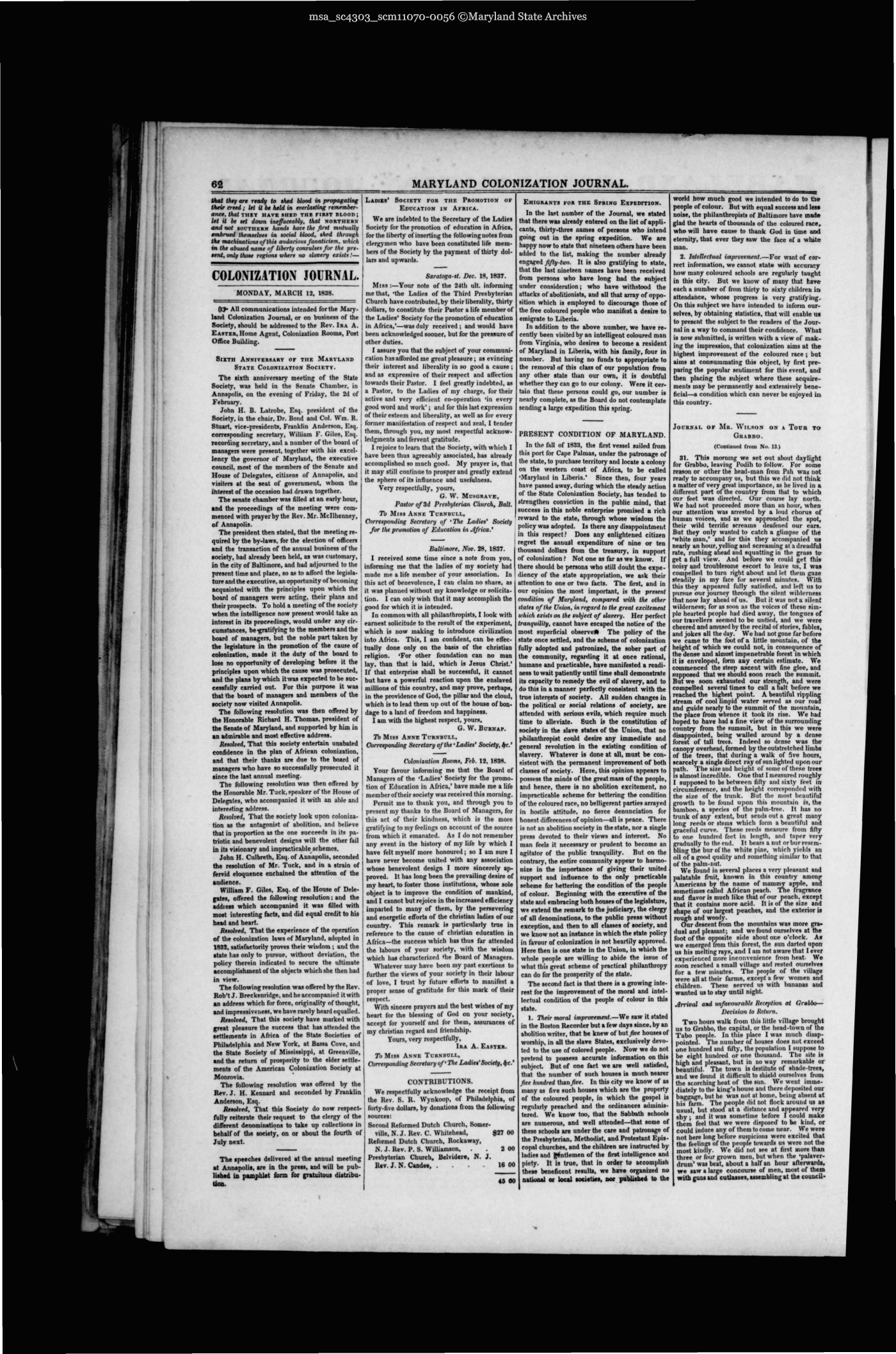
| 62 MARYLAND COLONIZATION JOURNAL. that they art ready to shed blood in propagating their creed ; let ii be held in everlasting remember- anee, that they have shed the first blood; let it be ut down ineffaceable, that northern and not southern hand' hare the first mutually rmbrued themselves in social blood, shed through the machinations of thit audaciout fanaticism, which m the abused name of liberty convulses for the pre- sent, only those regiont where no slavery exists'.— COLONIZATION JOURNAL. MONDAY, MARCH 12, 1838. All communications intended for the Mary- land Colonization Journal, or on business of the Society, should be addressed to the Rev. Ira A. Easter, Home Agent, Colonization Rooms, Post Office Building. Sixth Anniversary of the Maryland State Colonization Society. The sixth anniversary meeting of the State Society, was held in the Senate Chamber, in Annapolis, on the evening of Friday, the 2d of ; February. John H. B. Latrobe, Esq. president of the Society, in the chair. Dr. Bond and Col. Wm. R. Stuart, vice-presidents, Franklin Anderson, Esq. corresponding secretary, William F. Giles, Esq. recording secretary, and a number of the board of managers were present, together with his excel- lency the governor of Maryland, the executive council, most of the members of the Senate and House of Delegates, citizens of Annapolis, and visiters at the teat of government, whom the interest of the occasion had drawn together. The senate chamber was filled at an early hour, and the proceedings of the meeting were com- menced with prayer by the Rev. Mr. Mcllhenney, of Annapolis. The president then stated, that the meeting re- quired by the by-laws, for the election of officers and the transaction of the annual business of the society, had already been held, as was customary, in the city of Baltimore, and had adjourned to the present time and place, so as to afford the legisla- ture and the executive, an opportunity of becoming acquainted with the principles upon which the board of managers were acting, their plans and their prospects. To hold a meeting of the society when the intelligence now present would take an interest in its proceedings, would under any cir- cumstances, be-gratifying to the members and the board of managers, but the noble part taken by the legislature in the promotion of the cause of colonization, made it the duty of the board to lose no opportunity of developing before it the principles upon which the cause was prosecuted, and the plans by which it was expected to be suc- cessfully carried out. For this purpose it was that the board of managers and members of the society now visited Annapolis. The following resolution was then offered by the Honorable Richard H. Thomas, president of the Senate of Maryland, and supported by bim in an admirable and most effective address. Resolved, That this society entertain unabated confidence in the plan of African colonization, and that their thanks are due to the board of managers who have so successfully prosecuted it since the last annual meeting. The following resolution was then offered by the Honorable Mr. Tuck, speaker of the House of Delegates, who accompanied it with an able and interesting address. Resolved, That the society look upon coloniza- tion as the antagonist of abolition, and believe that in proportion as the one succeeds in its pa- triotic and benevolent designs will the other fail in its visionary and impracticable schemes. John H. Culbreth, Esq. of Annapolis, seconded the resolution of Mr. Tuck, and in a strain of fervid eloquence enchained the attention of the audience. William F. Giles, Esq. of the House of Dele- gates, offered the following resolution: and the addiess which accompanied it was filled with most interesting facts, and did equal credit to his head and heart. Resolved, That the experience of the operation of the colonization laws of Maryland, adopted in 1832, satisfactorily proves their wisdom ; and the state has only to pursue, without deviation, the policy therein indicated to secure the ultimate accomplishment of the objects which she then had in view. The following resolution was offered by the Rev. Rob't J. Breekenridge, and he accompanied it with an address which for force, originality of thought, and impressiveness, we have rarely heard equalled. Resolved, That this society have marked with great pleasure the success that has attended the settlements in Africa of the State Societies of i Philadelphia and New York, at Bassa Cove, and the State Society of Mississippi, at Greenville, and the return of prosperity to the elder settle- ments of the American Colonization Society at Monrovia. The following resolution was offered by the] Rev. J. H. Kennard and seconded by Franklin Anderson, Esq. Resolved, That this Society do now respect- fully reiterate their request to the clergy ol the different denominations to take up collections in behalf of the society, on or about the fourth of July next. Ladies' Society for the Promotion or Education in Africa. We are indebted to the Secretary of the Ladies Society for the promotion of education in Africa, for the liberty of inserting the following notes from ; clergymen who have been constituted life metn- | bers of the Society by the payment of thirty dol- | lars and upwards. Saratoga-st. Dec. 18, 1837. Miss :—Your note of the 24th ult. informing me that, 'the Ladies of the Third Presbyterian Church have contributed, by their liberality, thirty dollars, to constitute their Pastor a life member of the Ladies' Society for the promotion of education in Africa,'—was duly received ; and would have been acknowledged sooner, but for the pressure of other duties. I assure yon that the subject of your communi- cation has afforded me great pleasure; as evincing their interest and liberality in so good a cause ; and as expressive of their respect and affection towards their Pastor. I feel greatly indebted, as a Pastor, to the Ladies of my charge, for their active and very efficient co-operation 'in every good word and work'; and for this last expression of their esteem and liberality, as well as for every former manifestation of respect and zeal, I tender them, through you, my most respectful acknow- ledgments and fervent gratitude. I rejoice to learn that the Society, with which I have been thus agreeably associated, has already accomplished so much good. My prayer is, that it may still continue to prosper and greatly extend the sphere of its influence and usefulness. Very respectfully, yours, G. W. Musgrave, Pastor of 3d Presbyterian Church, Bait. To Miss Anne Turnblll, Corresponding Secretary of 'The Ladies' Society for the promotion of Education in Africa.' Emigrants fob the Spring Expedition. In the last number of the Journal, we stated that there was already entered on the list of appli- cants, thirty-three names of persons who intend going out in the spring expedition. We are happy now to state that nineteen others have been added to the list, making the number already engaged fifty-two. It is also gratifying to state, that the last nineteen names have been received from persons who have long had the subject under consideration; who have withstood the attacks of abolitionists, and all that array of oppo- sition which is employed to discourage those of the free coloured people who manifest a desire to emigrate to Liberia. In addition to the above number, we have re- cently been visited by an intelligent coloured man from Virginia, who desires to become a resident of Maryland in Liberia, with his family, four in number. But having no funds to appropriate to the removal of this class of our population from any other state than our own, it is doubtful whether they can go to our colony. Were it cer- tain that these persons could go, our number is nearly complete, as the Board do not contemplate sending a large expedition this spring. Baltimore, Nov. 28, 1837. I received some time since a note from you, informing me that the ladies of my society had made me a life member of your association. In this act of benevolence, I can claim no share, as it was planned without my knowledge or solicita- tion. I can only wish that it may accomplish the good for which it is intended. In common with all philanthropists, I look with earnest solicitude to the result of the experiment, which is now making to introduce civilization into Africa. This, I am confident, can be effec- tually done only on the basis of the christian religion. 'For other foundation can no man lay, than that is laid, which is Jesus Christ.' If that enterprise shall be successful, it cannot but have a powerful reaction upon the enslaved millions of this country, and may prove, perhaps, in the providence of God, the pillar and the cloud, which is to lead them up out of the house of bon- dage to a land of freedom and happiness. I am with the highest respect, yours, G. W. BURNAP. To Miss Anne Turnbull, Corresponding Secretary of the'Ladies' Society, &c.' Colonization Rooms, Feb. 12, 1838. Your favour informing me that the Board of Managers of the -Ladies' Society for the promo- tion of Education in Africa,' have made me a life member of their society was received this morning. Permit me to thank you, and through you to present my thanks to the Board of Managers, for this act of their kindness, which is the more gratifying to my feelings on account of the source from which it emanated. As I do not remember any event in the history of my life by which I have felt myself more honoured; so I am sure I have never become united with any association whose benevolent design I more sincerely ap- proved. It has long been the prevailing desire of my heart, to foster those institutions, whose sole object is to improve the condition of mankind, and I cannot but rejoice in the increased efficiency impaited to many of them, by the persevering and energetic efforts of the christian ladies of our country. This remark is particularly true in reference to the cause of christian education in Africa—the success which has thus far attended the labours of your society, with the wisdom which has characterized 'he Board of Managers. Whatever may have been my past exertions to further the views of your society in their labour of love, I trust by future efforts to manifest a proper sense of gratitude for this mark of their respect. With sincere prayers and the best wishes of my heart for the blessing of God on your society, accept for yourself and for them, assurances of my christian regard and friendship. Yours, very respectfully, Ira A. Easter. To Miss Anne Turnbui.l, Corresponding Secretary of The Ladies' Society, &c' The speeches delivered at the annual meeting at Annapolis, are in thr press, and will be pub- lished is pamphlet form for gratuitous distribu- tion. CONTRIBUTIONS. We respectfully acknowledge the receipt from [ the Rev. S. R. Wynkoop, of Philadelphia, of forty-five dollars, by donations fioin the following . sources: Second Reformed Dutch Church, Somer- ville, N. J. Rev. C. Whitehead, $27 00 Reformed Dutch Church, Rockaway, N. J. Rev. P. S. Williamson, . 2 00 Presbyterian Church, Belvidere, N. J, Rev. J. N. Cand«, . 16 00 43 00 PRESENT CONDITION OF MARYLAND. In the fall of 1833, the first vessel sailed from this port for Cape Palmas, under the patronage of the state, to purchase territory and locate a colony on the western coast of Africa, to be called 'Maryland in Liberia.' Since then, four years have passed away, during which the steady action of the State Colonization Society, has tended to strengthen conviction in the public mind, that success in this noble enterprise promised a rich reward to the state, through whose wisdom the policy was adopted. Is there any disappointment in this respect? Does any enlightened citizen regret the annual expenditure of nine or ten thousand dollars from the treasury, in support of colonization ? Not one as far as we know. If there should be persons who still doubt the expe- diency of the state appropriation, we ask their attention to one or two facts. The first, and in our opinion the most important, is the present condition of Maryland, compared with the other itates of the Union, in regard to the great excitement which exists on the subject of slavery. Her perfect tranquility, cannot have escaped the notice of the most superficial observe*) The policy of the state once settled, and the scheme of colonization fully adopted and patronized, the sober part of the community, regarding it at once rational, humane and practicable, have manifested a readi- ness to wait patiently until time shall demonstrate its capacity to remedy the evil of slavery, and to do this in a manner perfectly consistent with the true interests of society. All sudden changes in the political or social relations of society, are attended with serious evils, which require much time to alleviate. Such is the constitution of society in the slave states of the Union, that no philanthropist could desire any immediate and general revolution in the existing condition of slavery. Whatever is done at all, must be con- sistent with the permanent improvement of both classes of society. Here, this opinion appears to possess the minds of the great mass of the people, and hence, there is no abolition excitement, no impracticable scheme for bettering the condition of the coloured race, no belligerent parties arrayed in hostile attitude, no fierce denunciation for honest differences of opinion—all is peace. There is not an abolition society in the state, nor a single press devoted to their views and interest. No man feels it necessary or prudent to become an agitator of the public tranquility. But on the contrary, the entire community appear to harmo- nize in the importance of giving their united support and influence to the only practicable scheme for bettering the condition of the people of colour. Beginning with the executive of the state and embracing both houses of the legislature, we extend the remark to the judiciary, the clergy of all denominations, to the public press without exception, and then to all classes of society, and we know not an instance in which the state policy in favour of colonization is not heartily approved. Here then is one state in the Union, in which the whole people are willing to abide the issue of what this great scheme of practical philanthropy can do for the prosperity of the state. The second fact is that there is a growing inte- rest for the improvement of the moral and intel- lectual condition of the people of colour in this state. 1. Their moral improvement.—We saw it stated in the Boston Recorder but a few days since, by an abolition writer, that he knew of but/roe houses of worship, in all the slave States, exclusively devo- ted to the use of colored people. Now we do not pretend to possess accurate information on this subject. But of one fact we are well satisfied, that the number of such bouses is much nearer five hundred thanjlre. In this city we know of as many as five such houses which are the property of the coloured people, in which the gospel is regularly preached and the ordinances adminis- tered. We know too, that the Sabbath schools are numerous, and well attended—that some of these schools are under the care and patronage of the Presbyterian, Methodist, and Protestant Epis- copal churches, and the children are instructed by ladies and gentlemen of the first intelligence and piety. It is true, that in order to accomplish these beneficent results, we hire organized no national or local societies, dot pabiiiocd to the world how much good we intended to do to the people of colour. But with equal success and less noise, the philanthropists of Baltimore have made glad the hearts of thousands of the coloured race, who will have cause to thank God in time and eternity, that ever they saw the face of a white man. 2. Intellectual improvement.—For want of cor- rect information, we cannot state with accuracy how many coloured schools are regularly taught in this city. But we know of many that have each a number of from thirty to sixty children in attendance, whose progress is very gratifying. On this subject we have intended to inform our- selves, by obtaining statistics, that will enable us to present the subject to the readers of the Jour- nal in a way to command their confidence. What is now submitted, is written with a view of mak- ing the impression, that colonization aims at the highest improvement of the coloured race ; but aims at consummating this object, by first pre- paring the popular sentiment for this event, and then placing the subject where these acquire- ments may be permanently and extensively bene- ficial—a condition which can never be enjoyed in this country. Journal of Mr. Wilson on a Tour to Grabbo (nmliini.il from No. 13 ) 31. This morning we set out about daylight for Grabbo, leaving Podih to follow. For some reason or other the head-man from Pah was not ready to accompany us, but this we did not think a matter of very great importance, as he lived in a different part of the country from that to which our feet was directed. Our course lay north. We had not proceeded more than an hour, when our attention was arrested by a loud chorus of human voices, and as we approached the spot, their wild terrific screams deafened our ears. But they only wanted to catch a glimpse of the 'white man,' and for this they accompanied ut nearly an hour, yelling and screaming at a dreadful rate, rushing ahead and squatting in the grass to get a full view. And before we could get this noisy and troublesome escort to leave us, I was compelled to turn right about and let them gaze steadily in my face for several minutes. With this they appeared fully satisfied, and left us to pursue our journey through the silent wilderness that now lay ahead of us. But it was not a silent wilderness; for as soon M the voices of these sim- ple hearted people had died away, the tongues of our travellers seemed to be untied, and we were cheered and amused by the recital of stories, fables, and jokes all the day. We had not gone far before we came to the foot of a little mountain, of the height of which we could not, in consequence of the dense and almost impenetrable forest in which it is enveloped, form any certain estimate. We commenced the steep ascent with fine glee, and supposed that we should soon reach the summit. But we soon exhausted our strength, and were compelled several times to call a halt before we readied the highest point. A beautiful rippling stream of cool limpid water served as our road and guide nearly to the summit of the mountain, the place from whence it took its rise. We had hoped to have had a fine view of the surrounding country from the summit, but in this we were disappointed, being walled around by a dense forest of tall trees. Indeed so dense was the canopy overhead, formed by the outstretched limbs of the trees, that during a walk of five hours, scarcely a single direct ray of sun lighted upon our path. The size and height of some of these trees is almost incredible. One that I measured roughly I supposed to be between fifty ami sixty feet in circumference, and the height corresponded with the size of the trunk. But the most beautiful growth to be found upon this mountain is, the bamboo, a species of the palm-tree. It has no trunk of any extent, but sends out a great many long reeds or steins which form a beautiful and graceful curve. These reeds measure from fifty to one hundred feet in length, and taper very gradually to the end. It bears a nut orburresem- bling the bur of the white pine, which yields an oil of a good quality and something similar to that of the palm-nut. We found in several places a very pleasant and palatable fruit, known in this country amour Americans by the name of mammy apple, and sometimes called African peach. The fragrance and flavor is much like that of our peach, except that it contains more acid. It is ol the size and shape of our largest peaches, and the exterior is rough and woody. Onr descent from the mountains was more gra- dual and pleasant; and we found ourselves at the foot of the opposite side about one o'clock. As we emerged from this forest, the sun darted upon us his melting rays, and I am not aware that I ever experienced more inconvenience from heat We soon reached a small village and rested ourselves for a lew minutes. The people of the village were all at their farms, except a few women and children. These served us with bananas and wanted us to stay until night. Arrival and unfavourable Reception at Grabbo— Decision to Return. Two hours walk from this little village brought us to Grabbo, the capital, or the head-town of the Tabo people. In this place I was much disap- pointed. The number of houses does not exceed one hundred and fifty, the population I suppose to be eight hundred or one thousand. The site is high and pleasant, but in no way remarkable or beautiful. The town is destitute of shade-trees, and we found it difficult to shield ourselves from the scorching heat of the sun. We went imme- diately to the king's house and there deposited our baggage, but he was not at home, being absent at his farm. The people did not flock around us as usual, but stood at a distance and appeared very shy ; and it was sometime before I could make them feel that we were disposed to he kind, or could induce any of them to come near. We were not here long before suspicions were excited that the feelings of the people towards us were not the most kindly. We did not see at first more than three or four grown men, but when the 'palaver- drum' was beat, about a half an hour afterwards, we saw a large concourse of men, most of them with guns and cutlasses, assembling at the council- |