 |
|
|
 |
|
 |
|
|||
|
||||
|
||||
|
Maryland State Archives Maryland Colonization Journal Collection MSA SC 4303 msa_sc4303_scm11070-0055 Enlarge and print image (5M) |
|
|
|
|
|
|
|
|||
|
||||
|
||||
|
Maryland State Archives Maryland Colonization Journal Collection MSA SC 4303 msa_sc4303_scm11070-0055 Enlarge and print image (5M) |
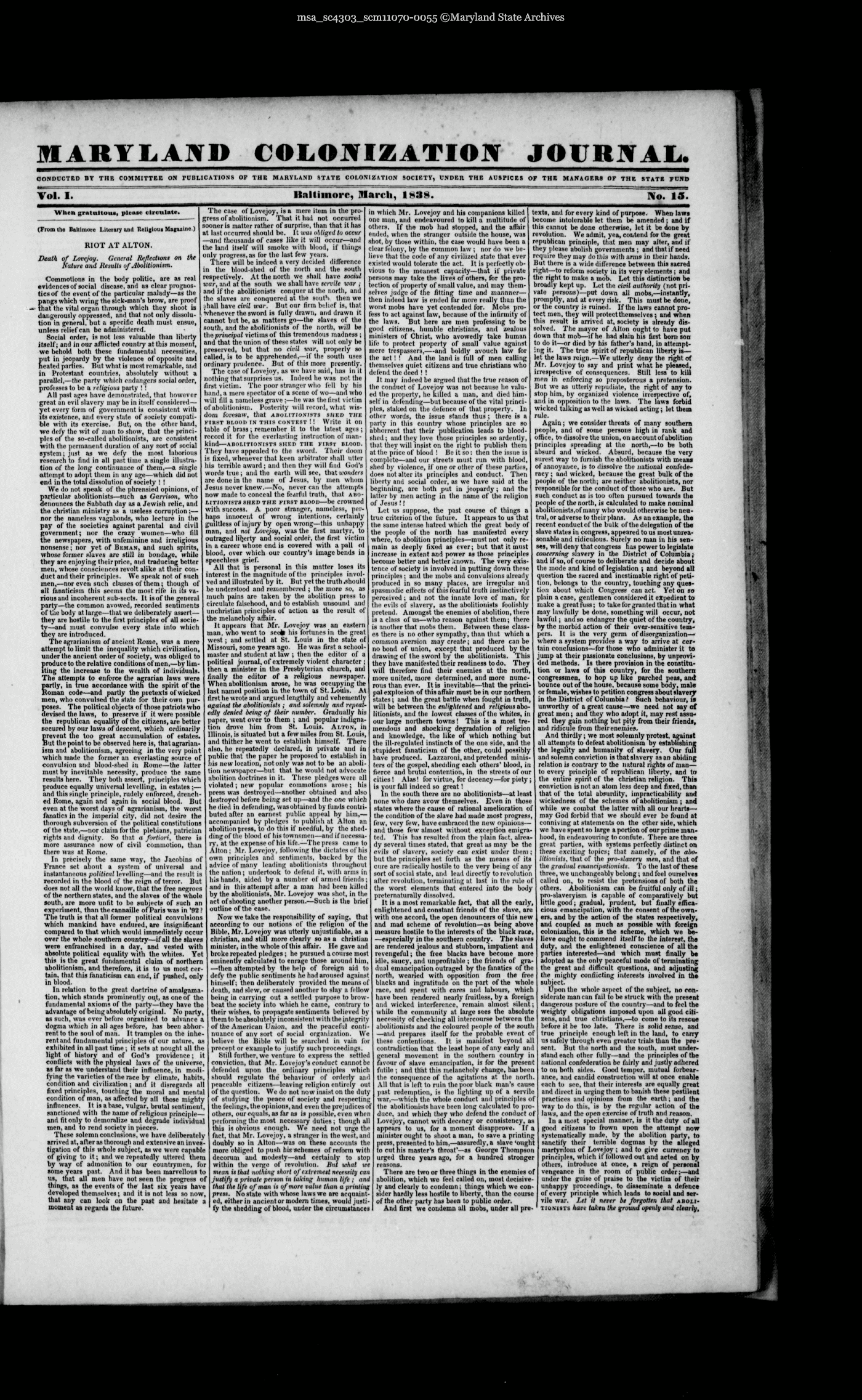
| MARYLAND COLONIZATION JOURNAL.. CONDUCTED BY THE COMMITTEE ON PUBLICATIONS OF THE MARYLAND STATE COLONIZATION SOCIETY, UNDER THE AUSPICES OF THE MANAGERS OF THE STATE FUND Vol. I. Baltimore, March, 1838. No. 15. When gratuitous! please circulate. (From the Baltimore Literary and Religious Magazine) RIOT AT ALTON. Death of Lovejoy. General Reflections on the Nature arid Results of Abolitionism. Commotions in the body politic, are as real evidences of social disease, and as clear prognos- tics of the event of the particular malady—as the pangs which wring the sick-man's brow, are proof that the vital organ through which they shoot is dangerously oppressed, and that not only dissolu- tion in general, but a specific death must ensue, unless relief can be administered. Social order, is not less valuable than liberty itself; and in our afflicted country at this moment, we behold both these fundamental necessities, put in jeopardy by the violence of opposite ami neated parties. But what is most remarkable, and in Protestant countries, absolutely without a parallel,—the party which endangers social order, professes to be a religious party ! ! All past ages have demonstrated, that however great an evil slavery may be in itself considered— yet every form of government is consistent with its existence, and every state of society compati- ble with its exercise. But, on the other hand, we defy the wit of man to show, that the princi- ples ot the so-called abolitionists, are consistent with the permanent duration of any sort of social system; just as we defy the most laborious research to find in all past time a single illustra- tion of the long continuance of them,—a single attempt to adopt them in any age—which did not end in the total dissolution of society ! ! We do not speak of the phrensied opinions, of particular abolitionists—such as Garrison, who denounces the Sabbath day as a Jewish relic, and the christian ministry as a useless corruption;— nor the nameless vagabonds, who lecture in the pay of the societies against parental and civil government; nor the crazy women—who fill the newspapers, with unfeminine and irreligious nonsense; nor yet of Bkman, and such spirits, whose former slaves are still in bondage, while they are enjoying thcirprice, and traducing better men, whose consciences revolt alike at their con- duct and their principles. We speak not of such men,—nor even such classes of them ; though of all fanaticism this seems the most rife in its va- rious and incoherent sub-sects. It is of the general party—the common avowed, recorded sentiments of the body at large—that we deliberately assert— they are hostile to the first principles of all socie- ty—and must convulse every state into which they are introduced. The agrarianism of ancient Rome, was a mere attempt to limit the inequality which civilization, under the ancient order of society, was obliged to produce to the relative conditions of men,—by lim- iting the increase to the wealth of individuals. The attempts to enforce the agrarian laws were partly, in true accordance with the spirit of the Roman code—and partly the pretexts of wicked men, who convulsed the slate for their own pur- poses. The political objects of those patriots who devised the laws, to preserve if it were possible the republican equality of the citizens, are better secured by our laws of descent, which ordinarily prevent the too great accumulation of estates. But the point to be observed here is, that agrarian- ism and abolitionism, agreeing in the very point which made the former an everlasting source of convulsion and blood-shed in Rome—the latter must by inevitable necessity, produce the same results here. They both assert, principles which produce equally universal levelling, in estates ;— and this single principle, rudely enforced, drench- ed Rome, again and again in social blood. But even at the worst days of agrarianism, the worst fanatics in the imperial city, did not desire the thorough subversion of the political constitutions of the state,—nor claim for the plebians, patrician rights and dignity. So that a fortiori, there is more assurance now of civil commotion, than there was at Rome. In precisely the same way, the Jacobins of France set about a system of universal and instantaneous politieul levelling—and the result is recorded in the blood of the reign of terror. But does not all the world know, that the free negroes of the northern states, and the slaves of the whole south, are more unfit to be subjects of such an experiment, than thecannaille of Paris was in '02 ? The truth is that all former political convulsions which mankind have endured, are insignificant compared to that which would immediately occur over the whole southern country—if all the slaves were enfranchised in a day. and vested with absolute political equality with the whites. Yet this is the great fundamental claim of northern abolitionism, and therefore, it is to us most cer- tain, that this fanaticism can end, if pushed, only in blood. In relation to the great doctrine of amalgama- tion, which stands prominently out, as one of the fundamental axioms of the party—they have the advantage of being absolutely original. No party, as such, was ever before organized to advance a dogma which in all ages before, has been abhor- rent to the soul of man. It tramples on the inhe- rent and fundamental principles of our nature, as exhibited in all past time ; it sets at nought all the light of history and of God's providence; it conflicts with the physical laws of the universe, as far as we understand their influence, in modi- fying the varieties of the race by climate, habits, condition and civilization ; and it disregards all fixed principles, touching the moral and mental condition of man, as affected by all those mighty influences. It is abase, vulgar, brutal sentiment, sanctioned with the name of religious principle— and fit only to demoralize and degrade individual men, and to rend society in pieces. These solemn conclusions, we have deliberately arrived at, after as thorough and extensive an inves- tigation of this whole subject, as we were capable of giving to it; and we repeatedly uttered them by way of admonition to our countrymen, for some years past. And it has been marvellous to us, that all men have not seen the progress of things, as the events of the last six years have developed themselves; and it is not less so now, that any can look on the past and hesitate a moment as regards the future. The case of Lovejoy, is a mere item in the pro- gress of abolitionism. That it had not occurred sooner is matter rather of surprise, than that it has at last occurred should be. It teas obliged to occur —and thousands of cases like it will occur—and the land itself will smoke with blood, if things onlv progress, as for the last few years. There will be indeed a very decided difference in the blood-shed of the north and the south respectively. At the north we shall have tociul war, and at the south we shall have servile war ; and if the abolitionists conquer at the north, and the slaves are conquered at the sout1'. then we shall have civil war. But our firm belief is, that Whenever the sword is fully drawn, and drawn it cannot but be, as matters go—the slaves of the south, and the abolitionists of the north, will he the principal victims of this tremendous madness ; and that the union of these states will not only he preserved, but that no civil war, properly so called, is to be apprehended,—if the south uses ordinary prudence. But of this more presently. The case of Lovejoy, as we have said, has in it nothing that surprises us. Indeed he was not the first victim. The poor stranger who fell by his hand, a mere spectator of a scene of wo—and who will fill a nameless grave ;—he was the first victim of abolitionism. Posterity will record, what wis- dom foresaw, that abolitionists shed the first blood in this contest !! Write it on table of brass; remember it to the latest ages ; record it for the everlasting instruction of man- kind—ABOLITIONISTS SHED THE FIRST BLOOD. They have appealed to the sword. Their doom is fixed, whenever that keen arbitrator shall utter his terrible award; and then they will find God's words true; and the earth will see, that wonders are done in the name of Jesus, by men whom Jesus never knew.—No, never can the attempts now made to conceal the fearful truth, that abo- litionists shed the first BLOOD—be crowned with success. A poor stranger, nameless, per- \ haps innocent of wrong intentions, certainly guiltless of injury by open wrong—this unhappy man, and not Lovejoy, was the first martyr, to outraged liberty and social order, the first victim in a career whose end is covered with a pall ni blood, over which our country's image bends in speechless grief. All that is personal in this matter loses its interest in the magnitude of the principles invol- ved and illustrated by it. But yet the truth .should be understood and remembered ; the more so, as much pains are taken by the abolition press to circulate falsehood, and to establish unsound and unchristian principles of action as the result of the melancholy affair. It appears that Mr. Lovejoy was an eastern man, wlio went to seoil his fortunes in the great west; and settled at St. Louis in the state of Missouri, some years ago. He was first a school- master and student at law ; then the editor of a political journal, of extremely violent character; then a minister in the Presbyterian church, and finally the editor of a religious newspaper. When abolitionism arose, he was occupying the last named position in the town of St. Louis. At first he wrote and argued lengthily and vehemently against the abolitionists; and solemnly and repeat- edly denied being of their number. Gradually his paper, went over to them ; and popular indigna- tion drove him from St. Louis. Alton, in Illinois, is situated but a few miles from St. Louis, and thither he went to establish himself. There also, he repeatedly declared, in private and in fiublic that the paper he proposed to establish in lis new location, not only was not to be an aboli- tion newspaper—but that he would not advocate abolition doctrines in it. These pledges were all violated; new popular commotions arose; his press was destroyed—another obtained and also destroyed before being set up—and the one which he died in defending, was obtained by funds contri- buted after an earnest public appeal by him,— accompanied by pledges to publish at Alton an abolition press, to do this if needful, by the shed- ding of the blood of his townsmen—ami if necessa- ry, at the expense of his life.—The press came to Alton; Mr. Lovejoy, follow ing the dictates of his own principles and sentiments, backed by the advice of many leading abolitionists throughout the nation; undertook to defend it, with arms in his hands, aided by a number of armed friends; and in this attempt after a man had been killed by the abolitionists, Mr. Lovejoy was shot, in the act of shooting another person.—Such is the brief outline of the case. Now we take the responsibility of saying, that according to our notions of the religion of the Bible, Mr. Lovejoy was utterly unjustifiable, as a christian, and still more clearly so as a christian minister, in the whole of this affair. He gave and broke repeated pledges ; he pursued a course most eminently calculated to enrage those around him, —then aitempted by the help of foreign aid to defy the public sentiments he had aroused against himself; then deliberately provided the means of death, and slew, or caused another to slay a fellow being in carrying out a settled purpose to brow- beat the society into which he came, contrary to their wishes, to propagate sentiments believed by them to be absolutely inconsistent with the integrity of the American Union, and the peaceful conti- nuance of anv sort of social organization. We believe the Bible will be searched in vain for precept or example to justify such proceedings. Still further, we venture to express the settled conviction, that Mr. Lovejoy's conduct cannot be defended upon the ordinary principles which should regulate the behaviour of orderly and peaceable citizens—leaving religion entirely out of the question. We do not now insist on the duty of studying the peace of society and respecting the feelings, the opinions, and even the prejudices of others, our equals, as far as is possible, even when performing the most necessary duties ; though all this is obvious enough. We need not urge the fact, that Mr. Lovejoy, a stranger in the west, and doubly so in Alton—was on these accounts the more obliged to push his schemes of reform with decorum and modesty—and certainly to stop within the verge of revolution. But what we mean is that nothing short of extremett necessity can justify a private person in taking human life ; and that the UJ'e of man is of more value than a printing press. No state with whose laws we are acquaint- ed, either in ancient or modern times, would justi- fy the shedding of blood, under the circumstances in which Mr. Lovejoy and his companions killed one man, and endeavoured to kill a multitude of others. If the mob had stopped, and the affair ended, when the stranger outside the house, was shot, by those within, the case would have been a clear felony, by the common law ; nor do we be- lieve that the code of any civilized state that ever existed would tolerate the act. It is perfectly ob- vious to the meanest capacity—that if private persons may take the lives of others, for the pro- tection of property of small value, and may them- selves judge of the fitting time and mannner— then indeed law is ended far more really than the worst mobs have yet contended for. Mobs pro- fess to act against law, because of the infirmity of the laws. But here are men professing to be good citizens, humble christians, and zealous ministers of Christ, who avowedly take human life to protect property of small value against mere trespassers,—and boldly avouch law for the act ! I And the land is lull of men calling themselves quiet citizens and true christians who defend the deed ! ! It may indeed be argued that the true reason of the conduct of Lovejoy was not because he valu- ed the property, he killed a man, and died him- self in defending—but because of the vital princi- ples, staked on the defence of that property. In other words, the issue stands thus ; there is a party in this country whose principles are so abhorrent that their publication leads to blood- shed; and they love those principles so ardently, that they will insist on the right to publish them at the price of blood ! Be it so: then the issue is complete—and our streets must run with blood, shed by violence, if one or other of these parties, does not alter its principles and conduct. Then liberty and social order, as we have said at the beginning, are both put in jeopardy; and the hitler by men acting in the name of the religion of Jesus !! Let us suppose, the past course of things a true criterion of the future. It appears to us that the same intense hatred which the great body of the people of the north has manifestrd every where, to abolition principles—must not only re- main as deeply fixed as ever; but that it must increase in extent and power as those principles become better and better linnwn. The very exis- tence of society is involved in putting down these principles; and the mobs and convulsions already produced in so many places, are irregular and spasmodic effects of this tearful truth instinctively perceived ; and not the innate love of man, for the evils of slavery, as the abolitionists foolishly pretend. Amongst the enemies of abolition, there is a class of us—who reason against them; there is another that mobs them. Between these class- es there is no other sympathy, than that which a common aversion may create; and there can be no bond of union, except that produced by the drawing of the sword by the abolitionists. This they have manifested their readiness to do. They will therefore find their enemies at the north, more united, more determined, and more nume- rous than ever. It is inevitable—that the princi- pal explosion of this affair must be in our northern states; and the great battle when fought in truth, will be between the enlightened and religious abo- litionists, and the lowest classes of the whites, in our large northern towns! This is a most tre- mendous and shocking degradation of religion and knowledge, the like of which nothing but the ill-regulated instincts of the one side, and the stupidest fanaticism of the other, could possibly have produced. Lazzaroni, and pretended minis- ters of the gospel, shedding each others' blood, in fierce and brutal contention, in the streets of our cities! Alas', for virtue, for decency—for piety ; is vourfall indeed so great! In the south there are no abolitionists—at least none who dare avow themselves. Even in those states where the cause of rational amelioration of the condition of the slave had made most progress, few, very few, have embraced the new opinions— and those few almost without exception emigra- ted. This has resulted from the plain fact, alrea- dy several times stated, that great as may be the evils of slavery, society can exist under them; but the principles set forth as the means of its cure are radically hostile to the very being of any sort of social state, and lead directly to revolution alter revolution, terminating at last in the rule of the worst elements that entered into the body preternaturally dissolved. It is a most remarkable fact, that all the early, enlightened and constant friends of the slave, are with one accord, the open denouncers of this new and mad scheme of revolution—as being above measure hostile to the interests of the black race, —especially in the southern country. The slaves are rendered jealous and stubborn, impatient and revengeful; the free blacks have become more idle, saucy, and unprofitable ; the friends of gra- dual emancipation outraged by the fanatics of the north, wearied with opposition from the free blacks and ingratitude on the part of the whole race, and spent with cares and labours, which have been rendered nearly fruitless, by a foreign and wicked interference, remain almost silent; while the community at large sees the absolute necessity of checking all intercourse between the abolitionists and the coloured people of the south —and prepares itself for the probable event of these contentions. It is manifest beyond all contradiction that the least hope of any early and geneial movement in the southern country in favour of slave emancipation, is for the present futile | and that this melancholy change, has been the consequence of the agitations at the north. All that is left to ruin the poor black man's cause past redemption, is the lighting up of a servile war,—which the whole conduct and principles of the abolitionists have been long calculated to pro- duce, and which they who defend the conduct of Lovejoy, cannot with decency or consistency, as appears to us, for a moment disapprove. If a minister ought to shoot a man, to save a printing press, presented to him,—assuredly, a slave 'ought to cut his master's throat'—as George Thompson urged three years ago, for a hundred stronger reasons. There are two or three things in the enemies of abolition, which we feel called on, most decisive- ly and clearly to condemn; things which we con- sider hardly less hostile to liberty, than the course of the other party has been to public order. And first we condemn all mobs, under all pre- texts, and for every kind of purpose. When laws become intolerable let them be amended ; and if this cannot be done otherwise, let it be done by revolution. We admit, yea, contend for the great republican principle, that men may alter, and if they please abolish governments ; and that if need require they may do this with arms in their hands. But there is a wide difference between this saered right—to reform society in its very elements ; and the right to make a mob. Let this distinction be broadly kept up. Let the civil authority (not pri- vate persons)—put down all mobs,—instantly, promptly, and at every risk. This must be done, or the country is ruined. If the laws cannot pro- tect men, they will protectthemselves ; and when this result is arrived at, society is already dis- solved. The mayor of Alton ought to have put down that mob—if he had slain his first born son to do it—or died by his father's hand, in attempt- ing it. The true spirit of republican liberty is— let the laws reign.—We utterly deny the right of Mr. Lovejoy to say and print what he pleased, irrespective of consequences. Still less to kill men in enforcing so preposterous a pretension. But we as utterly repudiate, the right of any to stop him, by organized violence irrespective of, and in opposition to the laws. The laws forbid wicked talking as well as wicked acting; let them rule. Again; we consider threats of many southern people, and of some persons high in rank and office, to dissolve the union, on account of abolition principles spreading at the north,—to be both absurd and wickeil. Absurd, because the very surest way to furnish the abolitionists with means of annoyance, is to dissolve the national confede- racy ; and wicked, because the great bulk of the people of the north; are neither abolitionists, nor responsible for the conduct of those who are. But such conduct as is too often pursued towards the people of the north, is calculated to make nominal abolilionists.of many who would otherwise be neu- tral, or adverse to their plans. As an example, the) recent conduct of the bulk of the delegation of tbe slave states in congress, appeared to us most unrea- sonable and ridiculous. Surely no man in his sen- ses, will deny that congress has power to legislate concerning slavery in the District of Columbia; and if so, of course to deliberate and decide about the mode and kind of legislation ; and beyond all question the sacred and inestimable right of peti- tion, belongs to the country, touching any ques- tion about which Congress can act. Yet on so plain a case, gentlemen considered it expedient to make a great fuss; to take for granted that in what may lawfully be done, something will occur, not lawful; and so endanger the quiet of the country, by the morbid action of their over-sensitive tem- pers. It is the very germ of disorganization— where a system provides a way to arrive at cer- tain conclusions—for those who administer it to jump at their passionate conclusions, by unprovi- ded methods. Is there provision in the constitu- tion or laws of this country, for the southern congressmen, to hop up like parched peas, and bounce out of the house, because some body, male or female, wishes to petition congress about slaverer in the District of Columbia ? Such behaviour, if unworthy of a great cause—we need not say of great men; and they who adopt it, may rest assu- red they gain nothing but pity from their friends, and ridicule from their enemies. And thirdly; we most solemnly protest, against all attempts to defeat abolitionism by establishing the legality and humanity of slavery. Our full and solemn conviction is that slavery as an abiding relation is contrary to the natural rights of man— to every principle of republican liberty, and to the entire spirit of the christian religion. This conviction is not an atom less deep and fixed, than that of the total absurdity, impracticability and wickedness of the schemes of abolitionism ; and while we combat the latter with all our hearts— may God forbid that we should ever be found at conniving at statements on the other side, which we have spent so large a portion of our prime man- hood, in endeavouring to confute. There are three great parties, with systems perfectly distinct on these exciting topics; that namely, of the abo- litionists, that of the pro-slavery men, and that of the gradual emancipationists. To the last of these three, we unchangeablv belong; and feel ourselves called on, to resist the pretensions of both the others. Abolitionism can be fruitful only of ill; pro-slaveryism is capable of comparatively but little good; gradual, prudent, but finally effica- cious emancipation, with the consent of the own- ers, and by the action of the states respectively, and coupled as much as possible with foreign colonization, this is the scheme, which we be- lieve ought to commend itself to the interest, the duty, and the enlightened conscience of all the parties interested—and which must finally be adopted as the only peaceful mode of terminating the great and difficult questions, and adjusting the mighty conflicting interests involved in the subject. Upon the whole aspect of the subject, no con- siderate man can fail to be struck with the present dangerous posture of the country—ami to feel the weighty obligations imposed upon all good citi- zens, and true christians,—to come to its rescue before it be too late. There is solid sense, and true principle enough left in the land, to carry us safelv through even greater trials than the pre- sent. But the north and the south, must under- stand each other fully—and the principles of tbe national confederation be fairly and justly adhered to on both sides. Good temper, mutual forbear- ance, and candid construction will at once enable each to see, that their interests are equally great and direct in urging them to banish these pestilent practices and opinions from the earth; and the way to do this, is by the regular action of the laws, and the open exercise of truth and reason. In a most special manner, is it the duty of all good citizens to frown upon the attempt now systematically made, by the abolition party, to sanctify their terrible dogmas by the alleged martyrdom of Lovejoy ; and to give currency to principles, which if followed out and acted on by others, introduce at once, a reign of personal vengeance in the room of public order;—and under the guise of praise to the victim of their unhappy proceedings, to disseminate a defence of every principle which leads to social and ser- vile war. Let it never be forgotten that aboli- tionists have taken the ground openly and clearly, |