 |
|
|
 |
|
 |
|
|||
|
||||
|
||||
|
Maryland State Archives Maryland Colonization Journal Collection MSA SC 4303 msa_sc4303_scm11070-0060 Enlarge and print image (4M) |
|
|
|
|
|
|
|
|||
|
||||
|
||||
|
Maryland State Archives Maryland Colonization Journal Collection MSA SC 4303 msa_sc4303_scm11070-0060 Enlarge and print image (4M) |
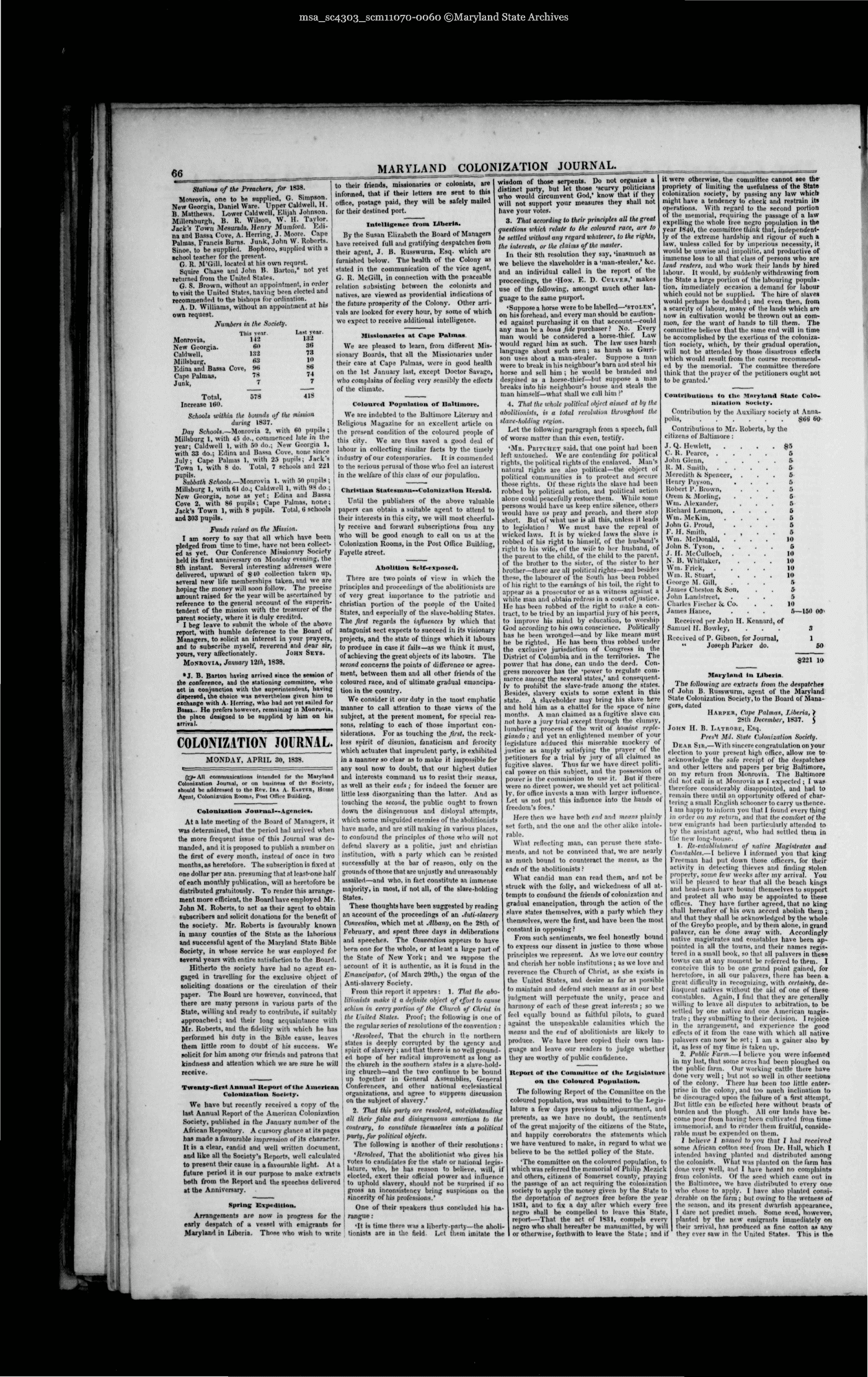
| 66 MARYLAND COLONIZATION JOURNAL. Staliont of the Preacher*, for 1938. Monrovia, one to be supplied, G. Simpson. New Georgia, Daniel Ware. Upper Caldwell, H. B. Matthews. Lower Caldwell, Elijah Johnson. Millersburgh, B. R. Wilson, W. H. Taylor. Jack's Towti Mesurada, Henry Mumford. Edi- na and Bassa Cove, A. Herring, J. Moore. Cape Palmas, Francis Burns. Junk, John W. Roberts. Sinoe, to be supplied. Bophoro, supplied with a ichool teacher for the present. G. R. M'Gill. located at his own request. Squire Chase and John B. Barton,* not yet returned from the United States. G. S. Brown, without an appointment, in order to visit the United States, having been elected and recommended to the bishops for ordination. A. D. Williams, without an appointment at his own request. Numbers in the Society, Monrovia, New Georgia. Caldwell, Millsburg, Edina and Bassa Cove, Cape Palmas, Junk, Last year 142 132 60 36 132 73 63 10 96 86 78 74 7 7 Total, 578 Increase 160. 418 to their friends, missionaries or colonists, are informed, that if their letters are sent to this office, postage paid, they will be safely mailed for their destined port. Intelligence from Liberia. By the Susan Elizabeth the Board or Managers have received full and gratifying despatches from their agent, J. B. Russwurm, Esq. which are furnished below. The health of the Colony as stated in the communication of the vice agent, G. R. McGill, in connection with the peaceable relation subsisting between the colonists and natives, are viewed as providential indications of the future prosperity of the Colony. Other arri- vals are looked for every hour, by some of which we expect to receive additional intelligence. Missionaries at Cape Palmas. We are pleased to learn, from different Mis- sionary Boards, that all the Missionaries under their care at Cape I'almas, were in good health on the 1st January last, except Doctor Savage, who complains of feeling very sensibly the effects of the climate. Schools within the bounds of the mission during 1837. Day Schools—Monrovia 2, with 60 pupils ; Millsburg 1, with 45 do., commenced late in the year; Caldwell 1, with M do.; New Georgia 1, with 33 do.; Edina and BMW Cove, none since July; Cape 1'alnias V, with 25 pupils; Jack"s Town 1, with 8 do. Total, 7 schools and 221 pupils. Sabbath Schools.—Monrovia 1, with 50 pupils ; Millsburg I, with 61 do.; Caldwell 1, with M do ; New Georgia, none as vet j Edina and Bassa Cove 2, with 86 pupils'; Cape Palmas, none; Jack's Town 1, with 8 pupils. Total, 6 schools and 303 pupils. Funds raised on the Mission. I am sorry to say that all which have been pledged from time to time, have not been collect- ed as yet. Our Conference Missionary Society held its first anniversary on Monday evening, the 8th instant. Several interesting addresses were delivered, upward of $« collection taken up, several new life memberships taken, and we are hoping the money will soon follow. The precise amount raised for the year will be ascertained by reference to the general account of the superin- tendent of the mission with the treasurer of the parent society, where it is duly credited. I beg leave to submit the whole of the above report, with humble deference to the Board of Managers, to solicit an interest in your prayers, and to subscribe myself, reverend and dear sir, yours, very affectionately. John Sevs. Monrovia, January Vlth, 1838. • J. B. Barton having arrived since the session of the conference, and the stationing committee, who act in conjunction with the superintendent, having dispersed, the choice was nevertheless given him to exchange with A. Herring, who had not vet sailed for Basia. He prefers however, remaining in Monrovia, the place designed to be supplied by him on his arrival. COLONIZATION JOURNAL. MONDAY, APRIL 30, 1838. All communications intended for the Maryland Colonization Journal, or on business of the Society, should be addressed to the Rev. Ira A- Easter, Home Agent, Colonization Rooms. Post Office Building. Coloured Population of Baltimore. We are indebted to the Baltimore Literary and Religious Magazine for an excellent article on the present condition of the coloured people of this city. We are thus saved a good deal of labour in collecting similar facts by the timely industry of our cotemporaries. It is commended to the serious perusal of those who feel an interest in the welfare of this class of our population. Christian Statesman—Colonization Herald. Until the publishers of the above valuable papers can obtain a suitable agent to attend to their interests in this city, we will most cheerful- ly receive and forward subscriptions from any who will be good enough to call on us at the Colonization Rooms, in the Post Office Building, Fayette street. Colonization Journal—Agencies. At a late meeting of the Board of Managers, it was determined, that the period had arrived when the more frequent issue of this Journal was de- manded, and it is proposed to publish a number on the first of every month, instead of once in two months, as heretofore. The subscription is fixed at one dollar per ann. presuming that at least-one half of each monthly publication, will as heretofore be distributed gratuitously. To render this arrange- ment more efficient, the Board have employed Mr. John M. Roberts, to act as their agent to obtain subscribers and solicit donations for the benefit of the society. Mr. Roberts is favourably known in many counties of the State as the lahorious and successful agent of the Maryland State Bible 8ociety, in whose service he was employed for several years with entire satisfaction to the Board. Hitherto the society have had no agent en- ] gaged in travelling for the exclusive object of I soliciting; donations or the circulation of their I paper. The Board are however, convinced, that ! there are many persons in various parts of the \ State, willing and ready to contribute, if suitably | approached; and their long acquaintance with I Mr. Roberts, and the fidelity with which he has j performed his duty in the Bible cause, leaves ! them little room to doubt of his success. We solicit for him among our friends and patrons that kindness and attention which we are sure he will receive. Twenty-first Annual Report of the American Colonization Society. We have but recently received a copy of the last Annual Report of the American Colonization Society, published in the January number of the African Repository. A cursory glance at its pages has made a favourable impression of its character. It is a clear, candid and well written document, and like all the Society's Reports, well calculated to present their cause in a favourable light. At a future period it is our purpose to make extracts both from the Report and the speeches delivered at the Anniversary. Abolition Self-exposed. There are two points of view in which the principles and proceedings of the abolitionists are of very great importance to the patriotic and christian portion of the people of the United States, and especially of the slave-holding States. The first regards the influences by which that antagonist sect expects to succeed in its visionary projects, and the state of things which it labours to produce in case it fails—as we think it must, of achieving the great objects of its labours. The second concerns the points of dilference or agree- ment, between them and all other friends of the coloured race, and of ultimate gradual emancipa- tion in the country. We consider it our duty in the most emphatic manner to call attention to these views of the subject, at the present moment, for special rea- sons, relating to each of those important con- siderations. For as touching the first, the reck- less spirit of disunion, fanaticism and ferocity which actuates that imprudent party, is exhibited in a manner so clear as to make it impossible {or any soul now to doubt, that our highest duties and interests command us to resist their means, as well as their ends ; for indeed the former are little less disorganizing than the latter. And as touching the second, the public ought to frown down the disingenuous and disloyal attempts, which some misguided enemies of the abolitionists have made, and are still making in various places, to conlbund the principles of those who will not defend slavery as a politic, just and christian | institution, with a party which can he resisted ; successfully at the bar of reason, only on the grounds of those that are unjustly and unreasonably assailed—and who, in fact constitute an immense majority, in most, if not all, of the slave-holding States. These thoughts have been suggested by reading an account of the proceedings of an .hti-stavcry Convention, which met at .Albany, on the 28th of February, and spent three days in deliberations and speeches. The Convention appears to have been one for the whole, or at least a Urge part of the Slate of New York; and we suppose the account of it is authentic, ns it is found in the Emancipator, (of March 29th,) the organ of the Anti-slavery Society. From this report it appears: 1. That the abo- litionists make it a definite object of effort to cause schism in every portion of the Church of Christ in the United States. Proof; the following is one of the regular series of resolutions of fhe convention : 'Resolved, That the church in the northern states is deeply corrupted by the agency and spirit of slavery ; and that there is no well ground- ed hope of her radical improvement as long as the church in the southern states is a slave-hold- ing church—and the two continue to be bound up together in General Assemblies, General Conferences, and other national ecclesiastical organizations, and agree to suppress discussion on the subject of slavery.' 2. That this party are resolved, not vithstanding \ all their false and disingenuous assertions to the contrary, to constitute themselves into a political party, for political objects. The following is another of their resolutions : wisdom of those serpents. Do not organize a distinct party, but let those -scurvy politicians who would circumvent God,' know that it they will not support your measures they shall not have your votes. 3. That according to their principles all the great questions which relate to the coloured race, are to be settled without any regard whatever, to the rights, the interests, or the claims of the master. In their 8th resolution they say, 'inasmuch as we believe the slaveholder is a 'man-stcaler,' Ike. and an individual called in the report of the proceedings, the 'Hon. E. D. Culver,' makes use of the following, amongst much other lan- guage to the same purport. 'Suppose a horse were to be labelled—'stolen', on his forehead, and every man should be caution- ed against purchasing it on that account—could any man be a bona fide purchaser ? No. Every man would be considered a horse-thief. Law would regard him as such. The law uses harsh language about such men; as harsh its Garri- son" uses about a man-stealer. Suppose a man were to break in his neighbour's barn and steal his horse and sell him ; he would be branded and despised as a horse-thief—but suppose a man breaks into his neighbour's house and steals the man himself—what shall we call him ?' 4. That the whole political object aimed at by the abolitionists, is a total revolution throughout the slave-holding region. Let the following paragraph from a speech, full of worse matter than this even, testify. 'Mr. Pritchet said, that one point had been h'fl untouched. We are contending for political rights, the political rights of the enslaved. Man's natural rights are also political—the object of political communities is to protect and secure those rights. Of these rights the slave had been robbed by political action, and political action alone could peacefully restore them. While some persons would have us keep entire silence, others would have us pray and preach, and there slop short. But of what use is all this, unless it leads to legislation I We must have the repeal of wicked laws. It is by wicked laws the slave is robbed of his right to himself, of the husband's right to his wife, of the wife to her hu.-diand, of the parent to the child, of the child to the parent, of the brother to the sister, of the sister to her brother—these are all political rights—and besides these, the labourer of the South has been robbed of his right to the earnings of his toil, the right to appear as a prosecutor or as a witness against a white man and obtain redr.-ss in a court of justice. He has been robbed of the right to make a con- tract, to be tried by an impartial jury of his peers, to improve his mind by education, to worship God according to his own conscience. Politically has he been wronged—and by like means must lie be righted. He has been thus robbed under the exclusive jurisdiction of Congress in the District of Columbia and in the territories. The power that has done, can undo the deed. Con- gress moreover has the 'power to regulate com- merce among the several states,' and consequent- ly to prohibit the slave-trade among the states. Besides, slavery exists to some extent in this state. A slaveholder may bring his slave here and hold him as a chattel for the space of nine months. A man claimed as a fugitive slave can not have a jury trial except through the clumsy, lumbering process of the writ of hnminc reph- giando ; and vet an enlightened member of your legislature adduced this miserable mockerv of justice as amply satisfying the prayer o( the petitioners for a trial by jury of all claimed as fugitive slaves. Thus far we have direct politi- cal power on this subject, and the possession of power is the commission to use it. But if there were no direct power, we should yet act political ly, for office invests a man with larger inlluence. Let us not put this influence into the hands of freedom's foes.' Here then we have both end and means plainly set forth, and the one and the other alike intole- rable. What reflecting man, can peruse these state- ments, and not be convinced that, we are nearly as much bound to counteract the meant, as the ends of the abolitionists ? What candid man can read them, and not be struck with the folly, and wickedness of all at- tempts to confound the friends of colonization and gradual emancipation, through the action of the slave states themselves, with a paity which they themselves, were the first, and have been the most constant in opposing? From such sentiments, we feel honestly bound to express our dissent in justice to those whose principles we represent. As we love our country and cherish her noble institutions ; as we love and reverence the Church of Christ, as she exists in the United States, and desire as far as possible to maintain and defend such means as in our best judgment will perpetuate the unity, peace and harmony of each of those great interests ; so we feel equally bound as faithful pilots, to guard against the unspeakable calamities which the means and the end of abolitionists are likely to produce. We have here copied their own lan- guage and leave our readers to judge whether they are worthy of public confidence. it were otherwise, the committee cannot see the propriety of limiting the usefulness of the State colonization society, by passing any law which might have a tendency to check and restrain its operations. With regard to the second portion of the memorial, requiring the passage of a law expelling the whole free negro population in the year 1840, the committee think tliat, independent- ly of the extreme hardship and rigour of such a law, unless called for by imperious necessity.it would be unwise and impolitic, and productive of immense loss to all that class of persons who are land renters, and who work their lands by hired labour. It would, by suddenly withdrawing from the State a large portion of the labouring popula- tion, immediately occasion a demand for labour which could not be supplied. The hire of slaves would perhaps be doubled ; and even then, from a scarcity of labour, many of the lands which are now in cultivation would be thrown out as com- mon, for the want of hands to till them. The committee believe that the same end will in time be accomplished by the exertions of the coloniza- tion society, which, by their gradual operation, will not be attended by those disastrous effects which would result from the course recommend- ed by the memorial. The committee therefore think that the prayer of the petitioners ought not to be granted.' Contributions to the Maryland State Colo- nization Society. Contribution by the Auxiliary society at Anna- polis, ......$66 60 Contributions to Mr. Roberts, by the citizens of Baltimore : J.Q.Hewlett..... $5 C. R. Pearce..... 5 John Glenn, . 5 R. M. Smith..... 5 Meredith & Spencer, 5 Henry Payson, 5 Robert P. Brown, 5 Oram & Morling, 5 Wm. Alexander, 5 Richard Lemmon, 5 Wm. McKim..... 5 John G. Proud, 5 F. H. Smith, . , . . 5 Wm. McDonald, 10 John S. Tyson, ... 5 J. H. McCulloch, . 10 N. B. Whittaker, 10 Wm. Frick, .... 10 Wm. R. Stuart, 10 George M. Gill, 5 James Cheston & Son, 5 John Landstreet, 5 Charles Fischer & Co. 10 James Hance, 5—150 00 Received per John H. Kennard, of Samuel H. Bowley, 3 Received of P. Gibson, for Journal 1 " Joseph Parker do. 50 'Resolved, That the abolitionist who gives his votes to candidates for the state or national legis- lature, who, he has reason to believe, will, if elected, exert their official power and influence to uphold slavery, should not be surprised if so gross an inconsistency bring suspicions on the sincerity of his professions." One of their speakers thus concluded his ha- rangue : 'It is time there wiu> a liberty-party—the aboli- tionists are in the field Let tlieni imitate the Spring Expedition. Arrangements are now in progress for the early despatch of a vessel with emigrants for Maryland in Liberia. Those who wish to write Report of the Committee of the Legislation on the Coloured Population. The following Report of the Committee on the coloured population, was submitted to the Legis- lature a few days previous to adjournment, and presents, as we have no doubt, the sentiments of the great majority of the citizens of the State, and happily corroborates the statements which we have ventured to make, in regard to what we believe to be the settled policy of the State. 'The committee on the coloured population, to which was referred the memorial of Philip Mez.ick and others, citizens of Somerset county, praying the passage of an act requiring the colonization society to apply the money given by the State to the deportation of negroes free before the MM 1X31, and to fix a day after which every free negro shall be compelled to leave this State, report—That the act of 1831, compels every negro who shall hereafter be manumitted, by will or otherwise, forthwith to leave the State ; and if $221 10 Maryland in Liberia. The following are extracts from the despatches of John B. Russwurm, agent of the Maryland State Colonization Society, to the Board of Mana- gers, dated Harper, Cape Palmas, Liberia, 28th December, 1837. John H. B. Latrobe, Esq. Pres't Md. State Colonization Society. Dear Sir,—With sincere congratulation on your election to your present high office, allow me to acknowledge the safe receipt of the despatches and other letters and papers per brig Baltimore, on my return from Monrovia. The Baltimore did nut call in at Monrovia as I expected ; I was therefore considerably disappointed, and had to remain there until an opportunity oll'ercd of char- tering a small English schooner to carry us thence. I am happy to inform you that I found every thing 1« order on inV return', and that the comfort of the new emigrants had been particularly attended to by the assistant agent, who had settled them in the new long-house. 1. Re-establifhment of native Magistrates and Constables.—I believe 1 informed you that king Freeman had put down those officers, for their activity in detecting thieves and finding stolen property, some few Weekl after my arrival. You will be phased to hear that all tile beach kings and head-men have bound themselves to support and protect all who may be appointed to these offices. Tliey have further agreed, that no king shall hereafter of his own accord abolish them ; and that they shall be acknowledged by the whole of the Greybo people, and by them alone, in grand palaver, can be done away with. Accordingly native magistrates and constables have been ap- pointed in all the towns, and their names regis- tered in a small book, so that all palavers in these towns can at any moment be referred to them. I conceive this to be one grand point gained, for heretofore, in all our palavers, there has been a great difficulty in recognizing, with certainty, de- linquent natives without the aid of one of these constables. Again, I find that they are generally willing to leave all disputes to arbitration, to be settled by one native and one American magis- trate ; they submitting to their decision. I rejoice in the arrangement, and experience the good effects of it from the ease with which all native palavers can now be set; I am a gainer also by it, as less of my time is taken up. 2. Public Farm.—I believe you were informed in my last, that some acres had been ploughed on the public farm. Our working cattle there have done very well; but not so well in other sections of the colony. There has been too little enter- prise in the colony, and too much inclination to lie discouraged upon the failure of a first attempt. But little can be effected here without beasts of burden and the plough. All our lands have be- come poor from having been cultivated from time immemorial and to render them fruitful, conside- rable must be expended on them. I believe I named to you that I had received some African cotton seed from Dr. Hall, which 1 intended having planted and distributed among the colonists. What was planted on the farm has done very well, and I have heard no complaints from colonists. Of the seed which came out in the Baltimore, we have distributed to every one who chose to apply. I have also planted consi- derable on the farm; but owing to the wetness at the season, and its present dwarfish appearance, I dare not predict much. Some seed, however, planted by the new emigrants immediately on their arrival, has produced as fine cotton as any they ever saw in the United States. This is the |