 |
|
|
 |
|
 |
|
|||
|
||||
|
||||
|
Maryland State Archives Maryland Colonization Journal Collection MSA SC 4303 msa_sc4303_scm11070-0061 Enlarge and print image (5M) |
|
|
|
|
|
|
|
|||
|
||||
|
||||
|
Maryland State Archives Maryland Colonization Journal Collection MSA SC 4303 msa_sc4303_scm11070-0061 Enlarge and print image (5M) |
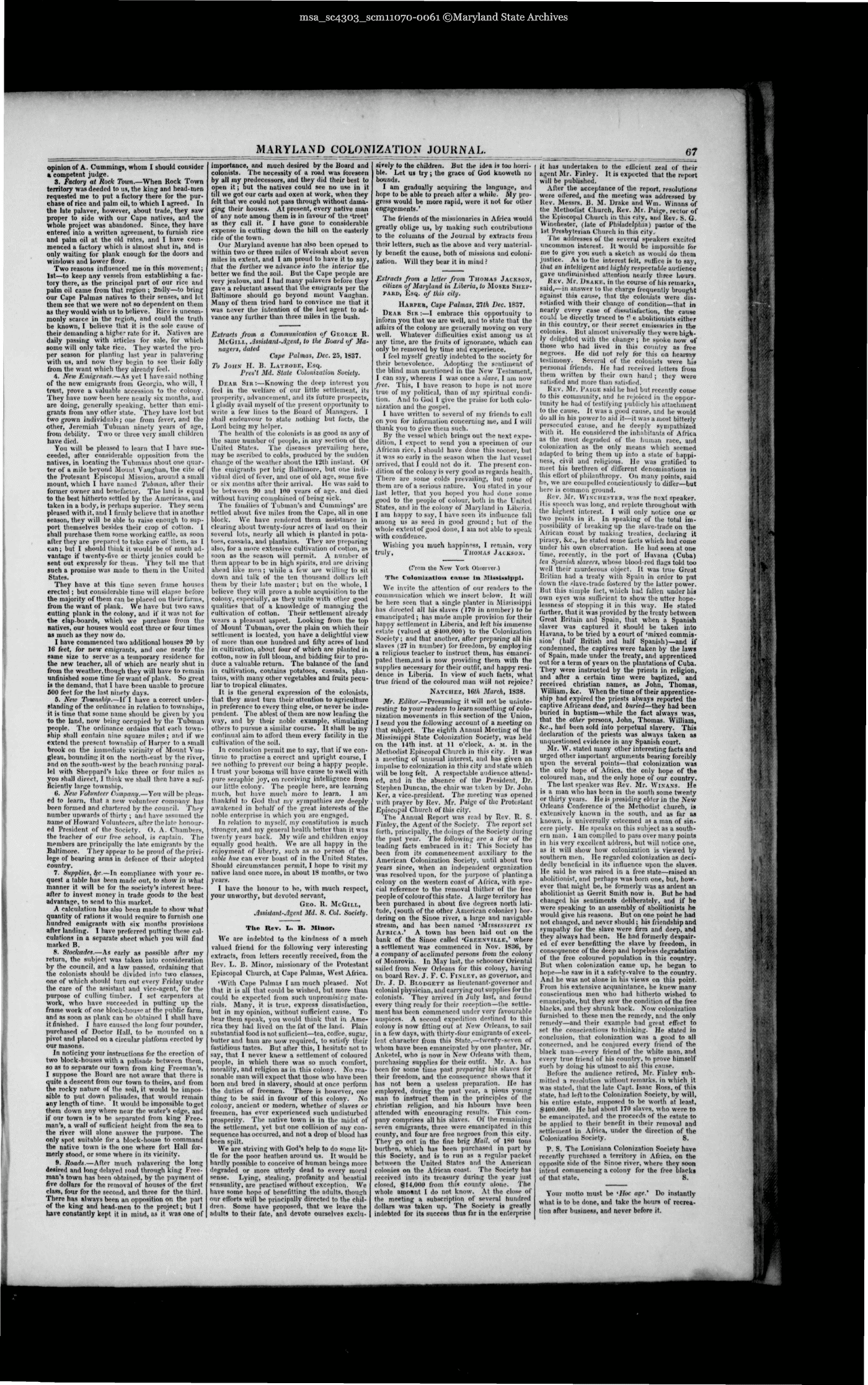
| MARYLAND COLONIZATION JOURNAL. 67 opinion of A. Cummings, whom I should consider a competent judge. 3. Factory at Rock Town.—When Rock Town territory was deeded to us, the king and head-men requested me to put a factory there for the pur- chase of rice and palm oil, to which I agreed. In the late palaver, however, about trade, they saw proper to side with our Cape natives, and the whole project was abandoned. Since, they have entered into a written agreement, to furnish rice and palm oil at the old rates, and I have com- menced a factory which is almost shut in, and is only waiting for plank enough for the doors and windows and lower floor. Two reasons influenced me in this movement; 1st—to keep any vessels from establishing a fac- tory there, as tlie principal part of our rice and palm oil came from that region ; 2ndly—to bring our Cape Palmas natives to their senses, and let them see that we were not so dependent on them as they would wish us to believe. Rice is uncom- monly scarce in the region, and could the truth be known, I believe that it is tlie sole cause of their demanding a higlie- rate for it. Natives are daily passing with articles for sale, for which some will only take rice. They wasted the pro- per season lor planting last year in palavering with us, and now they begin to see their folly from the want which they already feel. 4. New Emigrants.—As yet 1 have said nothing of the new emigrants from Georgia, who will, 1 trust, prove a valuable accession to the colony. They have now been here orally six mouths, and are doing, generally speaking, better than emi- grants from anv other state. They have lost hot two grown individuals; one from fever, and tlie other, Jeremiah Tubman ninety years of age, from debility. Two or three very small children have died. You will be pleased to learn that I have suc- ceeded, after considerable opposition from the natives, in locating the Tubman* about one quar- ter of a mile beyond Mount Vaughan, the cite of the Protesant Episcopal Mission, around a small mount, which I nave named Tabiiutii, after their former owner and benefactor, The land is equal to the best hitherto settled by the Americans, and taken in a body, is perluips superior. They seem pleased with it, and 1 firmly believe that in another season, they will be able to raise enough to sup- port themselves besides their crop of cotton. I shall purchase them some working cattle, as soon after they are prepar id to take care of them, as I can; but I should think it would be of much ad- vantage if twenty-live or thirty jennies could be sent out expressly for them. They tell me that such a promise was made to them in the United States. They have at this time seven frame houses erected ; but considerable time will elapse before the majority of them can be placed on their farms, from the want of plank. We have but two saws cutting plank in tlie colony, and if it was not for the clap.boards, which we purchase from the natives, our houses would cost three or four times as much as they now do. I have commenced two additional houses 20 by 16 feet, for new emigrants, and one nearly the same size to serve as a temporary resilience for the new teacher, all of which are nearly shut in from the weather,though they will have to remain unfinished some time for want of plank. So great is the demand, that I have been unable to procure 600 feet for the last ninety days. 5. New Township.—If I have a correct under- standing of the ordinance in relation to townships, it is time that some name should be given by you to the land, now being occupied by the Tubman people. The ordinance ordains that each town- ship shall contain nine square miles; and if we extend the present township of Harper to a small brook on the Immediate vicinity of Mount Van- glean, bounding it on the north-east by the river, and on the south-west hy the beach running paral- lel with Sheppard's lake three or four miles ai you shall direct, I think we shall then have a suf- ficiently large townsliip. 6. New Volunteer Company.—You will be pleas- ed to learn, that a new volunteer Company has been formed and chartered bv the council. They number upwards of thirty ; and have assumed the name of Howard Volunteers, after the late honour- ed President of the Society. O. A. Chambers, the teacher of our free school, is captain, The members are principally the late emigrants by the Ballimore. The)' appear to he proud of the privi- lege of bearing arms in defence of their adopted country. 7. Supplies, &c.—In compliance with your re- quest a table has been made out, to show la what manner it will be for the society's interest here- after to invest money in trade goods to the best advantage, to send to this market. A calculation has also been made to show what quantity of rations it would require to furnish one hundred emigrants with six months provisions after landing. I have preferred putting these cal- culations in a separate sheet which you will find marked B. 8. Stockades.—As early as possible after my return, the subject was taken into consideration by the council, and a law passed, ordaining that the colonists should be divided lata two classes, one of which should turn out every Friday under the care of the assistant and vice-agent, for the purpose of culling timber. I set carpenters at work, who have succeeded in putting up the frame work of one blork-hou«e at the public farm, and as soon as plank can be obtained I shall have it finished. 1 have caused the long four pounder, purchased of Doctor Hall, to be mounted on a pivot and placed on a circular platform erected hy our masons. In noticing your instructions for the erection of two block-houses with a palisade between them, so as to separate our town from king freeman's, I suppose the Board are not aware that there is quite a descent from our town to theirs, and from the rocky nature of the soil, it would he impos- sible to put down palisades, that would remain any length of time. It would be impossible to get them down any where near the water's edge, and if our town i» to he separated from king Free- man's, a wall of sufficient height from the sea to the river will alone answer the purpose. The only spot suitable for a block-house to command the native town is the one where fort Hall for- merly stood, or some where in its vicinity. 9. Roads.—After much palavering tin; long desired and long delayed load through king Free- man's town has been obtained, by the payment o( five dollars for the removal of houses of the first class, four for the second, and three for the third. There has always been an opposition on the part of the king and head-men to the project; but ( lave constantly kept it in mind, as it was one of importance, and much desired by the Board and colonists. The necessity of a road was foreseen by all my predecessors, and they did their best to open it; but the natives could see no use in it till we got our carts and oxen at work, when they felt that we could not pass through without dama- ging their houses. At present, every native man of any note among them is in favour of the 'treet' as they call it. I have gone to considerable expense in cutting down the hill on the easterly side of the town. Our Maryland avenue has also been opened to within two or three miles of Weissah about seven miles in extent, and I am proud to have it to say, that the further we advance into the interior the better we find the soil. But the Cape people are very jealous, and I had many palavers before they gave a reluctant assent that the emigrants per the Baltimore should go beyond mount Vaughan. Many of them tried hard to convince me that it was never the intention of the last agent to ad- vance any further than three miles in the bush. Extracts from a Communication of George R. McGii.l, Assistant-Agent, to the Board of Ma- nagers, dated Cape Palmas, Dec. 25, 1837. To John H. B. Latrobe, Esq. Pres't Md. State Colonization Society. Dear Sir:—Knowing the deep interest you feel in the weltare of our little settlement," its prosperity, advancement, and its future prospects, I gladly mail myself of the present opportunity to write a few lines to the Board of Managers. I shall endeavour to state nothing but facts, the Lord being my helper. The health of the colonists is as good as any of the same number of people, in any section of tlie United States. The diseases prevailing hire, may be ascribed to colds, produced by the sudden Change ol the weather about the 12th instant. Of the emigrants per brig Baltimore, but one indi- \idual died of lever, and one of old us, some five or six months alter their arrival. He was .said to ha between N and 100 years of an, ami died without having complained of being sick. The families of Tubman's and Cuiiiniiugs' arc settled about live miles from the Cape, all in one block. We have rendered them assistance in clearing about twenty-four acres of land on their several lots, nearly all which is planted in pota- toes, cassada, and plantains. They are preparing also, for a more extensive cultivation of cotton, as soon as the season will permit. A number of them appear to be in high spirits, and are driving ahead like man ; while a few are willing to sit down and talk of the ten thousand dollars left them by their late master; but on the whole, I believe they will prove a noble acquisition to the colony, especially, as they unite with other good qualities that ol a knowledge of managing the cultivation of cotton. Their settlement already wears a pleasant aspect. Looking from the top of Mount Tubman, over the plain on which their settlement is located, you have a delightful view of more than one hundred and fifty acres of land in cultivation, about four of wdiich are planted in cotton, now in full bloom, and bidding fair to pro- duce a valuable return. The balance of the land in cultivation, contains potatoes, cassada, plan- tains, with many other vegetables and fruits pecu- liar to tropical climates. It is the general expression of the colonists, that they must turn their attention to agriculture in preference to every thing else, or never be inde- pendent. The ablest of them are now leading the way, and by their noble example, stimulating others to pursue a similar course. It shall be my continual aim to afford them every facility in the cultivation of the soil. In conclusion permit me to say, that if we con- tinue to practise a correct and upright course, I see nothing to prevent our being a happy people. I trust your bosoms will have cause to swell with pan seraphic joy, on receiving intelligence from our little colony. The people here, are learning much, but have much more to learn. 1 am thankful to God that my sympathies are deeply awakened in behalf of the great interests of the noble enterprise in which you are engaged. In relation to myself, my constitution is much stronger, and my general health better than it was twenty years hack. My wife and children enjoy equally good health. We are all happy in the enjoyment of liberty, such as no person of the sable hue can ever boast of in the United States. Should circumstances permit, I hope to visit my native land once more, in about 18 months, or two years. I have the honour to be, with much respect, your unworthy, but devoted servant, Geo. R. McGill, Assistant-Agent Md. S. Col. Society. The Rev. L. B. Minor. We are indebted to the kindness of a much valued friend for the following very interesting extracts, from letters recently received, from the Rev. L. B. Minor, missionary of the Protestant Episcopal Church, at Cape Palmas, West Africa. 'With Cape Palmas I am much pleased. Not that it is all that could be wished, but more than could he expected from such unpromising mate- rials. Many, it is true, express dissatisfaction, but in my opinion, without sufficient cause. To hear thorn speak, you would think that in Ame- rica they had lived on the fat of the land. Plain substantial food is not sufficient—tea, coffee, sugar, butter and ham are now required, to satisfy their fastidious tastes. But after this, I hesitate not to say, that I never knew a settlement of coloured people, in wdiich there was so much comfort, morality, and religion as in this colony. No rea- sonable man will expect that those who have been born and bred in slavery, should at once perform the duties of freemen. There is however, one tiling to be said in favour of this colony. No colony, ancient or modern, whether of slaves or freemen, has ever experienced such undisturbed prosperity, The native town is in the aridfl of the settlement, yet but one collision of any con- sequence has occurred, and not a drop of blood has been spilt. We are striving with God's help to do some lit- tle for the poor heathen around us. It would be hardly possible to conceive of human beings more degraded or more utterly dead to every moral sense. Lying, stealing, profanity and bcastial sensuality, are practised without exception. We have some hope of benefitting the adults, though our efforts will be principally directed to the chil- dren. Some have proposed, that we leave the adults to their fate, and devote ourselves exclu- sirely to the children. But the idea is too horri- ble. Let us try ; the grace of God knoweth no bounds. I am gradually acquiring the language, and hope to be able to preach after a while. My pro- gress would be more rapid, were it not for other engagements.' The friends of the missionaries in Africa would greatly oblige us, by making such contributions to the columns of the Journal by extracts from their letters, such as the above and very material- ly benefit the cause, both of missions and coloni- zation. Will they bear it in mind ' Extracts from a letter from Thomas Jackson, citizen of Maryland in Liberia, to Moses Shep- pard, Esq. of this city. Harper, Cape Palmas, 21th Dec. 1837. Dear Sir:—I embrace this opportunity to inform you that we are well, and to state that the affairs of the colony are generally moving on very well. Whatever difficulties exist among us at any time, are the fruits of ignorance, which can only be removed by time and experience. I feel myself greatly indebted to the society for their benevolence. Adopting the sentiment of the blind man mentioned in the New Testament, I can say, whereas I was once a stare, I am now free. This, I have reason to hope is not more true of my political, than of my spiritual condi- tion. Ami to God 1 |ira the praise for both colo- nization and the gospel. I have written to several of my friends to call on you for informal ion concerning me, and I will thank you to give them such. By the vessel which brings out the next expe- dition, I expect to send you a specimen of our African rice, I should have done this sooner, but it was so early in the season when the last vessel arrived, that I could not do it. The present con- dition of the colony is very good as regards health. There arc some colds prevailing, but none of them are of a serious nature. You stated in your last letter, that you toped you had done some good to the people of colour, both in tin' United States, and in the colony of Maryland in Liberia. I am happy to say, I have seen ils influence fall among us as seed in good ground ; but of the whole extent of good done, I am not able to speak with confidence. Wishing you much happiness, I remain, very truly, Thomas Jackson. (From the New York Observer.) Tlie Colonization cause in Mississippi. We invite the attention of our readers to the communication which we insert eatow. It will be here seen that a single planter in Mississippi has directed all his slaves (170 in number) to be emancipated ; has made ample provision for their happy settlement in Liberia, and left liis immense estate (valued at §100,000) to the Colonization Society; and that another, after preparing all his slaves (27 in number) for freedom, by employing a religious teacher to instruct them, has emanci- pated them,and is now providing them with the supplies necessary for their outfit, and happy resi- dence in Liberia. In view of such facts, what true friend of the coloured man will not rejoice? Natchez, 16th March, 1838. Mr. Editor.—Presuming it will not be uninte- resting to your readers to learn something of colo- nization movements in this section of the Union, I send you the following account of a meeting on that subject. The eighth Annual Meeting of the Mississippi State Colonization Society, was held on the 14th inst. at 11 o'clock, a. m, in the Methodist Episcopal Church in this city. It was a mreting of unusual interest, and has given an impulse to colonization in this city and slate which will be long felt. A respectable audience attend- ed, and in the absence of the Picsident, Dr. Stephen Duncan, the chair was takes by Dr. John Ker, a vice-president. The meeting was opened with prayer by Rev. Mr. Paige of the Protestant Episcopal Church of this city. The Annual Report was read by Rev. R. S. Finley, the Agent of the Society. The report set forth, principally, the doings of the Society during the past year. The following are a tew of the leading facts embraced in it: This Society has been from its commencement auxiliary to the American Colonization Society, until about two years since, when an independent organization was resolved upon, for the purpose of planting a colony on the western coast of Africa, with spe- cial reference to the removal thither of the free fieople of colourof this state. A large territory has leen purchased in about five degrees north lati- tude, (south of the other American colonies) bor- dering on the Sinoe river, a large and navigable stream, and has been named 'Mississippi in Africa.' A town has been laid out on the bank of the Sinoe called 'Greenville,' where a settlement was commenced in Nov. 1836, by a company of acclimated persons from the colony of Monrovia. In May last, the schooner Oriental sailed from New Orleans for this colony, having on board Rev. J. F. C. Finlev, as governor, ami Dr. J. D. Bi.odgett as lieutenant-governor ami colonial physician, and carrying out supplies for the colonists. They arrived in July last, and found every thing ready for their reception—the settle- ment has been commenced under very favourable auspices. A second expedition destined to this colony is now fitting out at New Orleans, to sail in a few days, with thirty-four emigrants of excel- lent character from this" State.—twentv-soveii of whom have been emancipated by one planter, Mr. Anketel, who is now in New Orleans with them, purchasing supplies for their outfit. Mr. A. has been for some time past preparing his slaves lor their freedom, and the consequence shows that it has not been a useless preparation. He has employed, during the past year, a pious young man to instruct them in the principles of the christian religion, and his labours have been attended with encouraging results. This com- pany comprises all his slaves. Of the remaining seven emigrants, three were emancipated in this county, and four are free negroes from this city. They' go out in the fine brig Mail, of ISO tons burthen, which has been purchased in part by tins Society, and is to run as a regular packet between the United States and the American colonies on the African coast. The Society has received into its treasury during the year just closed, $11,000 from this county alone. The whole amoant I do not know. At the ejaat of the meeting a subscription of several hundred dollars was taken up. The Society is greatly indebted for its success thus far in the enterprise it has undertaken to the efficient zeal of their agent Mr. Finley. It is expected that the report will be published. After the acceptance of the report, resolution? were ottered, and the meeting was addressed by Rev. Messrs. B. M. Drake and Wm. Winans of the Methodist Church, Rev. Mr. Paige, rector of the Episcopal Church in this city, and Rev, S. G. Winchester, (late of Philadelphia) pastor of the 1st Presbyterian Church in this city. The addresses of tlie several speakers excited uncommon interest. It would be impossible for me to give you such a sketch as would do them justice. As to the interest felt, suffice is to say, that an intelligent and highly respectable audience gave undiminished attention nearly three hours Rev. Mr. Drake, in (he course of his remarks, said,—in answer to the charge frequently brought against this cause, that the colonists were dis- satisfied with their change of condition—that in nearly every case of dissatisfaction, the cause could be directly traced to {! e abolitionists either in this country, or their secret emissaries in the colonies. But almost universally they were high- ly delighted with the change; he siioke now" of those who had lived in this Country as free negroes. He did not rely for tin's on hearsay testimony. Several of the colonists were hi'* personal friends. He hail received letters from them written by tin ir own hand ; they were satisfied and more than satisfied. Rev. Mr. Paige said he had but recently come to this community, and he rejoiced in the oppor- tunity he had of testifying publicly his attachment to the cause. It was a good cause, and he would do all in his power to aid it—it was a most bitterly persecuted cause, and he deeply Sympathised with it. He considered the inhabitants of Africa as the most degraded of the human race, and colonization as the only means which seemed adapted to bring them up into a state of happi- ness, civil and religions. He was gratified to meet his brethren of different denominations in this ellbrt of philanthropy. On many points, said he, we are compelled cni'icicntiously to differ—but here is common ground. Rev. Mr. Winchester, was the next speaker. His speech was long, and replete throughout with the highest interest, i will only notice one or two points in it. In speaking 'of the total Im- possibility of breaking up the slave-trade on the African coast by making treaties, declaring it piracy, fce., he stated some facts which had come under his own observation. He had seen at one time, recently, in the port of Havana (Cuba) ten Spanish slurers, whoso blood red flails told too Well their murderous object. It was true Great llritian had a treaty with Spain in order to put down the sjuve-trade fostered by the latter power. But this simple fact, which had fallen under his own eyes was sufficient to show the utter hope- lessness of stopping it in this way. He stated further, that it was provided by the treaty between Great Britain ami Spain, that when a Spanish slaver was captured it should be taken into Havana, to be tried by a court of 'mixed commis- sion' (half British and half Spanish)—and if condemned, the captives were taken by the laws of Spain, made under the treaty, and apprenticed out for a term of years on the plantations of Cuba. They were instructed by the priests in religion, and after a certain time were baptized, and received christian names, as John, Thomas, William, &.c. When the time of their apprentice- ship had expired the priests always reported the captive Africans dead, and buried—they had been buried in baptism—while the fact always was, that the other persons, John, Thomas. William, fee., had been sold into perpetual slavery. This declaration of the priests was always taken as unquestioned evidence in any Spanish court. Mr. W. stated many other interesting facts and urged other important arguments bearing forcibly upon the several points—that colonization was the only hope of Africa, the only hope of the coloured man, and the only hope of our country. The last speaker was Rev. Mr. Wixans. He is a man who has been in the south some twenty or thirty years. He is presiding elder in the New Orleans Conference of the Methodist church, is extensively known in the south, and as far as known, is universally esteemed as a man of sin- cere piety. He speaks on this subject as a south- ern man. 1 am compiled to pass over many points in his very excellent address, but will notice one, as it will show how colonization is viewed by southern men. He regarded colonization as deci- dedly beneficial in its influence upon the slaves. He said he was raised in a free state—raised an abolitionist, and perhaps was born one, but, how- ever that might be, he formerly was as ardent an abolitionist as Gerrit Smith now is. But he had changed his sentiments deliberately, and if he were speaking to an assembly of abolitionists he would give his reasons. But on one point he had not changed, and never should; his friendship and Sympathy for the slave were firm and deep, and they always had been. He had formerly despair- ed of ever benefitting the slave by freedom, in consequence of the deep and hopeless degradation of the free coloured population in this country. But when colonization came up, he began to hope—he saw in it a safety-valve to the country. And he was not alone in his views on this point, from his extensive acquaintance, he knew many conscientious men who had hitherto wished) to emancipate, but they saw the condition of the free blacks, and they shrunk back. Now colonization furnished to these men the remedy, and the only remedy—and their example had great effect to set the conscientious to thinking. He stated in conclusion, that colonization was a good to all concerned, and he conjured every friend of the black man—every friend of the wdiite man, and every true friend of his country, to prove himself such by doing his utmost to aid this cause. Before the audience retired, Mr. Finley sub- milled a resolution without remarks, in which it was stated, that the late Capt. Isaac Ross, of this state, had lift to the Colonization Society, by will, his entire estate, supposed to be worth at least, $400.000. He had about 170 slaves, who were to be emancipated, and the proceeds of the estate to be applied to their benefit in their removal and settlement in Africa, under the direction of the Colonization Society. S. P. S. The Louisiana Colonization Society have recently purchased a territory in Africa, on the opposite side of the Sinoe river, where they soon intend commencing a colony for the free blacks of that state. S. Your motto must be 'Hoc age.' Do instantly what is to be done, and take the hours of recrea- tion after business, and never before it. |