 |
|
|
 |
|
 |
|
|||
|
||||
|
||||
|
Maryland State Archives Maryland Colonization Journal Collection MSA SC 4303 msa_sc4303_scm11070-0065 Enlarge and print image (5M) |
|
|
|
|
|
|
|
|||
|
||||
|
||||
|
Maryland State Archives Maryland Colonization Journal Collection MSA SC 4303 msa_sc4303_scm11070-0065 Enlarge and print image (5M) |
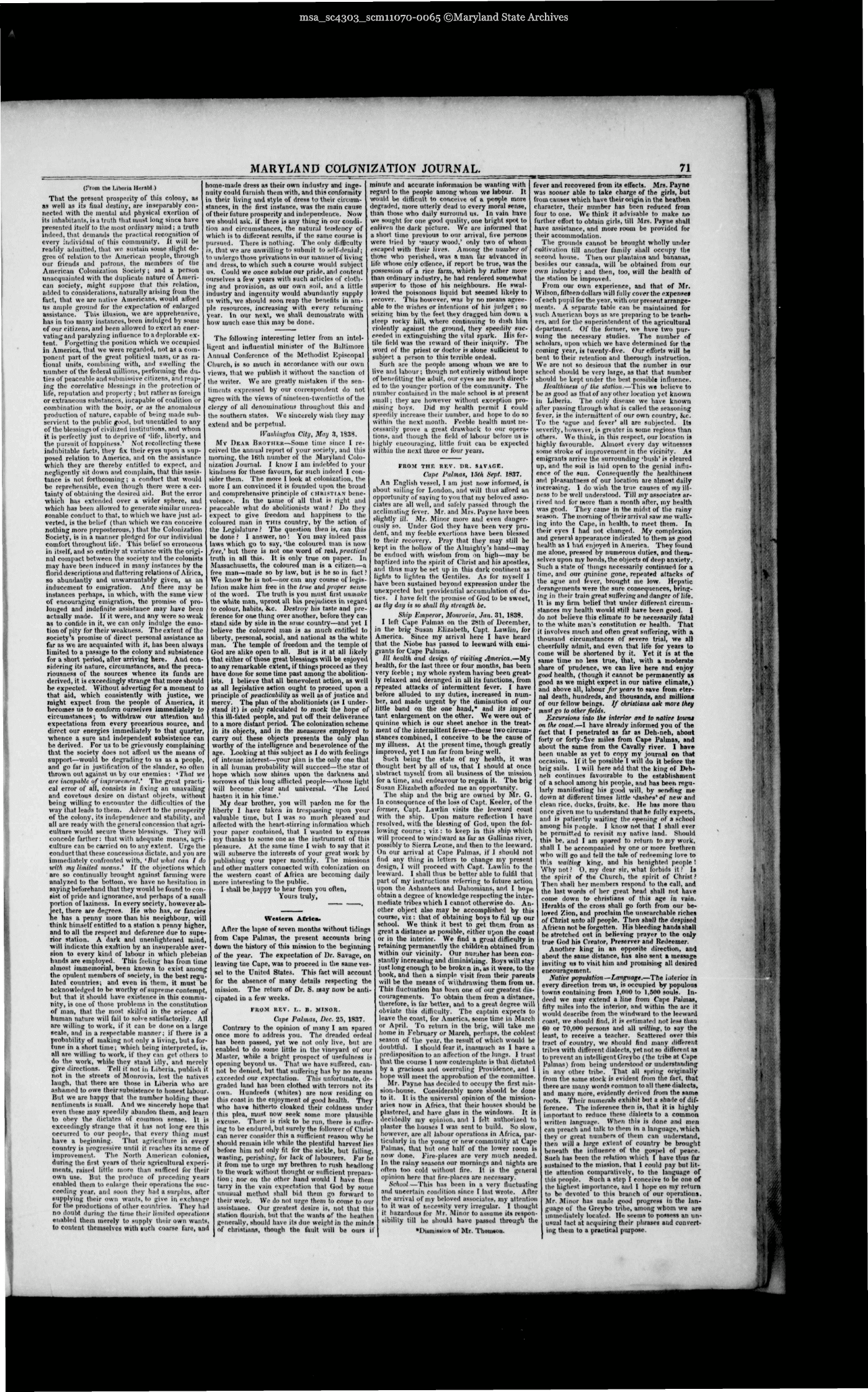
| MARYLAND COLONIZATION JOURNAL. 71 (From the Liberia Herald.) That the present prosperity of tliis colony, as as well as its final destiny, are inseparably con- nected with the menial ami physical exertion of its inhabitants, is a truth that must long since have PftiaWd itself In the most onlinary mind; a truth indeed, that demands the practical recognition of every individual of this community. It will be readily admitted, that we sustain some slight de- gree of relation to the American people, through our friends and patrons, the members of the American Colonisation Society; and a person Unacquainted with the duplicate nature of Ameri- can society, might suppose that this relation, added to considerations, naturally arising from the fact, that we are native Americans, would alford lis ample ground lor the expectation of enlarged assistance. This illusion, we are apprehensive, lias in too many instances, been indulged by some of our citizens, and been allowed to exert an ener- vating and paralyzing influence to a deplorable ex- tent. Forgetting the position which we occupied in America, that we were, regarded, not as a com- ponent part of the great political mass, or as ra- tional units, combining with, and swelling the number of the federal millions, performing the du- ties of peaceable and submissive citizens, and reap- ing the correlative blessings in the protection of life, reputation and property ; but rather as foreign or extraneous substances, incapable of coalition or combination with the body, or as the anomalous production of nature, capable of being made sub- servient to the public good, but unentitled to any of the blessings of civilized institutions, and whom it is perfectly just to deprive of 'life, liberty, and the pursuit of happiness.' Not recollecting these indubitable facts, they fix their eyes upon a sup- posed relation to America, and on the assistance which they are thereby entitled to expect, and negligently sit down and complain, that this assis- tance is not forthcoming; a conduct that would be reprehensible, even though there were a cer- tainty of obtaining the desired aid. But the error which has extended over a wider sphere, and which has been allowed to generate similar unrea- sonable conduct to that, to which we have just ad- verted, is the belief (than which we can conceive nothing more preposterous,) that the Colonization Society, is in a manner pledged for our individual comfort throughout life. This belief so erroneous in itself, and so entirely at variance with the origi- nal compact between the society anil the colonists may have been induced in many instances by the florid descriptions and Mattering relations of Africa, so abundantly and unwarrantably given, as an inducement to emigration. And there may be instances perhaps, in which, with the same view of encouraging emigration, the promise of pro- longed and indefinite assistance /nay have been actually made. If it were, and any were so weak as to confide in it, we can only indulge the emo- tion of pity for their weakness. The extent of the society's promise of direct personal assistance as far as we arc acquainted with it, has been always limited to a passage to the colony and subsistence for a short period, after arriving here. And con- sidering its nature, circumstances, and the preca- riousness of the sources whence its funds are derived, it is exceedingly strange that more should be expected. Without adverting for a moment to that aid, which consistently with justice, we might expect from the people of America, it becomes us to conform ourselves immediately to circumstances; to withdraw our attention and expectations from every precarious source, and direct our energies immediately to that quarter, whence a sure and independent subsistence can be derived. For us to be grievously complaining that the society does not afford us the means of support—would be degrading to us as a people, and go far in justification of the slander, so often thrown out against us by our enemies ; ' That M are incapable of improvement' The great practi- cal error of all, consists in fixing an unavailing and covetous desire on distant objects, without being willing to encounter the difficulties of the way that leads to them. Advert to the prosperity of the colony, its independence and stability, and ail are ready with the general concession that agri- culture would secure these blessings. They will concede farther: that with adequate means, agri- culture can be carried on to any extent. Urge the conduct that these concessions dictate, and you are immediately confronted with, 'But what can I do with my limited means.' If the objections which are so continually brought against farming were analyzed to the bottom, we have no hesitation in saying beforehand that they would be found to con- sist of pride and ignorance, and perhaps of a small portion of laziness. In every society, however ab- ject, there are degrees. He who has, or fancies tie has a penny more than his neeighbour, will think himself entitled to a station a penny higher, and to all the respect ami deference due to supe- rior station. A dark and unenlightened mind, will indicate this exaltion by an insuperable aver- sion to every kind of labour in which plebeian hands are employed. This feeling has from time almost immemorial, been known to exist among the opulent members of society, in the best regu- lated countries; and even in them, it must be acknowledged to be worthy of supreme contempt, but that it should have existence in this commu- nity, is one of those problems in the constitution of man, that the most skilful in the science of human nature will fail to sob e satisfactorily. All are willing to work, if it can be done on a large scale, and in a respectable manner; if there is a probability of making not only a living, but a for- tune in a short time; which being interpreted, is, all are willing to work, if they can get others to do the work, while they stand idly, and merely give directions. Tell it not in Liberia, publish it not in the streets of Monrovia, lest the natives laugh, that there are those in Liberia who are ashamed to owe their subsistence to honest labour. But we are happy that the number holding these sentiments is small. And we sincerely hope that even these may speedily abandon them, and learn to obey the dictates of common sense. It is exceedingly strange that it has not long ere this occurred to our people, that every thing must have a beginning. That agriculture in every country is progressive unfit it reaches its acme o( improvement. The North American colonies, during the first years of their agricultural experi- ments, raised little more than sufficed (or their own use. But the produce of preceding years enabled them to enlarge their operations the suc- ceeding year, and soon they had a surplus, after supplying their own wants, to give in exchange for the productions of other countries. They had no doubt during the time their limited operations enabled them merely to supply their own wants, to content themselves with such coarse fare, and home-made dress as their own industry and inge- nuity could furnish them with, and this conformity in their living and style of dress to their circum- stances, in the first instance, was the main cause of their future prosperity and independence. Now we should ask. if there is any thing in our condi- tion anil circumstances, the natural tendency of which is to different results, if the same course is pursued. There is nothing. The only difficulty is, that we are unwilling to submit to self-denial; to undergo those privations in our manner of living and dress, to which such a course would subject us. Could we once subdue our pride, and content ourselves a few years with such articles of cloth- ing and provision, as our own soil, and a little industry and ingenuity would abundantly supply us with, we should soon reap the benefits in am- ple resources, increasing with every returning year. In our next, we shall demonstrate with how much ease this may be done. The following interesting letter from an intel- ligent and influential minister of the Baltimore Annual Conference of the Methodist Episcopal Church, is so much in accordance with our own views, that we publish it without the sanction of the writer. We are greatly mistaken if the sen- timents expressed by our correspondent do not agree with the views of nineteeii-twentieths of the clergy of all denominations throughout this and the southern states. We sincerely wish they may extend and be perpetual. Washington City, May 3, 1838. My Dear Brother—Some time since I re- ceived the annual report of your society, and this morning, the 16th number of the Maryland Colo- nization Journal. I know I am indebted to your kindness for these favours, for such indeed I con- sider them. The more 1 look at colonization, the more I am convinced it is founded upon the broad and comprehensive principle of Christian bene- volence. In the name of all that is right and peaceable what do abolitionists want.' Do they expect to give freedom and happiness to the coloured man in this country, by the action of the Legislature? The question then is, can this be done ? I answer, no! You may indeed pass laws which go to say, 'the coloured man is now free,' but there is not one word of real, practical truth in all this. It is only true on paper. In Massachusetts, the coloured man is a citizen—a free man—made so by law, but is he so in fact ? We know he is not—nor can any course of legis- lation make him free in the true and proper sense ot the word. The truth is you must first unmake the white man, uproot all his prejudices in legard to colour, habits, &c. Destroy his taste and pre- lerence for one thing over another, before they can stand side by side in the same, country—anil yet I believe the coloured man is as much entitled to liberty, personal, social, and national as the white man. The temple of freedom and the temple ol Goil are alike open to all. But is it at all likely that either of those great blessings will be enjoyed to any remarkable extent, if things proceed as they have done for some time past among the abolition- ists. I believe that all benevolent action, as well as all legislative action ought to proceed upon a principle of practicability as well as of justice and mercy. The plan of the abolitionists (as I under- stand it) is only calculated to mock the hope of this ill-fated people, and put off their deliverance to a more distant period. The colonization scheme in its objects, and in the measures employed to carry out these objects presents the only plan worthy of the intelligence and benevolence of the age. Looking at this subject as I do with feelings of intense interest—your plan is the only one that in all human probability will succeed—the star ol hope which now shines upon the darkness and sorrows of this long atilicted people—whose light will become clear and universal. 'The Lord hasten it in his time.' My dear brother, you will pardon me for the liberty 1 have taken in trespassing upon your valuable time, but I was so much pleased and affected wilh the heart-stiiring information which your paper contained, that I wanted to express my thanks to some one as the instrument ol this pleasure. At the same time I wish to say that it will subserve the interests of your great work by publishing your paper monthly. The missions and other matters connected with colonization on the western coast of Africa are becoming daily more interesting to the public. 1 shall be happy to hear from you often, Yours truly, minute and accurate inliirmaiion be wanting with regard to the people among whom we labour. It would be difficult to conceive of a people more degraded, more utterly dead to every moral sense, than those who daily surround us. In vain have we sought for one good quality, one bright spot to enliven fhe dark picture. We are informed that a short time previous to our arrival, five persons were tried by 'saucy wood,' only two of whom escaped wilh their lives. Among the number of those who perished, was a man tar advanced in life whose only offence, if report be true, was the possession id' a rice farm, which by rather more than ordinary industry, he had rendered somewhat superior to those of' his neighbours. He swal- lowed the poisonous liquid but seemed likely to recover. This however, wis by no means agree- able to the wishes or intentions of his judges ; so seizing him by the feet tliev dragged him down a steep rocky hill, where continuing to dash him violently against the ground, they speedily suc- ceeded in extinguishing the vital spark, His fer- tile field was the icward of their iniquity. The word of the priest or doctor is alone sufficient to subject a person to this terrible ordeal. Such are the people among whom we are to live and labour; though not entirely without hope of benefitting the adult, our eyes are much direct- ed to the younger portion of the community. The number contained in the male school is at present small; they are however without exception pro- mising boys. Did my health permit I could speedily increase their number, and hope to do so within the next monlh. Feeble health must ne- cessarily prove a great drawback to our opera- tions, and though the field of labour before us is highly encouraging, little fruit can be expected within the next three or four years. Western Africa. After the lapse of seven months without tidings from Cape Palmas, the present accounts bring down the history of this mission to the beginning of the year. The expectation of Dr. Savage, on leaving die Cape, was to proceed in the Rauie ves- sel to the United States. This fact will account lor the absence of many details respecting the mission. The return of Dr. S. may now be anti- cipated in a few weeks. FROM REV. L. B. MINOR. Cape Palmas, Dec. 23, 1837. Contrary to the opinion of many I am spared once more to address you. The dreaded ordeal has been passed, yet we not only live, but are enabled to do some little in the vineyard of our Master, while a bright prospect of usefulness is opening beyond us. That we have suffered, can- not be denied, but that suffering has hy no means exceeded our expectation. This unfortunate, de- graded land has been clothed with terrors not its own. Hundreds (whites) are now residing on this coast in the enjoyment ol good health. They who have hitherto cloaked their coldness under this plea, must now seek some more plausible excuse. There is risk to be run, there is suffer- ing to be endured, but surely the follower of Christ can never consider this a sufficient reason why he should remain idle while the plentiful harvest lies before him not only fit for the sickle, but falling, wasting, perishing, for lack of labourers. Far be it from me to urge mv brethren to rush headlong to the work without thought or sufficient prepara- tion; nor on the other hand would I have them tarry in the vain expectation that God by some unusual method shall bid them go forward to their work. We do not urge them to come to our assistance. Our greatest desire is, not that this station flouridi, but that the wants of the heathen generally, should have its due weight in the minds of christians, though the fault will be ours il FROM THE REV. DR. SAVAGE. Cape Palmas, 15th Sept. 1837. An English vessel, I am just now informed, is about sailing for London, and will thus afford an opportunity of saying to you that my beloved asso- ciates are all Weil, and safely passed through the acclimating fever. Mr. and Mrs. Payne have been slightly ill. Mr. Minor more and even danger- ously so. Under God they have been very pru- dent, and my feeble exertions have been blessed to their recovery. Pray that they may still be kept in the hollow of the Almighty's hand—may be endued with wisdom from on high—may be baptized into the spirit of Christ and his apostles, and thus may be set up in this dark continent as lights to lighten the Gentiles. As lor myself I have been sustained beyond expression under the unexpected but providential accumulation of du- ties. I have felt the promise of (iod to be sweet, as thy day is so shall thy strength be. Ship Emperor, Monrovia, Jan. 31, 1838. I left Cape Palmas on the 28th of December, in the brig Susan Elizabetb, Capt. Lawliu, for America. Since my airival here I have heard that the Niobe has passed to leeward with emi- grants for Cape Palmas. Ill health and design of visiting America.—My health, for the last three or four months, has been very feeble ; my whole system having been great- ly relaxed and deranged in all its functions, from repeated attacks of intermittent fever. I have before alluded to my duties, increased in num- ber, and made urgent by the diminution of our little band on the one hand,* and its impor- tant enlargement on the other. We were out of quinine which is our sheet anchor in the treat- ment of the intermittent fever—these two circum- stances combined, I conceive to be the cause of my illness. At the present time, though greatly improved, yet I am far from being well. Such being the state of my health, it was thought best by all of us, that I should at once abstract myself from all business of the mission for a time, and endeavour to regain it. The brig Susan Elizabeth atlbrded me an opportunity. The ship and the brig are owned by Mr. G. In consequence of the loss of Capt. Keeler, of the former, Capt. Lawlin visits the leeward coast with the ship. Upon mature reflection I have resolved, with the blessing of God, upon the fol- lowing course; viz : to keep in Ibis ship which will proceed to windward as far as Gallinas river, possibly to Sierra Leone, and then to the leeward. On our arrival at Cape Palmas, if 1 should not find any thing in letters to change my present design, 1 will proceed with Capt. Lawlin to the j leeward. I shall thus be better able to fulfil that part of my instructions referring to future action upon the Ashantees and Dahomians, and I hope obtain a degree of knowledge respecting the inter- mediate tribes which 1 cannot otherwise do. An- other object also may be accomplished by this course, viz : that of obtaining boys to f'.il up our school. We think it best to get them from as great a distance as possible, either u'pon the coast or in the interior. We find a grjat difficulty in retaining permanently the children obtained from within our vicinity. Our number has been con- stantly increasing and diminishing. Boys will stay just long enough to be broken in, as it were, to the book, and then a simple visit from their parents will be the means of withdrawing them from us. This fluctuation has h«en one of our greatest dis- couragements. To obtain them from a distance, therefore, is far better, and to a great degree will obviate this difficulty. The captain expects to leave the coast, for America, some time in March or April. To return in the brig, will take me home in February or March, perhaps, the coldest season of the year, the result of which would be doubtful. I should fear it, inasmuch as I have a predisposition to an affection of the lungs. I trust that the course I now contemplate is that dictated by a gracious and overruling Providence, and I hope will meet the approbation of the committee. Mr. Payne has decided to occupy the first mis- sion-house. Considerably more should be done to it. It is the universal opinion of the mission- aries now in Africa, that their houses should be plastered, and have glass in the windows. It is decidedly my opinion, and I felt authorized to plaster tlio houses 1 was sent to build. So slow, however, are all labour operations in Africa, par- ticularly in the young or new community at Cape I'almas, that hut one half of the lower room is now done. Fire-places are very much needed. In the rainy seasons our mornings and nights are often too cold without fire. It is the general opinion here that fire-places are necessary. School —This has been in a very fluctuating and uncertain condition since I last wrote. After the arrival of my beloved associates, my attention to it was of necessity very irregular. I thought it hazardous for Mr. Minor to assume its respon- sibility till lie should have passed through the 'Dismission of Mr. Thomson. fever and recovered from its effects. Mrs. Payne was sooner able to take charge of the girls, but from causes which have their origin in the heathen character, their number has been reduced from four to one. We think it advisable to make no further effort to obtain girls, till Mrs. Payne shall have assistance, and more room be provided for their accommodation. The grounds cannot be brought wholly under cultivation till another family shall occupy the second house. Then our plantains and bananas, besides our cassada, will be obtained from our own industry ; and then, too, will the health of the station be improved. From our own experience, and that of Mr. Wilson, fifteen dollars will fully cover the expense* of each pupil for the year, with our present arrange- ments. A separate table can he maintained lor such American boys as are preparing to be teach- ers, and for the superintendent of the agricultural department. Of the former, we have two pur- suing the necessary studies. The number of scholars, upon which we have determined for the corning year, is twenty-five. Our efforts will be bent to their retention and thorough instruction. We are not so desirous that the number in our school should be very large, as that that number should be kept under the best possible influence. Healthiness of the station.—This we believe to be as good as that of any other location yet known in Liberia. The only disease we have known after passing through what is called the seasoning fever, is the intermittent of our own country', ttc. To the 'ague and fever' all are subjected. Its severity, however, is greater in some regions than others. We think, in this respect, our location is highly favourable. Almost every day witnesses some stroke of improvement in the vicinity. As emigrants arrive the surrounding 'bush' is cleared up, and the soil is laid open to the genial influ- ence of the sun. Consequently the healthiness and pleasantness of our location aie almost daily increasing. I do wish the true causes of my ill- ness to be well understood. Till in)' associates ar- rived and for more than a month after, iny health was good. They carne in the mid-t of the rainy season. The morning of their arrival saw me walk- ing into the Cane, in health, to meet them. In their eyes I harl not changed. My complexion and genenl appearance indicated to them as good health as 1 had enjoyed in Amerira. They found rue alone, pressed by numerous duties, and them- selves upon mv bands, the objects of dee)) anxiety. Such a state of things necessarily continued for a time, and our quinine gone, repeated attacks of the ague and lever, brought me low Hepatic derangements were the sure consequences, bring- ing in their train great suffering and danger of lile. It is my firm belief that under different circum- stances my health would still hare been good. I do not believe this climate to be necessarily fatal to the white man's constitution or health. That it involves much and often great suffering, with a thousand circumstances of severe trial, we all cheerfully admit, and even that life for years to come will be shortened by it. Yet it is at the same time no less true, that, with a moderate share of prudence, we can live here and enjoy good health, (though it cannot be permanently as good as we might expect in our native climate,) and above all, labour for years to save from eter- nal death, hundreds, and thousands, and millions of our fellow beings. If christians ask more they must go to other fields. Excursions into the interior and to native towns on the coast.—I have already informed you of the fact that I penetrated as far as Deh-neh, about forty or forty-Svc miles from Cape Palmas, and about the same from the Cavally river. I have been unable as yet to ropy my journal on that occasion. If it be possible I will do it before the brig sails. 1 will here add that the king of l>eh- neh continues favourable to the establishment of a school among his people, and has been regu- larly manifesting his good will, by sending me down at different times little 'dashes* of new and clean rice, ducks, fruits, fkc. He has more than once given me to understand that he fully expects, and is patiently waiting the opening of a school among his people. I know not that I shall ever be permitted to revisit my native land. Should this be. and I am spared to return to my work, shall I be accompanied by one or more brethren who will go and tell the tale of redeeming love to this trailing king, and his benighted people! Why not? O, my dear sir, what forbids it? Is the spirit of the Church, the spirit of Christ ? Then shall her members respond to the call, and the last words of her great head shall not have come down to christians of this age in vain. Heralds of the cross shall go forth from our be- loved Zion, and proclaim the unsearchable riches of Christ unto all people. Then shall the despised African not be forgotten. His bleeding hands shall be stretched out in believing prayer to the only true God his Creator, Preserver and Redeemer. Another king in an opposite direction, and about the same distance, has also sent a message inviting us to visit hiin and promising all desired encouragement. Native population—Language.—The interior in every direction from us, is occupied by populous towns containing from 1,000 to 1,500 souls. In- deed we may extend a line from Cape Paimas, filly miles into the interior, and within the arc it would describe from the windward to the leeward coast, we should find, it is estimated not less than 60 or 70,000 persons and all willing, to say the least, to receive a teacher. Scattered over this tract of country, we should find many different tribes with different dialects, yet not so different as to prevent an intelligent Greybo the tribe at Cape Palmas) from being understood or understanding in any other tribe. That all spring originally from the same stock is evident from the fact, that there are many wools common to all these dialects, and many more, evidently derived from the same roots. Their numerals exhibit but a shade of dif- ference. The inference then is, that it is highly important to reduce these dialects to a common written language. When this is done and men can preach and talk to them in a language, which they or great numbers of them can understand, then will a large extent of country be brought beneath the influence of the go»|iel of peace. Such has been the relation which I have thus far sustained to the mission, that 1 could pay but lit- tle attention comparatively, to the language of this people. Such a step I conceive to be one of the highest importance, and I hope on my return to be devoted to this branch of our operations. Air. Minor has made good progress in the lan- guage of the Greybo tribe, among whom we are immediately located. He seems to possess an un- usual tact at acquiring their phrases and convert- ing them to a practical purpose. |