 |
|
|
 |
|
 |
|
|||
|
||||
|
||||
|
Maryland State Archives Maryland Colonization Journal Collection MSA SC 4303 msa_sc4303_scm11070-0066 Enlarge and print image (5M) |
|
|
|
|
|
|
|
|||
|
||||
|
||||
|
Maryland State Archives Maryland Colonization Journal Collection MSA SC 4303 msa_sc4303_scm11070-0066 Enlarge and print image (5M) |
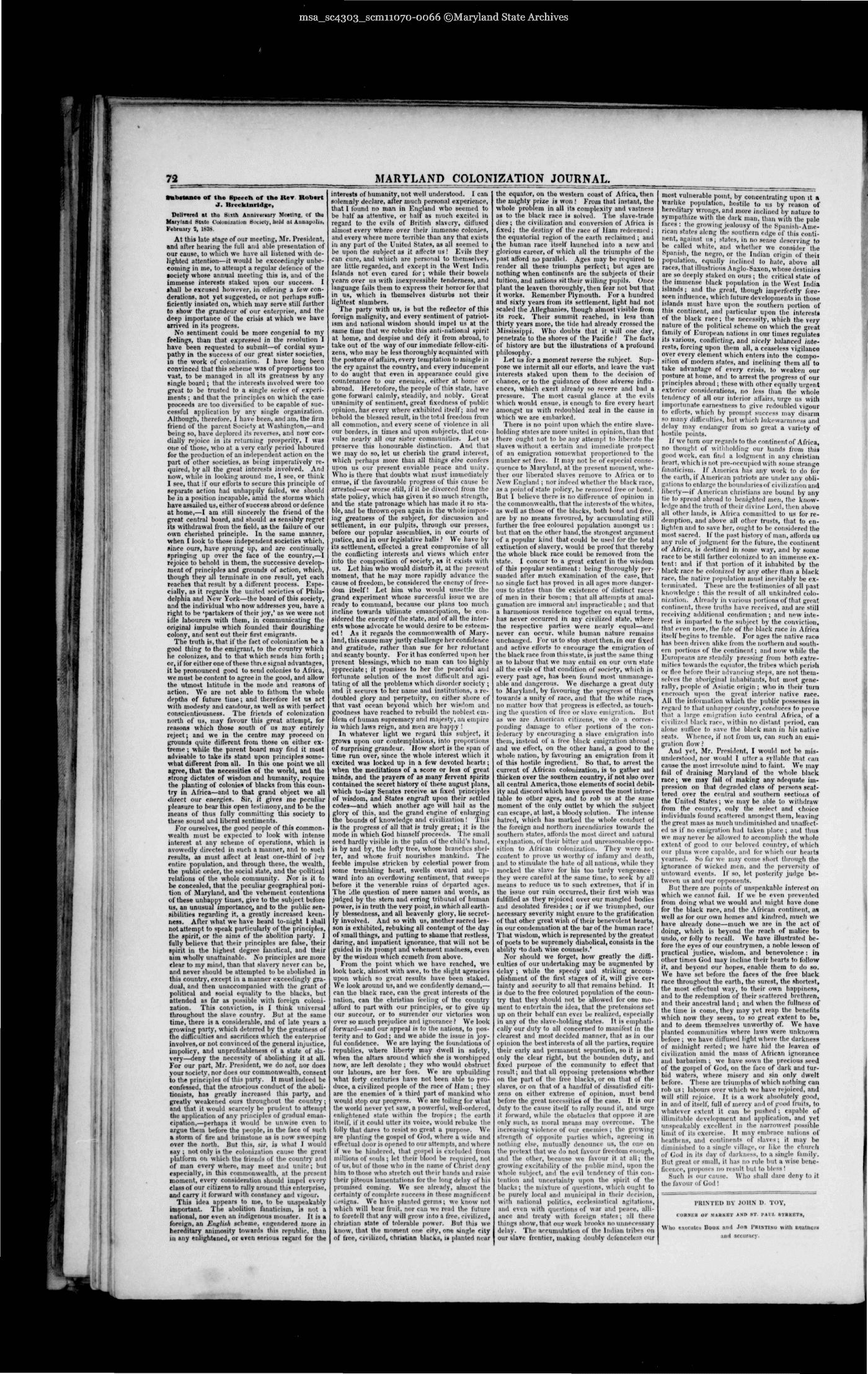
| 72 MARYLAND COLONIZATION JOURNAL. Substance of the Speech of the Rev Robert J. Breckinridge, Delivered at the Sixth Anniversary Meeting, or the Maryland State Colonization Society, held at Annapolis, February 2, 1838. At this late stage of our meeting, Mr. President, and alter hearing the full and aide presentation of our cause, to which we have all listened with de- lighted attention—it would be exceedingly unbe- coming in me, to attempt a regular defence of the society whose annual meeting this is, and of the immense interests staked upon our success. I shall be excused however, in Offering a lew con- derations, not yet suggested, or not perhaps sufR- ficiently insisted on, which may serve still farther to show the grandeur of our enterprise, and the deep importance of the crisis at which we have arrived in its progress. No sentiment could be more congenial to my feelings, than that expressed in the resolution I have Deen requested to submit—of cordial sym- pathy in the success of our great sister societies, in the work of colonization. I have long been convinced that this scheme was of proportions too vast, to be managed in all its greatness by any single board ; that the interests involved were too great to be trusted to a single series of experi- ments ; and that the principles on which the case proceeds are too diversified to be capable of suc- cessful application by any single organization. Although, therefore, 1 have been, ami am, the linn friend of the parent Society at Washington,—and being so, have deplored its reverses, and now cor- dially rejoice in its returning prosperity, I was one of those, who at a very early period laboured for the production of an independent action on the part of other societies, as being imperatively re- quired, by all the great interests involved. And liow, while in looking around me, I see, or think I see, that if our efforts to secure this principle of separate action had unhappily failed, we should be in a position incapable, amid the storms which have assailed us, either of success abroad or defence at home,—I am still sincerely the friend of the great central board, and should as sensibly regret its withdrawal from the field, as the failure of our own cherished principle. In the same manner, when I look to those independent societies which, since ours, have sprung up, and are continually springing up over the face of the country,—I rejoice to behold in them, the successive develop- ment of principles and grounds of action, which, though they all terminate in one result, yet each reaches that result by a dilferent process. Espe- cially, as it regards the united societies of Phila- delphia and New York—the board of this society, and the individual who now addresses you, have a right to be 'partakers of their joy,' as we were not idle labourers with them, in communicating the original impulse which founded their nourishing colony, and sent out their first emigrants. The truth is, that if the fact of colonization be a good thing to the emigrant, to the country which he colonizes, and to that which sends him forth; or, if lor either one of these three signal advantages, it be pronounced good to send colonies to Africa, we must be content to agree in the good, and allow the utmost latitude in the mode and reasons of action. We are not able to fathom the whole depths of future time; and therefore let us act with modesty and candour, as well as with perfect conscientiousness. The friends of colonization north of us, may favour this great attempt, for reasons which those south of us may entirely reject; and we in the centre may proceed on grounds quite dilferent from those on either ex- treme ; while the parent board may find it most advisable to take its stand upon principles some- what dilferent from all. In this one point we all agree, that the necessities of the world, and the strong dictates of wisdom and humanity, require the planting of colonies of blacks from this coun- try in Africa—and to that grand object we all direct our energies. Sir, it gives me peculiar pleasure to bear this open testimony,and to be the means of thus fully committing this society to these sound and liberal sentiments. For ourselves, the good people of this common- wealth must be expected to look with intense interest at any scheme of operations, which is nvowedly directed in such a manner, and to such results, as must aflect at least one-third of i'er entire population, and through these, the wealth, the public order, the social state, and the 'political relations of the whole community. Nor is it to he concealed, that the peculiar geographical posi- tion of Maryland, and the vehement contentions of these unhappy times, give to the subject before us, an unusual importance,, and to the public sen- sibilities regarding it, a greatly increased keen- ness. After what we have heard to-night 1 shall not attempt to speak particularly of the principles, the spirit, or the aims of the abolition parly. I fully believe that their principles are false, their spirit in the highest degree fanatical, and their aim wholly unattainable. No principles are more clear to my mind, than thai slavery never cm be, and never should be attempted to be abolished in this country, except in a manner exceedingly gra- dual, and then unaccompanied with the grant of political and social equality to the blacks, but attended as far as possible with foreign coloni- zation. This conviction, is I think universal throughout the slave country. But at the same time, there is a considerable, and of late years a growing party, which deterred bv the greatness of the difficulties and sacrifices which the enterprise involves, or not convinced of the general injustice, impolicy, and unprofitableness of a state of sla- very—efeny the necessity of abolishing it at all. For our part, Mr. President, we do not, nor does your society, nor does our commonwealth, consent to the principles of this party. It must indeed be confessed, that the atrocious conduct of the aboli- tionists, has greatly increased this party, ami greatly weakened ours throughout the country; and that it would scarcely be prudent to attempt the application of any principles of gradual eman- cipation,—perhaps it would be unwise even to argue them before the people, in the face of such a storm of fire and brimstone as is now sweeping over the north. But this, sir, is what I would say; not only is the colonization cause the great platform on which the friends id' the country and of man every where, may meet and unite; but especially, in this commonwealth, at the present moment, every consideration should impel every class of our citizens to rally around this enterprise, and carry it forward with constancy and vigour. This idea appears to me, to be unspeakably important. Tne abolition fanaticism, is not a national, nor even an indigenous monster. It is a foreign, an English scheme, engendered more in hereditary animosity towards this republie, than in any enlightened, or even serioiu regard for the interests of humanity, not well understood. I can solemnly declare, after much personal experience, that I found no man in England who seemed to be half as attentive, or half as much excited in regard to the evils of British slavery, diffused almost every where over their immense colonies, and every w here more terrible than any that exists in any part of the United States, as all seemed to be upon the subject as it affects us! Evils they can cure, and which arc personal to themselves, are little regarded, and except in the West India Islands not even cared lor; while their bowels yearn over H with inexpressible tenderness, and language fails them to express their horror lor that in us, which in themselves disturbs not their lightest slumbers. The party with us, is hut the reflector of this foreign malignity, and every sentiment of patriot- ism and national wisdom should impel us at the same time that we rebuke this anti-national spirit at home, and despise and defy it from abroad, to take out of the way of our immediate fellow-citi- zens, who may be less thoroughly acquainted with the posture of affairs, every temptation to mingle in the cry against the country, and every inducement to do aught that even in appearance could give countenance (o our enemies, either at home: or abroad. Heretofore, the people of this state, have gone forward calmly, steadily, and nobly, tin at unanimity of sentiment, great fixedness of public opinion, ha? everv where exhibited itself; and we behold the blessed result, in the total freedom from all commotion, and every scene of violence in all our borders, in times and upon subjects, that con- vulse nearly all our sister communities. Lot us preserve this honourable distinction. And that we may do so, let us cherish the grand interest, which perhaps more than all things else confers upon us our present enviable peace and unity. Who is there that doubts what must Immediately ensue, if the favourable progress of this cause be arrested—or worse still, if it be divorced from the state policy, which has given it so much strength, and the state patronage which has made it so sta- ble, and be thrown open again in the whole impos- ing greatness of the subject, for discussion and settlement, in our pulpiis, through our pusses, before our popular assemblies, in our courts of justice, and in our legislative halls? We have by its settlement, effected a great compromise of all the conflicting interests and views which enter into the composition of society, as it exists with us. Let him who would disturb it, at the present moment, that he may more rapidly advance the cause ol freedom, be considered the enemy of free- dom itself! Let him who would unsettle the grand experiment whose successful issue we are ready to command, because our plans too much incline towards ultimate emancipation, be con- sidered the enemy of the state, and of all (he inter- ests whose advocate he would desire to be esteem- ed ! As it regards the commonwealth of Mary- land, this cause may justly challenge her confide nee and gratitude, rather than sue for her reluctant and scanty bounty. For it has conferred upon her present blessings, which no man can too highly appreciate; it promises to her the peaceful and fortunate solution of the most difficult ami agi- tating of all the problems which disorder society ; and it secures to her name and institutions, a re- doubled glory and perpetuity, on either shore of that vast ocean beyond which her wisdom and goodness have reached to rebuild the noblest em- blem of human supremacy and majesty, an empire in which laws reign, and men are happy ! In whatever light we regard this subject, it grows upon our contemplations, into proportion! of surprising grandeur. How short is the span of time run over, since the whole interest which it excited was locked up in a few devoted hearts; when the meditations of a score or less of great minds, and the prayers of as many fervent spirits contained the secret history of these august plans, which to-day Senates receive as fixed principles of wisdom, and States engraft upon their setfled codes—and which another age will hail as the glory of this, anil the grand engine of enlarging the bounds of knowledge and civilization! This is the progress of all that is truly great; it is the mode in which God himself proceeds. The small seed hardly visible in the palm of the child's hand, is by and by, the lofty tree, whose blanches shel- ter, and whose fruit nourishes mankind. The feeble impulse stricken by celestial power from some trembling heart, swells onward and up- ward into an overflowing sentiment, that sweeps before it the venerable ruins of departed ages. The idle question of mere names and words, as judged by the stern and erring tribunal of human pow er, is in truth the very point, il which all earth- ly blessedness, and all heavenly glory, lie secret- ly involved. And so with us, another sacred les- son is exhibited, rebuking all contempt of the day of small tilings, and putting to shame that restless, daring, and impatient ignorance, that will not be guided in its prompt and vehement madness, even by the wisdom which cemeth from above. From the point which we have reached, wo look back, almost with awe, to the slight agencies upon which so great results have been staked. We look around us, and we confidently demand,— can the black race, can the great interests of the nation, can the christian feeling of the country afford to part with our principles, or to give lip our succour, or to surrender our victories wen over so much prejudice and ignorance'. We look forward—and our appeal is to the nations, to pos- terity and to God; and we abide the issue in joy- ful confidence. We are laying the foundations of republics, where liberty may dwell in safety, when the altars around which she is worshipped now, are left desolate ; they who would obstruct our labours, are her foes. We are upbuilding what forty centuries have not been able to pro- duce, a civilized people of the race of Ham ; they are the enemies of a third part of mankind who would slop our progress. We are toiling far what the world never yet saw, a powerful, well-ordered, enlightened state within the tropics ; the earth itself, if it could utter its voice, would rehuke the folly that dares to resist so great a purpose. We are planting the gospel of God, where a wide and effectual door is opened to our attempts, and where if we be hindered, that gospel is excluded from millions of souls; let their mood be required, not of us, but of those who in the name of Christ deny him to those who stretch out their hands and raise their piteous lamentations for the long delay of his promised coming. We see already, almost the Certainty of complete success in these magnificent Ileaigns. We have planted germs; we know not which will bear fruit, nor can we read the future to foretell that any will grow into a free, civilized, christian state ot tolerable power. But this we know, that the moment one city, one wngle city of free, civilized, christian blacks, is planted near the equator, on the western coast of Africa, then the mighty prize is won ! From that instant, the whole problem in all its complexity and vastuoss as to the black race is solved. The slave-trade dies; the civilization and conversion of Africa is fixed; the destiny of the race of Ham redeemed ; the equatorial region of the earth reclaimed ; and the human race itself launched into a new and glorious career, of which all the triumphs of the past afford no parallel. Ages may be required to render all these triumphs perfect; but ages are nothing when continents are the subjects of their tuition, and nations sit their willing pupils. Once plant the leaven thoroughly, then fear not but that it works, llemember Plymouth. For a hundred and sixty years from its settlement, light had not scaled the Alleghanies, though almost visible from its rock. Their summit reached, in less than thirty years more, the tide had already crossed the Mississippi. Who doubts that it will one day, penetrate to the shores of the Pacific ? The facts of history are but the illustrations of a profound philosophy. Let us for a moment reverse the subject. Sup- pose we intermit all our efforts, and leave the vast interests staked upon them to the decision of chance, or to the guidance of those adverse influ- ences, which exert already so severe and bad a pressure. The most casual glance at the evils which would ensue, is enough to fire every heart amongst us with redoubled zeal in the cause in which we are embarked. There is no point upon which the entire slave- holding states are more united in opinion, than that there ought not to be any attempt to liberate the slaves without a certain and immediate prospect of an emigration somewhat proportioned to the number set free. It may not be of especial conse- quence to Maryland, at the present moment, whe- ther our liberated slaves remove to Africa or to New England; nor indeed whether (he black race, as a point of state policy, be removed free or bond. But I believe there is no difference of opinion in the commonwealth, that the interests of the whites, as well as those of the blacks, both horn! and free, are by no means favoured, by accumulating still forth*? the free coloured population amongst us: but that on the other hand, the strongest argument of a popular kind that could be used for tho total extinction of slavery, would be proof that thereby the whole black race could be removed from the state. I concur to a great extent in the wisdom of this popular sentiment: being thoroughly per- suaded alter much examination of the case, that no single fact has proved in all ages more danger- ous to states than the existence of distinct races of men in their bosom; that all attempts at amal- gamation are immoral and impracticable ; and that a harmonious residence together on equal terms, has never occurred in any civilized state, where the respective parties were nearly equal—and never can occur, while human nature remains unchanged. For us to stop short then, in our fixed and active efforts to encourage the emigration of the black race from this state, is just the same thing as to labour that we may entail on our own state all the evils of that condition of society, which in every past age, has been found most unmanage- able and dangerous. We discharge a great duty to Maryland, by favouring the progress of things towards a unity of race, and that the white race, no matter how that progress is edected. as touch- ing the question of lice or slave emigration. lint as we are American citizens, we do a corres- ponding damage to other portions of the con- federacy by encouraging a slave emigration into them, instead of a free black emigration abroad ; and we ellect, on the other hand, a good to the whole nation, by favouring an emigration from it of this hostile ingredient. So that, to arrest the current of African colonization, is to gather and thicken over the southern country, if not also over all central America, those elements of social debil- ity and discord which have proved the most intrac- table to other ages, and to rob us at the same moment of the only outlet by which the subject can escape, at last, a bloody solution. The intense hatred, which has marked the whole conduct of the foreign and northern incendiaries towards the southern states, affords the most direct and natural explanation, of their bitter and unreasonable oppo- sition to African Colonization. They were not content to prove us worthy of infamy and death, and to stimulate the hate of all nations, while they mocked the slave for his too tardy vengeance; they were careful at the same time, to seek by all means to reduce us to such extremes, that if in the issue our ruin occurred, their first wish was fulfilled as they rejoiced over our mangled bodies and desolated firesides ; or if we triumphed, our necessary severity might enure to the gratification of that other great wish of their benevolent hearts, in our condemnation at the bar of the human race! That wisdom, which is represented by the greatest of poets to be supremely diaholical, consists in the ability 'to dash wise counsels.' Nor should we forget, how greatly the diffi- culties of our undertaking may he augmented by delay ; while the speedy and striking accom- plishment of the first stages of it, will give cer- tainty and security to all that remains behind. It is due to the free coloured population of the coun- try that they should not be allowed for one mo- ment to entertain the idea, that the pretensions set up on their behalf can evei be realized, especially in any of the slave-holding states. It is emphati- cally our duty to all concerned to manifest in the clearest and most decided manner, that as in our opinion the best interests of all the parties, require their early and permanent separation, so it is not only the clear right, but the bounden duty, and fixed purpose ol the community to effect that result; and that all opposing pretensions whether on the part of the free blacks, or on that of the slaves, or on that of a handful of dissatisfied citi- zens on either extreme of opinion, must bend before the great necessities of the case. It is our duty to the cause itself to rally round it, and urge- it forward, while the obstacles that oppose il are only such, as moral means in.iv overcome. The Increasing violence of out enemies; the growing strength id' opposite in ties which, agreeing in nothing else, mutually denounce us, the on" on the pretext that we do not favour freedom enough, and the other, he mm we favour it at all; the growing excitability of the public mind, upon the whole subject, and the evil tendency of this con- tention and uncertainty upon the spirit of the slacks; the mixture of questions, which ought to be purely local and municipal in their decision, with national politics, ecclesiastical agitations, and even with questions of war and peace, alli- ance and treaty with foreign states; all these things show, that our work brooks no unnci e-s.uy delay. The accumulation of the Indian tribes on our slave frontier, making doubly defenceless our most vulnerable point, by concentrating upon it a warlike population, hostile to us by reason of hereditary wrongs, and more inclined by nature to sympathize with the dark man, than with the pale faces : the growing jealousy of the Spanish-Ame- rican slates along the southern edge of this conti- nent, against us; states, in no sense deserving to be called white, and whether we consider the Spanish, the negro, or the Indian origin of theii population, equally inclined to hate, above all races, Ihat illustrious Anglo-Saxon, whose destinies are so deeply staked on ours ; the critical stale of the immense black population in (he West India islands; and the great, though imperfectly fore- seen influence, which future developments in those islands must have upon the southern portion of Ibis Continent, and particular upon the interests of the black race; the necessity, which the very nature of the political scheme on which the great family of European nations in our times regulates its various, conflicting, and nicely balanced inte- rests, forcing upon them all, a ceaseless vigilanco over every element which enters into the compo- sition of modem stales, and inclining them all to take advantage of every crisis, to weaken our posture at home, and to arrest the progress of our principles abroad ; these with other equally urgent exterior considerations, no less limn the whole tendency of all our Interior affairs, urge us with importunate earnestness to give redoubled vigour to efforts, which by prompt success may disarm so many difficulties, but which lakewarmness anil delay may endanger from so great a variety of hostiie points. If we turn OUT regards to the continent of Africa, no thought of withholding our hands from this good work, can find a lodgment in any christian heart, which is not pro-occupied with some strange fanaticism, If America has any work to do for the earth, if American patriots are under any obli- gations to enlarge the boundaries of civilization and liberty—if American christians are bound by any tie lo spread abroad to benighted men, the know- ledge and the truth id'their divine Lord, then above all other lands, is Africa committed to us for re- demption, and above all other trusts, that to en- lighten and to save her, ought to be considered the most sacred. If the past history of man, affords us any rule of judgment for the Inline, the continent of Africa, is destined in some way, and by some race to be still farther colonized to an immense ex- tent: and if that portion of it inhabited by the black race be colonized by any other than a black race, the native population must inevitably be ex- terminated. These are the testimonies of all past knowledge : this the result of all unkindred colo- nization. Already in various portions of that great continent, these truths have received, and are still receiving additional confirmation; and new inte- rest is imparted to the subject by the conviction, Ihat even now, (he fate of the black race in Africa itself begins to tremble. For ages the native race has been driven alike from the northern and south- ern portions of the continent; and now while the Europeans are steadily pressing from both extre- mities tow aids the equator, the tribes which perish or tlee before their advancing steps, are not them- selves the aboriginal inhabitants, hut most gene- rally, people of Asiatic origin ; who in (heir turn encroach upon the great interior native race. All the information which the public possesses in regard to thai unhappy country, conduces to prove that a large emigration into central Africa, of a ciyilized black race, within no distent period, can alone suffice fo sate} the black man in bis native scats. Whence, it not from us, can such an emi- gration flow ? And yet, Mr. President, I would not be mis- understood, nor would I Utter a syllable that can cause the most irresolute mind to taint. We may fail of draining Maryland of the whole black race; we may fail of making any adequate im- pression on that degraded class of persons scat- tered over the central and southern sections of the United States; we may be able to withdraw from the country, only the select and choice individuals found scattered amongst them, ha\ ing the great mass as much undiminished and unaffect- ed as if no emigration had taken place ; and thus we may never be allowed to accomplish tho whole extent of good to our beloved country, of which our plans wire capable, and for which our hearts yearned. So far We may come short through the ignorance of wicked men, and the perversity of untoward events. If so, let posterity judge be- tween us and our opponents. Hut there are points of unspeakable interest on which we cannot fail. If we be even prevented from doing what we would and might have done for the black race, and the African continent, as well as for our own homes and kindred, much wo have already done—much we are in the act of doing, which is beyond the reach of malice to undo, or folly to recall. We have illustrated be- fore the eyes of our countrymen, a noble lesson of practical justice, wisdom, and benevolence : in other times God may incline their hearts to follow it. and beyond our hopes, enable them to do so. We have set before the faces of the free black race throughout the earth, the surest, the shortest, the most elfectual way, to their own happiness, and to the redemption of their scattered brethren, and their ancestral land; and w hen the fullness of the time is come, they may yet reap the benefits which now they seem, to so great extent to be, and to deem themselves unworthy of. We have planted communities where laws were unknown before; we have diffused light where the darkness of midnight rested; we have hid the leaven of civilization amid the mass of African ignorance and barbarism ; we have sown the precious seed of the gospel of God, on the face of dark and tur- bid waters, where misery and sin only dwelt before. These are triumphs of which nothing can rob us; labours over which we have rejoiced, and will still rejoice. It is a work absolutely good, in and of itself, full of mercy and ol 'good fruits, to whatever extent it can be pushed ; capable of illimitable development and application, and yet unspeakably excellent in the narrowest possible limit of its exercise. It may embrace nations of heatln ns, and continents of slaves; it may be diminished to a single village, or like the church of God in its day of darkness, to a single family. But great or small, it has no rule but a wise bene- ficence, proposes no result but to btesal Such is our cause. Who shall dare deny to it the favour of God! PRINTED BY JOHN D. TOY, CORNER OF MARKET AND ST. PAUL STREETS, Who executes Book and Job Printing with neatness and accuracy. |