 |
|
|
 |
|
 |
|
|||
|
||||
|
||||
|
Maryland State Archives Maryland Colonization Journal Collection MSA SC 4303 msa_sc4303_scm11070-0068 Enlarge and print image (5M) |
|
|
|
|
|
|
|
|||
|
||||
|
||||
|
Maryland State Archives Maryland Colonization Journal Collection MSA SC 4303 msa_sc4303_scm11070-0068 Enlarge and print image (5M) |
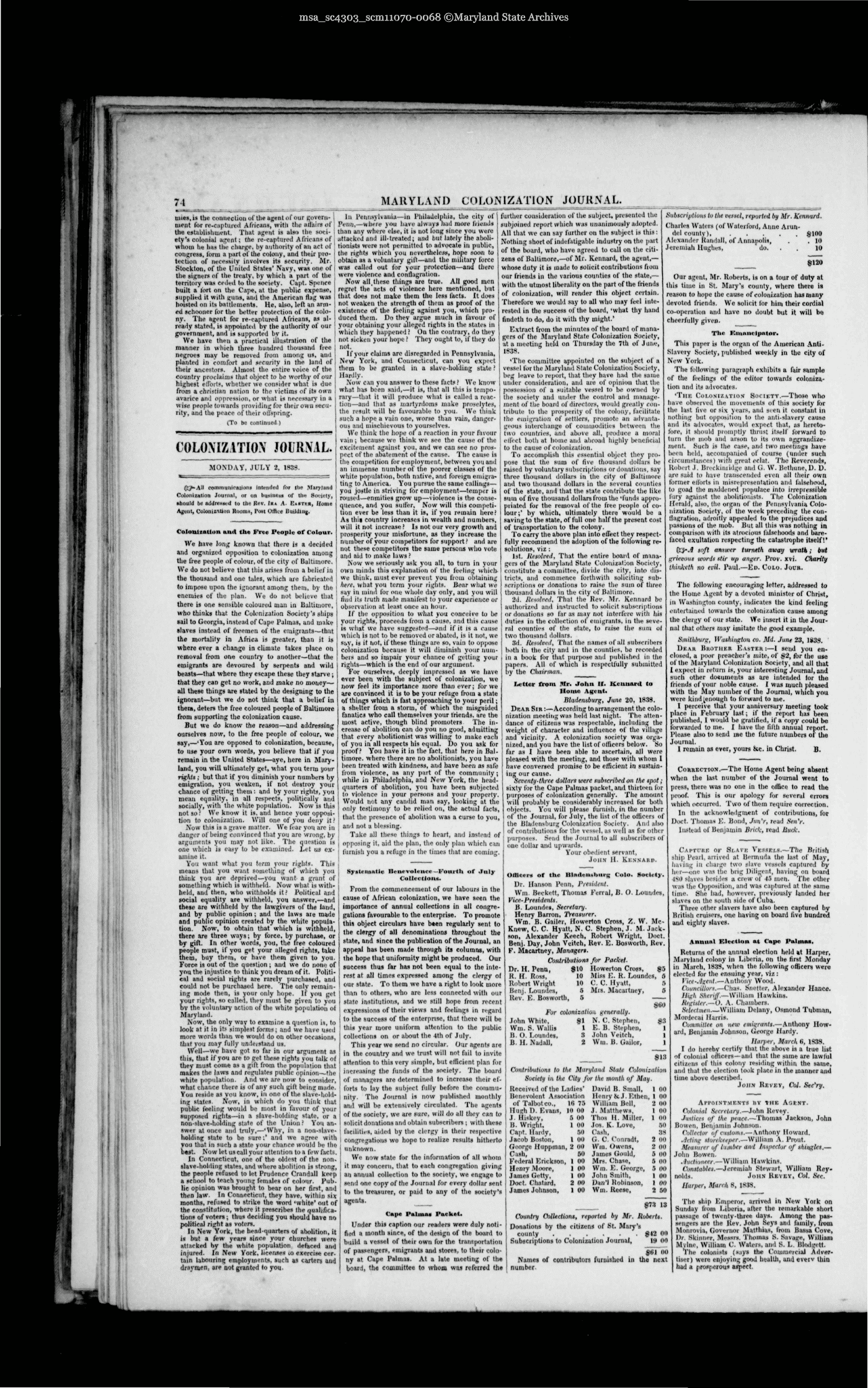
| 74 MARYLAND COLONIZATION JOURNAL. nues.is the connection of the agent of our govern- nient for re-captured Africans, with the art'airs of the establishment. That agent is also the soci- ety's colonial agent; the re-captured Africans of whom he has the charge, by authority of an act of congress, form a part of the colony, and their pro- tection of necessity involves its security. Mr. Stockton, of the United States' Navy, was one of the signers of the treaty, by which a part of the territory was ceded to the society. Capt. Spence built a fort on the Cape, at the public expense, supplied it with guns, and the American flag was hoisted on its battlements. He, also, left an arm- ed schooner for the better protection of the colo- ny. The agpnt for re-captured Africans, M al- ready stated, is appointed by the authority of our government, and is supported by it. We have then a practical illustration of the manner in which three hundred thousand free negroes may be removed from among us, ami planted in comfort and security in the land of their ancestors. Almost the entire voice of the country proclaims that object to be worthy of our highest efforts, whether we consider what is due from a christian nation to the victims of its own avarice and oppression, or what is necessary in a wise people towards providing for their owu secu- rity, and the peace of their offspring. (To be continued ) COLONIZATION JOURNAL. MONDAY, JULY 2, 1839. All communications intended for the Marylund Colonization Journal, or on business of the Society, should be addressed to tile Rev. Ira A. Easter, Home Agent, Colonization Rooms, Post Office Building. Colonization and the Free People of Colour. We have long known (hat there is a decided and organized opposition to colonization among the tree people of colour, of the city of Baltimore, We do not believe that this arises from a belief in the thousand and one tales, which are fabricated to impose upon the ignorant among them, by the enemies of the plan. We do not believe that there is one sensible coloured man m Baltimore, who thinks that the Colonization Society-s ships sail to Georgia, instead of Cape Palmas, and make slaves instead of freemen of the emigrants—that the mortality in Africa is greater, than it is where ever a change in climate takes place on removal from one country to another—that the emigrants are devoured by serpents and wild beasts—that where they escape these they starve ; that they can get no work, and make no money— all these things are stated by the designing to the ignorant—but we do not think that a belief in them, deters the free coloured people of Baltimore from supporting the colonization cause. But we do know the reason—and addressing ourselves now, to the free people of colour, we say,—'You are opposed to colonization, because, to use your own words, you believe that if you remain in the United States—aye, here in Mary- land, you will ultimately get, what you term yuur righh ; but that if you diminish your numbers by emigration, you weaken, if not destroy your chance of getting them: and by your rights, you mean equality, in all respects, politically and socially, with the white population. Now is this not so? We know it is, and hence your opposi- tion to colonization. Will one of you deny it? Now this is a grave matter. We fear you are in dangor of being convinced that you are wrong, by arguments you may not like. The question is one which is easy to be examined. Let us ex- amine it. Von want what you term your righfs. This means that you want something of which you think you are deprived—you want a grant of something which is withheld. Now what is with- held, and then, who withholds it? Political and social equality are withheld, you answer,—and these are withheld by the lawgivers of the land, and by public opinion ; and the laws are made and public opinion created by the white popula- tion. Now, to obtain that which is withheld, there are three ways; by force, by purchase, or by gift. In other words, you, the free coloured people must, if you get your alleged rights, take them, buy them, or have them given to you. Force is out of the question ; and we do none of you the injustice to think you dream of it. Politi- cal and social rights are rarely purchased, and could not be purchased here. The only remain- ing mode then, is your only hope. If you get your rights, so called, they must be given to you bv the voluntary action of the white population ot Maryland. Now, the only way to examine a question is, to look at it in it* simplest forms; and we have used more words than we would do on other occasions, that you may fully undeistand us. Well—we have got so far in our argument as this, that if you are to get these rights you talk o( they must come as a gilt from thepopillation that makes the laws and regulates public opinion~the white population. And we are now to consider, what chance there is of any such gift beiru; made. You reside as you know, in one of the slave-hold- inn states. Now, in which do you think that public feeling would be most in favour of your supposed rights—in a slave-holding state, or a non-slave-holding state of the Union ? Yon an- swer at once and truly,—'Why, in a non-s|ave- holding state to be sure;' and we agree with you that in such a state your chance would be the best. Now let us call your attention to a few facts. In Connecticut, one of the oldest of the non- slave-holding states, and where abolition is strong, the people refused to let Prudence Crandall keep a school to teach young females of colour. Pub. lie opinion was brought to bear on her first, ami then law. In Connecticut, they have, within six months, refused to strike the word 'white' out of the constitution, where it prescribes the qualifica- tions of voters; thus deciding you should have no political right as voters. In New York, the head-quarters of abolition, it is but a few years since your churches were attacked by the white population defaced and injured. In New York, licenses to exercise cer- tain labouring employments, such as carters and draymen, are not granted to you. In Pennsylvania—in Philadelphia, the city of Peim,—where you have always had more friends than any where else, it is not long since you were attacked and ill-treated; and hut lately the aboli- tionists were not permitted to advocate in public, the rights which you nevertheless, hope soon to obtain as a voluntary gift—and the military force was called out lor your protection—and there were violence and conflagration. Now all these things are true. All good men regret the acts of violence here mentioned, but that does not make them the less facts. It does not weaken the strength of them as proof of the existence of the feeling against you, which pro- duced them. Do they argue much in favour of your obtaining your alleged rights in the states in which they happened ? On the contrary, do they not sicken your hope ? They ought to, if they do not. If your claims are disregarded in Pennsylvania, New York, and Connecticut, can you expect them to be granted in a slave-holding state ? Hardly. Now can you answer to these facts ? We know what has been said,—it is, that all this is tempo- rary—that it will produce what is called a reac- tion—and that as martyrdoms make proselytes, the result will be favourable to you. We think such a hope a vain one, worse than vain, danger- ous and mischievous to yourselves. We think the hope ot a reaction in your favour vain; because we think we see the cause of the excitement against you, and we can see no pros- pect of the abatement of the cause. The cause is the competition for employment, between you and an immense number of the poorer classes of the white population, both native, and foreign emigra- ting to America. You pursue the same callings— you jostle in striving for employment—temper is roused—enmities grow up—violence is the conse- quence, and you suffer, Now will this competi- tion ever be less than it is, if you remain here? As thil country increases in wealth and numbers, will it not increase? Is not our very growth and prosperity your misfortune, as they increase the number of your competitors for support? and are not these competitors the same persons who vote and aid to make laws ? Now we seriously ask you all, to turn in your own minds this explanation of the feeling which, we think, must ever prevent you from obtaining here, what you term yuur right3. Hear what we say in mind for one whole day only, and you will find its truth made manifest to your experience or observation at least once an hour. If the opposition to what you conceive to be your rights, proceeds from a cause, and this cause is what we nave suggested—and if it is a cause which is not to be removed or abated, is it not, we say, is it not, if these things are so, vain to oppose colonization because it will diminish your luini- beis and so impair your chance of getting your rights—which is the end of our argument. For ourselves, deeply impressed as we have ever been with the subject of colonization, we now feel its importance more than ever; for we are convinced it is to be your refuge from a state of things which is fast approaching to your peril; a shelter from a storm, of which the misguided fanatics who call themselves your friends, are the most active, though blind promoters The in- crease of abolition can do you no good, admitting that every abolitionist was willing to make each of you in all respects his equal. Do you ask for proof? You have it in the fact, that here in Bal- timore, where there are no abolitionists, you have been treated with kindness, and have been as safe from violence, as any pari of the community ; while in Philadelphia, and New York, the head- quarters of abolition, you have been subjected to violence in your persons and your property. Would not any candid man say, looking at the only testimony to be relied on, the actual facts, that the presence of abolition was a curse to you, and not a blessing. Take all these things to heart, and instead of opposing it, aid the plan, the only plan which can furnish you a refuge in the times that are coming. further consideration of the subject, presented the subjoined report which was unanimously adopted. All that we can say further on the subject is this: Nothing short of indefatigable industry on the part of the board, who have agreed to call on the citi- zens of Baltimore,—of Mr. Kennard, the agent,— whose duty it is made to solicit contributions fiom our friends in the various counties of the state,— with the utmost liberality on the part of the friends of colonization, will render this object certain. Therefore we would say to all who may feel inte- rested in the success of the board, 'what thy hand fmdetli to do, do it with thy might.' Extract from the minutes of the board of mana- gers of the Maryland State Colonization Society, at a meeting held on Thursday the 7th of June, 1838. 'The committee appointed on the subject of a vessel for the Maryland State Colonization Society, beg leave to report, that they have had the same under consideration, and are of opinion that the possession of a suitable vessel to be owned by the society and under the control and manage- ment of the board of directors, would greatly con- tribute to the prosperity of the colony, facilitate the emigration of settlers, promote an advanta- geous interchange of commodities between the two countries, and above all, produce a moral ell'ect both at home and abroad highly beneficial to the cause of colonization. To accomplish this essential object they pro- pose that the sum of five thousand dollars he raised by voluntary subscriptions or donations, say three thousand dollars in the city of Baltimore and two thousand dollars in the several counties of the state, and that the state contribute the like sum of five thousand dollars from the'funds appro- priated for the removal of the free people of co- lour;' by which, ultimately there would be a saving to the state, of full one half the present cost of transportation to the colony. To carry the above plan into ell'ect they respect- fully recommend the adoption of the following re- solutions, viz : 1st. Resolved, That the entire board of mana- gers of the Maryland State Colonization Society, constitute a committee, divide the city, into dis- tricts, and commence forthwith soliciting sub- scriptions or donations to raise the sum of three thousand dollars in the city of Baltimore. 2d. Resolved, That the Rev. Mr. Kennard be authorized and instructed to solicit subscriptions or donations so tar as may not interfere with his duties in the collection of emigrants, in the seve- ral counties of the state, to raise the sum oi two thousand dollars. 3d Resolved, That the names of all subscribers both in the city and in the counties, be recorded in a book for that purpose and published in the papers. All of which is respectfully submitted by the Chairman. Letter from Mr. John H. Kennard to Home Agent. Bladensburg, June 20, 1838. Dear Sir:—According to arrangement the colo- nization meeting was held last night. The atten- dance of citizens was respectable, including the weight of character and influence of the vilhige and vicinity. A colonization society was orga- nized, and you have the list of oflicers below. So far as I have been able to ascertain, all were pleased with the meeting, and those with whom I have conversed promise to be efficient in sustain- ing our cause. Seventy-three dollars were subscribed on the spot; sixty for the Cape Palmas packet, and thirteen for purposes of colonization generally. The amount will probably be considerably increased for both objects. You will please furnish, in the number of the Journal, for July, the list of the officers of the Bladensburg Colonization Society. And also of contributions for the vessel, as well as for other purposes. Send the Journal to all subscribers of one dollar and upwards. Your obedient servant, John H. Kennard. Subscriptions to the vessel, reported by Mr. Kennard. Charles Waters (of Waterford, Anne Arun- del county),..... $100 Alexander Randall, of Annapolis, . . 10 Jeremiah Hughes, do. . . 10 $120 Our agent, Mr. Roberts, is on a tour of duty at this time in St. Mary's county, where there is reason to hope the cause of colonization has many devoted friends. We solicit lor him their cordial co-operation and have no doubt but it will be cheerfully given. The Emancipat or. This paper is the organ of the American Anti- Slavery Society, published weekly in the city of New York. The following paragraph exhibits a fair sample of the feelings of the editor towards coloniza- tion and its advocates. 'The Colonization Society.—Those who have observed the movements of this society for the last live or six years, and seen it constant in nothing but opposition to the anti-slavery cause and its advocates, would expect that, as hereto- fore, it should promptly thrust itself forward to turn the mob and arson to its own aggrandize- ment. Such is the case, and two meetings have been held, accompanied of course (under such circumstances) with great eclat. The Reverends, Robert J. Breckinridge and G. W. Bethune.D. D. are said to have transcended even all their own former eilbrts in misrepresentation and falsehood, to goad the maddened populace into irrepressible fury against the abolitionists. The Colonization Herald, also, (he organ of the Pennsylvania Colo- nization Society, of the week preceding the con- flagration, adroitly appealed to the prejudices and passions of the mob. But all this was nothing in comparison with its atrocious falsehoods and bare- faced exultation respecting the catastrophe itself!" A soft answer turneth away wrath; but grievous words stir up anger. Prov. xvi. Charity thinketh no evil. Paul.—Ed. Colo. Jour. The following encouraging letter, addressed to the Home Agent by a devoted minister of Christ, in Washington county, indicates the kind feeling entertained towards the colonization cause among the clergy of our state. We insert it in the Jour- nal that others may imitate the good example. Smithburg, Washington co. Md. June 23, 1838. Dear Brother Easter:—1 send you en- closed, a poor preacher's mite, of $2, for the use of the Maryland Colonization Society, and all that I expect in return is, your interesting Journal, and such other documents as are intended lor the friends of your noble cause. I was much pleased with the May number of the Journal, which you were kind ^enough to forward to me. I perceive that your anniversary meeting took place in February iast; if the report has been published, I would be gratified, if a copy could be forwarded to me. I have the filth annual report. Please also to send me the future numbers of the Journal. 1 remain as ever, yours etc. in Christ. B. Systematic Benevolence—Fourth of .Inly Collections*. From the commencement of our labours in the cause of African colonization, we have seen the importance of annual collections in all congre- gations favourable to the enterprise. To promote this object circulars have b«en regularly sent to the clergy of all denominations throughout the state, and since the publication of the Journal, an appeal has been made through its columns, with the hope that uniformity might be produced. Our success thus far has not been equal to the inte- rest at all times expressed among the clergy of our state. To them we have a right to look more than to others, who are less connected with our state institutions, and we still hope from recent expressions of their views and feelings in regard to the success of the enterprise, that there will be this year more uniform attention to the public collections on or about the 4th of July. This year we send no circular. Our Rgents are in the country and we trust will not fail to invite attention to this very simple, but efficient plan for increasing the funds of the society. The board of managers are determined to increase their ef- forts to lay the subject fully before the commu- nity. The Journal is now published monthly and will be extensively circulated. The agents of the society, we are sure, will do all they can to solicit donations and obtain subscribers ; with these facilities, aided by the clergy in their respective congregations we hope to realize results hitherto unknown. We now state for the information of all whom it may concern, that to each congregation giving an annual collection to the society, we engage to send one copy of the Journal for every dollar sent to the treasurer, or paid to any of the society's agents. Cape Palmas Packet. Under this caption our readers were duly noti- fied a month since, of the design of the board to build a vessel of their own for the transportation of passengers, emigrants and stores, to their colo- ny at Cape Palmas. At a late meeting of the board, the committee to whom was referred the Officers of the Bladensburg Colo. Society. Dr. Hanson Penn, President. Wm Beckett, Thomas Ferral, B. O. Loundes, Vice-Presidents. B. Loundes, Secretary. Henry Barron, Treasurer. Wm. B. Gailer, Howerton Cross, Z. W. Mc- Knew, C. C. Hyatt, N. C. Stephen, J. M. Jack- son, Alexander Keech, Robert Wright, Doct. Benj. Day, John Veitch, Rev. E. Bosworth, Rev. F. Macartney, Managers. Contributions for Packet Correction.—The Home Agent being absent when the last number of the Journal went to press, there was no one in the office to read the proof. This is our apology for several errors which occurred. Two of them require correction. In the acknowledgment of contributions, for Doct. Thomas K. Bond, Jun'r, read Sen'r. Instead of Benjamin Brick, read Buck. Capture of Slave Vessels.—The British ship Pearl, arrived at Bermuda the last of May, having in charge two slave vessels captured by her—one was the brig Diligent, having on board 480 slaves besides a crew of 45 men. The other was the Opposition, and was captured at the same time. She had, however, previously landed her slaves on the south side of Cuba. Three other slavers have also been captured by British cruisers, one having on board five hundred and eighty slaves. Dr. H. Penn, R. H. Ross, Robert Wright Benj. Lou ndes, Rev. E. Bosworth, $10 10 10 5 5 Howerton Cross, $5 Miss E. R. Loundes, 3 C. C. Hyatt, 1 Mrs. Macartney, 5 For colonization generally. John White, $1 Wm. S. Wallis 1 B. O. Loundes, 3 B. H. Nadall, 2 N. C. Stephen, $3 E. B. Stephen, 1 John Veitch, 1 Wm. B. Gailor, 1 $13 Received of the Ladies' David B. Small, 1 00 Benevolent Association Henry & J. Ethen 1 00 of Talbot co., 16 75 William Bell, 2 00 Hugh D. Evans, 10 00 J Matthews, 1 00 J. Hiskey, 5 00 Thos H. Miller, 1 00 B. Wright. 1 00 Jos. K. Love, 50 Capt. Hardy, 50 Cash, 38 Jacob Boston, 1 00 G. C. Conradt, 2 00 George Huppman , 2 00 Wm. Owens, 2 00 Cash, 50 James Gould, 5 00 Federal Erickson 1 00 Mrs. Chase, 5 00 Henry Moore, 1 00 Wm. E. George, 5 00 James Getty, 1 00 John Smith, 1 00 Doct. Chatard, 2 00 Dan'l Robinson, 1 00 James Johnson, 1 00 Wm. Reese, 2 50 $73 13 Annual Election at Cape Palmas. Returns of the annual election held at Harper, Maryland colony in Liberia, on the first Monday in March, 1838, when the following officers were elected for the ensuing year, viz: Vice-Agent.—Anthony Wood. Councillors.—Chas. Snetter, Alexander Hance. High Sheriff.—William Hawkins. Register.—O. A. Chambers. Selectmen--William Delany, Osmond Tubman, Mordecai Harris, Committee on new emigrants.—Anthony How- ard, Benjamin Johnson, George Hardy. Harper, March 6, 1838. I do hereby certily that the above is a true list of colonial oflicers—and that the same are lawful citizens of this colony residing within the same, and that the election took place in the manner and time above described. John Revey, Col. Sec'ry. APPOINTMENTS BY THE AGENT. Colonial Secretary.—JohnRevey. Justices of the peace.—Thomas Jackson, John Bowen, Benjamin Johnson. Collector of customs.— Anthony Howard. Acting Storekeeper.— William A. Prout. Measurer of lumber and Inspector of shingles.— John Bowen, Auctioneer -- William Hawkins. Constables.—Jeremiah Stewart, William Rey- nolds. John Revey, Col. Sec. Harper, March 8, 1838, Country Collections, reported by Mr. Roberts. Donations by the citizens of St. Mary's county......$42 00 Subscriptions to Colonization Journal, 19 00 $61 00 Names of contributors furnished in the next number The ship Emperor, arrived in New York on Sunday from Liberia, after the remarkable short passage of twenty-three days. Among the pas- sengers are the Rev. John Seys and family, from Monrovia, Governor Matthias, from Bassa Cove, Dr. Skinner, Messrs. Thomas S. Savage, William Mvlne, William C. Waters, and S. L Bodgett. The colonists (says the Commercial Adver- tiser) were enjoying good health, and eveiv thin had a prosperous aspect Contributions to the Maryland State Colonization Society in the City for the month of May. |