 |
|
|
 |
|
 |
|
|||
|
||||
|
||||
|
Maryland State Archives Maryland Colonization Journal Collection MSA SC 4303 msa_sc4303_scm11070-0067 Enlarge and print image (5M) |
|
|
|
|
|
|
|
|||
|
||||
|
||||
|
Maryland State Archives Maryland Colonization Journal Collection MSA SC 4303 msa_sc4303_scm11070-0067 Enlarge and print image (5M) |
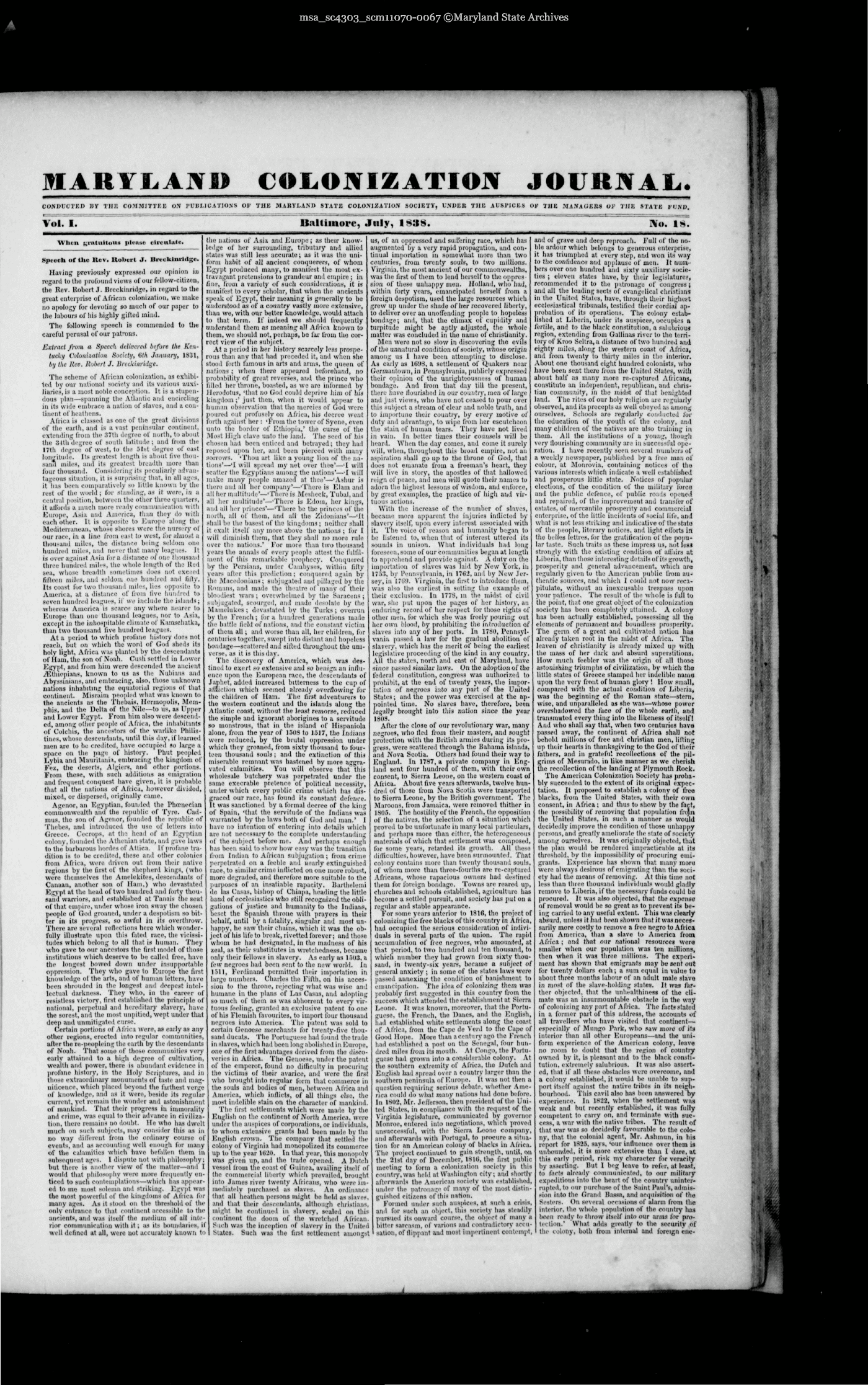
| MARYLAND COLONIZATION JOURNAL. CONDUCTED BY THE COMMITTEE ON PUBLICATlONS OF THE MARYLAND STATE COLONIZATION SOCIETY, UNDER THE AUSPlCES OF THE MANAGERS OF THE STATE FUND. Vol. I. Baltimore, July, l838. No. 19. When gratuitous please circulate. Speech of the Rev. Robert J. Breckinridge. Having previously expressed our opinion in regard to the profound views of our fellow-citizen, the Rev. Robert J. Breckinridge, in regard to the great enterprise of African colonisation, we make no apology for devoting so much of our paper to the labours of his highly gifted mind. The following speech is commended to the careful perusal of our pat'ons. Extract from a Speech delivered before the Ken- tucky Colonization Society, 6th January, 1831, by the Rev. Robert J. Breckinridge. The scheme of African colonization, as exhibi- ted by our national society and its various auxi- liaries, is a most noble conception. It is a stupen- dous plan—spanning the Atlantic and encircling in its wide embrace a nation of slaves, and a con- tinent of heathens. Africa is classed II one of the great divisions of the earth, and is a\ast peninsular continent, extending from the :57th degree of north, to about the 84th dene* of south latitude i and from the ITtii degree Of west, to the "list degree of east longitude, its greatest length is about live thou- sand mib's, and its greatest breadth more than lour thousand. Considering its peculiarly advan- tageous situation, it is surprising that, in all ages, it h is been comparatively so little known by tin- rest of the world ; lor standing, M it Mere, in a central position, between the other three quarters, it affords a much more ready communication with Europe, Asia and America, than they do witli each other, ll is opposite to Europe along the Mediterranean, whose shores were the nursery ol our race, in a line from east to west, for almost I thou-and miles, the distance being seldom one hundred miles, and Barer that many leagues. It is over against Asia for a distance of one thousand three hundred miles, the whole length of the Red .sea, whose breadth sometimes does not exceed fifteen miles, and seldom one hundred ami fifty. Its coast for two thousand miles, lies opposite to America, at a distance of from five hundred to seven hundred leagues, If we include the islands; whereas America is scare any where nearer to Europe than one thousand leagues, nor to Asia, except in the inhospitable climate of Kamschatka, than two thousand live hundred leagues. At a period to which profane history docs not reach, but on which the word of God sheds its holy light, Africa was planted by the descendants of ilam, the son of Noah. Cush settled in Lower Egypt, and from him were descended the ancient Ethiopians, known to us as the Nubians and Abyssinians, and embracing, also, those unknown nations inhabiting the equatorial regions of that continent. Misraim peopled what was known to the ancients as the Thebais, llermopolis, Mem- phis, ami the Delta of the Nile—to us, as Upper and Lower Egypt. From him also were descend- ed, among other people of Africa, the inhabitants of Colchis, the ancestors of the warlike Philis- tines, whoso descendants, until this day, if learned men are to he credited, have occupied so large a space on the page of history, l'hut peopled Lybia and Mauritania, embracing the kingdom of Fez, the deserts, Algiers, and other portions. From these, with such additions as emigration and frequent conquest have given.it is probable that all the nations of Africa, however divided, mixed, or dispersed, originally came. Agenor, an Egyptian, founded the Phrrncrian commonwealth and the republic of Tyre. Cad- mus, the sou of Agenor, founded the republic of 't'ln lies, and introduced the use of letters into Greece. Cecrops, at the head of an Egyptian colony, founded the Athenian state, and gave laws to the" barbarous hordes of Attica. If profane tra- dition is to be credited, these and other colonies from Afiica, were driven out from their native regions by the first of the shepherd kings, (who were themselves the Amelekites, descendants of Canaan, another son of Ham.) who devastated Egypt at the head of two hundred and forty thou- sand warriors, and established at Tauais the seat of that empire, under whose iron sway the chosen people of God groaned, under a despotism so bit- ter in its progress, so awful in its overthrow. There are several reflections here which wonder- fully illustrate upon this fated race, the vicissi- tudes which belong to all that is human. They who gave to our ancestors the first model of those institutions which deserve to be called free, have the longest bowed down under insupportable oppression. They who gave to Europe the first knowledge of the arts, and of human letters, have been shrouded in the longest and deepest intel- lectual darkness. They who, in the career of resistless victory, first established the principle of national, perpetual and hereditary slavery, have the sorest, and the most unpitied, wept under that deep and unmitigated curse. Certain portions of Africa were, as early as any other regions, erected into regular communities, after the re-peopleing the earth by the descend ants of Noah. That some of those communities very early attained to a high degree of cultivation, wealth and power, there is abundant evidence in profane history, in the Holy Scriptures, and in those extraordinary monuments of taste and mag- nificence, which placed beyond the I oiliest verge of knowledge, and as it were, beside its regular current, yet remain the wonder and astonishment of mankind. That their progress in immorality and crime, was eipial to their advance in civiliza- tion, there remains no doubt. He who has dwelt much on such subjects, may consider this as in no way different from the ordinary course of events,'and as accounting well enough for many of the calamities which have befallen them in subsequent ages. I dispute not with philosophy; but there is another view of the matter—and 1 would that philosophy were more frequently en- ticed to such contemplations—which has appear- ed to me most solemn and striking. Egypt was the most powerful of the kingdoms of Afiica for many ages. As it stood on the threshold of the onlv entrance to that continent accessible to the ancients, and was itself the medium of all inte- rior communication with it; as its boundaries, if well defined at all, were not accurately known to the nations of Asia and Europe; as their know- ledge of her surrounding, tributary and allied states was still less accurate; as it was the uni- form habit of all ancient conquerers, of whom Egypt produced many, to manifest the most ex- travagant pretensions to grandeur and empire ; in line, from a variety of such considerations, it is manifest to every scholar, that when the ancients speak of Egypt, their meaning is generally to be understood as of a country vastly more extensive, than we, with our better knowledge, would attach to that term. If indeed we should frequently understand them as meaning all Afiica known to them, we should not, perhaps, be far from the cor- rect view of the subject. At a period in her history scarcely less prospe- rous than any that had preceded it, and when she stood forth famous in arts and arms, the queen of nations ; when there appeared beforehand, no probability of great reverses, and the prince who idled her throne, boasted, as we are informed by Herodotus, 'that no God could deprive liim of his kingdom;' just then, when it would appear to human observation that the mercies of God were poured out profusely on Africa, his decree went ibrth against her : 'From the tower of Syene, even unto the border of Ethiopia,' the curse of the Most High clave unto the land. The seed of bis chosen had been enticed and betrayed; they had reposed upon her, and been pierced with many sorrows. 'Thou art like a young lion of the na- tions'—'I will spread my net over thee'—•! will scalier (he Egyptians among the nations'—-I will in,ike many people amazed at thee'—'Ashur is there an 1 all her company'—'There is Elam and all h.-r multitude'—'There is Mesheck, Tubal, and all her multitude'—•There is Edora, her kings, and all her princes'—'There be the princes of the north, all of them, and all the Zidonians'—'It shall be the basest of the kingdoms ; neither shall it exalt itself any more above the nations ; for I will diminish them, that they shall no more rule over the nations.' For more than two thousand years the annals of every people attest the fulfil- ment of this remarkable prophecy. Conquered by the Persians, under Cambyses, within fifty years after this prediction; conquered again by the Macedonians; subjugated ami pillaged by the Romans, and made the theatre of many of tlicir bloodiest wars ; overwhelmed by the Saracens ; subjugated, scourged, and made desolate by the Mamelukes; devastated by the Turks; overrun by the French; for a hundred generations made the battle field of nations, and the constant victim of them all; and worse than all, her children, for centuries together, swept into distant and hopeless bondage—scattered and silled throughout the uni- verse, as it is this day. The discovery of America, which was des- tined to exert so extensive and so benign an influ- ence upon the European race, the descendants of Japhet, added increased bitterness to the cup of affliction which seemed already overflowing for the children of Ham. The first adventurers to the western continent and the islands alon" the Atlantic coast, without the least remorse, reduced the simple and ignorant aborigines to a servitude so monstrous, that in the island of Hispaniola alone, from the year of 1508 to 1517, the Indians were reduced, by the brutal oppression under which they groaned, from sixty thousand to four- teen thousand souls; and the extinction of this miserable remnant was hastened by more aggra- vated calamities. You will observe that this wholesale butchery was perpetrated under the same execrable pretence of political necessity, under which every public crime which has dis- graced our race, has found its constant defence. It was sanctioned by a formal decree of the king of Spain, 'that the servitude of the Indians was warranted by the laws both of God and man.' I have no intention of entering into details which are not necessary to the complete understanding of the subject before me. And perhaps enough has been said to show how easy was the transition from Indian to African subjugation; from crime perpetrated on a feeble and nearly extinguished race, to similar crime iullicted on one more robust, more degraded, and therefore more suitable to the purposes of an insatiable rapacity. Uarthelemi do las Casas, bishop of Chiapa, heading the little baud of ecclesiastics who still recognized the obli- gations of justice and humanity to the Indians, beset the Spanish throne with prayers in their behalf, until by a fatality, singular and most un- happy, he saw their chains, which it was the ob- ject of his life to break, rivettcd forever; and those whom he had designated, in the madness of his zeal, as their substitutes in wretchedness, became only their fellows in slavery. As early as 1503, a lew negroes had been sent to the new world. In loll, Ferdinand permitted their importation in large numbers. Charles the Fifth, on his acces- sion to the throne, rejecting what was wise and bumattc in the plans of Las Casas, and adopting so much of them as was abhorrent to every vir- tuous feeling, granted an exclusive patent to one of his Flemish favourite*, to import four thousand Degroae into America. The patent was sold to certain Genoese merchants for twenty-five thou- sand ducats. The Portuguese had found the trade in slave*, which had been long abolished in Europe, one of the first advantages derived from the disco- veries in Africa. The Genoese, under the patent of the emperor, found no difficulty in procuring the victims of their avarice, and were the first who brought into regular form that commerce in the souls and bodies of men, between Africa and America, which inllicts, of all thing! else, the most indelible stain on the character of mankind. The first settlements which were made by the English on the continent of North America, wriv under the auspices of corporations, or individuals, to whom extensive grants had been made by the English crown. The company that settled the colony of Virginia had monopolized its commerce up to'the year MM. In that year, this monopoly was given up, and the trade opened. A Dutch vessel troui the coast of Guinea, availing itself of the commercial liberty which prevailed, brought into James river twenty Africans, who wore im- mediately purchased as slaves. An Ordinance that all heathen persons might be held as slaves, and that their descendants, although christians, might be continued in slavery, sealed on this continent the doom of the wretched African. Such was the inception of slavery in the United Slates. Such was the first settlement amongst us, of an oppressed and Suffering race, which has augmented by a very rapid propagation, and con- tinual importation in somewdiat more than two centuries, from twenty souls, to two millions. Virginia, the most ancient of our commonwealths, was the first of them to lend herself to the oppres sion of these unhappy men. Holland, who had, within forty years, emancipated herself from a foreign despotism, used the targe resources which grew up under the shade of her recovered liberty, to deliver over an unoffending people to hopeless bondage; and, that the climax of cupidity and turpitude might be aptly adjusted, the whole matter was concluded in the name of Christianity. Men were not so slow in discovering the evils of the unnatural condition of society, whose origin among us I have been attempting to disclose. As early as 1698, a settlement of Quakers near Gennantown, in Pennsylvania, publicly expressed their opinion of the unrighteousness of human bondage. And from that day till the present, there have flourished in our country, men of large and just views, who have not ceased to pour over this subject a stream of clear and noble truth, and to importune their country, by every motive of duty and advantage, to wipe from her escutcheon the slain of human tears. They have not lived in vain. In better times their counsels will be heard. When the day comes, and come it surely will, when, throughout this broad empire, not an aspiration shall go up to the throne of God, that does not emanate from a freeman's heart, they will live in story, the apostles of that hallowed reign of peace, and men will quote their names to adorn the highest lessons of wisdom, and enforce, by great examples, the practice of high and vir- tuous actions. With tlio increase of the number of slaves, bccauie more apparent the injuries inflicted by slavery itself, upon every interest associated with it. The voice of reason and humanity began, to be listened to, when that of interest uttered its sounds in unison. What individuals had long foreseen,some of our communities began at length to apprehend and provide against. A duty on the importation of slaves was laid by New York, in 1753, by Pennsylvania, in 1762, and by New Jer- sey, in 1769. Virginia, the first to introduce them, was also the earliest in setting the example of their exclusion. In 1773, in the midst ol civil war, she put upon the pages of her history, an enduring record of her respect for those rights of other men, for which she was freely pouring out her own blood, by prohibiting the introduction of slaves into any of her ports. In 173d, Pennsyl- vania passed a law for the gradual abolition of slavery, which has the merit of being the earliest legislative proceeding of the kind in any country. All the states, north and east of Maryland, have since passed similar laws. On the adoption of the federal constitution, congress was authorized to prohibit, at the cud of twenty years, the impor- tation of negroes into any part of the United States; and the power was exercised at the ap- pointed, time. No slaves have, therefore, been legally brought into this nation since the year 1808. After the close of our revolutionary war, many negroes, who lied from their masters, and sought protection witli the British armies during its pro- "ress, were scattered through the Bahama islands, and Nova Scotia. Others had found their way to England. In 1787, a private company in Eng- land sent four hundred of them, with their own consent, to Sierra Leone, on the western coast of Africa. About five years afterwards, twelve hun- dred of those from Nova Scotia were transported to Sierra Leone, by the British government. The Maroons, from Jamaica, were removed thither in 1805. The hostility of the French, the opposition of the natives, the selection of a situation which proved to be unfortunate in many local particulars, and perhaps more than either, the heterogeneous materials of which that settlement was composed, for some years, retarded its growth. All these difficulties, however, have been surmounted. That colony contains more than twenty thousand souls, of whom more than three-fourths are re-captured Africans, wdiosc rapacious owners had destined them for foreign bondage. Towns are reared up, churches and schools established, agriculture has become a settled pursuit, and society has put on a regular and stable appearance, For some years anterior to 1810, the project of colonizing the free blacks of this country in Africa, had occupied the serious consideration of indivi- duals in several parts of the union. The rapid accumulation of free negroes, who amounted, at that period, to two hundred and ten thousand, to which number they had grown from sixty thou- sand, in twenty-six years, became a subject of general anxiety ; in some of the states laws were passed annexing the condition of banishment to emancipation. "The idea of colonizing them was probably first suggested in this country from the success which attended the establishment at Sierra Leone. It was known, moreover, that the Portu- guese, the French, the Danes, and the English, had established white settlements along the coast of Africa, from the Cape de Verd to the Cape of Good Hope. More than a century ago the French had established a post on the Senegal, four hun- dred miles from its mouth. At Congo, the Portu- guese had grown into a considerable colony. At the southern extremity of Africa, the Dutch and English had spread over a country larger than the southern peninsula of Europe. It was not then a question requiring serious debate, whether Ame- rica could do what many nations hail done before. In 1802, Mr. Jefferson, then president of the Uni- ted States, in compliance with the request of the Virginia legislature, communicated by governor Monroe, entered into negotiations, which proved unsuccessful, with the Sierra Leone company, and afterwards with Portugal, to orocure a situa- tion for an American colony of blacks in Africa. The project continued to gain strength, until, on the 21st day of December, 1310, the first public meeting to form a colonization society in this country,was held at Washington city; and shortly afterwards the American society was established, under the patronage of many of the most distin- guished citizens of this nation. Formed under such auspices, at such a crisis, and for such an object, this society lias steadily pursued its onward course, the object of many a bitter sarcasm, of various and contradictory accu- sation, of flippant and most Impertinent contempt, and of grave and deep reproach. Full id' the no- ble ardour which belongs to generous enterprise, it has triumphed at every step, and won its way to the confidence and applause of men. It num- bers over one bundled and sixty auxiliary socie- ties ; eleven states have, by their legislatures, recommended it to the patronage of congress; and all the leading sects of evangelical christians in the United States, have, through their highest ecclesiastical tribunals, testified their cordial ap- probation of its operations. The colony estab- lished at Liberia, under its auspices, occupies a fertile, and to the black constitution, a salubrious region, extending from Gallinas river to the terri- tory of Kroo Seltra, a distance of two hundred and eighty miles, along the western coast of Africa, and from twenty to thirty miles in the interior. About one thousand eight hundred colonists, who have been sent there from the United Slates, with about half as many more re-captured Africans, constitute an independent, republican, and chris- tian community, in the midst of that benighted land. The rites of our holy religion are regularly observed, and its precepts us well obeyed is among ourselves. Schools are regularly conducted for the education of the youth of the colony, and many children of the natives are also training in them. All the institutions of a young, though very nourishing community are iu successful ope- ration, I have recently seen several numbers of a weekly newspaper, published by a free man of colour, at Monrovia, containing notices of tlio various interests which indicate a well established and prosperous little state. Notices of popular elections, of the condition of the military forco and the public defence, of public roads opened and repaired, of the improvement and transfer of •States, of mercantile prosperity and commercial enterprise, of the little incidents of social life, ami What is not less striking and indicative of the statu of the people, literary notices, and light efforts in the belles lettn-s, for the gratification of the popu- lar taste. Such traits as these impress us, not less strongly with the existing condition of affairs at Liberia, than those Interesting details of its growth, prosperity and general advancement, which aro regularly given to the American public from au- thentic sources, and which I could not now reca- pitulate, without an inexcusable trespass upon your patience. The result of the whole is full to the point, that one great object of the colonization society has been completely attained. A colony has been actually established, possessing all the elements of permanent and boundless prosperity. The germ of a great and cultivated nation has already taken root in the midst of Africa. The leaven of Christianity is already mixed up with the mass of her dark and absurd superstitions. How much feebler was the origin of all those astonishing triumphs of civilization, by which tlio little states of Greece stamped her indelible namo upon the very front of human glory ! How small, compared with the actual condition of Liberia, was the beginning of the Roman state—stern, wise, and unparalleled as she was—whose power overshadowed the face of the whole earth, ami transmuted every thing into the likeness of itself! And who shall say that, when two centuries have pissed away, the continent of Africa shall not behold millions of free and christian men, lilting up their hearts in thanksgiving to the God of their fathers, and in grateful recollections of the pil- grims of Mesurado, in like manner as we cherish the recollection of the landing at Plymouth Rock. The American Colonization Society has proba- bly succeeded to the extent of its original expec- tation. It proposed to establish a colony of free blacks, from the United States, with their own consent, in Africa; and thus to show by the fact, the possibility of removing that population frojm the United States, in such a manner as would decidedly improve the condition of those unhappy persons, and greatly ameliorate the state of society among ourselves. It was originally objected, that the plan would be rendered Impracticable at its threshold, by the impossibility of procuring emi- grants. Experience has shown tliat many mora were always desirous of emigrating than the soci- ety had the means of removing. At this time not less than three thousand individuals would gladly remove to Liberia, if the necessary funds could be procured. It was also objected, that the expense of removal would be so great as to prevent its be- ing carried to any useful extent. This was clearly absurd, unless it had been shown that it was neces- sarily more costly to remove a free negro to Afiica from America, than a slave to America from Africa ; and that our national resources were smaller when our population was ten millions, then when it was three millions. The experi- ment has shown that emigrants may be sent out for twenty dollars each; a sum equal in value td about three months labour of an adult male slave in most of the slave-holding states. It was far- ther objected, that the unhealthiness of the cli- mate was an insurmountable obstacle in the way of colonizing any part of Africa. The facts stated in a former part of this address, the accounts of all travellers who have visited that continent— especially of Mungo Park, who saw more of its interior than all other Europeans—and the uni- form experience of the American colony, leave no room to doubt that the region of country owned by it, is pleasant and to the black consti- tution, extremely salubrious. It was also assert- ed, that if all these obstacles were overcome, and a colony established, it would be unable to sup- port itself against the native tribes in its neigh- bourhood. This cavil also has lieen answered "by experience. In 1822, when the settlement was weak and but recently established, it was fully competent to carry on, and terminate with suc- cess, a war with the native tribes. The result of that war was so decidedly favourable to the colo- ny, that the colonial agent, Mr. Ashmun, in his report for 1825, says, 'our influence over them is unbounded, it is more extensive than I dare, at this eaily period, risk my character for veracity by asserting. But I beg leave to refer, at least, to facts already communicated, to our military expeditions into the heart of the eountrv uninter- rupted, to our purchase of the Saint Paul's, admis- sion into the Grand li.assa, and acquisition of the Beaten, On several occasions of alarm from the interior, the whole population of the country has been ready to throw itself into our arms lor pro- tection.' What adds greatly to the security of the colony, both from internal and foreign enc- |