 |
|
|
 |
|
 |
|
|||
|
||||
|
||||
|
Maryland State Archives Maryland Colonization Journal Collection MSA SC 4303 msa_sc4303_scm11070-0070 Enlarge and print image (5M) |
|
|
|
|
|
|
|
|||
|
||||
|
||||
|
Maryland State Archives Maryland Colonization Journal Collection MSA SC 4303 msa_sc4303_scm11070-0070 Enlarge and print image (5M) |
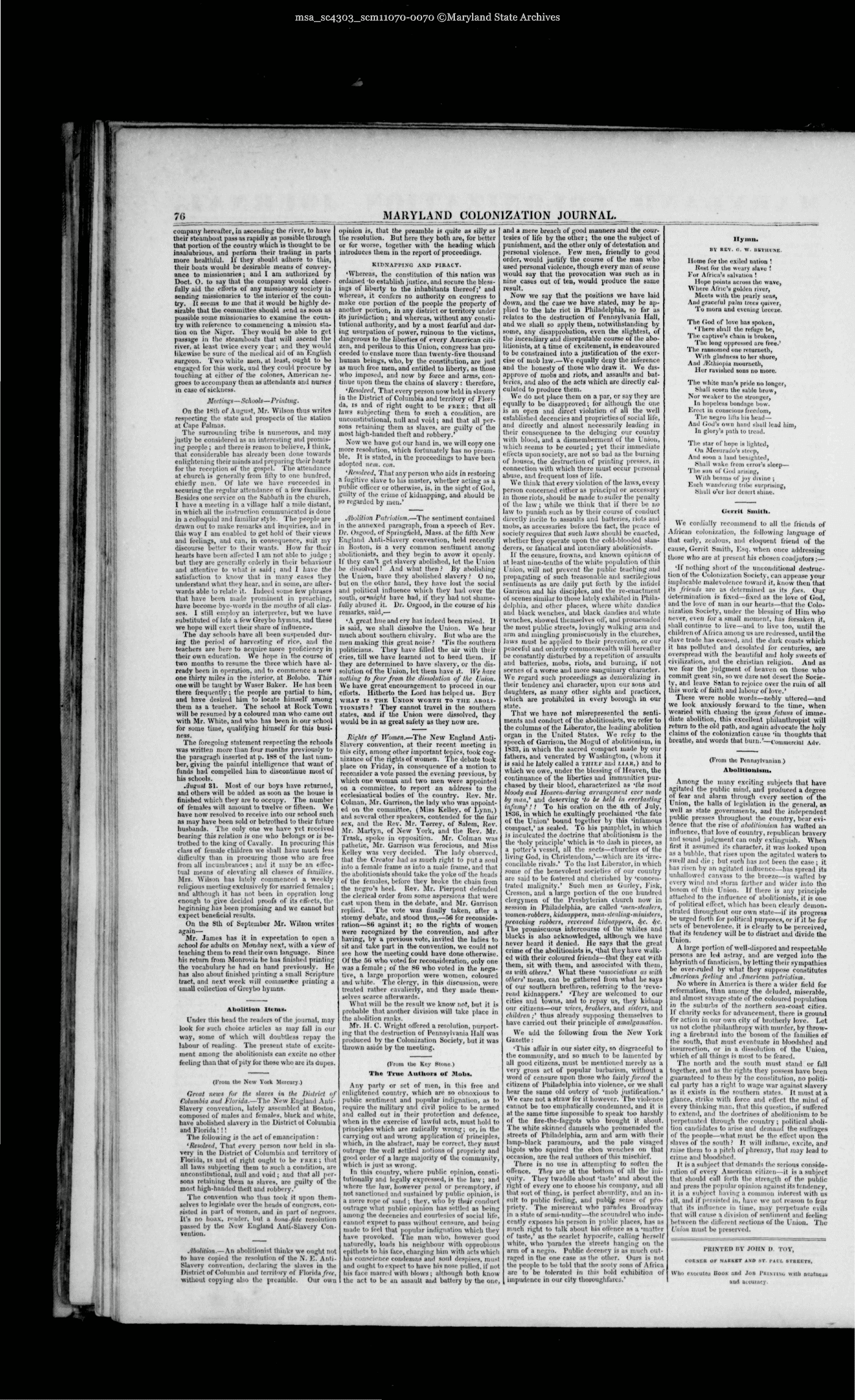
| 70 MARYLAND COLONIZATION JOURNAL. company hereafter, in ascending the river, to have their steamboat pass as rapidly as possible through that portion of the country which is thought to be insalubrious, and perform their trading in parts inure healthful. If they should adhere to this, their boats would be desirable means of convey- ance to missionaries ; and I am authorized by Doct. O. to say that the company would cheer- fully aid the efforts of any missionary society in sending missionaries to the interior of the coun- try. It seems to me that it would be highly de- sirable that the committee should send as soon as possible some missionaries to examine the coun- try with reference to commencing a mission sta- tion on the Niger. They would be able to get passage in the steamboats that will ascend the river, at least twice every year; and they would likewise be sure of the medical aid of an English surgeon. Two white men, at least, ought to be engaged for this work, and they could procure by touching at either of the colon**, American ne- groes to accompany them as attendants and nurses in case of sickness. Meetings—.Schools—Printing. On the lfftfc of August, Mr. Wilson thus writes respecting the state and prospects of the station at Cape Paliuas. The surrounding tribe is numerous, and may justly be considered as an interesting and promis- ing people ; and there is reason to believe, I think, that considerable has already been done towards enlightening their minds and preparing their hearts for the reception of the gospel. The attendance at church is generally from fifty to one hundred, chiefly men. Of late we have succeeded in securing the regular attendance of a few families, llesides one service on the Sabbath in the church, I have a meeting in a village half a mile distant, In which all the instruction communicated is done in a colloquial and familiar style. The people are drawn out to make remarks and inquiries, and in this way f am enabled to get hold of their views and feelings, and can, in consequence, suit my discourse better to their wants. How far their hearts have been affected 1 am not able to judge ; but they are generally mderlv in tin ir behaviour and attentive to wbal i* said; and I have the satisfaction to know that in many cases they understand what they hear, and in some, are after- wards able to relate it. Indeed some lew phrases that have been made prominent in preaching, have' become bye-words in the mouths of |U clas- ses. I still employ an interpreter, but we have substituted of late a few Greybo hymns, and these we hope will exert their share of influence. The day schools have all been suspended dur- ing the period of harvesting of rice, and the teachers are here to acquire more proficiency in their own education. We hope in the course of two months to resume the three which have al- ready been in operation, and to commence a new one thirty miles in the interior, at Kolobo. This one will be taught by Waser liaker. He has been there frequently; the people are partial to him, and have desired him to locate himself among them as a teacher. The school at Hock Town will be resumed by a coloured man who came out with Mr. White, and who has been in our school for some time, qualifying himself for ttiis busi- ness. The foregoing statement respecting the schools was written more than four months previously to the paragragh inserted at p. 188 of the last num- ber, giving the painful intelligence that want of funds had compelled him to discontinue most of his schools. August 31. Most of our boys have returned, and others will he added as soon as the house is finished which they are to occupy. The number of females will amount to twelve or fifteen. We have now resolved to receive into our school such as may have been sold or betrothed to their future husbands. The only one we have yet received bearing this relation is one who belongs or is be- trothed to the king of C'avally. In procuring this class of female children we shall have much ItM difficulty than in procuring those who are free from all incumbrances ; and it may be an effec- tual means of elevating all classes of families. Mrs. Wilson has lately commenced a weekly religion- meeting exclusively lor married females ; and although it has not been in operation long enough to give decided proofs of its effects, the beginning has been promising and we cannot but expect beneficial results. On the 8th of September Mr. Wilson writes again— Mr. James has it in expectation to open a school for adults on Monday next, with a view of teaching them to read their own language. Since his return from Monrovia he has finished printing the vocabulary be had on hand previously. He has also about finished printing a small Scripture tract, and next week will commence printing a small collection of Greybo hymns. Abolition Items. Under this head the readers of the journal, may look for such choice articles as may fall in our way, some of which will doubtless repay the labour of reading. The present state of excite- ment among the abolitionists can excite no other feeling than that of pity for those who are its dupes. opinion is, that the preamble is quite as silly as the resolution. But here they both are, for better or for worse, together with the heading which introduces them in the report of proceedings. Kidnapping and piracy. •Whereas, the constitution of this nation was ordained to establish justice, and secure the bless- ings of liberty to tlie inhabitants thereof;' and whereas, it confers no authority on congress to make one portion of the people the property of another portion, in any district or territory under its jurisdiction ; and whereas, without any consti- tutional authority, and by a most fearful and dar- ing usurpation of power, ruinous to the victims, dangerous to the liberties of every American citi- zen, and perilous to this Union, congress has pro- ceeded to enslave more than twenty-live thousand human beings, who, by the constitution, are just as much free men, and entitled to liberty, as those who imposed, and now by force and arms, con- tinue upon them the chains of slavery: therefore, 'Resolved. That every person now held in slavery in the District of Columbia and territory of Flori- da, is and of right ought to be krf.e; that all laws subjecting them to such a condition, are unconstitutional, null and void; and that all per- sons retaining them as slaves, are guilty of the most high-handed theft and robbery.' Now we have got our hand in. we will copy one more resolution, which fortunately has no pream- ble. It is stated, in the proceedings to have been adopted nem. con. 'Resolved, That any person who aids in restoring a fugitive slave to his master, whether acting as a public officer or otherwise, is, in the sight of Cod, guilty of the crime id'kidnapping, and should be so regarded by men.' Abolition Patriotism.—The sentiment contained in the annexed paragraph, from a speech of liev. Dr. Osgood. of Springfield, Mass. at the fifth New England Anti-Slavery convention, held recently in Boston, is a vary common sentiment among abolitionists, and they begin to avow it openly. If they can't get slavery abolished, let the Union be dissolved! And wiiat then? By abolishing the Union, have they abolished slavery; O no, but on the other hand, they have lost the social and political influence which they had over the south, or might have had, if they had not shame- fully abused it. Dr. Osgood, in the course of his remarks, said,— 'A great hue and cry has indeed been raised. It is said, we shall dissolve the Union, Wo hoar much about southern chivalry. Hut who are the men making this great noise? 'Tis the southern politicians. They have filled the air with their cries, till we have learned not to heed them. If they are determined to have slavery, or the dis- solution of the Union, let them have it. IIV have nothing to fear from the dissolution of the Union. We have great encouragement to proceed in our etl'orts. Hitherto the Lord has helped us. But what is the Union worth to the aboli- tionists? They cannot travel in the southern states, and if the Union were dissolved, they would be in as great safety as they now are. Rights of Women.—The New England Anti- Slavery convention, at their recent meeting in this city, among other important topics, took cog- nizance of the rights of women. The debate took place on Friday, in consequence of a motion to reconsider a vote passed the evening previous, by which one woman and two men were appointed on a committee, to report an address to the ecclesiastical bodies of the country, llev. Mr. Column, Mr. Garrison, the lady who was appoint- ed on the committee, (Miss Kelley, of Lynn,) and several other speakers, contended for the lair ME, and the Rev. Mr. Torrey, of Salem, Hev. Mr. Marty n, of New York, and the Hev. Mr. Tltlfe, spoke in opposition. Mr. Colman was pathetic, Mr. Garrison was ferocious, and Miss Kelley was very decided. The lady observed, that the Creator had as much right to put a soul into a female frame as into a male frame, and that the abolitionists should take the yoke oil' the heads of the females, before they broke the chain from the negro's heel. Rev. Mr. I'ierpont defended the clerical order from some aspersions that were cast upon them in the debate, and Mr. Garrison replied. The vote was finally taken, after a stormy debate, and stood thus,—M for reconside- ration—86 against it; so the rights of women were recognized by the convention, and after having, by a previous vote, invited the ladies to sit and take part in the convention, we could not see how the meeting could have done otherwise. Of the 56 who voted for reconsideration, only one was a female; of the 86 who voted in the nega- tive, a large proportion were women, coloured and white. The clergy, in this discussion, were treated rather cavalierly, and they made them- selves scarce afterwards. What will be the result we know not, but it is probable that another division will take place in the abolition ranks. Mr. 11. C. Wright offered a resolution, purport- ing that the destruction of Pennsylvania Hall was produced by the Colonization Society, but it was thrown aside by the meeting. (From the New York Mercury.) Great news for the slaves in the District of Columbia and Florida.—The New England Anti- Slavery convention, lately assembled at Boston, composed of males and females, black and while, have abolished slavery in the District ot Columbia and Florida!!! The following is the act of emancipation : 'Resolved, That every person now held in sla- very in the District of Columbia and territory of Florida, is and of right ought to be free; that all laws subjecting them to such a condition, are unconstitutional, null and void ; and that all pel - sons retaining them as slaves, are guilty of the most high-handed tbelt and robbery. The convention who thus took it upon them- selves to legislate over the heads of congress, con- sisted in pait of women. ami IM part of negroes, lis no hoax:, reader, but a ioasMMi rMOlution passed by the New England Anti-Slavery Con- vention. Abolition.—An abolitionist thinks we ought not to have copied the resolution of the .\. K. Anti- Slavery convention, declaring the slues in the District of Colombia and territory of Florida free, without copying also the preamble. Our own (From the Key Stone ) The True Authors of Mobs. Any party or set of men, in this free and enlightened country, which are so obnoxious to public sentiment and popular indignation, as to require the military and civil police to be armed and called out in their protection and defence, when in the exercise of lawlul acts, must hold to principles which are radically wrong; or, in the carrying out and wrong application of principles, which, in the abstract, may be correct, they must Outrage the well settled notions id' propriety and |Ood order of a large majority of the community, which is just as wrong. In this country, where public opinion, consti- tutionally and legally expressed, is the law; and where the law, however pan*] or peremptory, if not sanctioned and sustained by public opinion, is a mere rope id' sand ; they, who by their conduct outrage what public opinion has settled as being among the decencies and eointe ies of social life, cannot expect to pass without censure, and being made to feel that popular indignation which they have piovoked. The man who, however goo,I naturedly, loads his neighbour with opprobious epithets to his face, charging him with acts which his conscience condemn* and soul despises, must and ought to expect to have his nose pulled, if not his fin e marred with blows; although both know the act to be an assault and battery ley the one, and a mere breach of good manners and the cour- tesies of life by the other; the one the subject of punishment, and the other only of detestation and personal violence. Few men, friendly to good order, would justify the course of the man who used personal violence, though every man of sense would say that the provocation was such as in nine cases out of ten, would produce the same result. Now we say that the positions we have laid down, and the case we have stated, may be ap- plied to the late riot in Philadelphia, so far as relates to the destruction of Pennsylvania Hall, and we shall so apply them, notwithstanding by some, any disapprobation, even the slightest, of the incendiary and disreputable course oi the abo- litionists, at a time of excitement, is endeavoured to be constrained into a justification of the exer- cise of mob law.—We equally deny the inference and the honesty of those who draw it. We dis- approve of mobs and riots, and assaults and bat- teries, and also of the acts which are directly cal- culated to produce them. We do not place them on a par, or say they are equally to be disapproved; for although the one is an open and direct violation of all the well established decencies and proprieties of social life, and directly and almost necessarily leading in their consequence to the deluging our country with blood, and a dismemberment of the Union, which scums to be courted ; yet their immediate eli'ects upon society, are not so bad as the burning of houses, the destruction of printing presses, in connection with which there must occur personal ahu-e. and frequent loss of life. We think that every violation of the laws, every person concerned either as principal or accessary in those riots, should be made to.sudor the penalty of the law ; while we think that if there be no law to punish such as by their course of conduct directly incite to assaults and batteries, riots and mobs, as accessaries before the fact, the peace of society requires that such laws should he enacted, whether they operate upon the cold-blooded slan- derers, or fanatical and incendiary abolitionists. If the censure, frowns, and known opinions of at least nine-tenths of the white population of this Union, will not prevent the public teaching and propagating of such treasonable and sacrilegious sentiments as are daily put forth by the infidel Qarriaon and bis disciples, and the re-enactment of scenes similar to those lately exhibited in Phila- delphia, and other places, where while dandies and black wenches, and black dandies and white wemlies, showed themselves oil', and promenaded the most public streets, lovingly walking arm and arm and mingling promiscuously in the churches, laws must fie applied to their prevention, or our peaceful and orderly commonwealth will hereafter be constantly disturbed by a repetition of assaults and batteries, mobs, riots, and burning, if not scenes of a worse and more sanguinary character. We regard such proceedings as demoralizing in their tendency and character, upon our sons and daughters, as many other sights and practices, which are prohibited in every borough in our state. That wc have not misrepresented the senti- ments and conduct of the abolitionists, we refer to the columns of the Liberator, the leading abolition organ in the United States. We refer to the speech of Garrison, the Mogul of abolitionism, in 1833, in which the sacred compact made by our fathers, and venerated by Washington, (whom it is said he lately called a thief and liar,) and to which we owe, under the blessing of Heaven, the continuance of the liberties and immunities pur- chased by their blood, characterized as 'the most bloody and Heaven-daring arrangement ever made by man,' and deserving 'to be held in everlasting infamy'.'.' To his oration on the 4th of July, 1836, in which he exullingly proclaimed 'the tiile of the Union' bound together by this 'infamous compact,' as scaled. To bis pamphlet, in which is inculcated the doctrine that abolitionism is the the 'holy principle' which is •to dash in pieces, as a potter's vessel, all the sects—churches of the living God, in Christendom,'—which are its -in, - concilable rivals.' To the last Liberator, in which some of the benevolent societies of our country are said to be fostered and cherished by 'concen- trated malignity.' Such men as Giirley, Fisk, Cresson, and a large portion of the one hundred Clergyman of the Presbyterian church now in session in Philadelphia, are called 'men-stealers, women-robbers, kidnappers, man-strealing-ministers, preaching robbers, reverend kidnappers, &c. &c. The promiscuous intercourse of the wdiites and blacks is also acknowledged, although we have never heard it denied, lie says that the great crime of the abolitionists is, 'that they have walk- ed with their coloured friends—that they eat with them, sit with them, and associated with them, us with others.' What these 'associations as with others' mean, can be gathered lioiu what lie says of our southern brethren, referring to the 'reve- rend kidnappers.' 'They are welcomed to our cities and towns, and to repay us, they kidnap our citizens—our wives, brothers, and sisters, and children ,-' thus already supposing themselves to have carried out their principle of amalgamation. We add the following from the New York Gazette: 'This affair in our sister city, so disgraceful to the community, and so much to be lamented by all good citizens, must be mentioned merely as a very gross act of popular barbarism, without a word of censure upon those who fairly forced the citizens of Philadelphia into violence, or we shall hear the same old outcry of 'mob justification.' We care not a straw for it however. The violence cannot be too emphatically condemned, and it is at the same time impossible to speak too harshly of the fire-the-faggots who brought it about. The white skinned damsels who promenaded the streets of Philadelphia, arm and arm with their lamp-black paramours, and the pale visage I bigots who squired the ebon wenches on that occasion, are the real authors ol this mischief. There is no use in attempting to soften the offence. Theyare at the bottom of all the ini- quity. They twaddle about 'taste' and about the right of every one to choose bis company, and all that tori of tiling, is perfect abiurdity, and an in- sult to public feeling, and public sense of pro- priety. The miscreant win" parados Broadway in a state of semi-nudity—the scoundrel who inde- cently exposes his person ill public places, has as much right to talk about bis olienre as a 'matter of taste,' as the scarlet hypocrite, calling herself white, who parades the streets hanging on the arm of a negro. Public decency is as much out- raged in the one case as the other. Ours is not the people to be told that the sooty sons of Africa are to be tolerated in this bold exhibition of impudence in our city thoroughfares.' Hymn. By Rev. G. W. Bethune. Home for the exiled nation '. Rest for the weary slave ! For Africa's salvation ! none points aaiusi the wave, Where Al'ric's golden river, Meets with IM pearly seas, And graceful palm trees quiver, To morn and e\ cuing breeze. The God of love has spoken, 'There shall the refuse tie, The captive's chain is broken, The long oppressed are free.' The ransomed one relurneth, With gladness to her shore, And iKthiopia inournelli, Her ravished sous no more. The white man's pride no longer, Shall scorn the sable brow, Nor weaker to the stronger, In hopeless bondage how. F.reet in coliseums flcedom, The negro lifts his head— Ami God's own hunt shall lead him, III glory's path to tread. The star afbaps is lighted, On Mcstir.ttlo's sleep, And soon a laud benighted, Shall wake train error's sleep— The sua of God arising, With beams ot' joy divine ; Each "audi ring tribe surprising, Shall o'er her desert shine. Gerrit Smith. We cordially recommend to all the friends of African colonization, the following language of that early, zealous, and eloquent friend of the cause, Gerrit Smith, Esq. when once addressing those who are at present his chosen coadjutors :__ 'If nothing sboit of the Unconditional destruc- tion of the Colonization Society, can appease your implacable malevolence toward it, know then that its friends me as determined as its /i«-.s. Our determination is fixed—fixed as the love of God, and the love of man in our hearts—that the Colo- nization Society, under the blessing of Him who never, even for a small moment, has Ibrsaken it, shall continue to live—and to live too, until the children of Africa among us are redressed, until the slave trade has ceased, and the dark roasts which it has polluted and desolated for centuries, aro overspread with the beautiful and holy sweets of civilization, and the christian religion. And as we fear the judgment of heaven on those who commit gieat sin, so we dare not desert the Socie- ty, and leave Satan to rejoice over the ruin of all this work ol'faith and labour of hue.' These were noble words—nobly uttered—and we look anxiously forward to the time, when wearied with chasing the ignus fatuns of imme- diate abolition, this excellent philanthropist will return to the old path, and again advocate the holy claims of the colonization cause 'in thoughts that breathe, and words that bum.'— DasBssmW Adv. (From the Pennsylvanian ) Abolitionism. Among the many exciting subjects that have agitated the public mind, and produced a degree of fear and alarm through every section of the Union, the halls of legislation in the general, as well as state governments, and the independent public presses throughout the country, bear evi- dence that the rise of abolilimiisin has waited an influence, Oat love of country, republican bravery and sound judgment can only extinguish. When first it assumed its character, it was looked upon as a bubble, that rises upon the agitated waters to swell and die ; but such has not been the case; it has risen by an agitated influence—has spread its unhallowed canvass to the breen—is waited by every wind and storm farther and wider into the bosom of this Union. If there is any principle attached to the influence of abolitionists, it is one of political effect, which has been clearly demon. strated throughout our own state—if its progress be urged forth for political purposes, or if it be for acts of benevolence, it is clearly to be perceived, that its tendency will he to distract and divide the Union. A large portion of well-disposed and respectable persons are led astray, and are verged into the labyrinth of fanaticism, by letting tlicil sympathies he over-ruled by what they suppose constitutes American feeling and American patriotism. No where in America is there a wider field for reformation, than among the deluded, miserable, ami almost savage state of the coloured population in the suburbs of the northern sea-coast cities. If charity seeks for advancement, there is ground for action in our own city of brotherly love. Let us not clothe philanthropy with murder, by throw- ing a firebrand into the bosom of the families of the south, that must eventuate in bloodshed and insurrection, or in a dissolution of the Union, which of all things is most to be feared. The north and the south must stand or fall together, and as the rights they possess have been guaranteed to them by the constitution, no politi- cal party has a right to wage war against slavery as it exists in the southern state- It must at a glance, strike with force and effect the gated ol every thinking man. that this question, if suffered to extend, and the doctrines of abolitionism to be perpetuated through the country; political aboli- tion candidates to arise and demand the suffrages of the people—what must be the effect upon the slaves of tlie south I It will Inflame, excite, and raise them hi a pitch of phrenzy, that may lead to Clime and bloodshed. It is a subject that demands the serious conside- ration of every American citizen—it is a subject that should call forth the strength of the public and press the popular opinion against its t, ndencr, it is a subject having a common interest with us all. and If persisted in, have we not reason to leai that its influence in lime, may perpetuate evils that will cause a division of sentiment and feeling between the different sections of the Union. The Union must be preserved. PRINTED BY JOHN D. TOY, CORNER OF MMARKET AND ST. PAUL STREETS, Who executes Book and JOB Printing with neatness and accuracy. |