 |
|
|
 |
|
 |
|
|||
|
||||
|
||||
|
Maryland State Archives Maryland Colonization Journal Collection MSA SC 4303 msa_sc4303_scm11070-0071 Enlarge and print image (5M) |
|
|
|
|
|
|
|
|||
|
||||
|
||||
|
Maryland State Archives Maryland Colonization Journal Collection MSA SC 4303 msa_sc4303_scm11070-0071 Enlarge and print image (5M) |
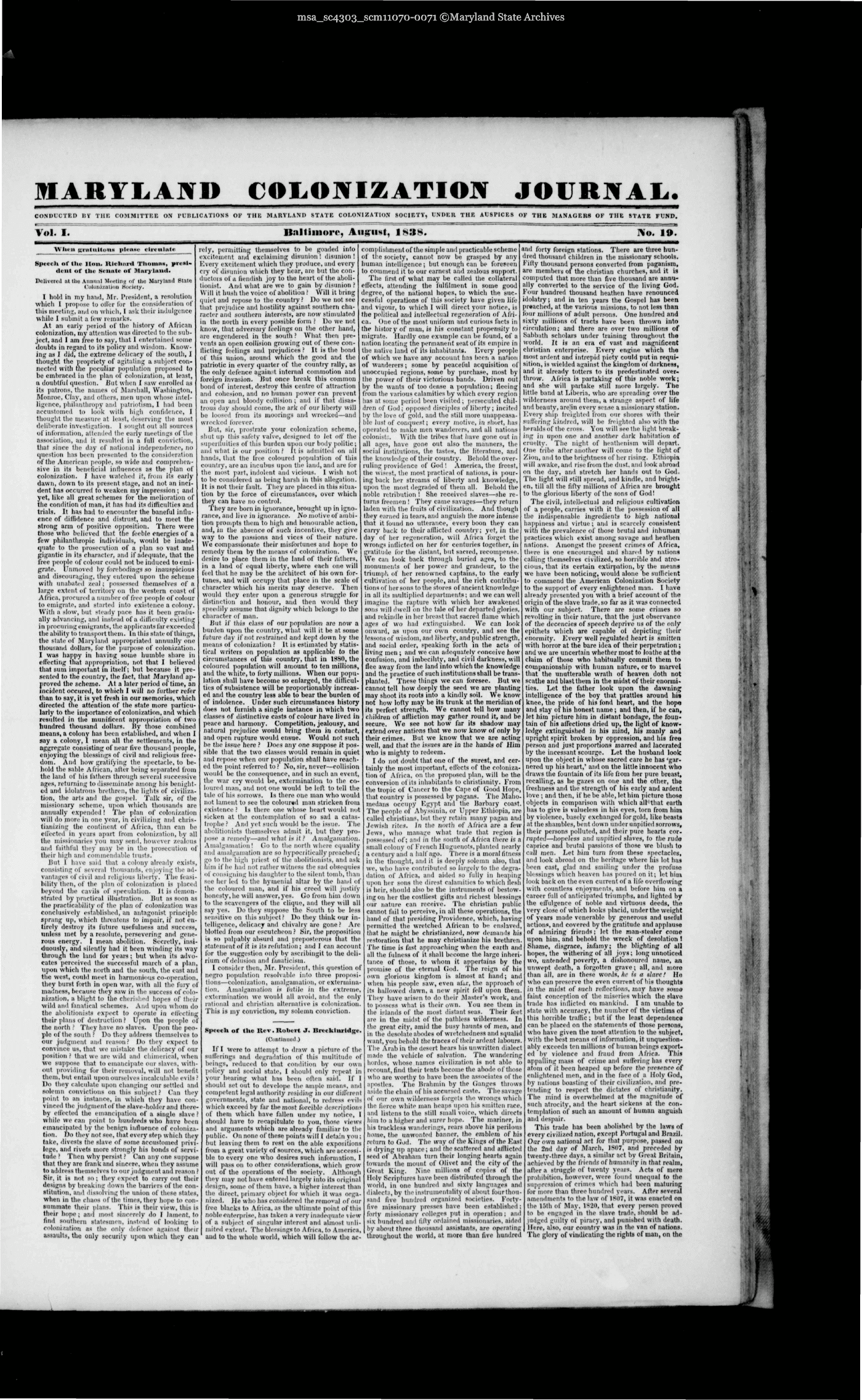
| MARYLAND COLONIZATION JOURNAL. CONDUCTED BY THE COMMITTEE ON PUBLICATIONS OF THE MARYLAND STATE COLONIZATION SOCIETY, UNDER THE AUSPICES OF THE MANAGERS OF THE STATE FUND. Vol. I. Baltimore, August, 1838. No. 19. when gratuitous please circulate Speech of the Hon. Richard Thomas,presi- dent of the Senate of Maryland. Delivered at the Annual Meeting of' the Maryland State Colonization Society. I hold in my hand, Mr. President, a resolution which I propose to offerfor the consideration of this meeting, and on which, I ask their indulgence while 1 submit a low remarks. At an early period of the history of African colonization, my attention was directed to the sub- ject, and I am free to say, that I entertained some doubts in regard to its policy and wisdom. Know- ing as I did, the extreme delicacy of the south, I thought the propriety of agitating a subject con- nected with the peculiar population proposed to lie embraced in the plan of colonization, at least, u doubtful ipiestion. But when I saw enrolled as its patrons, the names of Marshall, Washington, Monroe. Clay, and others, men upon whose intel- ligence, philanthropy and patriotism, I had been accustomed to look with high confidence, I thought the measure at least, deserving the most deliberate investigation. I sought out all sources of information, attended the early meetings of the association, and it molted in a full conviction, that since the day of national independence, no (piestion has been presented to the consideration of the American people, so wide and comprehen- sive in its beneficial inlluences as the plan of colonization. 1 have walched it, from its early dawn, down to its present stage, and not an inci- dent has occurred to weaken my impression; and yet, like all great schemes for the melioration of the condition of man, it has had its difficulties and trials. It has had to encounter the baneful infill- ence of difndence and distrust, and to meet the strong arm of positive opposition. There were those who believed that the feeble energies of a few philanthropic indi\ iduals, would be inade- quate to the prosecution of a plan so vast and gigantic in its character, and If adequate, that the free people of colour could not he induced to emi- grate. Unmoved by forebodings n inauspicious and dilcouraging, they entered upon the scheme with unabated zeal; possessed themselves of a ItrM extent of territory on the western coast of Africa, procured a number of free people of colour to emigrate, and started into existence a colony. With a slow, but steady pace has it been gradu- ally advancing, and instead of a difficulty existing in procuring emigrant!, the applicants far exceeded the ability to transport thoin. In this state of things, the state of Maryland appropriated annually one thousand dollars, for the purpose of colonization. I was happy in having some humble share in effecting that appropriation, not that I believed that sum Important in itself; but because it pre- sented to the country, the fact, that Maryland ap- proved the scheme. At a later period oi'tiine, an incident occured, to which I will no further refer than to say, it is yet fresh in our memories, which directed the attention of the state more particu- larly to the importance of colonization, and which resulted in the munificent appropriation of two hundred thousand dollars. By those combined means, a colony has been established, and when I say a colony, I mean all the settlements, in the aggregate consisting of near five thousand people, enjoying the blessings of civil and religious free- dom. And how gratifying the spectacle, to he- hold the sable African, after being separated from the land of his fathers through several successive ages, returning to disseminate among his benight- ed and idolatrous brethren, the light! of civiliza- tion, the arts and the goepel. Talk sir, of the missionary scheme, upon which thousands are annually expended ! i'he plan of colonization will do more in one year, in civilizing and chris- tianizing the continent of Africa, than can be effected in years apart from colonization, by all the missionaries you may send, however zealous and faithful they may be in the prosecution of their high anil commend able dusts. Hut 1 have said that a colony already exists, consisting of several thousands, enjoying the ad- vantages of civil and rellgioui liberty. The feaii- liility then, of the plan of colonization is placed beyond the cavils of speculation. It is demon- strated by practical illustration. But as soon as the practicability of the plan of colonization was conclusively established, an antagonist principle sprang up, which threatens to impair, if not en- tirely destroy its future usefulness and success, unless met by a resolute, persevering and gene- rous energy. I mean abolition. Secretly, insi- duously, and silently had it been windfall its way through the land for years ; but when its advo- cates perceived the successful march of a plan, upon which the north and the south, the east and the west, could meet in harmonious co-operation, they burst forth in open war, with all the fury of madness, because they saw in the success of colo- nization, a blight to the cherUhed hopes of tin ir wild and fanatical schemes. And upon whom do the abolitionists expect to operate in effecting their plans of destruction ? Upon the people of the north ? They have no slaves. Upon the peo- ple of the south ? Do they address themselves to our judgment and reason? Do they expect to convince us, that we mistake the delicacy of our position ? that we are wild and chimerical, when we suppose that to emancipate our slaves, with- out providing for their removal, will not benefit them, but entail upon ourselves incalculable evils! Do they calculate upon changing our settled and solemn convictions on this subject ? Can they point to an instance, in which they have con- vinced the Judgment of the slave-holder and there- by eli'ected the emancipation of a single slave? while we ran point to hundreds who have been emancipated by the basin influence of coloniza- tion. Do they not see, that every step which they take, divests the slave of some accustomed privi- lege, and rivets more strongly his bonds of servi- tude ? Then why persist ? Can any one suppose that they are frank and sincere, when they assume to address themselves to our judgment and reason ? Sir, it is not so ; they expect to carry out their designs by breaking down the barriers of the con- stitution, and di~sol\ log the union of these states, when in the chaos of the times, they hope to con- summate their plans. This is their view, tins i, their hope ; and most sincerely do I lament, to find southern statesmen, inste'ad of looking hi colonization as the only defence against their assaults, the only security upon which they can rely, permitting themselves to he goaded into excitement and exclaiming disunion I disunion ! Every excitement which they produce, and every cry of disunion which they hear, are but the con- ductor of a fiendish joy to the heart of the aboli- tionist. And what are wc to gain by disunion ? Will it hush the voice of abolition ? Will it bring quiet and repose to the country? Do we not see that prejudice and hostility against southern cha- racter and southern interests, are now stimulated in the north in every possible form I Do we not know, that adversary feelings on the other hand, are engendered in the south I What then pre- vents an open collision growing nut of these coli- llicting feelings and prejudice!! It is the bond of this union, around which the good and the patriotic in every ipiaitcr of the country rally, as the only defence' again.d internal commotion and foreign invasion. Hut once break this common bond of interest, destroy this centre of attraction and cohesion, and no human power can prevent an open arid bloody collision ; and if that disas- trous day should come, the ark of our liberty will be loosed from its mourings and wrecked?and wrecked Ibrever. Hut, sir, prostrate your colonization scheme, shut up this safety valve, designed to let off the superfluities of this burden upon our body politic: and what is our position ? It is admitted on all hands, that the free coloured population of this country, are an incubus upon the laud, and are for the most part, indolent and vicious. I wish not to be considered as being harsh in this allegation. It is not their fault. They are placed in this situa- tion by the force of circumstances, over which they can have no control. They are born in ignorance, brought up in igno- rance, and live in ignorance. Wo motive of ambi- tion prompts them to high and honourable action, and, in the absence of such incentive, they give way to the passions and vices of their nature. Wc compassionate their misfortunes and hope to remedy them by the means of colonization. We desire to place them in the land of their fathers, in a land of equal liberty, where each one will feel that he may be the architect of his own for- tunes, and will occupy that place in the scale of character which his merits may deserve. Then would they enter upon a generous struggle for distinction and honour, and then would they speedily assume that dignity which belongs to the character of man. But if this class of our population are now a burden upon the country, what will it be at some future day if not restrained and kept down by the means of colonization ? It is estimated by statis- tical writers on population as applicable to the circumstances of this country, that in 1880, the coloured population will amount to ten millions, and the white, to forty millions. When our popu- lation shall have become so enlarged, the difficul- ties of subsistence will be proportionably increas- ed and the country less able to bear the burden of of indolence. Under such circumstances history does not furnish a single instance in which two classes of distinctive casts of colour have lived in peace and harmony. Competition, jealousy, and natural prejudice would bring them in contact, and open rupture would ensue. Would not such be the issue here ? Does any one suppose it pos- sible that the two classes would remain in quiet and repose when our population shall have reach- ed the point referred to ? No, sir, never?collision would he the consequence, and in such an event, the war cry would be, extermination to the co- loured man, and not one would be left to tell the tale of his sorrows. Is there one man who would not lament to see the coloured man stricken from existence | Is there one whose heart would not sicken at the contemplation of so sad a catas- trophe? And yet such would be the issue. The abolitioniita themielvei admit it, but they pro- pose a remedy?and what is it? Amalgamation. Amalgamation I Co to the north where equality and amalgamation are so hypocritically preached; go to the high priest of the abolitionists, and ask him if he had not rather w itmss the sad obsequies of consigning his daughter to the silent tomb, than see hei led to the hymenial altar by the hand of the coloured man, and if his creed will justify honesty, he will answer, yes. Go from him down to the scavengers of the clique, and they will all say yes. Do they suppose the South to be less sensitive on Ibis subject? Do they think our in- telligence, delicacy and chivalry are gone? Arc blotted from our escutcheon ? Sir, the proposition is so palpably absurd and preposterous that the statement of it is its refutation; and 1 can account for the suggestion only by ascribingit to the deli- rium of delusion and fanaticism. I colisidi r then, Mr. President, this question of negro population rcsohahle into three proposi- tions?colonization, amalgamation, or extermina- tion. Amalgamation is futile in the extreme, i? x11 rmiuation we would all avoid, and the only rational and christian alternative is colonization. This is my conviction, my solemn conviction. Speech of the Rev. Robert J. Breckinridge. (Continued.) If I were to attempt to draw a picture of the sufferings and degradation of this multitude of beings, reduced to that condition by our own policy and social state, I should only repeat in your hearing what has been often said. If I should set out to develope the ample means, anil competent legal authority residing in our different governments, state and national, to redress evils which exceed by far the most forcible descriptions of them which have fallen under my notice, 1 should have to recapitulate to you, those views and arguments which are already familiar to the public. On none of these points will I detain you; lint leaving them to rest on the able expositions from a great variety of sources, which are accessi- ble to every one who desires such information, I will pass on to other considerations, which grow out of the operations of the society. Although they may not have entered largely into its original design, some of them have, a higher interest than the direct, primary object for which it was orga- nized. He who has considered the removal of our free blacks to Africa, as the ultimate point of this noble enterprise, has taken a very inadequate \ lew of a subject of singular interest and almo.-t unli- mited extent. The blessings to Africa, to Amerira, and to the whole world, which will follow the ac- complishment of the simple and practicable scheme of tr.e society, cannot now be grasped by any Iminan intelligence; but enough can be foreseen to cominenil it to our earnest and zealous support. The first of what may be called the collateral effects, attending the fulfilment in some pood degree, of the national hopes, to which the suc- cessful operations of this society have given life and vigour, to which I will direct your notice, is the political and intellectual regeneration of Afri- ca. One of the most uniform and curious facts in the history of man, is his constant propensity to migrate. Hardly one example can he found, of a nation locating the permanent seat of its empire in the native land of its inhabitants, l'.very people of which we have any account has been a nation of wanderers; some by peaceful acquisition of unoccupied regions, some by purchase, most by the power of their victorious bands. Driven out by the wants of too dense a population; fleeing from the various calamities by which every region has at some period been visited ; persecuted chil- dren of Godj opposed disciples of liberty; Incited by the love of gold, and the still more unappeasa- ble lust of conquest; every motive, in short, has operated to make men wanderers, and all nations colonist;. With the tribes that have gone out in all ages, have gone out also the manners, the social institutions, the (astes, the literature, and the knowledge of their country. Behold the over- ruling providence of God ! America, the freest, the wisest, the most practical of nations, is pour- ing back her streams of liberty and knowledge, upon the most degraded of them all. Behold the noble retribution ! She received slaves?she re- turns freemen ! They came savages?thev return laden with the fruits of civilization. And though they earned in tears, and anguish the morp intense that it found no utterance, every boon they can carry back to their afllicted country; yet, in the day of her regeneration, will Africa forget the wrongs Inflicted on her for centuries together, in gratitude for the distant, but sacred, recompense. We can look back through buried ages, to the monuments of her power and grandeur, to the triumph of her renowned captains, to the early cultivation of her people, and the rich contribu- tions of her sons to the stores of ancient knowledge in all its multiplied departments; and we can well imagine the rapture with which her awakened sons will dwell on the tale of her departed glories, and rekindle in her breast that sacred tlame which ages of wo had extinguished. We can look onward, as upon our own country, and see the lessons of wisdom, and liberty, and public strength, and social order, speaking forth in the acts of living men ; and we can adequately conceive how confusion, and imbecility, and civil darkness, will flee away from the land into which the knowledge and the practice of such institutions shall be trans- planted. These things we can foresee. But we cannot tell how deeply the seed we are planting may shoot its roots into a kindly soil. We know not how lofty may be its trunk at the meridian of its perfect strength. We cannot tell how many children of aflliction may gather round it, and be secure. We see not how far its shadow may extend over nations that we now know of only by their crimes. But we know that we are acting well, and that the issues are in the hands of Him who is mighty to redeem. I do not doubt that one of the surest, and cer- tainly the most important, ell'ects of the coloniza- tion of Africa, on the proposed plan, will be the conversion of its inhabitants to Christianity. From the tropic of Cancer to the Cape of Good Hope, that country is possessed by pagans. The Malio- medans occupy Egypt and the Barbary coast. The people of Abyssinia, or Upper Kthiopia, are called christians, hut they retain many pagan and Jewish rites. In the north of Africa are a few Jews, who manage what trade that region is possessed of; ami in the south of Africa there is a small colony of French Huguenots, planted nearly a century and a hall ago. There is a moral fitness in the thought, and it is deeply solemn also, that we, who have contributed so largely to the degra- dation of Africa, and aided so fully in heaping upon her sons the direst calamities to which flesh is heir, should also be the instruments of bestow- ing on her the costliest gifts and richest blessings our nature can receive. The christian public cannot fail to perceive, in all these operations, the btnd of that presiding I'rovidence, which, having permitted the wretched African to be enslaved, that he might be christianized, now demands his restoration that he may christianize his brethren. The time is fast approaching when the earth and all the fulness of it shall become the large inheri- tance of those, to whom it appertains by the promise of the eternal God. The reign of his own glorious kingdom is almost at hand; and when his people saw, even ali.r, the approach of its hallowed dawn, a new spirit fell upon them. They have arisen to do their Master's work, and to possess what is their own. You see them in the islands of the most distant seas. Their feet are in the midst of the pathless wilderness. In the great city, amid the busy haunts of men, and in the desolate abodes of wietcbedness and squalid want, you behold the traces of their ardent labours. The Arab in the desert hears his unwritten dialect made the vehicle of salvation. The wandering hordes, whose names civilization is not able to recount, find their fents become the abode of those who are worthy to have been the associates of the apostles. The Brahmin by the Ganges throws aside the chain of his accursed caste. Thesav.ige of our own wilderness forgets the wrongs which the fierce white man heap* upon his smitten rare, and listens to the still small voice, which directs him to a higher and surer hope. The mariner, in his trackless wanderings rears above his perilous home, the unwonted banner, the emblem of his return to God. The way of the Kings of the Kast is drying up apace; and the scattered and afllicted seed of Abraham turn their longing hearts again towards the mount of Olivet and the city of the Great King. Nine millions of copies of the Holy Scriptures have been distributed through the world, in one hundred and sixty languages and dialects, by tli^' instrumentality of about fourthou- sand five hundred organized societies. Forty- five missionary presses have been established; forty missionary colleges put in operation; and six hundred and fifty ordained missionaries, aided by about three thousand assistants, are operating throughout the world, at more than five hundred arid forty foreign stations. There are three hun- dred thousand children in the missionary schools. Fifty thousand persons converted from paganism, are members of the christian churches, and it is computed that more than five thousand are annu- ally converted to the service of the living God. Four hundred thousand heathen have renounced idolatry; and in ten years the Gospel has been preached, at the various missions, to not less than four millions of adult persons. One hundred and sixty millions of tracts have been thrown into circulation; and there are over two millions of Sabbath scholars under training throughout the world. It i9 an era of vast and magnificent christian enterprise. F.very engine which the most ardent and intrepid piety could put in requi- sition, is wielded against the kingdom of' darkness, and it already totters to its predestinated over- throw. Africa is partaking of this noble work; and she will partake still more largely. The little band at Liberia, wdio are spreading over the wilderness around them, a strange aspect of life and beauty, are'in every sense a missionary station. F.very ship freighted from our shores with their suffering kindred, will be freighted also with the heralds of the cross. You will seethe light break- ing in upon one and another dark habitation of cruelly. The night of heathenism will depart. One tribe after another will come to the light of Zion, and to the brightness of her rising. Kthiopia w ill awake, and rise from the dust, and look abroad on the day, and stretch her hands out to God. The light'will still spread, and kindle, and bright- en, till all the fifty millions of Africa are brought to the glorious liberty of the sons of God! The civil, intellectual and religious cultivation of a people, carries with it the possession of all the indispensable ingredients to high national happiness and virtue; and is scarcely consistent with the prevalence of those brutal and inhuman practices which exist among savage and heathen nations. Amongst the present crimes of Africa, there is one encouraged and shared by nations calling themselves civilized, so horrible and atro- cious, that its certain extirpation, by the means we have been noticing, would alone be sufficient to commend the American Colonization Society to the support of every enlightened man. I have abeady presented you with a brief account of the origin ol the slave trade,so far as it was connected with our subject. There are some crimes so revolting in their nature, that the just observance of the decencies of speech deprive us of the only epithets which are capable of depicting their enormity. F.very well regulated heart is smitten with horror at the bare idea of their perpetration; and we are uncertain whether most to loathe at the claim of those who habitually commit them to companionship with human nature, or to marvel that the unutterable wrath of heaven doth not scathe and blast them in the midst of their enormi- ties. Let the father look upon the dawning; intelligence of the boy that prattles around his knee, the pride of his fond heart, and the hope and stay of his honest name; and then, if be can, let him picture him in distant bondage, the foun- tain of his affections dried up, the light of know- ledge extinguished in his mind, his manly and upright spirit broken by oppression, and his free person and just proportions marred and lacerated by the incessant scourge. Let the husband look upon the object in whose sacred care he has 'gar- nered up his heart,' and on the little innocent who draws the fountain of its life from her pure breast, recalling, as he gazes on one and the other, the freshness and the strength of his early and ardent love; and then, if he be able, let him picture those objects in comparison with which all that earth has to give is valueless in bis eyes, torn from him by violence, basely exchanged for gold, like beasts at the shambles, bent down under unpitied sorrows, their persons polluted, and their pure hearts cor- rupted?hopeless and unpitied slaves, to the rudo caprice and brutal passions of those we blush to call men. Let him turn from these spectacles, and look abroad on the heritage where his lot has been cast, glad and smiling under the profuse blessing! which heaven has poured on it; let him look back on the even current of a life overflowing with countless enjoyments, and before him on a career full of anticipated triumphs, and lighted by the effulgence of noble and virtuous deeds, the very close of which looks placid, under the weight of years made venerable by generous and useful actions, and covered by the gratitude and applause of admiring friends; let the man-stealer come upon him. and behold the wreck of desolation ! Shame, disgrace, infamy; the blighting of all hopes, the withering of all joys; long unnoticed wo, untended poverty, a dishonoured name, an unwept death, a forgotten grave; all, and more than all, are in these words, Ac it a s/nrc.' He who can preserve the even current of his thoughts in the midst of such reflections, may have soino faint conception of the miseries which the slave trade has inflicted on mankind. I am unable to state with accuracy, the number of the victims of this horrible traffic; but if the least dependence can be placed on the statements of those persons, who have given the most attention to the subject, with the best means of information, it unquestion- ablv exceeds ten millions of human beings export. ed by violence and fraud from Africa. This appalling mass of crime and sutfering has every atom of it been heaped up before the presence of enlightened men, and in the face of a Holy God, by nations boasting of their civilization, and pre- tending to respect the dictates of Christianity. The mind is overwhelmed at the magnitude of such atrocity, and the heart sickens at the con- templation of such an amount of human anguish and despair. This trade has been abolished by the laws of every civilized nation, except Portugal and Brazil. Our own national act for that purpose, passed on the 2nd day of March, 1807, and preceded by twenty-three days, a similar art by Great Britain, achieved by the'frierids of humanity in that realm, after a struggle of twenty years. Acts of mere prohibition, however, were found unequal to the suppression of crimes which had been maturing for more than three hundred years. After several amendments to the law of 1807, it was enacted on the 15th of May, 1807, that every person proved to be engaged in the slave trade, should be ad- judged guilty of piracy, and punished with death. Here, also, our country was in the van of nations. The glory of vindicating the rights of man, on the |