 |
|
|
 |
|
 |
|
|||
|
||||
|
||||
|
Maryland State Archives Maryland Colonization Journal Collection MSA SC 4303 msa_sc4303_scm11070-0080 Enlarge and print image (5M) |
|
|
|
|
|
|
|
|||
|
||||
|
||||
|
Maryland State Archives Maryland Colonization Journal Collection MSA SC 4303 msa_sc4303_scm11070-0080 Enlarge and print image (5M) |
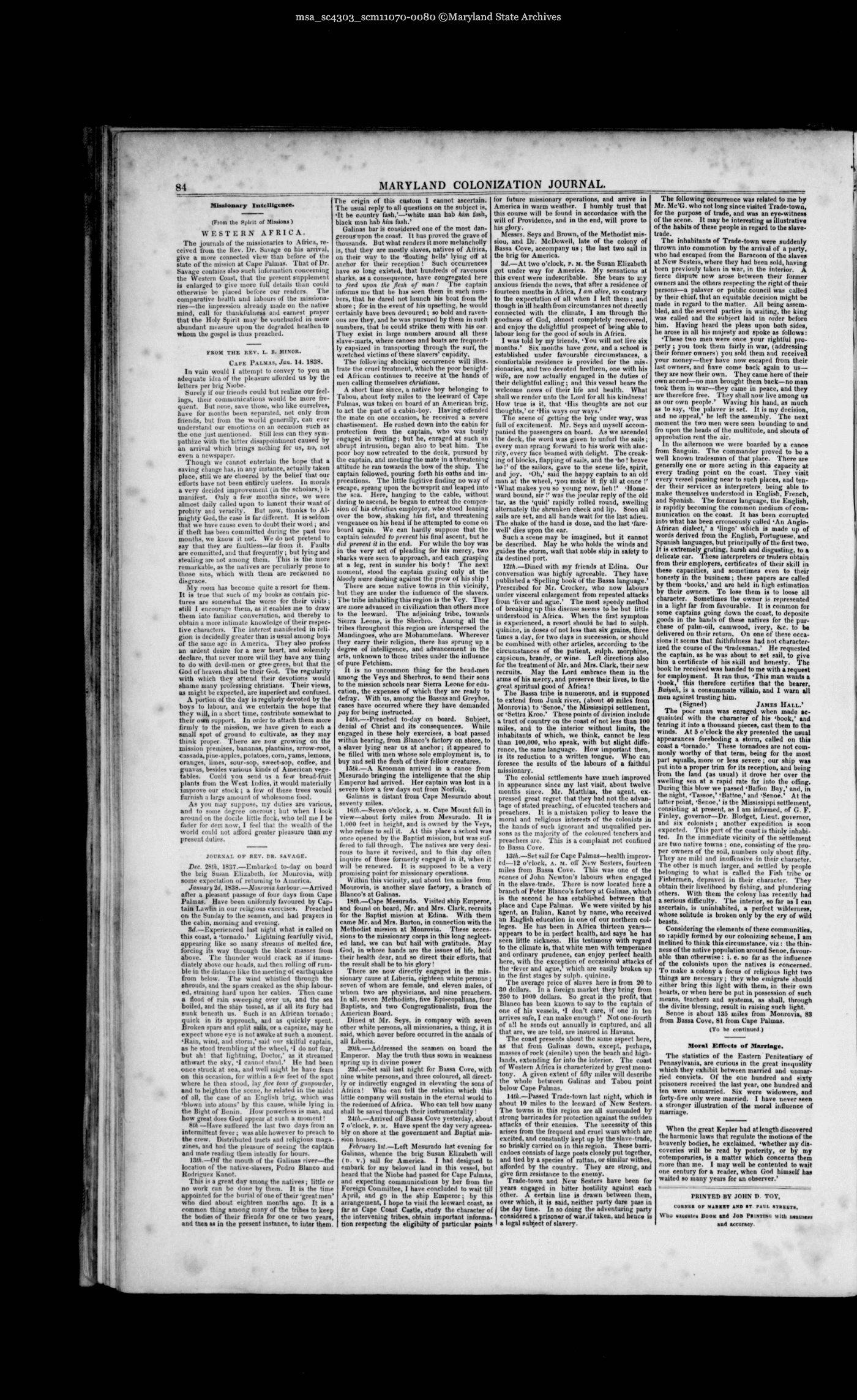
| 84 MARYLAND COLONIZATION JOURNAL. Missionary Intelligence. (From the Spirit of Missions) WESTERN AFRICA. The journals of the missionaries to Africa, re- ceived from the Bw. Or. Savage on his arrival. give a more connected view than before of the state of the mission at Cape Palmas. That of Dr. Savage contain* also such information concerning the Western Coast. til it the pi' -1 lit supplemi lit is enlarged to give more full details than could otherwise M placed before our readers. The comparative health and labours of the missiona- ries—the iinpre«siou already wade on the native mind, call lor thankfulness and earnest prayer that the Holy Spirit may be vouchsafed in more abundant measure upon the degraded heathen to whom the gospel is thus preached. FROM THE REV. L. B. MINOR. Cape Palmas, Jan. 14. 1838. In vain would I attempt to convey to you an adequate idea of the pleasure afforded us by the letters per brig Niobe. Surely if our friends could but realize our feel- ings, their communications would be more fre- quent. But none, save those, who like ourselves, have for months been separated, not only from friends, but from the world generally, can ever understand our emotions on an occasion such as the one just mentioned. Still less can they sym- pathize with the bitter disappointment caused by an arrival which brings nothing for us, no, not even a newspaper. Though we cannot entertain the hope that a saving change has, in any instance, actually taken place, still we are cheered by the belief that our efforts have not been entirely useless. In morals a very decided improvement (in the scholars,) is manifest. Only a lew months since, we were almost daily called upon to lament their want of probity and veracity. But now, thanks to Al- mighty God, the case is far different. It is seldom that w e have cause even to doubt their word; and if theft has been committed dining the past two mouths, we know it not. We do not pretend to say that they are faultless—far from it. Faults are committed, and that frequently ; but lying and stealing are not among them. This is the more remarkable, as the natives are peculiarly prone to those sins, which with them are reckoned no disgrace. Sly room has become quite a resort for Ihem. It is true that such of my books as contain pic- tures are somewhat the worse tor their visits; still I encourage them, as it enables me to draw them into lanuliar conversation, and thereby to obtain a more ultimata knowledge of their respec- tive characters. The interest manifested ill reli- gion is decidedly greater than is usual among boys of the same age in America. They also profess an ardent desire for a new heart, and solemnly declare, that never more will they have any thing to do with devil-men or gree grees, but that the God of heaven shall be their God. The regularity with which they attend their devotions would shame many professing christians. Their views, as might be expected, are imperfect and confused. A portion of the day is regularly devoted by the boys to labour, and we entertain the hope that they will, in a short time, contribute somewhat to their own support. In order to attach them more firmly to the mission, we have given to each a small spot of ground to cultivate, as they may think proper. There are now growing on the mission premises, bananas, plantains, arrow-root, cassada, pine-apples, potatoes, corn, yarns, lemons, oranges, limes, sour-sop, sweet-sop, coffee, and gnaws, besides various kinds of American vege- tables. Could you send us a few breadfruit plants from the West Indies, it would materially improve our stock ; a few of these trees would furnish a large amount of wholesome food. As you may suppose, my duties are various, and to some degree onerous; but w hen 1 look around on the docile little flock, who tell ine I be fader for item now, I feel that the wealth of the world could not allord greater pleasure than my present duties. JOURNAL OF REV. DR. SAVAGE. Dec. 28th, 1837.—Embarked to-day on board the brig Susan Elizabeth, lor .Monrovia, with some expectation of returning to America. January 2d, 838.—Monrovia harbour.—Arrived after a pleasant passage of four days from Cape Palmas. Have been uniformly favoured by Cap- tain I.awlin in our religious exercises. Preached on the Sunday to the seamen, and had prayers in the cabin, morning and evening. 3d.—Experienced last night what is called on this coast, a 'tornado.' Lightning fearfully vivid, appearing like so many streams of melted fire, forcing its way through the black masses from above. The thunder would crack as if imme- diately above our heads, and then rolling oil' rum- ble in the distance like the meeting of earthquakes from below. The wind whistled through the shrouds, and the spars creaked as the ship labour- ed, straining hard upon her cables. Then came a flood of rain sweeping over us, and the sea boiled, and the ship tossed, as if all its fury had sunk beneath us. Such is an African tornado; quick in its approach, and as quickly spent. Broken spars and split tails, or a capsize, may he expect whose eye is not awake at such a moment. •Rain, wind, and storm,' said our skilful captain, as he stood trembling at the wheel, 'I do not fear, but ah! that lightning, Doctor,' as it streamed athwart the sky, I cannot stand.' He had been once struck at sea, and wall might he have fears on this occasion, for within a few feet of the spot where he then stood, lay five tons of gunpowder, and to heighten the scene, he related in the midst of all, the case of an English brig, which was *bluwn into atoms' by this cause, while lying in the Bight of Benin. How powerless is man, and how great does fiod appear at such a moment! 8th—Have sutiered the last two days from an intermittent fever; was able however to preach to the crew. Distributed tracts arid religious Ban. lines, and had the pleasure of seeing the captain and mate reading them intently for hours. 13th.—Off the mouth of the Galinas river—the location of the native-slavers, Pedro Blanco and Rodriguez Kanot. This is a great day among the natives; little nr no work can be done by them. It is the time appointed for the burial of one of their'great men' who died about eighteen months ago. It is a common thing among many of the tribes to keep the bodies of their friends for one or two years, and then as in the present instance, to inter them The origin of this custom I cannot ascertain. The usual reply to all questions on the subject is, 'It be country fash,'—'white man hab Aim lash, black man hab Aim fash.' Galinas bar is considered one of the most dan- gerous upon the coast. It has proved the grave of thousands. But what renders it more melancholly is, that they are mostly slaves, natives of Africa, on their way to the 'floating hells' lying oil' at anchor for their reception! Such occurrences have so long existed, that hundreds of ravenous sharks, as a consequence, have congregated here to feed upon the flesh of man.' The captain informs me that he has seen them in such num- bers, that he dared not launch his boat from the shore ; for in the event of his upsetting, he would certainly have been devoured ; so bold and raven- ous are they, and he w as pursued by them in such numbers, that he could strike them with his oar. They exist in large numbers around all these slave-marts, where canoes and boats are frequent- ly capsized in transporting through the surf, the wretched victims of these slavers' cupidity. The follov ing shocking occurrence will illus. tr.ite the cruel treatment, which the poor benight- ed African continues to receive at the hands of men calling themselves christians. A short time since, a native boy belonging to Tabou, about forty miles to the leeward of Cape I'alnias, was taken on board of an American brig, to act the part of a cabin-boy. Having oliended the mate on one occasion, he received a severe chastisement. He rushed down into the cabin for protection from the captain, who was busily engaged in writing; but he, enraged at such an abrupt intrusion, began also to beat him. The poor boy now retreated to the deck, pursued by the captain, and meeting the mate in a threatening attitude he ran towards the bow of the ship. The captain followed, pouring forth his oaths and im- precations. The little fugitive finding no way of escape, sprang upon the bowsprit and leaped into the sea. Here, hanging to the cable, without daring to ascend, he began to entreat the compas- sion of his christian employer, who stood leaning over the bow, shaking his fist, and threatening vengeance on his head if he attempted to come on board again. We can hardly suppose that the captain intended to prerent bis final ascent, but he did prevent it in the end. For while the boy was in the very act of pleading for his mercy, two sharks were seen to approach, and each grasping at a leg, rent in slimier his body ! The next moment, stood the captain gazing only at the bloody wave dashing against the prow of his ship ! There are some native towns in this vicinity, but they are under the influence of the slavers. The tribe inhabiting this region is the Vey. They are more advanced in civilization than others more to the leeward. The adjoining tribe, towards Sierra Leone, is the Sherbro. Among all the tribes throughout this region are interspersed the Mandingoes, who are Mohammedans. Wherever they carry their religion, there has sprung up a degree of intelligence, and advancement in the arts, unknown to those tribes under the influence of pure Fetchism. it is no uncommon thing for the head-men among the Veys and Sherbros, to send their sons to the mission schools near Sierra Leone for edu- cation, the expenses of which they are ready to defray. With us, among the Bassas and Greybos, rases have occurred where they have demanded pay for being instructed. 14th.—Preached to-day on board. Subject, denial of Christ and its consequences. While engaged in these holy exercises, a boat passed within hearing, from Blanco's factory on shore, to a slaver lying near us at anchor; it appeared to be filled with men whose sole employment is, to buy and sell the flesh of their fellow creatures. 15th—A Krooman arrived in a canoe from Mesurado bringing the intelligence that the ship Emperor had arrived. Her captain was lost in a severe blow a few days out from Norfolk. Galinas is distant from Cape Mesurado about seventy miles. 16th,—Seven o'clock, a. m. Cape Mount full in view—about forty miles from Mesurado. It is 1.000 feet in height, and is owned by the Veys, who refuse to sell it. At this place a school was once opened by the Baptist mission, but was suf- fered to lall through. The natives are very desi- rous to have it revived, and to this day olten impure of those formerly engaged in it, when it will be renewed. It is supposed to be a very promising point for missionary operations. Within this vicinity, and about ten miles from Monrovia, is another slave factory, a branch of Blanco's at Galinas. 18th.—Cape Mesurado. Visited ship Emperor, and found on board, Mr. and Mrs. Clark, recruits for the Baptist mission at Edina. With them came Mr. and Mrs. Barton, in connection with the Methodist mission at Monrovia. These acces- sions to the missionary corps in this long neglect- ed land, we can but hail with gratitude. May Gad, in whose hands are the issues of life, hold their health dear, and so direct their efforts, that the result shall be to his glory! There are now directly engaged in the mis- sionary cause at Liberia, eighteen white persons ; seven of whom are female, and eleven males, of whom two are physicians, and nine preachers. In all, seven Methodists, five Episcopalians, four Baptists, and two Congregationalism, from the American Board. Dined at Mr. Seys, in company with seven other white persons, all missionaries, a thing, it is said, which never before occurred in the annals of all Liberia. 20th.—Addressed the seamen on board the Emperor. May the truth thus sown in weakness spring up in divine power 23d—Set sail last night for Bassa Cove, with nine white persons, and three coloured, all direct- ly or indirectly engaged in elevating the sons of Africa! Who can tell the relation which this little company will sustain in the eternal world to the redeemed of Africa. Who can tell how many shall he saved through their instrumentality! 24th.—Arrived otf Bassa Cove yesterday, about 7 o'clock, p. M. Have spent the day very agreea- bly on shore at the government and Baptist mis- sion houses. February 1st.—Left Mesurado last evening for Galinas, whence the brig Susan Elizabeth will (d. v.) sail for America. I had designed to embark for my beloved land in this vessel, but heard that the Niobe had passed for Cape Palmas, and expecting communications by her from the Foreign Committee, I have concluded to wait till April, and go in the ship Emperor; by this arrangement, I hope to visit the leeward coast, as far as Cape Coast Cattle, study the character of the intervening tribes, obtain important informa- tion respecting the eligibilty of particular points for future missionary operations, and arrive in America in warm weather. I humbly trust that this course will be found in accordance with the will of Providence, and in the end, will prove to his glory. Messrs. Seys and Brown, of the Methodist mis- sion, and Dr. McDowell, late of the colony of Bassa Cove, accompany us ; the last two sail in the brig lor America. 3d.—At two o'clock, p. m. the Susan Elizabeth got under way for America. My sensations at this event were indescribable. She bears to my anxious friends the news, that after a residence of fourteen months in Africa, 7 am alive, so contrary to the expectation of all when I left them ; and though in ill health from circumstances not directly connected with the climate, I am through the goodness of God, almost completely recovered, and enjoy the delightful prospect of being able to labour long for the good of souls in Africa. I was told by my friends, 'You will not live six months." Six months have gone, and a school is established under favourable circumstances, a comfortable residence is provided for the mis. sionaries, and two devoted brethren, one with his wife, are now actually engaged in the duties of their delightful calling ; and this vessel bears the welcome news of their life and health. What shall we render unto the Lord for all his kindness! How true is it, that 'His thoughts are not our thoughts,' or 'His ways our ways.' The scene of getting the brig under way, was full of excitement. Mr. Seys and myself accom- panied the passengers on board. As we ascended the deck, the word was given to unfurl the sails ; every man sprang forward to his work with alac- rity, every face beamed with delight. The creak- ing of blocks, flapping of sails, and the 'ho ! heave hoi' of the sailors, gave to the scene life, spirit, and joy. 'Oh,' said the happy captain to an old man at the wheel, 'you make it fly all at once !' •What makes you so young now, heh!' 'Home- ward bound, sir !' was the jocular reply of the old tar, as the 'quid' rapidly rolled round, swelling alternately the shrunken cheek and lip. Soon all sails are set, and all hands wait for the last adieu. The shake of the hand is done, and the last 'fare- well' dies upon the ear. Such a scene may be imagined, but it cannot be described. May he who holds the winds and guides the storm, waft that noble ship in salcty to its destined port. 12th.—Dined with my friends at Edina. Our conversation was highly agreeable. They have published a 'Spelling book of the Bassa language.' Prescribed for Mr. Crocker, who now labours under visceral enlargement from repeated attacks from 'fever and ague.' The most speedy method of breaking up this disease seems to be but little understood in Africa. When the first symptom is experienced, a resort should be had to sulph. quinine, in doses of not less than six grains, three times a day, for two days in succession, or should be combined with other articles, according to the circumstances of the patient, sulph. morphine, capsicum, brandy, or wine. Left directions also for the treatment of Mr. and Mrs. Clark, their new recruits. May the Lord embrace them in the arms of his mercy, and preserve their lives, to the great spiritual good of Africa! The Bassa tribe is numerous, and is supposed to extend from Junk river, (about 40 miles from Monrovia) to 'Senoe,' the Mississippi settlement, or 'Settra Kroo.* These points of division include a tract of country on the coast of not less than 100 miles, and to the interior without limits, the inhabitants of which, we think, cannot be less than 100,000, who speak, with but slight diffe- rence, the same language. How important then, is its reduction to a written tongue. Who can foresee the results of the labours of a faithful missionary. The colonial settlements have much improved in appearance since my last visit, about twelve months since. Mr. Matthias, the agent, ex- pressed great regret that they had not the advan- tage of stated preaching, of educated teachers and preachers. It is a mistaken policy to leave the moral and religious interests of the colonists in the hands of such ignorant and unqualified per- sons as the majority of the coloured teachers and preachers are. This is a complaint not confined to Bassa Cove. 13th.—Set sail for Cape Palmas—health improv- ed—12 o'clock, A. m. off New Sesters, fourteen miles from Bassa Cove. This was one ot the scenes of John Newton's labours when engaged in the slave trade. There is now located here a branch of Peter Blanco's factory at Galinas, which is the second he has established between that place and Cape Palmas. We were visited by his agent, an Italian, Kanot by name, who received an English education in one of our northern col- leges. He has been in Africa thirteen years— appears to be in perfect health, and says he has seen little sickness. His testimony with regard to the climate is, that white men with temperance and ordinary prudence, can enjoy perfect health here, with the exception of occasional attacks of the 'fever and ague, which are easily broken up in the first stages by sulph. quinine. The average price of slaves here is from 20 to 30 dollars. In a foreign market they bring from 250 to 1000 dollars. So great is the profit, that Blanco has been known to say to the captain of one of his vessels, 'I don't care, if one in ten arrives safe, I can make enough!' Not one-fourth of a!l he sends out annually is captured, and all that are, we are told, are insured in Havana. The coast presents about the same aspect here, as that from Galinas down, except, perhaps, masses of rock (sienite) upon the beach and high- lands, extending far into the interior. The coast of Western Africa is characterized by great mono- tony. A given extent of fifty miles will describe the whole between Galinas and Tabou point below Cape Palmas. 14th.—Passed Trade-town last night, which is about 10 miles to the leeward of New Sesters. The towns in this region are all surrounded by strong barricades for protection against the sudden attacks of their enemies. The necessity of this arises from the frequent and cruel wars which are excited, and constantly kept up by the slave-trade, so briskly carried on in this region. These barri- cadoes consists of large posts closely put together, and tied by a species of rattan, or similar withes, afforded by the country. They are strong, and give firm resistance to the enemy. Trade-town and New Sesters have been for years engaged in bitter hostility against each other. A certain line is drawn between them, over which, it is said, neither party dare pass in the day time. In so doing the adventuring party considered a prisoner of war, if taken, and hence is a legal subject of slavery. The following occurrence was related to me by Mr. Mc'G. who not long since visited Trade-town, for the purpose of trade, and was an eye-witness of the scene. It may be interesting as illustrative of the habits of these people in regard lo the slave- trade. The inhabitants of Trade-town were suddenly thrown into commotion by the arrival of a party, who had escaped from the Baracoon of the slaves at New Sesters, where they had been sold, having been previouly taken in war, in the interior. A fierce dispute now arose between their former owners and the others respecting the right of their persons—a palaver or public council was called by their chief, that an equitable decision might be made in regard to the matter. All being assem- bled, and the several parties in waiting, the king was called and the subject laid in order before him. Having heard the pleas upon both sides, he arose in all his majesty and spoke as follows: 'These two men were once your rightful pro- perty ; you took them fairly in war, (addressing their former owners) you sold them and received your money—they have now escaped from their last owners, and have come back again to us— they are now their own. They came hereof their own accord—no man brought them back—no man took them in war—they came in peace, and they are therefore free. They shall now live among us as our own people.' Waving his hand, as much as to say, 'the palaver is set. It is my decision, and no appeal,' he left the assembly. The next moment the two men were seen bounding to and fro upon the heads of the multitude, and snouts of approbation rent the air. In the allernoon we were boarded by a canoe from Sanguin. The commander proved to be a well known tradesman of that place. There are generally one or more acting in this capacity at every trading point on the coast. They visit every vessel passing near to such places, and ten- der their services as interpreters, being able to make themselves understood in English, French, and Spanish. The former language, the English, is rapidly becoming the common medium of com- munication on the coast. It has been corrupted into what has been erroneously called 'An Anglo- African dialect,' a 'lingo' which is made up of words derived from the English, Portuguese, and Spanish languages, but principally of the first two. It is extremely grating, harsh and disgusting, to a delicate car. These interpreters or traders obtain from their employers, certificates of their skill in these capacities, and sometimes even to their honesty in the business ; these papers are called by them 'books,' and are held in high estimation by their owners. To lose them is to loose all character. Sometimes the owner is represented in a light far from favourable. It is common for some captains going down the coast, to deposite goods in the hands of these natives for the pur- chase of palm-oil, camwood, ivory, *tc. to be delivered on their return. On one of these occa- sions it seems that faithfulness had not character- ized the course of the 'tradesman.' He requested the captain, as be was about to set sail, to give him a certificate of his skill and honesty. The book he received was handed to me with a request for employment. It ran thus, 'This man wants a 'book, this therefore certifies that the bearer, Iiaiyah, is a consummate villain, and I warn all men against trusting him. (Signed) James Hall.' The poor man wa9 enraged when made ac- quainted with the character of his 'book,' and tearing it into a thousand pieces, cast them to the winds. At 5 o'clock the sky presented the usual appearances foreboding a storm, called on this coast a 'tornado.' These tornadoes are not com- monly worthy of that term, being for the most part squalls, more or less severe; our ship was put into a proper trim for its reception, and being from the land (as usual) it drove her over the swelling sea at a rapid rate far into the offing. During this blow we passed 'Baflon Bay,' and, in the night, 'Tassoe,' 'Battoe,' and 'Senoe.' Af the latter point, 'Senoe,' is the Mississippi settlement, consisting at present, as I am informed, of G. F. Finley, governor—Dr. Blodget, Lieut, governor, and six colonists; another expedition is soon expected. This part of the coast is thinly inhabi- ted. In the immediate vicinity of the settlement are two native towns ; one, consisting of the pro- er owners of the soil, numbers only about filly, 'hey are mild and inoffensive in their character. The other is much larger, and settled by people belonging to what is called the Fish tribe or Fishermen, depraved in their character. They obtain their livelihood by fishing, and plundering others. With them the colony has recently had a serious difficulty. The interior, so far as I can ascertain, is uninhabited, a perfect wildernrss, whose solitude is broken only by the cry of wild beasts. Considering the elements of these communities, so lapidly formed by our colonizing scheme, I am inclined to think this circumstance, viz : the thin- ness of the native population around Senoe, favour- able than otherwise: i. e. so far as the influence of the colonists upon the natives is concerned. To make a colony a focus of religious light two things arc necessary; thev who emigrate should either bring this light with them, in their own hearts, or when here be put in possession of such means, teachers and systems, as shall, through the divine blessing, result in raising such light. Senoe is about 135 miles from Monrovia, 83 from Bassa Cove, 81 from Cape Palmas. (To be continued ) Moral Effects of Marriage. The statistics of the Eastern Penitentiary of Pennsylvania, are curious in the great inequality which they exhibit betwten married and unmar- ried convicts. Of the one hundred and sixty prisoners received the last year, one hundred and ten were unmarried. Six were widowers, and forty-five only were married. I have never seen a stronger illustration of the moral influence of marriage. When the great Kepler had at length discovered the harmonic laws that regulate the motions of the heavenly bodies, he exclaimed, 'whether my dis- coveries will be read by posterity, or by my cotemporaries, is a matter which concerns them more than me. I may well be contented to wait one century for a reader, when God himself has waited so many years for an observer.' PRINTED BY JOHN D TOY, CORNER OF MARKET AND ST. PAUL STREETS, Who executes Book and Job Printing with neatness and accuracy. |