 |
|
|
 |
|
 |
|
|||
|
||||
|
||||
|
Maryland State Archives Maryland Colonization Journal Collection MSA SC 4303 msa_sc4303_scm11070-0081 Enlarge and print image (5M) |
|
|
|
|
|
|
|
|||
|
||||
|
||||
|
Maryland State Archives Maryland Colonization Journal Collection MSA SC 4303 msa_sc4303_scm11070-0081 Enlarge and print image (5M) |
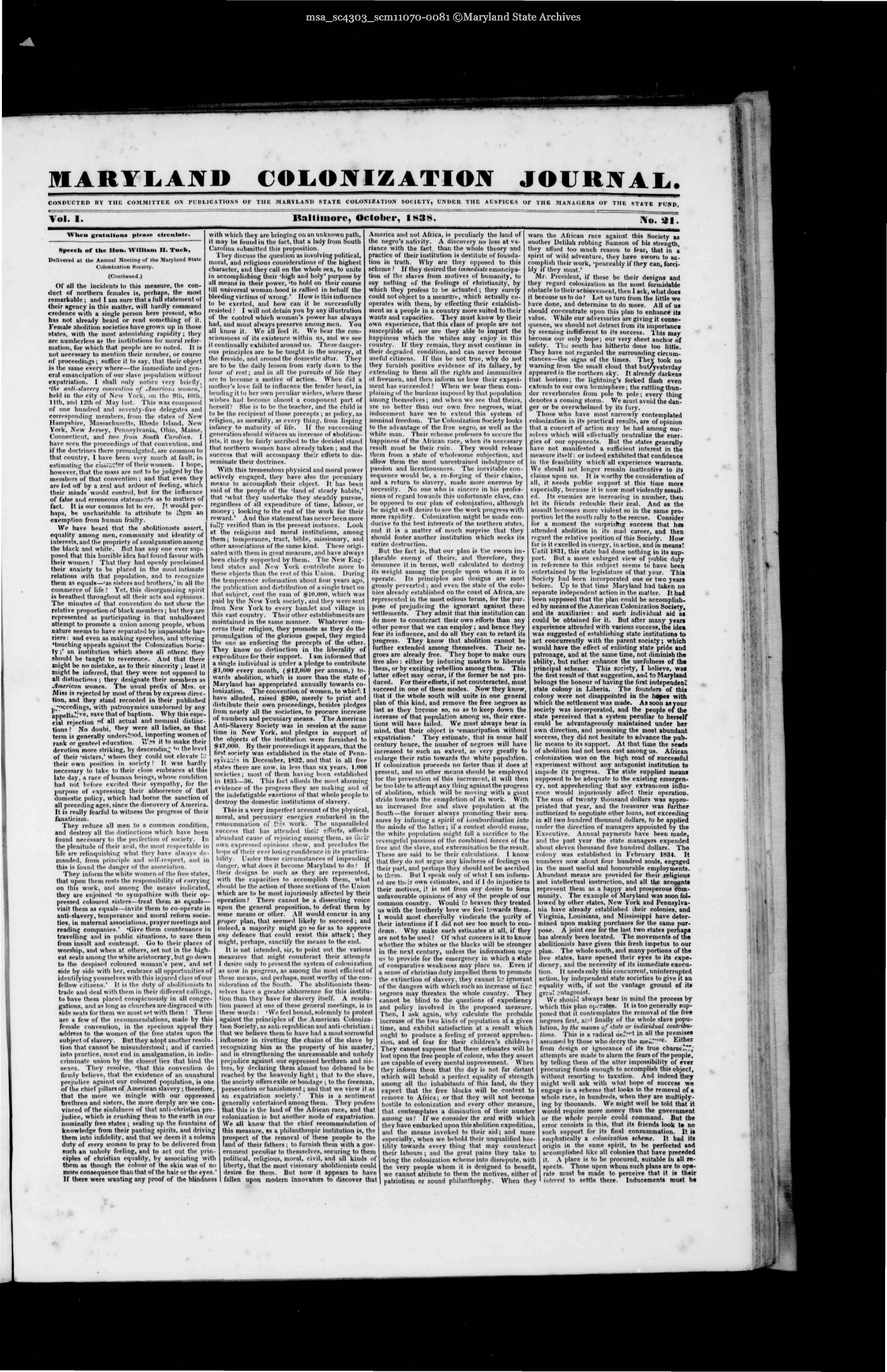
| MARYLAND COLONIZATION JOURNAL. CONDUCTED BY THE COMMITTEE ON PUBLICATIONS OF THE MARYLAND STATE COLONIZATION SOCIETY, UNDER THE AUSPICES OF THE MANAGERS OF THE STATE FUND Vol. I. Baltimore, October, 1838. No. 21. When gratuitous please circulate. Speech of the Hon. William H. Tuck, Delivered at the Annual Meeting of the Maryland State Colonization Society. (Continued.) Of all the incidents to this measure, the con- duct of northern females is, perhaps, the most remarkable , and I am sure that a full statement of their agency in this matter, will hardly command credence with a single person here present, who has not already heard or reail something of it. Female abolition societies have grown up in those states, with the most astonishing rapidity; they are numberless as the institutions for moral refor- mation, lor which that people are so noted. It is not necessary to mention their nuiuher, or course of proceedings ; suffice it to say, that their object is the same every where—the immediate and gen- eral emancipation of our slave population without expatriation, i shall only notice very briefly, 'the anti-slavery convention of American women,' held in the city of New York, on the 9th, 10th, 11th, and 12th of May last. This was composed of one hundred and seventy-five delegates and corresponding members, from the stales of New Hampshire, Massachusetts, Ithode Island, New York, New Jersey, Pennsylvania, Ohio, Maine, Connecticut, and two from South Carolina. I have seen the proceedings of that convention, and if the doctrines there promulgated, are common to that country, I have been very much at fault, in estimating the character of their women. I hope, however, that the mass are not to be judged by the members of that convention ; and that even they are led oil' by a zeal and ardour of fee ling, which their minds would control, but for the influence of false and erroneous statements as to matters of fact. It is our common lot to err. It would per- haps, be uncharitable to attribute to them an exemption from human frailty. We have heard that the abolitionists assert, •quality among men, community anil identity of interests, and the propriety of amalgamation among the black ami white. But has any one ever sup- posed that this horrible idea liad found favour with their women ? That they had openly proclaimed their anxiety to be placed in the most intimate relations with that population, and to recognize them as equals—4as sisters and brothers,' in all the commerce of life? Yet. this disorganizing spirit is breathed throughout all their acts and opinions. The minutes of that convention do not shew the relative proportion of black members ; hut they are represented as participating in that unhallowed attempt to promote a union among people, whom nature seems to have sepaiated by impassable bar- riers: and even as making speeches, and uttering ¦touching appeals against the Colonization Socie- ty ;' an institution which above all others* thev should be taught to reverence. And that there might he no mistake, as to their sincerity ; least it might be inferred, that they were not opposed to all distinctions ; they designate their members as American women. The usual prefix of Mrs. or Miss is rejected by most of them by express direc- tion, and they stand recorded in their published proceedings, with patronymics unadorned by any appellative, save that of baptism. Why this espe- cial rejection of all actual and nominal distinc- tions? No doubt, they were all ladies, as that term is generally understood, importing women of rank or genteel education. Was it to make their devotion more striking, by descending to the level of their 'sisters,' whom they could not elevate to their own position in society? It was hardly necessary to take lo their close embraces at this late day, a race of human beings, whose condition had not before excited their sympathy, for the purpose of expressing their abhorrence of that domestic policy, which had borne the sanction of all preceding ages, since the discovery of America. It is really fearful to witness the progress of their fanaticism. They reduce all men to a common condition, and destroy all the distinctions which have been found necessary to the pel lection of society. In the plenitude of their zeal, the most respectable in life are relinquishing what they have always de- manded, from principle and self-respect, and in this is found the danger of the association. They inform Ihe white women of the free states, that upon them rests the responsibility of carrying on this work, and among the means indicated, they are enjoined 'to sympathize with their op- pressed coloured sisters—treat them as equals— visit them as equals—invite them to co-operate in anti-slavery, temperance and moral reform socie- ties, in maternal associations, prayer meetings and reading companies.' 'Give them countenance in travelling ami in public situations, to save them from insult and contempt, (in to their places of worship, ami when at others, set not in the high- est seats among the white aristocracy, but go down to the despised coloured woman's pew, and set aide by side with her, embrace all opportunities of identifying yourselves with this injured class of our fellow citizens.' It is the duty of abolitionists to trade and deal with them in their different callings, to have them placed conspicuously in all congre- gations, and as long as churches are disgraced with side seats for them we must set with thein ! These are a few of the recommendations, made by this female convention, in the specious appeal they address to the women of the free states upon the subject of slavery. But they adopt another resolu- tion that cannot be misunderstood; and if carried into practice, must end in amalgamation, in indis- criminate union by the closest ties that bind the sexes. They resolve, 'that this convention do firmly believe, that the existence of an unnatural prejudice against our coloured population, is one of the chief pillars of American slavery; therefore, that the more we mingle with our oppressed brethren and sisters, the more deeply are we con- vinced of the sinfulness of that anti-christian pre- judice, which is crushing them to the earth in our nominally free states ; sealing up the fountains of knowledge from their panting spirits, and driving them into infidelity, and that we deem it a solemn duty of every woman to pray to be delivered from such an unholy feeling, ami to act out the prin- ciples of christian equality, by associating with them as though the colour of the skin was of no more consequence than that of the hair or the eyes.' If there were wanting any proof of the blindness with which they are bringing on an unknown path, it may be found in the fact, that a lady from South Carolina submitted this proposition. They discuss the question as involving political, moral, and religious considerations of the highest character, and they call on the whole sex, to unite in accomplishing their 'high and holy' purpose by all means in their power, 'to hold on their course till universal womanhood is rallied in behalf the bleeding victims of wrong.' How is this influence to he exerted, and how can it he successfully resisted ? I will not detain you by any illustration of the control which woman's power has always had, and must always preserve among men. You all know it. We all feel it. We hear the con- sciousness of its existence within us, and we see it continually exhibited around us. These danger- ous principles are to be taught in the nursery, at the tireside, and around the domestic altar. They are to be the daily lesson from early dawn to the hour of rest; and in all the pursuits of life they are to become a motive of action. When did a mother's love fail to inlluencu the tender heart, in bending it to her own peculiar wishes, where these wishes had become almost a component part of herself? She is to be the teacher, and the child is to he the recipient of those precepts ; as policy, as religion, as morality, as every thing, from lisping infancy to maturity of life. If the succeeding generation should witness an increase of abolition- ists, it may be fairly ascribed to the decided stand that northern women have already taken ; and the success that will accompany their efforts to dis- seminate their doctrines. With this tremendous physical and moral power actively engaged, they have also the pecuniary means to accomplish their object. It has been said of the people of the 'land of steady habits,' that 'what they undertake they steadily pursue, regardless of all expenditure of time, labour, or money ; looking to the end of the work lor their reward.' And this statement has never been more fully verified than in the present instance. Look at the religious and moral institutions, among them ; temperance, tract, bible, missionary, and other associations of the same kind. These origi- nated with them in great measure,and have always been childly supported by them. The New Eng- land states and New York contribute more to these objects than the rest of this Union. During the temperance reformation about four years ago, the publication and distribution of a single tract on that subject, cost the sum of $10,000, which was paid by the New York society, and they were sent from New York to every hamlet and village in this vast country. Their other establishments are maintained in the same manner. Whatever con- cerns their religion, they promote as they do the promulgation of the glorious gospel, they regard the one as enforcing the precepts of the other. They know no distinction in the liberality of expenditure for their support. I am informed that a single individual is under a pledge to contribute $1,000 every month, ($12,000 per annum,) to- wards abolition, which is more than the state of Maryland has appropriated annually towards co- lonization. The convention of women, to whicf I have alluded, raised $360, merely to print and distribute their own proceedings, besides pledges from nearly all the societies, to procure increase of numbers and pecuniary means. The American Anti-Slavery Society was in session at the same time in New York, and pledges in support of the objects of the institution were furnished to $47,000. By their proceedings it appears, that the first society was established in the state of Penn- sylvania in December, 1832, and that in all free states there are now, in less than six years, 1,006 societies; most of them haung been established 1 in 1835—36. This fact affords the most alarming | evidence of the progress they are making and of the indefatigable exertions of that whole people to destroy the domestic institutions of slavery. This is a very imperfect account of the physical, moral, and pecuniary energies embarked in the consummation of t!lW work. The unparalleled slice.-ss that has attended their Worts, all'ords abundant cause of rejoicing among thein. as Uji .; own expressed opinions shew, and precludes the hope of their ever losiiigcontidence in its practica- bility. I'uder these circumstances of impending danger, what does it become Maryland to do? If their designs be such as they are represented, with the capacities to accomplish them, what should he the action of those sections of the Union which are to be most injuriously affected by their operation? There cannot be a dissenting voice upon the general proposition, to defeat them by some means or other. All would concur in any proper plan, that seemed likely to succeed ; and indeed, a majority might go so far as to approve any defence that could resist this attack; they might, perhaps, sanctify the means to the end. It is not intended, sir, to point out the various measures that might counteract their attempts I desire only to present the system of colonization as now in progress, as among the most efficient of these means, and perhap9, most worthy of the con- sideration of the South. The abolitionists them- selves have a greater abhorrence for this institu- tion than they have for slavery itself. A resolu- tion passed at one of these general meetings, is in these words : 'We feel bound, solemnly to protest against the principles of the American Coloniza- tion Society, as anti-republican ami anti-christian ; that we believe them to have had a most sorrowful influence in rivetting the chains of the slave by lecognizing him as the property of his master,' and in strengthening the unreasonable and unholy prejudice against our oppressed brethren and sis- ters, by declaring them almost too debased to be reached by the heavenly light ; that to the slave, the society offers exile or bondage ; to the freeman, persecution or banishment; and that we view it as an expatriation society.' This is a sentiment generally entertained among them. They profess that this is the land of the African race, and that colonization is but another mode of expatriation. We all know that the chief recommendation of this measure, as a philanthropic institution is, the prospect of the removal of these people to the land of their fathers ; to furnish thein with a gov- ernment peculiar to themselves, securing to them political, religious, moral, civil, and all kinds of liberty, that the most visionary abolitionists could desire for them. But now it appears to have fallen upon modern innovators to discover that America and not Africa, is peculiarly the land of the negro's nativity. A discovery no less at va- riance with the fact, than the whole theory and practice of their institution is destitute of founda- tion in truth. Why are they opposed to this scheme ? If they desired the immediate emancipa- tion of the slaves from motives of humanity, to say nothing of the feelings of Christianity, by which they profess to he actuated ; they surely could not object to a measure, which actually co- operates with them, by effecting their establish- ment as a people in a country more suited to their wants and capacities. They must know by their own experience, that this class of people are not susceptible of, nor are they able to impart the happiness which the whites may enjoy in this country. If they remain, they must continue in their degraded condition, and can never become useful citizens. If this be not true, why do not they furnish positive evidence of its fallacy, by extending to them all the rights and immunities ot freemen, and then inform us how their experi- ment has succeeded ? When we hear them com- plaining of the burdens imposed by that population among themselves; and when we see that theirs, are no better than our own free negroes, what inducement have we to extend this system of nominal freedom. The Colonization Society looks to the advantage of the free negro, as well as the white man. Their scheme professes to secure the happiness of the African race, when its necessary result must be their ruin. They would release them from a state of wholesome subjection, and allow them the most unrestrained indulgence of passion and licentiousness. The inevitable con- sequence would be, a re-forging of their chains, and a return to slavery, made more onerous by necessity. No one who is sincere in his profes- sions of regard towards this unfortunate class, can be opposed to our plan id' colonization, although he might well desire to see the work progress with more rapidity. Colonization might be made con- ducive to the best interests of the northern states, and it is a matter of much surprise that they should foster another institution which seeks its entire destruction. But the fact is, that our plan is t.'ie sworn im- placable enemy of theirs, and therefore, they denounce it in terms, well calculated to destroy its weight among the people upon whom it is to operate. Its principles and designs are most grossly perverted ; and even the stale of the colo- nies already established on the coast of Africa, are represented in the most odious terms, for the pur- pose of prejudicing the ignorant against these settlements. They admit that this institution can do more to counteract their own ellbrts than any other power that we can employ; and hence they fear its influence, and do all they can to retard its progress. They know that abolition cannot be further extended among themselves. Their ne- groes are already free. They hope to make ours Iree also : either by inducing masters to liberate them, or by exciting rebellion among them. This latter effect may occur, if the former be not pro- duced. For their etlbrts, if not counteracted, must succeed in one of these modes. Now they know, that il the whole south will unite in one general plan of this kind, and remove the free negroes as last as they become so, so as to keep down the increase of that population among us, their exer- tions will have failed. We must always bear in mind, that their object is 'emancipation without expatriation.' They estimate, that in some half century hence, the number of negroes will have increased to such an extent, as very greatly to enlarge their ratio towards the white population. If colonization proceeds no faster than it does at present, and no other means should be employed tor the prevention of this increment, it will then be ton late to attempt any thing against the progress of abolition, which will be moving with a giant stride towards the completion of its work. With an increased free and slave population at the South—the former always promoting their mea- sures by infusing a spirit of insubordination into the minds ol'the latter; if a contest should ensue, the wdiite population might tail a sacrifice to the revengeful passions of the combined forces of the free and the slave, and extermination be the result. These are said to be their calculations. 1 know that they do not argue any kindness of feelings on their part, and perhaps they should not be ascribed to li:»in. But I speak only of what I am inform- ed are th. :r own estimates, and if I do injustice to their motives, i! is not from any desire to form unfavourable opinions of any of the people of our common country. Would !l< heaven they treated us with the brotherly love we feci inwards them. I would most cheerfully vindicate the purity of their intentions if I did not see too much to con- demn. Why make such estimates at all, if they are not to be used ! Of what concern is it to know whether the whites or the blacks will be stronger in the next century, unless the information urge us to provide for tile emergency in which a state of comparative weakness may place us. Even if a sense of christian duty impelled thein to promote the extinction of slavery, they cannot be ignorant of the dangers with which such an increase of free negroes may threaten the whole country. They cannot be blind to the questions of expediency and policy involved in the proposed measure. Then, I ask again, why calculate the probable increase of the two kinds of population at a given time, and exhibit satisfaction at a result which ought to pioduce a feeling of present apprehen- sion, and of fear for their children's children ? They cannot suppose that these estimates will be lost upon the free people of colour, who they assert are capable of every mental improvement. When they inform thein that the day is not far distant which will behold a perfect equality of strength among all the inhabitants of this land, do they expect that the free blacks will be content to remove to Africa; or that they will not become hostile to colonization and every other measure, that contemplates a diminution of their number among us? If we consider the zeal with which they have embarked upon this abolition expedition, and the means invoked to their aid; and more especially, when we behold their unqualified hos- tility towards every thing that may counteract their labours ; and the great pains they take to bring the colonization scheme into disrepute, with the very people whom it is designed to benefit, we cannot atribute to them the motives, either of patriotism or sound philanthrophy. When they warn the African race against this Society as another Delilah robbing Samson of his strength, they afford too much reason to fear, that in a spirit of wild adventure, thev have sworn to ac- complish their work, -peaceably if they can, forci- bly if they must.' Mr. President, if these be their designs and they regard colonization as the most formidable obstacle to their achievement, then I ask, what does it become us to do ? Let us turn from the little we have done, and determine to do more. All of us should concentrate upon this plan to enhance its value. While our adversaries are giving it conse- quence, we should not detract from its importance by seeming indifferent to its success. 'Ibis may become our only hope; our very sheet anchor of safety. Tin.- south lias hitherto done too little. They have not regarded the surrounding circum- stances—the signs of the times. Thev took no warning from the small cloud that but/yesterday appeared in the northern sky. It already darkens that horizon; the lightning's forked flash even extends to our own hemisphere; the rattling thun- der reverberates from pole to pole; every thing denotes a coming storm. We must avoid the dan- ger or be overwhelmed by its fury. Those who have most narrowly contemplated colonization in its practical results, are of opinion that a concert of action may be had among our- selves which will effectually neutralize the ener- gies of our opponents. But the states generally have not manifested a sufficient interest in the measure itself: or indeed exhibited that confidence in the feasibility which all experience warranta. We should not longer remain inattentive lo its claims upon us. It is worthy the consideration of all, it needs public support at this time more especially, because it is now most violently assail- ed. Its enemies are increasing in number, then let its friends redouble their zeal. And as the assault becomes more violent so in the same pro- portion let the south rally to the rescue. Consider for a moment the surprismg success that hat attended abolition in its mad career, and tlieu regard the relative position of this Society. How far is it excelled in energy, in action, and in means! Until 1831, this state had done nothing in its sup- port. But a more enlarged view of public duty in reference to this subject seems to have been entertained by the legislature of that year. This Society had been incorporated one or two years belbre. Up to that time Maryland had taken no separate independent action in the matter. It had been supposed that the plan could be accomplish- ed by means of the American Colonization Society, and its auxiliaries: and such individual aid ai could be obtained for it. But after many years experience attended with various success, the idea was suggested of establishing state institutions to act concurrently with the parent society; which would have the effect of enlisting slate pride and patronage, and at the same time, not diminish the ability, but rather enhance the usefulness of the principal scheme. This society, I believe, wai the first result of that suggestion, anil to Maryland belongs the honour of having the first independent state colony in Liberia. The founders of this colony were not disappointed in the hopes with which the settlement was made. As soon as your society was incorporated, and the people of the state perceived that a system peculiar to herself could be advantageously maintained under her own direction, and promising the most abundant success, they did not hesitate to advance the pub- lic means to its support. At that time the seeds of abolition had not been cast among us. African colonization was on the high road of successful experiment without any antagonist institution to impede its progress. The state supplied means supposed to be adequate to the existing emergen- cy, not apprehending that any extraneous influ- ence would injuriously affect their operation. The sum of twenty thousand dollars was appro- priated that year, and the treasurer was further authorized to negotiate other loans, not exceeding in nil two hundred thousand dollars, to be applied under the direction of managers appointed by the Executive. Annual payments have been made, and the past year the state managers expended about eleven thousand five hundred dollars. The colony w'as established in February 1834. It numbers now about four hundred souls, engaged in the most useful and honourable employments. Abundant means are provided for their religious and intellectual instruction, and all the accounts represent them as a happy and prosperous com- munity. The example of Maryland wa9 soon fol- lowed by other states. New Y'ork and Pennsylva- nia have already established iheir colonies, and Virginia, Louisiana, and Mississippi have deter- mined upon making purchases for the same pur- pose. A joint one for the last two states perhaps has already been located. The movements of the abolitionists have given this fresh impetus to our plan. The whole south, and many portions of the free states, have opened their eyes to its expe- diency, and the necessity of its immediate execu- tion. It needs only this concurrent, uninterrupted action, by independent state societies to give it an equality with, if not the vantage ground of it* great antagonist. We should always bear in mind the process by Which this plan op.rates. It is too generally sup- posed that it contemplates the removal of the free negroes first, and finally of the whole slave popu- lation, by the means of state or individual contribu- tions. This is a radical defect in all the premises assumed by those who decry the measure. Either from design or ignorance of its true character, attempts are made to alarm the fears of the people, by telling them of the utter impossibility of ever procuring funds enough to accomplish this object, without resorting to taxation. And indeed they might well ask with what hope of success we engage in a scheme that looks to the removal of a whole race, in hundreds, when they are multiply- ing by thousands. We might well be told that it would require more money than the government or the whole people could command. But the error consists in this, that its friends look te no such support for its final consummation. It is emphatically a colonization scheme. It had its origin in the same spirit, to be perfected and accomplished like all colonies that have preceded it. A place is to be procured, suitable in all re- spects. Those upon whom such plans are to ope- rate must ba made to perceive that it is their interest to settle there. Inducements mutt be |