 |
|
|
 |
|
 |
|
|||
|
||||
|
||||
|
Maryland State Archives Maryland Colonization Journal Collection MSA SC 4303 msa_sc4303_scm11070-0086 Enlarge and print image (5M) |
|
|
|
|
|
|
|
|||
|
||||
|
||||
|
Maryland State Archives Maryland Colonization Journal Collection MSA SC 4303 msa_sc4303_scm11070-0086 Enlarge and print image (5M) |
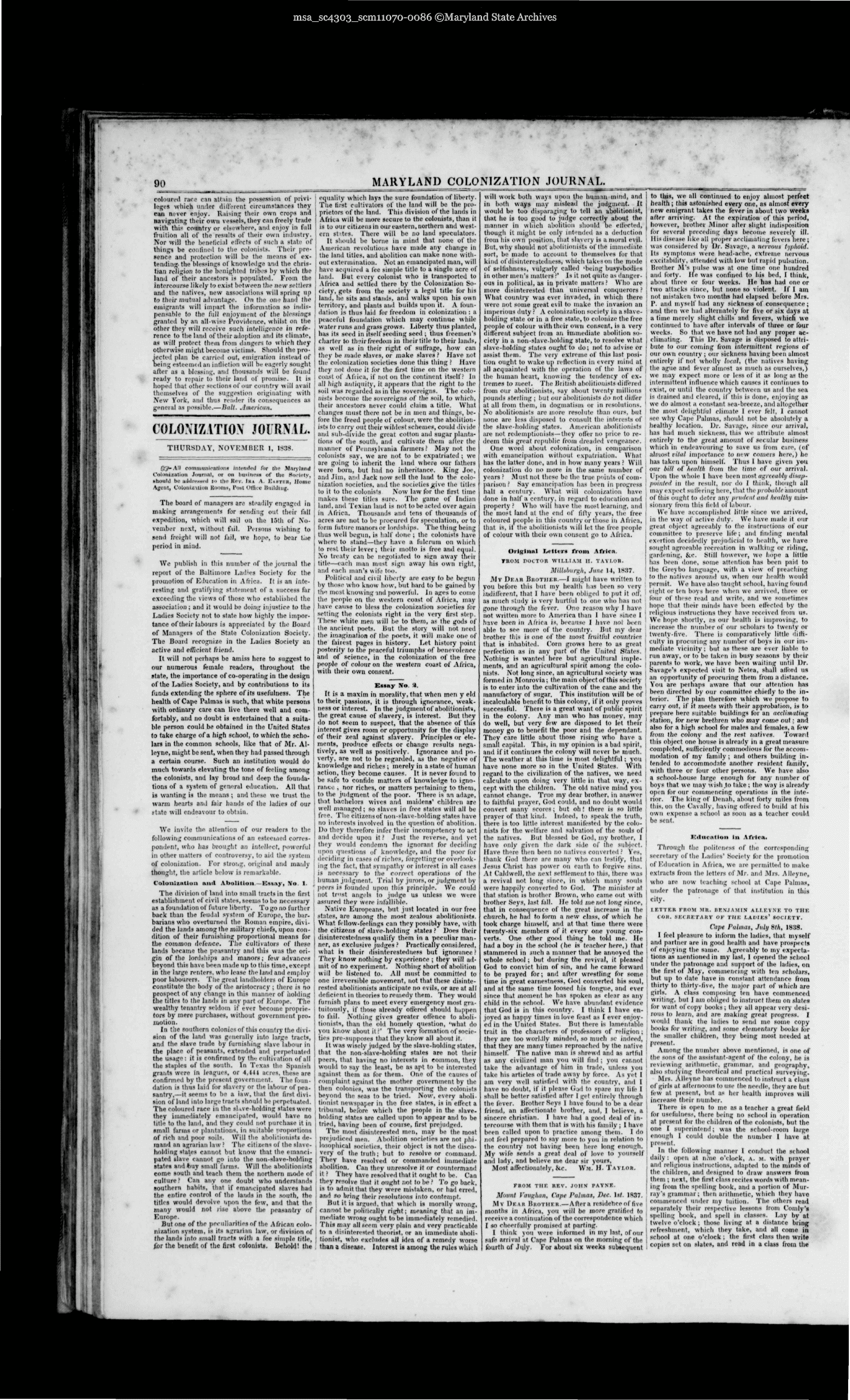
| 90 MARYLAND COLONIZATION JOURNAL. coloured race can att tin the possession of privi- leges which under different circumstances they ran never enjoy. Raising their own crops and navigating their own vessels, they can freely trade with this country or elsewhere, and enjoy in full fruition all of the results of their own industry. Nor will the beneficial effects of such a state of things be confined to the colonists. Their pre- sence and protection will be the means of ex- tending- the blessings of knowledge and the chris- tian religion to the benighted tribes by which the land of their ancestors is populated. From the intercourse likely to exi.st between the new settlers and the natives, new associations will spring up to their mutual advantage. On the one hand the emigrants will impart the information so indis- pensable to the full enjoyment of (he blessings granted by an all-wise Providence, whilst on the other they will receive such intelligence in refe- rence to the land of their adoption and its climate, as will protect them from dangers to which they otherwise might become victims. Should the pro- jected plan be carried out, emigration instead of being esteemed an intliclion will be eagerly sought after as a blessing, and thousands will be. found ready to repair to their land of promise. It is hoped that other sections of our country will avail themselves of the suggestion originating with New York, and thus render its consequences as general as possible.—Balt. American. COLONIZATION JOURNAL. THURSDAY, NOVEMBER 1 1838. All communications intended for the Maryland Colonization Journal, or on business of the Society, should be addressed to the Rev. Ira A. EASTER, Home Agent, Colonization Rooms, Post Office Building. The board of managers are steadily engaged in making arrangements for sending out their (all expedition, which will sail on the 15th of No- vember next, without fail. IVisons wishing to send freight will not fail, we hope, to bear Lie period in mind. We publish in this number of the journal the report of the Baltimore Ladies Society for the promotion of Education in Africa. It is an inte- resting and gratifying statement of a success far exceeding the views of those who established the association; and it would be doing injustice to the Ladies Society not to slate how highly the impor- tance of their labours is appreciated by the Board of Managers of the State Colonization Society. The Board recognize in the Ladies Society an active arid efficient friend. It will not perhaps be amiss here to suggest to our numerous female readers, throughout the state, the importance of co-operating in the design of the Ladies Society, and by contributions to its funds extending the sphere of its usefulness. The health of Cape Palmas is such, that white persons with ordinary care can live there well and com- fortably, and no doubt is entertained that a suita- ble person could be obtained in the United States to take charge of a high school, to which the scho- lars in the common schools, like that of Mr. Al- leyne, might be sent, when they had passed through a certain course. Such an institution would do much towards elevating the tone of feeling among the colonists, and lay bioad and deep the founda- tions of a system of general education. All that is wanting is the means ; and these we trust the warm hearts and fairhauds of the ladies of our state will endeavour to obtain. We invite the attention of our readers to the following communications of an esteemed corres- pondent, who has brought an intellect, powerful in other matters of controversy, to aid the system of colonization. For strong, original and manly thought, the article below is remarkable. Colonization and Abolition.— Essay, No 1. The division of land into small tracts in the first establishment of civil states, seems to be necessary as a foundation of future liberty. To go no further back than the feudal system of Europe, the bar- barians who overturned the Roman empire, divi- ded the lands among the military rhiefs, upon con- dition of their furnishing proportional means for the common defence. The cultivators of these lands became the peasantry and this was the ori- gin of the lordships and manors; few advances neyond this have been made up to this time, except in the large renters, who lease the land and employ poor labourers. The great landholders of Europe constitute the body of the aristocracy ; there is no prospect of any change in this manner of holding the titles to the lands in any part of Europe. The wealthy tenantry seldom if ever become proprie- tors by mere purchases, without government pro- motion. In the southern colonies of this country the divi- sion of the land was generally into large tracts, and the slave trade by furnishing slave labour in the place of peasants, extended and perpetuated the usage : it is confirmed by the cultivation of all the staples of the south. In Texas the Spanish grants were in leagues, or 4,444 acres, these are confirmed by the present government. The foun- dation is thus laid for slavery or the labour of pea- santry,—it seems to be a law, that the first divi- sion of land into large tracts should be perpetuated The coloured race in the sl.ve-holding states were they immediately emancipated, would have no title to the land, and they could not purchase it in small farms or plantations, in suitable proportions of rich and poor soils. Will the abolitionists de- mand an agrarian law ? The citizens of the slave- holding states cannot but know that the emanci- pated slave cannot go into the non-slave-holding states and buy small farms. Will the abolitionists come south and teach them the northern mode of culture | Can any one doubt who understands southern habits, that if emancipated slaves had the entire control of the lands in the south, the titles would devolve upon the few, and that the many would not rise above the peasantry of Europe. But one of the peculiarities of the African colo. nization system, is its agrarian law, or division of the lands Into small tracts with a fee simple title, fjor the benefit of the first colonists. Behold! the equality which lays the sure foundation of liberty. The lirst cultivators of the land will be the pro- prietor! of the land. This division of the lands in Africa will be more secure to the colonists, than it is to our citizens in our eastern, northern and west- ern sttes. There will be no land speculators. It should he borne in mind that none of the American revolutions have made any change in the land titles, and abolition can make none with- out extermination. Not an emancipated man, will have acquired a fee simple title to a single acre of land. Hut every colonist who is transported to Africa and settled there by the Colonization So- ciety, gets from the society a legal title for his land, lie sits and stands, and walks upon his own territory, and plants and builds upon it. A foun- dation is thus laid for freedom in colonization : a peaceful foundation which may continue while water runs and grass grows. Liberty thus planted, has its seed in itself seeding seed ; thus freemen's charter to their freedom in their title to their lands, as well as in their right of suffrage, how can they be made slaves, or make slaves? Have not the colonization societies done this thing ? Have they not done it for the first time on the western coast of Afiica, if not on the continent itself? In all high antiquity, it appears that the right to the soil was regarded as in the sovereigns. The colo- nists become the sovereigns o( the soil, to which, their ancestors never could claim a title. What changes must there not be in men and things, he- fore the freed people of colour, were the abolition- ists to carry out their wildest schemes, could divide and sub-divide the great cotton and sugar planta- tions of the south, and cultivate them after the manner of Pennsylvania farmers? May not the colonists say, we are not to be expatriated ; we are going to inherit the land where our fathers were born, but had no inheritance. King Joe, and Jim, ami Jack now tell the land to the colo- nization societies, and the societies .give the lilies to it to the colonists Now law for the first time makes these titles sure. The game of Indian land, ami Texian laud is not to be acted over again in Africa. Thousands and tens of thousands of acres are not to be procured for speculation, or to form future manors or lordships. The thing being thus well begun, is half done ; the colonists have where to stand—they have a fulcrum on which to rest their lever; their motto is free and equal. No treaty can be negotiated to sign away their title—each man must sign away his own right, and each man's wife too. Political and civil liberty are easy to be begun by those who know how, but bard to be gained by the most knowing and powerful. In ages to come the people on the western coast of Africa, may have cause to bless the colonization societies for setting the colonists right in the very first step. These white men will be to them, as the gods of the ancient poets. But the story will not need the imagination of the poets, it will make one of the faiiest pages in history. Let history point posterity' to the peaceful triumphs of benevolence and of science, in the colonization of the free people of colour on the western coast of Africa, with their own consent. Essay No. 2. It is a maxim in morality, that when men y eld to their passions, it is through ignorance, weak- ness or interest. In the judgment of abolitionist*, the great cause of slavery, is interest. But they do not seem to suspect, that the absence of this interest gives room or opportunity for the display of their zeal against slavery. Principles or ele- ments, produce effects or change results nega- tively, as well as positively. Ignorance and po- verty, are not to be regarded, as the negative of know ledge and riches; merely in a state of human action, they become causes. It is never found to be safe to confide matters of knowledge to igno- rancc , nor riches, or matters pertaining to them, to the judgment of the poor. There is an ada^e, that bachelors wives and maidens' children are well managed ; so slaves in free states will all be free. The citizens of non-sluve-holding states have no interests involved in the question of abolition. Ho they therefore infer their incompetency to act and decide upon it ? Just the reverse, and yet they would condemn the ignorant for deciding upon questions of knowledge, and the poor lor deciding in cases of riches, fbrgettingor overlook- ing the fact, that sympathy or interest in all cases is necessary to the correct operations of the human judgment. Trial by jurors, or judgment by peers is founded upon Ibis principle. We could not tmst angels to judge us unless we were assured they were infallible. Native Europeans, but just located in our free states, are among the most zealous abolitionists. What fellow-feelings can they possibly have, with the citizens of slave-holding states? Does their disinterestedness qualify them in a peculiar man- ner, as exclusive prdges ? Practically considered, what is their disinterestedness but ignorance ¦ They know nothing by experience ; they will ad- mit of no experiment. Nothing short of abolition will be listened to. All must be committed to one irreversible movement, not that these disinte- rested abolitionists anticipate no evils, or are at all deficient in theories to remedy them. They would furnish plans to meet every emergency most gra- tuitously, if those already ottered should happen to fail. Nothing gives greater offence to aboli- tionists, than the old homely question, 'what do you know about it:' The very formation of socie- ties prc-supposes that they know all about it. It was wisely judged by the slave-holding states, that the non-slave-holding states are not their peers, that having no interests in eomrnon, they would to say the least, be as apt to be interested against them as for them. One of the causes of complaint against the mother government by the then colonies, was the transporting the colonists beyond the seas to be tried. Now, every aboli- tionist newspaper in the free states, is in elfect a tribunal, beibre which the people in the slave- holding states are called upon to appear and to be tried, having been of course, first prejudged. The most disinterested men, may be the most prejudiced men. Abolition societies are not phi- fosophical societies, their object is not the disco- very of the truth; but to resolve or command. They have resolved or commanded immediate abolition. Can they unresolve it or countermand it ? They have resolved that it ought to be. Can they resolve that it ought not to be ? To go back, is to admit that they were mistaken, or had erred, and so bring their resolutions into contempt. Hut it is argued, that which is morally wrong, cannot be politically right; meaning that an im- mediate wrong ought to be immediately remedied. This may all seem very plain and very practicable to a di-interested theorist, or an immediate aboli- tionist, who excludes all idea of a remedy worse than a disease. Interest is among the rules which will work both ways upon the human mind, and in both ways may mislead the judgment. It would be too disparaging to tell an abolitionist, that he is too good to judge correctly about the manner in which abolition should be elfected, though it might be only intended as a deduction from his own position, that slavery is amoral evil. But, why should not abolitionists of the immediate sort, be made to account to themselves for that kind of disinterestedness, which takeson the mode of selfishness, vulgarly called 'being busy-bodies in other men's matters r Is it not quite as danger- ous in political, as in private matters? Who are more disinterested than universal conquerors ? What country was ever invaded, in which there were not some great evil to make the invasion an imperious duty ? A colonization society in a slave- holding state or in a free state, to colonize the free people of colour with their own consent, is a very different subject from an immediate abolition so- ciety in a non-slave-holding slate,to resolve what slave-holding states ought to do; not to advise or assist them. The very extreme of this last posi- tion ought to wake up reflection in every mind at all acquainted with tile operation of the laws of the human heart, knowing the tendency of ex- tremes to meet. The British abolitionists differed from our abolitionists, say about twenty millions pounds sterling ; but our abolitionists do not differ at all from them, in dogmatism or in resolutions. No abolitionists are more resolute fhan ours, but none are less disposed to consult the interests of the slave-holding states. American abolitionists arc not redemptionisls—they oiler no price to re- deem this great republic from dreaded vengeance. One word about colonization, in comparison with einancipalion without expatriation. What has the latter done, and in how many years ? Will colonization do no more in the same number of years ? Must not these be the true points of com- parison ? Say emancipation has been in progress halt a century. What will colonization have done in half a century, in regard to education and property ? Who will have the most learning, ami the most land at the end id' fifty years, the free coloured people in this country or those in Africa, that is, it the abolitionists will let the free people of colour with their own consent go to Africa. Original Letters from Africa. FROM DOCTOR WILLIAM H. TAYLOR. Millsburgh, June 14, 1837. My Dear Brother.—I might have written to you before this but my health has been so very indifferent, that 1 have been obliged to put it oil', as much study is very hurtful to one who has not gone through the fever. One reason why I have not written more to America than I have since I have been in Afiica is, because 1 hue nol been able to see more of the country. But my dear brother this is one of the most fruitful countries that is inhabited. Com grows here to as great perfection as in any part of the United States. Nothing is wanted here but agricultural imple- ments, and an agricultural spirit among the colo- nists. Not long since, an agricultural society was formed in Monrovia; the main object of this society- is to enter into the cultivation of the cane and the manufactory of sugar. This institution will be of incalculable benefit to this colony, if it onlv proves successful. There is a great want of public spirit in the colony. Any man who has money, may do well, but very few are disposed to let their money go to benefit the poor and the dependant. They care little about those rising who have a small capital. This, in my opinion is a bad spirit, and if it continues the colony will never be much. The weather at this time is most delightful; you have none more so in the United States. With regard to the civilization of the natives, we need calculate upon doing very little in that way, ex- cept with the children. The old native mind you cannot change. True my dear brother, in answer to faithful prayer, Cod could, and no doubt would convert many scores; but oh! there is so little prayer of that kind. Indeed, to speak the truth, there is too little interest manifested by the colo- nists for the welfare and salvation of the souls of the natives. But blessed be God, my brother, I have only given the dark side of the subject. Have there then been no natives converted? Yes, thank God there are many who can testify, that Jesus Christ lias power on eaith to forgive sins. At Caldwell, the next settlement to this, there was a revival not long since, in which many souls were happily converted to God. The minister at that station is brother Brown, who came out with brother Seys, last fall. He told me not long since, that in consequence of the great increase in the church, he had to form a new class, of which he took charge himself, and at that time there were twenty-six members of it every one young con- verts. One other good thing he toid me. He had a boy in (he school (he is teacher here.) that stammered in such a manner that he annoyed the whole school; but during the revival, it pleased God to convict him of sin, and he came forward to be prayed for; and after wrestling for some time in great earnestness, God converted his soul, and at the same time loosed his tongue, and ever since that moment he has spoken as clear as any child in the school. We have abundant evidence that God is in this country. I think I have en- joyed as happy times in love feast as I ever enjoy- ed in the United States. But there is lamentable trait in the characters of professors of religion; they are too worldly minded, so much sc indeed, that they are many times reproached by the native himself. The native man is shrewd anil as artful as any civilized man you will find; you cannot take the advantage of him in trade, unless you take his articles of trade away by force. As yet I am very well satisfied with the country, and I have no doubt, if it please Gad to spare mv life I shall be better satisfied alter 1 get entirely through the fever. Brother Seys I have found to be a dear friend, an affectionate brother, and, I believe, a sincere christian. I have hail a good deal of in- tercourse with them that is with his family ; I have been called upon to practice among them. I do not feel prepared to say more to you in relation to the country not having been here long enough. My wife sends a great deal of love to yourself and lady, and believe me dear sir yours, Most affectionately, &c. Wm. H. Taylor. to this, we all continued to enjoy almost perfect health; this astonished every one, as almost every new emigrant takes the fever in about two weeks after arriving. At the expiration of (his period, however, brother Minor alter slight indisposition tor several preceding days become severely ill. His disease like til proper acclimtting fevers here; was considered by Dr. Savage, a nervous typhoid. Its symptoms were head-ache, extreme nervous excitability, attended with low but rapid pulsation. Brother M's pulse was at one time one hundred and forty. lie was confined to his bed, I think, about three or four weeks. He has had one or two attacks since, but none so violent. If I am not mistaken two months had elapsed before Mrs. P. and myself had any sickness of consequence ; and then we had alternately lor five or six days at a time merely slight chills and fevers, which we continued to have alter intervals of three or four weeks. So that we have not had any proper ac- climating. This Dr. Savage is disposed to attri- bute to our coming from intermittent regions of our own country ; our sickness having been almost entirely if not wholly local, (the natives having the ague and lever almost as much as ourselves,) we may expect more or less of it as long as the intermittent influence which causes it conliiiues to exist, or until the country between us and the sea is drained and cleared, if this is done, enjoying as we do almost a constant sea-breeze, and altogether the most delightful climate I ever felt, 1 cannot see why Cape Palmas, should not be absolutely a healthy location. Dr. Savage, since our arrival, has had much sickness, this we attribute almost entirely to the great amount of secular business which in endeavouring to save us from cure, (of almost vital importance to new comers here,) he has taken upon himself. Thus I have given you our bill of health from the time of our arrival. Upon the whole I have been most agreeably disap- pointed in the result, nor do I think, though all may expect suffering here, that the probable amount of this ought to deter any prudent and healthy mis- sionary from this field of labour. We have accomplished little since we arrived, in the way of active duty. We have made it our greet Object agreeably to the instructions of our committee to preserve life; and finding mental exertion decidedly prejudicial to health, we have sought agreeable recreation in walking or ridirur, gardening, tkc. Still however, we hope a liltle has been done, some attention has been paid to the Greybo language, with a view of preaching to the natives around us. when our health would permit. We have also taught school, having found eight or ten boys here when we arrived, three or lour of these road and write, and we sometimes hope that their minds have been elfected by the religious instructions they have received from us. Wo hope shortly, es our health is improving, to Ulricas,, the number of our scholars to twenty or twenty-five. There is comparatively little diffi- culty in procuring any number of boys in our im- mediate vicinity; but as these are ever liable to run away, or to be taken in busy seasons by their parents to work, we have been waiting until Dr. Savage's expected visit to Netea, shall allbrd us an opportunity of procuring them from a distance. You are peihaps aware that our attention has been directed by our committee chiefly to the in- terior. The plan therefore which we propose to carry out, if it meets with their approbation, is to prepare here suitable buildings for an acclimating station, for new brethren who may come out; and also for a high school for males and females, a few from the colony and the rest natives. Toward this object one house is already in a great measure Completed) sufficiently commodious for the accom- modation of my family ; and others building in- tended lo accommodate another resident family, with three or four other persons. We have also a school-house large enouirh for any number of boys that we may wish, to take ; the way is already open for our commencing operations in the inte- rior. The king of Denab, about forty miles from this, on the Cavally, having offered to build at his own expense a school as soon as a teacher could be sent. FROM THE REV. JOHN PAYNE. Mount Vaughan, Cape Palmas, Dec.1st, 1837. My Dear Brother.—Afte ra residence of five months in Africa, you will be more gratified to receive a continuation of the correspondence which I so cheerfully promised at parting. I think you were informed in my last, of our safe arrival at Cape Palmas on the morning of the fourth of July. For about six weeks subsequent Education in Africa, Through the politeness of the corresponding secretary of the Ladies' Society for the promotion of Education in Africa, we are permitted to make extracts from the letters of Mr. and Mrs. Allcyne, who are now teaching school at Cape Palmas, under the patronage of that institution in this city. LETTER FROM MR. BENJAMIN ALLEYNE TO THE COR. SECRETARY OF THE LADIES' SOCIETY. Cape Palmas, July 8th, 1838. I feel pleasure to inform the ladies, that myself and partner are in good health and have prospects of enjoying the same. Agreeably to my expecta- tions as mentioned in my last, I opened the school under the patronage ami support of the ladies, on the first of May, commencing with ten scholars, but up to date have in constant attendance from thirty to thirty-tiie, the major part of which are girls. A class composing ten have commenced writing, but I am obliged to instruct them on slates lor want of copy books; they all appear very desi- rous to learn, and are making great progress. I would thank the ladies to send me some copy hooks for writing, and some elementary books for the smaller children, they being most needed at present. Among the number above mentioned, is one of the sons of the assistant-agent of the colony, he is reviewing arithmetic, grammar, and geography, also studying theoretical and practical surveying. Mrs. Alleyne has commenced to instruct a class of girls at afternoons to use the needle, they are but lew at present, but as her health improves will increase their number. There is open to me as a teacher a great field (or usefulness, there being no school in operation at present for the children ol the colonists, but the one I superintend; was the schoolroom large enough I could double the number I have at present. In the following manner 1 conduct the school daily: open at nl'nc o'clock, a. m. with prayer and religions Instructions, adapted to the minds of the eblldreB, and designed lo draw answers from them ; next, the first class recites words with mean- ing from the spelling book, and a portion of Mur- ray s grammar; then arithmetic, which they have commenced under my tuition. The others read separately their respective lessons Iroin Comly's spelling book, and spell in classes. Lay by at twelve o'clock ; those living at a distance bring refreshment, which they take, and all come in school at one o'clock ; the first class then write copies set on slates, and read in a class from the |