 |
|
|
 |
|
 |
|
|||
|
||||
|
||||
|
Maryland State Archives Maryland Colonization Journal Collection MSA SC 4303 msa_sc4303_scm11070-0085 Enlarge and print image (4M) |
|
|
|
|
|
|
|
|||
|
||||
|
||||
|
Maryland State Archives Maryland Colonization Journal Collection MSA SC 4303 msa_sc4303_scm11070-0085 Enlarge and print image (4M) |
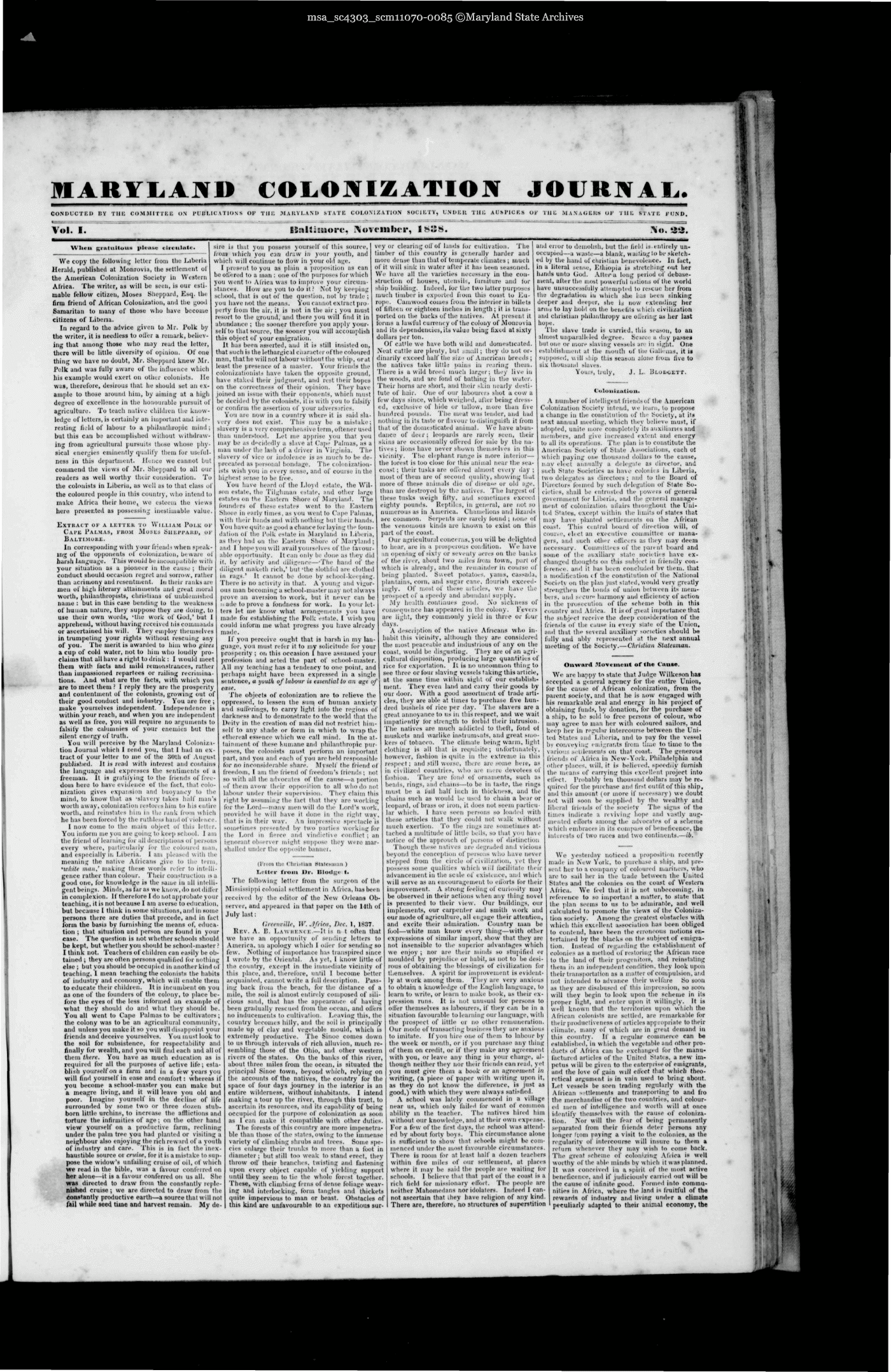
| MARYLAND COLONIZATION JOURNAL. CONDUCTED BY THE COMMITTEE ON PUBLICATIONS OF THE MARY1.AND STATE COLONIZATION SOCIETY, UNDER THE AUSPICES OF THE MANAGERS OF THE STATE FUND. Vol. I. Baltimore, November, 1838. No. 22. When gratuitous please circulate. We copy the following letter from the Liberia Herald, published at Monrovia, the settlement ol the American Colonization Society in Western Africa. The writer, as will be seen, is our esti- mable fellow citizen, Moses Sheppanl, Esq. tin firm friend of African Colonization, and the good Samaritan to many of those who have become citizens of Liberia. In regard to the advice given to Mr. Polk by the writer, it is needless to oiler a remark, believ- ing that among those who may read the letter, there will be little diversity of opinion. Of one thing we have no doubt, Mr. Sheppard knew Mr. Pi Ik and was fully aware of the influence which his example would exert on other colonists. He was, therefore, dcsiiuus that he should set an ex- ample to those around hiin, by aiming at a high degree of excellence in the honourable pursuit of agriculture. To teach native cliildien the know- ledge of letters, is certainly an important and inte- resting Acid of labour to a philanthropic mind ; but this can be accomplished without withdraw- ing from agricultural pursuits those whose phy- sical energies eminently qualify them for useful- ness in this department. Hence we cannot but commend the views of Mr. Sheppard to all our readers as well worthy their consideration. To the colonists in Liberia, as well as to that elm "l the coloured people in this country, who intend to make Africa (heir home, we esteem the views hero presented as possessing inestimable value. Extract of a letter to William Polk of Cape Palmas, from Moses Sheppard, Of Baltimore. In corresponding with your friends when speak* ing of the opponents of colonization, beware ol harsh language. This would be incompatible with your situation as a pioneer in the cause ; their conduct should occasion regret and sorrow, rather than acrimony and resentment, in their ranks are men of high literary attainment, and great moral worth, philanthropists, christians of unblemished name : but in this ease bending to the weakness of human nature, they suppose they are doing, to use their own words, 'the work of God,' but I apprehend, without having received hit commands or ascertained his will. They employ themselves in trumpeting your rights without rescuing any of you. The merit is awarded to him who gkut a cup of cold water, not to him who loudly pro- claims that all have a right to drink : I would meet them with facts and mild remonstrances, rather than impassioned repartees or railing recrimina- tions. And what are the facts, with which you are to meet them ? I reply they are the prosperity and contentment of the colonists, growing out of their good conduct and industry. You are free ; make yourselves independent. Independence is within your reach, and when you are independent as well as free, you will require no arguments to falsify the calumnies of your enemies but the silent energy of truth. You will perceive by the Maryland Coloniza- tiou Journal which 1 send you, tiiat I had an ex- tract of your letter to me of the 30th of August published. It is read with interest and contains the language and expresses the sentiments ol a freeman. It is gratifying to the friends of free- dom here to have evidence of the fact, that cofo- nizatiou gives expansion and buoyancy lo the mind, to know that as 'slavery takes half man's worth away, colonization restores him to his entire worth, and reinstates him in the rank from which he has been forced by the ruthless band Of riol( lice, I now come to the main object of this letti r. You Inform me you aie going to keep school, 1 am the friend of learning for all descriptions of pei sons every where, particularly for the coloured man, and especially ii. Liberia. 1 am please.! with the meaning the native Africans give to tie.- term, 'while mini,' making these words refer to intelli- gence rather than colour. Their construction is a good one, for knowledge is the same in all intelli- gent beings. Minds, as far as we know, do not differ in complexion. If therefore I do not approbate your teaching, it is not because I am averse to education, but because I think in some situations, and in some persons there are duties that precede, and in fact form the basis by furnishing the means of, educa- tion ; that situation and person are found in your case. The question is not whether schools should be kept, but whether you should he school-master? I think not. Teachers of children can easily be ob- tained ; they are often persons qualified for nothing else ; but you should be occupied in another kind of teaching, 1 mean teaching the colonists the habits of industry and economy, which will enable them to educate their childieu. It is incumbent on you as one of the founders of the colony, to place be- fore the eyes of the less inhumed an example of what they should do and what they should be. You all went to Cape 1'almas to he cultivators; the colony was to be an agricultural community, and unless you make it so you will disappoint your friends and deceive yourselves. You must look to the soil for subsistence, for respectability and finally for wealth, and you will find each and allot them there. You have as much education as is required for all the purposes of active life; esta- blish yourself on a farm and in a few years you will find yourself in ease and eomloit: whereas if you become a school-master you can make but a meagre living, and it will leave you old and poor. Imagine yourself in the decline of life surrounded by some two or three dozen stub- born little urchins, to increase the afflictions and torture the infirmities of age; on the other hand view yourself on a productive farm, reclining under the palm tree you had planted or visiting a neighbour also enjoying the rich rew ud of a youth of industry and care. This is in fact the inex- haustible source ol cruise, for it is a mistake to sup- pose the willow's unfailing emis* ol oil, ol which we read in the bible, was a favour conferred on her alone?it is a favour conferred on us all. She was directed to draw from the constantly reple- nished cruise; we are directed to draw from the Constantly productive earth?a source that will not fail while seed time and harvest remain. My de- sire is that you possess yourself of this source, from which you can draw in your youth, and which will continue to tlow in your oM age. I present to you as plain a proposition as can be otlircd to a man : one of the purposes for which you went in Africa was to Improve your circum- stances. How are you to do it; Nut by keeping school, that is out of the question, not by trade ; you have not the means. You cannot extract pro- perty Iron the air, it is not in the air; you must resort to the ground, anil there you will (mil it in abundance ; the sootier therefore you apply your- self to that source, the sooner you will accomplish this object of your emigration. It has been asserted, and it is still insisted on, that such is the lethargical characterofthe coloured man, that he will not labour without the whip, or at least the presence of a master. Your friends the colonizstionistl have talveri the opposite ground, have staked their judgment, and rest their hopes on the correctness of their opinion. They have joined an issue with their opponent!, which mii-t be decided by the colonlatl, ii is with you to falsify or confirm the assertion of your advers iries. Vou are now in a country where it is said sla- ycry does not exist. This may be a mistake; slavery is a verv comprehensive term,oftener Used than understood. Let me apprise you that you in.iv he .is decidedly a slave at Cape Palmas, as a man under lie- tatfa of a driver in Virginia, The slavery of vice or indolence is us much to be de- precated as personal bondage. The colonization- ists wish you in every sens.-, and of course in the highest tenae to be free. You have heard of the Lloyd estate, the Wil- son estate, the Tilghman estate, and other large estates on the Eastern shore of Maryland, The founders of these estates went to the Eastern Shore in early times, as you went to Cape I'alinas, w ith their hands and Willi nothing hut their hands. You have quite as good a chance for laying the loun- datinn of the folk estate in .Maryland in Liberia, as they bad sn the Eastern Shore of Maryland; ami I hopeyou will avail yourselves of the lavour- able opportunity. It can only he done as they did it. by activity and diligence?'The hand of the diligent maketh rich,' but 'the slothful are clothed in rugs.' It cannot be done by school-keeping. There is no activity in that. A young and vigor- ous man becoming a school-master may net always prove an aveision to work, but it never can be ii ade to prove a fondness for work, in your let- ters let me know what arrangements yuu have made foi establishing the Polk estate, I wish you could inform me what progress you have already made. If you perceive ought that is harsh in my lan- guage, you must refer it to my solicitude for your prosperity ; on this occasion I have assumed your profession and acted the part of school-master. All my teaching has a tendency to one point, and perhaps might have been expressed in a single sentence, a youth of labour is essential to an age of ease. The objects of colonization are to relieve the oppressed, to lessen the sum of human anxiety and sufferings, to carry light into the regions of darkness and to demonstrate to the world that the Deity in the creation of man did not restrict him- self to any shade or form in which to wrap the ethereal essence which we call mind. In the at- tainment of these kumane and philanthropic pur- poses, the colonists must perform an important part, and you and each of you are held responsible for no inconsiderable share. Myself the friend ol freedom, I am the friend of freedom's friends; not so with all the advocates of the cause?a portion so with avow their opposition to all who do not labour under their supervision. They claim this right by assuming the fact that they are working for the Lord?many men will do tin- Lord's work, provided he will have ii done in the right wav, that is in then way. An Impressive spectacle is sometimes presented by two parties working for the Lord in fierce and vindictive conflict; an Ignorant observer might suppose they were mar- shalled under the opposite banner. (From the Christian Statesman. ) Letter from Dr. Blodgett. The following letter from the surgeon of the Mississippi colonial settlement in Africa, has been received by the editor of the New Orleans Ob- server, and appeared in that paper on the 11th of July last; Greenville, W. Africa, Dec. 1, 1837. Rev. A. B. Lawrence?It is u t often that we have an Opportunity of sending letters to America, an apology which I oiier lor sending so few. Nothing of Importance has transpired since I wrote by the Oriental, As yet, 1 know little of the country, except in the Immediate vicinity of this place, and, therefore, until 1 become better acquainted, cannot write a full description. Pass- ing back from the beach, for the distance of a mile, the soil is almost entirely composed of sili- cious sand, that has the appearance of having been gradually rescued from the ocean, and oilers no inducements to cultivation. Leaving this, the country becomes billy, and the soil is principally made up ol clay and vegetable mould, which is extremely productive. The Sinoe comes down to us through Intervals of rich alluvion, much re- sembling thuse of the Ohio, and other western riven of the states. On the banks of this river, about three miles from the ocean, is situated the principal Siiioe town, beyond which, relying on the accounts of the natives, the country for the space of four days journey in the interior is an entire wilderness, without inhabitants. I intend making a tour up the river, through this tract, to ascertain its resources, and its capability of being occupied for the purpose of colonization as soon as I can make it compatible with other duties. The forests of this country are more impenetra- ble than those of the states, owing to the immense variety of climbing shrubs and trees. Some spe- cies enlarge their trunks to more than a foot in diameter; but still too weak to stand erect, they throw oil' their branches, twisting and fastening upon every object capable of yielding support until they seem to tie the whole forest together. These, with climbing ferns of dense foliage weav- ing and Interlocking, form tangles and thickets unite impervious to man or beast. Obstacles of this kind are unfavourable to an expeditious sur- vey or clearing oil of lands lor cultivation. The timber of this country is generally harder and more dense than that of temperate climates ; much of it will sink in water after it ha- been seasoned. We have all the varieties necessary in the con- struction of houses, utelisil-:, furniture and lor shin building. Indeed, lor the two latter purpoees mncb timber is exported from this coast lo Eu- rope. Camwood comes froiu the interior in billets of fifteen or eighteen inches in length ; it is trans- ported on the backs of the natives. At present it forms a lawful currency of tbe colony of Monrovia and its dependencies, its valuj being faced at sixty dollars per ton. Of eat'le we have both wild and domesticated. Neat cattle are plenty, but small; they do not or- dinarily exceed half the lice of American breeds; the natives take little pains in rearing them. There is a wild breed much larger; they live in the woods, and are fond of bathing in the water. Their bonis are short, and their -I.in nearly desti- tute of hair. One of our labourers shot a cow a few days since, which weighed, after being dreesa ed, exclusive of hide or tallow, more than five hundred pounds. The meat was tender, and had nothing in its taste or d ivour to distinguish it from that of the domesticated animal. We have abun- dance of deer; leopards are rarely seen, their shins are occasionally offered for sale by the na- tives; lions have never shown themselves in this vicinity. The elephant range is more interior? the I..rest is too close lor this animal near the sea- coast; their tusks are offered almost every day ; most of them are of second quality, showing that more of these animals die of disease or old age. than are destroyed by the natives. The largest of these tusks weigh fifty, and sometimes exceed eighty pounds. Reptiles, in general, are not so numerous as in America. Chamelions and lizards are common. Serpents are rarely found; none of the venomous kinds are known to exist on this part of tin.' coast. Our agricultural concerns, you will be ih lighted to iu-ar, are in a proeperous condition. We have an opening of sixty or seventy acres on the banks of tbe liver, about two miles from town, part of which is already, and the remainder in course of being planted. Sweet potatoes, yams, cassada, plantains, corn, and sugar cane. Sourish exceed- ingly, of most of these articles, we have the prospect of a speedy and abundant supply. My health continues good. No sickness of consequence has appeared in the colony. Fevers are light, they commonly yield in three or four days. A description of the native Africans who in- habit this vicinity, although they are considered the most peaceable and industrious of any on tbe mast, would be disgustiug. They are oi an agri- cultural disposition, producing large quantities of rice for exportation. It is no uncommon thing to see three or four slaving vessels taking this article, at the same time within siirht of our establish- ment. They even land and carry their goods by our door. With a good assortment of trade arti- cles, they are able at times to purchase five hun- dred bushels of rice per day. The slavers are a great annoyance to ns in this respect, and we wait Impatiently lor strength to forbid their intrusion. The natives are much addicted to theft, fond ol muskets and warlike Instruments, and great smo- kers of tobacco. The climate being warm, light clothing is all that is requisite; unfortunately, however, fashion is quite in the extreme in this respect; and still worse, there are some here, as in civilized countries, who are mere devotees of fashion. They are fond of ornaments, such as heads, rings, and chains?to he in taste, the rings must be a lull half inch in thickness, and the chains such as would be used to chain a bear or leopard, id'brass or iron, it does not seem particu- lar which. I have seen persons so loaded with these articles that they could not walk without much exertion. To the rings are sometimes at- tached a multitude of little hells, so that you have notice of the approach of persona of distinction Though these natives are degraded and vicious beyond the conception of persons win. have never stepped from the circle of civilization, yet they possess some qualities which will facilitate their advancement in the scale of existence, and which will serve as an encouragement to efforts Ibr their Improvement. A strong feeling of curiosity may be observed in their actions when any thing novel is presented to their view. Our buildings, our Implements, our carpenter and smith work and our mode of agriculture, all engage their attention, and excite their admiration. Country man be fool?white man know every thing?with other expressions of similar import, show that they are not insensible to the superior advantages which we enjoy ; nor are their minds ?o stupified or moulded by prejudice or habit, as not to be desi- rous of obtaining the blessings of civilization for themselves. A spirit tor Improvement is evident- ly at work among them. They are very anxious to obtain a knowledge of the English language, to learn to write, or learn to make book, as their ex- pression runs. It is not unusual lor persons to oiler themselves as labourers, if they can be in a situation favourable to learning our language, with the piospect of little or no other remuneration, Our mode of transacting business they are anxious to imitate. If you hire one of them to labour by the week or month, or if you purchase any thing of them on credit, or if they make any agreement with you, or leave any thing in your charge, al- though neither they nor their friends can read, yet you must give them a book or an agreement in writing, (a piece of paper with writing upon it, as they do not know the difference, is just as good,) with which they were always satisfied. A school was lately c.....nienced in a village near us, which only failed for want of common ability in the teacher. The natives hired him without our knowledge,and at their own expi use. For a few of the fust days, the school was attend- ed by about forty boys. This circumstance alone is sufficient to show' that schools might be com- .....need under the most favourable circumstances. There is room for at least half a dozen teachers within live mil. -s of our settlement, at places where it may be said the people aie waiting lor schools. I believe that that part of the coast is a rich held tor missionary elloil. The people are neither Mahomedans nor idolaters. Indeed I can- not ascertain that chey have religion of any kind. There are, therefore, no structures of superstition and enor to demolish, but the field Ii entirely un- occupied?a waste?a blank, waiting lo be sketch- ed by the band of christian benevolence. In fact, in a literal sense, Ethiopia is stretching out her hands unto God. After a long period of debase- ment, alter the most powerful nations of the world have unsuccessfully attempted to rescue her from the degradation in which she has been sinking deeper and deeper, she is now extending her arms to lay hold on the benefits which civilization and christian philanthropy are offering as her last hope. The slave trade is tarried, this season, to an almost unparalleled degree. Scarce a day passes hut one or more slaving vessels are in sight. One establishment at the mouth of the Gallenaa, it is supposed,, will ship this season alone lioui live to six thousand slaves. Youis, truly, J. L. Blodgett. Colonisation. A number of intelligent friends of the American Colonization Society intend, we learn, to piopose a change in the constitution of the Society, at its next annual meeting, which they believe must, if adopted, unite more completely its auxiliaries and members, and give increased extent and energy to all its operations. The plan is to constitute the American Society of state Associations, each ot which paying one thousand dollais to the cause, may elect annually a delegate OS director, and such State Societies as have colonies in Liberia, two delegates as directors; and to the Board of Directors foimed by such delegation of State So- cieties, shall he entrusted the powers of general government for Liberia, and the general manag.- ment of colonization affairs throughout the Uni- ted States. except within the limits of states that may have planted settlements on the African coast. This central board of direction will, of course, elect an executive committee or mana- gers, and such other ..fliers as they may deem necessary. Committees of the parent board and some of the auxiliary state societii I have ex- changed thoughts on this subject in friendly con- ference, and it has been concluded bv them, that a modification cf the constitution of the National Societv on the plan just stated, would very greatly strengthen the bonds of union between its mem- bers, and secure harmony and efficiency of action in the prosecution of the scheme both in this country and Africa. It is of great importance that the subject receive the deep consideration of the friends of the cause in every slate of the Union, and that the several auxiliary societies should be fully and ably represented at the next annual meeting of the Society.?Christian Statesman. Onward Movement of the Cause. We are happy to state that Judge Wilkeson has accepted a genera] agency for the entire Union, for the cause of African colonization, from the parent society, and that he is now engaged with Ids remarkable zeal and energy in his project of obtaining funds, by donation, ibr the purchase of a ship, to hi' sold lo free persons of colour, who may agree to man her with coloured sailors, and kei p her in regular intercourse between the Uni- ted States and Liberia, and to pay for the vessel by convey iii:; emigrant! from time to time to the various settlements on that coast. The generous friends of Africa iii New-York, Philadelphia and other places, will.it is believed, speedily furnish the in. ans of carrying this excellent project into effect, Probably tea thousand dollars may be re- quired for the purchase and hist outfit of this ship, and this amount (or more if necessary) we doubt not will soon be supplied by the wealthy and liberal friends of the society The rigm of the times Indicate a reviving hope and vastly aug- mented efforts among the advocates ol a scheme which embraces in its compass of beneficence, the interests of two races and two continents.?ib. We yesterday noticed a proposition recently made in New Yolk, to purchase a ship, and pre- sent her to a company of coloured mariners, who are to sail her in the trade between the United States and the colonies on the coast of Western Africa, We feel that it is not unbecoming, in reference lo so important a matter, to state that the plan seems to us to be admirable, and well calculated to promote the views of the Coloniza- tion society. Among the greatest obstacles with which Ibis excellent association has been obliged to contend, have been the erroneous notions en- tertained by the blacks on the subject of emigia- tion. Instead of regarding the establishment of colonies as a method of restoring the African race lo the land of their progenitors, and reinstating them iii an independent condition, they look upon their transportation as a matter of compulsion, and not intended to advance their welfare So soon as they are disabused of this Impression, so soon will liiey begin to look upon the scheme in its proper light, and enter upon it willingly. It is well known that the territories upon which the African colonists aie settled, are remarkable for their productiveness of articles appropriate to their climate, many of which are in gieat demand in this country. If a regular commerce can be established, la which the vegetable and other pro- ducts of Africa can be exchanged for the manu- facture articles of the United Stabs, a new im- petus will be given to the enterprise of emigrants, and the love of gain will etiect that which theo- retical argument is in vain used to bring about. Let vessels be seen trading regularly with the African settlements and transporting to and fro the merchandise of tbe two countries, and colour- ed men of intelligence and worth will at once Identify themselves with the cause of coloniza- tion. Nor will the fear of being permanently separated from their friends deter persons any longer from paying a visit to the colonies, as the regularity of intercourse will insure to them a return whenever they may wish to come back. The treat scheme oi' colonizing Africa is well worthy of the able minds by which it was planned. It was conceived in a spirit of the most active beneficence, and if judiciously carried out will be the cause of infinite good. Formed into commu- nities in Africa, where the land is fruitful of the rewards of industry and living under a climate peculiarly adapted to their animal economy, the |