 |
|
|
 |
|
 |
|
|||
|
||||
|
||||
|
Maryland State Archives Maryland Colonization Journal Collection MSA SC 4303 msa_sc4303_scm11070-0115 Enlarge and print image (5M) |
|
|
|
|
|
|
|
|||
|
||||
|
||||
|
Maryland State Archives Maryland Colonization Journal Collection MSA SC 4303 msa_sc4303_scm11070-0115 Enlarge and print image (5M) |
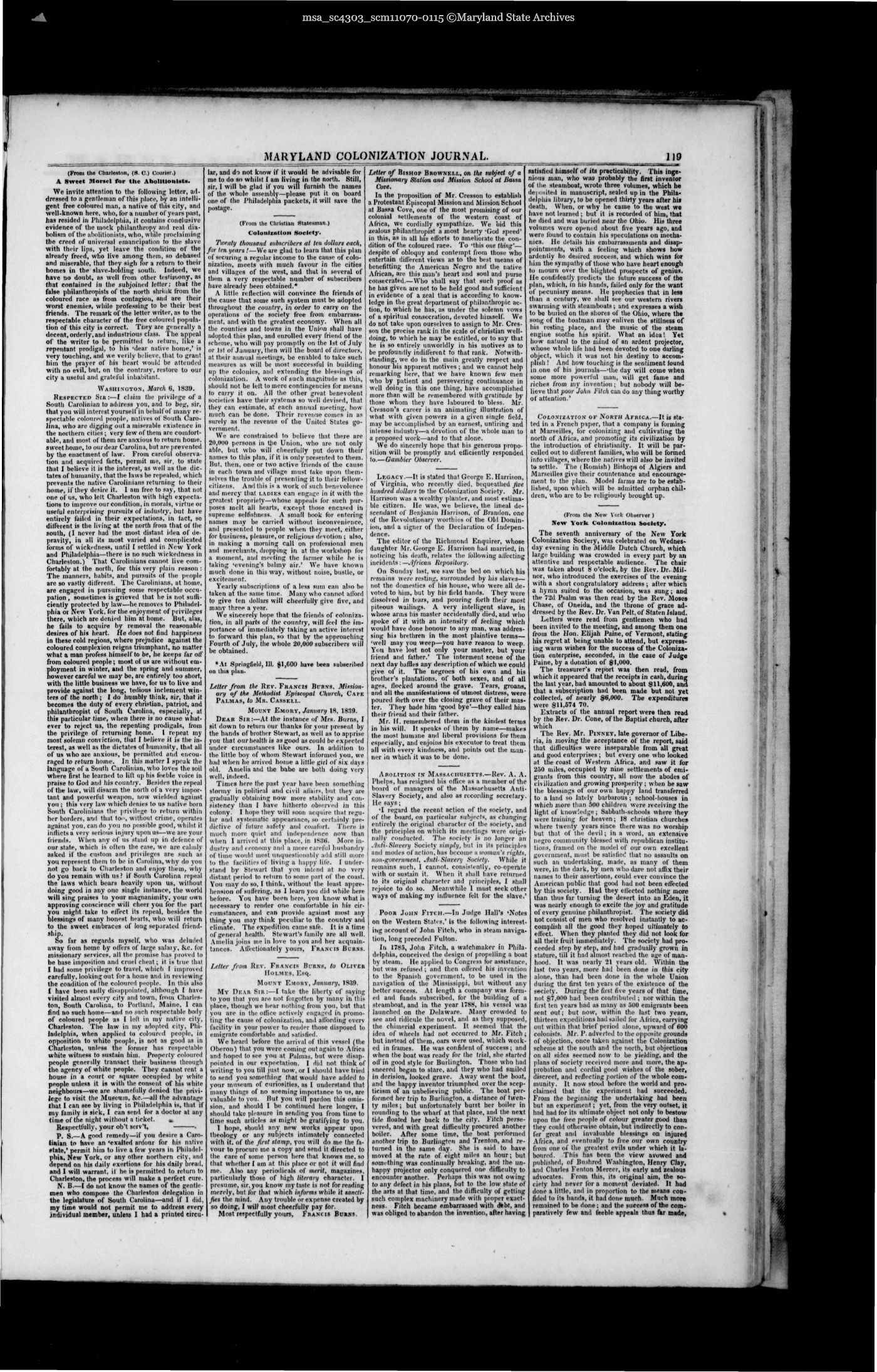
| (From the Charleston, (3. C.) Courier.) A Sweet Morsel for the Abolitionists. We invite attention to the following letter, ad- dressed to a gentleman of this place, by an intelli- gent free coloured man, a native of this city, and well-known here, who, for a number of years past, has resided in Philadelphia, it contains conclusive evidence of the mock philanthropy and real dia- bolism of the abolitionists, who, while proclaiming the creed of universal emancipation to the slave with their lips, yet leave the condition of the already freed, who live among them, so debased and miserable, that they sigh for a return to their homes in the slave-holding south. Indeed, we have no doubt, as well from other testimony, as that contained in the subjoined letter: that the false philanthropists of the north shrink from the coloured race as from contagion, and are their worst enemies, while professing to be their best friends. The remark of the letter writer, as to the respectable character of the tree coloured popula- tion of this city is correct. Tney are generally a decent,orderly,and industrious class. The appeal of the writer to be permitted to return, like a repentant prodigal, to his 'dear native home,' is very touching, and we verily believe, thai to grant him the prayer of his heart would be attended with no evil, but, on the contrary, restore to our city a uselul and grateful inhabitant. Washington, March 6. 1839. Respected Sir:—I claim the privilege of a South Carolinian to address you, and to beg, sir, that you will interest yourself in behalf of many re- spectable coloured people, natives ol South Caro- lina, who are digging out a miserable existence in the northern cities ; very lew of them are comlort- able, and most of them are anxious to return home, sweet home, to ourdear Carolina, but are prevented by the enactment of law. From careful observa- tion and acquired facts, permit me, sir. to state that I believe it is the interest, as well as the die tates of humanity, that the laws be repealed, which Krevents the native Carolinians returning to their ome, if they desire it. I am free to say, that not one of us, who U-It Charleston with high expecta- tions to improve our condition, in morals, virtue or uselul enterprising pursuits of industry, but have entirely failed in their expectations, in tact, so different is the living at the north from that ol the south, (I never had the most distant idea of de- pravity, in all its most varied and complicated lorms of wickedness, until I settled in New Vork and Philadelphia—there is no such wickedness in Charleston.) That Carolinians cannot live com- fortably at the north, for this very plain reason : The manners, habits, and pursuits of the people are so vastly dillerent. The Carolinians, at home, arc engaged in pursuing some respectable occu- pation , sometimes is grieved that lie is not stilli- ciently protected by law—he removes to Philadel- phia or New Vork, lor the enjoyment of privileges there, which are denied him at home. But, alas, he fails to acquire by removal the reasonable desires of his heart. He does not find happiness in these cold regions, where prejudice against the coloured complexion reigns triumphant, no matter what a man profess himself to be, he keeps far otf from coloured people; most ot us are without em- ployment in winter, and the spring and summer, however careful we may be, art entirely too short, with the little business we have, for us to live and provide against the long, tedious inclement win- ters of the north; I do humbly think, sir, that it becomes the duty of every christian, patriot, and philanthropist of South Carolina, especially, at this particular time, when there is no cause what- ever to reject us, the repenting prodigals, from the privilege of reluming home. I repeal my most solemn conviction, that 1 believe it is the in- terest, as well as the dictates ol humanity, that all of us who are anxious, be permitted and encou- raged to return home. In this matter I speak the language of a South Carolinian, who loves the soil where first he learned to lift up his feeble voice in praise to God and his country. Besides the repeal of the law, will disarm the north of a very impor- tant and powerful weapon, now wielded against you ; this very law which denies to us native bom South Carolinians the privilege to return within her borders, and that too, without crime, operates against you, can do you no possible good, whilst il inflicts a very serious injury upon us—we are your friends. When any of us stand up in deli-nee of our state, which is often the case, we are calmly asked if the custom and privileges are such as you represent them to be in Carolina, w by do you not go bark to Charleston and enjoy them, why do you remain with us? if South Carolina repeal the laws which bears heavily upon us, without doing good in any one single instance, the world will sing praises to your magnanimity, your own approving conscience will cheer you for the part yon might take to eil'ect its repeal, besides the blessings of many honest hearts, who will return to the sweet embraces of long separated friend- ship. So far as regards myself, who was deluded away fioin home by oilers of large salaiy, &.C. for missionary services, all the promise has proved to be base imposition and cruel cheat; it is tin.- thai I had some privilege to travel, which I unproved carefully, looking out for a home and in reviewing the condition of the coloured people. In this also I have been sadly disappointed, although I have visited almost every city and town, from Charles- ton, South Carolina, to Portland, Maine, I can find no such home—and no such respectable body of coloured people as I left in my native city, Charleston. The law in my adopted city, Phi- ladelphia, when applied to coloured people, in opposition to white people, is not as good as in Charleston, unless the former has respectable white witness to sustain him. Property coloured people generdly transact their business through the agency of white people. They cannot rent a house in a court or square occupied by while people unless it is with the consent of his white neighbours—we are shamefully denied the privi- lege to visit the Museum, &c.—all the advantage that I can see by living in Philadelphia is, that if my family is sick, I can send for a doctor at any time of the night without I ticket. Respectfully, your ob't serv't, P. S.—A good remedy—if you desire a Caro- linian to have an 'exalted ardour for his native state,' permit him to live a few years in Philadel- phia, New York, or any other northern city, and depend on his daily exertions for his daily bread, and 1 will warrant, il he is permitted to return to Charleston, the process will make a perfect cure. N. B.—I do not know the names of the gentle men who compose the Charleston delegation in the legislature of South Carolina—and if I did, my time would not permit me to address every individual member, unless I had a printed circu- lar, and do not know if it would be advisable for me to do so whilst I am living in the north. Still, sir, I will be glad if you will furnish the names of the whole assembly—please put it on board one of the Philadelphia packets, it will save the postage. (From the Christian Statesman.) Colonization Society . Twenty thousand subscribers at ten dollars each, for ten years.'—We are glad to learn that this plan of securing a regular income to the cause of colo- nization, meets with much favour in the cities and villages of the west, and that in several of them a very respectable number of subscribers have already been obtained.* A little reflection will convince the friends of the cause that some such system must be adopted throughout the country, in order to carry on the operations of the society free from embarrass- ment, and with the greatest economy. When all the counties and towns in the Union shall have adopted this plan, and enrolled every friend of the scheme, who will pay promptly on the 1st of July or 1st of January, then will the board of directors, at their annual meetings, be enabled to take such measures as will be most successful in building up the colonies, and extending the Hefting* of colonization. A work of such magnitude as this, should not he left to mere contingencies for means to carry it on. All the other great benevolent societies have their systems so well devised, that they can estimate, at each annual meeting, how much can be done. Their revenue comes in as surely as the revenue of the United States go- vernment. We are constrained to believe that there are 20,000 persons in the Union, who are not only able, but who will cheerfully put down their names to this plan, if it is only presented to them. But, then, one or two active friends of the cause in each town and village must fake upon them- selves the trouble of presenting it to their fellow- citizens. And this is a work of such benevolence and mercy that ladies can engage in it with the greatest propriety—whose appeals for such pur- poses inelt all hearts, except those encased in supreme selfishness. A small hook lor entering names may be carried without inconvenience, and presented to people when they meet, either tor business, pleasure, or religious devotion ; also, in making a morning call on professional men and merchants, dropping in at the workshop for a moment, and meeting the tanner while he is taking 'evening's balmy air.' We have known much done in this way, without noise, bustle, or excitement. Yearly subscriptions of a less sum can also be taken at the same time. Many who cannot allbrd to give ten dollars will cheerfully give five, and many three a year. We sincerely hope that the friends of coloniza- tion, in all parts of the country, will feel the im- portance of immediately taking an active interest to forward this plan, so that by the approaching Fourth of July, the whole 20,000 subscribers will be obtained. "At Springfield, Ill. $1,600 have been subscribed on this plan. Letter from the Rev. Francis Burns, Mission- ary of the Methodist Episcopal Church, Cape Palmas, to Mr. Cassell. Mount Emory, January 18, 1839. Dear Sir:—At the instance of Mrs. Burns, 1 sit down to return our thanks for your present by the hands of brother Stewart, as well as to apprise you that ourhealth is as good as could be expected under circumstances like ours. In addition to the little boy of whom Stewart inlormed you, we had when he arrived home a little girl of six dais old. Amelia and the babe are both doing very well, indeed. Times here the past year have been something stormy in political and civil aflair*, but they are gradually obtaining now more stability and con- sistency than I have hitherto observed in this colony- I hope they will soon acquire that regu- lar and systematic appearance, so certainly pre- dictive of future safety and comfort. There is much more quiet and independence now than when I arrived at this place, in 1836. More in- dustry ami i I'onomy and a more careful husbandry of time would most unquestionably add still more to the facilities of living a happy lite. 1 under- stand by Stewart that you fob nd at no very distant period to return to some part of the coast. You may do so, I think, without the least appre- hension of suffering, as I learn you did while here belbre. Y'ou have been here, you know what is necessary to render one comfortable in his cir- cumstances, and can piovide against most any thing you may think peculiar to the country and climate. The expedition came sale. It is a time of general health. Stewart's family are all well. Amelia joins me in love to you and her acquain- tances. Affectionately yours, Francis Burns. Letter of Bishop Brownell, on the subject of a Missionary Station and Mission School at Bassa Cove. In the proposition of Mr. Cresson to establish a Protestant Episcopal Mission and Mission School at Bassa Cove, one of the most promising of our colonial settlements of the western coast of Africa, we cordially sympathize. We bid this zealous philanthropist a most hearty 'Ood speed' in this, as in all his efforts to amelioiate the con- dition of the coloured race. To 'this one thing'— despite of obloquy and contempt lioni those who entertain dillerent views as to the best means of benefitting the American Negro and the native African, are this man's heart and soul and purse consecrated.— Who shall say that such proof as he has given are not to be held good and sufficient in evidence of a zeal that is according to know- ledge in the great department of philanthropic ac- tion, to which he has, as under the solemn vows of a spiritual consecration, devoted himself. We do not take upon ourselves to assign to Mr. Cres- son the precise rank in the scale ol christian well- doing, to which he may be entitled, or to say that he is so entirely unworldly in his motives as to be profoundly indifferent to that rank. Notwith- standing, we do in the main greatly respect and honour fiis apparent motives; and we cannot help remarking here, that we have known few men who by patient and persevering continuance in well doing in this one thing, have accomplished more than will be remembered with gratitude by those whom they have laboured to bless. Mr. Cresson's career is an animating illustration of what with given powers in a given single field, may be accomplished by an earnest, untiring and intense industiy—a devotion of the whole man to a proposed work—and to that alone. We do sincerely hope that his generous propo- sition will be promptly and efficiently responded to.—Gambler Observer. Legacy.—It is stated that George E. Harrison, of Virginia, who recently died, bequeathed five hundred dollars to the Colonization Society. Mr. Harrison was a wealthy planter, and most estitna- ble citizen. He was, we believe, the lineal de- scemlant of Benjamin Harrison, of Brandon, one of the Revolutionary worthies of the Old Douiin- ion, and a signer of the Declaration of indepen- dence. The editor of the Richmond F.nqnirer, whose daughter iMr. George E, Harrison had married, in noticing his death, relates the following affecting incidents:—.V/riam Repository. On Sunday last, we saw the bed on which his remains were resting, surrounded by his slaves— not the domestics of his house, who were all de- voted to him, but by his field hands. They were dissolved in tears, and pouring Ibrth their most piteous Mailings. A very intelligent slave, in whose arms his master accidentally died, and who spoke of it with an intensity ot reeling which would have done honour to any man, was addres- sing his brethren in the most plaintive terms— 'well may you weep—you have reason to weep Ton have lost not only your master, but your friend and father.' The interment scene of the next day balihs any description of which we could give of it. The negroes of his own and his brother's plantations, of both sexes, and of all ages, Hocked around the grave. Tears, groans, and all the manifestations of utmost distress, were poured Ibrth over the closing grave of their mas- ter. They bade him 'good bye'—they called him their friend and their father. Mr. II, remembered (hem in the kindest terms in his will. It speaks of them by name—makes the most humane and liberal provisions for them especially, and enjoins his executor to treat them all with every kindness, and points out the man- ner in which it was to he done. satisfied himself of its practicability. This inge- nious man, who was probably the first inventor of the steamboat, wrote three volumes, which he deposited in manuscript, sealed up in the Phila- delphia library, to be opened thirty years after his death. When, or why he came to the west we have not learned; but it is recorded of him, that he died and was buried near the Ohio. His three volumes were opened about five years ago, and were tbund to contain his speculations on mecha- nics. He details his embarrassments and disap- pointments, with a feeling which shows how ardently he desired success, and which wins for him the sympathy of those who have heart enough to mourn over the blighted prospects of genius. He confidently predicts the luture success of the plan, which, in his hands, failed only for the want of pecuniary means. He prophecies that in less than a century, we shall see our western rivers swarming with steamboats; and expresses a wish to be binied on the shores of the Ohio, where the song of the boatman may enliven the stillness of his resting place, and the music of the steam engine soothe his spirit. What an idea! Yet how natural to the mind of an ardent projector, whose whole life had been devoted to one darling object, which it was not his destiny to accom- plish ! And how touching is the sentiment found in one of his journals—'the day will come when some more powerful man, will get fame and riches from my invention; but nobody will be- lieve that poor John I'itch can do any thing worthy of attention.' Letter from Rev. Francis Burns, to Oliver Holmes, Esq Mount Emory, January, 1839. My Dear Sir:—I take the liberty of saying to you that you are. not forgotten by many in this place, though we hear nothing from you, but that you are in the ofliee actively engaged in promo- ting the cause of colonization, and affording even facility in your power to render those disposed to emigrate comfortable and satisfied. We heard before the arrival of this vessel (the Oberon) that you were coming out again to Africa and hoped to see you at Palmas, hut were disap- pointed in our expectation. I did not think of writing to you till raai now, or I should have tried to send you something that would have added to your museum of curiosities, as 1 understand that many tilings of no seeming importance to us, are valuable to you. But you will pardon this omis- sion, and should I be continued here longer, I should take pleasure in sending you from time to time such articles as might be gratifying to you. I hope, should any new works appear upon theology or any subjects intimately connected with it. of the first stamp, you. will do me the fa- vour to procure me a copy and send it directed to the care of some person here that knows me, so that whether I am at this place or not it will find me. Also any periodicals of merit, magazines, particularly those of high literary character. I presume, sir, you know my taste is not for reading merely, but for that which informs while it sancti- fies the mind. Any trouble or expense created by so doing, I will most cheerfully pay lor. Most respectfully yours, Francis Burns. Abolition in Massachusetts.—Rev. A. A. Phelps, has resigned his office as a member of the board of managers of the Massachusetts Anti- Slavery Society, and also as recording secretary, lie says; 'I regard the recent action of the society, and of the board, on particular subjects, as changing entirely the original character of the society, and the principles on which its meetings were origi- nally conducted. The society is no longer HI Anti-Slavery Society simply, but in its principles ami modes of action, has become a woman's rights, non-government, Jinti- Slavery Society. While it remains such, 1 cannot, consistently, co-operate with or sustain it. When it shall have returned to its original character ami principles, I shall rejoice to do so. Meanwhile 1 must seek other ways of making my influence felt for the slave.' Poor John Fitch.—In Judge Hall's 'Notes on the Western States,' is the following interest- ing account of John Fitch, who in steam naviga- tion, long preceded Fulton. In 1785, John Fitch, a watchmaker in Phila- di Iphia, conceived the design of propelling a boat In steam. He applied to Congress tor assistance, hut was refused; and then ollercd his invention to Ihe Spanish government, to be used in the navigation of the Mississippi, but without any better success. At length a company was form- ed and funds subscribed, lor the building of a steamboat, and in the year 1788, his vessel was launched on the Delaware. Many crowded to see and ridicule the novel, and as they supposed, the chiinerial experiment. It seemed that the idea of wheels had not occurred to Mr. Fitch; but instead of them, oars were used, which work- ed in frames. He was confident of success; and when the boat was ready for the trial, she started oil in good style for Buiiington. Those who had -iiH-u'i began to stare, and they who had smiled in derision, looked grave. Away went the boat, and the happy inventor triumphed over the scep- ticism of an unbelieving public. The boat per- formed her trip to Burlington, a distance of twen- ty miles; but unfortunately hurst her boiler in rounding to the wharf at that place, and Ihe next tide floated her back to the city. Fitch perse- vered, and with great difficulty procured another boiler. After some time, the boat performed another trip to Burlington and Trenton, and re- turned in the same day. She is said to have moved at the rate of eight miles an hour; but something was continually breaking, and the un- happy projector only conquered one difficulty to encounter another. Perhaps this was not owing to any defect in his plans, out to the low state of the arts at that time, and the difficulty of getting such complex machinery made with pioper exact- ness. Fitch became embarrassed with debt, and was obliged to abandon the invention, after having Colonization or North Africa.—It is sta- ted in a French paper, that a company is forming at Marseilles, for colonizing anil cultivating the north of Africa, and promoting its civilization by the introduction of Christianity. It will be par- celled out to dillerent families, who will be formed into villages, where the natives will also be invited to settle. The (Romish) Bishops of Algiers and Marseilles give their countenance and encourage- ment to Ihe plan. Model larms are to be estab- lished, upon which will be admitted orphan chil- dren, who are to be religiously brought up. (From the New York Observer ) New York Colonization Society. The seventh anniversary of the New York Colonization Society, was celebrated on Wednes- day evening in the Middle Dutch Church, which large building was crowded in every part by an attentive and respectable audience. The chair was taken about 8 o'clock, by the Rev. Dr. Mil- nor, who introduced the exercises of the evening with a short congratulatory address ; after which a hymn suited to the occasion, was sung; and the 72d Psalm was then read by the Rev. Moses Chase, of Oneida, and the throne of grace ad- dressed by the Rev. Dr. Van Pelt, of Staten Island. Letters were read from gentlemen who had been invited to the meeting, and among them one from the lion. Elijah Paine, of Vermont, stating his regret at being unable to attend, but express- ing warm wishes for the success of the Coloniza- tion enterprise, seconded, in the case of Judge Paine, by a donation of $1,000. The treasurer's report was then read, from which it appeared that the receipts in cash, during the last year, had amounted to about 811,600, and that a subscription had been made but not yet collected, of nearly $6,000. The expenditures were §11,57-1 70. Extracts of the annual report were then read by the Rev. Dr. Cone, of the Baptist church, after which The Rev. Mr. Pinney, late governor of Libe- ria, in moving the acceptance of the report, said that difficulties were inseparable from all great and good enterprises ; but every one who looked at the coast of Western Africa, and saw it lor 230 miles, occupied by nine settlements of emi- grants from this country, all now the abodes of civilization and growing prosperity; when he saw the blessings of our own happy land transferred to aland so lately barbarous; school-houses in which more than 500 children were receiving Ihe light of know ledge ; Sabbath-schools where Ihey were training for heaven; 18 christian churches where twenty years since there was no worship but that of the devil; in a word, an extensive negro community blessed with republican institu- tions, framed on the model of our own excellent government, must be satisfied that no assaults on such an undertaking, made, as many of them were, in the dark, by men who dare not affix their names to their assertions, could ever convince the American public that good had not been effected by this society. Had they effected nothing more than thus far turning the desert into an Eden, it was nearly enough to excite the joy and gratitude of every genuine philanthropist. The society did not consist of men who resolved instantly to ac- complish all the good they hoped ultimately to effect. When they planted they did not look for all their fruit immediately. The society had pro- ceeded step by step, and had gradually grown in stature, till it had almost reached the age of man- hood. It was nearly 21 years old. Within the last two years, more had heen done in this city alone, than had been done in the whole Union dining the first ten years of the existence of the society. During the fust five years of that time, not §7,000 had MM contributed ; nor within the first ten years had as many as 500 emigrants been sent out; but now, within the last two years, thirteen expedition had sailed for Africa, carrying out within that brief period alone, upward of'600 colonists. Mr. P. advertetl to the opposite grounds of objection, once taken against the Colonization scheme at the south and the north, but objections on all sides seemed now to be yielding, and the plans of society received more and more, the ap- probation and cordial good wishes of the sober, discreet, and reflecting portion o[ the whole com- munity. It now stood before the world and pro- claimed that the experiment had succeeded. From the beginning the undertaking had been but an experiment; yet, from the very outset, it had had lor its ultimate object not only to bestow upon the lice people of colour greater eood than they could otherwise obtain, hut indirectly to con- fer great and invaluable blessings on injured Africa, and eventually to free our own country from one of the greatest evils under which it la- boured. This has been the view avowed and published, of Bushrod Washington, Henry Clay, and Charles Fenton Mercer, its early and zealous advocates. From this, its original aim, the so- ciety bad never for a moment deviated. It had done a little, and in proportion to the means con- fided to its hands, it had done much. Much more remained to be done; and the success of the com- paratively few and feeble appeals thus far made. MARYLAND COLONIZATION JOURNAL. 119 |