 |
|
|
 |
|
 |
|
|||
|
||||
|
||||
|
Maryland State Archives Maryland Colonization Journal Collection MSA SC 4303 msa_sc4303_scm11070-0116 Enlarge and print image (5M) |
|
|
|
|
|
|
|
|||
|
||||
|
||||
|
Maryland State Archives Maryland Colonization Journal Collection MSA SC 4303 msa_sc4303_scm11070-0116 Enlarge and print image (5M) |
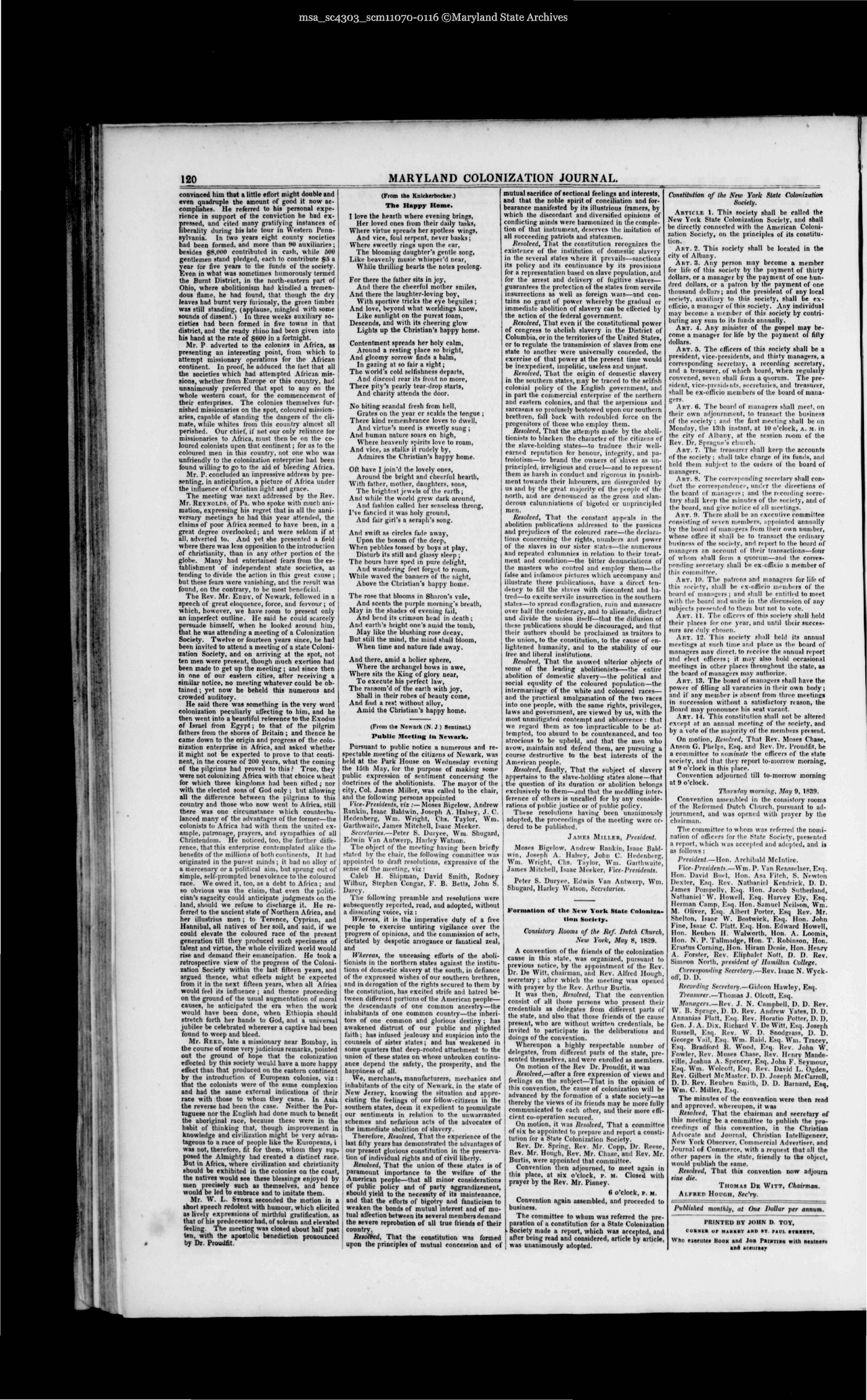
| 120 MARYLAND COLONIZATION JOURNAL. convinced him that a little eflort might double and even quadruple the amount of good it now ac- complishes. He referred to his personal expe- rience in support of the conviction he had ex- firessed, and cited many gratifying instances of iberality during his late tour in Western Penn- sylvania. In two years eight county societies had been formed, and more than 90 auxiliaries; besides £8,000 contributed in cash, while 500 gentlemen stand pledged, each to contribute $b a year tor five years to the funds of the society. Even in what was sometimes humorously termed the Burnt District, in the north-eastern part of Ohio, where abolitionism had kindled a tremen- dous flame, he had found, that though the dry- leaves had burnt very fuiionsly, the green timber was still standing, (applause, mingled with some sounds of dissent") In three weeks auxiliary so- cieties had been formed in five towns in that district, and the ready rhino had been given into his hand at the rate of $600 in a fortnight. Mr. P adverted to the colonies in Africa, as presenting an interesting point, from which to attempt missionary operations for the African continent. In proof, he adduced the lact that all the societies which had attempted African mis- sions, whether from Europe or this country, had unanimously preferred that spot to any on the whole western coast, for the commencement of their enteiprises. The colonies themselves fur- nished missionaries on the spot, coloured mission- aries, capable of standing the dangers of the cli- mate, while whites from this country almost all perished. Our chief, if not our only reliance lor missionaries to Africa, must then be on the co- loured colonists upon that continent; for as to the coloured men in this country, not one who was unfriendly to the colonization enterprise had been found willing to go to the aid of bleeding Africa. Mr. P. concluded an impressive address by pre- senting, in anticipation, a picture of Africa under the influence of Christian light and grace. The meeting was next addressed by the Rev. Mr. Reynolds, of Pa. who spoke with much ani- mation, expressing his regret that in all the anni- versary meetings he had this year attended, the claims of poor Africa seemed fo have been, in a great degree overlooked; and were seldom if at all, adverted to. And yet she presented a field where there was less opposition to the introduction of Christianity, than in any other portion of the globe. Many had entertained fears from the es- tablishment of independent state societies, as tending to divide the action in this great cause ; but these fears were vanishing, and the result was found, on the contrary, to be most beneficial. The Rev. Mr. Eddy, of Newark, followed in a speech of great eloquence, force, and fervour; of which, however, we have ioom to present only an imperfect outline. He said he could scarcely persuade himself, when he looked around him, that he was attending a meeting of a Colonization Society. Twelve or fourteen years since, he had been invited to attend a meeting of a state Coloni- zation Society, and on arriving at the spot, not ten men were present, though much exertion had been made to get up the meeting; and since then in one of our eastern cities, after receiving a similar notice, no meeting whatever could be ob- tained ; yet now he beheld this numerous and crowded auditory. He said there was something in the very word colonization peculiarly affecting to him, and he then went into a beautiful relerence to the Exodus ot Israel from Egypt; to that of the pilgrim fathers from the shores of Britain ; and thence he came down to the origin and progress of the colo- nization enterprise in Africa, and asked whether it might not be expected to prove to that conti- nent, in tne course of 200 years, what the coming of the pilgrims had proved to this ? True, they were not colonizing Africa with that choice wheat for which three kingdoms had been sifted ; nor with the elected sons of God only ; tut allowing all the deference between the pilgrims to this country and those who now went to Africa, still there was one circumstance which counterba- lanced many of the advantages of the (ormer—the colonists to Africa had with them the united ex- ample, patronage, prayers, and sympathies of all Christendom. "He noticed, too, the farther diffe- rence, that this enterprise contemplated alike the benefits of the millions of both continents, It had originated in the purest minds; it had no alloy of a mercenary or a political aim, but sprung out of simple, self-prompted benevolence to the coloured race. We owed it, too, as a debt to Africa ; and so obvious was the claim, that even the politi- cian's sagacity could anticipate judgments on the land, should we refuse to discharge it. He re- ferred to the ancient state of Northern Africa, and her illustrius men; to Terence, Cyprian, and Hannibal, all natives of her soil, and said, if we could elevate the coloured race of the present generation till they produced such specimens of talent and virtue, the whole civilized world would I rise and demand their emancipation. He took a retrospective view of the progress of the Coloni- | zation Society within the last fifteen years, and I argued thence, what effects might be expected from it in the next fifteen years, when all Africa j would feel its influence ; and thence proceeding on the ground of the usual augmentation of moral I causes, he anticipated the era when the work would have been done, when Ethiopia should J stretch forth her hands to God, and a universal jubilee be celebrated wherever a captive had been found to weep and bleed. Mr. Reed, late a missionary near Bombay, in the course of some very judicious remarks, pointed out the ground of hope that the colonization effected by this society would have a more happy efftct than that produced on the eastern continent by the introduction of European colonies, viz : that the colonists were of the same complexion and had the same external indications of their race with those to whom they came. In Asia the reverse had been the case. Neither the Por- tuguese nor the English had done much to benefit the aboriginal race, because these were in the habit of thinking that, though improvement in knowledge and civilization might be very advan- tageous to a race of people like the Europeans, i was not, therefore, fit for them, whom they sup- posed the Almighty had created a distinct race. But in Africa, where civilization and Christianity should be exhibited in the colonies on the coast, the natives would see these blessings enjoyed by men precisely such as themselves, and hence would be led to embrace and to imitate them. Mr. W. L. Stone seconded the motion in a short speech redolent with humour, which elicited as lively expressions of mirthm! gratification, as that of his predecessor had, of solemn and elevated feeling. The meeting was closed about half past ten, with the apostolic benediction pronounced by Dr. Proudfit. (From the Knickerbocker.) The Happy Home. I love the hearth where evening brings, Her loved ones from their daily tasks, Where virtue spreads her spotless wings. And vice, foul serpent, never basks; Where sweetly rings upon the ear, The blooming daughter's gentle song, Like heavenly music whisper'd near, While thrilling hearts the notes prolong. For there the father sits in joy. Anil there the cheerful mother smiles, And there the laughter-loving boy, With sportive tricks the eye beguiles; And love, beyond what worldings know, Like sunlight on the purest foam, Descends, and with its cheering glow- Lights up the Christian's happy home. Contentment spreads her holy calm, Around a resting place so blight, And gloomy sorrow finds a balm, In gazing at so fair a sight; The world's cold selfishness departs. And discoid rear its front no more, There pity's pearly teardrop starts, And charity attends the door. No biting scandal fresh from hell, Grates on the year cr scalds the tongue ; There kind remembrance loves to dwell, And virtue's meed is sweetly sung; And human nature soars on high, Where heavenly spirits love to roam, And vice, as stalks it rudely by, Admires the Christian's happy home. Oft have I join'd the lovely ones, Around the bright and cheerful hearth, With father, mother, daughters, sons, The brightest jewels of the earth; And while the world grew dark around, And fashion called her senseless throng, I've fancied it was holy ground, And fair girl's a seraph's song. And swift as circles fade away, Upon the bosom of the deep, When pebbles tossed by boys at play. Disturb its still and glassy sleep ; The hours have sped in pure delight, And wandering feet forgot to roam, While waved the banners of the night, Above the Christian's happy home. The rose that blooms in Sharon's vale. And scents the purple morning's breath, May in the shades of evening fail, And bend its crimson head in death ; And earth's blight one's amid the tomb, May like the blushing rose decay, But still the mind, the mind shall bloom, When time and nature lade away. And there, amid a holier sphere, Where the archangel bows in awe, Where sits the King of glory near, To execute his perfect law, The ransom'd of the earth with joy, Shall in their robes of beauty come, And find a res', without alloy, Amid the Christian's happy home. (From the Newark (N. J. ) Sentinel.) Public Meeting In Newark. Pursuant to public notice a numerous and re- spectable meeting of the citizens of Newark, was held at the Park House on Wednesday evening the 13th May. lor the purpose of making some public expression of sentiment concerning the doctrines of the abolitionists. The mayor of the city, Col. James Miller, was called to the chair, and the following persons appointed Vice-Presidents, viz.-—Moses Bigclow, Andrew Rankin, Isaac Baldwin, Joseph A. Halsey, J. C. Hedenherg, Win. Wright, Chs. Taylor, Wm. Gaithwaite, James Mitchell, Isaac Meeker. Secretaries.—Peter S. Duiyce, Wm Shugard, Edwin Van Antwerp, Hailey Watson. The object of the meeting having been briefly stated bjr fhe chair, fhe following committee was appointed to draft resolutions, expressive of the sense of the meeting, viz : Caleb H. Shipman, David Smith, Rodney Wilbur, Stephen Cougar, F. B. Betts, John S. Darcy. The following preamble and resolutions were subsequently reported, read, and adopted, without a dissenting voice, viz : Whereas, it is fhe imperative duty of a free people to exercise untiring vigilance over the progress of opinions, and the commission of acts, dictated by despotic arrogance or fanatical zeal, and Whereas, the unceasing efforts of the aboli- tionists in the northern states against the institu- tions ol domestic slavery at the south, in defiance of the expressed wishes of our southern brethren, and in derogation of the rights secured to them by the constitulion, has excited strife and hatred be- tween different portions of the American people— the descendants of one common ancestry—the inhabitants of one common country—the inheri- tors of one common and glorious destiny ; has awakened distrust of our public and plighted faith; has infused jealousy and suspicion into the counsels of sister states; and has weakened in some quarters that deep-rooted attachment to the union of these states on whose unbroken continu- ance depend the safety, the prosperity, and the happiness of all. We, merchants, manufacturers, mechanics and inhabitants of the city of Newark, in the state of New Jersey, knowing the situation and appre- ciating the feelings of our fellow-citizens in the southern states, deem it expedient to promulgate our sentiments in relation to the unwarranted schemes and nefarious acts of the advocates of the immediate abolition of slavery. Therefore, Resolved, That the experience of the last fifty years has demonstrated the advantages of our present glorious constitution in the preserva- > tion of individual rights and of civil liberty. Resolved, That the union of these states is of paramount importance to the welfare of the American people—that all minor considerations I of public policy and of party aggrandizement, should yield to the necessity of its maintenance, and that the efforts of bigotry and fanaticism to weaken the bonds of mutual interest and of mu- tual affection between its aeveral members demand I the severe reprobation of all true friends of their j country. Resolved, That the constitution was formed upon the principles of mutual concession and of mutual sacrifice of sectional feelings and interests, and that the noble spirit of conciliation and for- bearance manifested by its illustrious Cramers, by which the discordant and diversified opinions of conflicting minds were harmonized in the comple- tion of that instrument, deserves the imitation of all succeeding patriots and statesmen. Resolved, That the constitution recognizes the existence of the institution of domestic slavery in the several states where it prevails—sanctions its policy and its continuance by ils provisions for a representation based on slave population, and for the arrest and delivery of fugitive slaves— guarantees the protection of Ihe states from servile insurrections as well as foreign wars—and con- tains no grant of power wheieby the gradual or immediate abolition of slavery can be ellccted by the action of the federal government. Resolved, That even if the constitutional power of congress to abolish slavery in the District of Columbia, or in the territories of the United States, or to regulate the transmission of slaves from one state to another were universally conceded, the exercise of that power at the present time would be inexpedient, impolitic, useless and unjust. Resolved, That tlie origin of domestic slavery in the southern states, may be traced fo the selfish colonial policy of the English government, and in part the commercial enterprise of the northern and eastern colonies, and that the aspersions and sarcasms so prolusely bestowed upon our southern brethren, fall back with redoubled force on the progenitors of those who employ them. Resolved, That the attempts made by the aboli- tionists to blacken fhe chaiacter of the citizens of the slave-holding states—to traduce their well- earned reputation lor honour, integrity, and pa- troiotism—to brand the owners of slaves as un- principled, irreligious and cruel—and to icpiesent them as harsh in conduct and rigorous in punish- ment towards their labourers, are disregarded by us and by the great majority of the piople of the north, and are denounced as Ihe gross and slan- derous calumniations of bigoted or unprincipled men. Resolved, That the constant appeals in the abolition publications addressed to the passions and prejudices of the coloured race—the declar.i- tions concerning the rights, numbers and power of the slaves in our sister states—tlie numerous and repeated calumnies in relation to their treat- ment and condition—the bitter denunciations of tlie masters who control and employ them—the ialse and infamous pictures which accompany and illustrate these publications, have a direct" ten- dency to fill the slaves with discontent and ha- tred—to excite servile insurrection in the southern states—to spread conflagration, ruin and massacre over hall the confederacy, and to alienate, distract and divide Ihe union itself—that the diffusion of these publications should be discouraged, and that their authors should be proclaimed as traitors to the union, to the constitution, to the cause of en- lightened humanity, and to the stability of our Iree and liberal institutions. Resolved, That the avowed ulterior objects of some of the leading abolifionisfs—the entire abolition of domestic slavery—the political and social equality of the coloured population—the intermaniage of the white and coloured races— and the practical amalgamation of the two races into one people, with the same rights, privileges, laws and government, are viewed by us, with Ihe most unmitigated contempt and abhorrence: that we regard them as too impracticable lo be at- tempted, too absurd to be countenanced, and too atrocious to be upheld, and that the men who avow, maintain and defend them, are pursuing a course destructive to the best interests of the American people. Resolved, finally. That the subject of slavery appertains to the slave-holding states alone—that the question of its duration or abolition belongs exclusively to them—and that the meddling inter- ference of' others is uncalled for by any conside- rations of public justice or of public policy. These resolutions having been unanimously adopted, the proceedings of the meeting were or- dered to be published. James Miller, President. Moses Bigelow. Andrew Rankin, Isaac Bald- win, Joseph A. Halsey, John C. Hedenberg, Wm. Wright, Chs. Taylor, Win. Garthwaitc, James Mitchell, Isaac Meeker, lice-I'rcsidcnts. Peter S. Durvee. Edwin Van Antwerp, Wm. Shugard, Harley Watson, Secretaries. Formation of the New York State Coloniza- tion Society. Consistory Rooms of the Ref. Dutch Church, New York, May 8, 1839. A convention of the friends of the colonization cause in this state, was organized, pursuant to previous notice, by the appointment of the Rev. Dr. De Witt, chairman, and Rev. Alfred Hough, secretary ; after which the meeting was opened with prayer by the Rev. Arthur Burtis. It was then, Resolved, That the convention consist of all those persons who present their credentials as delegates from different parts of the state, and also that those friends of the cause present, who are without written credentials, be invited to participate in the deliberations and doings of the convention. Whereupon a highly respectable number of delegates, from different parts of the state, pre- sented themselves, and were enrolled as members. On motion of the Rev Dr. Proudfit, it was Resolved,—after a free expression of views and feelings on the subject—That in the opinion of this convention, the cause of colonization will be advanced by the formation of a state society—as thereby the views of ils friends may be more fully communicated to each other, and their more effi- cient co-operation secured. On motion, it was Resolved, That a committee of six be appointed to prepare and report a consti- tution for a State Colonization Society. Rev. Dr. Spring, Rev. Mr. Copp, Dr. Reese, Rev. Mr. Hough/Rev. Mr. Chase, and Rev. Mr. Burtis, were appointed that committee. Convention then adjourned, to meet again in this place, at six o'clock, p. m. Closed with prayer by the Rev. Mr. Pinney. 6 o'clock, r. m Convention again assembled, and proceeded to business. The committee to whom was referred the pre- paration of a constitution for a State Colonization Society made a report, which was accepted, and after being read and considered, article by article, was unanimously adopted. Constitution of theNew York State Colonization Society. Article. I. This society shall be called the New York State Colonization Society, and shall be directly connected with the American Coloni- zation Society, on the principles of its constitu- tion. Art. 2. This society shall be located in the city of Albany. Art. 3. Any person may become a member for life of this society by the payment of thirty dollars, or a manager by Ihe payment of one hun- dred dollars, or a patron by Ihe payment of one thousand dollars; and the president of any local society, auxiliary to this society, shall be ex- officio, a manager of Ibis society. Any individual may become a member of this society by contri- buting any sum to its funds annually. Art. 4. Any minister of the gospel may be- come a manager for life by the payment of filly dollars. Art. 5. The officers of this society shall be a president, vice-presidents, and thirty managers, a corresponding secrctaiy, a recording secretary, and a treasurer, of which board, when regulaily convened, seven shall bum a quorum. The pre- sident, vice-pn sidi nts, secretaries, and treasurer, shall he ex-officio members of the board of mana- gers. Art. 6. The board of managers shall meet, on their own adjournment, to transact the business of the society; and the first meeting shall be on Monday, the 18th instant, at 10 o'clock, a. M. in the city ol Albany, at the session room of the Rev. Dr. Sprague's church. Art. 7. The Ireasurrr shall keep the accounts of the society ; shall take charge of its funds, and hold them subject to the oiders of tlie board of managers. Art. 8. The corresponding secretary shall con- duct the correspondence, under the directions of the board of managers: and the recording secre- tary shall keep tlie minutes of the society, and of the board, and give notice of all meetings. Aiit. 9. There shall be an executive committee consisting of seven members, appointed annually bv the hoard of malingers from Iheir own number, whose office it shall be to transact the ordinary business of the society, and report In the board of managers an account of their transactions—four of whom shall form a quorum—and the corres- ponding secretary shall be ex-officio a member of Ibis committee. Aiit. 10. The pattens ami managers for life of this society, shall be ex-officio member! of the board of managers; and shall be entitled to meet with the board and unite in the discussion of any subjects presented to them but not to vote. Art. II. The officers of this society shall hold their places for one year, and until their succes- sors are duly chosen. Art. 12. This society shall hold ils annual meetings at such time and place as the board id" managers mav direct, to receive the annual report and elect officers; it may also hold occasional meetings in other places throughout Ibc state, as tfie board of managers may authorize. Art. IS, The board ol 'managers shall have the power of filling all vacancies in their own body; and if any member is absent from three meetings in succession without a satisfactory riason, the Board may pronounce his seat vacant. Art. II. This constitution shall not be altered exeopt at an annual meeting of the society, and by a vote of Ihe majority of the members present. On mofion. Resolved, That Rev. Moses Chase, Anson G. Phelps, F.sq. and Rev. Dr. Proudfit, be a committee to nominate tlie officers of the state society, and that they reporl to-morrow morning, at 8 o'clock in this place. Convention adjourned till to-morrow morning at 9 o'clock. Thursday morning. May 9, 1839. Convention assembled in the consistory rooms of the Reformed Dutch Church, pursuant to ad- journment, and was opened with prayer by the chairman. The committee to whom was referred the nomi- nation of officers for the State Society, piesented a report, which was accepted and adopted, and is as billows: President—Hon. Archibald Mclntire. Vice Presidents.—Wm. P. Van Rensselaer, Esq. Hon. David Hud, Hon. Asa Filch. S. Newton Dexter, Esq. Rev. Nathaniel Kendrick, I). 1). James Pompcllv, Esq. Hon. Jacob Sutherland, Nathaniel W. Howell. Esq. Harvey Ely, Ksq. Herman Camp, Esq. Hon. Samuel Ncilson, Wm. M. Oliver, Esq. Albeit Porter, Esq Rev. Mr. Shelton, Isaac W. Bnstwick, Esq. Hon. John Fine, Isaac C. Piatt. F.sq. Hon. Edward How-ell, Hon. Reuben II. Walworth. Hon. A. Loornis, Hon. N. P. TalliiKidge, Hon. T. Robinson, Hon. Erastus Corning, Hon. Hiram Di nie, Hon. Henry- A. Forster, Rev. Eliphalet Nott, D. D. Rev. Simeon North, president of Hamilton College. Corresponding Secretary.—Rev. Isaac N. Wyck- off, D. D. Recording Secretary.—Gideon Hawley, Esq. Treasurer.—Thomas J. Olcott, Esq. Managers.—Rev. J. N. Campbell, I). D. Rev. W. B. Sprnge, I). D. Rev. Andrew Yates, D. D. Annanias Plait, Ksq. Rev. Horatio Potter, D. D. Gen. J. A. Dix. Richard V. De Witt, Esq. Joseph Russell, Esq. Rev. W. D. Snodgiass, D. fa. George Vail, Esq. Wm. Raid. Esq. Win. Tracey, Esq. 'Bradford R. Woo.l, E*a. Rev. John W. Fowler, Rev. Moses Chase, Rev. Henry Mandc- ville, Joshua A. Spencer, Esq, John F. Seymour, F.sq. Win. Wolcoft, F.sq Rev. David L. Ogden, Rev. Gilbert McMaster. D.D. Joseph McOarroll, I). I). Rev. Reuben Smith, D. D. Barnard, Esq, Wm. C. Miller, Esq. The minutes of the convention were then read and approved, whereupon, it was Resolved, That fhe chairman and secretary of this meeting be a committee to publish the pro- ceedings of this convention, in Ihe Christian Advocate and Journal, Christian Intelligencer, New York Observer, Commercial Advertiser, and Journal of Commerce, with a request that nil the other papers in the state, friendly to the object, would publish the same. Resolved, That this convention now adjourn sine die. Thomas De Witt, Chairman. Alfred Hough, Sec'ry. Published monthly, at One Dollar per annum. PRINTED BY JOHN D. TOY, CORNER of MARKET ANDST PAUL STREETS, Who executes Book and Job Printing with neatness and accuracy. |