 |
|
|
 |
|
 |
|
|||
|
||||
|
||||
|
Maryland State Archives Maryland Colonization Journal Collection MSA SC 4303 msa_sc4303_scm11070-0119 Enlarge and print image (5M) |
|
|
|
|
|
|
|
|||
|
||||
|
||||
|
Maryland State Archives Maryland Colonization Journal Collection MSA SC 4303 msa_sc4303_scm11070-0119 Enlarge and print image (5M) |
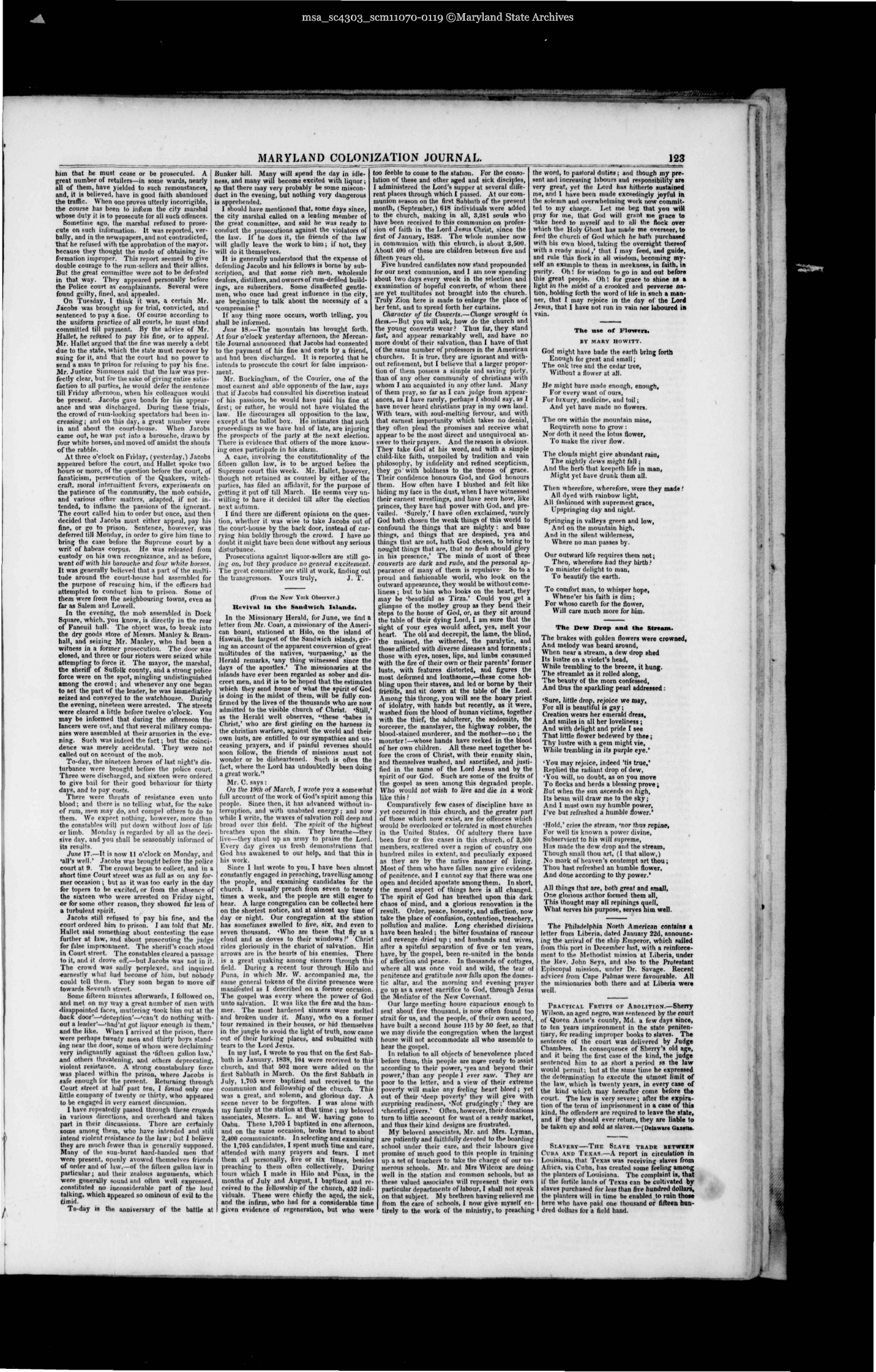
| MARYLAND COLONIZATION JOURNAL. 123 Bunker hill. Many will upend the day in idle- ness, and many will become excited with liquor; sp that there may very probably be some miscon- duct in the evening, but nothing very dangerous is apprehended. I should have mentioned that, some days since, the city marshal called on a leading member of the great committee, and said he was ready to conduct the prosecutions against the violators of the law. If he does it, the friends of the law will gladly leave the work to him; if not, they will do it themselves. It is generally understood that the expense ol defending Jacobs and his fellows is borne by sub- scription, and that some rich men, wholesale dealers, distillers, and owners of rum-defiled build- ings, are subscribers. Some disaffected gentle- men, who once had great influence in the city, are beginning to talk about the necessity of a 'compromise !' If any thing more occurs, worth telling, you shall be informed. June 18.— The mountain has brought forth. At four o'clock yesterday afternoon, the Mercan- tile Journal announced (hat Jacobs had consented to the payment of his fine aid costs by a friend, and had been discharged. It is reported that he intends to prosecute the court lor false imprison- ment. him that he must cease or be prosecuted. A great number of retailers—in some wards, nearly all of them, have yielded to such remonstances, and, it is believed, have in good faith abandoned the traffic. When one proves utterly incorrigible, the course has been lo inform the city marshal whose duty it is to prosecute for all such offences. Sometime ago, the marshal refused to prose- cute on such information. It was reported, ver- bally, and in the newspapers, and not contradicted, that he refused with the approbation of the mayor, because they thought the mode of obtaining in- fnrmalion improper. This report seemed to give double courage to the rum-sellers and their allies. But the great committee were not to be defeated in that way. They appeared personally before the Police court as complainants. Several were found guilty, fined, and appealed. On Tuesday, I think it was, a certain Mr. Jacobs was brought up for trial, convicted, and sentenced to pay a fine. Of course according to the uniform practice of all courts, he must stand committed till payment. By the advice of Mr. Hallet, he refused lo pay lis fine, or to appeal. Mr. Hallet argued that the fine was merely a debt due to the state, which the stale must recover by suing for it, and that the court had no power to send a man to prison for refusing to pay his fine. Mr. Justice Simmon! said that the law was per- fectly clear, but for the sake of giving entire satis- faction to all parties, he would defer the sentence till Friday afternoon, when his colleagues would be present. Jacobs gave bonds for his appear- ance and was discharged. During these trials, the crowd of rum-looking spectators had been in- creasing; and on this day, a great number were in and about the court-house. When Jacobs came out, he was put into a barouche, drawn by four white horses, and moved off amidst the shouts of the rabble. At three o'clock on Friday, (yesterday,) Jacobs appeared before the court, and Hallet spoke two hours or more, of the question before the court, of fanaticism, persecution of the Quakers, witch- craft, moral intermittent fevers, experiments on the patience of the community, the mob outside, and various other matters, adapted, if not in- tended, to inflame the passions of the ignorant. The court called him to order but once, and then decided that Jacobs must either appeal, pay his fine, or go to prison. Sentence, however, was deferred till Monday, in order to give him time to bring the case before the Supreme court by a writ of habeas corpus. He was released from custody on his own recognizance, and as before, went olf'with his barouche and four while horses. It was generally believed that a part of the multi- tude around the court-house had assembled for the purpose of rescuing him, if the officers had attempted to conduct him to prison. Some of them were from the neighbouring towns, even as far as Salem and Lowell. In the evening, the mob assembled in Dock Square, which, you know, is directly in the rear of Faneuil hall. The object was, to break into the dry goods store of Messrs. Manley 8c liram- hall, and seizing Mr. Manley, who had been a witness in I former prosecution. The door was closed, and three or four rioters were seized while attempting to force it. The mayor, the marshal, the sherilf of Suffolk county, and a strong police force were on the spot, mingling undistinguished among the crowd; and whenever any one began to act the part of the leader, he was immediately Kcizi'd and conveyed to the watchbouse, During the evening, nineteen were arrested. The streets were cleared a little before twelve o'clock. You may be informed that during the afternoon the lancers were out, and that several military compa- nies were assembled at their armories in the eve- ning. Such was indeed the fact; but the coinci- dence was merely accidental. They were not called out on account of the mob. To-day, the nineteen heroes of last night's dis- turbance were brought before the police court. Three were discharged, and sixteen were ordered to give bail for their good behaviour for thirty days, and to pay costs. There were threats of resistance even unto blood; and there is no telling what, for the sake of rum, men may do, and compel others to do lo them. We expert nothing, however, more than the constables will put down without loss of life or limb. Monday is regarded by all as the deri- sive day, and you shall be seasonably informed of its results. June 17.—It is now 11 o'clock on Monday, and 'all's well.' Jacobs was brought before the police court at 9. The crowd began to collect, and in a short time Court street was as full as on any for- mer occasion ; but as it was too early in the day for topers to be excited, or from the absence of the sixteen who were arrested on Friday night, or for some other reason, they showed far less of a turbulent spirit. Jacobs still refused to pay his fine, and the court ordered him to prison. I am told that Mr. Hallet said something about contesting the ease further at law, and about prosecuting the judge for false imprsonment. The sheriff's coach stood in Court street The constables cleared a passage to it, and it drove off,—but Jacobs was not in it. The crowd was sadly perplexed, and inquired earnestly what had become of him, but nobodv could tell them. They soon began to move otf towards Seventh street. Some fifteen minutes afterwards, I followed on, and met nn my way a great number of men with disappointed faces, muttering 'took him out at the back door'—'decepfion'—'can't do nothing with- out a leader'—'had'nt got liquor enough in them,' and the like. When I arrived at the prison, there were perhaps twenty men and thirty boys stand- ing near the door, some of whom were declaiming very indignantly against the 'fifteen gallon law," and others threatening, and others deprecating, violent resistance. A strong constabulary force was placed within the prison, where Jacobs is safe enough for the present. Returning through Court street at haJf past ten, I found only one little company of twenty or thirty, who appeared to be engaged in very earnest discussion. I have repeatedly passed through these crowds in various directions, and overheard and taken part in their discussions. There arc certainly tome among them, who have intended and sliil intend violent resistance to the law; b-it I believe they are much fewer than is generally supposed. Many of the suu-burnt hard-handed men that were present, openly avowed themselves friends of order and of law,—of the fifteen gallon law in particular; and their zealous arguments, which were generally sound and often well expressed, constituted no inconsiderable part of the loud talking, which appeared so ominous of evil to the timid. To-day is the anniversary of the battle at Mr. Buckingham, of the Courier, one of the most earnest and able opponents of the law, says that if Jacobs had consulted his discretion instead of his passions, he would have paid his fine at first; or rather, he would not have violated the law. He discourages all opposition to the law, except at the ballot box. He intimates that such proceedings as we have had of late, are injuring the prospects of the parly at the next election. There is evidence that others of the more know- ing ones participate in his alarm. A case, involving the constitutionality of the fifteen gallon law, is to be argued before the Supreme court this week. Mr. Hallct, however, though not retained as counsel by either of the parlies, has filed an affidavit, for the purpose of getting it put off till March. He seems very un- willing to have it decided till after the election next autumn. I find there are dilTerent opinions on the ques- tion, whether it was wise to take Jacobs out of the court-house by the back door, instead of car- rying him boldly through the crowd. I have no doubt it might have been done without any serious disturbance. Prosecutions again«t liquor-sellers are still go- ing on, but they produce no general excitement. The great committee are still at woik, finding out the transgressors. Yours truly, J. I'. (From the New Yok Observer.) Revival In the Sandwich Islands* In the Missionary Herald, for June, we find a letter fiom Mr. Coan, a missionary of the Ameri- can board, stationed at Hilo, on the island of Hawaii, the largest of the Sandwich islands, giv- ing an account ol the apparent conversion of great multitudes of the natives, 'surpassing,' as the Herald remarks, 'any thing witnessed since the days of the apostles.' The missionaries at the islands have ever been regarded as sober and dis- creet men, and it is to be hoped that the estimates which they send home of what the spirit of God is doing in the midst of them, will be fully con- firmed by the lives of the thousands who are now admitted to the visible church of Christ. 'Still,' as the Herald well observes, "these 'babes in Christ,' who are first girding on the harness in the christian warfare, against the world and their own lusts, are entitled to our sympathies and un- ceasing prayers, and if painful reverses should soon follow, the friends of missions must not wonder or be disheartened. Such is often the fact, where the Lord has undoubtedly been doing a great work." Mr. C says : On the 19th of March, I wrote you a somewhat full account of the work of God's spirit among this people. Since then, it has advanced without in- terruption, and wi'h unabated energy; and now while I write, the waves of salvation roll deep and broad over this field. The spirit of the highest breathes upon the slain. They breathe—they live—they stand up an army to praise the Lord. Every day gives us fresh demonstrations that God has awakened to our help, and that this is bis work. Since I last wrote to you, I have been almost constantly engaged in preaching, travelling among the people, and examining candidates for the church. 1 usually preach fiom seven to twenty times a week, and the people are still eager to hear. A large congregation can be collected here on the shortest notice, and at almost any time of day or night. Our congregation at the station has sometimes swelled to five, six, and even to seven thousand. 'Who are these that fly as a cloud and as doves to their windows!' Christ rides gloriously in the chariot of salvation. His arrows are in the hearts of his enemies. There is a great quaking among sinners through this field. During a recent tour through Hilo and Puna, in which Mr. W. accompanied me, the same general tokens of the divine presence were manifested as I described on a former occasion. The gospel was every where the power of God unto salvation. It was like the fire and the ham- mer. The most hardened sinners were melted and broken under it. Many, who on a former tour remained in their houses, or hid themselvss in the jungle to avoid the light of truth, now came out of their lurking places, and submitted with tears to the Lord Jesus. In my last, I wrote to you that on the first Sab- bath in January. 1838, 104 were received to this church, and that 502 more were added on the first Sabbath in March. On the first Sabbath in July, 1,705 were baptized and received to the communion and fellowship of the church. This was a great, and solemn, and glorious day. A scene never to be forgotten. I was alone with my family at the station at that time ; my beloved associates, Messrs. L. and W. having gone to Oahu. These 1,705 I baptized in one afternoon, and on the same occasion, broke bread to about 2,400 communicants. In selecting and examining the 1,705 candidates, I spent much time and care, attended with many prayers and tears. I met them all personally, five or six times, besides preaching to them often collectively. During tours which I made in Hilo and Puna, in the months of July and August, I baptized and re- ceived to the fellowship of the church, 452 indi- viduals. These were chiefly the aged, the sick, and the infirm, who had for a considerable time given evidence of regeneration, but who were too feeble to come to the station. For the conso- lation of these and other aged and sick disciples, I administered the Lord's supper at several diffe- rent places through which I passed. At our com- munion season on the first Sabbath of the present month, (September,) 618 individuals were added to the church, making in all, 3,381 souls who have been received to this communion on profes- sion of faith in the Lord Jesus Christ, since the first of January, 1S3S. The whole number now in communion with this church, is about 3,500. About 400 of these are children between five and fifteen years old. Five hundred candidates now stand propounded for our next communion, and I am now spending about two days every week in the selection and examination of hopeful converts, of whom there are yet multitudes not brought into the church. Truly Zion here is made to enlarge the place of her tent, and to spread forth her curtains. Character of the Converts.—Change wrought in Mem.—But you will ask, how do the church and the young converts wear? Thus far, they stand fast, and appear remarkably well, and have no more doubt of their salvation, than I have of that of the same number of professors in the American churches. It is true, they are ignorant and with- out refinement, but I believe that a larger propor- tion of them possess a simple and saving piety, than of any other community of christians with whom I am acquainted in any other land. Many of them pray, so far as I can judge from appear- ances, as I have rarely, perhaps I should say, as I have never heard christians pray in my own land. With tears, with soul-melting fervour, and with that earnest importunity which takes no denial, they often plead the promises and receive what appear to be the most direct and unequivocal an- swer to their prayers. And the reason is obvious. They take God at his word, and with a simple child-like faith, unspoiled by tradition and vain philosophy, by infidelity and refined scepticism, they go' with boldness to the throne of grace. Their confidence honours God, and God honours them. How often have I blushed and felt like hiding my face in the dust, when I have witnessed their earnest wrestlings, and have seen how, like princes, they have had power with God. and pre- vailed. 'Surely,' I have oflen exclaimed, 'surely God hath chosen the weak things of this world to confound the things that are mighty: and base things, and things that are despised, yea and things that are not, hath God chesen, to bring to nought things that are, that no flesh should glory in his presence,' The minds of most of these converts are dark and rude, and the personal ap- pearance of many of them is repulsive- So to a proud and fashionable world, who look on the outward appearance, they would be without come- liness ; but to him who looks on the heart, they may be 'beautiful as Tirza.' Could you get a glimpse of the motley group as they bend their steps to the house of God, or, as they sit around the table of their dying Lord, I am sure that the sight of your eyes would affect, yes, melt your heart. The old and decrepit, the lame, the blind, the maimed, the withered, the paralytic, and those afflicted with diverse diseases and torments ; those with eyes, noses, lips, and limbs consumed with the fire of their own or their parents' former lusts, with features distorted, and figures the most deformed and loathsome,—these come hob- bling upon their staves, and led or borne by their friends, and sit down at the table of the Lord. Among this throng, you will see the hoary priest of idolatry, with hands but recently, as it were, washed from the blood of human victims, together with the thief, the adulterer, the sodomite, the sorcerer, the manslayer, the highway robber, the blood-stained murderer, and the mother—no; the monster!—whose hands have reeked in the blood of her own children. All these meet together be- fore the cross of Christ, with their enmity slain, and themselves washed, and sanctified, and justi- fied in the name of the Lord Jesus and by the spirit of our God. Such are some of the fruits of the gospel as seen among this degraded people. Who would not wish to live and die in a work like this ? Comparatively few cases of discipline have as yet occurred in this church, and the greater part of those which now exist, are for offences which would be overlooked or tolerated in most churches in the United States. Of adultery there have been four or five cases in this church, of 3,500 members, scattered over a region of country one hundred miles in extent, and peculiarly exposed as they are by the native manner of living. Most of them who have fallen now give evidence of penitence, and I cannot say that there was one open and decided apostate amongthem. In short, the moral aspect of things here is all changed. The spirit of God has breathed upon this dark chaos of mind, and a glorious renovation is the result. Order, peace, honesty, and affection, now take the place of confusion, contention, treachery, pollution and malice. Long cherished divisions have been healed ; the bitter fountains of rancour and revenge dried up ; and husbands and wives, alter a spiteful separation of five or ten years, have, by the gospel, been re-united in the bonds of all'ectinn and peace. In thousands of cottages, where all was once void and wild, the tear of penitence and gratitude now falls upon the domes tic altar, and the morning and evening prayer go up as a sweet sacrifice to God, through Jesus the Mediator of the New Covenant. Our large meeting house capacious enough to seat about five thousand, is now often found too strait for us, and the people, of their own accord, have built a second house 115 by 50 feet, so that we may divide the congregation when the largest house will nut accommodate all who assemble to hear the gospel. In relation to all objects of benevolence placed before them, this people are more ready to assist according to their power, 'yea and beyond their power,' than any people I ever saw. They are poor to the letter, and a view of their extreme poverty will make any feeling heart bleed; yet out of their 'deep poverty' they will give with surprising readiness, 'Not grudgingly;' they are 'cheerful givers." Often, however, their donations turn to little account for want of a ready market, and thus their kind designs are frustrated. My beloved associates, Mr. and Mrs. Lyman, are patiently and faithfully devoted to the boarding school under their care, and their labours give promise of much good to this people in training up a set of teachers to take the charge of our nu- merous schools. Mr. and Mrs Wilcox are doing well in the station and common schools, but as these valued associates will represent their own particular departments of labour, I shall not speak on that subject. My brethren having relieved me from the care of schools, I now give myself en- tirely to the work of the ministry, to preaching the word, to pastoral duties; and though my pre- sent and increasing labours and responsibility are very great, yet the Lord has hitherto sustained me, and I have been made exceedingly joyful in the solemn and overwhelming work now commit- ted to my charge. Let me beg that yon will pray for me, that God will grant me giace to 'take heed to myself and to all the flock over which the Holy Ghost has made me overseer, to feed the church of God which he hath purchased with his own blood, taking the oversight thereof with a ready mind ,' that I may feed, and guide, and rule this thick in all wisdom, becoming my- self an example to them in meekness, in faith, in purity. Oh ! for wisdom to go in and out before this great people. Oh ! for grace to shine as a light in the midst of a crooked and perverse na- tion, holding forth the word of life in such a man- ner, that I may rejoice in the day of the Lord Jesus, that I have not run in vain nor laboured in vain. The use of Flowers. BY MARY HOWITT. God might have bade the earth bring forth Enough for great and small; The oak tree and the cedar tree, Without a flower at all. He might have made enough, enough, For every want of ours, For luxury, medicine, and toil; And yet have made no flowers. The ore within the mountain mine, Requireth none to grow : Nor doth it need the lotus flower, To make the river flow. The clouds might give abundant rain, The nightly dews might fall; And the herb that keepeth life in man, Might yet have drunk them all. Then wherefore, wherefore, were they made ' All dyed with rainbow light, All fashioned with supremest grace, Upspringing day and night. Springing in valleys green and low. And on the mountain high, And in the silent wilderness, Where no man passes by. Our outward life requires them not; Then, wherefore had they birth ? To minister delight to man, To beautify the earth. To comfort man, to whisper hope, Whene'er his faith is dim; For whoso careth for the flower, Will care much more for him. The Dew Drop and the Stream. The brakes with golden flowers were crowned, And melody was neard aroHnd, When near a stream, a dew drop shed Its lustre on a violet's head, While trembling to the breeze, it hung. The streamlet as it rolled along, The beauty of the morn confessed, And thus the sparkling pearl addressed : 'Sure, little drop, rejoice we may, For all is beautiful is gay; Creation wears her emerald dress, And smiles in all her loveliness ; And with delight and pride I see That little flower bedewed by thee; Thy lustre with a gem might vie, While trembling in its purple eye.' 'You may rejoice, indeed 'tis true,' Replied the radiant drop of dew, 'You will, no doubt, as on you move To flocks and herds a blessing prove; But when the sun ascends on high. Its beam will draw me to the sky; And I must own my humble power, I've but refreshed a humble flower.' 'Hold,' cries the stream, 'nor thus repine, For well tis known a power divine. Subservient to his will supreme. Has made the dew drop and the stream, Though small thou art, (I that allow,) No mark of heaven's contempt art thou; Thou hast refreshed an humble flower. And done according to thy power.' All things that are, both great and small, One glorious author formed them all. This thought may all repinings quell, What serves his purpose, serves him well. The Philadelphia North American contains a letter from Liberia, dated January 22d, announc- ing the arrival of the ship Emperor, which sailed from this port in December last, with a reinforce- ment to the Methodist mission at Liberia, under the Rev. John Seys, and also to the Protestant Episcopal mission, under Dr. Savage. Recent advices from Cape Palmas were favourable. All the missionaries both there and at Liberia were well. Practical Fruits of Abolition.—Sherry Wilson, an aged negro, was sentenced by the court of Queen Anne's county, Md. a few days since, to ten years imprisonment in the state peniten- tiary, for reading improper books to slaves. The sentence of the court was delivered by Judge Chambers. In consequence of Sherry's old age, and it being the first case ol the kind, the judge sentenced him to as short a period ss the law would permit; but at the same time he expressed the determination to execute the utmost limit of the law, which is twenty years, in every case of the kind which may hereafter come before the court. The law is very severe; after the expira- tion of the term of imprisonment in a case of this kind, the offenders are required to leave the state, and if they should ever return, they are liable to be taken up and sold as slaves.—[Delaware Gazette. Slavery—The Slave trade between Cuba and Texas.—A report in circulation in Louisiana, that Texas was receiving slaves from Africa, via Cuba, has created some feeling among the planters of Louisiana. The complaint is, that if the fertile lands of Texas can be cultivated by slaves purchased for less than five hundred dollars, the planters will in time be enabled to ruin those here who have paid one thousand or fifteen hun- dred dollars for a field hand. |