 |
|
|
 |
|
 |
|
|||
|
||||
|
||||
|
Maryland State Archives Maryland Colonization Journal Collection MSA SC 4303 msa_sc4303_scm11070-0120 Enlarge and print image (5M) |
|
|
|
|
|
|
|
|||
|
||||
|
||||
|
Maryland State Archives Maryland Colonization Journal Collection MSA SC 4303 msa_sc4303_scm11070-0120 Enlarge and print image (5M) |
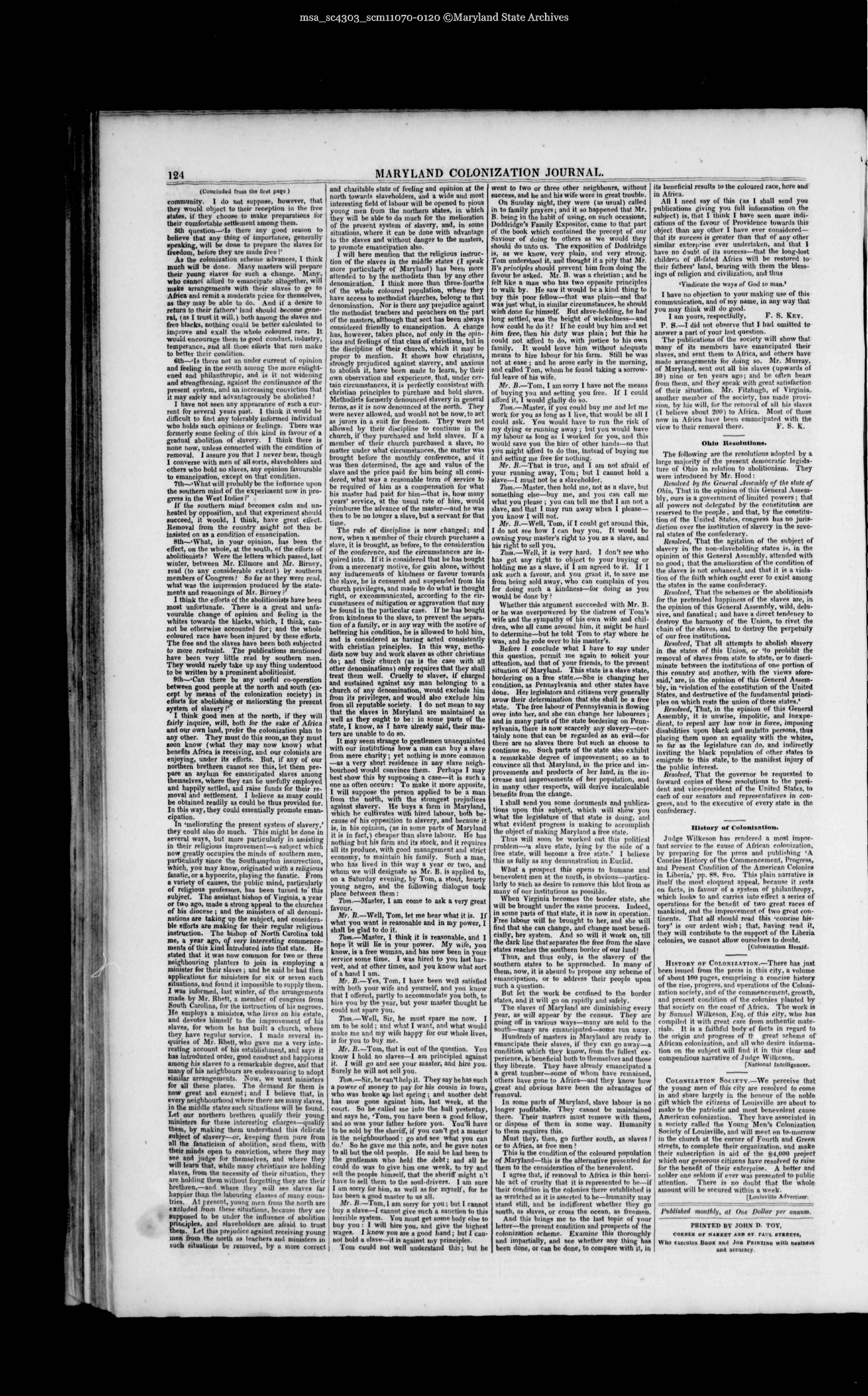
| 124 MARYLAND COLONIZATION JOURNAL. (Concluded from the first page ) community. I do not suppose, however, that they would object to their reception in the live states, if they choose to make preparations lor their comfortable settlement anions; them. 6th question—-Is there any good reason to believe that any thing of importance, generally speaking, will be done to prepare the slaves lor freedom, before they are made free I* As the colonization scheme advances, I think much will be done Many masters will prepare their youns slaves for such a change. Many, who cannoi afford to emancipate altogether, will make arrangements with their slaves to go to Africa ami remit a moderate price for themselves, as they may be able to do. And if a desire to retun to their fathers' land should become gene- ral, (as 1 trust it will.) both among the slaves and free blacks, nothing could be better calculated to improve and exalt the whole coloured race. It would encourage them to good conduct, industry, temperance, and all those'eiibrts that men make to bettei their condition. 6th—'Is there not an under current of opinion and feeling in the south among the more enlight- ened and philanthropic, and is it not widening and strengthening, against the continuance of the present system, and an increasing conviction that it may safely and advantageously be abolished ? I have not seen any appearance of such a cur- rent for several years past. 1 think it would be difficult to find any tolerably informed individual who holds such opinions or feelings. There was formerly some feeling of this kind in favour of a gradual abolition ot slavery. I think there is none now, unless connected with the condition of removal. I assure you that 1 never hear, though I converse with men of all sorts, slaveholders and others who hold no slaves, any opinion favourable to emancipation, except on that condition. 7th—'What will probably be the influence upon the southern mind of the experiment now in pro- gress in the West Indies?' if the southern mind becomes calm and un- seated by opposition, and that experiment should succeed, it would, I think, have great effect. Kemoval from the country might not then be insisted on as a condition of emancipation. 8th—'What, in your opinion, has been the effect, on the whole, at the south, of the efforts of abolitionists ? Were the letters which passed, last winter, between Mr. Ellmore and Mr. Biriiey, read (to any considerable extent) by southern members of Congress ? So far as they were nail, what was the impression produced by the state- ments and reasonings of Mr. Birney r I think the efforts of the abolitionists have been most unfortunate. There is a great and unfa- vourable change of opinion and feeling in the whites towards the blacks, which, I think, can- not be otherwise accounted for; and the whole coloured race have been injured by these efforts. The free and the slaves have been both subjected to more restraint. The publications mentioned have been very little read by southern men. They would rarely take up any thing understood to be written by a prominent abolitionist. 9th—'Can there be any useful co-operation between good people at the north and south (ex- cept by means of the colonization society) in efforts for abolishing or meliorating the present system of slavery!' I think good men at the north, if they will fairly inquire, will, both for the sake of Africa and our own land, prefer the colonization plan to any other. They must do this soon,as they must soon know (what they may now know) what benefits Africa is receiving, and our colonists are enjoying, under its efforts. But, if any of our northern brethren cannot see this, let them pre- pare an asylum for emancipated slaves among themselves, where they can be usefully employed and happily settled, and raise funds for their re- moval and settlement. I believe M many could be obtained readily a3 could be thus provided for. In this way, they could essentially promote eman- cipation. In 'meliorating the present system of slavery,' they could also do much. This might be done in several ways, but more particularly in assisting in their religious improvement—a subject which now greatly occupies the minds of southern men, particularly since the Southampton insurrection, which, you may know, originated with a religious fanatic, or a hypocrite, playing the fanatic. From a variety of causes, the public mind, particularly of religious professors, has been turned to this subject. The assistant bishop of Virginia, a year or two ago, made a strong appeal to the churches of his diocese ; and the ministeis of all denomi- nations are taking up the subject, and considera- ble efforts are making for their regular religious instruction. The bishop of North Carolina told me, a year ago, of very interesting commence inents of this kind Introduced into that state. He stated that it was now common for two or three neighbouring planters to join in employing a minister for their slaves ; and he said he had then applications for ministers for six or seven such situations, and found it impossible to supply them. 1 was informed, last winter, of the arrangements made by Mr. Bhett, a member of congress from South Carolina, for the instruction of his negroes. He employs a uiinistes, who lives on bis estate, and devotes himself to the improvement of his slaves, tor whom he has built a church, where they have regular service. I made several in- quiries of Mr. Uhett, who gave me a very inte- resting account of his establishment, and savs it has introduced order, good conduct and happiness among his slaves to a remarkable degree, and that many'of his neighbours are endeavouring to adopt similar arrangements. Now, we want ministers for all these places. The demand for them is now great and earnest; and I believe that, in every neighbourhood where there are many slaves, in the middle states such situations will be found. Let our northern brethren qualify their young ministers for these interesting charges—qualify them, by making them understand this delicate subject of slavery—or, keeping them pure from all the fanaticism of abolition, send them, with their minds open to conviction, where they may see and judge for themselves, and where they will learn that, while many christians are holding slaves, from the necessity of their situation, they are holding them without forgetting they are their brethren,—and where they will see slaves far happier than the labouring classes of many coun- tries. At present, young men from the north are excluded from these situation", because they are supposed to be under the influence of abolition principles, and slaveholders are afraid to trust theni. Let this prejudice against receiving young men from the north as leacher. and ministers in such situations be removed, by a more correct ami charitable state of feeling and opinion at the north towards slaveholders, and a wide and most interesting held of labour will be opened to pious young men from the northern states, in which they will be able to do much for the melioration of the present system of slavery, and, in some situations, where it can be done with advantage to the slaves and without danger to the masters, to promote emancipation also. 1 will here mention that the religious instruc- tion of the slaves in the middle states (I speak more particularly of Maryland) has been more attended to by the methodists than by any other denomination. I think more than three-fourths of the whole coloured population, where they have access to methodist churches, belong to that denomination. Nor is there any piejudice against the methodist teachers and preachers on the part of the masters, although that sect has been always considered friendly to emancipation. A change has, however, taken place, not only in the opin- ions and feelings of that class of christians, but in the discipline of their church, which it may be proper to mention. It shows how christians, strongly prejudiced against slavery, and anxious to abolish it, have been made to learn, by their own observation and experience, that, under cer- tain circumstances, it is perfectly consistent with christian principles to purchase and hold slaves. Methodists formerly denounced slavery in general terms, as it is now denounced at the north. They were never allowed, and would not be now, to act as jurors in a suit for freedom. They were not allowed by their discipline to continue in the church, if they purchased and held slaves. If a member of their church purchased a slave, no matter under what circumstances, the matter was brought before the monthly conference, and it was then determined, the age and value of the slave and the price paid for him being all consi- dered, what was a reasonable term of service to be required of him as a compensation for what his master had paid for him—that is, how many years' service, at the usual rate of hire, would reimburse the advance of the master—and he was then to be no longer a slave, but a servant for that time. The rule of discipline is now changed; and now, when a member of their church purchases a slave, it is brought, as before, to the consideration of the conference, and the circumstances are in- quired into. If it is considered that he has bought from a mercenary motive, for gain alone, without any inducements of kindness or favour towards the slave, he is censured and suspended from his church privileges, and made to do what is thought right, or excommunicated, according to the cir- cumstances of mitigation or aggravation that may be found in the particular case. If he has bought from kindness to the slave, to prevent the separa- tion of a family, or in any way with the motive of bettering his condition, he is allowed to hold him, and is considered as having acted consistently with christian principles. In this way, metho- dists now buy and work slaves as other christians do; and their church (as is the case with all other denominations) only requires that they shall treat them well. Cruelty to slaves, if charged and sustained against any man belonging to a church of anv denomination, would exclude him from its privileges, and would also exclude him from all reputable society. I do not mean to say that the slaves in Maryland are maintained as well as they ought to be: in some parts of the state, I know, as I have already said, their mas- ters are unable to do so. It may seem strange to gentlemen unacquainted with our institutions how a man can buy a slave from mere charity; yet nothing is more common —as a very short residence in any slave neigh- bourhood would convince them. Perhaps I may best show this by supposing a case—it is such a one as often occurs: To make it more apposite, I will suppose the person applied to be a man from the north, with the strongest prejudices against slavery. He buys a farm in Maryland, which he cultivates with hired labour, both be- cause of his opposition to slavery, and because it is, in his opinion, (as in some parts of Maryland it is in fact,) cheaper than slave labour. He has nothing but his farm and its stock, and it requires all its produce, with good management and strict economy, to maintain his family. Such a man, who has lived in this way a year or two, and whom we will designate as Mr. B. is applied to, on a Saturday evening, by Tom, a stout, hearty young negro, and the following dialogue took place between them : Tom.—Master, I am come to ask a very great favour. Mr. B.—Well, Tom, let me hear what it is. If what you want is reasonable and in my power, I shall be glad to do it. Tom.—Master, I think it is reasonable, and I hope it will lie in your power. My wife, you know, is a free woman, and has now been in your service some time. I was hired to you last har- vest, and at other times, and you know what sort of a hand I am. Mr. B.—Yes, Tom, I have been well satisfied with both your wife and yourself, and you know that I offered, partly to accommodate you both, to hire you by the year, but your master thought he could not spare you. Tom.—Well, Sir, he must spare me now. I am to be sold; and what I want, and what would make me and my wife happy for our whole lives, is ibr you to buy mc. Mr. B.—Tom, that is out of the question. You know I hold no slaves—I am principled against it. I will go and see your master, and hire you. Surely he will not sell you. Tom.—Sir, he can't help it. They say he has such a power of money to pay for his cousin in town, who was broke up last spring; anil another debt has now gone against him, last week, at the court. So he called ine into the hall yesterday, and says he, 'Tom, you have been a good fellow, and so was your father before you. You'll have to be sold by the sherilf, if you can't get a master in the neighbourhood; go and see what you can do.' So he gave me this note, and he gave notes to all but the old people. He said he had been to the gentleman who held the debt; and all he could do was to give him one week, to try and sell the people himself, that the sheriff might n't have to sell them to the soul-drivers. I am sure I am sorry for him, as well as for myself, for he has been a good master to us all. Mr. B.—Tom, I am sorry for you; but I cannot buy a slave—I cannot give such a sanction to this horrible system. You must get some body else to buy you : I will hire you, and give the highest MM. I know you are a good hand; hut I can- not hold a slave—it m against my principles. Tom could not well understand this; but he went to two or three other neighbours, without success, and he and his wile were in great trouble. On Sunday night, they were (as usual) called in to family prayers; and it so happened tiiat Mr. B. being in the habit of using, on such occasions, Doddridge's Family Expositor, came to that part of the book which contained the precept of our Saviour of doing to others as we would they should do unto us. The exposition of Doddridge is, as wo know, very plain, and very strong. Tom understood it, ami tfioiight it a pity that Mr. B's principles should prevent him from doing the favour he asked. Mr. B. was I christian ; and he felt like a man who has two opposite principles to walk by. He saw it would be a kind thing to buy this poor fellow—that was plain—and that was just what, in similar circumstances, he should wish done for himself. But slave-holding, he had long settled, was the height of wickedness—and how could he do it? If he could buy him and set dim free, then his duty was plain; but this he could not atlbrd to do, with justice to his own family. It would leave him without adequate means to hire labour for his farm. Still he was not at ease i and he arose early in the morning, and called Tom, whom he found taking a sorrow- ful leave of his wife. Mr. B.—Tom, I am sorry I have not the means of buying you and setting you free. If I could allbrd it, I would gladly do so. Tom.—Master, If you could buy me and let me work for you as long as 1 live, that would be all I could ask. You would have to run the risk of my dying or running away ; but you would have my labour as long as 1 worked for you, and this would save you the hire of other hands—so that you might ajiord to do this, Instead of buying me and setting ine free for nothing. Mr. B.—That is true, and I am not afraid of your running away, Tom; but I cannot hold a slave—I must not be a slaveholder. Tom.—Master, then hold me, not as a slave, but something else—buy me, and you can call ine what you please ; you can tell ine that I am not a slave, and that 1 may run away when I please— you know I will not. Mr. B.—Well, Tom, if I could get around this, I do not see how I can buy you. It would be owning your master's right to you as a slave, and bis right to sell you. Tom.—Well, it is vry hard. I don't see who has got any right to object to your buying or holding me as a slave, if 1 am agreed to it. Ill ask such a favour, and you grant it, to save me from being sold away, who can complain of you for doing such a kindness—for doing as you would be done by ? Whether this argument succeeded with Mr. B. or lie was overpowered by the distress of Tom's wife and the sympathy of his own wile and chil- dren, who all came around him, it might he hard to determine—but he told Tom to stay where he was, and he rode over to his master's. Before I conclude what I have to say under this question, permit ine again to solicit your attention, and that of your friends, to the present situation of Maryland. This state is a slave state, bordering on a free state.—She is changing her condition, as Pennsylvania and other states have done. Her legislators and citizens very generally avow their determination that she shall be a free state. The free labour of Pennsylvania is flowing over into her, and she can change her labourers ; and in many parts of the state bordering on Penn- sylvania, there is now scarcely any slavery—cer- tainly none that can be regarded as an evil—for there are no slaves there but such as choose to continue so. Such parts of the state also exhibit a remarkable degree of improvement; so as to convince all that Maryland, in the price and im- provements and products of her land, in the in- crease and improvements of her population, and in many other respects, will derive incalculable benefits from the change. I shall send you some documents find publica- tions upon this subject, which will show you what the legislature of that state is doing, and what evident progress is making to accomplish the object of making Maryland a free state. Thus will soon be worked out this political problem—'a slave state, lying by the side of a free state, will become a free state.' I believe this as fully as any demonstration in Euclid. What a prospect this opens to humane and benevolent men at the north, is obvious—particu- larly to such as desire to remove this blot from as many of our institutions as possible. When Virginia becomes the bonier state, she will be brought under the same process. Indeed, in some parts of that state, it is now in operation. Free labour will be brought to her, and she will find that she can change, and change most benefi- cially, her system. And so will it work on, till the dark line that separates the free from the slave states reaches the southern border of our land! Thus, and thus only, is the slavery of the southern states to be approached. In many of them, now, it is absurd to propose any scheme of emancipation, or to address their people upon such a question. But let the work be confined to the border states, and it will go on rapidly and safely. The slaves of Maryland are diminishing every year, as will appear by the census. They are going off in various ways—many are sold to the south—many are emancipated—some run away. Hundreds of masters in Maryland arc ready to emancipate their slaves, if they can go away—a condition which they know, from the fullest ex- perience, is beneficial both to themselves and those they liberate. They have already emancipated a a great number—some of whom have remained, others have gone to Africa—and they know how great and obvious have been the advantages of removal. In some parts of Maryland, slave labour is no longer profitable. They cannot be maintained there. Their masters must remove with them, or dispose of them in some way. Humanity to them requires this. Must they, then, go further south, as slaves ? or to Africa, as free men ? This is the condition of the rolnured population of Maryland—this is the alternative presented for them to the consideration of the benevolent. I agree that, if removal to Africa is this horri- ble act of cruelty that it is represented to be—if their condition in the colonies there established is as wretched as it is asserted to be—humanity may stand still, and be inditferent whether they go south, as slaves, or cross the ocean, as freemen. And this brings me to the last topic of your letter—the present condition and prospects of the colonization scheme. Examine this thoroughly and impartially, and see whether any thing has been done, or can be done, to compare with it, in its beneficial results to the coloured race, here and in Africa. All I need say of this (as I shall send you publications giving you full information on the subject) is, that I think I have seen more indi- cations of the favour of Providence towards this object than any other I have ever considered — that its success is greater than that of any other similar enterprise ever undertaken, and that 1 have no doubt of its success—that the long-lost children of ill-fated Africa will be restored to their fathers' land, bearing with them the bless- ings of religion and civilization, and thus 'Vindicate the ways of God to man.' I have no objection to your making use of this communication, and of my name, in any way that you may think will do good. I am yours, respectfully, F. S. Key. P. S.—I did not observe that I had omitted to answer a part of your last question. The publications of the society will show that many of its members have emancipated their slaves, and sent them to Africa, and others have made arrangements for doing so. Mr. Murray, of Maryland, sent out all his slaves (upwards of M] nine or ten years ago; and he often hears from them, and they speak with great satisfaction of their situation. Mr. Fitzhugh, of Virginia, another member of the society, has made provi- sion, by his will, for the removal of all his slaves (I believe about MO) to Africa. Most of those now in Africa have been emancipated with the view to their removal there. F. S. K. Ohio Resolutions. The following are the resolutions adopted by a large majority of the present democratic legisla- ture of Ohio in relation to abolitionism. They were introduced by Mr. Hood: Resolved by the General Assembly of the state of Ohio, That in the opinion of this General Assem- bly, ours is a government of limited powers ; that all powers not delegated by the constitution are reserved to the people , and that, by the constitu- tion of the United States, congress has no juris- diction over the institution of slavery in the seve- ral states of the confederacy. Resolved, That the agitation of the subject of slavery in the non-slaveholding states is. in the opinion of this General Assembly, attended with no good; that the amelioration of the condition of the slaves is not enhanced, and that it is a viola- tion of the faith which ought ever to exist among the states in the same confederacy. Resolved, That the schemes or the abolitionists for the pretended happiness of the slaves are, in the opinion of this General Assembly, wild, delu- sive, and fanatical; and have a direct tendency to destroy the harmony of the Union, to rivet the chain of the slaves, and to destroy the perpetuity of our free institutions. Resolved, That all attempts to abolish slavery in the states of this Union, or 'to prohibit the removal of slaves from state to state, or to discri- minate between the institutions of one portion of this country and another, with the views afore- said," are, in the opinion of this General Assem- bly, in 'violation of the constitution of the United States, and destructive of the fundamental princi- ples on which rests the union of these states.' Resolved, That, in the opinion of this General Assembly, it is unwise, impolitic, and inexpe- dient, to repeal any law now in force, imposing disabilities upon black and mulatto persons, thus placing them upon an equality with the whites, so far as the legislature can do, and indirectly inviting the black population of other states to emigrate to this state, to the manifest injury of the public interest. Resolved, That the governor be requested to forward copies of these resolutions to the presi- dent and vice-president of the United States, to each of our senators and representatives in con- gress, and to the executive of every state in the confederacy. History of Colonization, Judge Wilkeson has rendered a most impor- tant service to the cause of African colonization, by preparing for the press and publishing 'A Concise Hisjory of the Commencement, Progress, and Present Condition of the American Colonies in Liberia,' pp. 88, 8vo. This plain narrative is itself Ihe most eloquent appeal, because it tests on facts, in favour of a system of philanthropy, which looks to and carries into effect a series of operations for the benefit of two great races of mankind, and the improvement of two great con- tinents. That all should read this 'concise his- tory' is our ardent wish ; that, having read it, they will contribute to the support of the Liberia colonies, we cannot allow ourselves to doubt. [Colonization Herald. History of Colonization.—There has just been issued from the press in this city, a volume of about 100 pages, comprising a concise history of the rise, progress, and operations of the Coloni- zation society, and of the commencement, grnwlh, and present condition of the colonies planted by that society on the coast of Africa. The work is by Samuei Wilkeson, Esq. of this city, who has compiled it with irreat care from authentic mate- rials. It is a faithful body of facts in regard to the origin and progress of tf great scheme of African colonization, and all who desire informa- tion on the subject will find it in this clear and compendious narrative of Judge Wilkeson. (National Intelligencer. Colonization Society.—We perceive that the young men of this city are resolved to come in and share largely in the honour of Ihe noble gift which the citizens of Louisville are aboul to make to the patriotic and most benevolent cause American colonization. They have associated in a society called the Young Men's Colonization Society of Louisville, and will meet on to-mnrrovv in the church at fhe corner of Fourth and Green streets, to complete their organization, and make their subscription in aid of the $4,000 project which our generous citizens have resolved to raise for the benefit of their enterprise. A better and nobler one seldom if ever was presented to public attention. There is no doubt that the whole amount will be secured within a week. [Louisville Advertiser. Published monthly, at One Dollar per annum. printed by john d. toy, CORNER of MARKET AMD ST PAUL STREETS, Who executes Book and Job Printing, with neatness and accuracy. |